 Purdue University - Extension - Forestry and Natural Resources
Got Nature? Blog
Purdue Landscape Report: We are often the bearers of bad news when a new exotic insect species is discovered in Indiana. This time, however, we have some good news to share. Agrilus smaragdifrons, a beetle that feeds exclusively on Tree-of-Heaven (Ailanthus altissima), was detected in Indiana last year in Allen County.
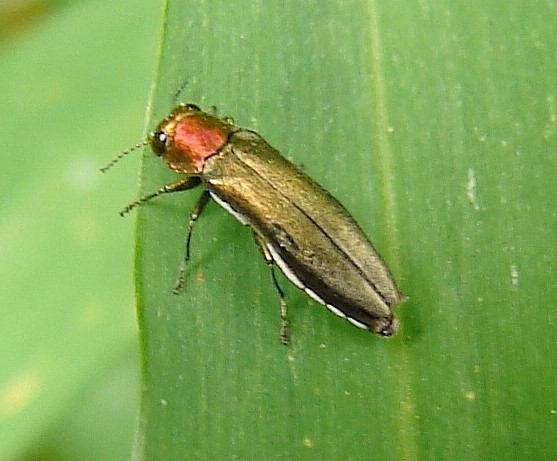
Figure 1. Agrilus smaragdifrons adult (Photograph by Dave Eib, iNaturalist)
You might notice that this beetle belongs to the same genus as the infamous Emerald Ash Borer (Agrilus planipennis) (EAB). Indeed, the two species look quite similar, although there are subtle differences in their striking metallic coloration. While Emerald Ash Borer is a vibrant green from head to wing, A. smaragdifrons has a golden-red head and thorax with green to black-green wings (Fig. 1).
This beetle has been present in the United States for several years, with the earliest record dating back to 2011 from a photograph taken in New Jersey that was uploaded to BugGuide.net. Subsequent detections occurred in several neighboring eastern states, often as bycatch during Emerald Ash Borer surveys (Hoebeke et al. 2017).
The life cycle of A. smaragdifrons also shares many similarities with Emerald Ash Borer. Although its life cycle under North American conditions has not yet been formally described, Hoebeke et al. (2017) summarize the beetle’s biology in its native Asian range based on Chinese literature (Xu and Yang 2007).
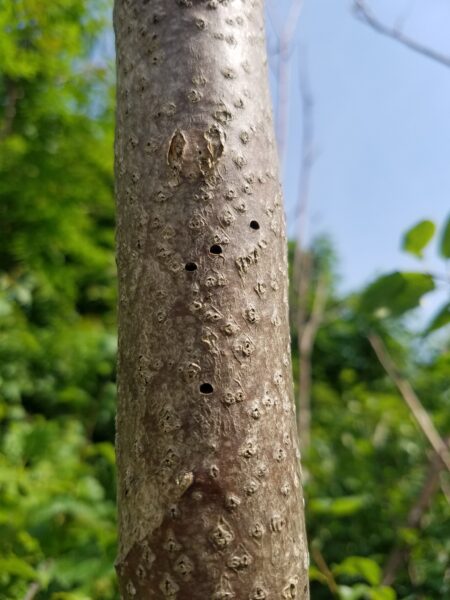
Figure 2. Agrilus smaragdifrons exit holes in Ailanthus altissima (Photograph by Patrick Perish, iNaturalist)
Females lay eggs in bark crevices during mid- to late summer, and newly hatched larvae burrow into the tree. The larvae overwinter within galleries beneath the bark and resume feeding the following spring. Pupation occurs in early summer, around June, and adult mating flights take place from June through July. When adults emerge, they leave characteristic “D”-shaped exit holes in the bark (Fig. 2; Photograph by Patrick Perish, iNaturalist).
It is not yet known whether A. smaragdifrons will function as a biological control agent for Tree-of-Heaven. Additional research and field observations are needed to determine its impact on its host. However, reports from Beijing Forestry University indicate that attacks by A. smaragdifrons can lead to decline and eventual death of Tree-of-Heaven (Hoebeke et al. 2017).
Scientists with the Indiana Department of Natural Resources and Purdue University are interested in tracking the distribution of A. smaragdifrons across the state. The next time you encounter a Tree-of-Heaven, keep an eye out for the distinctive D-shaped exit holes. In late summer, you may also observe adults feeding on the leaves.
See something? Report it Identifying and Reporting Pests at just as you would any other invasive species!
Original article posted: Beetle that attacks Tree-of-Heaven found in Indiana.
Subscribe and receive the newsletter: Purdue Landscape Report Newsletter.
Resources:
Ask the Expert: Pests in Your Woods, Purdue Extension – Forestry & Natural Resources (FNR) YouTube Channel
Report Spotted Lanternfly, Purdue Landscape Report
Invasive Species Playlist, Purdue Extension – FNR YouTube Channel
Indiana Department of Natural Resources: Invasive Species
Indiana Invasive Species Council
Cooperative Invasive Species Management Area (CISMA)
Report Invasive, Purdue Extension
What are invasive species and why should I care?, Got Nature? Blog, Purdue Extension – FNR
Purdue Plant Doctor, Purdue Extension
An Introduction to Trees of Indiana, The Education Store, Purdue Extension’s resource center
Fifty Common Trees of Indiana, Forestry & Natural Resources
ID That Tree, Playlist, Purdue Extension – FNR YouTube Channel
A Woodland Management Moment, Playlist, Purdue Extension – FNR YouTube Channel
Woodland Stewardship for Landowners, Playlist, Purdue Extension – FNR YouTube Channel
Native Trees of the Midwest, Purdue University Press
Forest Improvement Handbook, The Education Store
Alicia Kelley, Cooperative Agricultural Pest Survey (CAPS) Coordinator
Purdue Extension – Entomology
Figure 1: Spongy moth caterpillar, credit to John Obermeyer.
Purdue Landscape Report: Spring is always a wonderful, if somewhat chaotic, time of year in Indiana. Between the heavy rains and beautiful flowers blooming, the months leading up to summer can make your head spin. While we enjoy the trees greening out and watch out for storms, we need to be aware that spring awakens other organisms, many of which have a major impact on our lives. This time of the year introduces a host of insect species hatching from eggs, emerging from cocoons, or returning from their overwintering nap, and many of those species mean bad news for our trees. One of the most impactful species we deal with in Indiana is Lymantria dispar, or the spongy moth.
The spongy moth, so named for the sponge-like egg masses they lay in the early fall, is an invasive species belonging to family Erebidae, a large group of moths that include species such as the woolly bear we see every year in Indiana. Spongy moth is a native to Eurasia, and historical record shows it has caused problems throughout Europe as early as the seventeenth century. In the late nineteenth century, an amateur entomologist and would-be entrepreneur brought spongy moth to North America in a failed attempt to create a new silk moth hybrid. Inevitably, the insect escaped captivity and has since spread through several states over the last century, including the northern portion of Indiana.

Figure 2: Mating spongy moth adults, credit to John Obermeyer.
Spongy moth is a generalist pest that strips leaf tissue from many species of trees, though it has a particular preference for oak. Like all butterflies and moths, the larva, or caterpillar, is the damaging form of this insect. Spongy moth caterpillars bear chewing mouthparts they use to consume leaf tissue, but they do not attack wood or root systems of their hosts. Adults are non-feeding and only survive long enough to reproduce. Spongy moth can produce large populations each year and move quickly across a landscape, creating sudden infestations and near-complete defoliation in those areas. While trees will typically recover after losing a significant portion of their leaf tissue, repeated infestations will make a host tree more susceptible to disease, reduce resilience, and potentially lead to death.
Like other moths and butterflies, spongy moth has well-defined life stages that can be used to easily identify them. Caterpillars will begin to appear between mid-April and early May and can be identified by their hairy appearance, distinct black, blue, and red coloration, and the tendency to move up and down the surface of a tree (Fig. 1). Male larvae will develop through five instars, while female larvae will grow over the course of six instars. Larvae will enter the pupal stage midsummer and spend approximately ten to twelve days developing. The pupae of this insect are darkly colored and lack the silk cocoon seen in other species. Adult male moths will emerge in the latter half of the summer season, followed by female moths about a week later. The moths can be identified by the pattern on their wings: a black chevron associated with a dot on a pale white or cream background (Fig. 2). Male moths will have large, feathery antennae and are capable of flight, while females are flightless with smaller antennae. Adult moths will only survive for a few days to reproduce and lay sponge-like egg masses, which will overwinter and hatch the following spring (Fig. 3).
Figure 3: Spongy moth egg mass on tree, credit to John Obermeyer.
Management of spongy moth often involves work by state and federal agencies, such as the Indiana’s Department of Natural Resources. Within the Hoosier state, the DNR has quarantined several northern counties to prevent movement of materials that could potentially spread spongy moth even further. They also conduct yearly mitigation programs to eliminate infestations that are outside of the quarantined area. Indiana DNR, specifically the Division of Entomology and Plant Pathology, posts information on all mitigation efforts as well as hosts public meetings so residents understand what treatments are used for spongy moth management, and how it will affect their community.
Most organizations, including Indiana DNR, typically use two methods to control spongy moth: mating disruption and Btk applications. Mating disruption uses the moth’s biology against it by confounding its ability to locate a mate. Spongy moths, like many species, use a chemical signal called a pheromone to attract potential mates; male moths follow the trail of pheromones emitted by a female. By filling an area with the pheromone, the male moths become unable to follow individual chemical signals, resulting in fewer eggs being laid for the next spring. Pheromones are also highly species-specific, ensuring little to no impact on other organisms. In Indiana, the chemical used for mating disruption is applied aerially to cover a significant area, and the chemical used is made of food grade materials that break down easily.
Btk applications are also done aerially, coating foliage with a selective pesticide that only affects moth and butterfly species. Btk is a protein derived from a native soil-borne bacteria (Bacillus thuringiensis kurstaki) and works by damaging the internal lining of an insect’s gut after being consumed. This is a pesticide that is commonly applied to all manner of crops, persists only for a short time in the environment, and only harms insects. It also has the benefit of having minimal impact on pollinators, especially when applied using label directions.
While spongy moth is a serious challenge, there are some options you can use to protect your natural spaces. The first option, and perhaps the most important, is to be vigilant. If you live in or near an infestation, get into the habit of checking your trees for egg masses starting in the late summer through the fall. When you find egg masses, check for small pinholes in the sponge-like covering; the hole is created by a beneficial parasitoid wasp that uses the caterpillars as hosts for their young. You can also destroy egg masses by using a horticultural oil labeled for that purpose, or by scraping off the egg masses into a bucket of soapy water. Also be watchful of egg masses being laid on homes, firewood, or the sides and undersides of vehicles that move through infested areas.
Larvae will begin to appear in late April, with warmer temperatures encouraging populations to hatch earlier. One method of controlling larvae is to use burlap banding as a trap to capture larvae moving up and down the surface of the tree trunk. This can be done by tying a folded piece of burlap around the trunk of the tree at approximately chest height. Caterpillars, attempting to hide from predators during the day, will crawl into the folds. Once the late afternoon arrives, the caterpillars can be removed and destroyed by dumping them into soapy water. You can also use sticky substances in an effort to capture the caterpillars by coating a tree at chest height with it, but this method has several drawbacks. Any substrate that is sticky enough to capture spongy moth caterpillars will also capture any other insect, beneficial and damaging, and could potentially catch small mammals and birds as well.
If you plan to use pesticides, May through June is the best time to apply. Biological pesticides such as Btk, spinosad, and others, are available for homeowner use, as well as systemic insecticides such as dinotefuran and emamectin benzoate. However, given how widespread the caterpillars can be and the heights they can reach, using some insecticides may not be feasible or may require professional assistance. Homeowners and property managers should consult certified arborists to learn what options will be best, and use pesticides as per the label directions.
While spongy moth is now a permanent part of our ecosystem, we still want to limit its ability to move into new parts of Indiana. If you live outside of quarantine areas and find an egg mass, caterpillar, or adult moth, report them by contacting the Indiana Department of Natural Resources at 1-866-NOEXOTIC, or by emailing DEPP@dnr.in.gov; make sure to include pictures and location. You can also consult your local Extension office for assistance in finding arborists, speaking with specialists, or getting problem insects identified.
Original article posted: Purdue Landscape Report.
Subscribe and receive the newsletter: Purdue Landscape Report Newsletter.
Resources:
Spongy Moth, Indiana Department of Natural Resources
The Spongy Moth in Indiana, Purdue Extension – Entomology
Invasive Species, Playlist, Purdue Extension – FNR YouTube Channel
Report Invasive Species, Purdue Invasive Species
What are invasive species and why should I care?, Got Nature? Blog, Purdue Extension – Forestry and Natural Resources
Pest Management, The Education Store
Protecting Pollinators: Why Should We Care About Pollinators?, The Education Store, Purdue Extension resource center
Subscribe Purdue Extension-Forestry and Natural Resources YouTube Channel
Bob Bruner, Exotic Forest Pest Educator
Purdue Entomology
Purdue Landscape Report, Why are the Japanese beetles running late this year?: Nothing heralds summer like the hum of Japanese beetles ravenously descending on a flower garden. Cool weather this spring has slowed emergence of adults from the soil. Heavy spring rains early followed by relatively drier weather in late June, may have trapped adult Japanese beetles under a crusty layer of hardened soil. Due to their large numbers in many parts of Indiana last year, they are very likely just waiting for a good rain to soften the surface, so they can dig themselves into the light of day and on to your flowers. So, if we get a little more rain by the time this article comes out, we are likely to be awash in adult beetles.
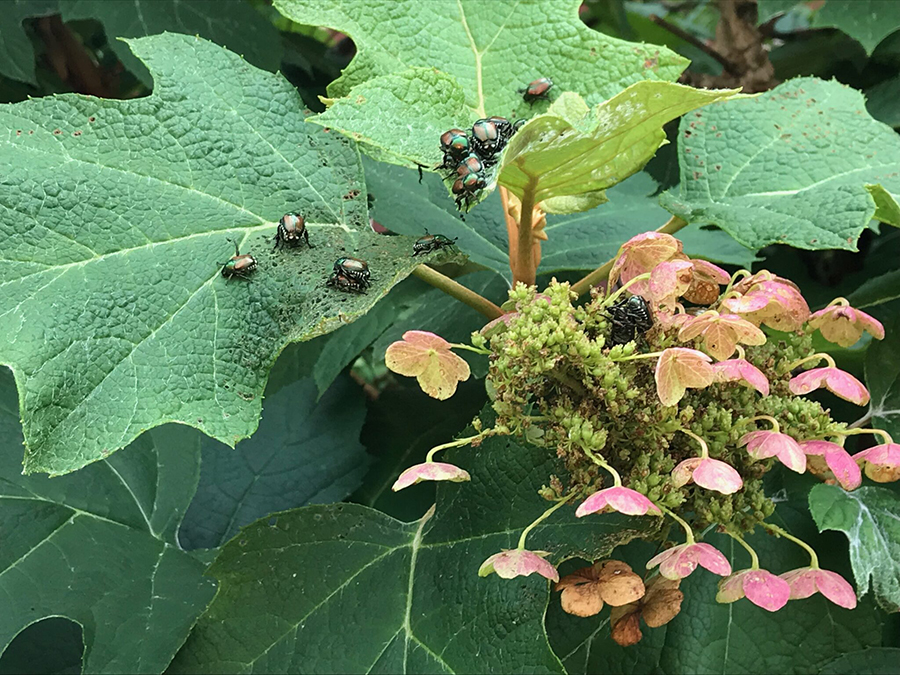 Weather is only part of what makes Japanese beetles predictably unpredictable. Beneficial organisms including fungi, microsporidia, and parasitic wasps also act different life stages of Japanese beetles. Japanese beetles have been the target of several national programs to release these beneficial organisms to reduce beetle populations. Favorable conditions for these beneficials can help reduce the local abundance of grubs and beetles.
Although killing grubs will reduce the number of beetles, the small size of lawns and the long flight range of makes it unlikely for your grub control program to reduce defoliation. In experiments conducted in my lab over 20 years ago, we found adult beetles can easily fly a kilometer (0.66 miles) in a single day. With adults living for several weeks, it is easy to image beetles traveling long distances from untreated lawns to plants on your property.
Life cycle of Japanese beetles: As the weather warms in the spring larvae (aka white grubs) move closer to the surface and begin feeding on turf roots. In May they enter a pupal stage and stop feeding. In June they typically emerge from the soil as adults. Adults fly in summer when they feed on flowers and leaves. In late July and early August adults lay eggs into the turfgrass. White grubs hatch from eggs and feed on the roots until frost when the larvae begin dig deeper into the soil to avoid killing temperatures.
To find out what you can do about Japanese beetles and view photos view: Why are the Japanese beetles running late this year?
Resources:
Report Invasive
Invasive Species, Got Nature?
Invasive Species, Playlist, Purdue Extension – FNR YouTube Channel
Indiana Department of Entomology and Plant Pathology
Spotted lanternfly: Everything You Need to Know in 30 Minutes, Video, Emerald Ash Borer University
Emerald Ash Borer, EAB Information Network
Invasive plants: impact on environment and people, The Education Store, Purdue Extension’s resource center
Woodland Management Moment: Invasive Species Control Process, Video, Purdue Extension – Forestry and Natural Resources (FNR) YouTube Channel
What are invasive species and why should I care?, Got Nature? Blog, Purdue Extension – Forestry and Natural Resources
Pest Management, The Education Store
Cliff Sadof, Professor Entomology/Extension Fellow
Purdue Entomology
The Purdue Landscape Report, a blog which provides science-based, timely information regarding Midwest landscapes to commercial growers, garden centers, landscapers, arborists and the general public, was recognized with the Extension Division Education Materials Award for Outstanding Blog at the American Society of Horticultural Science convention in August.
The Purdue Landscape Report is a collaborative effort between Purdue Extension specialists and diagnosticians in the areas of horticulture, entomology, plant pathology, urban forestry and turf science. Articles cover everything from tree maintenance to pest and disease problems and management to plant selection.
“Our Purdue Green Industry Team brings together many disciplines and expertise for the industry and homeowners as well as any other university in the country,” Nursey and Landscape Outreach Specialist Kyle Daniel said. “The research and outreach efforts of each member of the team contributes to helping the industry be more sustainable, efficient, environmentally conscious, and profitable. The Purdue Landscape Report is one way that we present science-based information to our stakeholders around the state. In addition to this information being distributed locally, there are many subscribers from across the country.”
The PLR team includes:
 Kyle Daniel – Nursey and Landscape Outreach Specialist, Purdue Horticulture and Landscape Architecture
- Rosie Lerner – Extension Consumer Horticulturist, Purdue Horticulture and Landscape Architecture
- Cliff Sadof – Professor, Entomology Extension Specialist
- Tom Creswell – Clinical Engagement Professor, Director of the Plant & Pest Diagnostic Laboratory; Purdue Botany and Plant Pathology
- Janna Beckerman – Professor of Botany and Plant Pathology
- John Bonkowski – Clerk, Purdue Botany and Plant Pathology
- Lindsey Purcell – Purdue Extension urban forester, Purdue Forestry and Natural Resources
- Gail Ruhl – Visiting Scholar, Purdue Biological Sciences
- Elizabeth Barnes – Exotic Forest Pest Educator, Purdue Entomology
- Todd Abrahamson – Purdue Plant & Pest Diagnostic Lab Secretary
- Lori Jolly-Brown – Extension Events and Communications Coordinator, Purdue Horticulture and Landscape Architecture
- Kirby Kalbaugh – Application and Systems Administrator, Purdue Horticulture and Landscape Architecture

Since launching in February 2018, the Purdue Landscape Report has included more than 144 articles. The website boasted more than 75,000 unique article downloads in 2019. PLR is also sent out in a bi-weekly email newsletter to more than 4,000 subscribers nationwide. The blog has brought in 137,000 unique visitors thus far in 2020.
In August, the Purdue Landscape Report staff also began a live, virtual series every other Wednesday, which addresses articles and hot topics. In just two months, that series has had more than 1,100 views.
Resources
Purdue Landscape Report Team Begins New Virtual Series, Got Nature? Blog, Purdue Extension – Forestry and Natural Resources
The Purdue Landscape Report Issues, Purdue Landscape Report
Tree wounds and healing, Got Nature? Blog
Fall webworms: Should you manage them, Got Nature? Blog
Purdue Landscape Report Facebook Page
 The Forest Pest Outreach and Survey Project at Purdue reminds us that early detection is the best way to slow the spread of invasive species. You can report invasive species by calling the Invasive Species hotline at 1-866-NO-EXOTIC (1-866-663-9684) or using the free Great Lakes Early Detection Network smartphone app, which can be downloaded on iTunes or Google Play. View video to see how easy it is to use the app, Great Lakes Early Detection Network App (GLEDN).
If you’re interested in learning more about invasive pests and how to report them, sign up for one of our free Early Detector Training workshops!
National Invasive Species Awareness Week: February 27-March 3, 2017.
Resources:
Invasive Species – Indiana Department of Natural Resources (IDNR)
Ask an Expert – Purdue Extension-Forestry and Natural Resources
Indiana Invasive Species Council – Includes: IDNR, Purdue Department of Entomology and Professional Partners
Invasive Species Week a reminder to watch for destructive pests, Purdue entomologist says – Purdue Agriculture News
Sara Stack, MS student
Purdue Department of Entomology
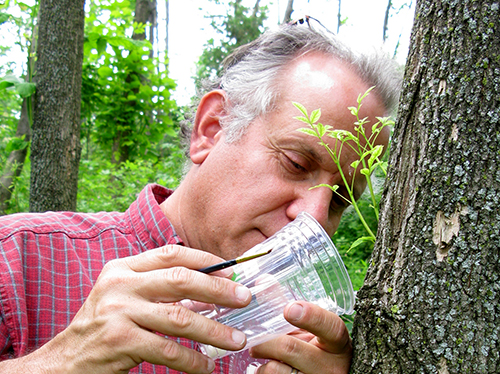 Cities and towns with “urban forests” such as parks and streets lined with trees could spend less money by taking steps to save emerald ash borer-infested trees early rather than wait until they can only replace them, Purdue University researchers concluded in a study.
Cliff Sadof, professor of Entomology and Matt Ginzel, associate professor in the Department of Entomology and Department of Forestry and Natural Resources, developed a model to help foresters predict the progression of ash decline over time. This model helps them use early reports of damaged trees to alert the community to the imminent threat posed by EAB. The percentage of damaged ash trees in a city typically doubles every year.
Owners of ash trees in Indiana, as well as all around the country, are encouraged to check out the full article provided by Purdue Agriculture News EAB research: Saving trees early less costly than replacing them. You will find several resources on what we can do to aid the ash trees.
Resources:
EAB research: Saving trees early less costly than replacing them – Purdue Agriculture News
Purdue Tree Doctor – Purdue Botany and Plant Pathology
Emerald Ash Borer in Indiana – Purdue Extension
Emerald Ash Borer Cost Calculator – Purdue Extension Entomology
Emerald Ash Borer – Purdue Extension Entomology
Cliff Sadof, Professor of Ornamental and Pest Management
Purdue University Department of Entomology
Matt Ginzel, Associate Professor
Department of Entomology and Department of Forestry & Natural Resources
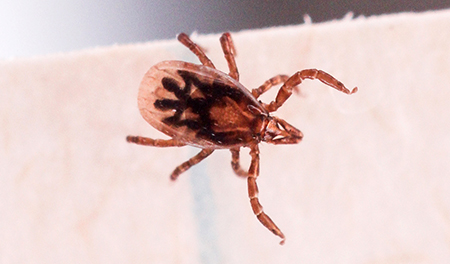
Photo Credit: Andrew Nuss
An international team of scientists led by Purdue University has sequenced the genome of the tick that transmits Lyme disease, the most common vector-borne illness in North America.
The decade-long project, involving 93 authors from 46 institutions, decodes the biology of an arachnid with sophisticated spit, barbed mouthparts and millions of years of successful parasitism. The genome of Ixodes scapularis, known as the deer tick or blacklegged tick, also sheds light on how ticks acquire and transmit pathogens and offers tick-specific targets for control.
“The genome provides a foundation for a whole new era in tick research,” said Catherine Hill, lead author of the paper, Purdue professor of medical entomology and Showalter Faculty Scholar. “Now that we’ve cracked the tick’s code, we can begin to design strategies to control ticks, to understand how they transmit disease and to interfere with that process.”
The full article is available at Purdue Agriculture News.
Resources:
Tick genome reveals inner workings of a versatile blood-guzzler – Purdue Agriculture News
Watch Out For Forest Hitchhikers – Ticks! – Got Nature?
Lyme Disease – The Education Store, Purdue Extension Resource Center
The Biology and Medical Importance of Ticks in Indiana – The Education Store
Ticks – Biology and Their Control – The Education Store
Ticks – Purdue Medical Entomology

Recent Posts
- Spotted Lanternfly Feeds on Over 70 Plus Plant Species
Posted: May 20, 2026 in Alert, Forestry, Forests and Street Trees, Gardening, Invasive Insects, Urban Forestry, Wildlife - Painted Hickory Borer, Purdue Landscape Report
Posted: May 14, 2026 in Forestry, Invasive Insects, Wildlife - Saving Giants of the Blue River: Purdue Team Earns Statewide Recognition
Posted: in Aquaculture/Fish, Aquatic/Aquaculture Resources, Wildlife - Restoring Roots to Save the Salamanders, USDA – Natural Resources Conservation Service
Posted: May 6, 2026 in Aquaculture/Fish, Forestry, Wildlife - Spring Storms Are Coming: How to Reduce Tree Damage and Risk
Posted: May 1, 2026 in How To, Urban Forestry, Wildlife, Woodlands - Cryptocline Leaf Spot (Anthracnose) of Elm, Purdue Landscape Report
Posted: April 30, 2026 in Disease, Forestry, Woodlands - Mechanical Damage to Trees: Mowing and Maintenance Equipment
Posted: April 24, 2026 in Forestry, Forests and Street Trees, Urban Forestry - A Woodland Management Moment: Growing Quality Black Walnut in Openings
Posted: April 20, 2026 in Urban Forestry, Woodland Management Moment, Woodlands - Spring Into Bloom With ID That Tree
Posted: in Forests and Street Trees, Urban Forestry, Woodlands - Question: Have Whippoorwill Birds Declined in Numbers?
Posted: in Ask the Expert, Wildlife
Archives
Categories
- Alert
- Aquaculture/Fish
- Aquatic/Aquaculture Resources
- Ask the Expert
- Christmas Trees
- Community Development
- Disease
- Drought
- Forestry
- Forests and Street Trees
- Gardening
- Got Nature for Kids
- Great Lakes
- How To
- Invasive Animal Species
- Invasive Insects
- Invasive Plant Species
- Land Use
- Natural Resource Planning
- Nature of Teaching
- Plants
- Podcasts
- Ponds
- Publication
- Safety
- Spiders
- Timber Marketing
- Urban Forestry
- Webinar
- Wildlife
- Wood Products/Manufacturing
- Woodland Management Moment
- Woodlands