 Purdue University - Extension - Forestry and Natural Resources
Got Nature? Blog
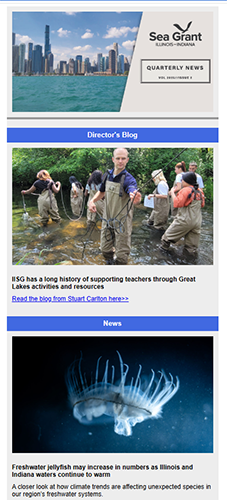 Dive into the latest stories from the Illinois-Indiana Sea Grant (IISG) Newsletter which highlights research, outreach, and partnerships making a difference across the Great Lakes region. In this issue, explore how communities, scientists and educators are working together to protect water quality, strengthen coastal resilience, and inspire stewardship.
Highlights from the newsletter include:
- IISG has a long history of supporting teachers through Great Lakes activities and resources
Read the blog from Stuart Carlton. - Freshwater jellyfish may increase in numbers as Illinois and Indiana waters continue to warm
A closer look at how climate trends are affecting unexpected species in our region’s freshwater systems. - New step-by-step guide and veterinary brochures expand UnwantedMeds.org resources
New tools help communities safely dispose of unwanted or expired medicine—from household to veterinary use—reducing pollution and protecting public health. - The Know Your H₂O Kit gets a real-world lab test by middle schoolers
Students dove into hands-on learning with IISG’s Know Your H₂O Kit, testing their local water and connecting science concepts to real environmental data. - Educators engage with Great Lakes scientists aboard the Lake Guardian
Teachers joined researchers on Lake Michigan aboard the R/V Lake Guardian, collecting samples, learning new field techniques, and bringing Great Lakes science back to their students. - IISG looks back on 30 years of AIS outreach
Illinois-Indiana Sea Grant is in the midst of its 30th year of dedicated outreach to address the spread of aquatic invasive species (AIS) in Great Lakes waters. - Coastal communities face challenges in managing beach sand and structures
Beginning in 2025, IISD has not one, but two coastal resilience specialists who are providing support for communities along the southern Lake Michigan shore. - The Helm
Our latest edition of The Helm brings together insights from field research, outreach efforts, and education across the Great Lakes region. - Shaping the Shoreline: Video Series
Explore how natural and engineered structures shape our Great Lakes coastlines. - Welcome Stuart Carlton, new IISG director
Stuart Carlton, longtime Sea Grant communicator and leader, steps into the director role—continuing IISG’s mission of connecting research, education, and outreach. - Tomas Höök reflects on a legacy of leadership, collaboration and impact at IISG
After more than a decade as director, Tomas Höök looks back on milestones that shaped IISG’s growth and lasting partnerships.
Subscribe to the IISG newsletter by sending your name and email to iisg@purdue.edu. To view the full newsletter visit: Illinois-Indiana Sea Grant (IISG) Quarterly Newsletter.
More Resources:
Prescription For Safety: How to Dispose of Unwanted Household Medicine, IISG Publications
A Guide to Marketing for Small-Scale Aquaculture Producers, The Education Store, Purdue Extension resource center
A Guide to Small-Scale Fish Processing Using Local Kitchen Facilities, The Education Store
Marine Shrimp Biofloc Systems: Basic Management Practices, The Education Store
Sustainable Aquaculture: What does it mean to you?, The Education Store
The Benefits of Seafood Consumption The Education Store
Walleye Farmed Fish Fact Sheet: A Guide for Seafood Consumers, The Education Store
Fish Muscle Hydrolysate, The Education Store
Fish Cleaning with Purdue Extension County Extension Director, Got Nature? Blog, Purdue Extension – Forestry and Natural Resources
Aquatics & Fisheries, Playlist, Purdue Extension – Forestry and Natural Resources
Eat Midwest Fish, Illinois-Indiana Sea Grant online resource hub
Community Development, Purdue Extension
Climate Change and Sustainable Development, The Education Store
Climate Change: Are you preparing for it?, The Education Store
Natty Morrison, Communications Coordinator
Illinois-Indiana Sea Grant (IISG)
Diana Evans, Extension & Web Communications Specialist
Purdue University Department of Forestry and Natural Resources

Recent Posts
- ID That Tree: Virgin’s Bower Clematis
Posted: April 6, 2026 in Urban Forestry, Wildlife, Woodlands - It’s Timberdoodle Time!
Posted: April 3, 2026 in Got Nature for Kids, How To, Wildlife - Keep An Eye Out for Hammerhead Worms, Purdue Landscape Report
Posted: April 2, 2026 in Invasive Animal Species, Wildlife, Woodlands - When is the Peak Migration For Hummingbirds and How Can You Attract Them?
Posted: in How To, Wildlife - ID That Tree Featured in National Woodland Owners Association Newsletter
Posted: April 1, 2026 in Urban Forestry, Wildlife, Woodlands - New 2026 Indiana Woodland Steward Newsletter
Posted: March 30, 2026 in Urban Forestry, Wildlife, Woodlands - A Woodland Management Moment: Why Aspect Matters
Posted: in Urban Forestry, Woodland Management Moment, Woodlands - 2026 Winter Bat Survey In Progress, MyDNR
Posted: March 27, 2026 in How To, Wildlife - Fast-Growing Trees for the Landscape, Purdue Landscape Report
Posted: March 26, 2026 in Forestry, Urban Forestry, Woodlands - Urban Tree Spotlight: Planting Deciduous Shade Trees, Purdue Landscape Report
Posted: March 25, 2026 in Forests and Street Trees, Urban Forestry, Woodlands
Archives
Categories
- Alert
- Aquaculture/Fish
- Aquatic/Aquaculture Resources
- Ask the Expert
- Christmas Trees
- Community Development
- Disease
- Drought
- Forestry
- Forests and Street Trees
- Gardening
- Got Nature for Kids
- Great Lakes
- How To
- Invasive Animal Species
- Invasive Insects
- Invasive Plant Species
- Land Use
- Natural Resource Planning
- Nature of Teaching
- Plants
- Podcasts
- Ponds
- Publication
- Safety
- Spiders
- Timber Marketing
- Uncategorized
- Urban Forestry
- Webinar
- Wildlife
- Wood Products/Manufacturing
- Woodland Management Moment
- Woodlands