 Purdue University - Extension - Forestry and Natural Resources
Got Nature? Blog
 The Indiana Department of Natural Resources (INDNR) has just released a new and updated application for iPhone and Android users. A successor to the previous app released in March 2011, this iteration introduces new features and DNR Director Cameron Clark calls it a “portable field guide.” The free app contains helpful information about any DNR-related properties such as forests, wildlife areas and state parks and serves as a helpful companion while planning outdoor activities. To download this app, visit iTunes for iPhone users or Google Play Store for Android users.
Resources
Indiana DNR Smartphone Apps, Indiana Department of Natural Resources
DNR Releases New, Improved Mobile Apps, WANE15
Publications and Maps, Indiana Department of Natural Resources
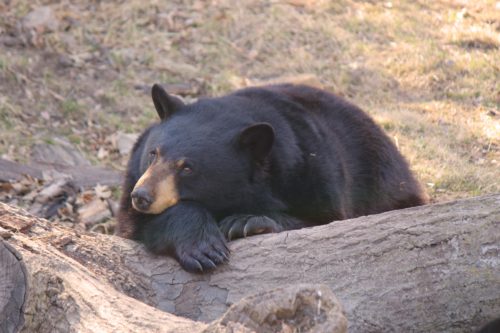 After being sighted in Indiana for the first time in 144 years on June 12 around South Bend, a second sighting of the bear has occurred in the Michigan City area, and this time, the bear has done a little bit of damage foraging for food. The bear had knocked over multiple bee hives and tore into some food at a local farm. It also bent poles holding up bird boxes, likely eating the baby birds inside.
The Department of Natural Resources is hoping the bear will return to upper Michigan on its own where the black bear population reaches around 15,000. However, they are continuing to monitor its movement and are prepared to trap it if needed.
While startling, it is important to note that black bears aren’t as dangerous as most people think. They are usually scared of humans, but it is a wise idea to move bird feeders, grills and trash cans out of your yard. If you encounter a bear, the DNR recommends standing your ground and making a lot of noise while slowly backing away. Do not turn and run. Black bears are also considered an exotic animal in Indiana, and shooting or killing one is a serious offense that can result in large fines or jail time.
Please report bear sightings to dfwinput@dnr.IN.gov or call 812-334-1137.
Resources
Black Bear, Indiana Department of Natural Resources
Black Bear Confirmed in Indiana For First Time in 144 Years, FOX59
 A new educational exhibit aimed for kindergartners to fifth graders called “A Salamander Tale” is ready to be shipped around the country and spread amphibian awareness. This interactive attraction is roughly 300 square feet and helps educate visitors at all ages about hellbenders, other salamanders and amphibians in general. Built into the exhibit is a video game called “Hellbender Havoc,” which provides a fun and unique way to learn about hellbenders. “Hellbender Havoc” is also playable online using Chrome or Firefox browsers.
Rental fees do apply for reserving the exhibit. Indiana state and extension professionals, also including Purdue staff, can rent the exhibit for free after paying for shipping. For more information, please check out the Salamander Tale web page, or feel free to take a look at other current exhibits on the Purdue Traveling Exhibits page. Check out Herbie the Hellbender today and inspire the Herpetologists of tomorrow!
Resources
Purdue Traveling Exhibits, Purdue Agriculture
Help the Hellbender, Purdue Extension
Salamanders of Indiana Book, The Education Store
This is the time of year that many homeowners start their annual battle with nuisance wildlife. While trapping animals is not always required or desirable, it may be necessary in some cases to alleviate damage. Homeowners will typically use a box-style or cage “live” trap. Before you take action, there are a few key points you should first consider.
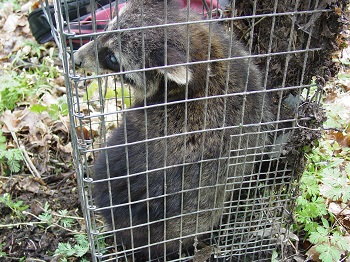
What permits, if any, are required?
Some animals require a permit prior to trapping. Raccoons, skunks, opossums, groundhogs, gray squirrels and fox squirrels are examples of mammals that do not require a permit in Indiana. Resident landowners or tenants can legally capture these species if the animal is causing damage to the property. However, you no longer have to report capture of wildlife to a conservation officer within 72 hours. Perhaps to the surprise of probably most people, rabbits do require a Nuisance Animal Control Permit prior to trapping. The Indiana DNR has a list of permitting requirements.
What do you do with wildlife you catch?
You have two choices of what to do with wildlife you capture: let it go or euthanize it (put to death humanely by injection). In either case, you may not possess an animal for more than 24 hours. If you relocate an animal, you must have permission of the landowner or property manager (even for public lands) AND you may only release that animal within the county of capture.
A common question I receive is, “What should I do?” There is no answer for which is best because circumstances differ. Most people probably prefer to let them go somewhere else because they find euthanizing animals unacceptable. They also may think that letting them go allows them to live out their lives, but this may not be the case. There has been some research on what happens to translocated raccoons and tree squirrels. In both cases, the animals don’t stay where they were let go. In the case of squirrels, a high number died within 88 days of release. Raccoons removed from structures tended to relocate in another structure.
Other things to consider
- Despite being cute and furry, wild animals are exactly that – wild animals. You should always use caution when handling traps that contain wildlife. Wear thick leather gloves and avoid sticking fingers inside the trap.
- If you transport an animal to be released (assuming you have gotten permission), do not place the trap inside your vehicle. Use a pickup truck to avoid contaminating your vehicle with animal waste and to minimize the spread of disease. Wildlife carry many pathogens and diseases that are transmittable to people.
- Animals can roll traps or pull in vegetation from the immediate vicinity. Be careful where you place the trap. Staking box traps is also a good idea.
- Be sure the trap is stable or “bedded” when you set it. Remove rocks and debris from under the trap. You may have to “work” the trap into the ground. Just be sure that debris doesn’t get caught under the treadle. If it does, the trap may not fire.
- You may want to cover your trap by wrapping it with cardboard and wire.
- Check your traps frequently. Indiana has a 24-hour trap check law. It is often a good idea to check them more frequently – perhaps 2 to 3 times a day. This is especially true if you are trapping during extremely hot or cold weather.
- Wildlife species have different times of activity, so you can be selective what time of day you trap. For example, tree squirrels and groundhogs are not active at night. Closing traps at night can avoid non-targets but would also require opening the trap at sunrise.
If you are interested in hiring a state licensed animal control professional, you can visit the Indiana DNR Nuisance Wildlife page and click on the link to “Nuisance Wildlife Control Operators.”
Additional Resources
Preventing Wildlife Damage – Do You Need a Permit?
Indiana Wildlife Conflicts Information
Indiana DNR Nuisance Wildlife
Brian MacGowan, Wildlife Extension Specialist
Department of Forestry and Natural Resources, Purdue University
Question: I just finished cutting down the last of my backyard oaks due to oak wilt. I have also lost several redbuds due to verticillium wilt. I would like to replant a tree in the spot where the oaks and redbuds were, but I would like some advice on the most resistant tree I can find. I live in Crown Point, IN, primarily clay, on a slope, with heavy brush on my property lines. I know most people would say NEVER plant again once wilt has been detected, but I thought I might ask before giving up (and moving all my shade plants). Do you have information/research on an appropriate and sturdy replacement shade tree?
Response: In general, replanting of oaks in an old oak wilt disease center does not result in disease occurrence in the replanted trees. Root grafts are not thought to form with the dead, diseased oaks. It does not appear that the fungus is transmitted outside the primary phases of transmission: vector-borne via insects (e.g., Nitidulidae) and xylem-limited disease spread via live root grafts of infected trees (MacDonald et al., 2009). This does not mean, of course, that the young oak trees as they grow and age over time are immune to oak wilt; rather, it simply means that oak wilt is not sitting dormant in the soil waiting to attack newly planted or germinated oak seedlings.

Thus, it is only through insect spread from active oak wilt centers in the vicinity that disease would occur in replanted oaks. Healthy oak trees are not susceptible to oak wilt in an infected area. Bur oak, white oak and other members of the white oak family are resistant to the fungus and can be planted in oak wilt centers. For additional prevention measures, plant tree species other than Oaks to guarantee no infection from the disease.
Resources
Diseases in Hardwood Tree Plantings, The Education Store
Tree Installation: Process and Practices, The Education Store
Forest Health Problems Impacting Indiana Forest Resources, Indiana Department of Natural Resources
Lindsey Purcell, Urban Forestry Specialist
Department of Forestry and Natural Resources
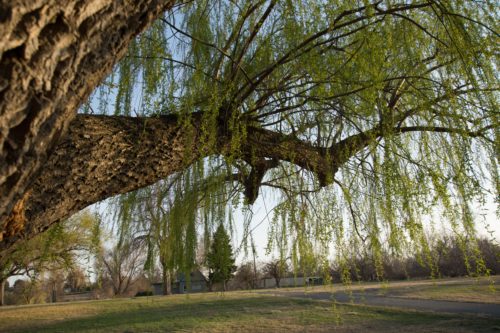 Question: Weeping willow, six years old and 9″ diameter. Wet, clay ground and thriving. Suddenly late last summer, I noticed the leaves were dead, and the bark on the trunk was completely loose and falling off. No other trees or shrubs within 50 feet (black walnut, sycamore, maple, rose of sharon) were affected. No obvious sign of insects, boring, trails, worms, etc.
Answer: When a tree starts to lose leaves, especially in the spring when they should be expanding for the new growing season, it can be puzzling. Often, this is a sign of troubles which can be caused by biotic or abiotic issues but not always a major cause for alarm. The dropping leaves can be a symptom of foliar diseases which weakens the tree, or it could be the result of an insect pest feeding on the petioles of the leaves. There are many pests which can cause leaf drop.
Another possible cause is the response to abiotic disorders which is typically a complex of issues. Leaf drop can occur on trees that have been exposed to prolonged wetness in heavy, clay soils. Some tree species like wet soils but not prolonged wetness without drainage. If trees are exposed to continual wetness, their roots can become diseased and cause the leaf drop. Additionally, it has been noted that trees which were planted improperly, especially if planted too deep, can result in several physiological issues such as decline and dieback.
If trees reveal symptoms of premature fall color, yellowing of leaves or unusual leaf drop, it may be necessary to send in a sample for diagnosis. The Purdue Plant and Pest Diagnostic Laboratory (PPDL) provides this service by a very capable team of pathologists, entomologists and extension specialists to analyze plant issues in the landscape. This is an inexpensive approach to investigating the issues and leading to the best possible curative measures. Protocol for submitting plant samples can be found on the PPDL website.
Resources
Hardwood Tree Improvement and Regeneration Center, Paula Pijut, Research Plant Physiologist, Purdue University
Relationships Between Advance Oak Regeneration and Biotic and Abiotic Factors, Songlin Fei, Associate Professor of Measurements and Quantitative Analysis, Purdue University
Diseases of Landscape Plants: Leaf Diseases, The Education Store, Purdue Extension Resource Center
Lindsey Purcell, Urban Forestry Specialist
Department of Forestry and Natural Resources, Purdue University
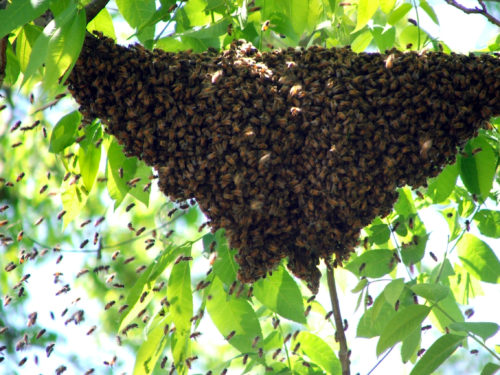 The idea of 10,000 honey bees swarming is a very, very unsettling thought for many people. This sounds like a dangerous and maybe even deadly situation, but in reality, it usually isn’t. Large swarms of honey bees are actually fairly common and completely harmless unless provoked.
As a colony of honey bees grows, sooner or later it outgrows its hive, and it is time to spread out and create a new one. This process starts with the production of new queens. They are grown in special chambers and are fed a diet of “royal jelly” as they grow. When the first one emerges from its chamber fully developed, it kills the others to eliminate the competition.
This new queen leaves the hive in search of “drone zones,” areas where male honey bee drones congregate in hopes to mate with the queen. After a successful mating, the queen returns to the hive, signaling the worker bees of the colony to begin preparing for swarming. Some fly from the hive to explore and search for possible new locations for a new hive. Meanwhile, others start reducing the old queen’s diet, slimming her down in preparation for the swarming. When the new queen begins laying eggs, it is officially time to swarm.
The older bees escort the old queen out of the hive in a massive swarm towards the location scouted out previously to begin a new colony. However, sometimes when a suitable location hasn’t been found in time, the swarm lands on the ground, protecting the queen in the center until one can be found. While probably terrifying to someone with a fear of bees, there is no reason to be alarmed. These bees are focused on protecting the queen and won’t leave the cluster or sting anyone unless provoked. Eventually, when a location is found, the cluster swarms to it and starts a new colony.
So if you encounter a huge group of honey bees, don’t panic. While they might look intimidating, these bees are busy transitioning to a new colony and don’t pose a hazard to anyone.
Resources
Swarms Hanging Around, Purdue Extension
Indiana Honey Bee Swarms, Indiana Department of Natural Resources
The Education Store, Purdue Extension Resource Center
Tom Turpin, Professor, Insect Outreach, Instruction Development Specialist
Department of Entomology, Purdue University
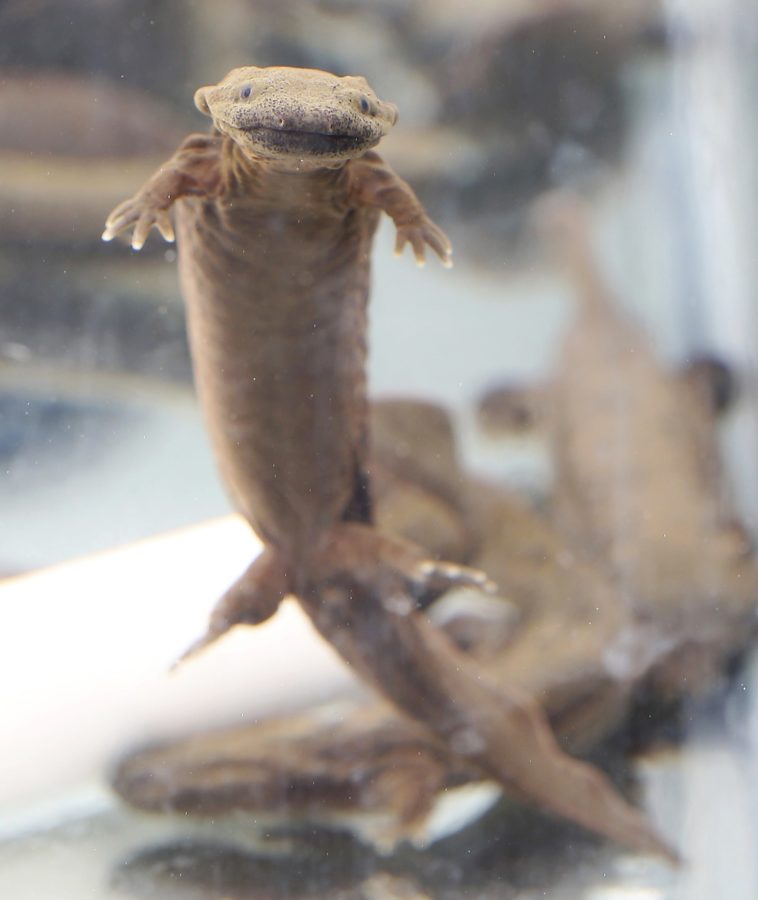 The next big step in the initiative to save the hellbenders of Indiana was completed on May 18, 2015, as three hellbenders were transferred from Purdue University’s Aquaculture Research Lab to the Columbian Park Zoo in Lafayette. This is the last of 50 hellbenders transferred from the lab to Columbian Park Zoo, Fort Wayne Children’s Zoo and Mesker Park Zoo in Evansville.
In 2013, Associate Professor of Wildlife Science Rod Williams and his team collected 300 eggs from the Blue River in Southern Indiana. These eggs grew into young hellbenders in the lab and were transferred to the three zoos to continue growing to adulthood. In the wild, hellbender mortality rate is extremely high, as high as 99%. The salamanders are at their most vulnerable state during their juvenile years, and being raised in captivity will greatly improve their chances of survival when they are released back into the wild in a couple years.
Once released, the hellbenders will be tracked via radio transmitters to monitor their movements, habitat preferences and survivorship. The last group of 18 hellbenders released into the wild had a 22.5% survival rate after one year, and Williams hopes to improve on that. A group of 80 more hellbenders will be released in 2016 with 130 in the following year. Williams’ goal of 40-50% survival rate would mark huge progress in saving the hellbenders of Indiana.
Resources
Help the Hellbender, Purdue Extension
The Nature of Teaching: Adaptations for Aquatic Amphibians, The Education Store, Purdue Extension resource center
How Our Zoos Help Hellbenders, The Education Store
Hellbenders Rock!, The Education Store
Help the Hellbender, North America’s Giant Salamander, The Education Store
How Anglers and Paddlers Can Help the Hellbender, Purdue Extension-FNR YouTube Video
Subscribe to Purdue Extension-FNR YouTube Channel
Rod Williams, Associate Professor of Wildlife Science
Purdue University Department of Forestry and Natural Resources
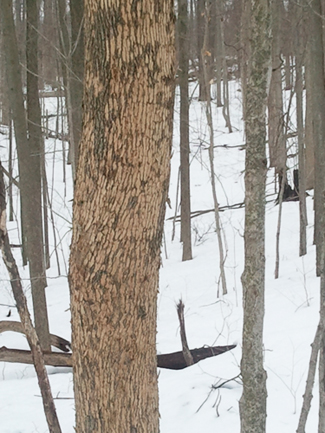 If you’re walking in the woods or maybe even traveling along a road this spring in Indiana, you may come across some trees that look like the one in the photos. Clearly, something unusual is going on here. What made the bark change color so quickly, and why are there holes in the bark?
The answer to both of those questions for ash trees around the state is Emerald Ash Borer and woodpeckers. As Emerald Ash Borer spreads across Indiana, the population of Emerald Ash Borer larvae overwintering under the bark of ash trees can quickly increase. These grubs provide a tasty treat and important winter and early spring nutrition to hungry woodpeckers.
 Woodpeckers of several species are experts at detecting and extracting these grubs by pounding holes in tree bark. Ash bark is generally gray on the surface, but the inner bark is a light corky tan color. Once the woodpeckers find the EAB larvae, their excavation activities flake off the outer bark to expose the lighter colored inner bark. This is actually one of the best indicators of the presence of Emerald Ash Borer in a tree. The woodpecker activity often starts in the upper main stem and branches of ash trees, but as the population of EAB larvae in the trees increase, the woodpecker activity spreads down the trunk of the tree. Trees with this much inner bark exposed indicate an advanced infestation of EAB and signal ash tree mortality in the next year or two.
If you would like to learn more about ash trees and the Emerald Ash Borer, visit the Purdue Emerald Ash Borer website.
Resources
Arrest That Pest! – Emerald Ash Borer in Indiana, Purdue Extension
Purdue Extension – Forestry & Natural Resources website with search bar, place “Invasive Insect”
Emerald Ash Borer, Indiana Department of Natural Resources (IDNR)
Emerald Ash Borer in Indiana, Purdue Extension
New Hope for Fighting Ash Borer, Purdue Extension – Forestry and Natural Resources Got Nature? blog
Lenny Farlee, Extension Forester
Purdue University Department of Forestry and Natural Resources
When you rush to the closet to grab your favorite shorts and T-shirt, remember that you are not the only creature looking forward to the warmer weather. It is important to check yourself or have a buddy check you for passengers when you get back from the field to lessen the likelihood of bringing ticks home with you.
Indiana has 15 tick species, but the three listed below are the most prevalent.
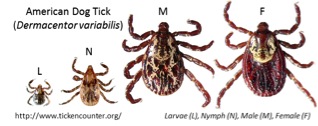
American Dog Tick (Dermacentor variabilis): Found primarily along trails, walkways or in fields, American Dog ticks are rarely found in forests. Despite their name, these ticks feed on a multitude of hosts in addition to the family pet and can transmit Rocky Mountain Spotted Fever, a potentially fatal disease contracted by 32 people in Indiana last year. The American Dog Tick also carries Tularemia, a rare but dangerous disease that is often misdiagnosed for the flu.
American Dog ticks can survive for two years at any stage in life until a suitable host is found. Male ticks mate with the female while she is feeding as after she is sated, she drops off of the host and lays 4,000+ eggs before dying. Larval ticks only feed for three to four days from a host before molting into nymphs. The nymph feeds on a variety of small/medium-sized hosts before dropping to the leaf litter and molting into adults. Interestingly, these ticks are least likely to bite humans.
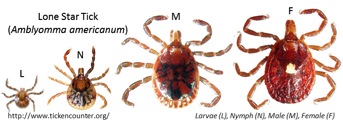 Lone Star Tick (Amblyomma americanum): Found primarily in dense underbrush and forested areas. As with the American Dog Tick, these ticks are capable of transmitting Rocky Mountain Spotted Fever in addition to Monocytic Ehrlichiosis, another tickborne disease that presents with symptoms similar to the flu but was confirmed in 49 Indiana cases in 2013. ‘Stari’ (Southern Tick-Associated Rash Illness) Borreliosis is a tick-vectored disease that presents with a large round or elliptical rash and flu symptoms transmitted by the Lone Star Tick.
Voracious eaters, adult Lone Star ticks often take human hosts or other large mammals. After a week, the female is capable of laying 3,000+ eggs. The larval Lone Star ticks only feed for four days before detaching, burying themselves in leaf litter and molting into nymphs. Able to quickly ascend up pant legs, these nymphs can be firmly attached to a host in < 10 minutes. After five days, the nymphs detach and molt into adults.
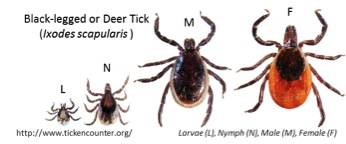
Black-legged or Deer Tick (Ixodes scapularis): Found primarily in deciduous forests, these ticks predominantly use white-tailed deer or other large mammals as hosts. Unlike the relatively accelerated life cycles of the American Dog and Lone Star ticks, the Deer Tick life cycle takes nearly two years to complete.
Deer ticks are most notorious for spreading Lyme disease, a dangerous disease that causes flu-like symptoms that, if left untreated, can spread to joints and compromise the nervous system. More than 100 cases of Lyme disease were confirmed in Indiana in 2013. Babesiosis is caused by microscopic parasites that infect red blood cells, and Anaplasmosis is caused by the bacterium Anaplasma phagocytophilum. Both of these diseases are transmitted through the bite of an infected Deer Tick.
Only the female Deer Tick feeds, and once completely engorged, they lay an egg mass of 1,900+ eggs before dying in late-May. Deer Tick larvae and nymphs remain in the moist leaf litter within forested areas and prefer smaller hosts. After feeding for three days in each developmental stage, they burrow into the litter to molt. Larvae emerge as nymphs in spring, and nymphs emerge as adults in fall.
 The table here illustrates the months of activity for the larval, nymph, male and female tick life cycle stages which gives you a quick reference for Indiana. This information was gathered from the resources listed in this post.
Indiana ticks can carry several diseases, but the three most common are Rocky Mountain Spotted Fever, Lyme Disease and Ehrlichiosis. Symptoms of all three diseases range from spreading rashes, headaches, fatigue, fevers and muscle aches. Likelihood of infection is rare; however, instances of each disease are increasing in Indiana.
Be careful and try not to pick up eight-legged hitchhikers. If you suspect that you have been bitten by a tick or develop a rash along with flu symptoms, contact your local health department for a disease screening.
Resources
Ticks, Indiana Department of Natural Resources
Ticks, Medical Entomology, Purdue University
Rocky Mountain Spotted Fever, Centers for Disease Control and Prevention
Tularemia, Centers for Disease Control and Prevention
Lyme Disease, Centers for Disease Control and Prevention
Ehrlichiosis, Centers for Disease Control and Prevention
Parasites – Babesiosis, Centers for Disease Control and Prevention
Anaplasmosis, Centers for Disease Control and Prevention
‘Stari’ Borreliosis, Columbia University Medical Center
tickencounter.org, Tick Encounter Resource Center, University of Rhode Island
Shaneka Lawson, Adjunct Assistant Professor
Department of Forestry and Natural Resources

Recent Posts
- 2026 Winter Bat Survey In Progress, MyDNR
Posted: March 27, 2026 in Wildlife - Fast-Growing Trees for the Landscape, Purdue Landscape Report
Posted: March 26, 2026 in Forestry, Urban Forestry, Woodlands - Urban Tree Spotlight: Planting Deciduous Shade Trees, Purdue Landscape Report
Posted: March 25, 2026 in Forests and Street Trees, Urban Forestry, Woodlands - Beetle that attacks Tree-of-Heaven found in Indiana, Purdue Landscape Report
Posted: March 20, 2026 in Invasive Insects, Wildlife, Woodlands - ID That Tree: Dwarf Chinkapin Oak
Posted: in Forestry, Urban Forestry, Wildlife, Woodlands - IN-PREPared: Essential Resources for Indiana’s Severe Weather Season
Posted: March 11, 2026 in How To, Safety - DNR Hiring for Indiana Conservation Officer Positions, MyDNR
Posted: March 9, 2026 in Urban Forestry, Wildlife, Woodlands - ID That Tree: Shumard Oak
Posted: in Plants, Urban Forestry, Wildlife, Woodlands - A Woodland Management Moment: Windbreak Around Walnut Plantings
Posted: March 3, 2026 in Forestry, Urban Forestry, Woodland Management Moment - Getting Certified as an Indiana Certified Prescribed Burn Manager
Posted: March 2, 2026 in How To, Urban Forestry, Woodlands
Archives
Categories
- Alert
- Aquaculture/Fish
- Aquatic/Aquaculture Resources
- Ask the Expert
- Christmas Trees
- Community Development
- Disease
- Drought
- Forestry
- Forests and Street Trees
- Gardening
- Got Nature for Kids
- Great Lakes
- How To
- Invasive Animal Species
- Invasive Insects
- Invasive Plant Species
- Land Use
- Natural Resource Planning
- Nature of Teaching
- Plants
- Podcasts
- Ponds
- Publication
- Safety
- Spiders
- Timber Marketing
- Uncategorized
- Urban Forestry
- Webinar
- Wildlife
- Wood Products/Manufacturing
- Woodland Management Moment
- Woodlands