 Purdue University - Extension - Forestry and Natural Resources
Got Nature? Blog
Welcome to the Nature of Teaching Professional Development Webinar Series: Ecotoxicology Part 1. This webinar shared by Rod Williams, a professor and extension wildlife specialist with Purdue University Extension, and Jason Hoverman, an associate professor at Purdue University and a co-author on the unit on ecotoxicology, discusses the principles of ecotoxicology, contaminants, and threats to the freshwater ecosystems.
This webinar shares the resources teachers, and K-12 leaders, need to teach students about ecotoxicology. This state standard curriculum includes free downloads of posters, photos, charts, data sheets, and fun activities along with the opportunity to receive a Certificate of Completion.
Resources
The Nature of Teaching: Ecotoxicology and Environmental Health, The Education Store, Purdue Extension’s resource center
Benefits of Connecting with Nature, The Education Store
The Nature of Teaching: Disease Ecology, The Education Store
Resourceful Animal Relationships, The Education Store
The Nature of Teaching, YouTube Channel
Nature of Teaching, Website
Rod Williams, Professor of Wildlife Science
Purdue University Department of Forestry and Natural Resources
Jason Hoverman, Associate Professor Vertebrate Ecology
Purdue University Department of Forestry and Natural Resources
Join Purdue Extension forester Lenny Farlee as he introduces you to the Bald Cypress in the video below, one of two deciduous conifers in Indiana.
If you have any questions regarding trees, forests, wildlife, wood products or other natural resource topics, feel free to contact us by using our Ask an Expert web page.
Resources
Indiana Department of Natural Resources – Division of Forestry, District Foresters
Forest Improvement Handbook, The Education Store, Purdue Extension resource center
Tree Appraisal and the Value of Trees, The Education Store
ID That Tree, Playlist, Purdue Extension – Forestry and Natural Resources Youtube Channel
A Woodland Management Moment, Playlist
Lenny Farlee, Sustaining Hardwood Extension Specialist
Purdue University Department of Forestry and Natural Resources
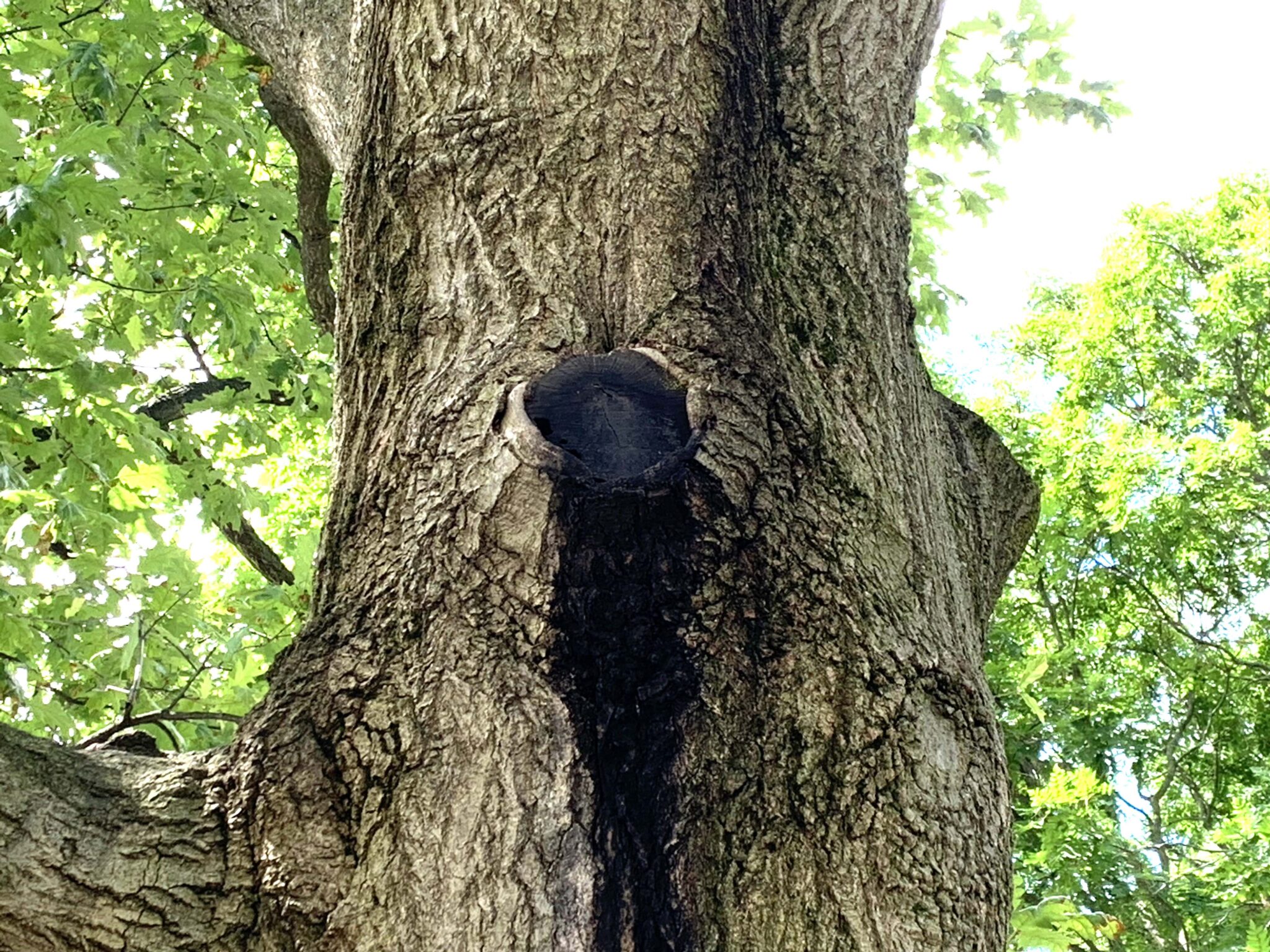
Figure 1. White oak slime flux
Purdue Landscape Report: Slime flux (also known as wet wood) is a dark, foul-smelling and unsightly seepage of sap from tree trunks (fig. 1). The disease is not usually a serious problem but the appearance can be alarming. Slime flux is caused by common surface-inhabiting bacteria or yeast fungi that enter the trunk through wounds associated with improper pruning, stem breakage, injections, cracks from freeze injury or weak limb crotches. The bacteria and yeast may live on sap nutrients within injured trees for many years without any outward evidence.
Symptoms
The main symptom is the appearance of the dark sap oozing on the trunk exterior which happens when gasses produced by growth of the bacteria and yeast cause the internal pressure of the sap to become high enough to force the sap out through cracks in the bark. The dark streaks usually turn light gray or white upon drying. Oozing sap may be frothy and white at the point of exit. Airborne bacteria, yeasts, and fungi often colonize the wet oozing material, which ferments and releases a foul odor. Slime flux may delay wound healing (callus formation).
Slime flux is extremely common on mature elms (fig 2), oak (fig 3) and mulberry; and is seen less frequently on maples (fig 4), paper birch, sycamore, and walnut.
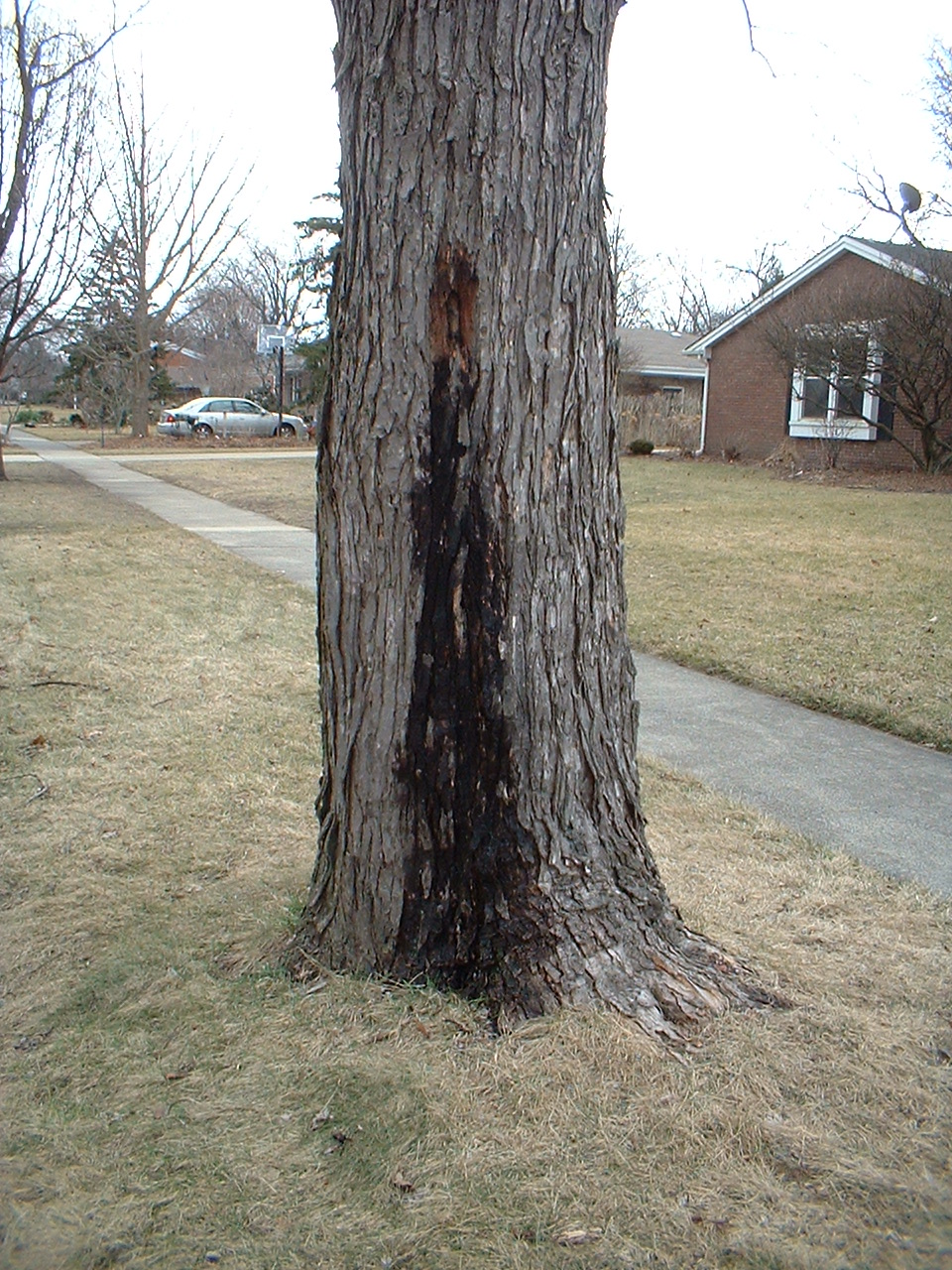
Figure 4. Silver Maple
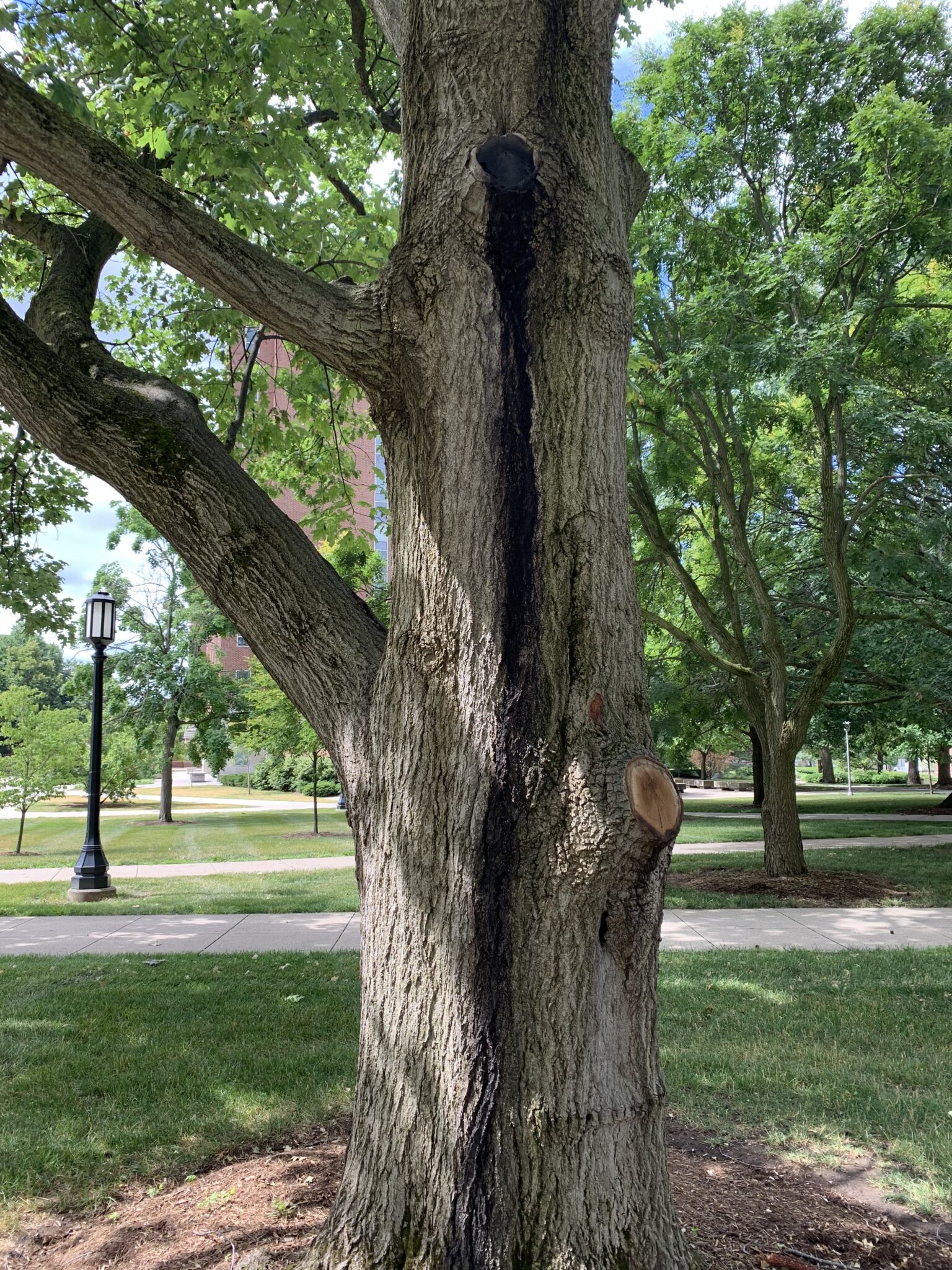
Figure 3. White Oak
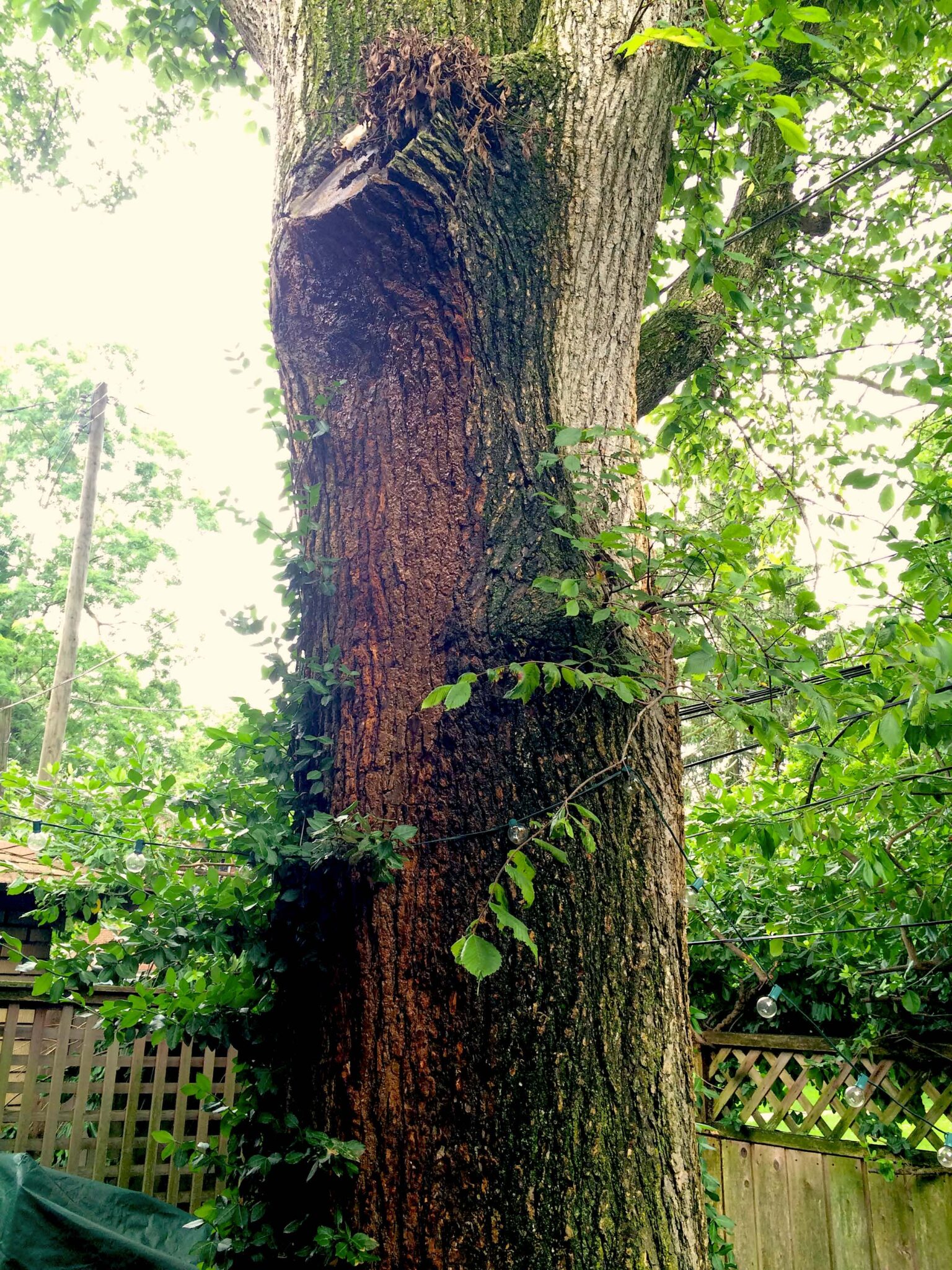
Figure 2. American Elm
Prevention
There is no control or treatment for slime flux. Inserting a drain tube into the tree to relieve pressure and drain infected sap was once an accepted treatment, but is no longer recommended and may do more harm than good. Boring holes in affected trees causes internal spread of the bacteria within the tree and may allow entry of wood decay fungi.
To reduce the chances of susceptible trees developing wet wood avoid unnecessary wounding of the trunk and branches. Proper pruning techniques, HO-4-W, will allow branches to heal more rapidly. Make sure susceptible trees receive good general care; including irrigation when needed and mulch to conserve moisture and keep mowers away from the trunk. Avoid excess traffic in tree root zone to prevent soil compaction and root injury.
The first and most important step for managing a tree disease is to accurately diagnose the problem. The best approach to diagnosis of tree problems is to start by submitting photos of the tree via the digital upload tool on the Purdue Pest & Diagnostic Lab (PPDL) website. In the case of slime flux it is impractical to collect the type of physical sample needed for confirmation so photos are the best alternative.
References
Sinclair, W. A. and H. H. Lyon. 2005. Diseases of trees and shrubs. Cornell University Press, Ithaca, NY. 660 pp.
Stipes, R. J. and Campana, R. J. (eds.) 1981. Compendium of Elm Diseases. APS Press, St. Paul, MN.
Resources
Diseases in Hardwood Tree Plantings , The Education Store, Purdue Extension’s resource center
Iron Chlorosis of Trees and Shrubs, The Education Store
Surface Root Syndrome, The Education Store
Tom C Creswell, Clinical Engagement Professor – Plant & Pest Diagnostic Laboratory
Purdue University Department of Botany and Plant Pathology
Lindsey Purcell, Chapter Executive Director
Indiana Arborist Association
Purdue extension forester Lenny Farlee introduces the red maple, a native tree to Indiana, known for its red to maroon foliage.
If you have any questions regarding trees, forests, wildlife, wood products or other natural resource topics, feel free to contact us by using our Ask an Expert web page.
Resources
ID That Tree, Playlist, Purdue Extension – Forestry and Natural Resources Youtube Channel
A Woodland Management Moment, Playlist, Purdue Extension – Forestry and Natural Resources Youtube Channel
Investing in Indiana Woodlands, The Education Store
Tree Appraisal and the Value of Trees, The Education Store
Forest Improvement Handbook, The Education Store
Lenny Farlee, Sustaining Hardwood Extension Specialist
Purdue University Department of Forestry and Natural Resources
Meet Dr. Stephen Spears the director of wildlife ecology at the 10,000 acre zoo in Ohio, The Wilds. Dr. Spears takes you on a virtual tour of their hellbender conservation center and gives us insight of where they find hellbenders in Ohio. Don’t miss the question and answer time with Dr. Spears and Purdue University’s wildlife biologists.
Resources
Help the Hellbender Website
Hellbender Havoc, Video Game: Purdue Envision PC / Apple App Store
The Wilds
Help the Hellbender, Playlist, Purdue Extension – Forestry and Natural Resources
The Nature of Teaching: Adaptations for Aquatic Amphibians, The Education Store, Purdue Extension resource center
Hellbenders Rock!, The Education Store
Rod Williams, Professor of Wildlife Science
Purdue University Department of Forestry and Natural Resources
This webinar titled “Tree Selection for the Landscape” by FNR Urban Forestry Specialist Lindsey Purcell talks about the tree selection process including the benefits of trees, urban tree planting, purpose for planting, environmental considerations, proper placement and utility considerations, along with many shared resources.
Please visit the Tree Selection for the Landscape Survey after you watch the video so we can learn more about you and feel free to share your suggestions for future topics.
Resources
Tree Appraisal and the Value of Trees, The Education Store, Purdue Extension resource center
Tree Selection for the “Un-natural” Environment, The Education Store
Tree Pruning Essentials, Video & Document
Tree Pruning: What Do Trees Think?, The Education Store
Mechanical Damage to Trees: Mowing and Maintenance Equipment, The Education Store
Tree Installation Process and Practices, The Education Store
Tree Planting Part 1: Choosing a Tree, The Education Store
Tree Planting Part 2: Planting Your Tree, The Education Store
Planting Problems: Planting Too Deep, Video, Purdue Extension – Forestry and Natural Resources Youtube Channel
Lindsey Purcell, Urban Forestry Specialist
Purdue University, Department of Forestry and Natural Resources
If you missed the LIVE Q&A about invasive plant species from June 4, 2020, no worries. Now you can view the archived video on our Purdue Extension-FNR YouTube Channel with Lenny Farlee, sustaining hardwood extension specialist, and Liz Jackson, extension specialist with Walnut Council and Indiana Forestry Woodland Owners’ Association (IFWOA), discussing invasive plant species, how to identify them, reporting and controlling techniques.
Here are the resources that were talked about in the video as it will help guide you as you identify invasives.
Resources
Help Stop Invasive Species with PlayCleanGo
Best management practices – Top 10 list (pdf)
Great Lakes Early Detection Network – Download the app at Apple App Store
Eddmaps website – A good place to see mapping and keep track of your reports and overall reports by species or location.
Call DEPP 1-866-NOEXOTIC or email depp@dnr.in.gov
Indiana Native Plant Society – Natives to replace invasives
Alternative Option for Invasive Landscape Plants (pdf)
A Guide to the Regulated Terrestrial Plant Species” (pdf)
Calendar of control- seasonality to treatment (pdf)
County CISMA groups, SICiM website
Work assistance- Contractor list, SICiM website
CISMA Virtual Conference in August – Learn about the impact of invasives, importance of native species, a bit about how to control, SICiM website
Midwest Invasive Plant Network Control Database provides an outline and efficacy rating for control techniques for many common invasive plant species.
Grow Indiana Natives Certification Program – Learn about substitutes for invasive species, Indiana Native Plants Society
Report Invasive
Indiana Invasive Species Council is an excellent doorway site to invasive species information for the state
Contact your local NRCS office for EQIP Brush Control practice, tree planting and habitat development practices, Natural Resources Conservation Service Indiana
Woodland Management Moment – Garlic Mustard, Video, Purdue Extension – Forestry and Natural Resources Youtube Channel
Woodland Management Moment: Asian Bush Honeysuckle, Video, Purdue Extension – Forestry and Natural Resources Facebook Page
Elizabeth Jackson, with Manager Walnut Council/IN Forestry Woodland Owners’ Association (IFWOA) & Engagement Specialist
Purdue University Department of Forestry and Natural Resources
Lenny Farlee, Sustaining Hardwood Extension Specialist
Purdue University Department of Forestry and Natural Resources
Purdue urban forester Lindsey Purcell shares tips for tree pruning for the landscape, including knowing why you are pruning, how to prune and how to help the tree heal properly.
Please visit the Tree Pruning for the Landscape Survey after you watch the video so we can learn more about you and feel free to share your suggestions for future topics.
Resources
Tree Pruning Essentials, Video & Document
Tree Appraisal and the Value of Trees, The Education Store, Purdue Extension resource center
Tree Pruning: What Do Trees Think?, The Education Store
Mechanical Damage to Trees: Mowing and Maintenance Equipment, The Education Store
Tree Installation Process and Practices, The Education Store
Tree Planting Part 1: Choosing a Tree, The Education Store
Tree Planting Part 2: Planting Your Tree, The Education Store
Planting Problems: Planting Too Deep, Video, Purdue Extension – Forestry and Natural Resources Youtube Channel
Lindsey Purcell, Urban Forestry Specialist
Purdue University, Department of Forestry and Natural Resources
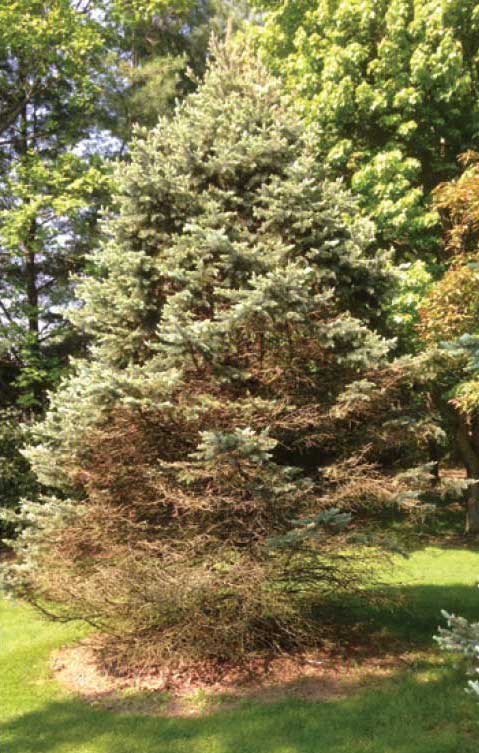 Question: I have a blue spruce that is 40-years old and very tall. It is dying up the middle. I have read about the Needle Cast problem. Also read about Spectro 90 copper based fungus control. I can only spray so high. Is there a chemical that can be placed on the ground to be absorbed by the tree?
Answer: Thank you for contacting us regarding your tree issues. Rhizosphaera needle cast (Rhizosphaera kalkhoffii) is a foliar disease of spruce trees. It is most common in trees growing outside of their native range. It starts on the inner and lower growth and progresses upward through the tree. It can take up to 15 months for the needles to show visible symptoms after the initial infection. Young trees may be killed by this disease, but usually branches die off after 3-4 consecutive years of defoliation, causing trees to look disfigured.
Early identification of Rhizosphaera can prevent major damage to individual trees and prevent the spread to nearby trees. Protecting new growth as it emerges is very important. For best effectiveness, fungicides should be applied when the emerging needles are half elongated (1/2 to 2 inches in length). Needle cast diseases can be effectively controlled with fungicides containing chlorothalonil. For Rhizosphaera needle cast, two properly-timed applications per year for at least two consecutive years, and sometimes three years, is required for control. Heavily infected trees may require several years of fungicide applications but should be sprayed, soil drenches are not effective. Also, clean-up of any infected needles and branches will help reduce the spread of the disease.
Resources
Needle cast in Colorado Blue Spruce, Purdue Landscape Report
Blue Spruce Update, Purdue Landscape Report
Why Spruce Trees Lose Their Needles, Purdue Extension
Blue Spruce Decline, Purdue Extension
Diseases Common in Blue Spruce, Purdue Extension
Tree Installation: Process and Practices, The Education Store, Purdue Extension resource center
Tree Planting and Urban Forestry Videos, Subscribe to our Purdue Extension-FNR YouTube Channel
Find an Arborist, International Society of Arboriculture
Lindsey Purcell, Urban Forestry Specialist
Purdue University, Department of Forestry and Natural Resources
Purdue sustaining hardwood extension specialist Lenny Farlee talks about identifying invasive plant species in the webinar below.
Don’t forget to fill out the Invasive Plants Threaten our Woodlands Part 1, Identification survey after watching video to share your suggestions, other forest topics you would like to see and to help us learn more about you.
Resources
A Woodland Management Moment, Playlist, Purdue Extension – Forestry and Natural Resources Youtube Channel
Invasive Species, Playlist
Report Invasive Species, Purdue Invasive Species
The GLEDN Phone App – Great Lakes Early Detection Network
EDDMaps – Early Detection and Distribution Mapping System (Report Invasives)
Cooperative Invasive Species Management Area (CISMA)
Indiana Department of Natural Resources: Invasive Species
Indiana Invasive Species Council
Woodland Stewardship for Landowners, Playlist
Invasive plants: impact on environment and people, The Education Store, Purdue Extension resource center
Woodland Invaders, Got Nature? Blog
Indiana Invasive Species Council
Hardwood Tree Improvement & Regeneration Center (HTIRC)
Lenny Farlee, Sustaining Hardwood Extension Specialist
Purdue University Department of Forestry and Natural Resources

Recent Posts
- Urban Tree Spotlight: Planting Deciduous Shade Trees, Purdue Landscape Report
Posted: March 25, 2026 in Forests and Street Trees, Urban Forestry, Woodlands - Beetle that attacks Tree-of-Heaven found in Indiana, Purdue Landscape Report
Posted: March 20, 2026 in Invasive Insects, Wildlife, Woodlands - ID That Tree: Dwarf Chinkapin Oak
Posted: in Forestry, Urban Forestry, Wildlife, Woodlands - IN-PREPared: Essential Resources for Indiana’s Severe Weather Season
Posted: March 11, 2026 in How To, Safety - DNR Hiring for Indiana Conservation Officer Positions, MyDNR
Posted: March 9, 2026 in Urban Forestry, Wildlife, Woodlands - ID That Tree: Shumard Oak
Posted: in Plants, Urban Forestry, Wildlife, Woodlands - A Woodland Management Moment: Windbreak Around Walnut Plantings
Posted: March 3, 2026 in Forestry, Urban Forestry, Woodland Management Moment - Getting Certified as an Indiana Certified Prescribed Burn Manager
Posted: March 2, 2026 in How To, Urban Forestry, Woodlands - Uniting Indiana Residents Against Invasive Species
Posted: February 27, 2026 in Community Development, Invasive Insects, Wildlife - Have You Seen a Soaring Eagle Lately? Morning Ag Clips
Posted: February 25, 2026 in Urban Forestry, Wildlife
Archives
Categories
- Alert
- Aquaculture/Fish
- Aquatic/Aquaculture Resources
- Ask the Expert
- Christmas Trees
- Community Development
- Disease
- Drought
- Forestry
- Forests and Street Trees
- Gardening
- Got Nature for Kids
- Great Lakes
- How To
- Invasive Animal Species
- Invasive Insects
- Invasive Plant Species
- Land Use
- Natural Resource Planning
- Nature of Teaching
- Plants
- Podcasts
- Ponds
- Publication
- Safety
- Spiders
- Timber Marketing
- Uncategorized
- Urban Forestry
- Webinar
- Wildlife
- Wood Products/Manufacturing
- Woodland Management Moment
- Woodlands