Join Purdue Extension wildlife specialists Brian MacGowan and Rod Williams as they clear up what is fact and fiction when it comes to wildlife. They burst the bubble on some commonly heard “facts” about snapping turtles, hellbenders, coyotes, snakes and more.
 Purdue University - Extension - Forestry and Natural Resources
Subscribe to our Got Nature? Newsletter
Got Nature? Blog
In this “A Moment in the Wild” episode, Rod Williams, Purdue professor of wildlife science, talks about the conservation efforts to save the North America’s giant salamander, the hellbender. Walk with Rod through Purdue Forestry and Natural Resources’ facilities and see how they are raised and released in the few clean rivers and streams that they can still be found.
If you have any questions regarding wildlife, or other natural resource topics, feel free to contact us by using our Ask an Expert web page.
Resources
A Moment in the Wild, Playlist, Purdue Extension – Forestry and Natural Resources
Help the Hellbender, Playlist & Website
The Nature of Teaching: Adaptations for Aquatic Amphibians, The Education Store, Purdue Extension resource center
How Our Zoos Help Hellbenders, The Education Store
Hellbenders Rock!, The Education Store
Rod Williams, Professor of Wildlife Science
Purdue University Department of Forestry and Natural Resources
In this “A Moment in the Wild” episode, Rod Williams, Purdue professor of wildlife science, talks about where hellbenders hide and how sedimentation adds more difficulty for these endangered giant salamanders living on the bottom of our rivers and streams. How can we help?
If you have any questions regarding wildlife, or other natural resource topics, feel free to contact us by using our Ask an Expert web page.
Resources
A Moment in the Wild, Playlist, Purdue Extension – Forestry and Natural Resources
Help the Hellbender, Playlist & Website
The Nature of Teaching: Adaptations for Aquatic Amphibians, The Education Store, Purdue Extension resource center
How Our Zoos Help Hellbenders, The Education Store
Hellbenders Rock!, The Education Store
Rod Williams, Professor of Wildlife Science
Purdue University Department of Forestry and Natural Resources
Posted on July 31st, 2020 in Forestry, Forests and Street Trees, Land Use, Publication, Urban Forestry, Wildlife | No Comments »
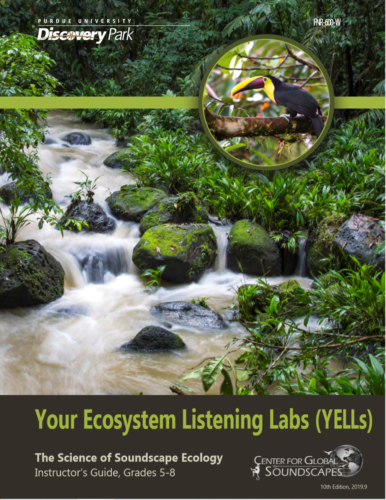 Your Ecosystem Listening Labs (YELLS): The Science of Soundscape Ecology Instructor’s Guide, Grades 5-8 is a 160-page publication, consisting of four chapters that focus on physics of sound, animal communication, soundscapes, and soundscape ecology.
The world around us is full of amazing sounds that are often ignored by humans. Unfortunately, many of the sources of these sounds are actually in danger of being destroyed by human activities. The activities contained in this package take students through the entire scientific method, from observations through conclusions, pairing the practice of science with the exploration of soundscape-based content.
To learn more about soundscape ecology and the sounds around us we might be missing or don’t know are there, visit Center for Global Soundscapes.
Resources
Record the Earth, APP
Community Soundscape Planning Guide: Controlling Noise & Protecting Natural and Cultural Sonic Spaces, The Education Store, Purdue Extension resource center
Bryan Pijanowski, Professor of Landscape and Soundscape Ecology
Purdue University Department of Forestry and Natural Resources
Kristen Bellisario, Post Doc Research Associate
Purdue University Department of Forestry and Natural Resources
Posted on July 30th, 2020 in How To, Land Use, Natural Resource Planning, Publication | No Comments »
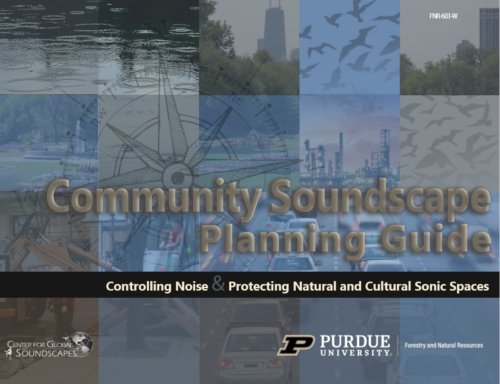 This Community Soundscape Planning Guide is to be used by communities in the United States and other places, to focus land use planning within the context of the sonic spaces of built and natural areas locally.
This guide focuses on:
– Learning the Basics: helping planners understand what a soundscape is and what is noise
– Impacts of Noise on People and Wildlife: summarizes what is known about how sound affects people and wildlife
– Soundscape Workbook: allowing individual planners or community groups to work through major issues related to natural and cultural soundscapes and the occurrence of noise in their community
– Planning Tools and Resources: which describes tools already in existence and new tools such as an app and online mapping system developed at Purdue University.
This planning guide is also associated with several Purdue Extension projects that are underway and which can be offered to communities.
Resources
Center for Global Soundscapes, Purdue University
Record the Earth, APP
Your Ecosystem Listening Labs (YELLS): The Science of Soundscape Ecology Instructor’s Guide, Grades 5-8, The Education Store, Purdue Extension resource center
Bryan Pijanowski, Professor of Landscape and Soundscape Ecology
Purdue University Department of Forestry and Natural Resources
Kara Salazar, Assistant Program Leader and Extension Specialist for Sustainable Communities
Purdue University Department of Forestry and Natural Resources
Dan Walker, Community Planning Extension Specialist
Purdue University Department of Forestry and Natural Resources
If you have any questions regarding wildlife, or other natural resource topics, feel free to contact us by using our Ask an Expert web page.
Ask an Expert, Playlist, Purdue Extension – Forestry and Natural Resources Youtube Channel
Wildlife, Playlist
Wildlife, Playlist
Reptiles: Turtles, Snakes, and Lizards, Purdue Nature of Teaching
Coyotes are on the Move, Got Nature? Blog, Purdue FNR Extension
Help the Hellbender, Website
Indiana Amphibian and Reptile ID Package (4 softcover books), The Education Store, Purdue Extension resource center
Coyotes are on the Move, Got Nature? Blog, Purdue FNR Extension
Help the Hellbender, Website
Indiana Amphibian and Reptile ID Package (4 softcover books), The Education Store, Purdue Extension resource center
Brian MacGowan, Wildlife Extension Specialist
Purdue Forestry and Natural Resources
Purdue Forestry and Natural Resources
Rod Williams, Professor of Wildlife Science
Purdue Forestry and Natural Resources
Purdue Forestry and Natural Resources
Purdue Landscape Report: Now that we’ve reach midsummer, many people tending to small plants and bushes may notice small odd round grey objects attached to their plants that are made by potter wasps. Do you need to do anything about them? Do these nests help or harm your plants? And are they dangerous to people?
What do they look like?
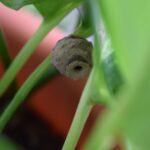
You are more likely to notice the nests of potter wasps than the adults. Potter wasp nests often look, like the name suggests, like a small grey pot (figure 1). They are rounded with a small opening that looks like the neck of a vase and are about the size of a cherry tomato. These wasps will attach their nests to many different surfaces but tend to prefer plant and bush stems. Potter wasp nests are often found hidden behind foliage in bushes.
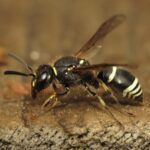
Potter wasp adults come in a variety of colors but all of them look like small hornets. The most common species found in Indiana are mostly black with pale yellow bands around their abdomen (figure 2).
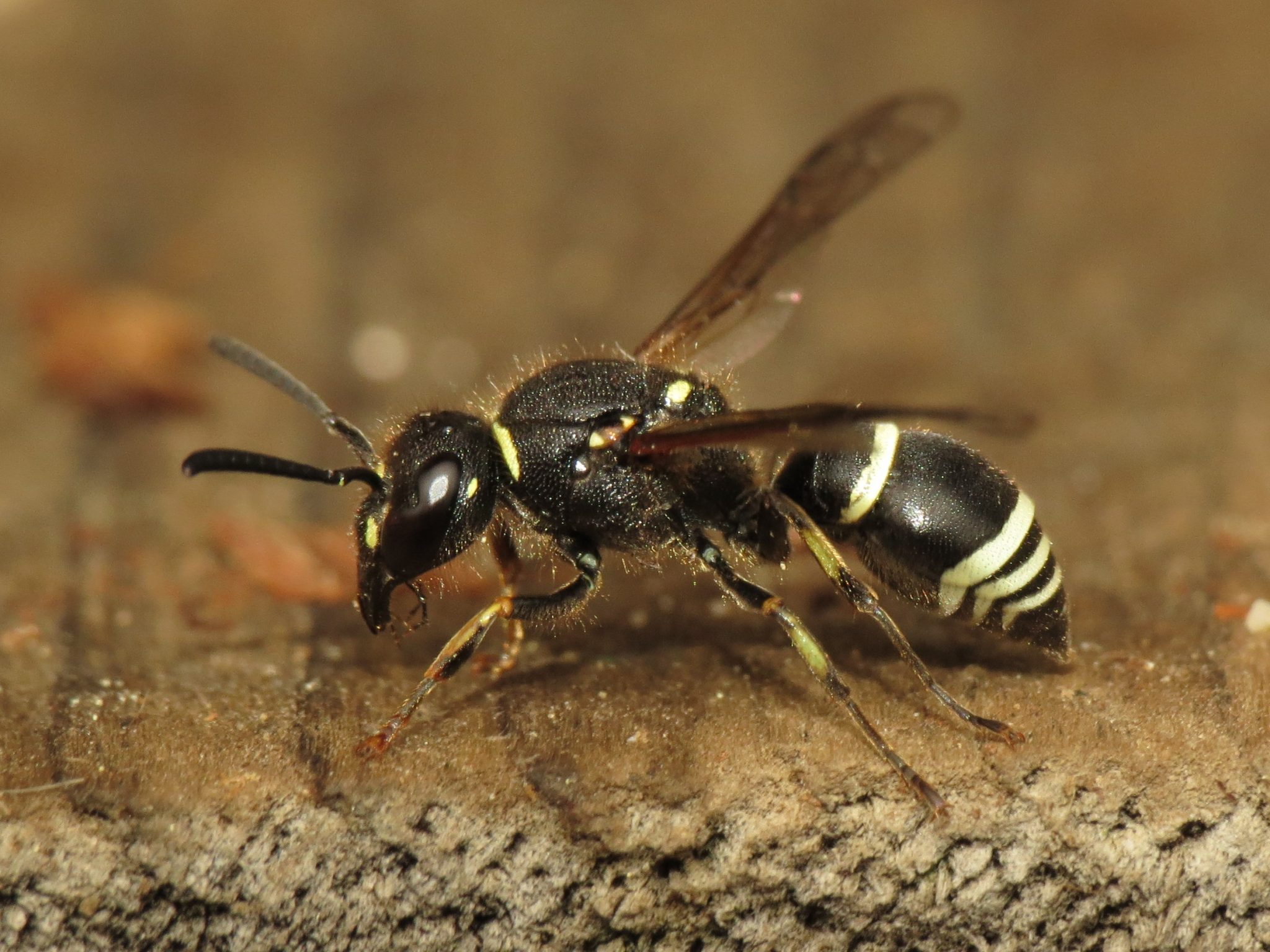
Figure 2. An adult potter wasp resting. This is just one of many different species of potter wasps. Photo by Fyn Kynd on flickr
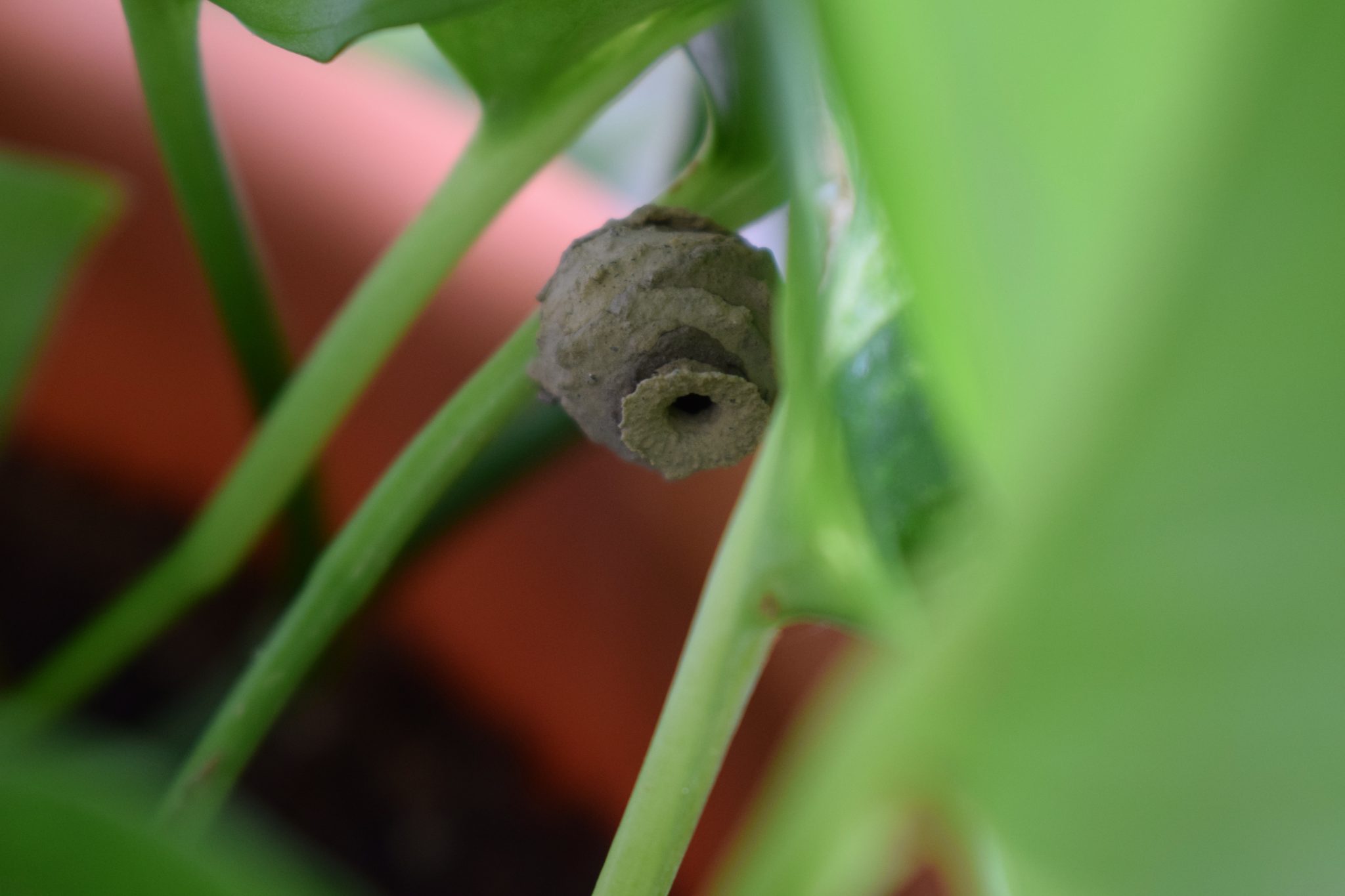
Figure 1. Close up of a potter wasp nest attached to the stem of a house plant. Photo by Elizabeth Barnes, Department of Entomology, Purdue University.
How do they help plants?
Each “pot” that the wasps build is a tiny nursery for a single wasp. Adult potter wasps lay a single egg in each “pot” and then fill it with paralyzed caterpillars and small beetle larvae. When the wasp egg hatches it has all the food it needs to develop into an adult contained in the pot. Each wasp does a small part to keep down the number of caterpillars in the landscape which can reduce the amount of leaf damage on nearby plants.
Will they hurt me?
Probably not! Potter wasps don’t defend their nests and are generally not aggressive. Unless you actively try to bother them they will probably not bother you. If you need to remove one of their nests, you can simply pull it off the plant or object that it’s attached to. However, since they help with pest control, you may want to either leave the nest be or relocate it to a different section of the landscape.
Does anything else look like the “pots”?
Although the “pots” have a very distinct shape there are a few other things that could be confused with them at first glance. Mantis egg masses (ootheca) and some types of galls are both about the same size as potter wasp nests and also often grey. However, they both lack the vase neck-like opening that potter wasp nests have.
What should I do if I see one?
Let it be! Since these wasps rarely sting and help keep caterpillar populations down leave them alone so that they can continue to act as biocontrol agents. If you think you’ve seen a potter wasp or one of their nests and would like help identifying it, take a picture and either upload it to a community science project like iNaturalist or send a picture to the author of this article.
Resources
Social Bees and Wasps, The Education Store, Purdue Extension resource center
Parasitic Wasps, The Education Store
Mud Daubers, The Education Store
Cicada Killers, The Education Store
Industrial, Institutional, Structural and Health-Related Pest Management, The Education Store
Elizabeth E Barnes, Exotic Forest Pest Educator
Purdue University Department of Entomology
Posted on July 23rd, 2020 in Forestry, How To, Plants, Timber Marketing, Webinar, Woodlands | No Comments »
Join Purdue Extension forestry specialist Lenny Farlee and John Woodmansee, extension educator, as they share:
– Why should I sell timber?
– Getting help from a professional forester
– Common concerns when selling timber
– Best management practices loggers use
– Types of tree sales, pros and cons of each
– Tax considerations
– Potential cost sharing opportunities through USDA
– Where to get additional information
Several resources are listed at the end of the webinar for those who may be considering timber sales or for those who may be thinking of purchasing land in the future, or may inherit land with woodlands. These resources will guide you as you meet your goals.
Resources
Woodland Stewardship for Landowners: Sealed Bid (FNR 592 WV), Video, Purdue Extension – Forestry and Natural Resources Youtube channel
Woodland Stewardship for Landowners: EQIP (FNR 587 WV), Video, Purdue Extension – Forestry and Natural Resources Youtube channel
Forest/Timber, Playlist, Purdue Extension – Forestry and Natural Resources Youtube channel
A Woodland Management Moment, Playlist, Purdue Extension – Forestry and Natural Resources Youtube channel
Find an Indiana Forester
Marketing Timber, The Education Store, Purdue Extension resource center
Determining Tax Basis of Timber, The Education Store, Purdue Extension resource center
Lenny Farlee, Sustaining Hardwood Extension Specialist
Purdue University Department of Forestry and Natural Resources
John Woodmansee, Extension Educator, Whitely County
Purdue Extension
Purdue extension forester Lenny Farlee explains how to tell identify black maple and how to tell it apart from its cousin, sugar maple.
If you have any questions regarding trees, forests, wildlife, wood products or other natural resource topics, feel free to contact us by using our Ask an Expert web page.
Resources
ID That Tree, Playlist, Purdue Extension – Forestry and Natural Resources Youtube Channel
A Woodland Management Moment, Playlist, Purdue Extension – Forestry and Natural Resources Youtube Channel
Investing in Indiana Woodlands, The Education Store
Tree Appraisal and the Value of Trees, The Education Store
Forest Improvement Handbook, The Education Store
Lenny Farlee, Sustaining Hardwood Extension Specialist
Purdue University Department of Forestry and Natural Resources
In this tree identification episode, Purdue Extension forester Lenny Farlee will talk about how American elm leaves have jagged edges with a large tooth and then smaller teeth like edges on top of it. Find out why these trees are not as easy to find as they used to be.
If you have any questions regarding trees, forests, wildlife, wood products or other natural resource topics, feel free to contact us by using our Ask an Expert web page.
Resources
Elm, The Education Store, Purdue Extension resource center
American Elm, The Purdue Arboretum Explorer
ID That Tree, Playlist, Purdue Extension – Forestry and Natural Resources Youtube Channel
A Woodland Management Moment, Playlist, Purdue Extension – Forestry and Natural Resources Youtube Channel
Investing in Indiana Woodlands, The Education Store
Tree Appraisal and the Value of Trees, The Education Store
Forest Improvement Handbook, The Education Store
Lenny Farlee, Sustaining Hardwood Extension Specialist
Purdue University Department of Forestry and Natural Resources
Posted on July 13th, 2020 in Forestry, Land Use, Natural Resource Planning, Plants, Ponds, Woodlands | No Comments »
Join Mike Saunders and Charlotte Owings of the Hardwood Ecosystem Experiment as they share about the 100-year old project that aims to study and regenerate the oak-hickory population in Indiana and beyond.
Resources
Hardwood Ecosystem Experiment (HEE), Playlist, Purdue Extension – Forestry and Natural Resources Youtube Channel
Ask The Expert, Purdue Extension-FNR YouTube Channel-Playlist
Hardwood Ecosystem Experiment, Website
The Hardwood Ecosystem Experiment: 2006-2016, The Education Store, Purdue Extension resource center
Hardwood Ecosystem Experiment – Wildlife Responses to Timber Harvesting, Purdue Extension
Hardwood Ecosystem Experiment – Sustaining Our Oak-Hickory Forests, Purdue Extension
The Hardwood Ecosystem Experiment: Indiana Forestry and Wildlife, The Education Store
Mike Saunders, Associate Professor of Ecology and Natural Resources
Purdue University Department of Forestry and Natural Resources
Charlotte Owings, Hardwood Ecosystem Experiment Project Coordinator
Purdue University Department of Forestry and Natural Resources

Recent Posts
- ID That Tree: Nannyberry Viburnum
Posted: July 22, 2026 in Forestry, Plants, Wildlife, Woodlands - ID That Tree: Eastern Swamp Privet
Posted: in Forestry, Plants, Wildlife, Woodlands - Jarred Brooke Receives Early Career Award for Prescribed Fire Work
Posted: July 20, 2026 in Forestry, Forests and Street Trees, Natural Resource Planning, Safety - Bovine Tuberculosis in Wild White-tailed Deer: Background and Frequently Asked Questions
Posted: in Disease, Natural Resource Planning, Wildlife - ID That Tree: Carolina Buckthorn
Posted: July 15, 2026 in Forestry, Wildlife, Woodlands - Bat Roost Reporting Tool
Posted: July 8, 2026 in Alert, Community Development, Invasive Animal Species, Wildlife - Pruning Highlight; Espalier Pruning: Training Trees into Living Patterns
Posted: in Forestry, Forests and Street Trees, Gardening - Thank You, Turkey Trackers! Your Brood Counts Make a Difference – MyDNR
Posted: in Alert, Community Development, Wildlife - Identifying Evergreens
Posted: June 24, 2026 in Forestry, Wildlife, Woodlands - Celebrate Pollinator Week With Flowers of June Tour
Posted: June 15, 2026 in Forestry, Gardening, How To, Wildlife
Archives
Categories
- Alert
- Aquaculture/Fish
- Aquatic/Aquaculture Resources
- Ask the Expert
- Christmas Trees
- Community Development
- Disease
- Drought
- Forestry
- Forests and Street Trees
- Gardening
- Got Nature for Kids
- Great Lakes
- How To
- Invasive Animal Species
- Invasive Insects
- Invasive Plant Species
- Land Use
- Natural Resource Planning
- Nature of Teaching
- Plants
- Podcasts
- Ponds
- Publication
- Safety
- Spiders
- Timber Marketing
- Urban Forestry
- Webinar
- Wildlife
- Wood Products/Manufacturing
- Woodland Management Moment
- Woodlands