 Purdue University - Extension - Forestry and Natural Resources
Got Nature? Blog
The classic and trusted book “Fifty Common Trees of Indiana” by T.E. Shaw was published in 1956 as a user-friendly guide to local species. Nearly 70 years later, the publication has been updated through a joint effort by the Purdue Department of Forestry and Natural Resources, Indiana 4-H, and the Indiana Department of Natural Resources, and reintroduced as “An Introduction to Trees of Indiana.”
The full publication is available for download for $7 in the Purdue Extension Education Store. The field guide helps identify common Indiana woodlot trees.
Each week, the Intro to Trees of Indiana web series will offer a sneak peek at one species from the book, paired with an ID That Tree video from Purdue Extension forester Lenny Farlee to help visualize each species as it stands in the woods. Threats to species health as well as also insight into the wood provided by the species, will be provided through additional resources as well as the Hardwoods of the Central Midwest exhibit of the Purdue Arboretum, if available.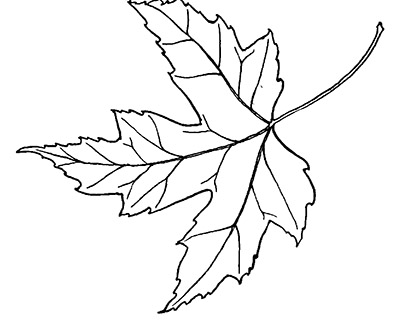
This week, we introduce the silver maple or Acer saccharinum.
Silver maple has simple, typically five-lobed leaves with deeply cut divisions, or sinuses, between the lobes, with narrow lobes at the base. The leaves, which are silvery on the underside, are held oppositely on long leaf stems coming off the twigs. The bark on young trees is smooth and light gray, and darker and scaly on older trees.
Silver maple, which is commonly found in swamps and overflow bottomlands, is one of Indiana’s soft maples alongside red maple. It flowers early and sheds its large winged seed in the spring, typically by late May.
Silver maples, which prefer moist or well-drained soil, grow 50 to 80 feet tall and are found growing from the Great Plains eastward, excluding the Gulf and Atlantic coastal region. Most silver maple lumber is produced in the Mississippi Delta and central states region.
The Morton Arboretum warns that without proper and frequent pruning, high winds and ice can cause limbs to break on silver maple trees due to its weak wood and branch structure. These species is also drought sensitive, so be careful to provide supplemental water during dry periods.
For full article with additional photos view: Intro to Trees of Indiana: Sugar Maple
If you have any questions regarding wildlife, trees, forest management, wood products, natural resource planning or other natural resource topics, feel free to contact us by using our Ask an Expert web page.
Other Resources:
Hardwoods of the Central Midwest: Silver Maple
Hardwood Lumber and Veneer Series, The Education Store: Soft Maple
Morton Arboretum: Silver Maple
Fifty Common Trees of Indiana
An Introduction to Trees of Indiana
Native Trees of the Midwest, The Education Store
Shrubs and Woody Vines of Indiana and the Midwest, The Education Store
Investing in Indiana Woodlands, The Education Store
Forest Improvement Handbook, The Education Store
ID That Tree, Purdue Extension-Forestry & Natural Resources (FNR) YouTube playlist
Woodland Management Moment , Purdue Extension-FNR YouTube playlist
Wendy Mayer, FNR Communications Coordinator
Purdue University Department of Forestry and Natural Resources
Lenny Farlee, Sustaining Hardwood Extension Specialist
Purdue University Department of Forestry and Natural Resources
The classic and trusted book “Fifty Common Trees of Indiana” by T.E. Shaw was published in 1956 as a user-friendly guide to local species. Nearly 70 years later, the publication has been updated through a joint effort by the Purdue Department of Forestry and Natural Resources, Indiana 4-H, and the Indiana Department of Natural Resources, and reintroduced as “An Introduction to Trees of Indiana.”
The full publication is available for download for $7 in the Purdue Extension Education Store. The field guide helps identify common Indiana woodlot trees.
Each week, the Intro to Trees of Indiana web series will offer a sneak peek at one species from the book, paired with an ID That Tree video from Purdue Extension forester Lenny Farlee to help visualize each species as it stands in the woods. Threats to species health as well as also insight into the wood provided by the species, will be provided through additional resources as well as the Hardwoods of the Central Midwest exhibit of the Purdue Arboretum, if available.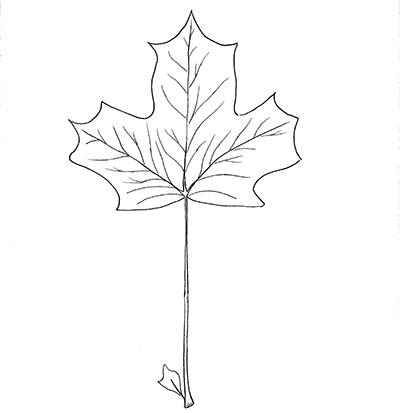
This week, we introduce the black maple or Acer nigrum.
Black maple is easily confused with its cousin, the sugar maple, but there are a few key identifying characteristics to tell them apart. Black maple commonly has stipules, or miniature leaves, at the base of the leaf stem. This species features mottled gray stems and black pointed buds oppositely arranged on the stems. The lobed leaves are darker green and tend to droop down at the edges as the summer goes on.
The bark is lighter gray and smooth in young trees and features flakes or plates in older trees.
The seed or fruit of black maple is a winged seed which occurs in pairs and turns from green to brown when mature, similar to sugar maple.
Black maples, frequently found on moist or bottomland sites, grow 60 to 75 feet tall and can be 40 to 50 feet wide, providing excellent shade with their full foliage.
The Morton Arboretum warns again pruning maps in the spring as they are ‘bleeders’ and will lose large amounts of sap. This species also is susceptible to leaf scorch, verticillium wilt, tar spot and anthracnose and can be affected by borers and cottony maple scale. Black maple suffers from salt, drought and air pollution.
“Don’t be confused by the similarities. Use the tiny stipule (leaf) at the base of the stem, the drooping edges of the dark leaf and its dark buds on gray mottled stems to tell this native apart from its cousin sugar maple. Can you ID this native tree? Meet black maple or Acer nigrum.”
For full article with additional photos view: Intro to Trees of Indiana: Sugar Maple
If you have any questions regarding wildlife, trees, forest management, wood products, natural resource planning or other natural resource topics, feel free to contact us by using our Ask an Expert web page.
Other Resources:
Morton Arboretum: Black Maple
Fifty Common Trees of Indiana
An Introduction to Trees of Indiana
Native Trees of the Midwest, The Education Store
Shrubs and Woody Vines of Indiana and the Midwest, The Education Store
Investing in Indiana Woodlands, The Education Store
Forest Improvement Handbook, The Education Store
ID That Tree, Purdue Extension-Forestry & Natural Resources (FNR) YouTube playlist
Woodland Management Moment , Purdue Extension-FNR YouTube playlist
Black Maple, Native Trees of Indiana River Walk, Fort Wayne, Purdue University
Wendy Mayer, FNR Communications Coordinator
Purdue University Department of Forestry and Natural Resources
Lenny Farlee, Sustaining Hardwood Extension Specialist
Purdue University Department of Forestry and Natural Resources
In this Moment in the Wild, Purdue wildlife technician Zach Truelock introduces you to the Fowler’s Toad, shares how to tell it apart from the American toad, and dispels some common myths about toads in general.
If you have any questions regarding wildlife, trees, forest management, wood products, natural resource planning, or other natural resource topics, feel free to contact us by using our Ask an Expert web page.
Resources:
Sounds of Frogs & Toads, Purdue Extension – Forestry and Natural Resources (FNR)
Frogs & toads of Indiana, The Education Store, Purdue Extension resource center
Salamanders of Indiana Book, The Education Store
Amphibians: Frogs, Toads, and Salamanders, Purdue Nature of Teaching
The Nature of Teaching: Adaptations for Aquatic Amphibians, The Education Store
Hellbender ID, Playlist, Purdue Extension – FNR YouTube Channel
A Moment in the Wild, Playlist, Purdue Extension – FNR YouTube Channel
Zach Truelock, Hellbender Technician
Purdue Forestry and Natural Resources
Rod Williams, Assistant Provost for Engagement/Professor of Wildlife Science
Purdue University Department of Forestry and Natural Resources
Each week, the Intro to Trees of Indiana web series will offer a sneak peek at one species from the book, paired with an ID That Tree video from Purdue Extension forester Lenny Farlee to help visualize each species as it stands in the woods. Threats to species health as well as also insight into the wood provided by the species, will be provided through additional resources as well as the Hardwoods of the Central Midwest exhibit of the Purdue Arboretum, if available.
This week, we introduce the sugar maple or Acer saccharum.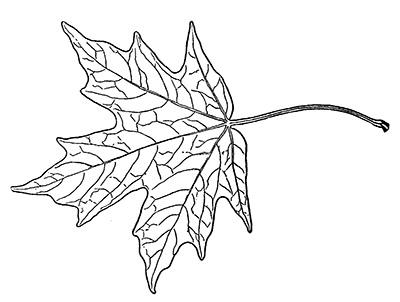
This tree, also called hard maple, has simple leaves typically with five lobes, two smaller lobes at the base and three larger lobes at the top, with u-shaped sinuses between the lobes. The shade-tolerant species has opposite leaf arrangement with relatively long leaf stems as well as opposite branch arrangement. The thin twigs are green in their youth, turning to a medium brown as they age. The leaves produce brilliant fall colors ranging from yellow to burnt orange.
The bark of sugar maple typically has a light to medium gray color, but its appearance is variable and somewhat confusing. It can range from relatively smooth on saplings to minor crevices and ridging on medium sized trees to deeper ridges on older trees.
The seed or fruit of sugar maple is a winged seed which occurs in pairs and turned from green to brown when mature.
Sugar maples grow 60 to 75 feet tall and can be 40 to 50 feet wide, providing excellent shade with their full foliage.
Sugar maples produce maple sap, which can be used to make maple syrup. The yield of sugar maples is one of the highest among maple trees. The Morton Arboretum warns again pruning maps in the spring as they are ‘bleeders’ and will lose large amounts of sap. This species also is susceptible to leaf scorch, verticillium wilt, tar spot and anthracnose and can be affected by borers and cottony maple scale.
For full article with additional photos view: Intro to Trees of Indiana: Sugar Maple
If you have any questions regarding wildlife, trees, forest management, wood products, natural resource planning or other natural resource topics, feel free to contact us by using our Ask an Expert web page.
Other Resources:
Hardwoods of the Central Midwest: Sugar Maple
Hardwood Lumber and Veneer Series: Sugar Maple
Morton Arboretum: Sugar Maple
Sugar Maple, Native Trees of Indiana River Walk, Purdue Fort Wayne
Fifty Common Trees of Indiana
An Introduction to Trees of Indiana
Native Trees of the Midwest, The Education Store
Shrubs and Woody Vines of Indiana and the Midwest, The Education Store
Investing in Indiana Woodlands, The Education Store
Forest Improvement Handbook, The Education Store
ID That Tree, Purdue Extension-Forestry & Natural Resources (FNR) YouTube playlist
Woodland Management Moment , Purdue Extension-FNR YouTube playlist
Wendy Mayer, FNR Communications Coordinator
Purdue University Department of Forestry and Natural Resources
Lenny Farlee, Sustaining Hardwood Extension Specialist
Purdue University Department of Forestry and Natural Resources
In this Moment in the Wild, Purdue wildlife technician Zach Truelock explains the differences between frogs and toads, from physical characteristics to breeding and movement habits.
If you have any questions regarding wildlife, trees, forest management, wood products, natural resource planning, or other natural resource topics, feel free to contact us by using our Ask an Expert web page.
Resources:
Sounds of Frogs & Toads, Purdue Extension – Forestry and Natural Resources (FNR)
Frogs & toads of Indiana, The Education Store, Purdue Extension resource center
Salamanders of Indiana Book, The Education Store
Amphibians: Frogs, Toads, and Salamanders, Purdue Nature of Teaching
The Nature of Teaching: Adaptations for Aquatic Amphibians, The Education Store
Hellbender ID, Playlist, Purdue Extension – FNR YouTube Channel
A Moment in the Wild, Playlist, Purdue Extension – FNR YouTube Channel
Zach Truelock, Hellbender Technician
Purdue Forestry and Natural Resources
Rod Williams, Assistant Provost for Engagement/Professor of Wildlife Science
Purdue University Department of Forestry and Natural Resources
Purdue College of Agriculture News: Purdue University has received $12 million of a $35 million project led by the American Forest Foundation and funded by the U.S. Department of Agriculture’s Partnership for Climate Smart Commodities to help family forest owners practice climate-smart forestry in Indiana and eight other states throughout the eastern half of the U.S.
The project’s other partners are The Nature Conservancy, the Center for Heirs Property Preservation, and Women Owning Woodlands. The project could sequester an estimated 4.9 million tons of atmospheric carbon—a greenhouse gas that affects climate—over a 20- to 30-year period.
“Our digital forestry group has been working on various tools and thinking about how to apply these tools to real-life problems,” said Songlin Fei, who directs Purdue’s Integrated Digital Forestry Initiative. “This is an opportunity to apply our expertise to solving part of the climate-change puzzle.” Purdue’s cross-disciplinary Integrated Digital Forestry Initiative includes faculty members from the colleges of Agriculture, Engineering, Sciences, Liberal Arts and Libraries and the Polytechnic Institute. The Integrated Digital Forestry Initiative, one of the five strategic investments in Purdue’s Next Moves, leverages digital technology and multidisciplinary expertise to measure, monitor and manage urban and rural forests to maximize social, economic and ecological benefits. “We’re bringing a traditional field into the digital age,” said Fei, professor, Forestry and Natural Resources, and Dean’s Chair of Remote Sensing.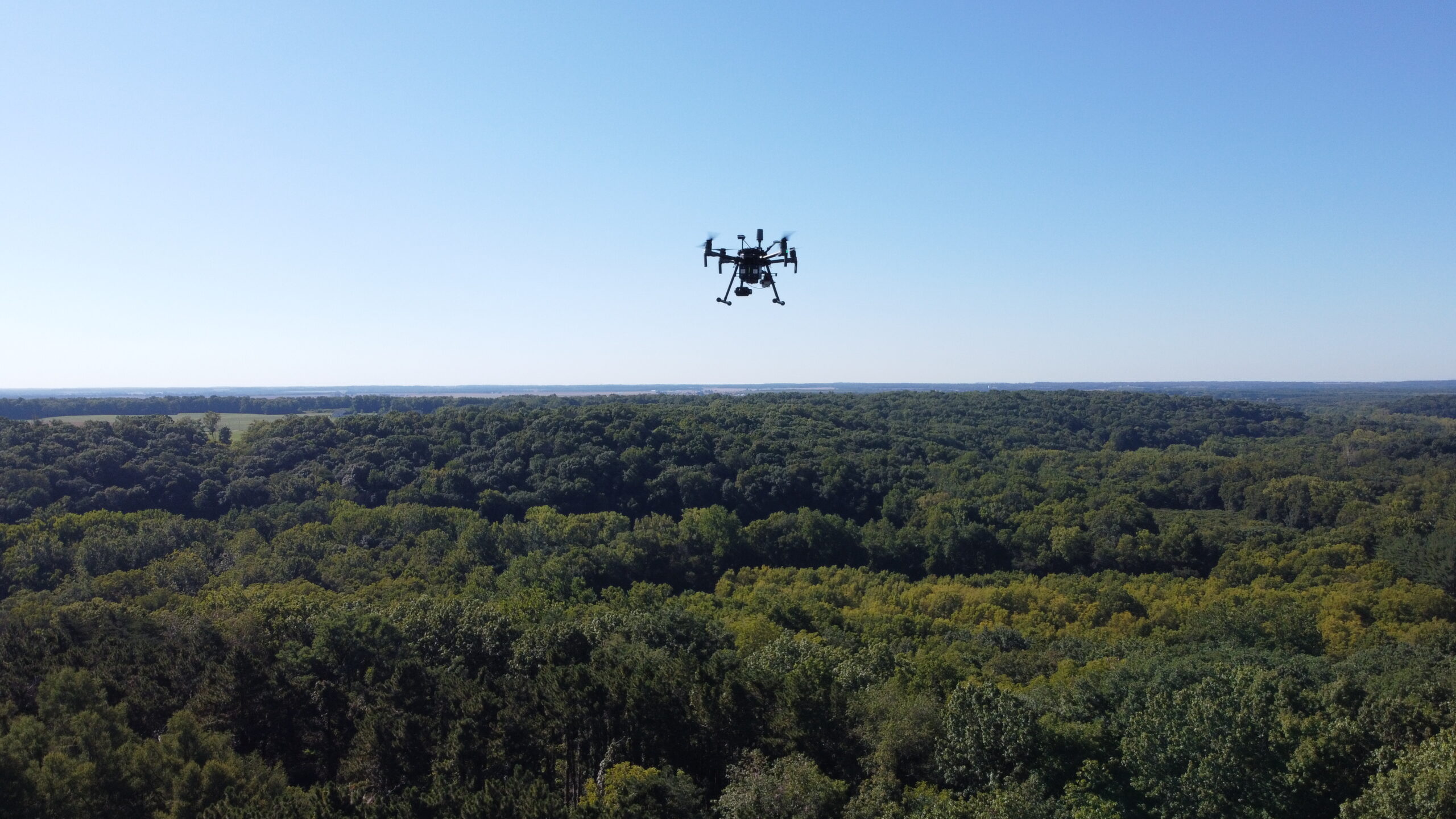
Purdue will utilize advanced digital forestry technologies to do the measurement, monitoring, reporting and verification of carbon sequestrations that the project requires. The automated technology, applied at a regional scale with unprecedented accuracy, will be based on data collected by satellites and drones with various sensors, such as light detection and ranging (LiDAR). The team will also develop a simulation system that will utilize artificial intelligence to generate optimized forest management scenarios.
The work will result in a web-based tool that landowners can use to estimate and predict the climate-smart commodity market potential of their properties. The team is also building a smartphone-based app for tree measurement and monitoring.
American families own nearly 40 percent of the nation’s forests, yet few of them take part in forest carbon projects or work from a management plan. However, with proper management, trees can grow faster and sequester more carbon, Fei said.
Landowners will receive economic incentives for participating in the program. Payment to landowners will depend on which climate-smart carbon practices they use. Project staff or consulting foresters will also provide landowners technical advice and guidance in establishing a forest management plan.
Resources:
Timber Harvesting and Logging Practices for Private Woodlands, The Education Store, Purdue Extension’s resource center
Investing in Indiana Woodlands, The Education Store
Marketing Timber, The Education Store
Woodland Wildlife Management, The Education Store
A Landowner’s Guide to Sustainable Forestry: Part 3: Keeping Your Forest Healthy and Productive, The Education Store
Investing in Indiana Woodlands, The Education Store
ID That Tree, Playlist, Purdue Extension – Forestry & Natural Resources (FNR) YouTube Channel
Woodland Stewardship for Landowners Video Series, Playlist, Purdue Extension – FNR YouTube Channel
In this Moment in the Wild, Purdue wildlife technician Zach Truelock introduces the painted turtle, how to identify the species, its mating rituals and what is its preferred habitat. Learn more inside.
If you have any questions regarding wildlife, trees, forest management, wood products, natural resource planning, or other natural resource topics, feel free to contact us by using our Ask an Expert web page.
Resources:
Turtles of Indiana, The Education Store
Forestry Management for Reptiles and Amphibians: A Technical Guide for the Midwest, The Education Store
Appreciating Reptiles and Amphibians in Nature, The Education Store
Indiana Amphibian and Reptile ID Package (4 softcover books), The Education Store
When Juvenile Snakes Come Calling, FNR Got Nature? blog
A Moment in the Wild, Playlist, Purdue Extension – Forestry and Natural Resources
A Moment in the Wild: Black Racer, Video, Purdue Extension – Forestry and Natural Resources YouTube channel
A Moment in the Wild: Eastern Kingsnake, Purdue Extension – FNR Video
A Moment in the Wild: Eastern Hognose, Purdue Extension – FNR Video
Ask An Expert, Purdue Extension – FNR Playlist
Zach Truelock, Hellbender Technician
Purdue Forestry and Natural Resources
Rod Williams, Assistant Provost for Engagement/Professor of Wildlife Science
Purdue University Department of Forestry and Natural Resources
The classic and trusted book “Fifty Common Trees of Indiana” by T.E. Shaw was published in 1956 as a user-friendly guide to local species. Nearly 70 years later, the publication has been updated through a joint effort by the Purdue Department of Forestry and Natural Resources, Indiana 4-H, and the Indiana Department of Natural Resources, and reintroduced as “An Introduction to Trees of Indiana.”
The full publication is available for download for $7 in the Purdue Extension Education Store. The field guide helps identify common Indiana woodlot trees.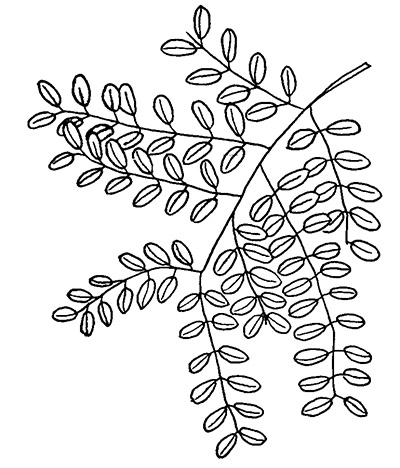
Each week, the Intro to Trees of Indiana web series will offer a sneak peek at one species from the book, paired with an ID That Tree video from Purdue Extension forester Lenny Farlee to help visualize each species as it stands in the woods. Threats to species health as well as also insight into the wood provided by the species, will be provided through additional resources as well as the Hardwoods of the Central Midwest exhibit of the Purdue Arboretum, if available.
This week, we introduce the honey locust or Gleditsia triacanthos.
This tree, also called “thorn-tree,” has multi-pronged thorns of two inches or more in length, which occur on the trunk as well as on the limbs and twigs. Honey locust can be found with doubly compound leaves with very small oval leaflets arranged alternately on the main leaf stem, or it can have singly compound leaves with very small leaves on a straight stem. Leaves produce a bright yellow fall color.
The bark is tight and red-brown on young trees and features gray-brown scaly strips on older trees. The fruit of the honey locust is a wavy, glossy brown flat pod that reaches lengths of between eight inches and one foot and curl or twist at maturity. These pods, which contain several seeds, are held on the tops of the trees and are highly favored by wildlife.
Honey locusts grow 70 to 80 feet tall.
For full article with additional photos view: Intro to Trees of Indiana: Honey Locust
If you have any questions regarding wildlife, trees, forest management, wood products, natural resource planning or other natural resource topics, feel free to contact us by using our Ask an Expert web page.
Other Resources:
Hardwoods of the Central Midwest: Honey Locust
Hardwood Lumber and Veneer Series: Honey Locust
Morton Arboretum: Honey Locust
Fifty Common Trees of Indiana
An Introduction to Trees of Indiana
Native Trees of the Midwest, The Education Store
Shrubs and Woody Vines of Indiana and the Midwest, The Education Store
Investing in Indiana Woodlands, The Education Store
Forest Improvement Handbook, The Education Store
ID That Tree, Purdue Extension-Forestry & Natural Resources (FNR) YouTube playlist
Woodland Management Moment , Purdue Extension-FNR YouTube playlist
Honey Locust, Native Trees of Indiana River Walk, Fort Wayne-Purdue University
Wendy Mayer, FNR Communications Coordinator
Purdue University Department of Forestry and Natural Resources
Lenny Farlee, Sustaining Hardwood Extension Specialist
Purdue University Department of Forestry and Natural Resources
Purdue College of Agriculture News: Timber rattlesnakes are widely distributed across the eastern half of the United States, living as far north as New Hampshire and as far south as Florida. Hilly forests like those found in Brown, Monroe and Morgan County, Indiana suit the secretive lifestyle of the venomous snake. According to Purdue Extension wildlife specialist Brian MacGowan, there is no reliable estimate of the number of Timber rattlesnakes living in Indiana. Sightings are rare but most likely to occur during the hottest parts of the year.
“Late July and August are the peak of their breeding season in Indiana,” said MacGowan. “The males move around a lot more, tracking the scent of the females.”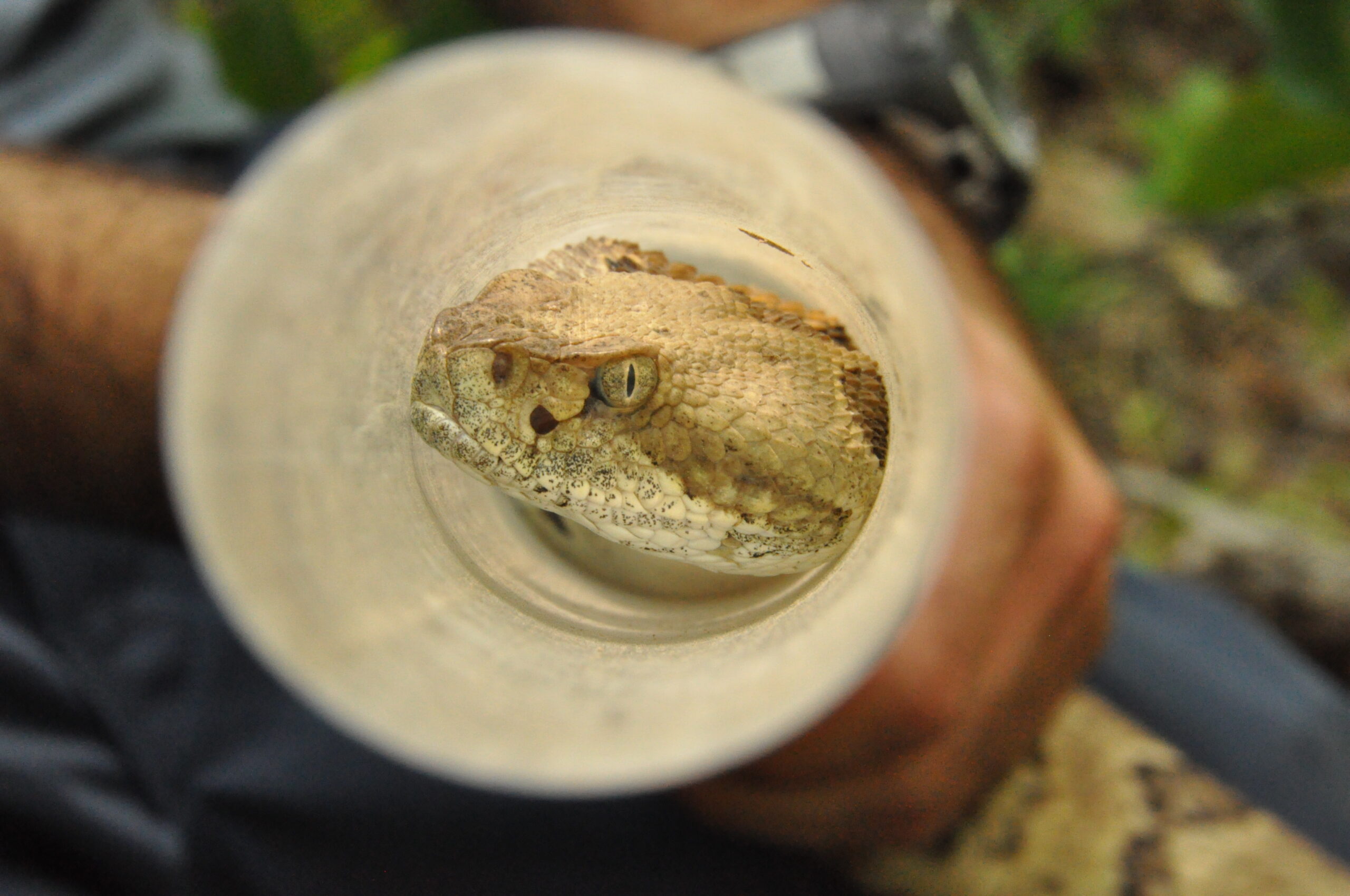
While they are normally hidden among rocks and brush, rattlesnakes have been observed 20 feet high in trees on rare occasion.
“Chipmunks are their primary food source in Indiana, but larger males eat squirrels and similarly-sized prey,” MacGowan explained. “They even consume songbirds.” A typical adult grows to be between three and five feet in length.
Rattlesnakes are patient hunters. Most often they use their natural camouflage to ambush prey. They inject a lethal venom, potentially strong enough to kill a human if left untreated. The venom contains hemotoxic elements, meaning it can damage or destroy blood vessels and cells.
But just because rattlesnakes are venomous does not mean they create frequent problems for nature lovers. “Timber rattlesnakes are reclusive and are quite unaggressive as far as snakes go,” MacGowan explained. “A lot of the locals in the areas I research don’t realize rattlers live nearby since the snakes keep to themselves.” According to the CDC, roughly 7,500 instances of venomous snakebites are recorded a year in the United States. Of those, about 5 are fatal. During his time as part of the Hardwood Ecosystems Experiment, MacGowan realized that even when looking, finding a rattlesnake is not an easy task.
For full article on the rattlesnake please visit: Unexpected Plants and Animals of Indiana: Timber Rattlesnake
Resources:
Snakes and Lizards of Indiana, The Education Store, Purdue Extension’s resource center
Snakes of the Central and Northeastern United States, The Education Store
Snakes of Indiana, The Education Store
Indiana Amphibian and Reptile ID Package (4 softcover books), The Education Store
Reptiles: Turtles, Snakes, and Lizards, Purdue Nature of Teaching Website
Ask An Expert, Playlist, Purdue Extension – Forestry and Natural Resources YouTube channel
A Moment in the Wild: Eastern Hognose, Purdue Extension – FNR Video
A Moment in the Wild: Eastern Kingsnake, Purdue Extension – FNR Video
A Moment in the Wild: Racer, Purdue Extension – FNR Video
Purdue University Department of Agricultural Communication
Dr. Brian MacGowan, Extension Wildlife Specialist
Department of Forestry & Natural Resources, Purdue University
The classic and trusted book “Fifty Common Trees of Indiana” by T.E. Shaw was published in 1956 as a user-friendly guide to local species. Nearly 70 years later, the publication has been updated through a joint effort by the Purdue Department of Forestry and Natural Resources, Indiana 4-H, and the Indiana Department of Natural Resources, and reintroduced as “An Introduction to Trees of Indiana.”
The full publication is available for download for $7 in the Purdue Extension Education Store. The field guide helps identify common Indiana woodlot trees.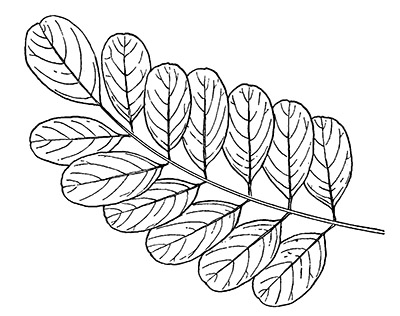
Each week, the Intro to Trees of Indiana web series will offer a sneak peek at one species from the book, paired with an ID That Tree video from Purdue Extension forester Lenny Farlee to help visualize each species as it stands in the woods. Threats to species health as well as also insight into the wood provided by the species, will be provided through additional resources as well as the Hardwoods of the Central Midwest exhibit of the Purdue Arboretum, if available.
This week, we introduce the black locust or Robinia pseudoacacia.
This tree has compound leaves that are eight to 10 inches long, made up of seven to 17 small rounded leaflets arranged alternately on the twigs. The black locust has thorns on the twig where the buds and leaf stems branch off and also on the limbs and trunks of young trees. The bark is a light to medium gray marked by very rough, long running ridges. An orange coloration can be seen when scraping the bark surface.
In the spring, black locust produces long hanging clusters of fragrant white flowers. It is a member of the broad legume family and its fruit resembles a bean, with brown or black pods that are approximately three inches long and very thin and papery.
For full article with additional photos view: Intro to Trees of Indiana: Black Locust
If you have any questions regarding wildlife, trees, forest management, wood products, natural resource planning or other natural resource topics, feel free to contact us by using our Ask an Expert web page.
Other Resources:
Hardwood Lumber and Veneer Series: Black Locust
Morton Arboretum: Black Locust
The Wood Database: Black Locust
Fifty Common Trees of Indiana
An Introduction to Trees of Indiana
Native Trees of the Midwest, The Education Store
Shrubs and Woody Vines of Indiana and the Midwest, The Education Store
Investing in Indiana Woodlands, The Education Store
Forest Improvement Handbook, The Education Store
ID That Tree, Purdue Extension-Forestry & Natural Resources (FNR) YouTube playlist
Woodland Management Moment , Purdue Extension-FNR YouTube playlist
Wendy Mayer, FNR Communications Coordinator
Purdue University Department of Forestry and Natural Resources
Lenny Farlee, Sustaining Hardwood Extension Specialist
Purdue University Department of Forestry and Natural Resources

Recent Posts
- Beetle that attacks Tree-of-Heaven found in Indiana, Purdue Landscape Report
Posted: March 20, 2026 in Invasive Insects, Wildlife, Woodlands - ID That Tree: Dwarf Chinkapin Oak
Posted: in Forestry, Urban Forestry, Wildlife, Woodlands - IN-PREPared: Essential Resources for Indiana’s Severe Weather Season
Posted: March 11, 2026 in How To, Safety - DNR Hiring for Indiana Conservation Officer Positions, MyDNR
Posted: March 9, 2026 in Urban Forestry, Wildlife, Woodlands - ID That Tree: Shumard Oak
Posted: in Plants, Urban Forestry, Wildlife, Woodlands - A Woodland Management Moment: Windbreak Around Walnut Plantings
Posted: March 3, 2026 in Forestry, Urban Forestry, Woodland Management Moment - Getting Certified as an Indiana Certified Prescribed Burn Manager
Posted: March 2, 2026 in How To, Urban Forestry, Woodlands - Uniting Indiana Residents Against Invasive Species
Posted: February 27, 2026 in Community Development, Invasive Insects, Wildlife - Have You Seen a Soaring Eagle Lately? Morning Ag Clips
Posted: February 25, 2026 in Urban Forestry, Wildlife - Register for Natural Resources Teacher Institute’s Class of 2026
Posted: February 19, 2026 in Forestry, Wildlife, Woodlands
Archives
Categories
- Alert
- Aquaculture/Fish
- Aquatic/Aquaculture Resources
- Ask the Expert
- Christmas Trees
- Community Development
- Disease
- Drought
- Forestry
- Forests and Street Trees
- Gardening
- Got Nature for Kids
- Great Lakes
- How To
- Invasive Animal Species
- Invasive Insects
- Invasive Plant Species
- Land Use
- Natural Resource Planning
- Nature of Teaching
- Plants
- Podcasts
- Ponds
- Publication
- Safety
- Spiders
- Timber Marketing
- Uncategorized
- Urban Forestry
- Webinar
- Wildlife
- Wood Products/Manufacturing
- Woodland Management Moment
- Woodlands