 Purdue University - Extension - Forestry and Natural Resources
Got Nature? Blog
MyDNR, Indiana’s Outdoor Newsletter: Each year, Indiana DNR invites the public to provide feedback on the management of white-tailed deer via the Deer Management Survey.
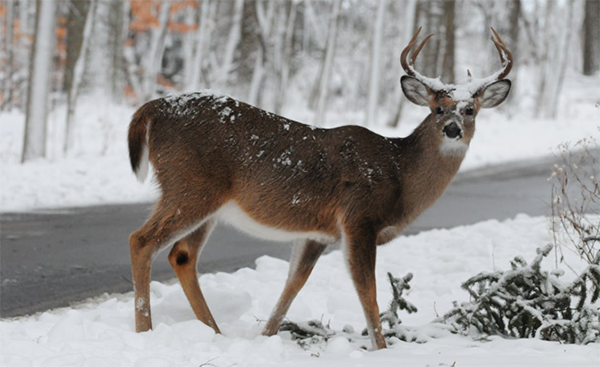
Picture from MyDNR Newsletter
This electronic survey gathers opinions on deer management at both the county and state levels, covering deer population management, trends in deer populations, and other relevant topics.
The survey will include questions about this past year’s epizootic hemorrhagic disease (EHD) event in southern Indiana, as well as questions regarding Indiana DNR’s approach to managing EHD outbreaks.
Anyone can sign up to receive the survey by visiting the Deer Management Survey webpage. If you have previously filled out the survey, you will automatically receive one in future years.
Resources:
Purdue Extension Pond and Wildlife Management
Introduction to White-tailed Deer Impacts on Indiana Woodlands
Understanding White-tailed Deer and Their Impact on Indiana Woodlands, The Education Store
Monitoring White-tailed Deer and Their Impact on Indiana Woodlands, The Education Store
Managing White-tailed Deer Impacts on Indiana Woodlands, The Education Store
Ask an Expert: Wildlife Food Plots, video, Purdue Extension – FNR YouTube Channel
How to Build a Plastic Mesh Deer Exclusion Fence, The Education Store
Managing Your Woods for White-Tailed Deer, The Education Store
Bovine Tuberculosis in Wild White-tailed Deer, The Education Store
Handling Harvested Game: Episode 1, Field Dressing, video, Purdue Extension – FNR YouTube Channel
Deer Harvest Data Collection, Got Nature? Blog, Purdue Extension – FNR
How to Score Your White-tailed Deer, video, The Education Store, Purdue Extension Resource Center
White-Tailed Deer Post Harvest Collection, video, The Education Store
Age Determination in White-tailed Deer, video, The Education Store
Handling Harvested Deer Ask an Expert? video, Purdue Extension – FNR YouTube Channel
Subscribe to Purdue Extension-Forestry & Natural Resources YouTube Channel, Wildlife Playlist
Division of Fish and Wildlife
Indiana Department of Natural Resources (IN DNR)
Explore the latest newsletter updates on the Indiana Woodland Steward website. Stay up-to-date with forestry news and receive their free e-newsletter by subscribing at IWS Subscribe.
Highlights from the new Newsletter include:
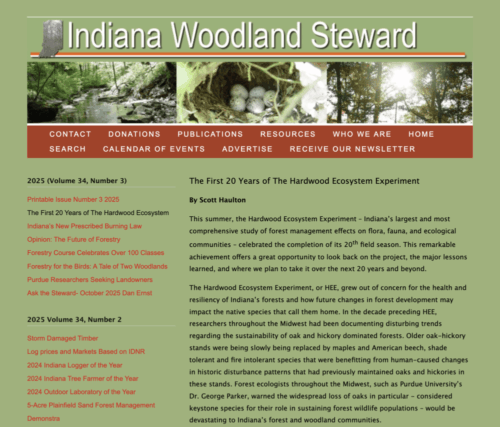 The First 20 Years of The Hardwood Ecosystem Experiment
By Scott Haulton
“This summer, the Hardwood Ecosystem Experiment – Indiana’s largest and most comprehensive study of forest management effects…”- Information on Indiana’s New Prescribed Burning Law
By Rob McCrea
“On July 1st, 2025, Indiana’s newly enacted law on prescribed burning took effect. This law does not.. - Opinion: The Future of Forestry
By Liz Jackson
“For decades the approach to forestry in Indiana has been one of restoration and recovery from the years of overcutting and abandonment…” - Purdue Extension Forestry Course Celebrates Over 100 Classes
“Forest Management for the Private Woodland Owner Course,” sometimes referred to as the Purdue Forestry short course…” - Forestry for the Birds: A Tale of Two Woodlands
By Dr. Jessica Outcalt
“Once upon a time, a few centuries ago, a woodland grew in a river valley of central Indiana. The people who managed this grove…” - Purdue Researchers Seeking Landowners
“In natural resource management, there is a need to understand the densities of wildlife species to determine hunting quotas, issue take permits, and predict…” - Ask the Steward
by Dan Ernst
“Question: Why does my glyphosate foliar treatment sometimes seem ineffective?”
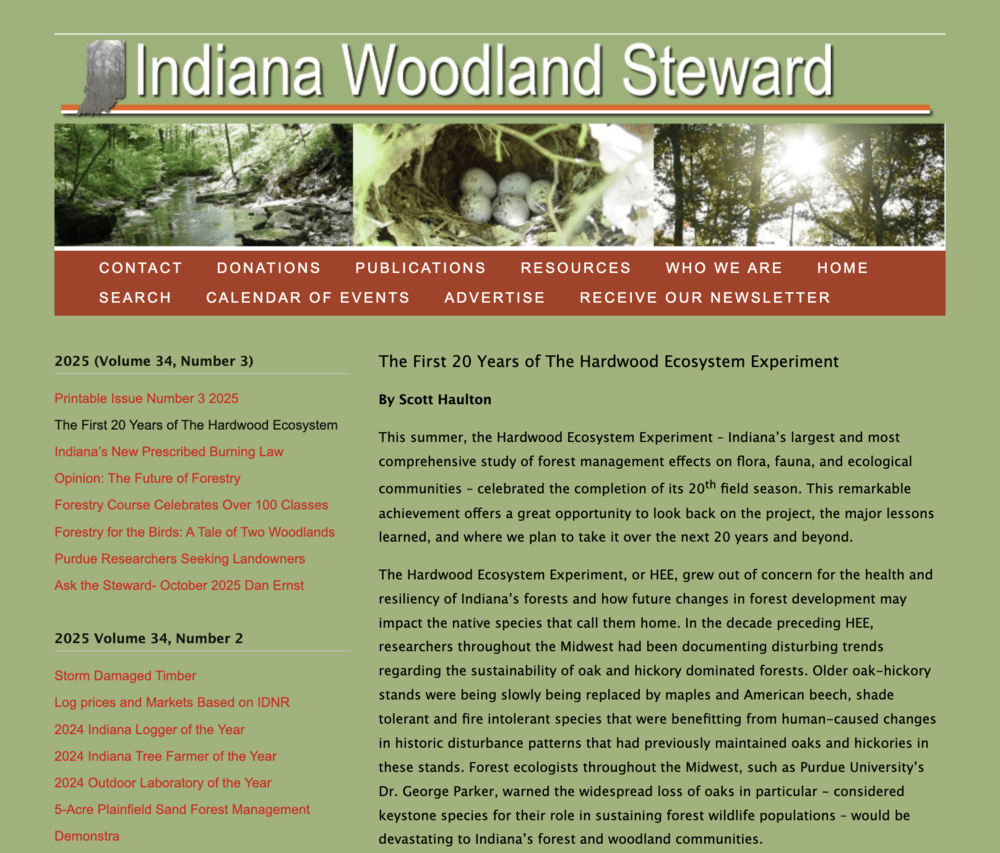
The Indiana Woodland Steward Newsletter is a resource offering a wealth of valuable information for foresters, woodland owners, timber marketing specialists, woodland and wildlife enthusiasts. The Indiana Woodland Steward Institute (IWS) is an entity made from 11 organizations within the state including Purdue University, Indiana Department of Natural Resources (DNR), and Indiana Hardwood Lumbermen’s Association (IHLA), that works to promote best usage practices of Indiana’s woodland resources through their Woodland Steward publication.
Resources
Hardwood Ecosystem Experiment (HEE) website
Hardwood Ecosystem Experiment – Wildlife Responses to Timber Harvesting, Purdue Extension
Forest Improvement Handbook, The Education Store
Invasive plants: impact on environment and people, The Education Store
Managing Your Woods for White-Tailed Deer, The Education Store
Shrubs and Woody Vines of Indiana and the Midwest, Purdue University Press
Virtual Tour Brings Forest Management for Birds to Life, Got Nature? Blog Post, Purdue Extension – Forestry and Natural Resources (FNR)
Breeding Birds and Forest Management: the Hardwood Ecosystem Experiment and the Central Hardwoods Region, The Education Store
Deer Impact Toolbox, Purdue Extension
Grassland Management Series, Purdue Extension Pond and Wildlife Management
Birdfeeder tips, The National Audubon Society
Explore the Rich World of Oaks with Purdue FNR Extension & Partners, Purdue Extension – FNR
Managing Woodlands for Birds Video, Purdue Extension-Forestry and Natural Resources YouTube Channel
Subscribe: Deer, Forest Management, ID That Tree, Woodland Management Moment, Invasive Species and many other topic video playlists Purdue Extension-Forestry and Natural Resources YouTube Channel
Dan McGuckin, President
Indiana Woodland Steward
Dr. Brian MacGowan, Extension Wildlife Specialist
Department of Forestry & Natural Resources, Purdue University
Do you want to learn more about trees, forests and how to better manage your woodlands for a variety of purposes?
Sign up for one of four upcoming editions of the award-winning Forest Management for the Private Woodland Owner course in Spring 2026. The course received the 2024 Family Forests Education Award from the National Woodland Owners Association (NWOA) and the National Association of University Forestry Resources Programs (NAUFRP).
Forest Management for the Private Woodland Owner introduces forest landowners to the biology and management of forests. Topics covered include tree identification, forest biology and history, forest management planning and practices, wildlife management, considerations for selling timber, forest economics and taxation, and resources and assistance available to forest landowners.
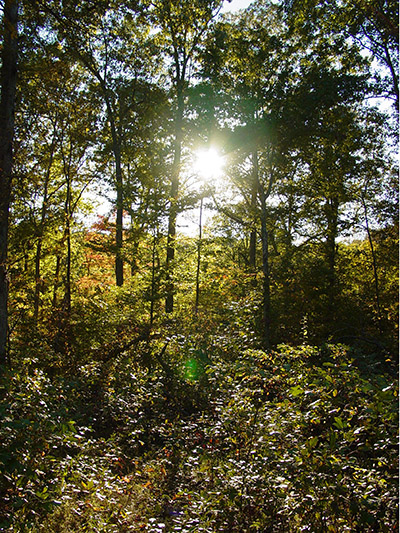 According to survey results from course participants in 2021, “94.4% stated that the information was useful to help them make future decisions and 92.5% stated that the information was useful to help act to manage their property objectives.”
Ron Rathfon is set to teach an eight-week version of the course at the Southern Indiana Purdue Agricultural Center (SIPAC) in Dubois, Indiana, from January 26 to March 16.
The course will meet on Monday evenings (6-9 p.m.) at 11371 East Purdue Farm Rd., and also will include one Saturday field session. Class size is limited to 40 registrants. Advanced registration is required by Jan. 16. Cost is $50 with couples/family registration available for $30 for each additional person.
Those interested should contact Amity Traylor, District Coordinator with the Pike County Soil & Water Conservation District at 812-354-6120 ext. 3 or pikecoswcd@gmail.com to receive a brochure and registration form as well as payment information.
Purdue Extension forester Lenny Farlee will teach two iterations of the course in Tippecanoe County, beginning on Feb. 18 and March 5 respectively.
- A virtual course is slated to begin on Wednesday Feb. 18. The course will feature three live online meetings during which participants may ask questions and receive updated information from the course instructor related to the recorded videos available to view at any time by the registrants. Live meetings are set for Feb. 18, March 11 and April 1. Full registration fee is $15. Registration for this virtual edition is available online through Feb. 13.
- Farlee also will teach an in-person edition of the course, meeting on Thursday evenings from March 5 to April 23 at the John S. Wright Center (1007 N 725 W, West Lafayette, IN 47906). In addition to the eight evening meetings (from 6-9 p.m. ET), the course will include two Saturday field days, which will provide in-person experience with forest biology and management demonstrations and instruction. Full registration fee ($50) includes handouts, flash drive with class reference resources and a tree measuring stick. Guest registration fee ($30) includes class handouts. Visit Forest Management for the Private Woodland Owner Event webpage to learn more and register by February 28th.
Veronica Bullock and Dave Osborne will be teaching a program in Franklin County from Feb. 10 to March 31.
The course will take place on Tuesdays from 5:30 – 8:30 p.m. ET at the Franklin County Public Library – 919 Main Street, Brookville, IN 47012. This course also will include a field tour at the Southeast Purdue Agriculture Center (4426 County Road 360 North, Butlerville, IN 47223) on March 21. Registration is available online. Contact Bullock with any questions at bullockv@purdue.edu.
To view this article along with other news and stories posted on the Purdue Forestry and Natural Resources website view: FNR Extension Set to Offer Four Editions of Forest Management for the Private Woodland Owner Course in Spring 2026.
Resources:
Woodland Stewardship for Landowners YouTube Playlist, Purdue Extension – FNR
Wildlife Habitat Hint YouTube Playlist, Purdue Extension – FNR
Woodland Management Moment YouTube Playlist, Purdue Extension – FNR
Invasive Species YouTube Playlist, Purdue Extension – FNR
Forest Management for the Private Woodland Owner Course – Got Nature? Blog, Purdue Extension – Forestry and Natural Resources
Report Invasive Species, Purdue Invasive Species
Finding help from a professional forester, Indiana Forestry & Woodland Owners Association
Forest Improvement Handbook, The Education Store, Purdue Extension resource center
Indiana Woodland Steward Institute
Hardwood Ecosystem Experiment (HEE)
Hardwood Tree Improvement & Regeneration Center (HTIRC)
Help the Hellbender
The Nature of Teaching
Pond and Wildlife Management, Website
Sustainable Communities and Community Planning, Purdue Extension
Subscribe Purdue Extension – Forestry and Natural Resources YouTube Channel
Wendy Mayer, FNR Communications Coordinator
Purdue University Department of Forestry and Natural Resources
Join Purdue Extension forester Lenny Farlee in this episode of “A Woodland Management Moment” as he discusses the presence of black walnut within a pine plantation. This episode explores how hardwood species like black walnut can become established in planted pine stands and what that means for woodland management decisions. Watch the video to learn about opportunities, challenges and considerations for managing mixed-species woodlands over time.
A good resource to learn more is the Walnut Council website. Founded in 1970, the Walnut Council is an international association representing nearly 700 woodland owners, foresters, forest scientists, and wood-producing industry representatives in 45 states and three foreign countries. The purpose is to assist in the technical transfer of forest research to field applications, help build and maintain better markets for wood products and nut crops, and to promote sustainable forest management, conservation, reforestation, and utilization of American black walnut (Juglans nigra) and other high quality fine hardwoods.
If you have any questions regarding trees, forests, wildlife, wood products, or other natural resource topics, feel free to contact us by using our Ask an Expert web page.
Resources:
A Woodland Management Moment, Playlist, Purdue Extension – Forestry and Natural Resources (FNR) YouTube Channel
The Nature of Oaks Webinar, Purdue Extension-FNR YouTube Channel, Shared from Indiana Forestry & Woodland Owners Association
Conservation Tree Planting: Steps to Success, Purdue Extension – FNR YouTube Channel
Shrubs and Woody Vines of Indiana and the Midwest, Purdue University Press
Native Trees of the Midwest, Purdue University Press
ID That Tree, Playlist, Purdue Extension – FNR YouTube Channel
Investing in Indiana Woodlands, The Education Store
Woodland Stewardship for Landowners Video Series, Playlist, Indiana Department of Natural Resources YouTube Channel
Ask an Expert: Tree Selection and Planting, Purdue Extension – FNR YouTube Channel
Forest Improvement Handbook, The Education Store
Find an Indiana Professional Forester, Indiana Forestry & Woodland Owners Association (IFWOA)
Purdue Arboretum Explorer
Lenny Farlee, Extension Forester
Hardwood Tree Improvement and Regeneration Center
Purdue Department of Forestry & Natural Resources
In this edition of ID That Tree, Purdue Extension Forester Lenny Farlee introduces us to sugarberry, a native relative of hackberry that can be found throughout Indiana. Often overlooked among other hardwoods, this species has its own distinctive features and ecological role. Learn about where it grows, how it fits into our woodland landscapes and what sets it apart from its close cousins. Whether you’re a student, landowner or simply interested in the rees you see along rivers and lowlands, this video provides a quick introduction to sugarberry in Indiana.
If you have any questions regarding wildlife, trees, forest management, wood products, natural resource planning or other natural resource topics, feel free to contact us by using our Ask an Expert web page.
Resources:
ID That Tree – Video Playlist, Purdue Extension – Forestry and Natural Resources (FNR) YouTube Channel
Purdue Arboretum Explorer
Conservation Tree Planting: Steps to Success, Purdue Extension – FNR YouTube Channel
A Woodland Management Moment, Playlist, Purdue Extension – FNR YouTube Channel
Woodland Stewardship for Landowners, Playlist, Purdue Extension – FNR YouTube Channel
Fifty Common Trees of Indiana, Purdue Extension – FNR
Indiana Invasive Species Council
Cooperative Invasive Species Management Area (CISMA)
Report Invasive, Purdue Extension
Habitat University, Episode 12 – Exploring the challenges of Invasive Species, Habitat University-Natural Resource University
Shrubs and Woody Vines of Indiana and the Midwest, Purdue University Press
Native Trees of the Midwest, Purdue University Press
Professional Forester, Indiana Forestry Woodland Owners Association
District Forester, Indiana Department of Natural Resources, 10+ acres
Find an Arborist, International Society of Arboriculture
Forest Improvement Handbook, The Education Store
Lenny Farlee, Extension Forester
Hardwood Tree Improvement and Regeneration Center
Purdue Department of Forestry & Natural Resources
Institute for Sustainable Future News: Rural communities across the Midwest, whose agricultural economies and energy infrastructure are frequently threatened by extreme weather events such as hailstorms, heat waves and high winds, are getting a new lifeline through a National Science Foundation–funded project at Purdue University.
The NSF’s Regional Resilience Innovation Incubator (R2I2): Midwest Agrivoltaics for Resilient Communities (MARC), supported under grant #2519425, is designed to help these communities become more resilient by combining agriculture with solar energy — to improve resilience from local to national levels. This phase 1 grant positions the team to compete for a Phase 2 grant worth up to $15M for an additional 5 years.
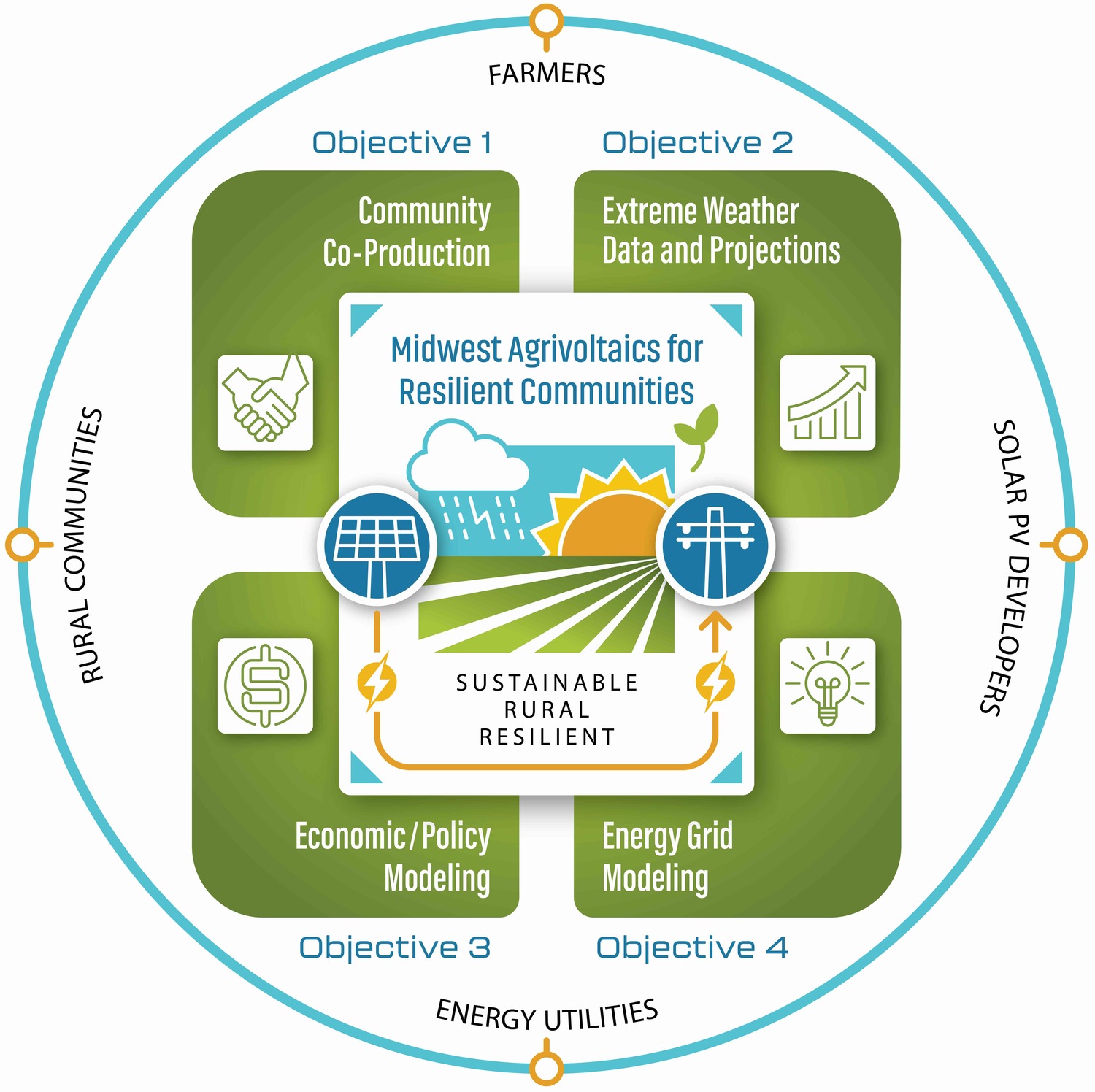
Image: Institute for a Sustainable Future
Agrivoltaics, which allows the dual use of land for agricultural production and solar energy generation, holds great promise to diversify farm income, reduce power outages, and increase energy production as energy demand soars. But agrivoltaics systems have seen slow adoption in the Midwest due to uncertainties about land use trade-offs, lack of trusted information about community impacts and benefits, and concerns from farmers and communities about economic viability and performance under extreme weather. The incubator intends to bring together community members, stakeholders and experts to fill those gaps.
“When hail ruins a harvest, heat strains livestock, or windstorms cut electricity, farmers and their communities are hit hard. Our goal is to understand how agrivoltaics can make our nation’s rural communities more resilient and prosperous,” stated Dr. Dan Chavas, principal investigator.
This project is an ambitious interdisciplinary effort that brings together experts across atmospheric science, agriculture, energy systems, economics, and social science – all housed here at Purdue University across the Colleges of Science, Engineering, Polytechnic and Agriculture, including Extension. Purdue’s Institute for a Sustainable Future (ISF) played an integral role in the development and continued support of the project. ISF provided strategic research teaming support, helping assemble an initial interdisciplinary team of faculty address the complex social, economic and technical aspects of agrivoltaics. This collaborative approach strengthened the project’s ability to meet NSF’s goals for resilience, innovation and community engagement.
The project is led by Purdue University experts across multiple disciplines:
Dr. Dan Chavas is a Professor of atmospheric science in the Department of Earth, Atmospheric, and Planetary Sciences at Purdue University and is part of the leadership team for the Purdue Institute for a Sustainable Future. Dan is the principal investigator and will lead the project’s effort on extreme weather and its risks to agriculture and solar energy systems.
Dr. Aaron Thompson is an Associate Professor in the Department of Horticulture and Landscape Architecture at Purdue University and Director of the Center for Community and Environmental Design. Dr. Thompson is also part of the leadership team for the Purdue Institute for a Sustainable Future. His research applies social-ecological science to sustainable landscape development, focusing on agricultural conservation and nature-based solutions. He teaches courses in ecological planning, research methods, and sustainable development.
Dr. Xiaonan Lu is an Associate Professor in the School of Engineering Technology and the Elmore Family School of Electrical and Computer Engineering (by courtesy) at Purdue University, also holding a joint appointment with Argonne National Laboratory. Xiaonan will lead the efforts of resilience quantification and energy modeling of rural electric power grids considering impacts of distributed energy resources and microgrids.
Dr. Kara Salazar is Assistant Program Leader for community development with Purdue Extension and sustainable communities extension specialist with Illinois-Indiana Sea Grant and the Department of Forestry and Natural Resources. Kara will co-lead community engagement and social science efforts.
Dr. Juan Sesmero is a Professor in the Department of Agricultural Economics at Purdue University. He will lead the economic modeling of agrivoltaics technology deployment and assess its economic impacts on community resilience.
The team is also comprised of additional Purdue and industry collaborators. Key project activities include:
- Building Trust & Community Engagement: Working directly with community, agriculture, and energy partners in co-designing strategies for agrivoltaics deployment to support local communities in the rural Midwest.
- Quantifying Extreme Weather Resilience Benefits: Analyzing how extreme weather events—hail, heat, wind—impact both agriculture and the power grid and how agrivoltaics may be able to reduce these impacts on communities.
- Economic and Power Grid Models & Community Tools: Developing tools, metrics and models that incorporate local conditions to help farmers, planners and communities understand risks and potential benefits to make informed decisions about agrivoltaics.
- Identifying Agrivoltaics Pathways: Evaluating which agrivoltaic configurations are suitable under different land, climatic, and economic conditions.
- Roadmap & Policy Framework: Producing a dynamic roadmap and a policy/planning framework aimed at facilitating broader, community-supported adoption of agrivoltaics.
By the end of the initial funding period, the incubator expects to deliver viable agrivoltaics models and pathways tailored to varying Midwest geographies and farming systems; decision-support tools for landowners, communities, and policymakers; as well as strengthened partnerships among academia, industry, government and local communities.
“For farmers, adapting to changing conditions, markets, and policies has always been crucial for success. Agrivoltaics offers an opportunity to maintain land in production while diversifying revenue by tapping into a growing segment of the energy market,” stated Dr. Aaron Thompson. “This initiative focuses on answering key questions about balancing reliable energy income with the production of food and fiber that are essential for maintaining the strength of Indiana’s agricultural economy.”
For more information about the NSF Regional Resilience Innovation Incubator, and the Midwest Agrivoltaics Incubator, visit the project website.
View the original article here: Purdue Leads NSF-Funded Midwest Agrivoltaics Incubator to Boost Rural Energy and Economic Resilience to Extreme Weather.
Resources:
Community Development, Purdue Extension
Wind Energy, Purdue Community Development
National Renewable Energy Laboratory (NREL)
Environmental Planning in Community Plans, The Education Store, Purdue Extension’s resource center
Enhancing the Value of Public Spaces Program, Purdue Extension YouTube Channel
Enhancing the Value of Public Spaces: Creating Healthy Communities, The Education Store
Conservation through Community Leadership, The Education Store
Conservation through Community Leadership, Purdue Extension You Tube Channel
Implementation Examples of Smart Growth Strategies in Indiana, The Education Store, Purdue Extension’s resource center
Conservation Through Community Leadership, The Education Store
Community Planning Playlist, Purdue Extension-Forestry & Natural Resources (FNR) YouTube Channel
One Water Approach to Water Resources Management, The Education Store
Rainscaping Education Program, Purdue Extension
Rainscaping and Rain Gardens, Purdue Extension YouTube Channel
Indiana Creek Watershed Project – Keys to Success, Partnerships and People, Purdue Extension You Tube Channel
Illinois-Indiana Sea Grant
Subscribe – Purdue Extension – Forestry and Natural Resources YouTube Channel
Purdue Extension-Forestry and Natural Resources Calendar, workshops and Conferences
Institute for a Sustainable Future
Purdue University
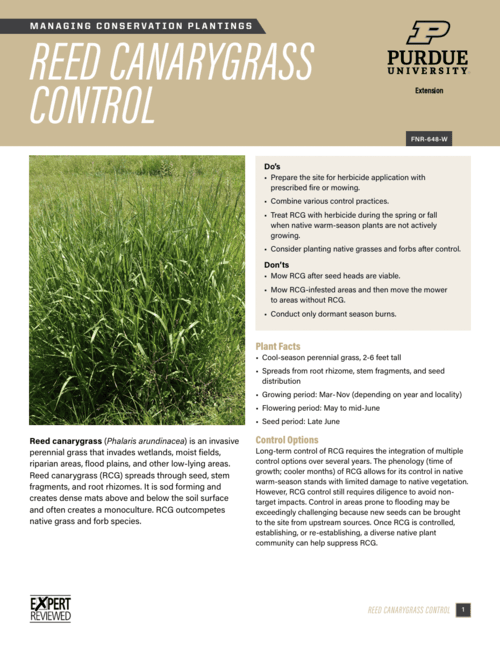 Uncover the challenges posed by reed canarygrass, an invasive perennial grass that threatens conservation plantings, wetlands and low-lying areas. This guide details control options for reed canarygrass. Essential for conservationists and land managers dedicated to preserving native ecosystems: Reed Canarygrass Control.
Check out the Managing Conservation Plantings Series which include details on how to control invasive species and other problematic plants in Conservation Reserve Program (CRP) plantings and native warm-season grass and wildflower conservation plantings.
Publications in this series include:
- Golden Rod Control
- Thinning Native Warm-Season Grasses
- Sericea Lespedeza Control
- Woody Encroachment and Woody Invasives
- Jonhsongrass Control
- Reed Canarygrass Control
- Teasel Control (Common and Cut Leaved)
- Controlling Introduced Cool-Season Grasses
- Crownvetch, Sweetclover and Birdsfoot Trefoil Control
Resources:
Deer Impact Toolbox & Grassland Management, Purdue Extension Pond and Wildlife Management
Pond and Wildlife Management, Purdue Extension
Forestry for the Birds Virtual Tour and Pocket Guide, Got Nature? Blog, Purdue Extension – FNR
Frost Seeding to Establish Wildlife Food Plots and Native Grass and Forb Plantings – Purdue Extension – FNR YouTube channel
Wildlife Habitat Hint: Tips for Evaluating a First Year Native Grass and Forb Plantings, Purdue Extension – FNR YouTube Channel
Drone Seeding Native Grasses and Forbs: Project Overview & Drone Setup, Purdue Extension – FNR YouTube channel
Ask an Expert: Wildlife Food Plots, video, Purdue Extension – FNR YouTube Channel
Handling Harvested Game: Episode 1, Field Dressing, video, Purdue Extension – FNR YouTube Channel
Managing Your Woods for White-Tailed Deer, The Education Store
Forest Improvement Handbook, The Education Store
Forest Management for Reptiles and Amphibians: A Technical Guide for the Midwest, The Education Store
A Template for Your Wildlife Habitat Management Plan, The Education Store
Woodland Stewardship for Landowners, Playlist, Purdue Extension – FNR YouTube channel
Nature of Teaching Unit 1: Animal Diversity and Tracking, The Education Store
Nature of Teaching, Purdue College of Agriculture
Invasive Species Playlist, Playlist, Purdue Extension – FNR YouTube Channel
Report Invasive, Purdue Extension
Subscribe Purdue Extension – Forestry and Natural Resources YouTube Channel
Jarred Brooke, Wildlife Extension Specialist
Purdue Department of Forestry and Natural Resources
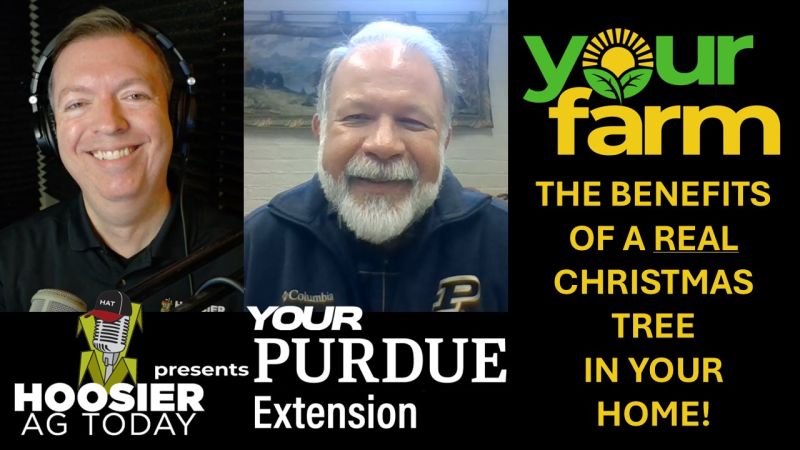 Hoosier Ag Today – Your Farm Podcast: On the latest episode of the “Your Farm” podcast, C.J. Miller chats with Lenny Farlee from Purdue Forestry & Natural Resources, about the environmental and sustainability benefits of a having a real Christmas tree in your home this holiday season.
“It’s a great family experience and there is also some really significant environmental benefits to using live trees as your Christmas tree decorations.” — Lenny Farlee, Purdue FNR extension forester.
Looking for the perfect Christmas tree but feeling overwhelmed by all the options? Whether you’re debating between fir, pine, or cedar, this podcast has you covered! Join Lenny as he shares expert tips and the key questions every first-time buyer should ask to find the tree that fits your home and your holiday dreams.
Watch the YouTube video from the podcast episode 5 The Benefits of a Real Christmas Tree in Your Home!
The “Your Farm” Podcast is one of the many new podcasts available as Hoosier Ag Today presents YOUR Purdue Extension—a Podcast Network!
About Hoosier Ag Today
Hoosier Ag Today is Indiana’s leading agricultural news network, dedicated to providing timely, relevant and credible information for the state’s farming community. It delivers farm news, market updates, weather forecasts and analysis through the largest network of local radio stations in Indiana, as well as digital platforms like its website, podcasts, e-newsletter and mobile app. Founded in 2006, Hoosier Ag Today serves as a trusted source for farmers and agribusiness leaders to stay informed about state, national and international agricultural developments.
Resources:
A Choose-and-Cut Pine and Fir Christmas Tree Case Study, The Education Store, Purdue Extension’s resource center
Living Christmas Trees For The Holidays and Beyond, The Education Store
Tips for First-Time Buyers of Real Christmas Trees, The Education Store
Growing Christmas Trees, The Education Store
Selecting an Indiana-Grown Christmas Tree, The Education Store
Winterize Your Trees, The Education Store
Tree Installation: Process and Practices, The Education Store
What do Treed Do in the Winter?, Got Nature? Blog, Purdue Extension – Forestry and Natural Resources (FNR)
Forest/Timber Playlist, subscribe to Purdue Extension – Forestry and Natural Resources (FNR) YouTube Channel
Ask the Expert: Holidays in the Wild, Purdue Extension – FNR YouTube Channel
ID That Tree: Balsam Fir, Purdue Extension – FNR YouTube Channel
ID That Tree: Scotch Pine, Purdue Extension – FNR YouTube Channel
To identify other pine trees view ID That Tree, Purdue Extension – FNR YouTube Channel
Report Invasive, Purdue Extension
Purdue Plant Doctor, Purdue Extension
C.J. Miller, Assistant News Director
Hoosier Ag Today
Diana Evans, Extension & Web Communications Specialist
Purdue University Department of Forestry and Natural Resources
Families planning the transfer of farms to the next generation of often look for guidance and resources. Purdue Extension’s Succession Planning Resource is designed to help Indiana farm families navigate this critical transition. The succession planning process includes considerations for financial well-being, farm management and risk assessment. It is crucially important for families to properly develop plans that address the transfer of ownership and management.
The Succession Planning Team offers: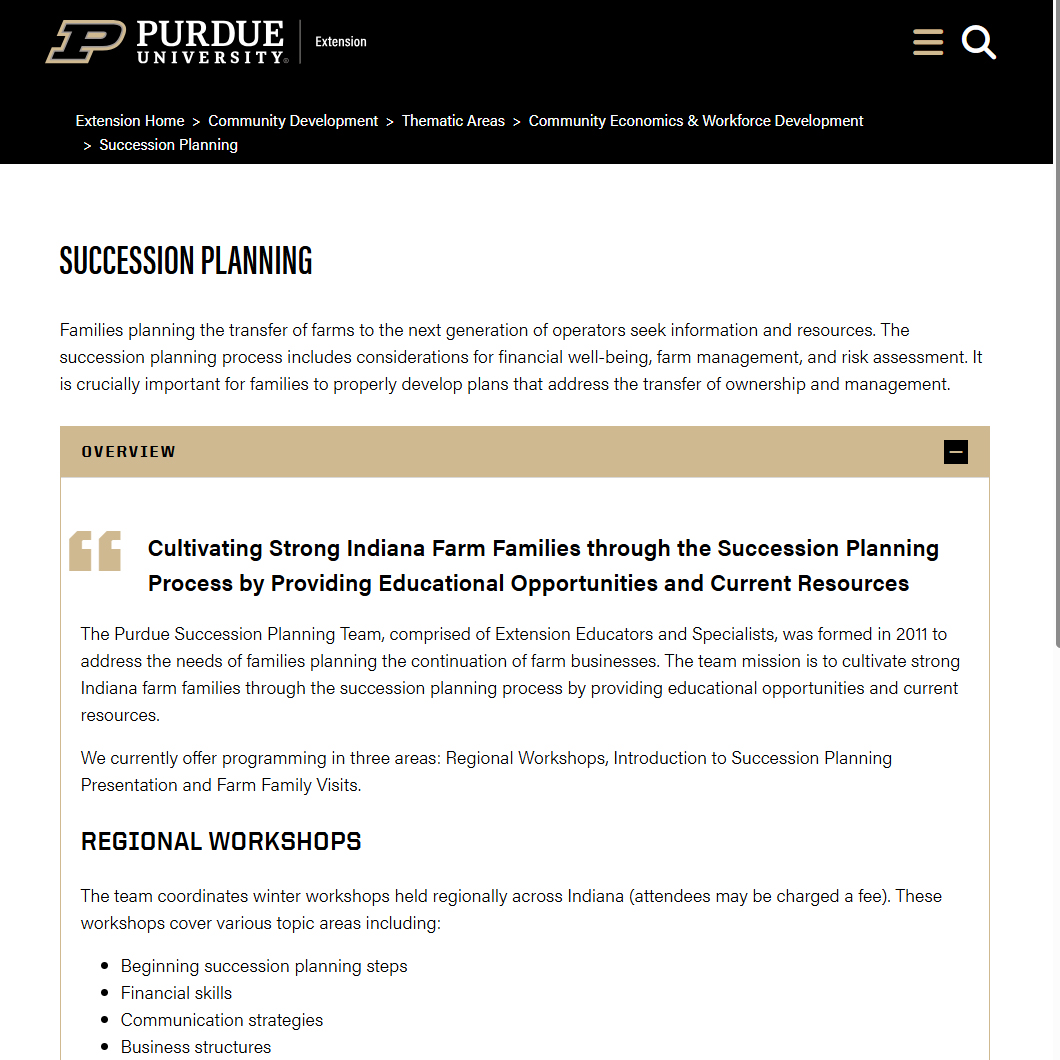
- Regional Workshops with experts in law, finance, and farm management
- Introductory Presentations to kickstart your planning process
- Farm Family Visits for personalized guidance
Regional Workshops
The team coordinates winter workshops held regionally across Indiana (attendees may be charged a fee). These workshops cover various topic areas including:
- Beginning succession planning steps
- Financial skills
- Communication strategies
- Business structures
- Risk management tools
- Options for asset transfer to the next generation
- Management transfer plans
Workshop presenters include experienced professionals (i.e., attorneys and accountants), Extension specialists and Extension Educators. Team members may also hold family meetings with the workshop attendees to help them move forward with the next steps of their succession plans. Fees charged for these workshops have been lowered due to grant funding provided by the North Central Extension Risk Management Education Center.
Explore the resource and start building a stronger foundation for your future: Succession Planning.
Resources:
Community Development, Purdue Extension
Wind Energy, Purdue Community Development
National Renewable Energy Laboratory (NREL)
Environmental Planning in Community Plans, The Education Store, Purdue Extension’s resource center
Enhancing the Value of Public Spaces Program, Purdue Extension YouTube Channel
Enhancing the Value of Public Spaces: Creating Healthy Communities, The Education Store
Conservation through Community Leadership, The Education Store
Conservation through Community Leadership, Purdue Extension You Tube Channel
Implementation Examples of Smart Growth Strategies in Indiana, The Education Store, Purdue Extension’s resource center
Conservation Through Community Leadership, The Education Store
Community Planning Playlist, Purdue Extension-Forestry & Natural Resources (FNR) YouTube Channel
One Water Approach to Water Resources Management, The Education Store
Rainscaping Education Program, Purdue Extension
Rainscaping and Rain Gardens, Purdue Extension YouTube Channel
Indiana Creek Watershed Project – Keys to Success, Partnerships and People, Purdue Extension You Tube Channel
Illinois-Indiana Sea Grant
Subscribe – Purdue Extension – Forestry and Natural Resources YouTube Channel
Purdue Extension-Forestry and Natural Resources Calendar, workshops and Conferences
Diana Evans, Extension & Web Communications Specialist
Purdue University Department of Forestry and Natural Resources
Join Purdue Extension forester Lenny Farlee in this episode of “A Woodland Management Moment” as he highlights the breeding programs with the native Indiana tree Butternut. This episode introduces viewers to the once frequently found species and why there’s been a notable decline in its population. Watch the video to learn the reason behind butternut’s decline, how we have been trying to combat that with conservation efforts and details about how butternut grows.
If you have any questions regarding trees, forests, wildlife, wood products, or other natural resource topics, feel free to contact us by using our Ask an Expert web page.
Resources:
ID That Tree: Butternut
Hardwoods of the Central Midwest: Butternut
Hardwood Lumber and Veneer Series: Butternut, The Education Store
Morton Arboretum: Butternut
Identification of Butternuts and Butternut Hybrids, The Education Store
Conservation and Management of Butternut Trees, The Education Store
The Plight of the Butternut
HTIRC Seed Propagation Protocol for Purdue and Hybrid Butternut
Purdue Arboretum Explorer
Butternut, Native Tree of Indiana River Walk, Purdue Fort Wayne
The Woody Plant Seed Manual, U.S. Forest Service
A Woodland Management Moment, Playlist, Purdue Extension – Forestry and Natural Resources (FNR) YouTube Channel
Conservation Tree Planting: Steps to Success, Purdue Extension – FNR YouTube Channel
Shrubs and Woody Vines of Indiana and the Midwest, Purdue University Press
Native Trees of the Midwest, Purdue University Press
ID That Tree, Playlist, Purdue Extension – FNR YouTube Channel
Investing in Indiana Woodlands, The Education Store
Woodland Stewardship for Landowners Video Series, Playlist, Indiana Department of Natural Resources YouTube Channel
Ask an Expert: Tree Selection and Planting, Purdue Extension – FNR YouTube Channel
Forest Improvement Handbook, The Education Store
Find an Indiana Professional Forester, Indiana Forestry & Woodland Owners Association (IFWOA)
Purdue Arboretum Explorer
Lenny Farlee, Extension Forester
Hardwood Tree Improvement and Regeneration Center
Purdue Department of Forestry & Natural Resources

Recent Posts
- Beetle that attacks Tree-of-Heaven found in Indiana, Purdue Landscape Report
Posted: March 20, 2026 in Invasive Insects, Wildlife, Woodlands - ID That Tree: Dwarf Chinkapin Oak
Posted: in Forestry, Urban Forestry, Wildlife, Woodlands - IN-PREPared: Essential Resources for Indiana’s Severe Weather Season
Posted: March 11, 2026 in How To, Safety - DNR Hiring for Indiana Conservation Officer Positions, MyDNR
Posted: March 9, 2026 in Urban Forestry, Wildlife, Woodlands - ID That Tree: Shumard Oak
Posted: in Plants, Urban Forestry, Wildlife, Woodlands - A Woodland Management Moment: Windbreak Around Walnut Plantings
Posted: March 3, 2026 in Forestry, Urban Forestry, Woodland Management Moment - Getting Certified as an Indiana Certified Prescribed Burn Manager
Posted: March 2, 2026 in How To, Urban Forestry, Woodlands - Uniting Indiana Residents Against Invasive Species
Posted: February 27, 2026 in Community Development, Invasive Insects, Wildlife - Have You Seen a Soaring Eagle Lately? Morning Ag Clips
Posted: February 25, 2026 in Urban Forestry, Wildlife - Register for Natural Resources Teacher Institute’s Class of 2026
Posted: February 19, 2026 in Forestry, Wildlife, Woodlands
Archives
Categories
- Alert
- Aquaculture/Fish
- Aquatic/Aquaculture Resources
- Ask the Expert
- Christmas Trees
- Community Development
- Disease
- Drought
- Forestry
- Forests and Street Trees
- Gardening
- Got Nature for Kids
- Great Lakes
- How To
- Invasive Animal Species
- Invasive Insects
- Invasive Plant Species
- Land Use
- Natural Resource Planning
- Nature of Teaching
- Plants
- Podcasts
- Ponds
- Publication
- Safety
- Spiders
- Timber Marketing
- Uncategorized
- Urban Forestry
- Webinar
- Wildlife
- Wood Products/Manufacturing
- Woodland Management Moment
- Woodlands