 Purdue University - Extension - Forestry and Natural Resources
Got Nature? Blog
 MyDNR, Indiana’s Outdoor Newsletter: Did you know that Indiana’s waterways can be altered by the presence of aquatic invasive species? Non-native plants, animals, and organisms can disrupt bodies of water and ecosystems, threatening sport fisheries and other commercial resources.
If you’re wondering what you can do to help prevent the spread of aquatic invasive species, there are many easy steps that Hoosiers and out-of-state visitors can take to stop aquatic hitchhikers:
- Clean off any animals, plants, and mud from any angling or boating gear.
- Drain the water from watercrafts, bladder tanks, bilges, motors, livewells, and portable bait containers before leaving the water access area.
- Make sure everything air-dries for five days or longer or is dried with a towel.
- Dispose of any unwanted or unused bait, fish parts, and packing materials in the trash, rather than on the ground or in water. Remember, littering harms the environment.
DNR is counting on you to help protect Indiana’s waterways and species.
Newsletter can be found online: MyDNR Email Newsletter
For more information please visit DNR: Fish & Wildlife: Aquatic Invasive Species (AIS).
Resources:
Invasive Mussels, IN DNR Fish and Wildlife
Aquatic Invasive Species in the Great Lakes: The Quagga Mussel, Purdue Extension – Forestry & Natural Resources (FNR) Got Nature? Blog
Aquatic Invaders in the Marketplace, Illinois-Indiana Sea Grant (IISG)
Invasive Species, Playlist, Purdue Extension – FNR YouTube Channel
What are invasive species and why should I care?, Got Nature? Blog, Purdue Extension – Forestry and Natural Resources
Report Invasive Species, Purdue Invasive Species
The GLEDN Phone App – Great Lakes Early Detection Network
EDDMaps – Early Detection and Distribution Mapping System
Indiana Department of Natural Resources: Invasive Species
Indiana Invasive Species Council
Cooperative Invasive Species Management Area (CISMA)
Great Lakes Sea Grant Network (GLERL), NOAA – Great Lakes Environmental Research Laboratory
A Field Guide to Fish Invaders of the Great Lake Regions, Illinois-Indiana Sea Grant (IISG)
Purdue Researchers Get to the Bottom of Another Quagga Mussel Impact, Illinois-Indiana Sea Grant (IISG)
Invasive plants: Impact on Environment and People, The Education Store, Purdue Extension’s resource center
Protect Your Waters, U.S. Fish and Wildlife Service & U.S. Coast Guard
Nongame and Endangered Wildlife, Indiana Department of Natural Resources
Indiana Department of Natural Resources, Department of Fish & Wildlife
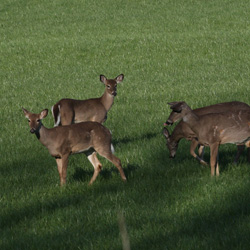 MyDNR, Indiana’s Outdoor Newsletter: As we head into month 07, remember that all fall hunting license types are available for purchase. If you’re looking for a deer or turkey license, now is a handy time to buy it. With plenty of license options available for residents and nonresidents, we’ve got the perfect outdoor adventure for you.
Spend some time this fall bonding with your friends and family and helping DNR’s efforts to conserve Indiana’s natural resources.
Newsletter can be found online: MyDNR Email Newsletter
For more information please visit Fish & Wildlife: Licenses & Permits.
Resources:
How to Score Your White-tailed Deer, video, The Education Store, Purdue Extension Resource Center
White-Tailed Deer Post Harvest Collection, video, The Education Store
Age Determination in White-tailed Deer, video, The Education Store
How to Build a Plastic Mesh Deer Exclusion Fence, The Education Store
Managing Your Woods for White-Tailed Deer, The Education Store
Bovine Tuberculosis in Wild White-tailed Deer, The Education Store
Help With Wild Turkey Populations, Video, Purdue Extension – Forestry and Natural Resources YouTube Channel
Turkey Brood Reporting, Indiana Department of Natural Resources (IDNR)
Wild Turkey, Indiana Department of Natural Resources (IDNR)
Wild Turkey Hunting Biology and Management, Indian Department of Natural Resources (IDNR)
Subscribe to Purdue Extension-Forestry & Natural Resources YouTube Channel, Wildlife Playlist
Indiana Department of Natural Resources, Department of Fish & Wildlife
 MyDNR, Indiana’s Outdoor Newsletter: Out with the old, in with the new! Our upgraded, free DNR smartphone app is now available to guide you to the best places for outdoor exploration in Indiana. View the nearest State Parks, Fish & Wildlife areas, State Forests, Archery & Shooting Ranges, Nature Preserves, and more.
With a fresh interface, better maps, and more content, you’ll be the most prepared explorer in the wild. DNR app-reciates you!
Whether you are just visiting, hunting, fishing or staying at a campground or state park inn, we hope you will find this portable guide to DNR properties and services useful. Please send questions or suggestions to dnrwebmaster@dnr.IN.gov. Don’t forget to leave a review on the app stores.
Newsletter can be found online: MyDNR Email Newsletter
For more information please visit Communications: Indiana DNR Smartphone Apps
Resources:
Wildfire Prevention, National Association of State Foresters
Ask the Expert: Learn All About Hellbenders and Take a Tour, Subscribe Purdue Extension – Forestry & Natural Resources (FNR) YouTube Channel
Managing Woodlands for Birds Video, Purdue Extension-Forestry and Natural Resources (FNR) YouTube Channel
Ask the Expert: What’s Buzzing or Not Buzzin About Pollinators, Purdue Extension – FNR YouTube Channel.
Observing Seasonal Changes in Nature-IFWOA Webinar | Purdue Extension Forestry & Natural Resources , Purdue Extension – FNR Got Nature? Blog
Report if You See a Spotted Lanternfly – MyDNR , Purdue Extension – FNR Got Nature? Blog
What are invasive species and why should I care?, Got Nature? Blog, Purdue Extension – FNR
Report Invasive, Purdue College of Agriculture – Entomology
Indiana Department of Natural Resources, Department of Fish & Wildlife
In this episode of ID That Tree, Purdue Extension forester Lenny Farlee introduces the Paper Birch. This species is found in the North Woods of Northern Wisconsin and the Upper Peninsula of Michigan. This species has white chalky bark that peels and flakes off the sides of the tree. Under the bark, the tree tends to be a light tan to bronze color. They have alternate leaf arrangement, are catkins as part of their flowering structure, and have simple leaves.
If you have any questions regarding wildlife, trees, forest management, wood products, natural resource planning or other natural resource topics, feel free to contact us by using our Ask an Expert web page.
Resources:
ID That Tree, Playlist, Purdue Extension – Forestry and Natural Resources YouTube Channel (Invasive White Mulberry, Siberian Elm, Tree of Heaven)
Invasive Species Playlist, Playlist, Purdue Extension – FNR YouTube Channel (Asian Bush Honeysuckle, Burning Bush, Callery Pear, Multiflora rose)
A Woodland Management Moment, Playlist, Purdue Extension – FNR YouTube Channel (Against Invasives, Garlic Mustard, Autumn Olive)
Woodland Stewardship for Landowners, Playlist, Purdue Extension – FNR YouTube Channel (Common Buckthorn, Japanese Barberry)
Report Invasive Species, Purdue Invasive Species
The GLEDN Phone App – Great Lakes Early Detection Network
EDDMaps – Early Detection and Distribution Mapping System
How long do seeds of the invasive tree, Ailanthus altissima remain viable? (Invasive Tree of Heaven), USDA Forest Service
Indiana Department of Natural Resources: Invasive Species
Indiana Invasive Species Council
Cooperative Invasive Species Management Area (CISMA)
Aquatic Invasive Species, Illinois-Indiana Sea Grant (IISG)
Episode 11 – Exploring the challenges of Invasive Species, Habitat University-Natural Resource University
What are invasive species and why should I care?, Got Nature? Blog, Purdue Extension – FNR
Shrubs and Woody Vines of Indiana and the Midwest, The Education Store, Purdue Extension Resource Center
Native Trees of the Midwest, The Education Store
Investing in Indiana Woodlands, The Education Store
Forest Improvement Handbook, The Education Store
Lenny Farlee, Extension Forester
Hardwood Tree Improvement and Regeneration Center
Purdue Department of Forestry & Natural Resources
Join alumna Megan Benage, a regional ecologist for the Minnesota Department of Natural Resources, and Bee Redfield, a postgraduate research assistant, as they explore the world of pollinators. They cover the who’s, the what’s and how’s of pollination as well as how you can help bring pollinators to your yard and help the pollinator population in general. They also share about ongoing research and cool projects related to pollinators.
If you have any questions regarding wildlife, trees, forest management, wood products, natural resource planning or other natural resource topics, feel free to contact us by using our Ask an Expert web page.
Resources
Protecting Pollinators: Biology and Control of Varroa Mites in Bee Hives, The Education Store, Purdue Extension resource center
The Complex Life of the Honey Bee: Environmental, Biological, and Chemical Challenges to Colony Health, The Education Store
Pollinator Protection, Website, Purdue Extension
Gardening for Pollinators, Purdue Graden Articles
Megan Benage, Regional Ecologist
Minnesota Department of Natural Resources
Bee Redfield, Postgraduate Research Assistant
Purdue Forestry and Natural Resources
MyDNR, Indiana’s Outdoor Newsletter: Blotchy bass syndrome (BBS) is the occurrence of black ink-like spots (hyperpigmentation) on the skin, fins, and/or mouths of freshwater bass species.
Researchers once thought that melanosis was caused by sun exposure or stress related to fishing, temperature, or pollution; however, researchers recently discovered that a family of viruses was associated with the black spots in fish that were in poor body condition.
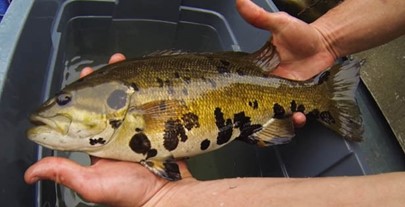
Photo courtesy of USGS
The Division of Fish & Wildlife is partnering with the United States Geological Survey (USGS) to collect samples from black bass species to test for BBS and needs your help. DNR encourages anglers to report observations of affected bass when you are fishing, so they and USGS can learn more about the effect of this family of viruses.
How to participate:
- Download the MyCatch app from Angler’s Atlas.
- Register for the “Blotchy Bass Bonanza.”
- Take photos of all the bass you’ve caught (preferably on a measuring board) while fishing and upload them to the MyCatch app.
The Blotchy Bass Bonanza runs from March 1, 2023 —Feb. 29, 2024. The Indiana DNR is not associated with the MyCatch app or the Blotchy Bass Bonanza.
Newsletter can be found online: MyDNR Email Newsletter
For more information please visit Investigating blotch bass syndrome in black basses.
Resources:
FNR Extension Aquaculture and Aquatic Resources
FNR Extension Publications
Indiana Pond Fish, Species Identification Card Set, Purdue Extension – Forestry and Natural Resources (FNR)
Walleye Farmed Fish Fact Sheet, The Education Store, Purdue Extension’s resource center
Pacific White Shrimp Farmed Fact Sheet, The Education Store
Yellow Perch Farmed Fish Fact Sheet, The Education Store
Tilapia Farmed Fish Fact Sheet, The Education Store
Rainbow Trout Farmed Fish Fact Sheet, The Education Store
American Paddlefish, The Education Store
A Guide to Small-Scale Fish Processing Using Local Kitchen Facilities, The Education Store
Aquaculture Family Coloring Book Development, The Education Store
Eat Midwest Fish, Illinois-Indiana Sea Grant online resource hub
Aquatics & Fisheries Videos, Purdue Extension-Forestry and Natural Resources YouTube Channel Playlist
Indiana Department of Natural Resources, Department of Fish & Wildlife
In this episode of ID That Tree, Purdue Extension forester Lenny Farlee introduces the Black Ash. This species is typically found in wetland environments within Indiana and the North Woods of Northern Wisconsin. This species has light gray flaky bark, opposite leaf arrangement, and compound leaves. These trees separate very easily along their growth rings and thus have a long tradition of native peoples creating baskets with them. This species is under is a major threat by the emerald ash borer.
If you have any questions regarding wildlife, trees, forest management, wood products, natural resource planning or other natural resource topics, feel free to contact us by using our Ask an Expert web page.
Resources:
ID That Tree, Playlist, Purdue Extension – Forestry and Natural Resources YouTube Channel (Invasive White Mulberry, Siberian Elm, Tree of Heaven)
Black Ash, Native Trees of Indiana River Walk, Fort Wayne-Purdue
Invasive Species Playlist, Playlist, Purdue Extension – FNR YouTube Channel (Asian Bush Honeysuckle, Burning Bush, Callery Pear, Multiflora rose)
A Woodland Management Moment, Playlist, Purdue Extension – FNR YouTube Channel (Against Invasives, Garlic Mustard, Autumn Olive)
Woodland Stewardship for Landowners, Playlist, Purdue Extension – FNR YouTube Channel (Common Buckthorn, Japanese Barberry)
Report Invasive Species, Purdue Invasive Species
The GLEDN Phone App – Great Lakes Early Detection Network
EDDMaps – Early Detection and Distribution Mapping System
How long do seeds of the invasive tree, Ailanthus altissima remain viable? (Invasive Tree of Heaven), USDA Forest Service
Indiana Department of Natural Resources: Invasive Species
Indiana Invasive Species Council
Cooperative Invasive Species Management Area (CISMA)
Aquatic Invasive Species, Illinois-Indiana Sea Grant (IISG)
Episode 11 – Exploring the challenges of Invasive Species, Habitat University-Natural Resource University
What are invasive species and why should I care?, Got Nature? Blog, Purdue Extension – FNR
Shrubs and Woody Vines of Indiana and the Midwest, The Education Store, Purdue Extension Resource Center
Native Trees of the Midwest, The Education Store
Investing in Indiana Woodlands, The Education Store
Forest Improvement Handbook, The Education Store
Lenny Farlee, Extension Forester
Hardwood Tree Improvement and Regeneration Center
Purdue Department of Forestry & Natural Resources
In this episode of ID That Tree, Purdue Extension forester Lenny Farlee introduces the Balsam Fir. This species is found in the North Woods of Northern Wisconsin and the Upper Peninsula of Michigan. It’s the primary fir found in the area and features soft and aromatic needles, which are flattened and have white stripes along the underside. Another notable characteristic is the three buds at the end of the twigs. This species can be easily identified from a distance due to its tight pointed spire like appearance.
If you have any questions regarding wildlife, trees, forest management, wood products, natural resource planning or other natural resource topics, feel free to contact us by using our Ask an Expert web page.
Resources:
ID That Tree, Playlist, Purdue Extension – Forestry and Natural Resources YouTube Channel (Invasive White Mulberry, Siberian Elm, Tree of Heaven)
Invasive Species Playlist, Playlist, Purdue Extension – FNR YouTube Channel (Asian Bush Honeysuckle, Burning Bush, Callery Pear, Multiflora rose)
A Woodland Management Moment, Playlist, Purdue Extension – FNR YouTube Channel (Against Invasives, Garlic Mustard, Autumn Olive)
Woodland Stewardship for Landowners, Playlist, Purdue Extension – FNR YouTube Channel (Common Buckthorn, Japanese Barberry)
Report Invasive Species, Purdue Invasive Species
The GLEDN Phone App – Great Lakes Early Detection Network
EDDMaps – Early Detection and Distribution Mapping System
How long do seeds of the invasive tree, Ailanthus altissima remain viable? (Invasive Tree of Heaven), USDA Forest Service
Indiana Department of Natural Resources: Invasive Species
Indiana Invasive Species Council
Cooperative Invasive Species Management Area (CISMA)
Aquatic Invasive Species, Illinois-Indiana Sea Grant (IISG)
Episode 11 – Exploring the challenges of Invasive Species, Habitat University-Natural Resource University
What are invasive species and why should I care?, Got Nature? Blog, Purdue Extension – FNR
Shrubs and Woody Vines of Indiana and the Midwest, The Education Store, Purdue Extension Resource Center
Native Trees of the Midwest, The Education Store
Investing in Indiana Woodlands, The Education Store
Forest Improvement Handbook, The Education Store
Lenny Farlee, Extension Forester
Hardwood Tree Improvement and Regeneration Center
Purdue Department of Forestry & Natural Resources
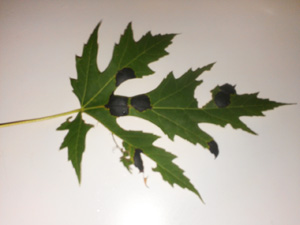 Question: we have several maple trees in our neighborhood afflicted with this black spot (see attached photo). What can we do to protect our maple trees?
Anwer: while it is difficult to confirm a diagnosis from photos alone it looks and could be a fungal disease called tar spot. The most common species are Rhytisma acerinum and R. punctatum. Symptoms first appear in late spring or early summer as infected leaves develop light green or yellow-green spots. During mid to late summer these produce black tar-like raised structures on the upper surface of leaves within the yellow spots. R. acerinum causes larger spots that are 0.5 to 2 cm in diameter; R.punctatum causes many small punctate spots that are smaller (about 1mm in diameter). Spots caused by R. punctatum are sometimes called speckled tar spots.
Tar spot is a common disease on silver maple and is primarily considered to be a cosmetic problem rather than a serious threat. The Purdue Plant and Pest Diagnostic Laboratory has additional information on tar spot including more photos and best treatment, Tar Spot on Maple.
To confirm a diagnosis, you can submit a sample directly to the Purdue Plant & Pest Diagnostic Lab (PPDL) or find a certified arborist to come to your property and access your tree.
Resources:
Large Spots on Maple Leaves that Look Like Tar, Purdue Extension News
Find an Arborist, International Society of Arboriculture
Diseases in Hardwood Tree Plantings, The Education Store, Purdue Extension’s resource center
Fifty Common Trees of Indiana
An Introduction to Trees of Indiana
Native Trees of the Midwest, The Education Store
Shrubs and Woody Vines of Indiana and the Midwest, The Education Store
Tree Installation: Process and Practices, The Education Store
Planting Your Tree Part 1: Choosing Your Tree, Video, Purdue Extension – Forestry & Natural Resource (FNR) YouTube Channel
Investing in Indiana Woodlands, The Education Store
Forest Improvement Handbook, The Education Store
ID That Tree, Purdue Extension-FNR YouTube playlist
Purdue Plant and Pest Diagnostic Laboratory
Diana Evans, Extension and Web Communication Specialist
Purdue University Department of Forestry and Natural Resources
Question: I have 2,700 young white oak and hickory trees that were planted in 2017 that now have black locust creeping in. Should I try to remove them by cutting them down and treating the stumps? What is the best treatment to control the brush?
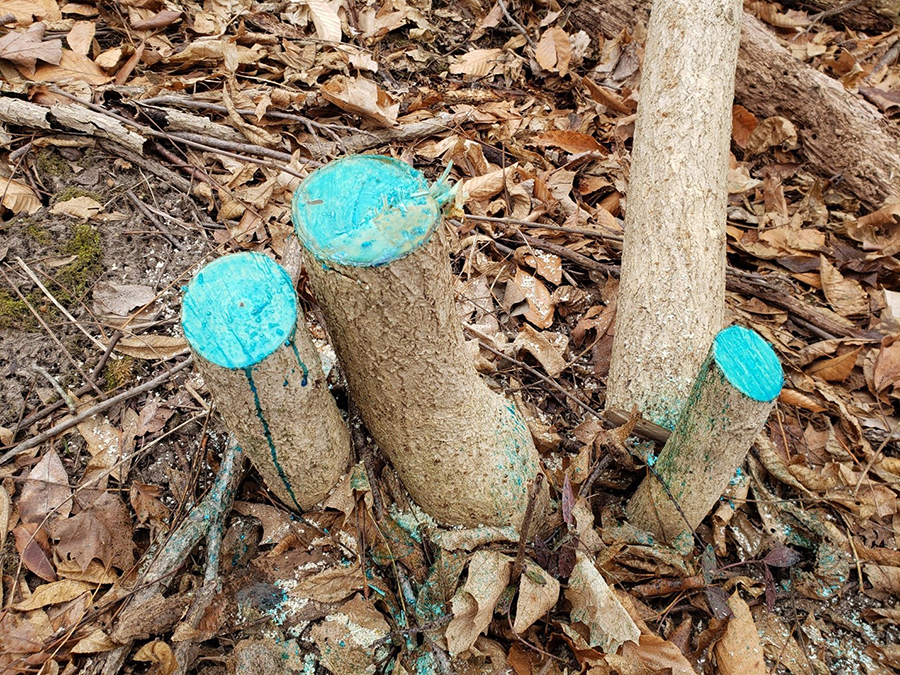
Cut stumps treated with herbicide including a dye to show application. Photo by Lenny Farlee.
Answer: Whether eliminating black locust competing with oaks in a tree planting, or controlling invasive woody shrubs like autumn-olive or Asian bush honeysuckles, cutting the stems near ground-line and treating the stumps with an appropriate herbicide provides a one-two punch to the target plant. Severing the stems from the roots cuts off the flow of photosynthesis-produced food to the roots, and may prevent production and ripening of seed, if done early enough in the growing season. The stump left behind provides a small target area for herbicide application, limiting the damage to nearby native plants that can result from foliar herbicide overspray and drift. The herbicide application should kill the roots and limit re-sprouting. While it requires two sequential operations, cutting and spraying, it may be one of the most efficient methods to control many smaller-diameter woody plants due to the high rate of control achieved when done correctly and limited damage to surrounding desirable vegetation.
So how do you do the “cut-stump” treatment correctly? Several factors need to be considered, but some common elements to effective and efficient treatments include a cutting tool you can operate safely, effective herbicide type and application, and correct timing for the site and situation. Tools can be powered by fuel or electric motors or by your muscles. Be sure you know how to operate them safely and wear appropriate safety gear. I prefer brush saws for near-ground cutting as it limits bending over and is safer to operate than a chainsaw, but they will struggle with some larger diameter or denser stems a chainsaw could cut easily. Handsaws, loppers, pruners, or blade-tools like machetes and brush-hooks are hand-tool options, but larger stems will require more time and effort to cut or will be too large for some hand-tools to handle. Herbicides should be applied immediately after you have cut off the stems. A good choice for many applications is herbicide containing the active ingredient Glyphosate. Glyphosate concentrate herbicides containing 42% or more active ingredient are widely available at many garden and farm stores. Read the label before using the herbicide to confirm the active ingredients, concentration, and requirements for safe and effective applications, including the appropriate safety gear during dispensing and application. Apply the concentrate straight or mixed with up to 50% water to the cut surface immediately after the cut is made. For stems over 3 to 4 inches in diameter, you can apply a band of spray around the perimeter of the stump so the bark, cambium and some sapwood is treated. If you wait to apply the spray to cut surfaces a dozen minutes to hours after the cut is made, two things will happen that can impact the effectiveness of the spray. The surface of the stump will seal as it dries, preventing the entry of the water/herbicide mixture into the plant. You may also have difficulty tracking down the cut stumps if the area is weedy and brushy.
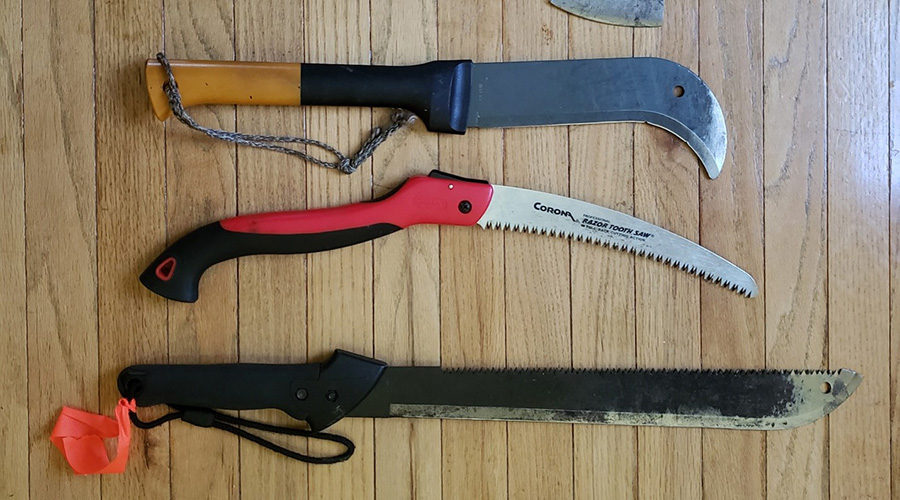
Hand-cutting tools suited for small diameter woody plants. Photo by Lenny Farlee.
Some cautions about timing and locations of this application method. Many plants are pumping lots of sap up from the roots in spring. That sap can flush herbicides out of the application area and result in herbicide failure and re-sprouting from the root system. If the stem is frozen, usually 25 degrees F or colder, herbicide may also not penetrate and evaporate off the frozen stump. Also avoid applications when rain could wash off the herbicide within two or three hours of application.
Several other herbicides are available for this treatment including Triclopyr and 2-4-D/Picloram herbicides. Be sure to read the labels and understand the safety requirements and application instructions before using.
For additional information see the Purdue Extension-FNR webinar Invasive Plants Threaten our Forests Part 2: Control and Management.
More resources:
District Forester, Indiana DNR Division of Forestry, for over 10 acres of woodlands
Directory of Professional Foresters, Indiana Forestry & Woodland Owners Association (IFWOA)
Indiana Woodland Steward E-newsletters, Eleven Member Organization
A Woodland Management Moment, Playlist, Purdue Extension – Forestry and Natural Resources (FNR) Youtube Channel
Conservation Tree Planting: Steps to Success, Purdue Extension – FNR Youtube Channel
Forest Improvement Handbook, The Education Store
Invasive Species, Playlist, Purdue Extension – FNR Youtube Channel
Woodland Stewardship for Landowners, Playlist, Purdue Extension – FNR Youtube Channel
Invasive Plant Species Identification, Video, Purdue Extension – FNR Youtube Channel
Report Invasive Species, Purdue Invasive Species
The GLEDN Phone App – Great Lakes Early Detection Network
EDDMaps – Early Detection and Distribution Mapping System
Indiana Department of Natural Resources: Invasive Species
Indiana Invasive Species Council
Cooperative Invasive Species Management Area (CISMA)
Invasive plants: impact on environment and people, The Education Store, Purdue Extension’s resource center
A Landowner’s Guide to Sustainable Forestry: Part 7: Managing for a Diversity of Value-Added Forest Products, The Education Store
Investing in Indiana Woodlands, The Education Store
Woodland Invaders, Got Nature? Blog, Purdue Extension – FNR
The Education Store, Purdue Extension’s resource center (place keywords in search bar, for ex: invasive, forest, timber)
Lenny Farlee, Extension Forester
Purdue University Department of Forestry and Natural Resources

Recent Posts
- Beetle that attacks Tree-of-Heaven found in Indiana, Purdue Landscape Report
Posted: March 20, 2026 in Invasive Insects, Wildlife, Woodlands - ID That Tree: Dwarf Chinkapin Oak
Posted: in Forestry, Urban Forestry, Wildlife, Woodlands - IN-PREPared: Essential Resources for Indiana’s Severe Weather Season
Posted: March 11, 2026 in How To, Safety - DNR Hiring for Indiana Conservation Officer Positions, MyDNR
Posted: March 9, 2026 in Urban Forestry, Wildlife, Woodlands - ID That Tree: Shumard Oak
Posted: in Plants, Urban Forestry, Wildlife, Woodlands - A Woodland Management Moment: Windbreak Around Walnut Plantings
Posted: March 3, 2026 in Forestry, Urban Forestry, Woodland Management Moment - Getting Certified as an Indiana Certified Prescribed Burn Manager
Posted: March 2, 2026 in How To, Urban Forestry, Woodlands - Uniting Indiana Residents Against Invasive Species
Posted: February 27, 2026 in Community Development, Invasive Insects, Wildlife - Have You Seen a Soaring Eagle Lately? Morning Ag Clips
Posted: February 25, 2026 in Urban Forestry, Wildlife - Register for Natural Resources Teacher Institute’s Class of 2026
Posted: February 19, 2026 in Forestry, Wildlife, Woodlands
Archives
Categories
- Alert
- Aquaculture/Fish
- Aquatic/Aquaculture Resources
- Ask the Expert
- Christmas Trees
- Community Development
- Disease
- Drought
- Forestry
- Forests and Street Trees
- Gardening
- Got Nature for Kids
- Great Lakes
- How To
- Invasive Animal Species
- Invasive Insects
- Invasive Plant Species
- Land Use
- Natural Resource Planning
- Nature of Teaching
- Plants
- Podcasts
- Ponds
- Publication
- Safety
- Spiders
- Timber Marketing
- Uncategorized
- Urban Forestry
- Webinar
- Wildlife
- Wood Products/Manufacturing
- Woodland Management Moment
- Woodlands