 Purdue University - Extension - Forestry and Natural Resources
Got Nature? Blog
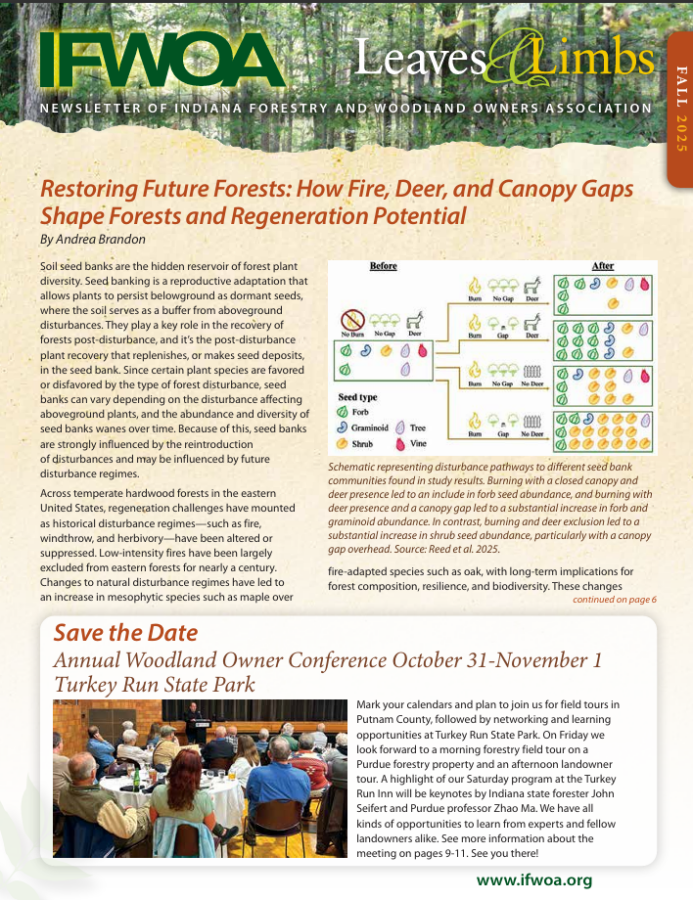 Indiana Forestry & Woodland Owners Association (IFWOA) is a non-profit organization dedicated to conservation and sustainable management of forests in Indiana. The Fall Leaves & Limbs Newsletter is now available online and is open to all who would like to view the articles and resources.
Fall 2025 Leaves & Limbs Newsletter includes:
-
- Restoring Future Forests: How Fire, Deer and Canopy Gaps Shape Forests and Regeneration Potential
- A Message from the IFWOA President, Lee Huss
- Upcoming forestry events
- Indiana 2025 Woodland Owner Conference (October 31-November 1 at Turkey Run): Agenda, field tours, overview, hotel and registration information
- Indiana Landowners to be Recognized for Their Stewardship
- District Nominees Share Their Passion
- Time to Order Tree Seedlings form Indiana DNR Vallonia Nursery
- Welcome New Executive Directory – Phil Woolery!
- New Resources from Purdue Extesion
- Program Overview: The Sourthern Indiana Sentinel Landscape (SISL) Regional Conservation Partnership Program
- What Can You Tell Me About the Dunstan Chestnut?
- Elm Zigzag Sawfly: New Pest to Elm
- Grasslands for Gamebirds and Songbirds Program
- Forestry Economic Contributions in Indiana and the U.S.
- What’s in a Name?, by Allen Pursell, Same Shine Foundation, Inc.
- Research on Indiana’s Paoli Experimental Forest
- Seven U.S. Animal Species That are Invasive in Other Countries
- And More!
More About IFWOA
IFWOA hosts the Indiana Woodland Owner Conference which include field programs and indoor sessions on wildlife and habitat, forest management and other topics for landowners. The 2026 conference is November 6-7 and is open to anyone. Over 200 landowners attend for discussions and networking.
IFWOA advocates for scientific best practices for woodland management to achieve objectives like clean water, wildlife habitat, soil protection, native species diversity, timber production, recreation, carbon sequestration and many others.
This Indiana association has members in every county of Indiana both woodland owners and non-owners, city and rural dwellers, family farmers, wildlife conservationists, agriculture and forestry professionals, tree farmers, loggers, scientists, educators — anyone who cares about the health of Indiana forests and woodlands, and wants to assure those lands receive the care and support they need.
Membership in IFWOA provides a valuable network linkage to information and resources at the leading edge of science, industry and politics impacting Indiana woodlands. If you would like to learn more about membership view Join Today, Indiana Forestry & Woodland Owners Association (IFWOA).
Resources:
Subscribe: Indiana Forestry & Woodland Owners Association (IFWOA) YouTube Channel
“Magnificent Trees of Indiana” webinar with author Carroll Ritter, IFWOA YouTube Channel
Forest Improvement Handbook, The Education Store, Purdue Extension’s resource center
Planting Hardwood Seedlings – The Education Store
Ordering Seedlings from the State Forest Nursery System, Got Nature? – Purdue Extension-FNR
Importance of Hardwood Tree Planting – The Education Store, Purdue Extension Resource Center
Designing Hardwood Tree Plantings for Wildlife – The Education Store
ID That Tree – YouTube Playlist
Forest Management for Reptiles and Amphibians: A Technical Guide for the Midwest, The Education Store
Hardwood Ecosystem Experiment – Forest Birds , Purdue Extension – FNR YouTube Channel
Ask the Expert: Hardwood Ecosystem Experiment – Birds and Salamander Research, Purdue Extension – FNR
Subscribe to Purdue Extension-FNR YouTube Channel
Phil Woolery, Forestry and Natural Resources
Walnut Council, IFWOA & HTIRC Engagement Specialist
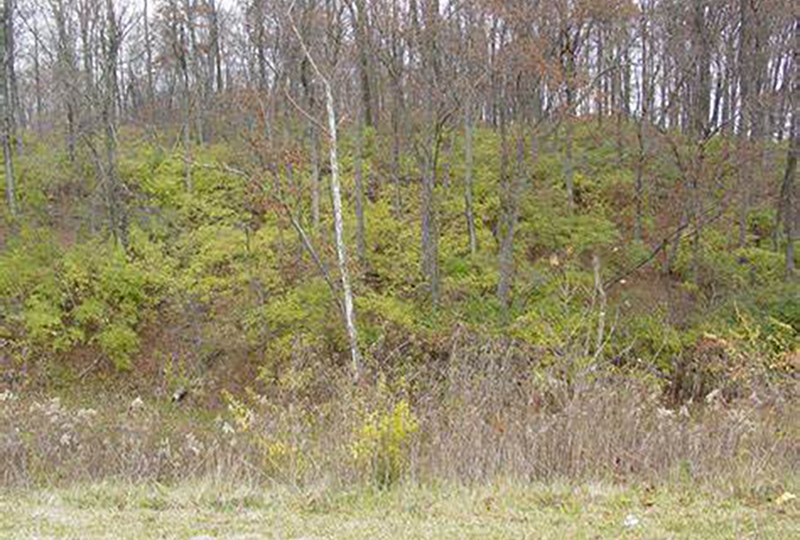
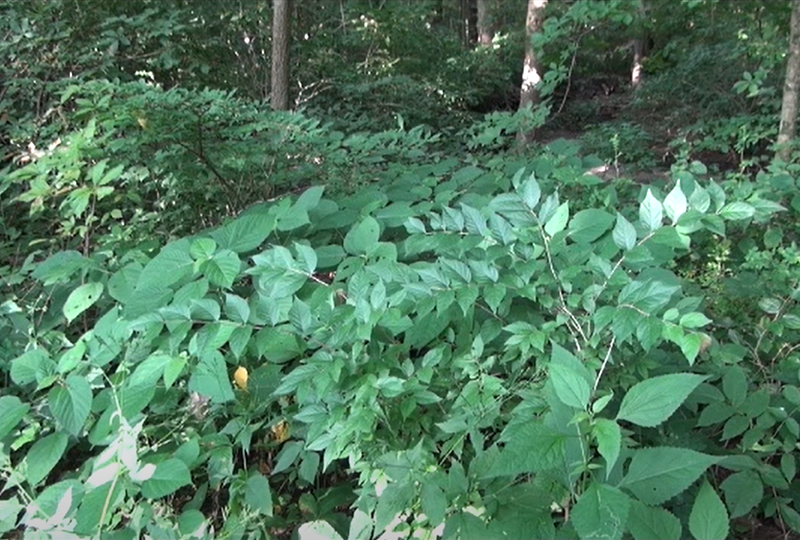
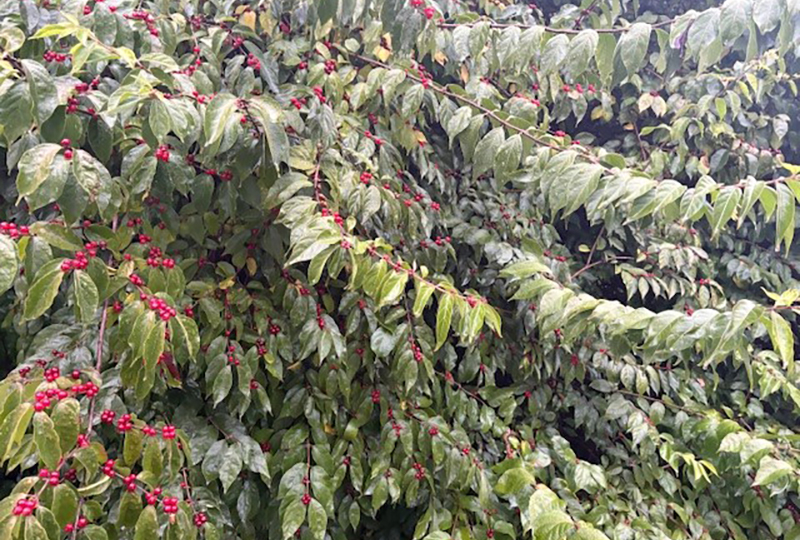
In early November, invasive bush honeysuckle is one of the only understory shrubs that are still green. While many of our native plants are dormant, Asian bush honeysuckle remains green longer making them easy to locate. Doing control measures this time of year also reduces impacts to non-target plants.
How do you control it? That depends on what resources you have available. Small plants can be easily pulled by hand; be sure to hang them on tree branch rather than laying them down on the ground so they don’t re-root. In most cases, some method of herbicide control will be necessary. Ohio State University has a good guide on various methods of control, Controlling Non-Native Invasive Plants in Ohio Forests: Bush Honeysuckle.
Not sure where to start on your property? One of the most daunting aspects of invasive plant control is where to begin. Ellen Jacquart, former Director of Stewardship for the Nature Conservancy in Indiana, wrote an article in the Indiana Woodland Steward. The Where do I Start?! Prioritizing Invasive Plant Control article describes how to plan your invasive plant control including prioritizing what to do first.
Click on the photos below for larger view to help as you identify Asian bush honeysuckle.

Resources:
Subscribe to the Indiana Woodland Steward Newsletter
Consider Fall Eradication of Asian Bush Honeysuckle, Purdue Landscape Report
Asian Bush Honeysuckle, Purdue Extension YouTube Video
A Woodland Moment: Asian Bush Honeysuckle, Purdue Extension – Forestry and Natural Resources (FNR) YouTube Video
Invasive Plants of the Eastern U.S.: An Introduction to the Problematic Non-Native Species, The Education Store, Purdue Extension’s resource center
Report Invasive Species, Purdue Invasive Species
Report Invasive Species: Asian Bush Honeysuckle, Purdue Invasive Species
The GLEDN Phone App – Great Lakes Early Detection Network
EDDMaps – Early Detection and Distribution Mapping System
Episode 11 – Exploring the challenges of Invasive Species, Habitat University-Natural Resource University
What Are Invasive Species and Why Should I Care?, Purdue Extension-FNR Got Nature? Blog
Emerald Ash Borer Information Network, Purdue University and Partners
Aquatic Invasive Species, Illinois-Indiana Sea Grant (IISG)
Invasive plants: impact on environment and people, The Education Store, Purdue Extension’s resource center
Subscribe Purdue Extension-Forestry and Natural Resources YouTube Channel
Brian MacGowan, Wildlife Extension Specialist
Department of Forestry and Natural Resources, Purdue University
Purdue College of Agriculture News: An armored mammal, once limited to the swamps and forests of the Deep South, is now burrowing its way through the backyards and woodlands of Indiana. The nine-banded armadillo—a 10 to 15 pound mammal often associated with Texas or Louisiana—has become an increasingly common sight in the Hoosier state.
Brian MacGowan, Purdue Extension wildlife specialist and coordinator in Purdue University’s Department of Forestry and Natural Resources, explains that while this isn’t a brand-new arrival, the armadillo population and range have grown steadily and moved north in recent years.
“The nine-banded armadillo was first discovered living in Indiana around 2003,” MacGowan said. “Since then, they have been found throughout most of the state, even into the far northeast corner of Steuben County.”
MacGowan explains that armadillos are known to establish themselves in woodland areas in search of their food source. “Their diet is generally ground insects,” he said. “If an animal wants to find loads of insects, they will find an abundance in decaying wood.”
Another distinct characteristic of the nine-banded armadillo is their burrowing tactics.
“In some studies, these armadillos have been known to use multiple burrows, sometimes over 30 in a single year,” MacGowan said. “If they run into trouble, their first response is often to jump up and run into their burrow as fast as they can.”
As a nocturnal animal with many burrows to call home, their chances of being seen by humans are diminished. However, occasionally homeowners and farmers will find signs of armadillos on their property, such as where they dig up insects and grubs or burrow under a deck.
While armadillos are not known to be dangerous, there is a risk of humans or animals stepping into their open burrows. MacGowan compares this concern with the challenge farmers face with groundhogs and ground squirrels.
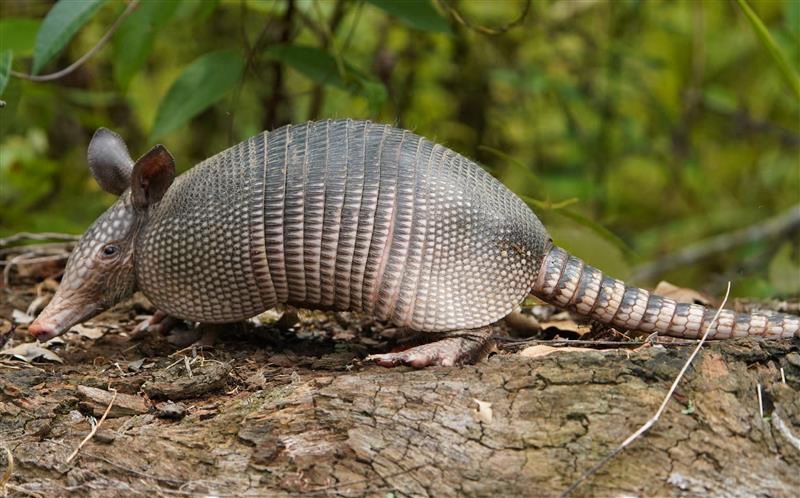 Rather than navigating by sight or sound, the nine-banded armadillos rely on smell, which could lead them to roadways while searching for food, MacGowan explains.
“The nine-banded armadillos also cannot curl up in a ball and protect their soft underbelly like other armadillo species can, so they’re vulnerable to predation by coyotes and other predators, said MacGowan.
Armadillo sightings are also influenced by the temperatures and moisture in an area. “If there’s a drought, it can kill off a lot of armadillos because the ground gets so hard and a lot of the insects and things they eat move below ground,” MacGowan said.
Typically, when it is cold out, the nine-banded armadillo adjusts its behavior to be more active during the day, partly because that helps them warm up. Also, some of the things they eat are more likely to be active when it’s warmer. MacGowan encourages people who encounter these animals to let them be.
“Armadillos are susceptible to a variety of diseases just like any wild animal,” he said. “You might have heard talk that armadillos can carry leprosy. That is generally an endemic issue for those animals specifically found in some regions in the south. While leprosy is quite deadly to armadillos, there is absolutely no evidence of transmission to people. However, they are wild animals, and the DNR will always caution people to keep their distance from any wild animal.”
The next time you spot this rare visitor in your backyard or scurrying across a Hoosier road, remember that you are witnessing history in motion. Reporting unusual animal sightings, like the nine-banded armadillo, not only helps the DNR track these shifts, but also deepens our understanding of a continually evolving ecosystem. After all, you never know what remarkable creature might be unexpectedly making its home in Indiana.
You can help the Indiana Division of Fish & Wildlife by submitting reports of certain mammals of interest. These mammals can potentially be seen from the comfort of your home, on your way to work, or while out biking, hiking, or camping. Reports can be made to the DNR here.
To view this article along with other news and stories posted on the Purdue College of Agriculture website view: Unexpected Plants and Animals of Indiana: The nine-banded armadillo.
Resources:
A Template for Your Wildlife Habitat Management Plan, The Education Store, Purdue Extension resource center
Wildlife Habitat Hint, Purdue Extension – Forestry & Natural Resources (FNR) YouTube Playlist
Woodland Stewardship for Landowners, Purdue Extension – FNR YouTube Playlist
Woodland Management Moment, Purdue Extension – FNR YouTube Playlist
Invasive Species, Playlist, Purdue Extension – FNR Youtube Channel
Invasive Plant Species Identification, Video, Purdue Extension – FNR Youtube Channel
Invasive plants: impact on environment and people, The Education Store, Purdue Extension’s resource center
Woodland Invaders, Got Nature? Blog, Purdue Extension – FNR
Preventing Wildlife Damage – Do You Need a Permit? – The Education Store, Purdue Extension resource center
Selecting a Nuisance Wildlife Control Professional, The Education Store
How to Construct a Scent Station, The Education Store
Question: How do I properly relocate raccoons from my attic?, Got Nature? Blog, Purdue Extension FNR
Nuisance Wildlife – Indiana Department of Natural Resources
Subscribe to our FNR Extension YouTube Channel with over 250 videos which include: aquatic, forestry, urban forestry, wildlife, community planning videos and much more.
Ericka Bethel, Digital Content Specialist
Purdue University Department of Forestry and Natural Resources
Dr. Brian MacGowan, Extension Wildlife Specialist
Department of Forestry & Natural Resources, Purdue University
IN-PREPared: The Indiana State Board of Animal Health has confirmed cases of Highly Pathogenic Avian Influenza (HPAI) in northeast Indiana. As millions of wild birds traverse the state during peak migration, the risk of additional outbreaks remains high. To support awareness and preparedness, Indiana PREPared offers a comprehensive resource library with science-based information on avian influenza, biosecurity practices, and public health guidance.
 What is HPAI?
Avian influenza, or “bird flu,” is a contagious viral disease of domestic and wild birds. It’s a major threat to the poultry industry, animal health, trade, and the economy worldwide.
Caused by influenza type A viruses, the disease varies in severity depending on the strain and species affected. Highly pathogenic avian influenza (HPAI) strains are deadly to domestic poultry and can wipe out entire flocks within a matter of days. Low pathogenicity avian influenza (LPAI) strains typically cause few or no signs of illness. They occur naturally in wild birds around the world. However, some LPAI strains can become highly pathogenic in poultry. (USDA-APHIS)
According to the Centers for Disease Control and Prevention (CDC):
- H5 bird flu is widespread in wild birds worldwide and is causing outbreaks in poultry and U.S. dairy cows with several recent human cases in U.S. dairy and poultry workers.
- While the current public health risk is low, CDC is watching the situation carefully and working with states to monitor people with animal exposures.
To learn more, visit the webpage: Avian Influenza.
More Resources:
Avian Flu (Bird Flu), IN DNR, Fish and Wildlife
Question: Is there any risk of becoming infected with avian influenza virus by feeding backyard birds?, Purdue Extension – FNR Got Nature? Blog
Virtual Tour Brings Forest Management for Birds to Life, Purdue Extension – Forestry and Natural Resources (FNR) Got Nature? Blog
Breeding Bird Atlas, Indiana Department of Natural Resources
IN DNR Shares How to Keep Your Backyard Birds Healthy, Purdue Extension – FNR Got Nature? Blog
Breeding Birds and Forest Management: the Hardwood Ecosystem Experiment and the Central Hardwoods Region, The Education Store, Purdue Extension resource center
Forest Birds, Purdue Extension – FNR YouTube Channel
Managing Woodlands for Birds Video, Purdue Extension – FNR YouTube Channel
The Birders’ Dozen, Profile: Baltimore Oriole, Indiana Woodland Steward
Birds and Residential Window Strikes: Tips for Prevention, The Education Store, Purdue Extension resource center
No Room at the Inn: Suburban Backyards and Migratory Birds, Education Store
The National Audubon Society
Subscribe, Purdue Extension – FNR YouTube Channel
Ed Sheldon, Farm/Veteran Job Coach and Engagement Coordinator
Department of Agriculture & Biological Engineering, Purdue University
Purdue Landscape Report: Spotted lanternfly (SLF) has been the subject of a lot of media attention in the last few years. In the east, states like Pennsylvania and New York have been dealing with heavy infestations since the insect was first detected in 2014. In Indiana, this invasive planthopper arrived three years ago, infesting two counties on the eastern side of the state. Since then, the Indiana Department of Natural Resources and Purdue University have been working together to mitigate the spread of this insect as well as educate Hoosiers on what they can do to help. Spotted lanternfly is still on the move, and this update will help refresh you on how this bug works, and where they are headed.
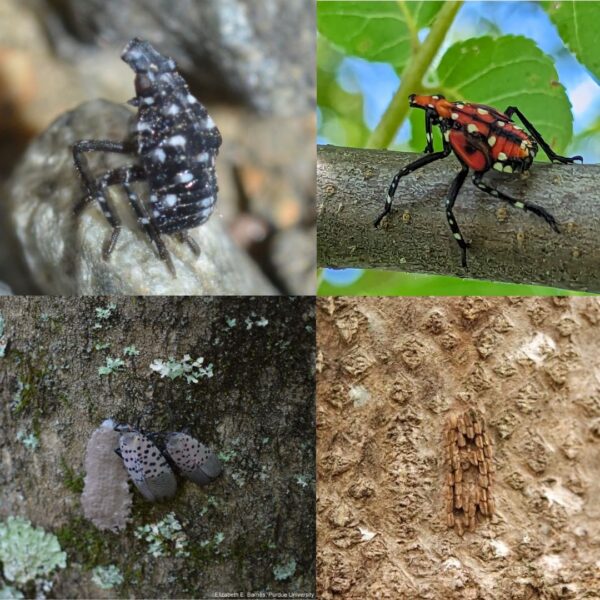
Figure 1. Upper left: early-instar SLF; upper right: late-instar SLF; bottom left: adult SLF with egg mass; bottom right: uncovered SLF eggs.
Life cycle
Spotted lanternfly is an annual insect, having only a single generation in a year under normal conditions. The insect goes through incomplete metamorphosis; immature stages, called nymphs, resemble smaller, wingless versions of the adults. Nymphs will begin to appear in April or May, developing through four instars, until they reach adulthood in late summer. With each instar, the period in between molting, the nymph will grow larger, develop wingpads, and eventually change color. Early instars are black with a white dot pattern, while later instars will be bright red with black and white patterning (Fig. 1). Late instar nymphs are often compared to milkweed bugs or lady beetles. Once they complete development in the late summer or early fall, they will mate and lay egg masses covered in a protective substance that makes them resemble mud. Eggs masses will overwinter until the spring, while adult insects will die as temperatures cool. In Indiana, depending on temperature, adults can be seen as late as early November.
Impact
Spotted lanternfly is a sap-feeding insect, using syringe-like mouthparts to drain nutrients directly from plant tissues. Like other sap-feeding insects, the activity of SLF wounds the plant, creating openings for various pathogens to exploit. Feeding by SLF has been shown to reduce overall health of their hosts, reducing their capacity to survive overwintering, and potentially kill the host plant depending on species. They also produce a sugary waste known as honeydew; while honeydew itself is not harmful, it acts as a growing substrate for sooty mold, which can have a serious impact the photosynthesis of understory foliage as well as attract other nuisance insects.
Spotted lanternfly is a generalist herbivore and can feed on over 100 different species of plant and tree in Indiana. However, this insect has shown strong preference towards certain species, often with devastating consequences. The most preferred host is tree-of-heaven, an invasive tree species in North America. Tree-of-heaven is the primary host of SLF in their shared native range, and the insect appears to experience high reproductive success on it even when they share a new environment. Grapes are also highly preferred by SLF, and infestations will typically result in overfeeding and the death of the plant. Black Walnut, American river birch, and various maple species are also at risk of severe damage from this insect. Evidence has also suggested that maple, when used for syrup production, will experience reductions in yield and quality when attack by spotted lanternfly.
Where are they now?
Spotted lanternfly has been present in Indiana since 2021, first arriving in Huntington and Switzerland Counties. In Huntington, the infestation occupies a stand of tree-of-heaven next to an industrial parking lot. Tree-of-heaven moved into the neighboring residential area, allowing SLF to also spread with it. The more rural infestation in Switzerland County was traced to a vehicle transported from Pennsylvania, and the insect has taken advantage of patches of tree-of-heaven in nearby wooded areas. While both infestations have strongly associated with the insect’s primary host, there is some evidence that SLF is beginning to take advantage of other nearby plants, such as maple. In the last year, SLF moved a significant distance and has been detected in several more counties, including Elkhart, St. Joseph, Porter, Allen, Dekalb, and Noble Counties. Most of the activity has been found on tree-of-heaven along rail lines, supporting the idea that the insect is dispersed by rail traffic moving westward out of infested areas.
It’s important to remember that trains aren’t the only vehicles that can have SLF passengers. These insects, and their egg masses, can be found on just about any surface, including the car you drive to work, the RV you used for recreation, semi-trucks that cross the country, and more. Purdue Entomology and Indiana DNR are encouraging everyone to inspect their vehicles when traveling through any of the infested areas. Also check all recreational vehicles and trailers for spotted lanternfly egg masses; if found, scrape them off into a bag or bucket filled with soapy water. This fall and winter, we also want to encourage everyone to please burn any firewood where you buy it, and please don’t move it off your property if you chop it yourself- especially if you are burning tree of heaven. Egg masses will stick to firewood and can survive our winters very well.
What can I do?
We are still learning about the spotted lanternfly’s distribution through Indiana, and we need the help of citizen scientists to effectively track the insect’s movement. If you believe you’ve seen spotted lanternfly, please report it using any of the resources listed below. You can also feel free to reach out to Bob Bruner, Exotic Forest Pest Educator, by emailing them at rfbruner@purdue.edu, or you can report sightings by calling 1-866-NOEXOTIC.
Original article posted: Spotted Lanternfly is on the Move!.
Subscribe and receive the newsletter: Purdue Landscape Report Newsletter.
Spotted Lanternfly Resources:
Spotted Lanternfly Found in Indiana, Indiana Woodland Steward
Spotted Lanternfly Feeds on Over 70 Plus Plant Species, Purdue Extension – Forestry and Natural Resources (FNR)
Spotted Lanternfly – includes map with locations, Indiana Department of Natural Resources Entomology
Spotted Lanternfly is on the Move!, Purde Landscape Report
Spotted Lanternfly Egg Hatch is Here, Purdue Landscape Report
Report Spotted Lanternfly, Purdue College of Agriculture Invasive Species
Other Resources Available:
Invasive plants: impact on environment and people, The Education Store, Purdue Extension’s resource center
Woodland Management Moment: Invasive Species Control Process, Video, Purdue Extension – Forestry and Natural Resources (FNR) YouTube Channel
Invasive Species, Playlist, Purdue Extension – FNR YouTube Channel
What are invasive species and why should I care?, Got Nature? Blog, Purdue Extension – FNR
Report Invasive, Purdue College of Agriculture – Entomology
ReportINvasive, Purdue Report Invasive Facebook posts include webinars and workshops
Bob Bruner, Exotic Forest Pest Educator
Purdue Entomology
Welcome to ID That Tree! In this episode, Purdue Extension Forester Lenny Farlee introduces us to multiflora, a non-native invasive shrub that has become widespread across Indiana. Once planted for practical purposes, it now creates big challenges for landowners and natural areas. Learn where you’re most likely to encounter it, why it spreads so aggressively and what makes it stand out on the landscape. Whether you’re a student, nature enthusiast or land manager, this video gives you a quick introduction to one of Indiana’s most troublesome invasive plants.
If you have any questions regarding wildlife, trees, forest management, wood products, natural resource planning or other natural resource topics, feel free to contact us by using our Ask an Expert web page.
Resources:
ID That Tree – Video Playlist, Purdue Extension – Forestry and Natural Resources (FNR) YouTube Channel
Purdue Arboretum Explorer
Conservation Tree Planting: Steps to Success, Purdue Extension – FNR YouTube Channel
A Woodland Management Moment, Playlist, Purdue Extension – FNR YouTube Channel
Woodland Stewardship for Landowners, Playlist, Purdue Extension – FNR YouTube Channel
Fifty Common Trees of Indiana, Purdue Extension – FNR
Indiana Invasive Species Council
Cooperative Invasive Species Management Area (CISMA)
Report Invasive, Purdue Extension
Habitat University, Episode 12 – Exploring the challenges of Invasive Species, Habitat University-Natural Resource University
Shrubs and Woody Vines of Indiana and the Midwest, Purdue University Press
Native Trees of the Midwest, Purdue University Press
Professional Forester, Indiana Forestry Woodland Owners Association
District Forester, Indiana Department of Natural Resources, 10+ acres
Find an Arborist, International Society of Arboriculture
Forest Improvement Handbook, The Education Store
Lenny Farlee, Extension Forester
Hardwood Tree Improvement and Regeneration Center
Purdue Department of Forestry & Natural Resources
Purdue Landscape Report: By now, the emerald ash borer (EAB) invasion is an old story for landscapes and forests in the Midwest. Since EAB was first found in North America in 2002 more millions of ash trees than we can know have died and this tiny insect continues to kill ash in an ever widening zone that currently includes 37 US states and 6 Canadian provinces. Arborists and landscape managers continue to protect valuable ash trees by use of systemic insecticides, typically applied via trunk injection every 2-3 years.
While EAB is the overarching threat, ash survival may also be threatened by wood decay fungi, which may colonize insect exit holes, injections sites and other wounds. The most common decay fungi we see in the lab are Perenniporia and Fomitopsis.
Perenniporia fraxinophila is the most frequently reported wood decay fungus on ash and causes a heart rot that contributes to loss of structural integrity of the tree. Infection sites tend to be high on the tree and may be easily overlooked until decay is advanced. The fungal structure is perennial, expanding each year, and may be confused with Ganoderma applanatum, the artist’s conk. The upper surface turns black or brown with age and the underside is white with pores instead of gills.
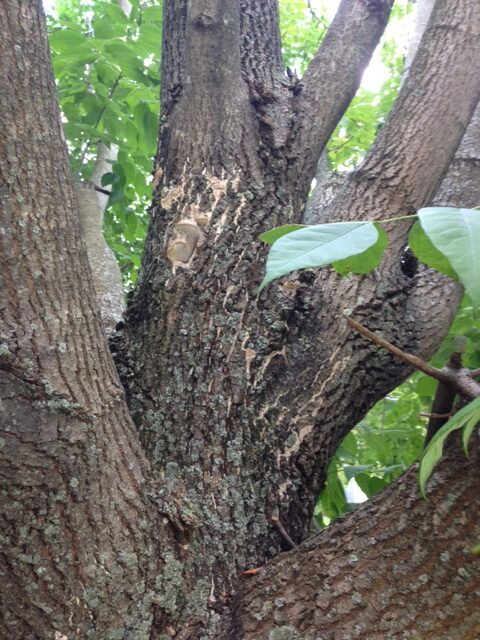

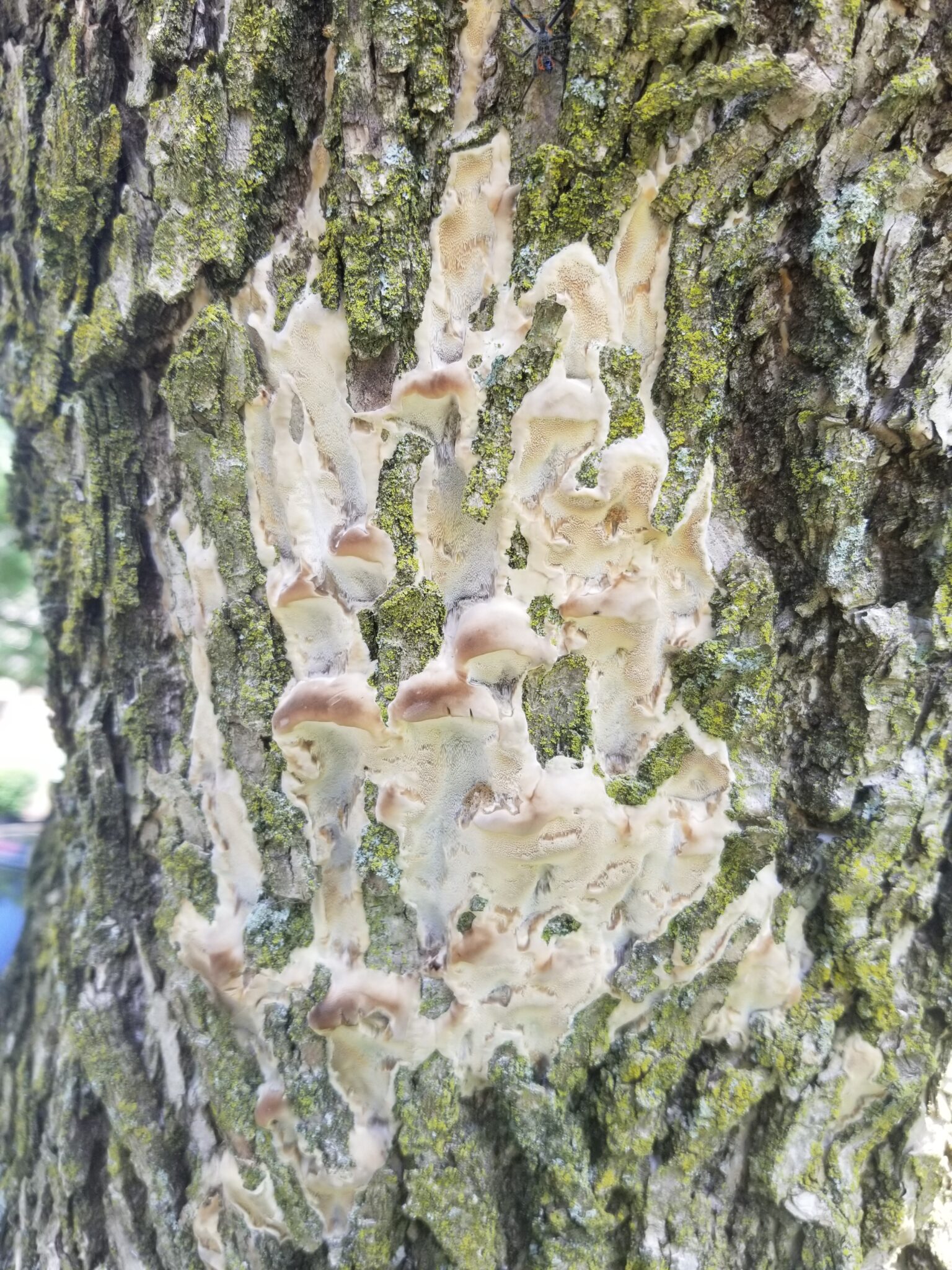
In the last few years, we have had a few samples of a similar fungus colonizing the trunk and base of ash trees, often near injection sites. Initially we were unable to identify the fungus, but DNA analysis revealed the fungus was a Fomitopsis species. This fungus develops a shallow shelf structure with white top and tan underside.
Fungal decay presents a greater risk to ash because it lacks the preservative enriched heartwood found in oak, walnut and other hardwoods that tends to slow down internal spread of fungi. Even fungi that initially invade dead areas of ash may rapidly colonize and degrade stem and trunk tissue.
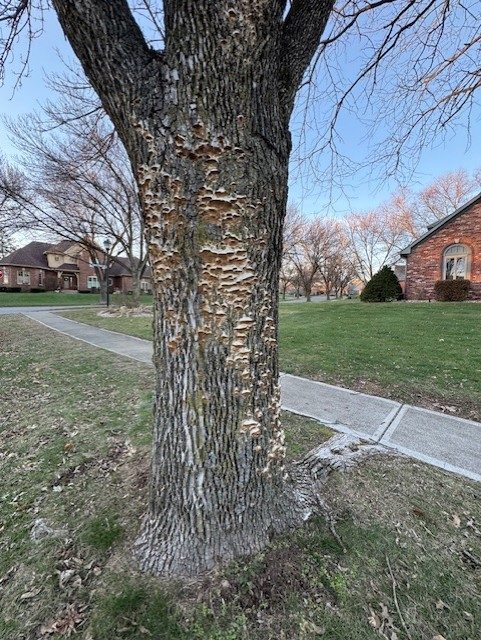
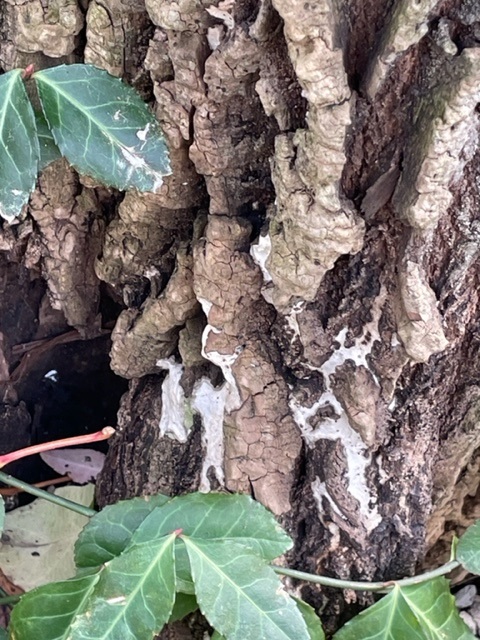
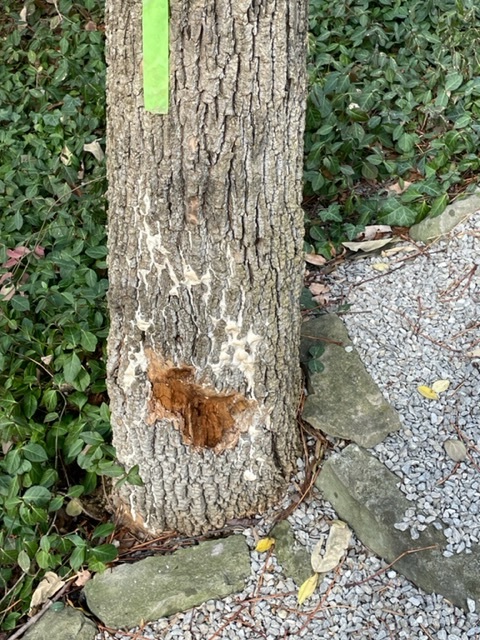
Fungal decay also disrupts vascular tissues in the stems and trunk, which further limits the movement and effectiveness of insecticide injections, so that infected trees may face greater damage from EAB. When found on small side branches the infection might be successfully pruned out, but in most cases the decay is in major branches or the trunk, which means the tree will need to be removed. If your ash trees that are being regularly treated for EAB but continue to show thinning and decline, check for these fungal invaders, they may be partly responsible.
View the original article on the Purdue Landscape Report website: Fungal Decay of Ash Trees.
Subscribe and receive the newsletter: Purdue Landscape Report Newsletter.
Resources:
Diplodia Tip Blight of Two-Needle Pines, The Education Store, Purdue Extension resource center
Boxwood Blight, The Education Store
Disease of Landscape Plants: Cedar Apple and Related Rusts on Landscape Plants, The Education Store
Planting Your Tree Part 1: Choosing Your Tree, Purdue Extension – Forestry & Natural Resources (FNR) YouTube Channel
Tree Planting Part 2: Planting a Tree, Purdue Extension – FNR YouTube Channel
Find a Certified Arborist, Trees are Good-International Society of Arboriculture (ISA)
Video: Step by Step to Find an Arborist, Trees are Good-International Society of Arboriculture (ISA)
Professional Forester, Indiana Forestry Woodland Owners Association
District Forester, Indiana Department of Natural Resources, 10+ acres
Trees and Storms: Understanding Damage, Risk and Recovery – Got Nature? Blog, Purdue Extension – FNR
Why Is My Tree Dying? – Got Nature? Blog, Purdue Extension – Forestry and Natural Resources
Tree Risk Management – Got Nature? Blog, Purdue Extension – FNR
Tree Pruning Essentials, Publication & Video, The Education Store
Tree Wound and Healing, Got Nature? Blog, Purdue Extension – FNR
What are Invasives Species and Why Should I Care?, Got Nature? Blog, Purdue Extension – FNR
Subscribe – Purdue Extension-FNR YouTube Channel
Tom Creswell, Plant & Pest Diagnostic Laboratory Director
Purdue Botany and Plant Pathology
Purdue Landscape Report: It’s finally October, and we should be enjoying lovely fall temps and colors. While some of the trees are changing, it’s not necessarily due to the change in seasons. As I write this, the temperature is 84 F (29 C). I look out my window and see mostly green leaves with some colors from the short cold snap we had and some from heat and drought stress. Whether you are worried about the trees in your yard and community or not, there are some simple tasks that we can do to assist them as we await the cooler temperatures of Autumn.

A 3 foot radius mulch ring around a medium sized tree (Purdue Landscape Report)
Mulching: One simple task to better prepare your trees for winter is to add a new layer of mulch, which benefits your trees in multiple ways. Adding a 2-3 inch thick layer of mulch will better maintain moisture levels and buffer extreme temperature changes in the soil and will add some organic matter too. Mulching to the drip line will benefit the tree the most, but in the case of larger trees it’s not always feasible. Try for at least a 3-foot radius from the trunk and make sure to leave a 2 inch or so gap between the trunk and the mulch. Remember, no volcano mulching.
Fertilizing: That mulch you just added will add some organic material to your soil as it slowly breaks down, but an autumn fertilization can benefit your trees too. Unlike trees in the forest that have a natural supply of nutrients from fallen leaves and twigs, trees around our homes are usually deprived as we rake and clean up our yards. Adding a slow-release fertilizer in the fall helps provide a nutrient boost over the winter, can promote root growth, and better prepare your tree for Spring.
Watering: Water is still an essential part of your tree care plan, but as temperatures drop and trees begin to head into dormancy they don’t need as much water as is required in the hit summer months. If you have irrigation systems in your yard start to drop the frequency of watering. You can water up until the first freeze, but make sure soils are just a little damp and not soaked. Evergreens in particular will benefit from slow deep watering 1-2 times a week until the soil freezes. Winter winds and temperatures can desiccate the needles without an adequate supply of water.
Pruning: Now is a good time to prune out any dead, damaged, or diseased limbs in your trees. If you have access to hand saws and pole saws or pruners, you can remove smaller branches or those closer to the ground. Make sure you are making proper pruning cuts though, and if there are large limbs, those at heights, or you are just unsure of how to make a good cut enlist the help of a professional arborist.

Use of white tree guards can protect the trunk from temperature changes that cause damage (Joseph O’Brien, USDA Forest Service)
Trunk Damage: Sunscald or southwest damage occurs on young and/or thin barked trees in the winter. Wounds can occur between the south to southwest facing part of the trunk on sunny days in the winter as temperatures rise and suddenly drop. Over time these wounds can become quite large. Trees can also incur damage from deer during the rut. Bucks will scrape trees with their antlers, scraping off the bark and damaging the cambium. Both of these injuries can be reduced one younger trees by installing tree guards in the fall. Tree guards are plastic barriers you place around the main stem of the tree. I recommend using white corrugated drainage pipe that can be found at most home centers. You can make a cut lengthwise along the pipe for easy installation and make sure it has a large enough diameter to leave a space between it and the tree. Just remember to remove it come Spring.
Inspections: Visual inspections can be done year-round, but this time of the year it might be easier to see changes in your tree as leaves are falling and the canopy becomes more visible. From the ground up to the canopy, some of the things you’re looking for include fungal growth around the base of the tree, any sort of damage on the main stem or branches, premature leaf drop or color change, and branches that are dead, cracked, diseased, or seem weak. Any concerns you find are also great information to share with an ISA Certified arborist which can be found using the Trees Are Good website.
View the original article on the Purdue Landscape Report website: Help Your Trees Transition into Autumn.
Subscribe and receive the newsletter: Purdue Landscape Report Newsletter.
Resources:
Re-mulch Your Trees, Purdue Landscape Report
Find an Arborist video, Trees are Good-International Society of Arboriculture (ISA)
Trees and Storms: Understanding Damage, Risk and Recovery – Got Nature? Blog, Purdue Extension – FNR
Moist soil and rotten roots makes it easy for trees to come crashing down – Fox 59 News
Expert: Some storm damage can be easily prevented – Fox 59
Why Is My Tree Dying? – Got Nature? Blog, Purdue Extension – Forestry and Natural Resources
Tree Risk Management – Got Nature? Blog, Purdue Extension – FNR
Tree Pruning Essentials, Publication & Video, The Education Store
Mechanical Damage to Trees: Mowing and Maintenance Equipment – The Education Store
Trees and Electric Lines – The Education Store
Tree Defect Identification, The Education Store
Planting Your Tree, video, Purdue Extension
Tree Installation, The Education Store
Tree Wound and Healing, Got Nature? Blog, Purdue Extension – Forestry and Natural Resources
Subscribe – Purdue Extension-FNR YouTube Channel
Ben McCallister, Urban Forestry Specialist
Purdue Forestry & Natural Resources
Welcome to ID That Tree! In this episode, Purdue Extension Forester Lenny Farlee introduces us to a widespread native shrub called smooth sumac. Found in open fields, roadsides and woodland edges across Indiana, this shrub is easily identified by its recognizable stems and leaves. Watch the video to learn about these characteristics, along with the differences in smooth sumac through the different seasons. For example, in summer, this shrub has flowers that turn into fruit heads! Whether you’re a student, naturalist or simply curious about native plants, this video offers a quick and helpful guide to identifying smooth sumac in the wild.
If you have any questions regarding wildlife, trees, forest management, wood products, natural resource planning or other natural resource topics, feel free to contact us by using our Ask an Expert web page.
Resources:
ID That Tree – Video Playlist, Purdue Extension – Forestry and Natural Resources (FNR) YouTube Channel
Purdue Arboretum Explorer
Conservation Tree Planting: Steps to Success, Purdue Extension – FNR YouTube Channel
A Woodland Management Moment, Playlist, Purdue Extension – FNR YouTube Channel
Woodland Stewardship for Landowners, Playlist, Purdue Extension – FNR YouTube Channel
Fifty Common Trees of Indiana, Purdue Extension – FNR
Indiana Invasive Species Council
Cooperative Invasive Species Management Area (CISMA)
Report Invasive, Purdue Extension
Habitat University, Episode 12 – Exploring the challenges of Invasive Species, Habitat University-Natural Resource University
Shrubs and Woody Vines of Indiana and the Midwest, Purdue University Press
Native Trees of the Midwest, Purdue University Press
Professional Forester, Indiana Forestry Woodland Owners Association
District Forester, Indiana Department of Natural Resources, 10+ acres
Find an Arborist, International Society of Arboriculture
Forest Improvement Handbook, The Education Store
Lenny Farlee, Extension Forester
Hardwood Tree Improvement and Regeneration Center
Purdue Department of Forestry & Natural Resources
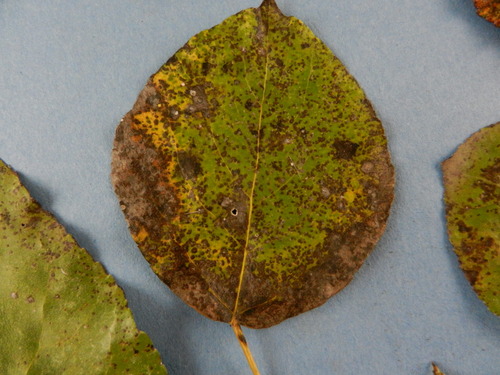
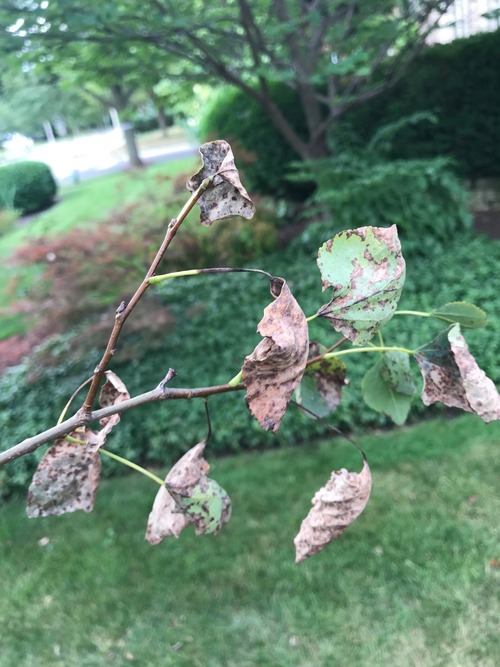
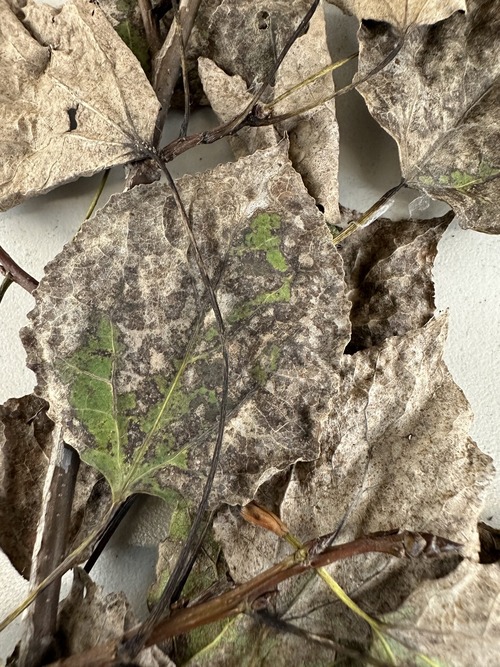
Purdue Landscape Report: Aspen, cottonwood, and poplar are all names for the fast-growing Populus tree species. Used widely for building materials, these trees are often located around ponds, riverbanks, and sloping areas toward water bodies (especially cottonwood). Cottonwood flowers produce little white tufted seeds that float through the air which a lot of people love (my kids included), unless it lands in their mouth. These beautiful trees are susceptible to a fungus that can cause significant damage under the right conditions: Marssonina (newer name is Drepanopeziza).
There are three species of Marssonina that can infect Populus – different tree species may only be susceptible to one of the Marssonina species. The fungi cause the same kind of disease and develop similarly on the host. Marssonina can infect the leaves, stems and seeds of Populus, which can lead to large amounts of leaf loss during wet weather, girdled stems and dieback, and aborted seeds. Since seeds can carry the fungus, the seed will take it with it to where it lands and can become infected immediately after germinating. It is common to see high disease severity in the canopy, but unless there is significant leaf loss (up to 70% defoliation) it may not reduce plant vigor. Leaf lesions typically develop as small black to brown dots or flecks which expand in size as time goes one. As the disease progresses, large areas of the leaf will become necrotic, creating odd dead blotches, potentially killing the majority of the leaf blade.
The fungus produces asexual spores in a small black pustule on the upper surface of the leaf which will eventually burst and release the spores during humid weather early in the spring. Marssonina will continue to produce spores and cause disease the whole season, creating repeat infections on the same tree. Symptoms tend to start lower in the canopy and ascend up the tree as the season progresses. The spores are spread by water splash, so rainfall will help spread this fungus in the landscape.
For trees planted in native landscapes, this disease will likely be inevitable and may make the foliage look less than stellar. That being said, removing leaves that drop or at the end of fall will reduce total inoculum for future seasons and can reduce total disease long-term. Similarly, trees that are stressed will typically develop increased disease severity, so if you are seeing large amounts of leaf spots or leaf loss, I would recommend employing stress mitigation strategies to keep the tree happy and healthy (fertilizer, mulch, irrigation as needed, etc.). If a tree appears to develop significant disease every year and has reduced limb growth, you may consider removing the tree if you are concerned it may die early and replace with a resistant clone, as disease susceptibility can vary greatly between clones of the same species.


View the original article on the Purdue Landscape Report website: Marssonina leaf spot and blotch of Poplar.
Subscribe and receive the newsletter: Purdue Landscape Report Newsletter.
Resources:
ID That Tree, Playlist, Purdue Extension – FNR YouTube Channel (Invasive White Mulberry, Siberian Elm, Tree of Heaven)
Eastern Cottonwood, Article, Purdue Fort Wayne
Find a Certified Arborist, Trees are Good-International Society of Arboriculture (ISA)
Video: Step by Step to Find an Arborist, Trees are Good-International Society of Arboriculture (ISA)
Professional Forester, Indiana Forestry Woodland Owners Association
District Forester, Indiana Department of Natural Resources, 10+ acres
Trees and Storms: Understanding Damage, Risk and Recovery – Got Nature? Blog, Purdue Extension – FNR
Why Is My Tree Dying? – Got Nature? Blog, Purdue Extension – Forestry and Natural Resources
Tree Risk Management – Got Nature? Blog, Purdue Extension – FNR
Tree Pruning Essentials, Publication & Video, The Education Store
Tree Defect Identification, The Education Store
Planting Your Tree, video, Purdue Extension
Tree Installation, The Education Store
A Woodland Management Moment, Playlist, Purdue Extension – FNR YouTube Channel (Against Invasives, Garlic Mustard, Autumn Olive)
Woodland Stewardship for Landowners, Playlist, Purdue Extension – FNR YouTube Channel (Common Buckthorn, Japanese Barberry)
Indiana Invasive Species Council
Indiana Department of Natural Resources: Invasive Species
Subscribe – Purdue Extension-FNR YouTube Channel
John Bonkowski, Lead Extension Administrator
Purdue Department of Botany and Plant Pathology

Recent Posts
- Popular Landscape Shrub is Invasive
Posted: October 15, 2026 in Alert, Forestry, Forests and Street Trees, Invasive Plant Species, Plants, Woodlands - Purdue Extension’s Regional Teams Are Here: Connecting Communities with Expertise and Opportunity
Posted: October 14, 2026 in Community Development, Forestry, Forests and Street Trees, Gardening, How To, Timber Marketing, Urban Forestry, Wildlife, Woodlands - Why Do Our Trees Go From Green Leaves to Different Colors?
Posted: in Forestry, Forests and Street Trees, Urban Forestry, Woodlands - Deer and Turkey Archery Seasons Opening Soon, MyDNR
Posted: October 13, 2026 in Alert, Safety, Wildlife - Distinguishing Dogwoods
Posted: in Forestry, Urban Forestry, Wildlife, Woodlands - It’s Not Too Early To Start Planning For Spring Tree Planting
Posted: in Forestry, How To - Can I Plant Trees in the Fall?
Posted: October 12, 2026 in Forestry, How To, Land Use, Plants, Urban Forestry, Wildlife - Burning for Benefits: Why Fire Belongs in Indiana
Posted: in Forestry, Safety, Woodlands - Publication Helps Midwest Fish Producers “Catch a Following” with Consumers
Posted: in Aquaculture/Fish, Aquatic/Aquaculture Resources, Wildlife - Disease May Cause Wilting and Eventual Death of Certain Trees and Shrubs, Purdue Landscape Report
Posted: October 5, 2026 in Disease, Forestry, Plants
Archives
Categories
- Alert
- Aquaculture/Fish
- Aquatic/Aquaculture Resources
- Ask the Expert
- Christmas Trees
- Community Development
- Disease
- Drought
- Forestry
- Forests and Street Trees
- Gardening
- Got Nature for Kids
- Great Lakes
- How To
- Invasive Animal Species
- Invasive Insects
- Invasive Plant Species
- Land Use
- Natural Resource Planning
- Nature of Teaching
- Plants
- Podcasts
- Ponds
- Publication
- Safety
- Spiders
- Timber Marketing
- Urban Forestry
- Webinar
- Wildlife
- Wood Products/Manufacturing
- Woodland Management Moment
- Woodlands