 Purdue University - Extension - Forestry and Natural Resources
Got Nature? Blog
 The Purdue Center for Global Soundscapes has been recognized by PBS. NOVA, a PBS documentary series focused on science, interviewed Bryan Pijanowski, Professor of Human-Environment Modeling and Analysis Laboratory, and Matt Harris, Graduate Research Assistant, to learn more on the subject and to share this story on the NOVA website in video format. Soundscape ecology is the study of how the environment changes by studying the sounds within that environment.
Anyone can be a citizen scientist and download their “sounds of earth” to the soundscape ecology database. There is no cost, and it is easy to do. Just visit the website, Record the Earth, for instructions.
Resources
Soundscape Ecology Research Projects, Forestry and Natural Resources
Purdue Boiler Bytes Highlights Discovery Park Global Soundscape Research Center Led by FNR’s Dr. Bryan Pijanowski, Got Nature?
Bryan Pijanowski, Professor of Human-Environment Modeling and Analysis Laboratory
Department of Forestry and Natural Resources
 “Community medicine collection programs make it easy for people to rid their homes of unwanted pharmaceuticals, but they can be difficult to get off the ground. That’s where our Unwanted Meds team comes in. They have helped police departments across Illinois and Indiana establish collection programs and raise awareness of the importance of proper disposal.
How to Dispose of Unwanted Medicine and Personal Care Products, Illinois-Indiana Sea Grant
Unwanted Medicine, IN.gov
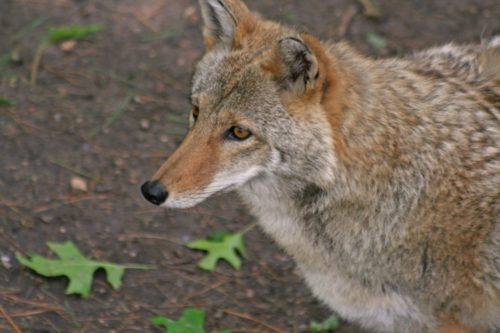 There have been multiple sightings of coyotes in the Indianapolis suburbs, especially the southern part of Indianapolis. As habitats for these animals shrink, the coyote sightings have increased. Coyotes no longer have any natural predators, but they are afraid of humans. These animals mainly eat small animals like rabbits, mice and squirrels but have been known to attack small pets. It is imperative to go outside with your pet to ensure their safety from coyotes. The Indiana Department of Natural Resources (INDNR) will be hosting a coyote seminar for the public in April.
What: Living with Coyotes, Greenwood
Where: Greenwood Library, 310 S. Meridian St., Greenwood, IN
When: April 2, 2015
Time: 5:30-7:30 pm
Cost: Free
Registration is required.
Resources
Coyotes a Constant Problem in Indy Suburbs, IndyStar
Dealing with Nuisance Coyotes, INDNR
Should I Be Worried About Coyotes In My Yard?, Got Nature?
Coyotes, Wildlife Conflicts, Department of Entomology, Purdue University
Dealing with Nuisance Coyotes, Indiana Department of Natural Resources
Permitted Wildlife Rehabilitators, Indiana Department of Natural Resources
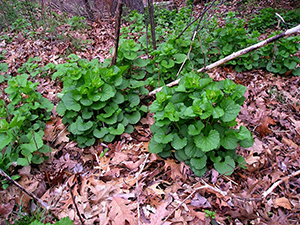 Sustainable Forests Roundtable will be hosting a Invasive Plant Best Management Practices webinar. Best Management Practices (BMP) help you identify effective and realistic practices that can be integrated into any behavior. Whether you’re a gardener, a landowner, a forester or a logger, the movement of invasive species is always a concern. A BMP can be as simple as cleaning your shoes or as complex as pressure washing your bulldozer. Regardless of your practice, the goal is always to minimize the spread of invasive species.
Learn how to create best management practices that help identify and minimize the spread of invasive species. The presenters for the webinar are Bernie Williams, Invasive Plants and Earthworms Outreach Specialist, Wisconsin Department of Natural Resources; Brad Herrick, Ecologist and Research Manager, University of Wisconsin Arboretum; and Judy Kingsbury, Volunteer Coordinator, University of Wisconsin Arboretum.
Who: Sustainable Forests Roundtable
What: Invasive Plant Best Management Practices webinar
Where: On the Sustainable Forests Roundtable website
When: March 24, 2015, 1 pm US/Eastern
Details: No registration is required. View the Sustainable Forests Roundtable website to see how to join the webinar.
Resources
Got Nature? Blog (Click on “Invasive Plant Species”), Department of Forestry and Natural Resources (FNR)
Invasive Plants, Purdue Agriculture Weed Science
Invasive Plant Species, Indiana Department of Natural Resources
Sustainable Forests Roundtable
Partners include: North Carolina State University’s Extension Forest Resources, Texas AgriLife Extension Service and the USDA Natural Resources Conservation Service.
 Have you ever wondered what an unfettered rainforest sounds like? Or maybe been curious about the sounds of the shifting coastal tides of Alaska? Well Purdue Department of Forestry and Natural Resources Professor Bryan Pijanowski and his students have now made it possible to hear sounds from a wide number of locations around the world. Dr. Pijanowski, Professor of Human-Environment Modeling & Analysis Laboratory, has led teams to locations across the globe, including Costa Rica, Borneo and the Sonaran Desert, in an effort to record and archive the sounds produced by various ecosystems. Dr. Pijanowski and his team have developed a series of applications for mobile devices and other technologies for soundscape recordings and research.
You can help capture and preserve sounds of the Earth and highlight their bellwether role in alerting scientists to environmental habitat changes by using the free app available at The Education Store, Purdue Extension. On Earth Day, April 22, 2015, The Global Soundscapes Research Center will try to surpass the number of downloads these received in 2014 on Earth Day.
Resources
Center for Global Soundscapes
Conserving Biodiversity in Agricultural Landscapes, Purdue University Press
Managing Forest & Wildlife Resources: An Integrated Approach, The Education Store
Bryan Pijanowski, Professor of Human-Environment Modeling & Analysis Laboratory
Department of Forestry and Natural Resources, Purdue University
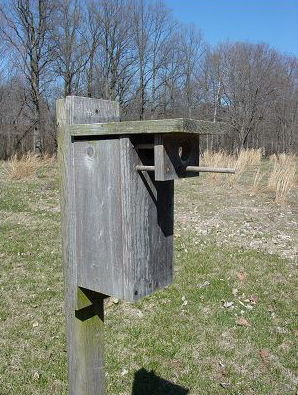
Remove perches from wildlife nest boxes like the bluebird box pictured here. Perches allow undesirable birds to harass native cavity nesters and take over a nest box.
Even though we have had some rough weather lately, this winter didn’t seem so bad to me. Now that the weather forecast is looking positive and the days are getting longer (this month, we gain about 75 minutes – I am embarrassed to admit that I check this frequently during the winter because it helps me get through the winter doldrums), it is a good time to think about wildlife habitat projects.
Many species of native birds and mammals will utilize nest boxes. When we put out a nest box, all we are doing is replicating what nature already provides with cavities in both live and dead trees. Woodpeckers are primary cavity users because they create their own. Other birds and mammals are secondary cavity users because they use what is already there – either those that occur in older, dying trees or those that are created by woodpeckers. Installing nest boxes in areas where cavities are likely scarce such as urban environments or young woods may be particularly beneficial.
Tips
- Use quality materials that are weather resistant. Exterior grade plywood and lumber are good choices. Cedar and other rot-resistant woods are best. Avoid using treated lumber and metal.
- Avoid painting or staining inside nest boxes. Painting the outside can prolong its life and may be attractive for some species (white for purple martins, for example).
- The roof should be sloped to allow water runoff and should hang over the sides.
- Drill at least four 3/8-inch drainage holes on the floor.
- The roof or one side should open to allow easy access for cleaning.
- Avoid perches. Natural cavities don’t have them and neither should your nest box. Perches also allow European starlings and English house sparrows, non-native invasive species, to harass native cavity nesters and take over a nest box.
- Near the top of each side, leave gaps or drill 5/8-inch holes (at least two per side).
More tips on design, such as nest box specifics by species (dimensions, hole size and placement, box placement and location), maintenance and problem species, can be found in our Nest Boxes for Wildlife publication.
Other resources available:
Attracting Hummingbirds to Your Yard, The Education Store
Birds of Benton County, Indiana, The Education Store
Brian MacGowan, Extension Wildlife Specialist
Department of Forestry and Natural Resources, Purdue University
 “When it snows…
and temperatures drop,
That’s when you’ll hear
The Snap, Crackle and Pop.”
Few things can compare to the peacefulness of walking in a forest filled with snow covered trees until you hear a snap, crackle or an explosive “POP” echoing through the woods. What on earth was that? If the noise is followed by a “whoosh,” it may be a limb that just broke and crashed to the ground. If it sounded like a gunshot but nobody is there, you may be listening to the sound of a frost crack forming on a tree.
What are frost cracks?
Nobody knows for sure. You may hear one happen, typically on a cold late winter morning after a warm spell. They sound like muffled to loud rifle shots. Typically, these cracks occur on the south side of the trunk between two and five feet up the tree (when measuring from the ground). With leaves on, water is pulled upwards from tree roots through the xylem vessels by the differences in water potential from the air to the soil and escapes through the leaves (the soil-plant-air continuum).
Water in the plant is under a negative water potential, or in common terms, under tension. In the winter, when deciduous trees have no leaves, the water pressure in the sap becomes positive. A flow occurs where water moves up in the xylem and cycles down in the phloem (food conducting cells). The mechanism of this winter flow in temperate trees is not well understood physiologically. The sap increases in simple soluble sugars as the cold weather begins and increases until midwinter to work like antifreeze, depressing the freezing point of water. This is why maple syrup can be tapped in late winter.
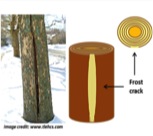 Scientists are challenged to study the phenomena of frost cracks. They involve thousands of xylem vessels in a very narrow vertical line bursting all at once – as if a line of sap is too low in sugar concentration – and then freezes hard explosively bursting the vessels. After several growing seasons, most trees will heal over the crack, but callus growth makes them appear wider. Valuable timber logs can still be profitably harvested with frost cracks as millers can cut through them to minimize the defect.
Species with darker colored bark and thinner bark can be affected by frost cracks. Some genotype effects have been found in black walnuts at Purdue. Field conditions and topography that effect cold air movement can affect frost cracks. Most form on the southwestern section of the trunk, the area most affected by warming from sunlight during winter afternoons. Somehow, this conditioning sets up the tree when temperatures plummet to single digits (in Fahrenheit) or lower, especially after a warmer period.
So if you wander through the woods this winter, stop but don’t “drop” when you listen to the sounds of the trees.
“When the snow twinkles
and the skies are bare…
Temperatures drop
and a chill fills the air.
If you listen real close
and adjust your cap,
You just might hear
a tree go ‘Snap!’”
Resources
Bark Splitting on Trees, Cornell University
Video: How Do Trees Survive Winter? MinuteEarth
Winterize Your Trees, The Education Store
Shaneka Lawson, Adjunct Assistant Professor
Department of Forestry and Natural Resources
James McKenna, Operational Tree Breeder
Department of Forestry and Natural Resources
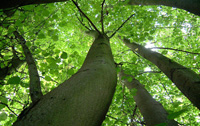 The 2015 Indiana Tree Farm Landowners Clinic is a program designed to provide landowners interested in managing their forests and wild lands an introduction to management practices and resources for advice and assistance. The program is open to anyone interested in trees and wildlife. Since 1941, the American Tree Farm System has educated and recognized the commitment of private family forestland owners demonstrated in sustainable forest stewardship. We will have tree measuring sticks available for sale. Join us to learn more about Tree Farm and how you can improve your property. This program is offered through the cooperation of the Indiana Tree Farm Committee, the Indiana Department of Natural Resources (INDNR) – Division of Forestry and the Hardwood Tree Improvement and Regeneration Center (HTIRC).
What: 2015 Indiana Tree Farm Landowners Clinic
When/Where: Friday, March 27, 2015, at The Reuter Tree Farm from 1-4 pm; Saturday, March 28, 2015, at McCormick’s Creek State Park, Spencer, IN from 9 am to 4 pm
Registration: $50 per person or $75 per couple. Must register by March 20, 2015.
See the brochure for more details and registration.
Resources
Purdue FNR Events
Forest Improvement Handbook, The Education Store
A Landowner’s Guide to Sustainable Forestry: Part 1: Sustainable Forestry – What Does It Mean For Indiana?, The Education Store
Lenny Farlee, Sustaining Hardwood Extension Specialist
Department of Forestry and Natural Resources & HTIRC
Bob Burke, Consulting Forester
Indiana Tree Farm Program
 Purdue University is partnering with three Indiana zoos and the state in a conservation program that will involve raising year-old hellbender salamanders and then returning them a few years later to their southern Indiana habitat to be tracked.
Rod Williams, associate professor of wildlife science and leader of the university’s hellbender effort, approached officials at Columbian Park Zoo in Lafayette, Fort Wayne Children’s Zoo and Mesker Park Zoo in Evansville about joining the program, which also includes the Indiana Department of Natural Resources.
North America’s largest salamander is in decline nationally and is most vulnerable to predators when young. “Mortality can be as high as 99 percent in the wild,” Williams said. “By rearing them in captivity for three to four years, they will have a much better survival rate.” Read the full article from Purdue Agriculture News.
Resources
Help the Hellbender, Purdue University
Aquaculture Research Lab, Department of Forestry and Natural Resources
The Nature of Teaching, The Education Store, Purdue Extension (Search “Nature of Teaching” for a list of all available lessons)
Rod Williams, Associate Professor of Wildlife Science
Department of Forestry and Natural Resources (FNR), Purdue University
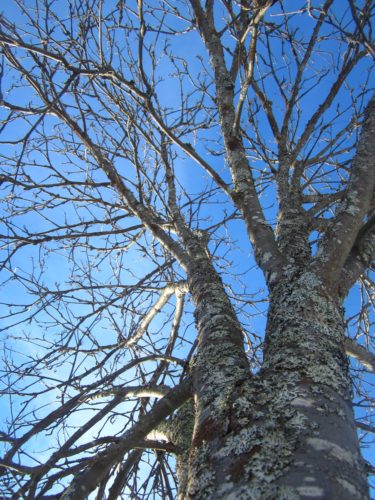 The Terre Haute area in Indiana is in a tree crisis. With Emerald Ash Borer and other deciding factors, 300+ trees a year will be removed. Over the next few years, this averages to approximately 24 percent of the total trees will be gone. Planning for the future with the knowledge of this loss is crucial. While the city will pay for removing the trees and tree-related projects, it is not in the city’s budget to replace the trees at this time. The city needs to apply for grants to fund replanting projects. The trees are removed due to diseases, age and when people run into them with cars. If you want to learn more about the tree crisis and the action that will be taken, you are welcome to attend the Emerald Ash Borer summit.
What: TREES Inc. Emerald Ash Borer Summit
Where: Vigo County Library, Meeting Rooms A, B and C
When: Thursday, February 12, 12-1:30 pm
Resources
Emerald Ash Borer in Indiana, Purdue Extension
Tree Installation: Process and Practices, The Education Store
Tree Risk Management, The Education Store
Got Nature?
Department of Forestry and Natural Resources
Purdue University

Recent Posts
- 2026 Winter Bat Survey In Progress, MyDNR
Posted: March 27, 2026 in Wildlife - Fast-Growing Trees for the Landscape, Purdue Landscape Report
Posted: March 26, 2026 in Forestry, Urban Forestry, Woodlands - Urban Tree Spotlight: Planting Deciduous Shade Trees, Purdue Landscape Report
Posted: March 25, 2026 in Forests and Street Trees, Urban Forestry, Woodlands - Beetle that attacks Tree-of-Heaven found in Indiana, Purdue Landscape Report
Posted: March 20, 2026 in Invasive Insects, Wildlife, Woodlands - ID That Tree: Dwarf Chinkapin Oak
Posted: in Forestry, Urban Forestry, Wildlife, Woodlands - IN-PREPared: Essential Resources for Indiana’s Severe Weather Season
Posted: March 11, 2026 in How To, Safety - DNR Hiring for Indiana Conservation Officer Positions, MyDNR
Posted: March 9, 2026 in Urban Forestry, Wildlife, Woodlands - ID That Tree: Shumard Oak
Posted: in Plants, Urban Forestry, Wildlife, Woodlands - A Woodland Management Moment: Windbreak Around Walnut Plantings
Posted: March 3, 2026 in Forestry, Urban Forestry, Woodland Management Moment - Getting Certified as an Indiana Certified Prescribed Burn Manager
Posted: March 2, 2026 in How To, Urban Forestry, Woodlands
Archives
Categories
- Alert
- Aquaculture/Fish
- Aquatic/Aquaculture Resources
- Ask the Expert
- Christmas Trees
- Community Development
- Disease
- Drought
- Forestry
- Forests and Street Trees
- Gardening
- Got Nature for Kids
- Great Lakes
- How To
- Invasive Animal Species
- Invasive Insects
- Invasive Plant Species
- Land Use
- Natural Resource Planning
- Nature of Teaching
- Plants
- Podcasts
- Ponds
- Publication
- Safety
- Spiders
- Timber Marketing
- Uncategorized
- Urban Forestry
- Webinar
- Wildlife
- Wood Products/Manufacturing
- Woodland Management Moment
- Woodlands