 Purdue University - Extension - Forestry and Natural Resources
Got Nature? Blog
Indiana joined 22 other states in 2025 when it launched its state-level Certified Prescribed Burn Manager (CPBM) Program. This program resulted from HB-1557, which went into effect on July 1, 2025. For more information about the new prescribed fire law in Indiana and what it means for burners, check out the Indiana Prescribed Burn Law Factsheet.
This article will walk through the steps to complete all stages of the program. The Indiana DNR CPBM Policy can be viewed by visiting the Indiana Prescribed Fire Council website.
The CPBM program consists of three parts:
- Online Training
- In-Person Training
- Prescribed Burn Experience
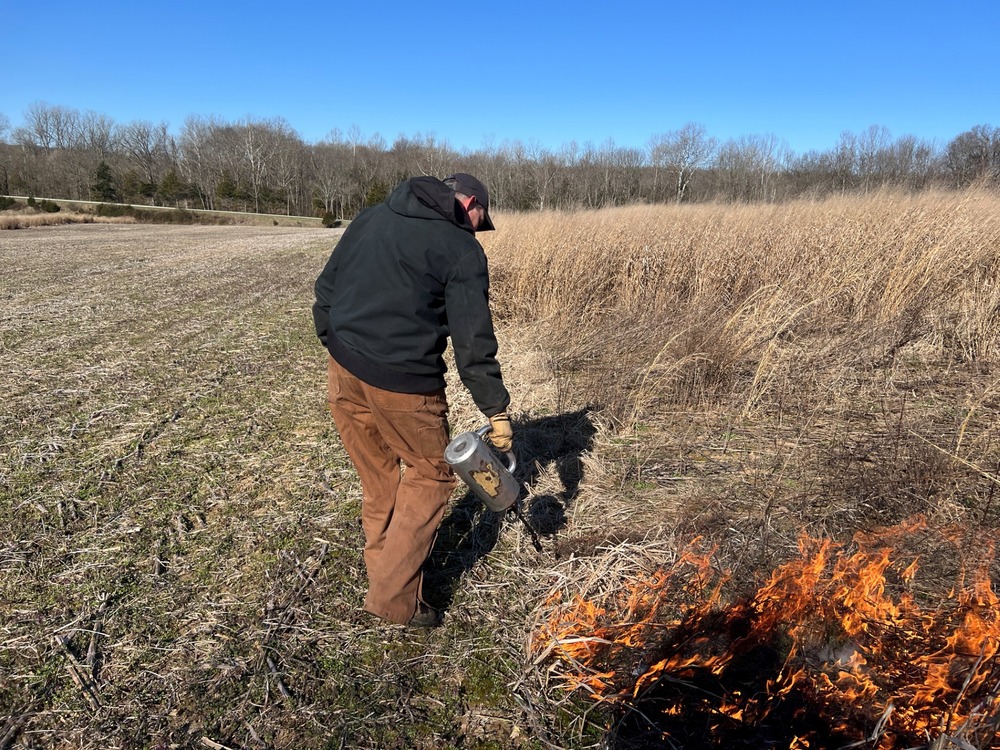 Indiana CPBM Requirements At-a-glance
- Online Training
- S-130
- S-190
- L-180
- IS-100
- In-Person Training
- S-130 Field Day (no pack test requirement)
- Indiana DNR Prescribed Fire for Managers
- Burn Experience (Minimum of 5 total burns for experience)
- Participate in 5 prescribed fires
- At least 3 in woodland at least 1 in grassland
- Ben an Apprentice Burn Manager for 2 burns
- 1 woodland and 1 grassland burn
- Paperwork and Documentation
- IN CPBM Application
- IN CPBM Experience Log
- IN CPBM Task Book
- Burn Plans for Apprentice Burns

Online Training Requirements
The online training required for the CPBM program includes many of the same courses as are necessary for Basic Wildland Firefighting.
- S-130 Firefighter Training
- S-190 Introduction to Wildland Fire Behavior
- L-180 Human Factors on the Fireline I
- S-100 Introduction to the Incident Command System
These are self-paced, free online courses available through FEMA, the National Fire Academy (NFA), and the Wildland Fire Learning Portal.
- FEMA – IS-100
- National Fire Academy Registration Page – S-130, S-190, L-180
- Wildland Fire Learning Portal – S-130, S-190, L-180
*Before taking any courses through FEMA or registering for the NFA, you need to obtain a FEMA SID#. You can do that at FEMA: Student Identification System.

In-Person Training Requirements
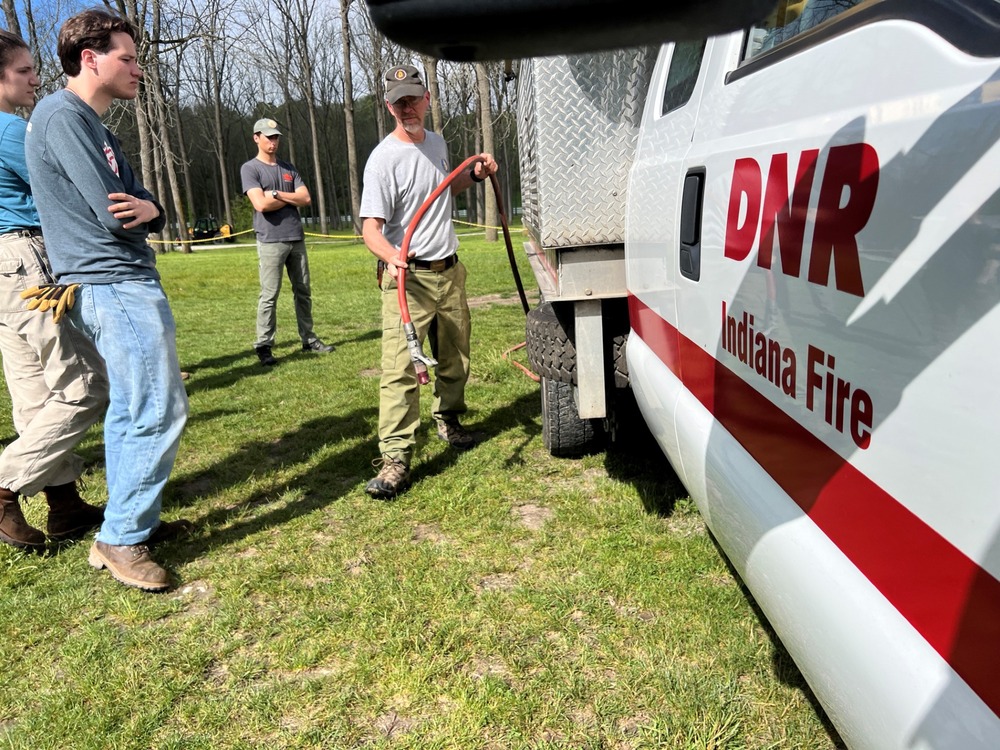 The two requirements for in-person training are:
- S-130 Field Day (1-day; no pack test required)
- Indiana DNR Prescribed Fire for Managers (2-day)
How to complete the in-person training?
In-person S-130 Field Days and Indiana DNR Prescribed Fire for Managers courses are offered 1-2 times per year, often offered in the spring (Feb-Mar) and in December.
*To take the S-130 Field Day, you need to complete the required online training before the field day. To take the Prescribed Fire for Managers Course, you need to take the S-130 Field Day.
You can find information about upcoming trainings by visiting the Indiana Prescribed Fire Council (INPFC) website and the Indiana DNR Fire Headquarters Training Portal.

Prescribed Burn Experience
To be an Indiana CPBM, you need the following prescribed fire experience:
- Participate in 5 prescribed fires across the 2 major fuel model groups in Indiana (grass and hardwood timber litter)
- At least 3 of the burns shall be in the hardwood timber litter fuel model
- Serve as an Apprentice Burn Manager on 2 of the 5 prescribed burns – 1 from each of the two fuel model groups (grass and timber litter)
Serving as an “Apprentice Burn Manager” means you need to lead burns under the guidance of an existing CPBM, RxB1, or RxB2 (RxB1 & RxB2 are Burn Boss qualifications through the National Wildfire Coordinating Group) and complete a Certified Prescribed Burn Manager Task Book related to preparing for and managing a prescribed burn.
How do I receive prescribed fire experience?
To get experience as a crew member on prescribed fires, here are a few steps:
- Meet Common Training Requirements: Many organizations (but not all) require burn crews to have basic wildland fire training courses, many of which are needed for the CPBM program. Having these trainings will open the door for more opportunities.
- Basic Wildland Firefighter (FFT2) Requirements (bolded are required for CPBM)
- S-130 (Online and Field Day)
- S-190
- L-180
- IS-100
- IS-700B
- Arduous Work Capacity Test (Pack Test)
- Basic Wildland Firefighter (FFT2) Requirements (bolded are required for CPBM)
- Attend a Learn-N-Burn: these half- or full-day events can help you get your feet wet with prescribed fire and are offered by groups like the Indiana DNR Division of Fish and Wildlife and Purdue Extension. Generally, prior experience or training is not required for these events.
- Upcoming Learn-N-Burns can be found under Events on the INPFC events website.
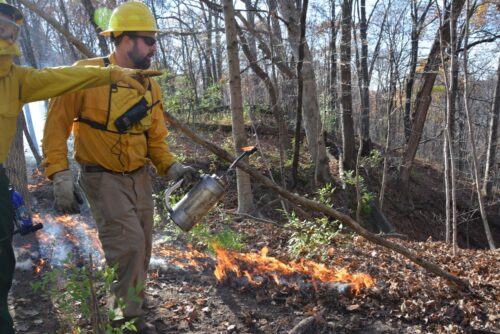 Find Volunteer Opportunities: Many organizations accept volunteers for prescribed fire, but may require Basic Wildland Firefighter Training (see above).
- Volunteer on burns with The Nature Conservancy
- To be a TNC fire volunteer, you need to be a FFT2 or complete the Prescribed Fire Crew Member (RxCM) standard, which is similar to FFT2 standards but does not require IS-700 and requires a moderate pack test. View the TNC Fire Manual for more information.
- To learn more about helping TNC on prescribed burns, contact Stuart Orr, Indiana Fire Program Manager at sorr@tnc.org.
- Volunteer on burns with The Nature Conservancy
- Volunteer with your Local Land Trust
- Indiana is home to over 20 land trusts, many of which utilize prescribed fire.
- Each land trust may have different requirements to volunteer for prescribed fire.
- Visit the Discover Your Land Trust page on the Indiana Land Protection Alliance website to find a land trust in your area.
- Find landowners in your area who are using prescribed fire and volunteer to help
- Several landowners across Indiana use prescribed fire and may be seeking help.
- You may be able to find landowners who burn through existing conservation networks, such as local NGOs (NWTF, NDA, PF, or QF Chapters) or landowner groups such as the Indiana Forest and Woodland Owners Association.
- Join or start a Prescribed Burn Association, which is a collection of landowners who help each other burn by pooling resources, equipment, knowledge, and crew through a “Neighbor Helping Neighbor” model.
- Several landowners across Indiana use prescribed fire and may be seeking help.
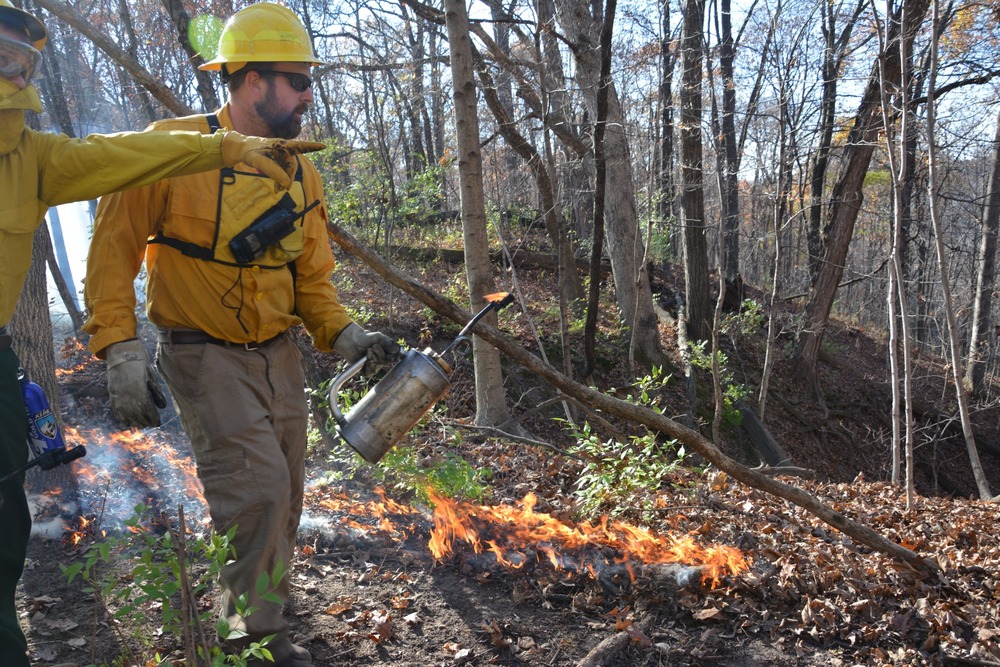
How do I receive apprentice burn manager fire experience?
The first step in finding opportunities is building relationships with current prescribed fire practitioners. By volunteering as a crew member, you start to learn about prescribed fire and build relationships with existing burn managers. This may lead to opportunities to apprentice in the future.
The Indiana Prescribed Fire Council is piloting a Prescribed Fire Opportunity Sharing Network to help connect those seeking burn experience with experienced burners. You can use the links below to sign up for this network as either a Mentor (have experience) or Mentee/Apprentice (need experience). Register on the Mentor sign-up or the Mentee sign-up.
Resources:
FNR Ask The Expert: Prescribed Fire, Purdue Extension Forestry & Natural Resources
100 Year Project Shares New Video, Prescribed Fire, Purdue Extension – FNR Got Nature? Blog
Brooke’s Prescribed Fire Videos Utilized in Global USFS Efforts, Purdue Extension – FNR Got Nature? Blog
Prescribed fire: 6 things to consider before you ignite, Got Nature? Blog, Purdue Extension – 4Forestry and Natural Resources
Wildlife Habitat Hint: Prescribed Fire Techniques – Backing Fire, Video, Purdue Extension – Forestry and Natural Resources YouTube channel
Wildlife Habitat Hint: Prescribed Fire Techniques – Flanking Fire, Purdue Extension – FNR Video
Wildlife Habitat Hint: Prescribed Fire Techniques – Strip Head Fire, Purdue Extension – FNR Video
Wildlife Habitat Hints: Prescribed Fire Techniques – Ring Fire, Purdue Extension – FNR Video
Wildlife Habitat Hints: Prescribed Fire Techniques – Point Source Fire, Purdue Extension – FNR Video
Wildlife Habitat Hint: Late Growing Season Prescribed Fire, Purdue Extension – FNR Video
FNR Ask The Expert: Prescribed Fire with Jarred Brooke and Mike Saunders, Purdue Extension – FNR Video
Indiana Prescribed Fire Council
Renovating Native Warm-Season Grass Stands for Wildlife: A Land Manager’s Guide, The Education Store, Purdue Extension resource center
Jarred Brooke, Wildlife Extension Specialist
Purdue Department of Forestry and Natural Resources
Attention teachers! If you’re interested in bringing real-world natural resources learning into their classrooms, you now have the opportunity to apply for the 2026 Indiana Natural Resources Teacher Institute (NRTI). Registration is officially open and applications are due March 31, 2026. The NRTI is a week-long, immersive professional development workshop designed to equip teachers with the knowledge, skills, and tools to effectively teach forest ecology, forest management, and natural resource science. Cohosted by the Indiana Department of Natural Resources Division of Forestry and Purdue University Forestry and Natural Resources Extension, the institute blends classroom-ready training with hands-on field experiences.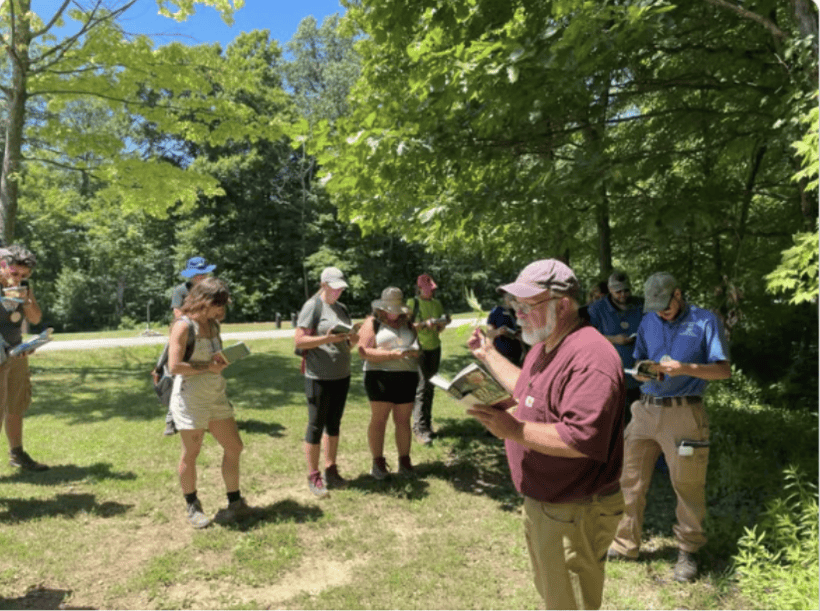
The 2026 institute will take place June 15–19, beginning at 1 p.m. on Monday and concluding at noon on Friday. Participants will stay at the Forestry Training Center at Morgan-Monroe State Forest near Martinsville, where meals and lodging are provided.
Throughout the week, educators will:
- Tour public and private forest lands, forest industry facilities, and forestry research sites
- Learn from natural resource professionals, researchers, and industry leaders
- Explore how sustainable forestry supports Indiana’s environment, economy, and quality of life
- Develop a curriculum project to implement with their students
There is no cost to attend. Accepted applicants (up to 18 educators) pay a refundable $50 deposit, returned at the end of the program.
To explore program details, visit the Indiana Natural Resources Teacher Institute webpage.
Resources:
Purdue Forestry and Natural Resources Facebook Page
Project Learning Tree
Indiana Department of Natural Resources Division of Forestry
The Nature of Teaching, Purdue Department of Forestry and Natural Resources
The Nature of Teaching: Trees of the Midwest, The Education Store
The Nature of Teaching: Adaptations for Aquatic Amphibians, The Education Store
Trees of the Midwest Webinar, Nature of Teaching YouTube channel
Indiana Forestry Educational Foundation, Indiana Forestry & Woodland Owners Association
Forest/Timber, Playlist, Purdue Extension – Forestry and Natural Resources YouTube Channel
Natural Resources Teacher Institute Takes Forestry to the Classroom, Purdue FNR News
Purdue Extension
Diana Evans, Extension & Web Communications Specialist
Purdue University Department of Forestry and Natural Resources
Check out the Purdue Extension – Forestry and Natural Resources YouTube Channel for more videos and webinars covering urban and forestry management, woodlands and wildlife.
Lenny Farlee, Extension Forester
Hardwood Tree Improvement and Regeneration Center
Purdue Department of Forestry & Natural Resources
Join Purdue Extension forester Lenny Farlee in this episode of “A Woodland Management Moment” as he talks about planting density when thinking about hardwood tree plantation. In an earlier video, we discussed higher density plantings for timber productions. In this video, we’ll continue that conversation and talk about planting with wide spacing specifically for nut production. This episode explores these nut producing species like black walnut, their growth in the forests and what that means for woodland management decisions. Watch the video to learn about opportunities, challenges and considerations for balancing growth rates with high quality output.
If you have any questions regarding trees, forests, wildlife, wood products, or other natural resource topics, feel free to contact us by using our Ask an Expert web page.
Resources:
A Woodland Management Moment, Playlist, Purdue Extension – Forestry and Natural Resources (FNR) YouTube Channel
The Nature of Oaks Webinar, Purdue Extension-FNR YouTube Channel, Shared from Indiana Forestry & Woodland Owners Association
Conservation Tree Planting: Steps to Success, Purdue Extension – FNR YouTube Channel
Shrubs and Woody Vines of Indiana and the Midwest, Purdue University Press
Native Trees of the Midwest, Purdue University Press
ID That Tree, Playlist, Purdue Extension – FNR YouTube Channel
Investing in Indiana Woodlands, The Education Store
Woodland Stewardship for Landowners Video Series, Playlist, Indiana Department of Natural Resources YouTube Channel
Ask an Expert: Tree Selection and Planting, Purdue Extension – FNR YouTube Channel
Forest Improvement Handbook, The Education Store
Find an Indiana Professional Forester, Indiana Forestry & Woodland Owners Association (IFWOA)
Purdue Arboretum Explorer
Lenny Farlee, Extension Forester
Hardwood Tree Improvement and Regeneration Center
Purdue Department of Forestry & Natural Resources
 Purdue Extension is proud to share the 2025 Impact Report, a showcase of the people, programs, and partnerships driving stronger, more resilient communities across Indiana. This year’s report highlights how research from Purdue’s College of Agriculture is being put into action, from addressing the spread of tar spot in corn, to monitoring invasive species, to supporting farmers navigating concerns around Highly Pathogenic Avian Influenza (bird flu).
Here is a quick snapshot of the great articles and information you will find:
- Saving One of Indiana’s Top Crops From Tar Spots
- 4-H Tech Changemakers Lead the Way in AI
- Teaching Small Steps to Achieve Healthier Lives
- Strengthening Financial Security Through Tax Preparation and Education
- Uniting Indiana Residents Against Invasive Species
Highlighting Lenny Farlee, Extension forester, and Henry Quesada, professor and assistant director of Extension. Check out all of our FNR resources listed below. - Supporting Childcare Providers to Create Stronger Communities
- Emergency Preparedness and Response to Highly Pathogenic Avian Flu
- Making the Best Better: Strengthening Teen Leadership Skills
- Check out program impacts
Explore the full report to see how Extension is making a difference statewide and beyond: Purdue Extension Impact Report 2025.
Resources:
What are Invasive Species and Why Should I Care?, Purdue Extension – Forestry & Natural Resources (FNR) Blog
Woodland Management Moment: Invasive Species Control Process, Purdue Extension – FNR YouTube channel
Asian Bush Honeysuckle, Purdue Extension – FNR YouTube channel
Burning Bush, Purdue Extension – FNR YouTube channel
Callery Pear, Purdue Extension – FNR YouTube channel
Multiflora Rose, Purdue Extension – FNR YouTube channel
Invasive Plants Threaten Our Forests Part 1: Invasive Plant Species Identification
Aquatic Invasive Species, Illinois-Indiana Sea Grant (IISG)
Indiana Invasive Species Council
Emerald Ash Borer Information Network, Purdue University and Partners
The GLEDN Phone App – Great Lakes Early Detection Network
EDDMaps – Early Detection and Distribution Mapping System
1-866 No EXOTIC (1-866-663-9684)
depp@dnr.IN.gov – Email Indiana Department of Natural Resources (DNR)
Woodland Stewardship for Landowners, Playlist, Purdue Extension – FNR YouTube channel
A Woodland Management Moment, Playlist, Purdue Extension – FNR YouTube channel
Subscribe to Purdue Extension – FNR YouTube channel YouTube channel
Nature of Teaching, Purdue College of Agriculture
Community Development, Purdue Extension
Are you a woodland owner who is just beginning to explore forest regeneration, restoration and reforestation activities?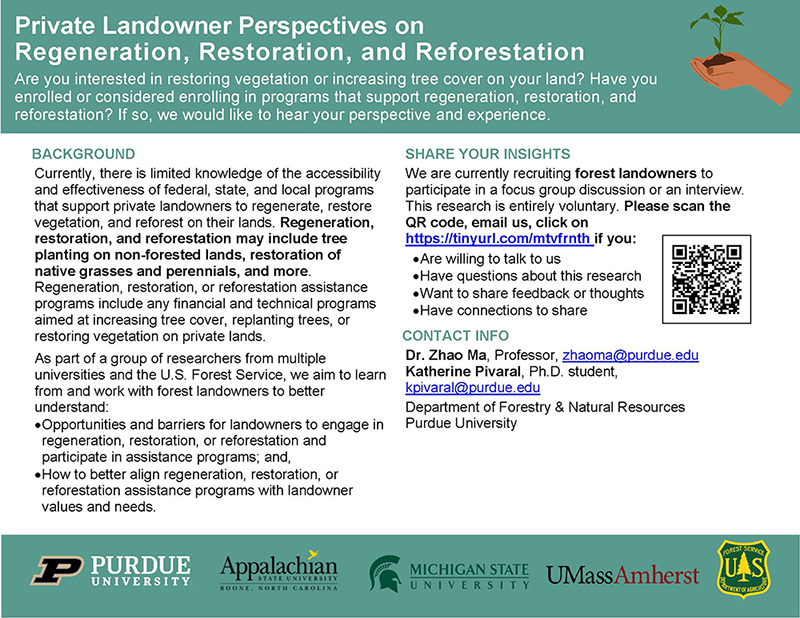
The Human Dimensions Lab at the Department of Forestry and Natural Resources with Purdue University is conducting research to understand private landowners’ perspectives on regeneration, restoration and reforestation. Private forest and woodland owners are key partners in forest and vegetation management efforts across the United States. These activities may involve tree planting, restoration of native vegetation or other practices aimed at enhancing forest and vegetation cover on private lands. Various federal, state and local programs offer financial and technical assistance to support these efforts and understanding landowner perspectives is important for informing future research and outreach.
About the Research
As part of a collaborative research effort involving multiple universities and the U.S. Forest Service, the Purdue University research team is working directly with private forest landowners to better understand real‑world experiences with regeneration, restoration and revegetation.
Specifically, the research aims to:
- Better understand the opportunities and barriers that landowners face when considering or engaging in regeneration, restoration or revegetation activities, including participation in assistance programs.
- Explore how assistance programs can better align with landowner values, needs and goals.
By learning directly from landowners, especially those who are in the early stages of exploring these activities, the researchers hope to generate insights that can improve the design and delivery of support programs in the future.
Who Can Participate?
The research team is currently recruiting forest and woodland owners who have recently begun exploring regeneration, restoration or reforestation topics and are willing to share their perspectives.
Participation may include an interview or focus group discussion, depending on participant preference and availability. All participation is entirely voluntary.
Why Participate?
By sharing your experiences, questions and thoughts, you can help researchers and land management agencies better understand what works, what doesn’t and what support landowners truly need. Your insights can contribute to more effective, landowner‑centered programs that support forest and woodland stewardship on private lands.
Learn More or Get Involved
If you are interested in participating, have questions about the research, would like to share feedback or know others who may be interested, please reach out before March 15 and visit the Landowners: Share Your Insight form provided by the Purdue Human Dimensions Lab.
Contact Information:
Primary: Katherine Pivaral, Ph.D. Student
Department of Forestry & Natural Resources, Purdue University
Email: kpivaral@purdue.edu
Dr. Zhao Ma, Professor
Department of Forestry & Natural Resources, Purdue University
Email: zhaoma@purdue.edu
FNR looks forward to learning from and collaborating with forest and woodland owners to better understand how regeneration, restoration and reforestation efforts can support both landowners and the landscapes they steward.
Katherine Pivaral, Ph.D. Student
Department of Forestry & Natural Resources, Purdue University
Resources:
Appalachian State University
Michigan State University
University of Massachusetts – Amherst
U.S. Forest Service
Hardwood Ecosystem Experiment (HEE)
Hardwood Tree Improvement & Regeneration Center (HTIRC)
Forest Improvement Handbook, The Education Store
Managing Your Woods for White-Tailed Deer, The Education Store
Deer Impact Toolbox, Purdue Extension
Virtual Tour Brings Forest Management for Birds to Life, Got Nature? Blog Post, Purdue Extension – Forestry and Natural Resources (FNR)
Silvics Succession Management Webinar, Purdue Extension-FNR YouTube Channel
Subscribe: Deer, Forest Management, ID That Tree, Woodland Management Moment, Invasive Species and many other topic video playlists Purdue Extension-FNR YouTube Channel
Rooted in Research, Northern Research Station: The USDA Forest Service Northern Research Station is highlighting one of its most historic and innovative partners in forest science: the Forest Products Laboratory (FPL) in Madison, Wisconsin. This feature appears in the January issue of the Station’s Rooted in Research newsletter, which spotlights science that supports healthy forests, sustainable wood products, and resilient communities.
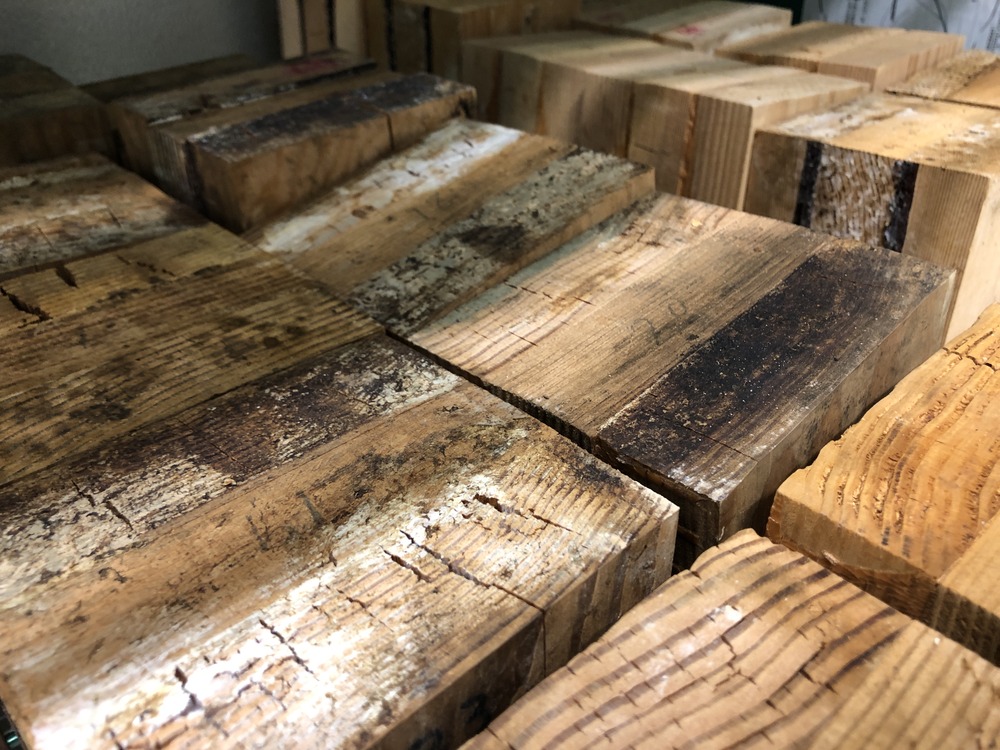
Picture from Northern Research Station, USDA, U.S. Forest Service
Established in 1910, the Forest Products Laboratory focuses on improving the use, durability, and performance of wood and wood‑based materials. Its research supports forest health, climate resilience, and economic development by helping land managers, manufacturers, and communities make informed decisions about forest products.
- Wood durability research
- Innovative wood products
- Dire and materials testing
- Nanocellulose and emerging technologies
FPL scientists collaborate with universities, industry partners and other Forest Service units to bring practical, science‑based solutions to the public. Their work touches everything from housing and transportation to packaging, energy and emerging bio‑based materials.
Learn more by visiting the Forest Products Laboratory webpage.
Additionally, each month, the Northern Research Station’s Rooted in Research newsletter highlights science that supports healthy forests and thriving communities across the region. The January issue introduces readers to the Forest Products Laboratory and explores how FPL’s work complements the Station’s mission to understand and sustain forests from the Midwest to the Northeast.
Subscribe to the newsletter: Northern Research Station – Rooted in Research.
Resources:
Wood Products Manufacturing Technology Minor, FNR Minor
Hardwoods of the Central Midwest, The Purdue Arboretum
Wood Products, Purdue Extension – Forestry & Natural Resources (FNR)
Wood is Best Video, Forestry and Natural Resources YouTube Channel, Woodisbest.org
An Introduction to Trees of Indiana, The Education Store, Purdue Extension resource center
Native Trees of the Midwest, Purdue University Press
Shrubs and Woody Vines of Indiana and the Midwest, Purdue University Press
ID That Tree, Playlist, Subscribe to Purdue Extension – Forestry and Natural Resources YouTube Channel
A Woodland Management Moment, Playlist, Purdue Extension – FNR YouTube Channel
Investing in Indiana Woodlands, The Education Store
Forest Improvement Handbook, The Education Store
Finding help from a professional forester, Indiana Forestry & Woodland Owners Association
District Foresters for 10 plus acres, Indiana Department of Natural Resources
Hardwood Tree Improvement & Regeneration Center (HTIRC)
Diana Evans, Extension & Web Communications Specialist
Purdue University Department of Forestry and Natural Resources
In this edition of ID That Tree, Purdue Extension Forester Lenny Farlee introduces us to trumpet creeper, a native vine commonly found throughout Indiana. Often noticed climbing trees and other structures, this species plays a visible role in many woodland edges and disturbed sites. Student, landowner or even just simply curious about the plants you see climbing through trees and along roadsides, this video provides a quick and informational introduction to trumpet creeper in Indiana.
If you have any questions regarding wildlife, trees, forest management, wood products, natural resource planning or other natural resource topics, feel free to contact us by using our Ask an Expert web page.
Resources:
ID That Tree – Video Playlist, Purdue Extension – Forestry and Natural Resources (FNR) YouTube Channel
Purdue Arboretum Explorer
Conservation Tree Planting: Steps to Success, Purdue Extension – FNR YouTube Channel
A Woodland Management Moment, Playlist, Purdue Extension – FNR YouTube Channel
Woodland Stewardship for Landowners, Playlist, Purdue Extension – FNR YouTube Channel
Indiana Department of Natural Resources: Invasive Species
Indiana Invasive Species Council
Cooperative Invasive Species Management Area (CISMA)
Report Invasive, Purdue Extension
Fifty Common Trees of Indiana, Purdue Extension – FNR
Habitat University, Episode 12 – Exploring the challenges of Invasive Species, Habitat University-Natural Resource University
Shrubs and Woody Vines of Indiana and the Midwest, Purdue University Press
Native Trees of the Midwest, Purdue University Press
Professional Forester, Indiana Forestry Woodland Owners Association
District Forester, Indiana Department of Natural Resources, 10+ acres
Find an Arborist, International Society of Arboriculture
Forest Improvement Handbook, The Education Store
Lenny Farlee, Extension Forester
Hardwood Tree Improvement and Regeneration Center
Purdue Department of Forestry & Natural Resources
Explore the latest newsletter updates on the Indiana Woodland Steward website. Stay up-to-date with forestry news and receive their free e-newsletter by subscribing at IWS Subscribe.
Highlights from the new Newsletter include:
 The First 20 Years of The Hardwood Ecosystem Experiment
By Scott Haulton
“This summer, the Hardwood Ecosystem Experiment – Indiana’s largest and most comprehensive study of forest management effects…”- Information on Indiana’s New Prescribed Burning Law
By Rob McCrea
“On July 1st, 2025, Indiana’s newly enacted law on prescribed burning took effect. This law does not.. - Opinion: The Future of Forestry
By Liz Jackson
“For decades the approach to forestry in Indiana has been one of restoration and recovery from the years of overcutting and abandonment…” - Purdue Extension Forestry Course Celebrates Over 100 Classes
“Forest Management for the Private Woodland Owner Course,” sometimes referred to as the Purdue Forestry short course…” - Forestry for the Birds: A Tale of Two Woodlands
By Dr. Jessica Outcalt
“Once upon a time, a few centuries ago, a woodland grew in a river valley of central Indiana. The people who managed this grove…” - Purdue Researchers Seeking Landowners
“In natural resource management, there is a need to understand the densities of wildlife species to determine hunting quotas, issue take permits, and predict…” - Ask the Steward
by Dan Ernst
“Question: Why does my glyphosate foliar treatment sometimes seem ineffective?”
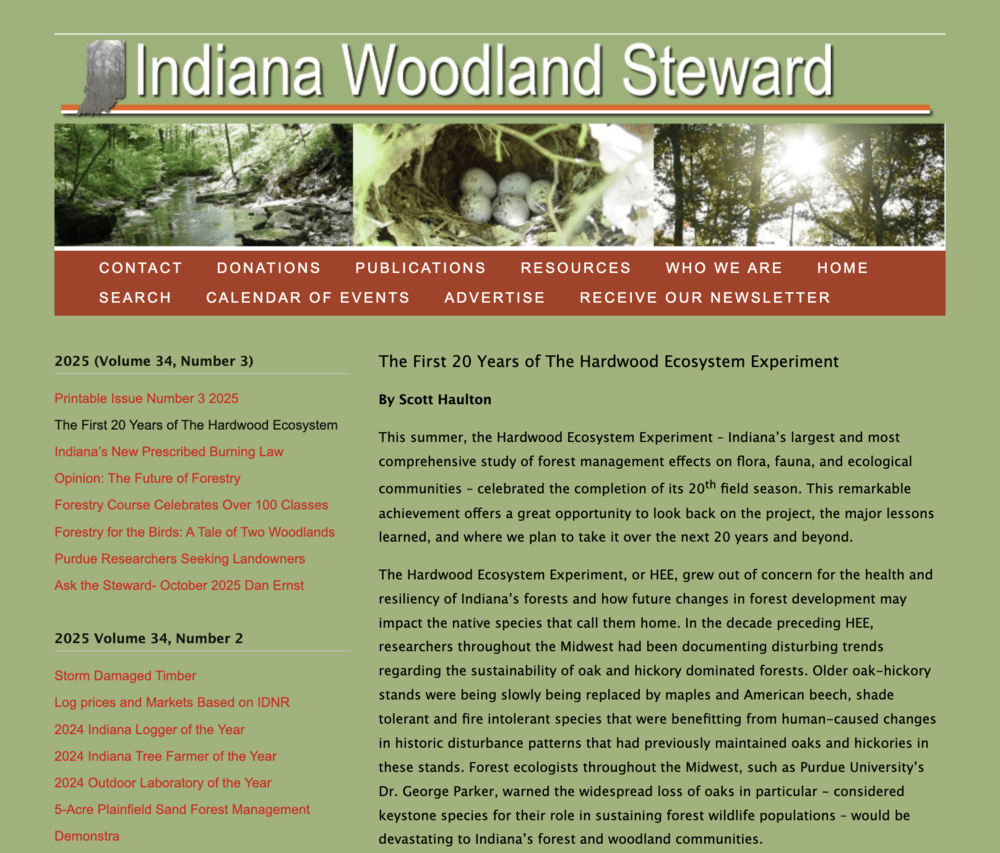
The Indiana Woodland Steward Newsletter is a resource offering a wealth of valuable information for foresters, woodland owners, timber marketing specialists, woodland and wildlife enthusiasts. The Indiana Woodland Steward Institute (IWS) is an entity made from 11 organizations within the state including Purdue University, Indiana Department of Natural Resources (DNR), and Indiana Hardwood Lumbermen’s Association (IHLA), that works to promote best usage practices of Indiana’s woodland resources through their Woodland Steward publication.
Resources
Hardwood Ecosystem Experiment (HEE) website
Hardwood Ecosystem Experiment – Wildlife Responses to Timber Harvesting, Purdue Extension
Forest Improvement Handbook, The Education Store
Invasive plants: impact on environment and people, The Education Store
Managing Your Woods for White-Tailed Deer, The Education Store
Shrubs and Woody Vines of Indiana and the Midwest, Purdue University Press
Virtual Tour Brings Forest Management for Birds to Life, Got Nature? Blog Post, Purdue Extension – Forestry and Natural Resources (FNR)
Breeding Birds and Forest Management: the Hardwood Ecosystem Experiment and the Central Hardwoods Region, The Education Store
Deer Impact Toolbox, Purdue Extension
Grassland Management Series, Purdue Extension Pond and Wildlife Management
Birdfeeder tips, The National Audubon Society
Explore the Rich World of Oaks with Purdue FNR Extension & Partners, Purdue Extension – FNR
Managing Woodlands for Birds Video, Purdue Extension-Forestry and Natural Resources YouTube Channel
Subscribe: Deer, Forest Management, ID That Tree, Woodland Management Moment, Invasive Species and many other topic video playlists Purdue Extension-Forestry and Natural Resources YouTube Channel
Dan McGuckin, President
Indiana Woodland Steward
Dr. Brian MacGowan, Extension Wildlife Specialist
Department of Forestry & Natural Resources, Purdue University
Do you want to learn more about trees, forests and how to better manage your woodlands for a variety of purposes?
Sign up for one of four upcoming editions of the award-winning Forest Management for the Private Woodland Owner course in Spring 2026. The course received the 2024 Family Forests Education Award from the National Woodland Owners Association (NWOA) and the National Association of University Forestry Resources Programs (NAUFRP).
Forest Management for the Private Woodland Owner introduces forest landowners to the biology and management of forests. Topics covered include tree identification, forest biology and history, forest management planning and practices, wildlife management, considerations for selling timber, forest economics and taxation, and resources and assistance available to forest landowners.
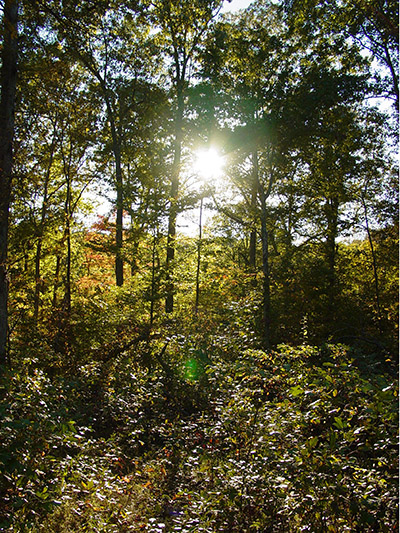 According to survey results from course participants in 2021, “94.4% stated that the information was useful to help them make future decisions and 92.5% stated that the information was useful to help act to manage their property objectives.”
Ron Rathfon is set to teach an eight-week version of the course at the Southern Indiana Purdue Agricultural Center (SIPAC) in Dubois, Indiana, from January 26 to March 16.
The course will meet on Monday evenings (6-9 p.m.) at 11371 East Purdue Farm Rd., and also will include one Saturday field session. Class size is limited to 40 registrants. Advanced registration is required by Jan. 16. Cost is $50 with couples/family registration available for $30 for each additional person.
Those interested should contact Amity Traylor, District Coordinator with the Pike County Soil & Water Conservation District at 812-354-6120 ext. 3 or pikecoswcd@gmail.com to receive a brochure and registration form as well as payment information.
Purdue Extension forester Lenny Farlee will teach two iterations of the course in Tippecanoe County, beginning on Feb. 18 and March 5 respectively.
- A virtual course is slated to begin on Wednesday Feb. 18. The course will feature three live online meetings during which participants may ask questions and receive updated information from the course instructor related to the recorded videos available to view at any time by the registrants. Live meetings are set for Feb. 18, March 11 and April 1. Full registration fee is $15. Registration for this virtual edition is available online through Feb. 13.
- Farlee also will teach an in-person edition of the course, meeting on Thursday evenings from March 5 to April 23 at the John S. Wright Center (1007 N 725 W, West Lafayette, IN 47906). In addition to the eight evening meetings (from 6-9 p.m. ET), the course will include two Saturday field days, which will provide in-person experience with forest biology and management demonstrations and instruction. Full registration fee ($50) includes handouts, flash drive with class reference resources and a tree measuring stick. Guest registration fee ($30) includes class handouts. Visit Forest Management for the Private Woodland Owner Event webpage to learn more and register by February 28th.
Veronica Bullock and Dave Osborne will be teaching a program in Franklin County from Feb. 10 to March 31.
The course will take place on Tuesdays from 5:30 – 8:30 p.m. ET at the Franklin County Public Library – 919 Main Street, Brookville, IN 47012. This course also will include a field tour at the Southeast Purdue Agriculture Center (4426 County Road 360 North, Butlerville, IN 47223) on March 21. Registration is available online. Contact Bullock with any questions at bullockv@purdue.edu.
To view this article along with other news and stories posted on the Purdue Forestry and Natural Resources website view: FNR Extension Set to Offer Four Editions of Forest Management for the Private Woodland Owner Course in Spring 2026.
Resources:
Woodland Stewardship for Landowners YouTube Playlist, Purdue Extension – FNR
Wildlife Habitat Hint YouTube Playlist, Purdue Extension – FNR
Woodland Management Moment YouTube Playlist, Purdue Extension – FNR
Invasive Species YouTube Playlist, Purdue Extension – FNR
Forest Management for the Private Woodland Owner Course – Got Nature? Blog, Purdue Extension – Forestry and Natural Resources
Report Invasive Species, Purdue Invasive Species
Finding help from a professional forester, Indiana Forestry & Woodland Owners Association
Forest Improvement Handbook, The Education Store, Purdue Extension resource center
Indiana Woodland Steward Institute
Hardwood Ecosystem Experiment (HEE)
Hardwood Tree Improvement & Regeneration Center (HTIRC)
Help the Hellbender
The Nature of Teaching
Pond and Wildlife Management, Website
Sustainable Communities and Community Planning, Purdue Extension
Subscribe Purdue Extension – Forestry and Natural Resources YouTube Channel
Wendy Mayer, FNR Communications Coordinator
Purdue University Department of Forestry and Natural Resources

Recent Posts
- Keep An Eye Out for Hammerhead Worms, Purdue Landscape Report
Posted: April 2, 2026 in Invasive Animal Species, Wildlife, Woodlands - ID That Tree Featured in National Woodland Owners Association Newsletter
Posted: April 1, 2026 in Urban Forestry, Wildlife, Woodlands - New 2026 Indiana Woodland Steward Newsletter
Posted: March 30, 2026 in Urban Forestry, Wildlife, Woodlands - A Woodland Management Moment: Why Aspect Matters
Posted: in Urban Forestry, Woodland Management Moment, Woodlands - Fast-Growing Trees for the Landscape, Purdue Landscape Report
Posted: March 26, 2026 in Forestry, Urban Forestry, Woodlands - Urban Tree Spotlight: Planting Deciduous Shade Trees, Purdue Landscape Report
Posted: March 25, 2026 in Forests and Street Trees, Urban Forestry, Woodlands - Beetle that attacks Tree-of-Heaven found in Indiana, Purdue Landscape Report
Posted: March 20, 2026 in Invasive Insects, Wildlife, Woodlands - ID That Tree: Dwarf Chinkapin Oak
Posted: in Forestry, Urban Forestry, Wildlife, Woodlands - DNR Hiring for Indiana Conservation Officer Positions, MyDNR
Posted: March 9, 2026 in Urban Forestry, Wildlife, Woodlands - ID That Tree: Shumard Oak
Posted: in Plants, Urban Forestry, Wildlife, Woodlands
Archives
Categories
- Alert
- Aquaculture/Fish
- Aquatic/Aquaculture Resources
- Ask the Expert
- Christmas Trees
- Community Development
- Disease
- Drought
- Forestry
- Forests and Street Trees
- Gardening
- Got Nature for Kids
- Great Lakes
- How To
- Invasive Animal Species
- Invasive Insects
- Invasive Plant Species
- Land Use
- Natural Resource Planning
- Nature of Teaching
- Plants
- Podcasts
- Ponds
- Publication
- Safety
- Spiders
- Timber Marketing
- Uncategorized
- Urban Forestry
- Webinar
- Wildlife
- Wood Products/Manufacturing
- Woodland Management Moment
- Woodlands