 Purdue University - Extension - Forestry and Natural Resources
Got Nature? Blog
Salamanders are often mistaken for lizards, but the two groups are very different.
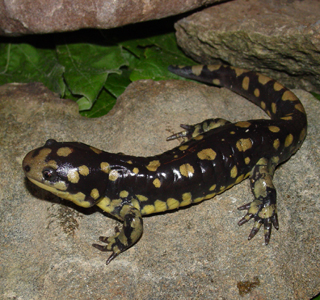
Tiger salamanders are a common species found in Indiana. The bright spotting is probably a sign to predators that they taste bad.
Though they both have similar body shapes, lizards are reptiles (along with turtles, snakes, crocodiles, dinosaurs, and yes, birds) while salamanders are amphibians (along with toads, frogs and a weird and rarely seen group called caecilians). This means lizards have dry scaly skin, while salamanders have moist, porous skin. Lizards all must breathe with lungs, just as humans do. Salamanders, on the other hand, can breathe through their skin, via gills, via lungs or in some cases via their skin and lungs!
Another major difference between lizards and salamanders is their reproduction. Lizards have leathery, partly calcified (shelled) eggs that are typically buried in sand or dirt, but a few species are hatched while still inside the mother before birth. Salamanders, as amphibians, mostly lay their eggs in water where the larvae hatch and after some time usually metamorphose and return to land. Lizards can be found most anywhere on land, while salamanders must stay where they won’t dry out: under logs or leaves, underground or directly in water. We have about six species of lizards and 23 species of salamanders here in Indiana.
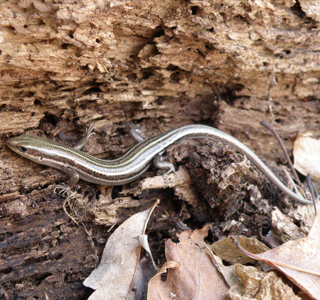
The five-lined skink is another Indiana native. Females will aggressively guard their nests, sometimes biting a threatening finger (don’t worry, they’re not venomous).
Several of the salamander species are listed as Special Concern or State Endangered. Regardless of their legal status, all wildlife should be left where you find it unless it’s in immediate danger, such as on a road.
For more information on how to identify Indiana salamanders and lizards:
Salamanders of Indiana book
Snakes and Lizards of Indiana
Place keywords in the search field at the Purdue Extension resource center for more information: The Education Store.
View Help The Hellbender website for more information on salamanders.
Steve Kimble, Post Doctoral Research Associate
Department of Forestry and Natural Resources, Purdue
Rod Williams, Associate Professor of Wildlife Science
Department of Forestry and Natural Resources, Purdue
Although perhaps a bit late, spring has seemingly sprung upon us. One of the best signals of spring is the symphony of calling frogs and toads in and around wetlands, ponds and lakes throughout Indiana. Amphibians native to Indiana are an important component of healthy ecosystems. They play important roles as both predator and prey in food webs. We can also consider many amphibians as “bio-indicators” of environmental health. Unfortunately, many species of amphibians and reptiles are thought to be in the decline. While the causes for declines are species-specific, the actions that people take can be a contributing factor.
Unlike other vertebrates, most amphibians and reptiles can be observed up close or even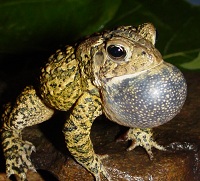 captured by hand – some more easily than others. Exploring natural habitats while searching for, catching and photographing reptiles and amphibians are great ways to gain hands-on experience with nature. However, be mindful that some activities, or the manner in which they are conducted, can harm the very creatures we value. Reptiles and amphibians represent numerous examples where interactions between wildlife and people can have negative consequences despite the best of intentions.
When you go outdoors to enjoy our amphibians and other wildlife, follow some of these simple tips:
Stay on designated roads and trail systems – Human foot traffic can affect plants and animals in some habitats (e.g., you may have noticed the compressed soil and lack of vegetation on even lightly used foot trails). Focusing foot traffic on trails can minimize human impacts on sensitive plants and animals. It is also required on some public properties.
Be a responsible pet owner – Dogs make good companions when hiking outdoors. However, research has demonstrated dogs can disturb, harass or even kill wildlife. While impacts on reptiles and amphibians are unclear, it is good practice to keep your dog leashed while exploring natural areas. Many parks and properties require dogs to be leashed.
Be a good steward of the land – Carelessly turning over logs and coarse woody debris in search of reptiles and amphibians can destroy microhabitat features that took decades to create. It is also prohibited on many public properties. If you do find an animal under a log or rock, return the object to its original location, then place the animal next to it rather than rolling the object directly over the animal.
Minimize or avoid handling animals – If you must handle a wild amphibian or reptile, 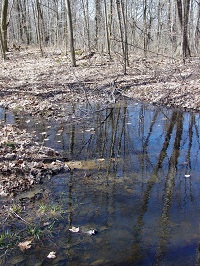 there are safe ways to hold and restrain them. Avoid handling amphibians for long periods of time. Amphibians are prone to desiccation (drying out). There are no formal guidelines on the length of time to handle an amphibian, and it is not clear how handling impacts an animal’s health and wellbeing. Common sense dictates that handling time should be minimized to the greatest extent possible. If a frog or salamander feels “dry,” you have handled it too long, and it should be returned to its location of capture immediately. Keep your hands moist and free of chemicals (e.g., bug spray or sunscreen).
Use good hygiene – The transmission of many diseases among animals can be facilitated by people. There are a number of safeguards that can be implemented to not only protect you, but also the animal populations as well. To prevent spreading diseases and pathogens from one site to another, regularly wash clothing and especially boots that you use in the field. All equipment that contacts an animal or the water the animal was in should be decontaminated using a 1-3 percent bleach solution or air dried for at least three hours before traveling to another water body. You also should use hand sanitizer before and after handling animals in nature. Before eating or handling food, thoroughly wash hands in hot, soapy water if possible; hand sanitizer is an acceptable substitute for remote locations.
For more information about responsibly enjoying wildlife and nature, see Appreciating Reptiles and Amphibians in Nature.
Resources:
Sounds of Frogs & Toads, Purdue Extension – Forestry and Natural Resources (FNR)
Frogs & toads of Indiana, The Education Store, Purdue Extension resource center
Salamanders of Indiana Book, The Education Store
Amphibians: Frogs, Toads, and Salamanders, Purdue Nature of Teaching
The Nature of Teaching: Adaptations for Aquatic Amphibians, The Education Store
Hellbender ID, Playlist, Purdue Extension – FNR YouTube Channel
A Moment in the Wild, Playlist, Purdue Extension – FNR YouTube Channel
Dr. Brian MacGowan, Extension Wildlife Specialist
Department of Forestry & Natural Resources, Purdue University
I seem to be finding Kirtland’s snakes as I am cleaning my gardens. There seems to be an increase of grubs, beetles and worms, but I have not seen the small lizards yet. We have an abundance of chipmunks. Is there something I can do to discourage the snakes from taking up residency in my yard?
Many people have questions about snakes, and this post addresses the two most common – what is it and what can I do? The answer to the latter is, in part, related to the first, so I’ll address that one first. Indiana is home to a diversity of snake species. Identifying snakes to species can be tricky. First, geographic location often can easily differentiate among similar species or subspecies. Check the distribution map of the species in question and that of similar species. This may not resolve all issues since the distribution of similar species often overlap, distribution maps are not 100 percent accurate (i.e., they are a “best guess”) and some species and subspecies share similar characteristics where their ranges overlap. Second, scale configuration and appearance differs among some groups of species. For snakes, the texture of the body scales (keeled or smooth) or the presence/absence of a divided anal plate (the large scale that covers the cloacal opening) are key. Finally, physical characteristics including size, color and pattern can be used. For some species, conclusive identification is easier with the specimen in hand, although handling venomous species (which are rare in Indiana) is not recommended. With practice, one can become quite adept at identifying all of them.
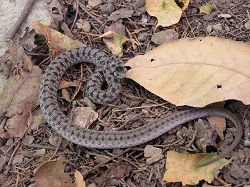
DeKay’s Brownsnake – This species is a small chestnut to dark brown snake averaging 25-30 centimeters in length. The belly is cream to pink. It has two rows of dark spots along the back that fade toward the tail. Dark bars may connect the dorsal spots, giving the impression of a ladder-like pattern. The area within this pattern is usually lighter in color than the sides, often giving the impression of a central stripe.
Kirtland’s snakes referenced in the homeowner’s question are endangered in Indiana. They are generally found near or along the margins of water bodies, but they can also be found in some urban areas on occasion. Due to these facts and since Kirtland’s snakes are generally quite secretive in behavior, this homeowner’s garden visitors are likely another species. Common garden visitors in Indiana include DeKay’s Brown snake (pictured above) or Eastern Gartersnake. Red-bellied Snakes (pictured below) have a pinkish-red belly similar to Kirtland’s snake. They are more of a woodland species, but it could be a possibility. All of these snakes can eat slugs and other garden pests.
Is there something homeowners can do to discourage snakes from taking up residency in their yards and around their homes? There really is no foolproof method to discourage snakes from utilizing a property. Reducing mulch layer thickness; removing brush piles, rock piles or other refuse; and keeping vegetation low are all steps that may help. Keep in mind that this may also reduce use of your property by wildlife you desire. There have been some repellents developed for snakes, but research results on their effectiveness have been mixed at best. In general, you should be wary of repellents that promise to keep animals out of an area. Lastly, there is plastic mesh fencing that you can purchase. Fencing can be used to exclude animals from small areas – it is generally cost-prohibitive for larger areas, and I am not aware of studies that test the effectiveness of fencing for snakes. Snake fencing is generally designed to exclude larger venomous snakes as opposed to the typical garden species that can be quite small. Snakes can also get stuck and die in mesh fences when their head fits through but the body gets stuck. The scales “catch” the mesh when the snake attempts to back out. Mesh fencing is also susceptible to damage from trimmers and falling limbs, and rabbits and rodents can chew holes in it. Thus, regular inspection and maintenance is required to maintain its function.
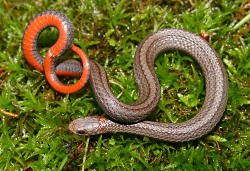
The Red-bellied Snake (18-25 cm) has both a brown and gray color phase. The two black lines along the length of its back may appear similar to the dark spots along the back of the DeKay’s Brownsnake (Storeria dekayi), but lack the crossbars. The belly has a distinctive bright pink or red coloration for which the species was named. Three light blotches may be visible behind the head on the neck.
Remember, while many folks are afraid of snakes or don’t want them around, the vast majority of species are harmless and can actually help homeowners by preying upon animals that actually are a nuisance and cause damage. Before taking any action, consider their benefits to you and how your actions affect other wildlife that call your yard home.
Resources
Snakes and Lizards of Indiana, The Education Store, Purdue Extension’s resource center
Snakes of the Central and Northeastern United States, The Education Store
Snakes of Indiana, The Education Store
Indiana Amphibian and Reptile ID Package (4 softcover books), The Education Store
Reptiles: Turtles, Snakes, and Lizards, Purdue Nature of Teaching Website
Ask An Expert, Playlist, Purdue Extension – Forestry and Natural Resources YouTube channel
A Moment in the Wild: Eastern Hognose, Purdue Extension – FNR Video
A Moment in the Wild: Eastern Kingsnake, Purdue Extension – FNR Video
A Moment in the Wild: Racer, Purdue Extension – FNR Video
Brian MacGowan, Extension Wildlife Specialist
Department of Forestry and Natural Resources, Purdue University
While the weather may tell you otherwise, spring is upon us. With the changing weather comes greening grass, breaking buds and sprouting plants. This plethora of fresh growth can help cure the winter blues, but it also provides wildlife with a desirable food source. Recently you may have noticed deer and other wildlife’s increased utilization of winter wheat fields and other green areas like lawns – early spring is the time you see deer in Indiana feed extensively on grass.
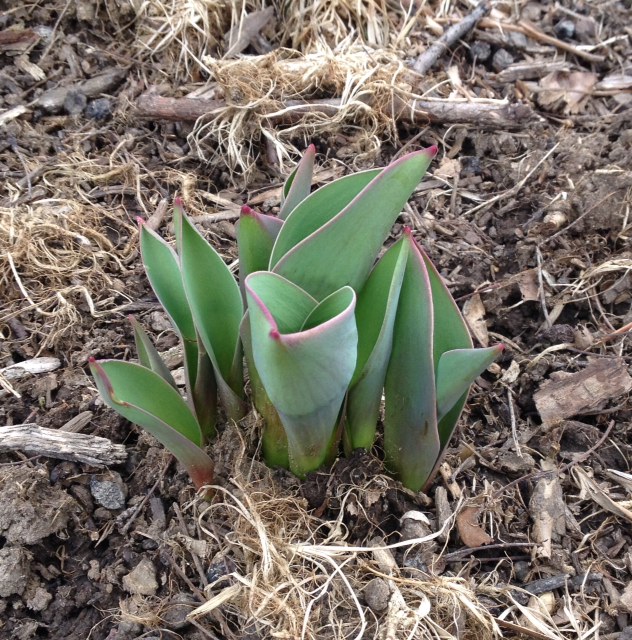 For homeowners, this is the time you need to scout around your home for emerging plants in your landscaping beds. Plants that are frequently browsed by deer such as tulips or hostas need special attention, but the limited amount of green plant material can leave any plant as a potential target. Most homeowners choose a type of taste repellent to protect plants. There are several tips on how to increase the efficacy of this approach.
- Timing: It helps to have some foresight into when damage is likely to occur and/or the plant developmental stage(s). Unfortunately, this is usually based on past experience. Ideally, you want to time applications during these periods. With tulips, for example, applying repellents early during sprouting, later during sprouting and during flower bud development will prevent damage during most years.
- Type of repellent: There are many types of taste repellents labeled for deer and other wildlife species. Most have a combination of capsaicin, putrefied egg solids and/or fatty acids of ammonium soaps. There are, of course, others with different ingredients. So which do you choose? There have been many studies that have investigated the efficacy of repellents. The bottom line – they work, but control is not 100%.
- Label: Failures can often result when not following the directions on the label. The label also provides safety information and what you can/can’t spray. Read and follow the label – it’s the law.
- Expectations: You aren’t going to solve all of your wildlife problems by spraying a few plants or even everything. If you use repellents, reapply according to label directions (every three to four weeks is usually a good rule of thumb). To increase success, you may use them as part of an integrated approach that includes exclusion, cultural practices and other approaches.
Resources
Diagnosing and Controlling Wildlife Damage
Preventing Wildlife Damage – Do You Need a Permit?
Corn and Soybean Crop Depredation by Wildlife
Wildlife Conflicts
Brian MacGowan, Extension Wildlife Specialist
Department of Forestry and Natural Resources
A recent article in ScienceDaily titled “Excessive Deer Populations Hurt Native Plant Biodiversity” shares how an overpopulation of deer is hurting native plant growth. Landowners seek best management practices as these challenges arise.
For the article from the University of Miami, view: “Excessive deer populations hurt native plant biodiversity.” ScienceDaily, 20 March 2014.
Resources
Preventing Wildlife Damage, Purdue EVERYTHING Wildlife
How to Build a Plastic Mesh Deer Exclusion Fence, Purdue Extension Publication
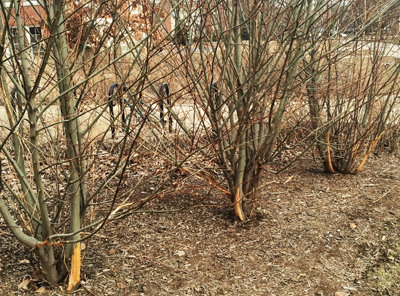 Cold winter winds, alternating extreme temperatures, ice and snow can be damaging to trees and shrubs. However, this spring, we are seeing additional damage due to the harsh winter conditions that is of the furry kind: rabbits and rodents. Mice and rabbits often damage young trees in the winter by feeding on the juicy, green cambium layer just under the bark and girdling the tree. Damage from these furry creatures occurs most commonly in winters when there is prolonged, heavy snow cover and food is scarce. Sound familiar? Rabbits feed on the bark above the snow while mice tunnel under the snow and feed near the ground level. Mouse damage is usually more severe when the trees are surrounded by heavy grass, weed cover or heavy mulch.
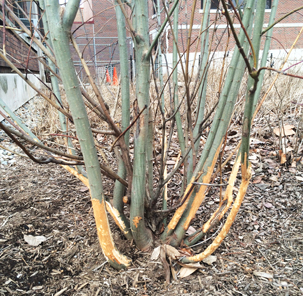 On young trees and multi-stemmed ornamental trees, rabbits remove the bark completely around the trunks and stems, effectively girdling them. All growth above the girdled areas will eventually decline and die, and for most situations, replacing the girdled trees is the best course of action. There are no applications that will mitigate the effects of rabbit damage or save severely damaged trees. Wound dressings, pruning paints, latex paints, wrappings and other alleged protective barriers do not help.
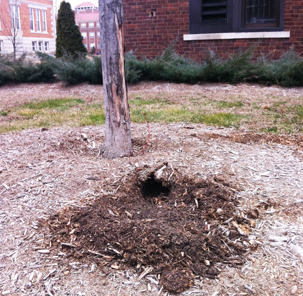 Many deciduous shrubs have the ability to produce new shoots or suckers at their base. Because of this ability, many severely damaged deciduous shrubs can recover. However, patience is required as several years may be required for some shrubs to fully recover. In early spring as the greening begins, prune off girdled stems just below the damaged areas. This will help rejuvenate the plant in most circumstances and replace the damage growth.
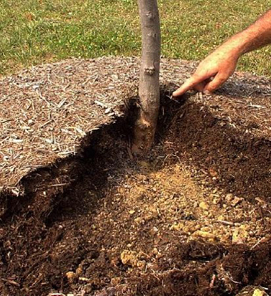 The most effective deterrent to girdling by mice or rabbits is to wrap the trunk and low branches of young trees with screen wire or hardware cloth. Be certain the wire wrap is buried below the ground line and extends high enough above the possible snow line to prevent rabbits from reaching to the trunk or branches. To help control mouse damage, maintain an area free of grass or weeds for a 1- to 2-foot radius around the base of the tree. Additionally, maintain proper mulch levels, never more than 2-3”, to eliminate the habitat for mice. Various chemicals are available to repel mice and rabbits, but these do not afford the reliability of a well-made barrier.
Resources
Preventing Wildlife Damage, The Education Store, Purdue Extension
Vole Damage in Pumpkins (and other crops), Purdue Extension – Forestry and Natural Resources (FNR) Got Nature? Blog
Moles, The Education Store, Purdue Extension resource center
Adjuvants and the Power of the Spray Droplet: Improving the Performance of Pesticide Applications, The Education Store
Preventing Wildlife Damage – Do You Need a Permit?, The Education Store
Attract Hummingbirds to Your Yard, Video, Purdue Extension Youtube Channel
How to Stop Woodland Animals from Digging in Your Flower Pots, Video, Purdue Extension Youtube Channel
Purdue Extension – Forestry and Natural Resources
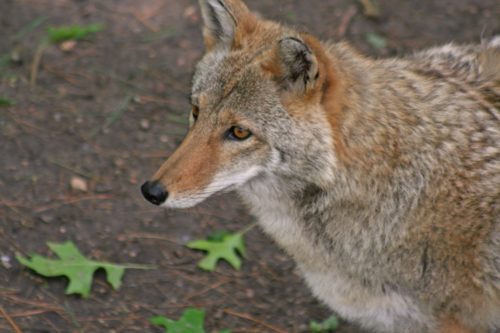 As you can imagine, there is no simple solution for this problem. There is no way to direct their movements. They will go where there is ample cover and food; yards and urban areas often have plenty of both. Also coyotes are territorial, so that plays an important role in their spatial ecology. What researchers are finding is that suburban and urban coyotes (and other wildlife for that matter) do not behave the same as their rural counterparts. Oftentimes, they need less space because resources are plentiful and close together.
Most biologists would agree that trapping and removing coyotes in general is not an appropriate management strategy. If you move them out, more will simply come in. However, trapping of specific problem coyotes can be part of a comprehension management approach. The best approach is to avoid problems, and this starts with preventing coyotes from getting comfortable around people. Never feed coyotes. Many problems in urban areas are the result of people feeding coyotes. If you see coyotes around your home or yard, scare them off by yelling, clapping your hands or with other loud noises.
Resources
Coyotes, IN DNR
Coyotes (PDF), Wildlife Conflicts, Department of Entomology, Purdue University
Should I Be Worried About Coyotes in My Yard?, Purdue Extension – Forestry & Natural Resources (FNR) Got Nature? Blog
Coexisting With Coyotes, Wild Bulletin, Indiana Department of Natural Resources, Division of Fish and Wildlife
Ask the Expert: Coexisting with Coyotes , Purdue Extension – FNR Got Nature? Blog
Urban Coyotes – Should You Be Concerned?, Purdue Extension – FNR Got Nature? Blog
Pets Disappearing? The Cause May Be Coyotes, Purdue Extension – FNR Got Nature? Blog
Question: Which is the correct species of coyotes I have on my land here in Indiana, coyote or coywolf?, Purdue Extension – FNR Got Nature? Blog
Permitted Wildlife Rehabilitators, Indiana Department of Natural Resources
How do you eliminate a nuisance animal on your property?, Indiana Department of Natural Resources (IN DNR)-Fish and Wildlife
Urban Coyote Research Center, Urban Coyote Ecology & Management, Cook County, Illinois
Brian MacGowan, Wildlife Extension specialist
Department of Forestry and Natural Resources, Purdue University
Determining what causes holes in lawn and landscaping can be a challenging endeavor for any homeowner. The size of the hole, the presence of excavated dirt and the timing of activity are all good clues to consider. Recently, I had several holes along my driveway and sidewalk that perplexed me. I’m no stranger to holes in my yard. I’ve been combating moles in my yard (we will save that for another post) and had recently observed dead mice and shrews in my driveway. I also have many chipmunks and gray squirrels around the yard.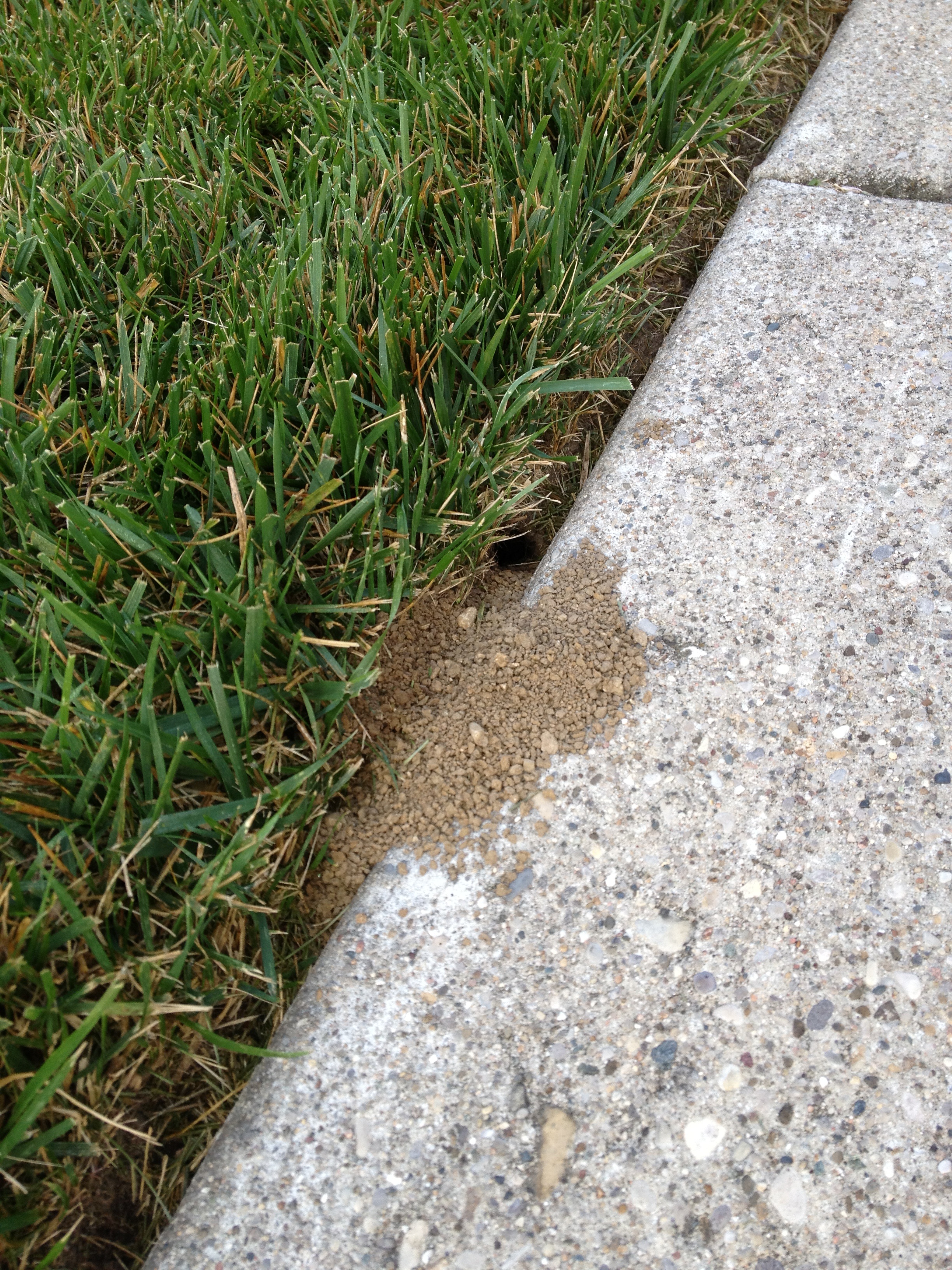 All of these can make holes of one type or another. However, these new holes looked different. They were clearly a tunnel/burrow with an entrance of 1.5 inches. Squirrels dig holes to bury/dig nuts or to feed on small plants. Chipmunks make 1.5 inch holes, but they carry the cast soil away in their mouths which results in a less conspicuous hole. Shrews and voles will excavate holes and tunnels, but these looked different. Voles usually are found in areas with overhead cover such as densely planted landscaping beds, areas with ground ivy or similar plants and beds with think mulch. These holes were exposed far from cover. So what were they?
It just so happens I was at a colleague’s house recently, and he mentioned all the cicada killers he has around the house. He literally had dozens of holes in areas with exposed soil just like the ones I observed at home. To my delight, I finally had the answer to my question.
Cicada killers are large wasps but unlikely to sting. Purdue’s Department of Entomology has more on cicada killers free downloadable pdf, Household and Structural, Cicada Killers.
Other resources:
Cicada killers: a nuisance or a danger?, Turfgrass Science at Purdue University
Cicada Killers, Plant & Pest Diagnostic Lab
Great Lakes Early Detection Network App (GLEDN) – The Center for Invasive Species & Ecosystem Health
EDDMaps – Early Detection and Distribution Mapping System
Report Invasives, College of Agriculture
Subscribe Purdue Extension – Forestry and Natural Resources YouTube Channel, Playlists include wildlife, Nature of Teaching, Moments in the Wild and much more.
Brian MacGowan, Wildlife Extension Specialist
Department of Forestry and Natural Resources
Purdue University
Wildlife identification guides are useful tools that help you figure out what kind of animal you may be looking at. However, they don’t always tell the complete story. Some animals such as garter snakes can have varied appearances which makes identification difficult. Some mammals have varied pelage such as striped skunks with some being almost completely black, white or some combination in between. A very small percentage of animals within a species may look dramatically different due to differences in pigment.
 Albinos lack the ability to produce color pigment in their skin, hair, feathers, scales or eyes. Animals with this condition have a white appearance with red or pink eyes. The latter is the result of tiny blood vessels that are now visible. They are typically hidden by the colored iris which is transparent in albinos.
In wildlife, albinism is a rare occurrence at birth caused by a recessive gene. The rate in wildlife is estimated from 1 in 20,000 to 1 in 1 million. Their solid white coat of fur makes them more susceptible to predation, or conversely, would make it difficult for an albino predator to stalk its prey. Albinos also have poor vision or may even be blind. The combination of these factors results in low survival of albinos, further decreasing their proportion in the population.
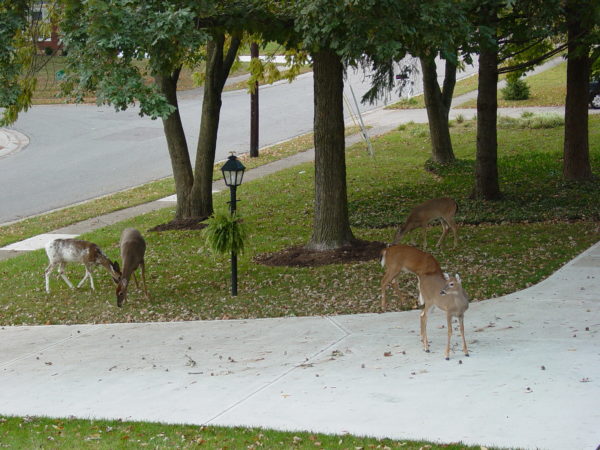
Partial albinism occurs in some animals and is much more common than true albinism. In white-tailed deer, this is sometimes referred to as ‘piebald’ where their fur has a blotchy, white appearance, but they lack the pink eyes found in albinos. Piebald deer occur at a frequency of less than 1 percent in hunted populations. A greater incidence of physical deformities have been reported for piebald deer.
*View in photo the piebald deer on the far left side.
Resources:
Ask an Expert: Wildlife Food Plots, video, Purdue Extension – FNR YouTube Channel
Handling Harvested Game: Episode 1, Field Dressing, video, Purdue Extension – FNR YouTube Channel
Deer Harvest Data Collection, Got Nature? Blog, Purdue Extension – FNR
How to Score Your White-tailed Deer, video, The Education Store, Purdue Extension Resource Center
Age Determination in White-tailed Deer, video, The Education Store
Handling Harvested Deer Ask an Expert? video, Purdue Extension – FNR YouTube Channel
Woodland Stewardship for Landowners: Managing Deer Damage to Young Trees, video, Purdue Extension – FNR YouTube Channel
Managing Your Woods for White-Tailed Deer, The Education Store
Deer Impact Toolbox, Pond and Wildlife Management, Purdue Extension
Snakes and Lizards of Indiana, The Education Store
Subscribe Purdue Extension – Forestry and Natural Resources YouTube Channel, Playlists include wildlife, Nature of Teaching, Moments in the Wild and much more.
Brian MacGowan, Extension Wildlife Specialist
Department of Forestry and Natural Resources, Purdue University
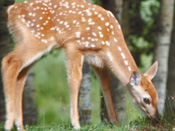 This time of year, sightings of white-tailed deer fawns, fledgling birds and other young critters becomes common. In most cases, the young animal is simply “spreading its wings” and exploring, or mom simply left it to get something to eat. Fawn deer are programmed to hide and remain motionless while mom is away. The fact is wildlife rarely abandons their young. They may leave briefly only to return.
Remember that you should never handle wild animals unless absolutely necessary. Any animal can bite you, and many harbor diseases and pests that can be transmitted to people.
In Indiana, wildlife rehabilitators have necessary state and federal permits to house and care for sick or injured wild animals. If you think you have found a sick or injured animal, you can find a list of licensed Wild Animal Rehabilitators in your area on the DNR Division of Fish and Wildlife’s website.
Resources
Mammals of Indiana, J.O. Whitker and R.E. Mumford
Common Indiana Mammals, R.N. Chapman and R.N. Williams, publication number FNR-413-W
Indiana DNR Orphaned and Injured Animals
Wildlife Habitat Hint: Tips for Evaluating a First Year Native Grass and Forb Plantings, Purdue Extension – FNR YouTube Channel
Drone Seeding Native Grasses and Forbs: Project Overview & Drone Setup, Purdue Extension – FNR YouTube channel
Designing Hardwood Tree Plantings for Wildlife – The Education Store
Forest Management for Reptiles and Amphibians: A Technical Guide for the Midwest, The Education Store
A Template for Your Wildlife Habitat Management Plan, The Education Store
Managing Your Woods for White-Tailed Deer, The Education Store
Woodland Stewardship for Landowners, Playlist, Purdue Extension – FNR YouTube channel
Nature of Teaching Unit 1: Animal Diversity and Tracking, The Education Store
Subscribe Purdue Extension – Forestry and Natural Resources YouTube Channel, Playlists include wildlife, Nature of Teaching, Moments in the Wild and much more.
Brian MacGowan, Extension Wildlife Specialist
Department of Forestry and Natural Resources, Purdue University

Recent Posts
- Beetle that attacks Tree-of-Heaven found in Indiana, Purdue Landscape Report
Posted: March 20, 2026 in Invasive Insects, Wildlife, Woodlands - ID That Tree: Dwarf Chinkapin Oak
Posted: in Forestry, Urban Forestry, Wildlife, Woodlands - DNR Hiring for Indiana Conservation Officer Positions, MyDNR
Posted: March 9, 2026 in Urban Forestry, Wildlife, Woodlands - ID That Tree: Shumard Oak
Posted: in Plants, Urban Forestry, Wildlife, Woodlands - Uniting Indiana Residents Against Invasive Species
Posted: February 27, 2026 in Community Development, Invasive Insects, Wildlife - Have You Seen a Soaring Eagle Lately? Morning Ag Clips
Posted: February 25, 2026 in Urban Forestry, Wildlife - Register for Natural Resources Teacher Institute’s Class of 2026
Posted: February 19, 2026 in Forestry, Wildlife, Woodlands - ID That Tree: Fragrant Sumac
Posted: February 4, 2026 in Plants, Urban Forestry, Wildlife - Woodsy Owl Edition for Educational Learning, USDA – U.S. Forest Service
Posted: January 21, 2026 in Forestry, Forests and Street Trees, Got Nature for Kids, Urban Forestry, Wildlife - Opt-in to the Deer Management Survey, MyDNR
Posted: January 12, 2026 in Forestry, Wildlife
Archives
Categories
- Alert
- Aquaculture/Fish
- Aquatic/Aquaculture Resources
- Ask the Expert
- Christmas Trees
- Community Development
- Disease
- Drought
- Forestry
- Forests and Street Trees
- Gardening
- Got Nature for Kids
- Great Lakes
- How To
- Invasive Animal Species
- Invasive Insects
- Invasive Plant Species
- Land Use
- Natural Resource Planning
- Nature of Teaching
- Plants
- Podcasts
- Ponds
- Publication
- Safety
- Spiders
- Timber Marketing
- Uncategorized
- Urban Forestry
- Webinar
- Wildlife
- Wood Products/Manufacturing
- Woodland Management Moment
- Woodlands