 Purdue University - Extension - Forestry and Natural Resources
Got Nature? Blog
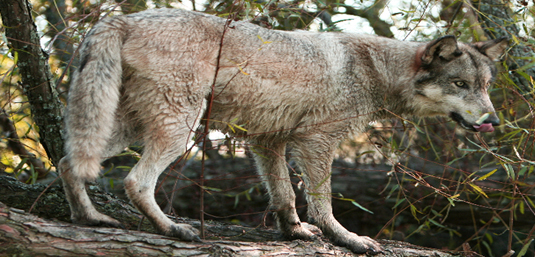 An Obama administration decision sought to remove gray wolves in the Great Lakes region from the endangered species list. However, a federal judge gave a 111-page opinion and ruled to keep the wolves on the list, resulting in a ban to trap and hunt wolves in the surrounding states. Michigan, Minnesota and Wisconsin were mainly affected by the ruling because they have allowed hunting and trapping of the wolves for one season already. There have been arguments on both side of the fence for these wolves. The Elkhart Truth reports, “Animal protection advocates repeatedly have sued over federal efforts to drop federal protections in both regions, arguing that the wolf’s situation remains precarious. Meanwhile, ranchers and farmers complain of heavy financial losses from wolf attacks on livestock.” As of today, it is only legal to shoot wolves if they are threatening human life. It is illegal to kill the wolves even if they are preying on livestock or pets.
Resources
Some Gray Wolves to be Returned to Endangered List, AP News
Gray Wolves in the Northern Rocky Mountains, U.S. Fish and Wildlife Service
Hunting and Trapping Guide, Indiana Department of Natural Resources
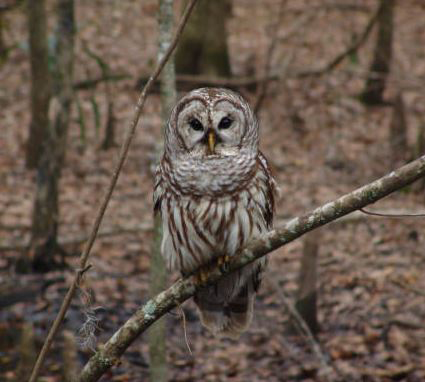
Photo Credit: U.S. Fish and Wildlife Service.
It’s me, the crazy wildlife student again. This time, I’m running around in the dark playing owl calls in the middle of the woods.
What was I doing? Owl surveys, and I was helping provide data for the Hardwood Ecosystem Experiment (or HEE). Basically what we’re trying to figure out is if barred owls and eastern screech owls prefer managed or unmanaged forests. Do they like pristine, untouched areas? Or do they desire a changing atmosphere where timber harvests are opening up new areas and there’s more variation in the age of trees? The data may tell. However, the process to get it is interesting. We drive between different checkpoints with about 90 for barred owls and 100 for eastern screech owls. At each of these, we blare owl noises out of a truck and wait for anything to respond.
How is this fun? Well first, I got to travel with Jeff Riegel, Field Supervisor of the HEE. He helped me understand what we were doing and told me all about the HEE as we bumped along logging roads just wide enough for his truck. “Be prepared for anything,” he told me as he took out a blowtorch to unfreeze lock after lock. He also had a chainsaw in case of fallen trees among various other tools I’m sure have been put to good use.
It was pretty cold outside, just hovering under 20 degrees Fahrenheit, and it was dropping as snow began to quilt the forest. It was also very quiet. One of the only disturbances was when we spooked an eastern screech owl; it flew away in its unique way, wings flapping rapidly but its body perfectly still in flight. As we repeated the process of the survey again and again (pop in the CD, roll down the windows, open both back doors and stand in front of the truck with the lights off), I scanned the trees for the silhouettes of owls as snow filtered down through the scarce frozen leaves. Jeff talked about how some owls would perch at the same branch every year and respond to the calls. He also talked about the volunteers that kept up the data flow, how some did it to enjoy the quiet night atmosphere, while others did it just to get the chance to hear the eerie but beautiful sounds of the owls. Even better was the chance to see dark wings among the trees.
The surveys are conducted in the winter to avoid messing with the owls’ nesting season. An owl’s eggs can freeze quickly if left unattended, and the birds will come to investigate the calls to make sure their territory is not being encroached upon, leaving the eggs. The timing has to be careful.
They’re mysterious creatures, but their calls remind us that the forest is alive in the darkness.
Learn more about the Hardwood Ecosystem Experiment.
Morgan Sussman, Freshman
Department of Forestry and Natural Resources, Purdue Univeristy
 Ever wondered why people go into wildlife? I mean, we’re expected to have low salaries. Why are we spending so much money to get a degree where we’ll go out to observe animals for a living or manage them? Can’t we do that as an everyday person with pets?
I can’t answer this question for everyone, but I’ll give it a shot. We are fascinated by the world around us. We love it and want to understand it, along with our role in it. It’s that simple.
There’s so much to be learned as a student in wildlife, even though we’ve been living alongside the concepts we’re learning about all our lives. Every time I walk into my Introduction to Environmental Conservation class, I walk out and gain an entirely new viewpoint. Recycling has taken on a whole new meaning when put into the dimensions of its actual effects. All my bathroom products give me a deep sense of suspicion because there are simply so many different chemicals and plastics being used with them. I have developed a rational hatred for ginkgo trees while on Purdue’s campus; not only do they stink, they’re also not even native. I worry about the squirrel population because that many squirrels in 10 yards of grass cannot be healthy. I’m all for wooden buildings, so long as it’s sustainable, thanks to carbon sequestration. Did you know wood is made up of 50 percent carbon? So when it’s built into buildings, it’s not actually harming the environment because it’s still holding in all that carbon dioxide that would have gone into the atmosphere had the tree been burned or decomposed. All this to say, I just pay a lot more attention to the environment around me.
Those are just some of the concepts we’ve learned so far, and it’s a blast. On top of this, I feel like we’re actually doing something good for humanity. Not many people want to do the dirty work or have months of research credited with one line in a scientific paper. However, we get to better see how it’s all interconnected. The world is more entwined than anyone knows. If everyone took just one day to be a wildlife student, it would be an incredible transformation in the world, even if each person only took one aspect away from the lesson learned.
Resources
FNR Majors and Minors, Purdue FNR
Prospective Students, Purdue FNR
We Know Nature! FNR This is Your Class Project Video
Morgan Sussman, Freshman
Department of Forestry and Natural Resources, Purdue University
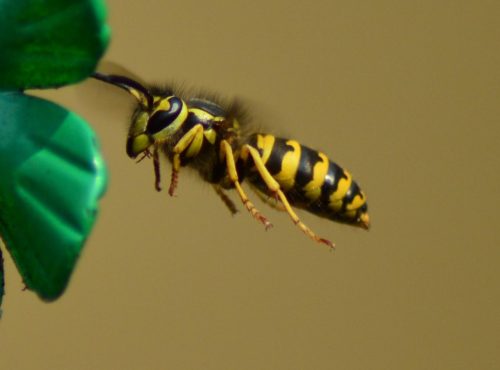 This question and answer were provided by Purdue Extension: In the Grow.
Question: I have small evergreen trees planted in my yard. They are the small, slow-growing type. They are around eight years old. Every fall, the yellow jackets start swarming around them, crawling in and out of the inside of the tree. They don’t seem to hurt it, but it looks like they are trying to find something, acting like a honey bee on a flower. But these have no flowers. They don’t bother us as long as we don’t get too close. Could you tell me why this is happening? – C.K., Shoals, Indiana
Answer: Our Purdue entomologists advise that yellow jackets commonly scavenge for food in the fall, and it is likely they are attracted to tree resin or sap that has some sugar content. Scavenging yellow jackets are less aggressive than those that are protecting a nest. And you are correct; they will not harm the trees and will generally not attack unless provoked. We commend you for aiming for a peaceful coexistence!
View the full post at Purdue Extension’s: In the Grow website.
Resources
Social Bees and Wasps, The Education Store
Indiana Beekeepers Swarm List, Indiana DNR
Department of Entomology, Purdue University
Purdue Extension: In the Grow
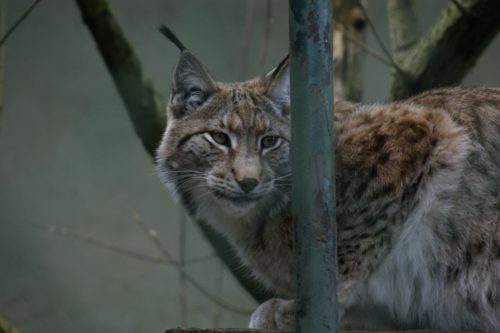 There has been an increase in bobcat sightings throughout central Indiana, namely Hamilton County, according to the Indiana Department of Natural Resources. Bobcats are not dangerous to the public, but beware of them while driving as there have been more “roadkill” cases involving these nocturnal animals. While bobcats were endangered from 1969 to 2005, they are no longer due to their growing population. However, it is still illegal to hunt or trap them in Indiana. Bobcats are also moving south as more males of this species need to find territory of their own. They feed on small animals like rats, mice, moles and squirrels. View the related articles below for more information.
Resources
Bobcat Sightings On Rise In Hamilton County, elsewhere, IndyStar.com
Bobcat, Indiana DNR
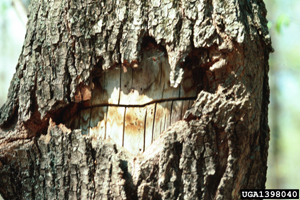
Glycobius speciosus, sugar maple borer, photo by Steven Katovich, USDA Forest Service.
Some of the most diverse taxa on the planet are rarely seen yet play critical roles within our environment. The insects found in the Order Coleoptera (beetles) are represented by over 500,000 species. Collectively, these insects provide a wide range of ecosystem services. They are important pollinators and predators on other insects, and they play essential roles in nutrient cycling. While most species are beneficial or vital for ecosystem functions, there are a few species that are considered pests.
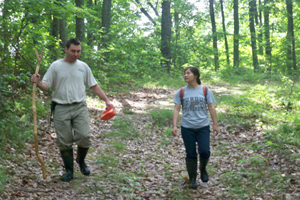
Dr. Jeff Holland and research team studying sugar maple borer in the woods.
The Sugar Maple Borer is a native species found throughout the eastern United States. The larval stage of the beetle specializes in feeding on sugar maple trees, particularly stressed or injured trees. In this podcast, our host, Rod Williams, will be interviewing Dr. Jeff Holland about the unique distribution of this wood-boring beetle, how to survey for this species on your property and the impacts to sugar maple trees throughout the eastern deciduous forests.
To find out more information about sugar maple borers, visit:
Holland Website
Bug Guide Identification
Resources
The Education Store (Search entomology or forest)
Got Nature? Blog Posts
Got Nature? Blog Posts
Jeff Holland, Associate Professor of Spatial Ecology and Biodiversity
Department of Entomology, Purdue University
Rod Williams, Associate Professor of Wildlife Science
Department of Forestry and Natural Resources, Purdue University
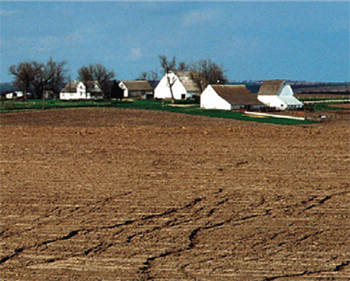 Agricultural educators, community organizers and others promoting environmental awareness can learn about the myths and realities of agricultural conservation from the perspective of a researcher, practitioner and student in a new Purdue Extension publication.
Adoption of Agricultural Conservation Practices: Insights from Research and Practice, developed by the Department of Forestry and Natural Resources at Purdue University, is available for free download from The Education Store.
The authors (Linda Prokopy, associate professor of Natural Resource Social Science; Dan Towery, Indiana Conservation Cropping System Initiative educator; and Nicholas Babin, postdoctoral research assistant in Forestry and Natural Resources) use academic studies and their own observations to address ways of motivating farmers to adopt environmentally-friendly farming practices.
To read the full article, visit Ag conservation publications available from Purdue Extension, Purdue Agriculture News.
Resources
Indiana Soils: Evaluation and Conservation Manual Review, Purdue Agronomy
Conservation Tillage and Water Quality, Purdue Extension
Optimizing Conservation Tillage Systems: Plant-to-Plant Uniformity is Essential for Optimum Yield in No-Till Cont. Corn, The Education Store
Linda Prokopy, Associate Professor of Natural Resource Social Science
Department of Forestry and Natural Resources
 The Wildlife Habitat Education Program (WHEP) helps students understand wildlife ecology and management practices. In addition, students gain skills in teamwork, oral and written communication, decision-making and leadership. The WHEP career development event includes three activities: Wildlife Challenge, Wildlife Management Practices and Wildlife Management Plan. Each activity has an important role in teaching about the management of wildlife populations. The instructions in this publication can help leaders teach students to evaluate habitat for Wildlife Management Practices (WMPs).
Wildlife Habitat Education Program – Teaching and Learning Wildlife Management Practices is available at The Education Store today.
Resources
Wildlife Habitat Education Program (WHEP)
A Template for Your Wildlife Habitat Management Plan, The Education Store
Managing Forest and Wildlife Resources: An Integrated Approach, The Education Store
Teaching and Learning Wildlife Management Practices, The Education Store
Indiana’s State Wildlife Action Plan, Indiana DNR
Brian MacGowan, Extension Wildlife Specialist
Department of Forestry and Natural Resources
The Guardian has published an article in regards to the large loss of wildlife in the past 40 years. Due to humans’ rapid consumption practices and our ecological footprint, the Earth cannot replenish what we use fast enough. The WWF analyzed 10,000 different populations consisting of animals, fish and birds in the study to create a representative “Living Planet Index” (LPI). The study showed that freshwater ecosystems had the fastest declining population. While the biggest decline in animal numbers are in low income, developing nations, rich nations are “outsourcing” wildlife decline in developing countries by importing food and other goods produced through habitat destruction. What can you do to make a difference to help keep the Earth clean?
View the full article, Earth Has Lost Half of its Wildlife in the Past 40 Years, says WWF, at theguardian.com.
Resources
Living Planet Report 2014, WWF.panda.org
Land and Water Conservation Fund, Indiana DNR
Saving Energy in Your Home series, The Education Store
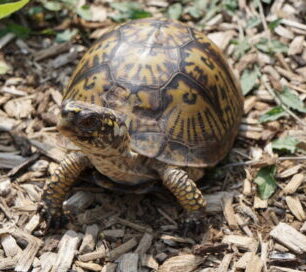
One of the most common questions people ask me is what to do with baby, orphaned wildlife that they find. Recently a homeowner from Carmel asked for advice regarding two hatchling box turtles that her family found in their yard. In early June, they saw the mother laying eggs. They watched the nest periodically throughout the summer only to find two hatchlings just before Labor Day. They wanted to help the young turtles survive but didn’t know what exactly they should do.
Much to the surprise of most people, my answer to this question is almost always “nothing,” regardless of the species. I can’t fault people for wanting to help. That shows me they care about wildlife and are concerned for their well-being. After all, that is a big reason why I got into my line of work. And when it comes to baby animals, we tend to really get concerned. Perhaps that is just the nurturing instinct of parents. We can sometimes forget that wildlife behave very differently than us.
Box turtles may mate anytime during the activity season. During field studies of box turtles in southern Indiana, I encountered pairs mating most often in late summer. After mating, females will store the sperm and delay fertilization up to four years. The following summer (usually late-May to early June), she will locate a nest site, dig the nest, deposit the clutch of eggs and subsequently conceal the nest. The selection of nest sites is unknown, but they generally return to the same area year after year. Some hypothesize they are returning to their own natal region since this is the case for other species of turtles. Once the female deposits her clutch of eggs, they are on their own – box turtles offer no parental care of eggs or hatchlings.
Our good-intended homeowner questioned if the hatchlings she found should be moved to a large state forest (some distance away), a local nature center or the park across the street where she thought the mother came from. Because hatchlings and juvenile box turtles are hard to find, there is very little information known about their movements. It really is not known if the hatching turtles would attempt to cross the street because that is the presumed home of their mother. However, since the wooded park clearly offers better habitat than the housing development, saving the young from a potentially perilous journey across the road is probably ok.
Moving them a long distance away is probably not a good idea and simply not necessary. Based on research of adult movements, we know adult box turtles are very familiar with their home range and are capable of finding this area if displaced from it by up to 3.3 km. Turtles moved a long distance away from their home range may establish a new home range but may also wander great distances looking for home. Similarly, taking the hatchling turtles to a nature center or wildlife rehabilitator isn’t really necessary. They are perfectly fine on their own as long as they have good habitat. Also maintaining a population of box turtles in the park depends on the influx of new turtles.
Resources
Turtles of Indiana, The Education Store
Eastern Box Turtle, Indiana Department of Natural Resources
Orphaned and Injured Animals, Indiana Department of Natural Resources
Brian MacGowan, Extension Wildlife Specialist
Department of Forestry and Natural Resources

Recent Posts
- Beetle that attacks Tree-of-Heaven found in Indiana, Purdue Landscape Report
Posted: March 20, 2026 in Invasive Insects, Wildlife, Woodlands - ID That Tree: Dwarf Chinkapin Oak
Posted: in Forestry, Urban Forestry, Wildlife, Woodlands - DNR Hiring for Indiana Conservation Officer Positions, MyDNR
Posted: March 9, 2026 in Urban Forestry, Wildlife, Woodlands - ID That Tree: Shumard Oak
Posted: in Plants, Urban Forestry, Wildlife, Woodlands - Uniting Indiana Residents Against Invasive Species
Posted: February 27, 2026 in Community Development, Invasive Insects, Wildlife - Have You Seen a Soaring Eagle Lately? Morning Ag Clips
Posted: February 25, 2026 in Urban Forestry, Wildlife - Register for Natural Resources Teacher Institute’s Class of 2026
Posted: February 19, 2026 in Forestry, Wildlife, Woodlands - ID That Tree: Fragrant Sumac
Posted: February 4, 2026 in Plants, Urban Forestry, Wildlife - Woodsy Owl Edition for Educational Learning, USDA – U.S. Forest Service
Posted: January 21, 2026 in Forestry, Forests and Street Trees, Got Nature for Kids, Urban Forestry, Wildlife - Opt-in to the Deer Management Survey, MyDNR
Posted: January 12, 2026 in Forestry, Wildlife
Archives
Categories
- Alert
- Aquaculture/Fish
- Aquatic/Aquaculture Resources
- Ask the Expert
- Christmas Trees
- Community Development
- Disease
- Drought
- Forestry
- Forests and Street Trees
- Gardening
- Got Nature for Kids
- Great Lakes
- How To
- Invasive Animal Species
- Invasive Insects
- Invasive Plant Species
- Land Use
- Natural Resource Planning
- Nature of Teaching
- Plants
- Podcasts
- Ponds
- Publication
- Safety
- Spiders
- Timber Marketing
- Uncategorized
- Urban Forestry
- Webinar
- Wildlife
- Wood Products/Manufacturing
- Woodland Management Moment
- Woodlands