 Purdue University - Extension - Forestry and Natural Resources
Got Nature? Blog
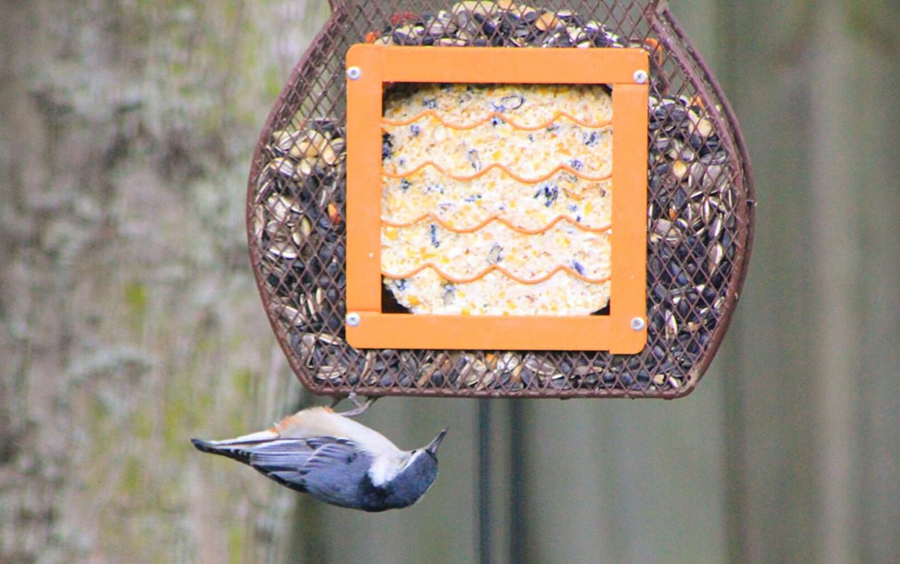
Starting in May, the Indiana Department of Natural Resources (DNR) began to receive reports of sick and dying songbirds from several counties around the state. As of now, the cause of the illness remains a mystery although submitted specimens have tested negative for avian influenza and West Nile virus according to the DNR. Affected birds have white crust and discharge around the eyes and damage to their nervous system. Reports of sick birds have expanded to many more counties in Indiana.
Several diseases that affect songbirds are transmitted from one animal to another. Bird feeders can increase the likelihood of disease transmission by facilitating close contact among birds. Even though the disease and its mode of transmission in this case is unknown, the DNR is recommending all Hoosiers remove their birdfeeders.
 Officials recommend the following steps:
- Use the DNR sick/dead wildlife reporting tool at on.IN.gov/sickwildlife to alert DNR staff.
- Stop feeding birds until the mortality event has concluded.
- Clean feeders and baths with a 10% bleach solution.
- Avoid handling birds. If you need to handle birds, wear disposable gloves.
- When removing dead birds, wear disposable gloves and place birds and gloves in a sealable plastic bag to dispose with household trash.
- Keep pets away from sick or dead birds as a precaution.
- Proper care of bird feeders and seed is an important part of preventing disease transmission at birdfeeders.
The Audubon Society recommends the following best practices:
- Clean feeders monthly using one part bleach to nine parts warm water. Soak the feeder in the solution for a few minutes, rinse, and air dry.
- If uneaten food is accumulating in or under feeders, consider using less food or switch to a seed more to the birds’ liking.
- If birds are fighting over space at a feeder, consider adding more feeders to alleviate the congestion that can potentially be responsible for the rapid spread of disease.
- Avoid throwing large amounts of food on the ground or alternate ground feeding areas so that uneaten food does not accumulate and develop bacteria or mold.
Resources:
DNR recommends removal of birdfeeders statewide – June 25, Indiana Department of Natural Resources
Birdfeeder tips, The National Audubon Society
Birds and Residential Window Strikes: Tips for Prevention, The Education Store, Purdue Extension resource center
Breeding Birds and Forest Management: the Hardwood Ecosystem Experiment and the Central Hardwoods Region, The Education Store
Managing Woodlands for Birds Video, Purdue Extension-Forestry and Natural Resources YouTube Channel
Brian MacGowan, Wildlife Extension Specialist
Purdue University, Department of Forestry and Natural Resources
Question:
I live in central Indiana and have had no cicadas yet. Are they still emerging or is it safe to uncover my tender trees?
Answer:
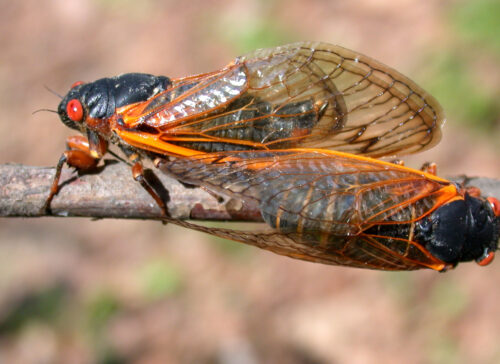
If you haven’t seen or heard any 17-year cicadas near your trees yet, there probably won’t be any emerging there this year. You should be safe to take off the netting now, but I’d still suggest learning the signs of cicada egg laying damage and keeping an eye on any trees you’re worried about. The damage typically looks like a row of small holes in the bark connected by cracks (exp. periodical cicada (Magicicada septendecim) but it can vary depending on the species of plant. If you see signs of egg laying damage, you can put the netting back on to protect your trees from any additional injury.
Resources:
17 Ways to Make the Most of the 17-year Cicada Emergence, Purdue College of Agriculture
Ask an Expert: Cicada Emergence Video, Got Nature? Blog, Purdue Extension-FNR
Periodical Cicada in Indiana, The Education Store, Purdue Extension resource center
Cicada Killers, The Education Store
Purdue Cicada Tracker, Purdue Extension-Master Gardener Program
Elizabeth Barnes, Exotic Forest Pest Educator
Purdue University Department of Entomology
In this episode of A Woodland Management Moment, Purdue Extension forester Lenny Farlee shares about some of the spring ephemeral plants, as well as shrubs, trees and even invasive species you may find in the forest understory.
If you have any questions regarding trees, forests, wildlife, wood products or other natural resource topics, feel free to contact us by using our Ask an Expert web page.
Resources:
A Woodland Management Moment, Playlist, Purdue Extension – Forestry and Natural Resources (FNR) YouTube Channel
ID That Tree, Playlist, Purdue Extension – FNR YouTube Channel
Invasive Species, Playlist, Purdue Extension – FNR YouTube Channel
Garlic Mustard, Purdue Extension – FNR YouTube Channel
Invasive plants: impact on environment and people, The Education Store, Purdue Extension resource center
Shrubs and Woody Vines of Indiana and the Midwest, Purdue University Press
Native Trees of the Midwest, Purdue University Press
Investing in Indiana Woodlands, The Education Store
Forest Improvement Handbook, The Education Store
Woodland Invaders, Got Nature? Blog
Resources and Assistance Available for Planting Hardwood Seedlings, The Education Store
Woodland Stewardship for Landowners Video Series, Playlist, Indiana Department of Natural Resources YouTube Channel
Lenny Farlee, Sustaining Hardwood Extension Specialist
Purdue University Department of Forestry and Natural Resources
Curious about the upcoming cicada emergence? What is different about this species than the ones you see every summer? What effect can they have on wildlife or on your trees and shrubs? Find out from Purdue Extension wildlife specialist Jarred Brooke, forester Lenny Farlee and Purdue Entomology’s Elizabeth Barnes. Don’t miss the question and answer time with our experts discussing “all things cicadas”.
If you have any questions regarding wildlife, trees, forest management, wood products, natural resource planning or other natural resource topics, feel free to contact us by using our Ask an Expert web page.
Resources:
17-year Cicadas Are Coming: Are You Ready?, Purdue Landscape Report
17 Ways to Make the Most of the 17-year Cicada Emergence, Purdue College of Agriculture
Periodical Cicada in Indiana, The Education Store, Purdue Extension resource center
Cicada Killers, The Education Store
Purdue Cicada Tracker, Purdue Extension-Master Gardener Program
Dr. Elizabeth Barnes, Exotic Forest Pest Educator
Purdue Department of Entomology
Lenny Farlee, Sustaining Hardwood Extension Specialist
Purdue Forestry and Natural Resources
Jarred Brooke, Wildlife Extension Specialist
Purdue Forestry and Natural Resources
In this episode of A Moment in the Wild, Purdue Extension wildlife specialist Nick Burgmeier introduces you to mole salamanders, which live most of their lives underground. He also shares about their breeding habits and their need for ephemeral ponds and other wetlands to survive.
If you have any questions regarding wildlife, trees, forest management, wood products, natural resource planning, or other natural resource topics, feel free to contact us by using our Ask an Expert web page.
Resources
I found this in my barn. Is it a Hellbender?, Purdue Extension
Question: Which salamander is this?, Got Nature? Blog, Purdue Extension – Forestry and Natural Resources
Is it a Hellbender or a Mudpuppy?, Got Nature? Blog
Amphibians: Frogs, Toads, and Salamanders, Purdue Nature of Teaching
A Moment in the Wild, Playlist, Purdue Extension – Forestry and Natural Resources
Help the Hellbender, Playlist & Website
The Nature of Teaching: Adaptations for Aquatic Amphibians, The Education Store, Purdue Extension resource center
Help the Hellbender, North America’s Giant Salamander, The Education Store
Nick Burgmeier, Research Biologist and Wildlife Extension Specialist
Purdue Department of Forestry and Natural Resources
Most of us have probably heard or seen a lot about pollinators in the media recently. The reason why is that pollinators are really, really important. We simply can’t live without them. Researchers estimate that one out of every three bites of food we eat is made possible by pollinators. More than 100 food crops in the U.S. depend on pollinators, including almost all fruit and grain crops.
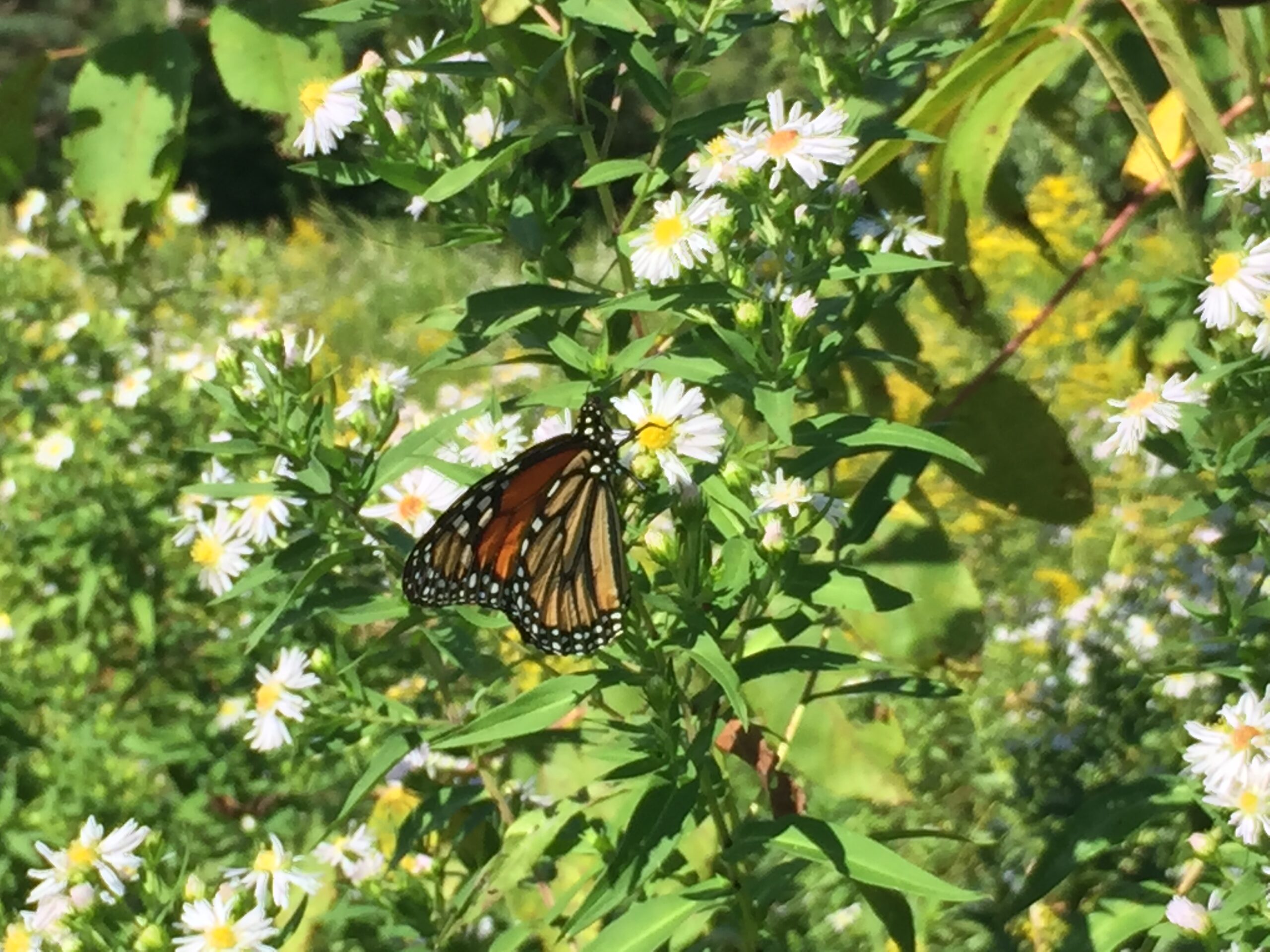
There are many different types of pollinators including native bees, butterflies and moths, beetles, flies, wasps, and of course hummingbirds. But perhaps one of the more interesting pollinators is the Monarch. Millions of Monarchs congregate in a relative small area in Mexico each winter. In March they start their journey north which has occurred over several generations. Unfortunately, the number of Monarchs counted in overwintering colonies has declined over the past 25 years.
In response, many states including Indiana have developed a state Monarch Conservation Plan. With input from many stakeholders over several years, the Indiana Monarch Conservation Plan was released in December 2020. One goal of the plan was to create an online resource that would act as a clearinghouse for Indiana monarch and pollinator conservation data, research, best management practices (BMPs), and events. I invite you to visit the Indiana Monarch and Pollinator Conservation Hub at https://indianawildlife.org/monarchs/.
You might be asking yourself, ‘Why is a wildlife specialist writing about pollinators?’ It turns out that quality habitat for wildlife is often quality habitat for pollinators. The diversity of wildflowers and structure that native grasslands, trees and shrubs benefit them all. Trees such as eastern redbud and Ohio buckeye provide early nectar sources. Native grasslands that have a diverse mixture of wildflowers provide food, bare ground, and structure desirable for a wide variety of pollinators.
Resources
Protecting Pollinators: Why Should We Care About Pollinators?, The Education Store, Purdue Extension resource center
Ask The Expert: What’s Buzzing or Not Buzzing About Pollinators , Purdue Extension – Forestry & Natural Resources (FNR) YouTube Channel
Purdue Pollinator Protection publication series, Purdue Extension Entomology
Indiana Monarch & Pollinator Conservation Hub, Indiana Wildlife Federation
Monarch Watch, University of Kansas
100 Plants to Feed the Monarch/Other Resources Available, Xerxes Society for Invertebrate Conservation
Brian MacGowan, Wildlife Extension Specialist & Extension Coordinator
Purdue Department of Forestry and Natural Resources
 Purdue Forestry and Natural Resources News & Stories: Vultures have a role to play as nature’s garbagemen, cleaning up animal carcasses, but what happens when a species goes from scavenging to harassing and even preying on livestock?
Pat Zollner, professor of wildlife science, along with PhD student Marian Wahl and their partners with the USDA Wildlife Services program are investigating black vultures in Indiana in order to better understand vulture ecology as well as to develop methods to mitigate future harm to Indiana livestock.
“Black vultures are relatively new to Indiana, they have been gradually moving in from the south, and right now there are a lot of unknowns that we need to figure out in order to make sound management decisions,” Wahl said. “Some of the pressing questions that we have are how many black vultures do we have here in Indiana, where are the birds located, how and where is conflict occurring, and how effective are different approaches to managing black vulture problems.
The aim of the research is two-fold. First, they are looking to see what causes some black vultures to become aggressive predators of livestock, instead of simply scavengers. Second, they are looking to learn signs that can determine whether an animal has been killed by vultures or simply scavenged, an important piece of evidence for livestock producers filing claims to the U.S. Department of Agriculture’s indemnity program hoping to recover compensation for their losses.
In order to achieve its goals, the research team is requesting the assistance of livestock producers through an online survey and also with the donation of calves believed to have been killed by black vultures. The qualtrics online survey is available now and will take only 15-20 minutes to complete. The survey is anonymous and data collected with be presented only in summary form and not via individual responses.
Resources
Qualtrics Online Survey
Contact Purdue FNR With Any Livestock Loss Due to Vultures
Black Vulture Research, March Edition of Beef Monthly
Black Vulture Ecology and Human-Wildlife Conflicts
Livestock, Education Store, Purdue Extension resource center
Pat Zollner, Professor of Wildlife Science
Purdue Forestry and Natural Resources
Marion Wahl, Graduate Research Assistant
Purdue Forestry and Natural Resources
In this edition of FNR Ask the Expert, join Rod Williams, Purdue Professor of Wildlife Science, Dr. Bruce Kingsbury Director of the Environmental Resources Center, Purdue Fort Wayne and Dr. Vicky Meretsky, Director of the Environmental Master’s Program, Indiana University, to learn about snakes and turtles, their natural history, interesting research happening in Indiana, and conservation information. Also learn the myths and truths from the experts as they discuss these reptiles.
If you have any questions regarding trees, forests, wildlife, wood products or other natural resource topics, feel free to contact us by using our Ask an Expert web page.
Resources
Snakes and Lizards of Indiana, The Education Store, Purdue Extension – Forestry and Natural Resources
Turtles of Indiana, The Education Store
Appreciating Reptiles and Amphibians in Nature, The Education Store
Forestry Management for Reptiles and Amphibians: A Technical Guide for the Midwest, The Education Store
The Nature of Teaching, Unit 3: Reptiles, Amphibians, and the Scientific Method, The Education Store
Snakes of Indiana, The Education Store
IDNR list of Endangered, Threatened & Rare Species
Indiana Herp Atlas
Partners in Amphibian and Reptile Conservation (PARC)
A Moment in the Wild: Black Racer, Video, Purdue Extension – Forestry and Natural Resources YouTube channel
A Moment in the Wild: Eastern Kingsnake, Purdue Extension – FNR Video
A Moment in the Wild: Eastern Hognose, Purdue Extension – FNR Video
Ask An Expert, Purdue Extension – FNR Playlist
Rod Williams, Professor of Wildlife Science
Purdue University Department of Forestry and Natural Resources
In this edition of A Moment in the Wild, Purdue Extension wildlife specialist Nick Burgmeier talks about ephemeral wetlands, also known as vernal or seasonal ponds. He discusses the formation of these wetlands, the species who live there, and the importance of keeping these areas for the future.
If you have any questions regarding wildlife, trees, forest management, wood products, natural resource planning or other natural resource topics, feel free to contact us by using our Ask an Expert web page.
Resources
A Moment in the Wild, Playlist, Purdue Extension – Forestry and Natural Resources
Improving Water Quality Around Your Farm, Video, Purdue Extension YouTube channel
Wildlife Habitat Evaluation Program: Preparing for the Wildlife Challenge, The Education Store, Purdue Extension resource center
Pond and Wildlife Management, Purdue College of Agriculture
Help the Hellbender
Nick Burgmeier, Research Biologist and Wildlife Extension Specialist
Purdue Department of Forestry and Natural Resources
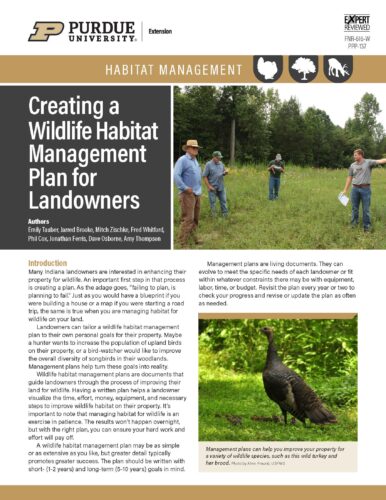 Many landowners are interested in enhancing their property for wildlife. An important first step in that process is creating a plan. As the adage goes, “failing to plan, is planning to fail.” Just as you would have a blueprint if you were building a house or a map if you were starting a road trip, the same is true when you are managing habitat for wildlife on your land.
Landowners can tailor a wildlife habitat management plan to their own personal goals for their property. Maybe a hunter wants to increase the population of upland birds on their property, or a bird-watcher would like to improve the overall diversity of songbirds in their woodlands. Management plans help turn these goals into reality.
This 12 page publication titled Creating a Wildlife Habitat Management Plan for Landowners is packed with photos, resources and suggestions to help meet your goals.
View other wildlife habitat management publications and video resources as you place keywords in the search field located on The Education Store website.
Resources
A Template for Your Wildlife Habitat Management Plan, Got Nature?, Purdue Extension
Managing Your Woods for White-Tailed Deer, The Education Store
Woodland Stewardship for Landowners, Playlist, Purdue Extension – Forestry and Natural Resources YouTube channel
A Woodland Management Moment, Purdue Extension – FNR playlist
Wildlife Habitat Hint, Purdue Extension – FNR playlist
Ask an Expert: Wildlife Food Plots, Video, Purdue Extension – Forestry and Natural Resources YouTube channel
Jarred Brooke, Wildlife Extension Specialist
Purdue Department of Forestry and Natural Resource

Recent Posts
- Beetle that attacks Tree-of-Heaven found in Indiana, Purdue Landscape Report
Posted: March 20, 2026 in Invasive Insects, Wildlife, Woodlands - ID That Tree: Dwarf Chinkapin Oak
Posted: in Forestry, Urban Forestry, Wildlife, Woodlands - DNR Hiring for Indiana Conservation Officer Positions, MyDNR
Posted: March 9, 2026 in Urban Forestry, Wildlife, Woodlands - ID That Tree: Shumard Oak
Posted: in Plants, Urban Forestry, Wildlife, Woodlands - Uniting Indiana Residents Against Invasive Species
Posted: February 27, 2026 in Community Development, Invasive Insects, Wildlife - Have You Seen a Soaring Eagle Lately? Morning Ag Clips
Posted: February 25, 2026 in Urban Forestry, Wildlife - Register for Natural Resources Teacher Institute’s Class of 2026
Posted: February 19, 2026 in Forestry, Wildlife, Woodlands - ID That Tree: Fragrant Sumac
Posted: February 4, 2026 in Plants, Urban Forestry, Wildlife - Woodsy Owl Edition for Educational Learning, USDA – U.S. Forest Service
Posted: January 21, 2026 in Forestry, Forests and Street Trees, Got Nature for Kids, Urban Forestry, Wildlife - Opt-in to the Deer Management Survey, MyDNR
Posted: January 12, 2026 in Forestry, Wildlife
Archives
Categories
- Alert
- Aquaculture/Fish
- Aquatic/Aquaculture Resources
- Ask the Expert
- Christmas Trees
- Community Development
- Disease
- Drought
- Forestry
- Forests and Street Trees
- Gardening
- Got Nature for Kids
- Great Lakes
- How To
- Invasive Animal Species
- Invasive Insects
- Invasive Plant Species
- Land Use
- Natural Resource Planning
- Nature of Teaching
- Plants
- Podcasts
- Ponds
- Publication
- Safety
- Spiders
- Timber Marketing
- Uncategorized
- Urban Forestry
- Webinar
- Wildlife
- Wood Products/Manufacturing
- Woodland Management Moment
- Woodlands