 Purdue University - Extension - Forestry and Natural Resources
Got Nature? Blog
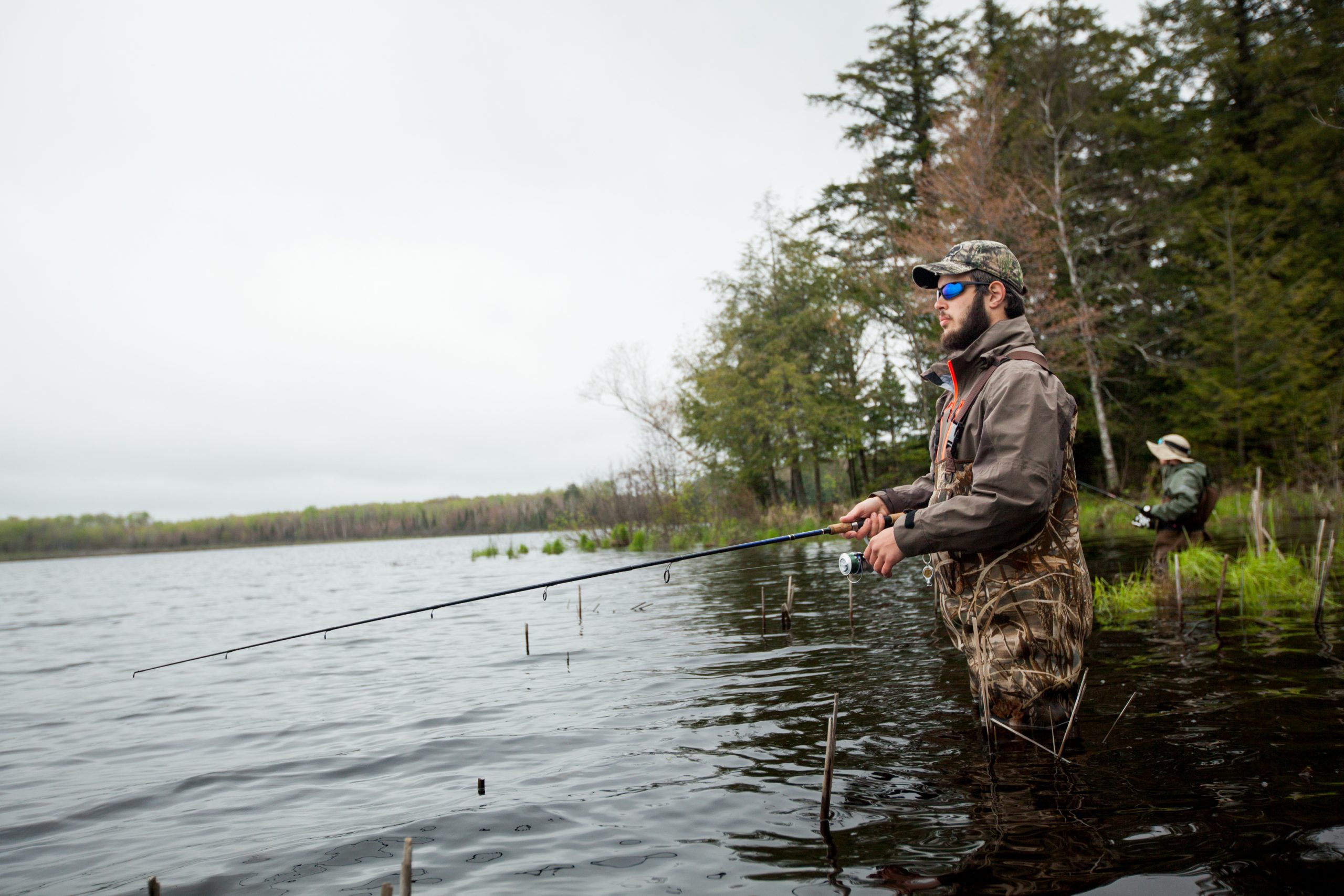 Wild Bulletin, Indiana Department of Natural Resources Fish & Wildlife email newsletter, Fishing Tips, and Videos: Fishing can be hard for someone just starting—the choice in rods, reels, bait, lures, and lines can be mind-boggling. So, when first learning how to fish, keep it simple, light, and close to home.
A light fishing line with small bobbers, weights, hooks, and bait can help you get some excitement on the end of the line fast. Beginner anglers (kids or adults) may tire quickly and often give up while waiting for a giant bass to bite. Most beginners would rather pull in 25 minnow-sized bluegills than wait for one trophy catch.
If you are looking for additional information on how to get get started, you can learn more fishing tips about:
For more fishing tips. Check out these advanced fishing tips.
To subscribe visit: Wildlife Bulletin Newsletter, Indiana DNR-Department of Fisheries and Wildlife.
Resources:
Lampreys, Indiana Division of Fish and Wildlife’s Animal Informational Series
Protect Your Waters, U.S. Fish, and Wildlife Service & U.S. Coast Guard
Nongame and Endangered Wildlife, Indiana Department of Natural Resources
Fishing Guide and Regulations, Indiana Department of Natural Resources
List of Indiana Fishes, Indiana Department of Natural Resources
Pond Management: Stocking Fish in Indiana Ponds, The Education Store
Indiana Department of Natural Resources
Follow the hellbenders as they start their journey with the Purdue Forestry and Natural Resources husbandry program starting with eggs found in the wild. Learn how they become part of the breeding program with our partner zoos. Travel with our Help the Hellbender crew and see the fruit of their labor as the team releases adult hellbenders into the Blue River. Be sure to follow the Help the Hellbender Facebook page for more videos as there are several release dates scheduled for this summer.
Learn more about the hellbender program and a locally made documentary in the Purdue Forestry and Natural Resources News & Stories, Hellbender Research Featured in New Documentary.
Resources:
Help the Hellbender website
Help the Hellbender Facebook page
Ask the Expert: Learn All About Hellbenders and Take a Tour, Subscribe Purdue Extension – Forestry & Natural Resources (FNR) YouTube Channel
Ask the Expert video: Help the Hellbender – Dr. Stephen Spear of The Wilds, Purdue Extension – FNR YouTube Channel
Ask the Expert video: Live with Mesker Park Zoo and Botanical Gardens – Hellbenders, Purdue Extension – FNR YouTube Channel
A Moment in the Wild video: Hellbender Hide, Purdue Extension – FNR YouTube Channel
A Moment in the Wild video: Release Moment of Hellbenders,
How Anglers and Paddlers Can Help the Hellbender video, Purdue Extension – FNR YouTube Channel
Eastern Hellbender ID Video, Purdue Extension – FNR YouTube Channel
Hellbenders Rock!, The Education Store, Purdue Extension’s resource center
Help the Hellbender, North America’s Giant Salamander, The Education Store
How Our Zoos Help Hellbenders, The Education Store
The Nature of Teaching: Adaptations for Aquatic Amphibians, The Education Store
Healthy Water, Happy Home – Lesson Plan, The Education Store
FNR Assists in First Natural Breeding of Eastern Hellbender in Captivity, Purdue FNR News & Stories
Wendy Mayer, FNR Communications Coordinator
Purdue University Department of Forestry and Natural Resources
Zach Truelock, Hellbender Technician
Purdue Forestry and Natural Resources
Rod Williams, Assistant Provost for Engagement/Professor of Wildlife Science
Purdue University Department of Forestry and Natural Resources
MyDNR, Indiana’s Outdoor Newsletter: It’s not too early to think about deer season. You can find season dates and answers to deer hunting FAQs at White-tailed Deer Hunting, and you can purchase deer licenses at an authorized retailer or online.
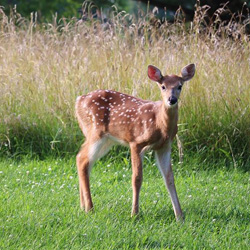 Remember, you must have an Access Indiana account before purchasing your license online. We recommend setting up or reviewing your account information ahead of time to avoid any delay. Some waterfowl, deer, game bird, and pheasant applications open on Aug. 22. See the full list on Reserved Hunt Information. You can submit only one application per hunt, and no changes can be made once an application is submitted.
The 2022-2023 deer hunting seasons are as follows:
- Reduction Zone: Sept. 15, 2022 – Jan. 31, 2023 (where open)
- Youth Season: Sept. 24-25, 2022
- Archery: Oct. 1, 2022 – Jan. 1, 2023
- Firearm: Nov. 12-27, 2022
- Muzzleloader: Dec. 3-18, 2022
- Special Antlerless: Dec. 26, 2022 – Jan. 1, 2023
A resident youth hunt/trap, or comprehensive lifetime hunting license is required to hunt for deer unless you meet one of the license exemptions. All deer harvested in Indiana must be reported within 48 hours of the time of harvest at an on-site check station. It is only available online, through your Indiana Fish & Wildlife Account, or by phone at 1-800-419-1326. There is a $3 charge for the phone service, payable only by Visa or Mastercard.
Want to apply for a reserved hunt? Applicants must possess a valid hunting license for the hunt for which they are applying. To find out more about reserved hunt applications that are open or open soon, please visit the full article > > >
Resources:
How to Score Your White-tailed Deer, video, The Education Store, Purdue Extension Resource Center
White-Tailed Deer Post Harvest Collection, video, The Education Store
Age Determination in White-tailed Deer, video, The Education Store
How to Build a Plastic Mesh Deer Exclusion Fence, The Education Store
Managing Your Woods for White-Tailed Deer, The Education Store
Bovine Tuberculosis in Wild White-tailed Deer, The Education Store
Subscribe to Purdue Extension-Forestry & Natural Resources YouTube Channel, Wildlife Playlist
Subscribe to MyDNR, Wild Bulletin and State Park Inns News, Indiana Department of Natural Resources (IN DNR)
Indiana Deer Hunting, Biology and Management, Safe Food Handling and Preparation IN DNR
Indiana Department of Natural Resources, Department of Fish & Wildlife
The classic and trusted book “Fifty Common Trees of Indiana” by T.E. Shaw was published in 1956 as a user-friendly guide to local species. Nearly 70 years later, the publication has been updated through a joint effort by the Purdue Department of Forestry and Natural Resources, Indiana 4-H, and the Indiana Department of Natural Resources, and reintroduced as “An Introduction to Trees of Indiana.”
 The full publication is available for download for $7 in the Purdue Extension Education Store. The field guide helps identify common Indiana woodlot trees.
Each week, the Intro to Trees of Indiana web series will offer a sneak peek at one species from the book, paired with an ID That Tree video from Purdue Extension forester Lenny Farlee to help visualize each species as it stands in the woods. Threats to species health as well as also insight into the wood provided by the species will be provided through additional resources as well as the Hardwoods of the Central Midwest exhibit of the Purdue Arboretum, if available.
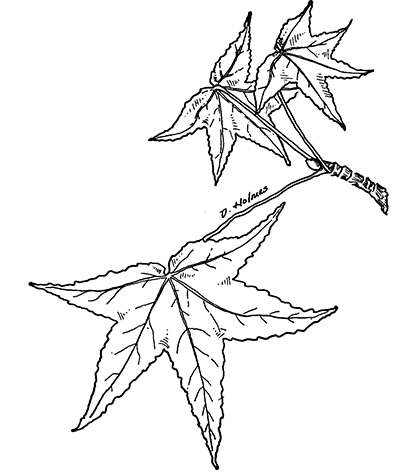
This week, we introduce the sweetgum or Liquidambar styraciflua.
This species is easily identified by its leaves, which are shaped like a five-pointed star and held alternately near the end of the twigs on long leaf stems. The leaves change from bright green in the summer to fall colors ranging from yellow to orange, red, and purple. The twigs of sweetgum may be smooth or feature corky winged projections. The fruit of the sweetgum are spiny spherical balls that hold tiny winged seeds inside, which are released in the fall.
Sweetgum is found natively in the low, wet bottomland woods of southern Indiana, but is planted ornamentally through the state. This species grows as far north as coastal New York, as far south as central Florida, as far west as eastern Texas as well as throughout the Midwest with the exception of the Appalachian Mountains.
For full article with additional photos view: Intro to Trees of Indiana: Sweet Gum
Other Resources:
Sweetgum in Hardwoods of the Midwest
Sweetgum in the Hardwood Lumber and Veneer Series
Fifty Common Trees of Indiana
An Introduction to Trees of Indiana
Native Trees of the Midwest
Shrubs and Woody Vines of Indiana and the Midwest
ID That Tree YouTube playlist
Woodland Management Moment YouTube playlist
Investing in Indiana Woodlands
Forest Improvement Handbook
Wendy Mayer, FNR Communications Coordinator
Purdue University Department of Forestry and Natural Resources
Lenny Farlee, Sustaining Hardwood Extension Specialist
Purdue University Department of Forestry and Natural Resources
 The classic and trusted book “Fifty Common Trees of Indiana” by T.E. Shaw was published in 1956 as a user-friendly guide to local species. Nearly 70 years later, the publication has been updated through a joint effort by the Purdue Department of Forestry and Natural Resources, Indiana 4-H, and the Indiana Department of Natural Resources, and reintroduced as “An Introduction to Trees of Indiana.”
The full publication is available for download for $7 in the Purdue Extension Education Store. The field guide helps identify common Indiana woodlot trees.
Each week, the Intro to Trees of Indiana web series will offer a sneak peek at one species from the book, paired with an ID That Tree video from Purdue Extension forester Lenny Farlee to help visualize each species as it stands in the woods. Threats to species health as well as also insight into the wood provided by the species, will be provided through additional resources as well as the Hardwoods of the Central Midwest exhibit of the Purdue Arboretum, if available.
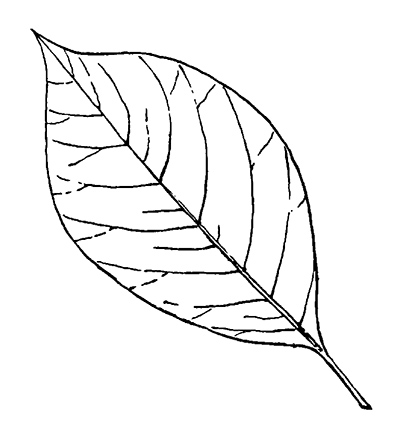
This week, we introduce the black gum or Nyssa sylvatica.
The black gum, also known as bee gum, sour gum, black tupelo or pepperidge, has glossy, green oblong leaves broader at the tip that at the base. The alternately held leaves are often found in clusters at the tips of the branches, which grow out of the trunk at nearly 90-degree angles. The bark, which can range from light gray to a dark grayish brown, resembles alligator hide or in some case features long running ridges.
Black gum produces a small dark-blue berry-like fruit which ripen in late September and are favored by birds. In the fall, this species also puts on quite a show with its striking red/maroon leaves, which begin to change in mid-September.
Black gum is a medium-sized tree that is found on moist, well-drained soils, but also grows on dry upland sites. This species can be found from southern Maine to nearly the tip of Florida. It also ranges from east Texas north across Missouri, southern Illinois, nearly all of Indiana and to central Michigan and back east, except in the lower Mississippi River bottom.
For full article with additional photos view: Intro to Trees of Indiana: Black Gum
Other Resources:
Black Gum in the Hardwood Lumber and Veneer Series
Black Gum/Tupelo, Native Trees of Indiana River Walk, Purdue Fort Wayne
Black Gum & Tupelo, Purdue Arboretum Explorer
Fifty Common Trees of Indiana
An Introduction to Trees of Indiana
Native Trees of the Midwest
Shrubs and Woody Vines of Indiana and the Midwest
ID That Tree YouTube playlist
Woodland Management Moment YouTube playlist
Investing in Indiana Woodlands
Forest Improvement Handbook
Wendy Mayer, FNR Communications Coordinator
Purdue University Department of Forestry and Natural Resources
Lenny Farlee, Sustaining Hardwood Extension Specialist
Purdue University Department of Forestry and Natural Resources
In this episode of A Moment in the Wild, Purdue extension wildlife technician Zach Truelock introduces you to the northern map turtle. This species is named for the fact that its shell resembles a topographic map. Learn more inside.
If you have any questions regarding wildlife, trees, forest management, wood products, natural resource planning, or other natural resource topics, feel free to contact us by using our Ask an Expert web page.
Resources:
Turtles of Indiana, The Education Store
Forestry Management for Reptiles and Amphibians: A Technical Guide for the Midwest, The Education Store
Appreciating Reptiles and Amphibians in Nature, The Education Store
Indiana Amphibian and Reptile ID Package (4 softcover books), The Education Store
When Juvenile Snakes Come Calling, FNR Got Nature? blog
A Moment in the Wild, Playlist, Purdue Extension – Forestry and Natural Resources
A Moment in the Wild: Black Racer, Video, Purdue Extension – Forestry and Natural Resources YouTube channel
A Moment in the Wild: Eastern Kingsnake, Purdue Extension – FNR Video
A Moment in the Wild: Eastern Hognose, Purdue Extension – FNR Video
Ask An Expert, Purdue Extension – FNR Playlist
Zach Truelock, Hellbender Technician
Purdue Forestry and Natural Resources
Rod Williams, Assistant Provost for Engagement/Professor of Wildlife Science
Purdue University Department of Forestry and Natural Resources
 The classic and trusted book “Fifty Common Trees of Indiana” by T.E. Shaw was published in 1956 as a user-friendly guide to local species. Nearly 70 years later, the publication has been updated through a joint effort by the Purdue Department of Forestry and Natural Resources, Indiana 4-H, and the Indiana Department of Natural Resources, and reintroduced as “An Introduction to Trees of Indiana.”
The full publication is available for download for $7 in the Purdue Extension Education Store. The field guide helps identify common Indiana woodlot trees.
Each week, the Intro to Trees of Indiana web series will offer a sneak peek at one species from the book, paired with an ID That Tree video from Purdue Extension forester Lenny Farlee to help visualize each species as it stands in the woods. Threats to species health as well as also insight into the wood provided by the species, will be provided through additional resources as well as the Hardwoods of the Central Midwest exhibit of the Purdue Arboretum, if available.
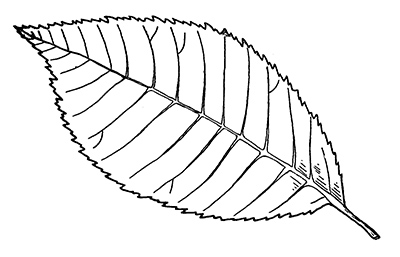
This week, we introduce the American elm or Ulmus americana.
The American elm, also called white elm, is easily identified by its simple doubly-serrated oval leaves, which feature a large tooth with small teeth like edges on top that. The leaves are held on fine twigs, which turn a medium brown over the summer. The bark of the American elm is spongy, with strong crisscrossing ridges. When sliced open, these ridges show distinct reddish brown and light tan/white colored layers inside the bark. This is different from the dark brown and reddish-brown layers found in the bark of red elm or slippery elm.
The American elm features an open, spreading crown and drooping limbs that form a vase shape.
American elm is a common tree in many riparian forest areas or moist soil forest areas. The species used to be a common street tree in Indiana, but that number has dwindled due to Dutch elm disease, a fungal diseased which ravaged the species in the second half of the 20th century.
American elm can be found throughout the northeastern United States south to central Florida and west to central Texas and north to southeastern Saskatchewan.
For full article with additional photos view: Intro to Trees of Indiana: American Elm
Resources:
Elm, The Education Store, Purdue Extension resource center
Slippery Elm, Native Trees of Indiana River Walk, Purdue – Fort Wayne
Top 5 List for Tree Selection and Planting, Purdue Extension-Forestry & Natural Resources (FNR) Got Nature? Blog
Fifty Common Trees of Indiana
An Introduction to Trees of Indiana
Native Trees of the Midwest, The Education Store, Purdue Extension’s resource center
Shrubs and Woody Vines of Indiana and the Midwest, The Education Store
ID That Tree, Purdue Extension-FNR’s YouTube playlist
Woodland Management Moment , Purdue Extension-FNR’s YouTube playlist
Investing in Indiana Woodlands, The Education Store
Forest Improvement Handbook, The Education Store
Wendy Mayer, FNR Communications Coordinator
Purdue University Department of Forestry and Natural Resources
Lenny Farlee, Sustaining Hardwood Extension Specialist
Purdue University Department of Forestry and Natural Resources
Purdue Landscape Report, Why are the Japanese beetles running late this year?: Nothing heralds summer like the hum of Japanese beetles ravenously descending on a flower garden. Cool weather this spring has slowed emergence of adults from the soil. Heavy spring rains early followed by relatively drier weather in late June, may have trapped adult Japanese beetles under a crusty layer of hardened soil. Due to their large numbers in many parts of Indiana last year, they are very likely just waiting for a good rain to soften the surface, so they can dig themselves into the light of day and on to your flowers. So, if we get a little more rain by the time this article comes out, we are likely to be awash in adult beetles.
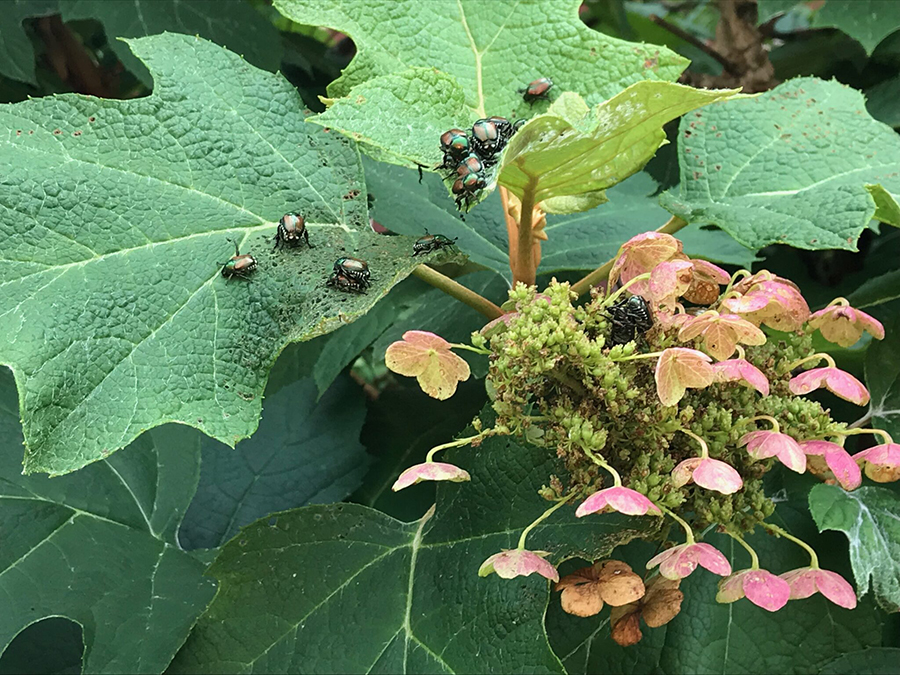 Weather is only part of what makes Japanese beetles predictably unpredictable. Beneficial organisms including fungi, microsporidia, and parasitic wasps also act different life stages of Japanese beetles. Japanese beetles have been the target of several national programs to release these beneficial organisms to reduce beetle populations. Favorable conditions for these beneficials can help reduce the local abundance of grubs and beetles.
Although killing grubs will reduce the number of beetles, the small size of lawns and the long flight range of makes it unlikely for your grub control program to reduce defoliation. In experiments conducted in my lab over 20 years ago, we found adult beetles can easily fly a kilometer (0.66 miles) in a single day. With adults living for several weeks, it is easy to image beetles traveling long distances from untreated lawns to plants on your property.
Life cycle of Japanese beetles: As the weather warms in the spring larvae (aka white grubs) move closer to the surface and begin feeding on turf roots. In May they enter a pupal stage and stop feeding. In June they typically emerge from the soil as adults. Adults fly in summer when they feed on flowers and leaves. In late July and early August adults lay eggs into the turfgrass. White grubs hatch from eggs and feed on the roots until frost when the larvae begin dig deeper into the soil to avoid killing temperatures.
To find out what you can do about Japanese beetles and view photos view: Why are the Japanese beetles running late this year?
Resources:
Report Invasive
Invasive Species, Got Nature?
Invasive Species, Playlist, Purdue Extension – FNR YouTube Channel
Indiana Department of Entomology and Plant Pathology
Spotted lanternfly: Everything You Need to Know in 30 Minutes, Video, Emerald Ash Borer University
Emerald Ash Borer, EAB Information Network
Invasive plants: impact on environment and people, The Education Store, Purdue Extension’s resource center
Woodland Management Moment: Invasive Species Control Process, Video, Purdue Extension – Forestry and Natural Resources (FNR) YouTube Channel
What are invasive species and why should I care?, Got Nature? Blog, Purdue Extension – Forestry and Natural Resources
Pest Management, The Education Store
Cliff Sadof, Professor Entomology/Extension Fellow
Purdue Entomology
In this Moment in the Wild video, Purdue Extension wildlife technician Zach Truelock introduces you to the common water snake. He shows you how to tell it apart from the venomous cottonmouth and also shares identification and breeding information.
If you have any questions regarding wildlife, trees, forest management, wood products, natural resource planning, or other natural resource topics, feel free to contact us by using our Ask an Expert web page.
Resources
Snakes of Indiana, The Education Store, Purdue Extension resource center
Snakes and Lizards of Indiana, The Education Store
Snakes of Indiana, The Education Store
Snakes of the Central and Northeastern United States, The Education Store
Forestry Management for Reptiles and Amphibians: A Technical Guide for the Midwest, The Education Store
Appreciating Reptiles and Amphibians in Nature, The Education Store
Indiana Amphibian and Reptile ID Package (4 softcover books), The Education Store
When Juvenile Snakes Come Calling, FNR Got Nature? blog
A Moment in the Wild, Playlist, Purdue Extension – Forestry and Natural Resources
A Moment in the Wild: Black Racer, Video, Purdue Extension – Forestry and Natural Resources YouTube channel
A Moment in the Wild: Eastern Kingsnake, Purdue Extension – FNR Video
A Moment in the Wild: Eastern Hognose, Purdue Extension – FNR Video
Ask An Expert, Purdue Extension – FNR Playlist
Zach Truelock, Hellbender Technician
Purdue Forestry and Natural Resources
Rod Williams, Assistant Provost for Engagement/Professor of Wildlife Science
Purdue University Department of Forestry and Natural Resources
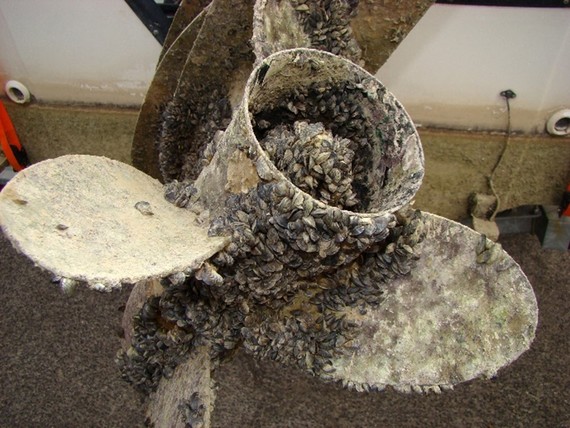 Wild Bulletin, Indiana DNR Fish & Wildlife email newsletter, Help stop the spread of aquatic invasive species: DNR and several Indiana conservation organizations gathered to take part in the fourth annual Great Lakes Aquatic Invasive Species Landing Blitz from June 24th to July 10th. Staff and volunteers were at state parks helping boaters, anglers and other water enthusiasts check their watercraft and other equipment for aquatic invasive species, along with educating them on preventive measures.
Aquatic invasive species are plants, animals, and other organisms that are not native to Indiana waters and have the potential to cause harm. These species are concerning because they outcompete native species, threaten human health, change and degrade the ecosystem, and/or require intense maintenance and monitoring.
Most invasive species find their way to Indiana through human behaviors. Modern transportation brings goods including invasive species from all around the world in a matter of hours or days. Some exotic pets or plants used in aquariums or water gardens escape into the wild and if they are adapted to Indiana’s conditions, they can become invasive. Boats and ships moving from waterbody to waterbody can spread invasives. Some invasives were brought to the U.S. intentionally as bio-controls for other invasives; others were introduced as game or food species.
Invasive species can be very expensive or impossible to control. For instance, Indiana spends an estimated $1 million per year in public waters to chemically control Eurasian watermilfoil, an invasive water plant that can shade out native species and interferes with boating and fishing. The damage to sport fisheries and commercial resources from AIS can be serious.
To learn how to stop “hitchhikers” and to learn more about aquatic invasive species view IN DNR: Aquatic Invasive Species.
Resources:
Invasive Mussels, IN DNR Fish and Wildlife
Aquatic Invasive Species in the Great Lakes: The Quagga Mussel, Purdue Extension – Forestry & Natural Resources (FNR) Got Nature? Blog
Aquatic Invaders in the Marketplace, Illinois-Indiana Sea Grant (IISG)
Invasive Species, Playlist, Purdue Extension – FNR YouTube Channel
What are invasive species and why should I care?, Got Nature? Blog, Purdue Extension – Forestry and Natural Resources
Report Invasive Species, Purdue Invasive Species
The GLEDN Phone App – Great Lakes Early Detection Network
EDDMaps – Early Detection and Distribution Mapping System
Indiana Department of Natural Resources: Invasive Species
Indiana Invasive Species Council
Cooperative Invasive Species Management Area (CISMA)
Great Lakes Sea Grant Network (GLERL), NOAA – Great Lakes Environmental Research Laboratory
A Field Guide to Fish Invaders of the Great Lake Regions, Illinois-Indiana Sea Grant (IISG)
Purdue Researchers Get to the Bottom of Another Quagga Mussel Impact, Illinois-Indiana Sea Grant (IISG)
Invasive plants: Impact on Environment and People, The Education Store, Purdue Extension’s resource center
Protect Your Waters, U.S. Fish and Wildlife Service & U.S. Coast Guard
Nongame and Endangered Wildlife, Indiana Department of Natural Resources
Indiana Department of Natural Resources (IN DNR) – Fish and Wildlife

Recent Posts
- Beetle that attacks Tree-of-Heaven found in Indiana, Purdue Landscape Report
Posted: March 20, 2026 in Invasive Insects, Wildlife, Woodlands - ID That Tree: Dwarf Chinkapin Oak
Posted: in Forestry, Urban Forestry, Wildlife, Woodlands - DNR Hiring for Indiana Conservation Officer Positions, MyDNR
Posted: March 9, 2026 in Urban Forestry, Wildlife, Woodlands - ID That Tree: Shumard Oak
Posted: in Plants, Urban Forestry, Wildlife, Woodlands - Uniting Indiana Residents Against Invasive Species
Posted: February 27, 2026 in Community Development, Invasive Insects, Wildlife - Have You Seen a Soaring Eagle Lately? Morning Ag Clips
Posted: February 25, 2026 in Urban Forestry, Wildlife - Register for Natural Resources Teacher Institute’s Class of 2026
Posted: February 19, 2026 in Forestry, Wildlife, Woodlands - ID That Tree: Fragrant Sumac
Posted: February 4, 2026 in Plants, Urban Forestry, Wildlife - Woodsy Owl Edition for Educational Learning, USDA – U.S. Forest Service
Posted: January 21, 2026 in Forestry, Forests and Street Trees, Got Nature for Kids, Urban Forestry, Wildlife - Opt-in to the Deer Management Survey, MyDNR
Posted: January 12, 2026 in Forestry, Wildlife
Archives
Categories
- Alert
- Aquaculture/Fish
- Aquatic/Aquaculture Resources
- Ask the Expert
- Christmas Trees
- Community Development
- Disease
- Drought
- Forestry
- Forests and Street Trees
- Gardening
- Got Nature for Kids
- Great Lakes
- How To
- Invasive Animal Species
- Invasive Insects
- Invasive Plant Species
- Land Use
- Natural Resource Planning
- Nature of Teaching
- Plants
- Podcasts
- Ponds
- Publication
- Safety
- Spiders
- Timber Marketing
- Uncategorized
- Urban Forestry
- Webinar
- Wildlife
- Wood Products/Manufacturing
- Woodland Management Moment
- Woodlands