 Purdue University - Extension - Forestry and Natural Resources
Got Nature? Blog
The classic and trusted book “Fifty Common Trees of Indiana” by T.E. Shaw was published in 1956 as a user-friendly guide to local species. Nearly 70 years later, the publication has been updated through a joint effort by the Purdue Department of Forestry and Natural Resources, Indiana 4-H, and the Indiana Department of Natural Resources, and reintroduced as “An Introduction to Trees of Indiana.”
The full publication is available for download for $7 in the Purdue Extension Education Store. The field guide helps identify common Indiana woodlot trees.
Each week, the Intro to Trees of Indiana web series will offer a sneak peek at one species from the book, paired with an ID That Tree video from Purdue Extension forester Lenny Farlee to help visualize each species as it stands in the woods. Threats to species health as well as also insight into the wood provided by the species, will be provided through additional resources as well as the Hardwoods of the Central Midwest exhibit of the Purdue Arboretum, if available. 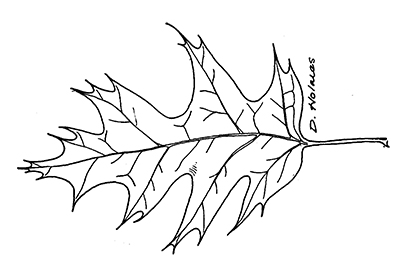
This week, we take a look at the sixth of our oak varieties in Indiana, the Northern Red Oak or Quercus rubra.
This native species is easily identified by its bark and its acorn. The bark looks like ski tracks or long running ridges that run up and down the sides of the tree, while the fruit is a large rounded acorn featuring a tight shallow cap with tight scales that resembles a beret sitting on top of a head.
Like other members of the red oak group, the leaves are multi-lobed and have bristle tips, including a sharp bristle tip on the terminal lobe. On the northern red oak, the alternately held leaves have veins that are palmate, or run out to the ends of the lobes from a single point in the middle. In the fall, the dark green leaves change to a bright red color.
The cluster of terminal buds at the end of northern red oak stems are smooth, shiny and reddish brown to brown in color. The twigs are somewhat angular in appearance.
Northern red oaks, which grow to 60 to 75 feet tall, are found mostly in upland areas. The natural range of northern red oak is the eastern United States and southern Canada, with the exception of the southern coastal plains. It grows well on moist, but well-drained soils.
The Morton Arboretum states that northern red oak has a high tolerance of salt and air pollution, making it a good tree for more exposed areas. This species prefers a well-drained, rich woodland site and it grows best in sandy, loam soil.
As with other oaks, the northern red oak should be pruned in the dormant season to avoid attracting beetles that may carry oak wilt. Galls and mites are common insect problems. This species can develop chlorosis symptoms in high pH soils.
For full article with additional photos view: Intro to Trees of Indiana: Northern Red Oak, Forestry and Natural Resources’ News.
If you have any questions regarding wildlife, trees, forest management, wood products, natural resource planning, or other natural resource topics, feel free to contact us by using our Ask an Expert web page.
Other Resources:
ID That Tree: Northern Red Oak
ID That Tree: Red Oak Group
Hardwood Lumber and Veneer Series: Red Oak Group
Morton Arboretum: Northern Red Oak
Red Oak, Native Trees of Indiana River Walk, Fort Wayne Purdue
Fifty Common Trees of Indiana
An Introduction to Trees of Indiana
Native Trees of the Midwest, The Education Store
Shrubs and Woody Vines of Indiana and the Midwest, The Education Store
Investing in Indiana Woodlands, The Education Store
Forest Improvement Handbook, The Education Store
ID That Tree, Purdue Extension-Forestry & Natural Resources (FNR) YouTube playlist
Woodland Management Moment, Purdue Extension-FNR YouTube playlist
Wendy Mayer, FNR Communications Coordinator
Purdue University Department of Forestry and Natural Resources
Lenny Farlee, Sustaining Hardwood Extension Specialist
Purdue University Department of Forestry and Natural Resources
The classic and trusted book “Fifty Common Trees of Indiana” by T.E. Shaw was published in 1956 as a user-friendly guide to local species. Nearly 70 years later, the publication has been updated through a joint effort by the Purdue Department of Forestry and Natural Resources, Indiana 4-H, and the Indiana Department of Natural Resources, and reintroduced as “An Introduction to Trees of Indiana.”
The full publication is available for download for $7 in the Purdue Extension Education Store. The field guide helps identify common Indiana woodlot trees. 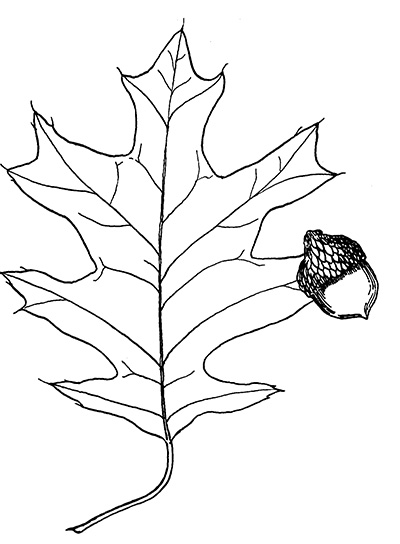
Each week, the Intro to Trees of Indiana web series will offer a sneak peek at one species from the book, paired with an ID That Tree video from Purdue Extension forester Lenny Farlee to help visualize each species as it stands in the woods. Threats to species health as well as also insight into the wood provided by the species, will be provided through additional resources as well as the Hardwoods of the Central Midwest exhibit of the Purdue Arboretum, if available.
This week, we take a look at the seventh of our featured oak varieties in Indiana, the Black Oak or Quercus velutina.
The leaves of black oak are multi-lobed, typically with seven lobes, with deep sinuses in between, and have bristle tips like all members of the red/black oak family. On the black oak, the alternately held leaves can be extremely variable in shape, but the tops of the leaves are dark and shiny and have a leathery appearance. Leaves change from dark green in summer to yellow or yellow-brown in fall.
One key characteristic of black oak are the terminal buds, which are angular and fuzzy, very large and light tan. Alternately, the cluster of terminal buds at the end of northern red oak stems are smooth, shiny and reddish brown to brown in color.
The bark is very dark in color with narrow, blocky ridges, and lacks the silvery running ridges that are found on northern red oak.
The fruit is a small rounded acorn with striping running up and down the sides and a fuzzy coating along the outside edge. The cap is deeper than northern red oak and the scales on the edge of the cap resemble loose, rough shingles.
Black oaks, which grow to 50 to 60 feet tall, are found mostly in dry, upland areas. The natural range of the black oak is nearly all of the eastern United States, from Nebraska, Iowa and Oklahoma to the west, dipping south into Texas, Louisiana, Mississippi, Alabama, Georgia and even a bit of the panhandle of Florida, extending along the eastern coastline, and northward into southern Ontario, Canada.
The Morton Arboretum states that black oak has a high tolerance of alkaline soils and dry sites, although it prefers acidic and dry soil. This species cannot withstand severe drought. It can also be difficult to transplant due to a deep taproot.
As with other oaks, the black oak should be pruned in the dormant season to avoid attracting beetles that may carry oak wilt, which can be a potential disease problem. Galls on leaves caused by mites or insects are common, but not harmful.
For full article with additional photos view: Intro to Trees of Indiana: Black Oak, Forestry and Natural Resources’ News.
If you have any questions regarding wildlife, trees, forest management, wood products, natural resource planning or other natural resource topics, feel free to contact us by using our Ask an Expert web page.
Other Resources:
ID That Tree: Black Oak
ID That Tree: Red Oak Group
Hardwood Lumber and Veneer Series: Red Oak Group
Morton Arboretum: Black Oak
Black Oak, Native Trees of Indiana River Walk, Fort Wayne Purdue
Fifty Common Trees of Indiana
An Introduction to Trees of Indiana
Native Trees of the Midwest, The Education Store
Shrubs and Woody Vines of Indiana and the Midwest, The Education Store
Investing in Indiana Woodlands, The Education Store
Forest Improvement Handbook, The Education Store
ID That Tree, Purdue Extension-Forestry & Natural Resources (FNR) YouTube playlist
Woodland Management Moment , Purdue Extension-FNR YouTube playlist
Wendy Mayer, FNR Communications Coordinator
Purdue University Department of Forestry and Natural Resources
Lenny Farlee, Sustaining Hardwood Extension Specialist
Purdue University Department of Forestry and Natural Resources
The classic and trusted book “Fifty Common Trees of Indiana” by T.E. Shaw was published in 1956 as a user-friendly guide to local species. Nearly 70 years later, the publication has been updated through a joint effort by the Purdue Department of Forestry and Natural Resources, Indiana 4-H, and the Indiana Department of Natural Resources, and reintroduced as “An Introduction to Trees of Indiana.”
The full publication is available for download for $7 in the Purdue Extension Education Store. The field guide helps identify common Indiana woodlot trees.
Each week, the Intro to Trees of Indiana web series will offer a sneak peek at one species from the book, paired with an ID That Tree video from Purdue Extension forester Lenny Farlee to help visualize each species as it stands in the woods. Threats to species health as well as also insight into the wood provided by the species, will be provided through additional resources as well as the Hardwoods of the Central Midwest exhibit of the Purdue Arboretum, if available.
This week, we take a look at the fifth of our oak varieties in Indiana, the Chinkapin Oak or Quercus muehlenbergii.
Also known as the Chinquapin Oak, the leaves of this species feature shallow, evenly lobed margins, but appear to have sharp-pointed teeth at the end resembling red or black oaks. This sharp point, however, is due to a gland at the end of the leaves, and there is no bristle tip as are typically found on red and black oaks. The shape of the leaves can be either broad like chestnut oak, or narrower.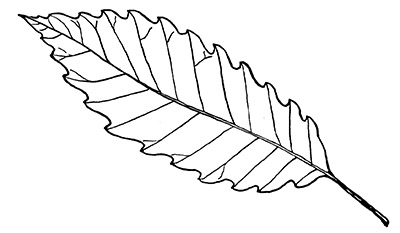
Like other members of the white oak group, the bark of chinkapin oak is light gray and ashy, however it has a flaky appearance.
The fruit of the chinkapin oak is a small acorn that is dark brown or almost black in color. It has a cap that resembles a stocking cap, covering a third or half of the acorn, that features loose knobby scales. Under the cap, the acorn has a large white spot similar to that of a buckeye.
Chinkapin oaks, which grow to 50 to 80 feet tall, are found in both upland and bottomland areas. The natural range of chinkapin oak is the eastern United States, with the exception of the Atlantic coast and the immediate gulf coastal plains.
The Morton Arboretum states that chinkapin oak is best grown in rich, deep soils, but that it is often found in the wild on dry, limestone outcrops in low slopes and wooded hillsides. It notes that this species is one of the best oaks for alkaline soils. As with other oaks, this chinkapin oaks should be pruned in the dormant season to avoid attracting beetles that may carry oak wilt. This species also can be affected by anthracnose, oak wilt and two-lined chestnut borers.
For full article with additional photos view: Intro to Trees of Indiana: Chinkapin Oak, Forestry and Natural Resources’ News.
If you have any questions regarding wildlife, trees, forest management, wood products, natural resource planning, or other natural resource topics, feel free to contact us by using our Ask an Expert web page.
Other Resources:
ID That Tree: Chinkapin Oak
ID That Tree: White Oak Group
Hardwood Lumber and Veneer Series: White Oak Group
Morton Arboretum: Chinkapin Oak
Chinkapin Oak, Native Trees of Indiana River Walk, Fort Wayne Purdue
Fifty Common Trees of Indiana
An Introduction to Trees of Indiana
Native Trees of the Midwest, The Education Store
Shrubs and Woody Vines of Indiana and the Midwest, The Education Store
Investing in Indiana Woodlands, The Education Store
Forest Improvement Handbook, The Education Store
ID That Tree, Purdue Extension-Forestry & Natural Resources (FNR) YouTube playlist
Woodland Management Moment, Purdue Extension-FNR YouTube playlist
Wendy Mayer, FNR Communications Coordinator
Purdue University Department of Forestry and Natural Resources
Lenny Farlee, Sustaining Hardwood Extension Specialist
Purdue University Department of Forestry and Natural Resources
The classic and trusted book “Fifty Common Trees of Indiana” by T.E. Shaw was published in 1956 as a user-friendly guide to local species. Nearly 70 years later, the publication has been updated through a joint effort by the Purdue Department of Forestry and Natural Resources, Indiana 4-H, and the Indiana Department of Natural Resources, and reintroduced as “An Introduction to Trees of Indiana.”
The full publication is available for download for $7 in the Purdue Extension Education Store. The field guide helps identify common Indiana woodlot trees.
Each week, the Intro to Trees of Indiana web series will offer a sneak peek at one species from the book, paired with an ID That Tree video from Purdue Extension forester Lenny Farlee to help visualize each species as it stands in the woods. Threats to species health as well as also insight into the wood provided by the species, will be provided through additional resources as well as the Hardwoods of the Central Midwest exhibit of the Purdue Arboretum, if available. 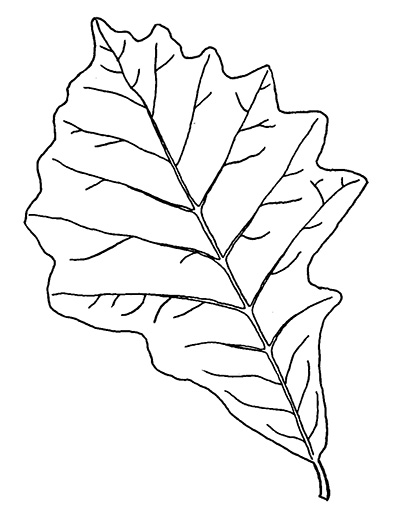
This week, we take a look at the third of our oak varieties in Indiana, the Swamp White Oak or Quercus bicolor.
The swamp white oak has leaves with wavy, uneven lobed margins with blunt teeth, which are wider toward the tip than at the base. The alternately-held leaves are typically dark green on top with a silvery-white underside, which turn orange, gold and yellow in the fall.
The bark on swamp white oak is similar to that of white oak and often peels back especially on younger trees. Mature bark is dark gray-brown with flaky/shreddy bark or blocky ridges that are consistent up and down the tree.
The fruit of the swamp white oak is an acorn held on a long stalk, typically an inch or inch and a half long, called a peduncle.
Swamp white oaks, which grow to 50 to 60 feet tall, are named for the fact that they often grow in wet places, such as line drawing of swamp white oak acorns and peduncle. upland swamps and lowlands. This species also can tolerate well-drained upland sites, making it a good option for landscape plantings. The natural range of swamp white oak is the northern half of the eastern United States, reaching as far south as Missouri, southern Illinois and Kentucky, and north into Wisconsin, Michigan and Pennsylvania.
The Morton Arboretum warns to plant swamp white oak in full sun and shares that the species is one of the easiest oaks to transplant and is more tolerant of poor drainage than other oaks. It also notes that oaks should be pruned in the dormant season to avoid attracting beetles that may carry oak wilt. Swamp white oak can be affected by pests such as anthracnose, powdery mildew, chlorosis in high pH soils, insect galls and oak wilt.
In general, lumber from the white oak group is among the heaviest next to hickory, weighing in at 47 pounds per cubic foot. It is very resistant to decay and is one of the best woods for steam bending.
White oak lumber has been used for a variety of purposes including log cabins, ships, wagon wheels and furniture. It also is preferred for indoor decorative applications ranging from furniture, especially in churches, to cabinets, interior trim, millwork and hardwood flooring and veneers. It also may be used for barrel making.
Its density and durability make white oak a favorite for industrial applications such as railroad ties, mine timbers, sill plates, fence posts and boards, pallets, and blocking, as well as industrial, agricultural and truck flooring.
For full article with additional photos view: Intro to Trees of Indiana: Swamp White Oak, Forestry and Natural Resources’ News.
If you have any questions regarding wildlife, trees, forest management, wood products, natural resource planning or other natural resource topics, feel free to contact us by using our Ask an Expert web page.
Other Resources:
ID That Tree: Swamp White Oak
ID That Tree: White Oak Group
Hardwood Lumber and Veneer Series: White Oak Group
Morton Arboretum: Swamp White Oak
Fifty Common Trees of Indiana
An Introduction to Trees of Indiana
Native Trees of the Midwest, The Education Store
Shrubs and Woody Vines of Indiana and the Midwest, The Education Store
Investing in Indiana Woodlands, The Education Store
Forest Improvement Handbook, The Education Store
ID That Tree, Purdue Extension-Forestry & Natural Resources (FNR) YouTube playlist
Woodland Management Moment , Purdue Extension-FNR YouTube playlist
Wendy Mayer, FNR Communications Coordinator
Purdue University Department of Forestry and Natural Resources
Lenny Farlee, Sustaining Hardwood Extension Specialist
Purdue University Department of Forestry and Natural Resources
The classic and trusted book “Fifty Common Trees of Indiana” by T.E. Shaw was published in 1956 as a user-friendly guide to local species. Nearly 70 years later, the publication has been updated through a joint effort by the Purdue Department of Forestry and Natural Resources, Indiana 4-H, and the Indiana Department of Natural Resources, and reintroduced as “An Introduction to Trees of Indiana.”
The full publication is available for download for $7 in the Purdue Extension Education Store. The field guide helps identify common Indiana woodlot trees.
Each week, the Intro to Trees of Indiana web series will offer a sneak peek at one species from the book, paired with an ID That Tree video from Purdue Extension forester Lenny Farlee to help visualize each species as it stands in the woods. Threats to species health as well as also insight into the wood provided by the species, will be provided through additional resources as well as the Hardwoods of the Central Midwest exhibit of the Purdue Arboretum, if available. 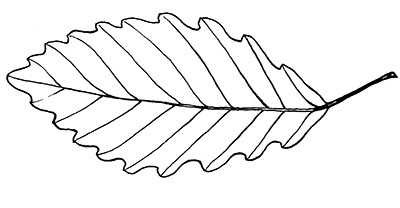
This week, we take a look at the fourth of our oak varieties in Indiana, the Chestnut Oak or Quercus montana.
The leaves of the chestnut oak have small, evenly lobed rounded margins. The upper leaf surface is leathery in appearance and is dark green in color, while the lower surface is a duller green. In the fall, the leaves can range from red and orange to yellow and brown.
The bark may be its tell-tale characteristic. Unlike other members of the white oak group, the bark of Chestnut oak bark chestnut oak is dark and deeply ridged.
The fruit of the chestnut oak is a relatively-large dark brown acorn with a smooth edge on the outer margin of the cap.
Chestnut oaks, which grow to 60 to 70 feet tall, are often found on high, dry sites in Indiana. The natural range of chestnut oak is across the northeastern United States, extending south to the northern parts of Alabama and Georgia and west to the southern tip of Illinois.
The Morton Arboretum warns that chestnut oak is a difficult to transplant due to a deep taproot, but that it can tolerate most soils except those that drain poorly. It also notes that oaks should be pruned in the dormant season to avoid attracting beetles that may carry oak wilt. Chestnut oak can be affected by pests such as scale insects and two-lined chestnut borer. Chestnut oak acorns
In general, lumber from the white oak group is among the heaviest next to hickory, weighing in at 47 pounds per cubic foot. It is very resistant to decay and is one of the best woods for steam bending. Chestnut oak, however, is considered a poor lumber species.
White oak lumber has been used for a variety of purposes including log cabins, ships, wagon wheels and furniture. It also is preferred for indoor decorative applications ranging from furniture, especially in churches, to cabinets, interior trim, millwork and hardwood flooring and veneers. It also may be used for barrel making.
Its density and durability make white oak a favorite for industrial applications such as railroad ties, mine timbers, sill plates, fence posts and boards, pallets, and blocking, as well as industrial, agricultural and truck flooring.
For full article with additional photos view: Intro to Trees of Indiana: Chestnut Oak, Forestry and Natural Resources’ News.
If you have any questions regarding wildlife, trees, forest management, wood products, natural resource planning or other natural resource topics, feel free to contact us by using our Ask an Expert web page.
Other Resources:
ID That Tree: Chestnut Oak
ID That Tree: White Oak Group
Hardwood Lumber and Veneer Series: White Oak Group
Morton Arboretum: Chestnut Oak
Fifty Common Trees of Indiana
An Introduction to Trees of Indiana
Native Trees of the Midwest, The Education Store
Shrubs and Woody Vines of Indiana and the Midwest, The Education Store
Investing in Indiana Woodlands, The Education Store
Forest Improvement Handbook, The Education Store
ID That Tree, Purdue Extension-Forestry & Natural Resources (FNR) YouTube playlist
Woodland Management Moment , Purdue Extension-FNR YouTube playlist
Chestnut Oak, Native Trees of Indiana River Walk, Purdue-Fort Wayne
Wendy Mayer, FNR Communications Coordinator
Purdue University Department of Forestry and Natural Resources
Lenny Farlee, Sustaining Hardwood Extension Specialist
Purdue University Department of Forestry and Natural Resources
The classic and trusted book “Fifty Common Trees of Indiana” by T.E. Shaw was published in 1956 as a user-friendly guide to local species. Nearly 70 years later, the publication has been updated through a joint effort by the Purdue Department of Forestry and Natural Resources, Indiana 4-H, and the Indiana Department of Natural Resources, and reintroduced as “An Introduction to Trees of Indiana.”
The full publication is available for download for $7 in the Purdue Extension Education Store. The field guide helps identify common Indiana woodlot trees.
Each week, the Intro to Trees of Indiana web series will offer a sneak peek at one species from the book, paired with an ID That Tree video from Purdue Extension forester Lenny Farlee to help visualize each species as it stands in the woods. Threats to species health as well as also insight into the wood provided by the species, will be provided through additional resources as well as the Hardwoods of the Central Midwest exhibit of the Purdue Arboretum, if available. 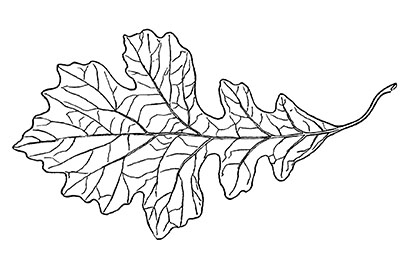
This week, we take a look at the second of our oak varieties in Indiana, the Bur Oak or Quercus macrocarpa.
The bur oak has rounded lobes on the end of the leaves, which have deep sinuses and are very broad across the top. Leaves are typically dark green that turn yellow or brown in the fall.
The bark on bur oak is medium to dark gray in color with heavy ridges and plates, often so thick that it is often fire resistant and resistant to damage from burning. Bur oak may have terminal buds that include small hairs and resemble bear claws.
The fruit of the bur oak is an acorn with a large cap that features a hairy fringe forming a burr along the outside edge. The acorns vary in size, but average one inch in length, and the cap covers half to two thirds of the acorn.
Bur oaks, which grow to 70-80 feet tall and up to five feet wide, are common in both bottomlands and prairie regions, and can tolerate many different sites. Bur oaks can be found in nearly any county and any habitat type in Indiana. The natural range of bur oak is the eastern Great Plains from the Dakotas to Ohio to the eastern Appalachians, except through the southeastern United States. The range also extends into southern Canada.
Lumber from the white oak group, which includes bur oak, is among the heaviest next to hickory, weighing in at 45 pounds per cubic foot. It is very resistant to decay and is one of the best woods for steam bending. Bur oak, however, is somewhat weaker than other species in the white oak group.
For full article with additional photos view: Intro to Trees of Indiana: Bur Oak
If you have any questions regarding wildlife, trees, forest management, wood products, natural resource planning or other natural resource topics, feel free to contact us by using our Ask an Expert web page.
Other Resources:
ID That Tree: Bur Oak
ID That Tree: White Oak Group
ID That Tree: Alternate Leaf Arrangement – Honey Locust/Bur Oak
Hardwood Lumber and Veneer Series: White Oak Group
Morton Arboretum: Bur Oak
Fifty Common Trees of Indiana
An Introduction to Trees of Indiana
Native Trees of the Midwest, The Education Store
Shrubs and Woody Vines of Indiana and the Midwest, The Education Store
Investing in Indiana Woodlands, The Education Store
Forest Improvement Handbook, The Education Store
ID That Tree, Purdue Extension-Forestry & Natural Resources (FNR) YouTube playlist
Woodland Management Moment , Purdue Extension-FNR YouTube playlist
Bur Oak, Native Trees of Indiana River Walk, Purdue-Fort Wayne
Wendy Mayer, FNR Communications Coordinator
Purdue University Department of Forestry and Natural Resources
Lenny Farlee, Sustaining Hardwood Extension Specialist
Purdue University Department of Forestry and Natural Resources
The White Oak Initiative – Landowners for Oaks series is now available! This series, made up of 11 publications, is geared toward landowners engaged in upland oak management with a focus on white oak. Three of the publications provide information on the importance of oaks, their biology, and an overview of common management practices to enhance oak regeneration and growth. Eight publications provide landowners with basic information on common upland oak species, how to identify them and important management and utilization information. All factsheets in the series are available for free download at Landowner Resources – White Oak Initiative.
Landowners for Oaks Series:
- Landowners Guide to – Challenges of Upland Oak Regeneration
- Landowners Guide to – Sustainable Oak Management Practices
- Landowners Guide to – Understanding the Importance of White Oak
Landowners Guide to Identification and Characteristics Series:
- Landowners Guide to Identification and Characteristics – Black Oak
- Landowners Guide to Identification and Characteristics – Chestnut Oak
- Landowners Guide to Identification and Characteristics – Chinkapin Oak
- Landowners Guide to Identification and Characteristics – Northern Red Oak
- Landowners Guide to Identification and Characteristics – Post Oak
- Landowners Guide to Identification and Characteristics – Scarlet Oak
- Landowners Guide to Identification and Characteristics – Southern Red Oak
- Landowners Guide to Identification and Characteristics – White Oak
University of Kentucky Department of Forestry & Natural Resources/Extension authors:
- Darren Morris, Forestry Extension Associate Senior
- Laurie T. Thomas, Extension Forester
- Jeffrey W. Stringer, Ph.D., Chairman, Department of Forestry and Natural Resources
Mike Saunders, associate professor of silviculture for Purdue Forestry & Natural Resources, continues adding his expertise with the white oak publications. “Personally, I think these are great resources for enlightening the public regarding the serious concerns natural resource managers have regarding the future of oak-hickory forests in the eastern U.S. They set a great tone in describing a complex issue. The impacts from the decades-long, persistent lack of oak regeneration are not easy for most to understand. For example, one may look up and see all the mature, large trees and think “hey, this is a healthy forest”. But the true future of the forest is at their feet, and whether they see it or their grandkids see it, that future is not great. There will be a dramatic shift to maple-dominance in our forests, something that will have profound, and potentially negative, impacts on all the values we associate with the forest (wildlife, water, recreation and timber),” states Dr. Saunders.
The White Oak Initiative is a diverse coalition of partners committed to the long-term sustainability of America’s white oak forests as well as the economic, social and environmental benefits they provide.
Resources:
Sustaining Our Oak-Hickory Forests – Hardwood Ecosystem Experiment, The Education Store
“The Nature of Oaks” Webinar With Author Doug Tallamy, Indiana Forestry & Woodland Owners Assocaition
Indiana Forestry and Wildlife: The Hardwood Ecosystem Experiment, The Education Store
Native Trees of the Midwest, The Education Store
Shrubs and Woody Vines of Indiana and the Midwest, The Education Store
Investing in Indiana Woodlands, The Education Store
Forest Improvement Handbook, The Education Store
ID That Tree, Purdue Extension-Forestry & Natural Resources (FNR) YouTube playlist
Woodland Management Moment , Purdue Extension-FNR YouTube playlist
Indiana Woodland Steward, promoting wise use of Indiana’s forest resources
Diana Evans, Extension and Web Communication Specialist
Purdue University Department of Forestry and Natural Resources
The classic and trusted book “Fifty Common Trees of Indiana” by T.E. Shaw was published in 1956 as a user-friendly guide to local species. Nearly 70 years later, the publication has been updated through a joint effort by the Purdue Department of Forestry and Natural Resources, Indiana 4-H, and the Indiana Department of Natural Resources, and reintroduced as “An Introduction to Trees of Indiana.”
The full publication is available for download for $7 in the Purdue Extension Education Store. The field guide helps identify common Indiana woodlot trees.
Each week, the Intro to Trees of Indiana web series will offer a sneak peek at one species from the book, paired with an ID That Tree video from Purdue Extension forester Lenny Farlee to help visualize each species as it stands in the woods. Threats to species health as well as also insight into the wood provided by the species, will be provided through additional resources as well as the Hardwoods of the Central Midwest exhibit of the Purdue Arboretum, if available.
This week, we introduce the red mulberry or Morus rubra.
Red mulberry has variable leaves, which can come without lobes (entire) or with two (mitten), three or even five lobes. Regardless of shape, the leaves have serrated margins and pointed tips and are arranged alternately on the twigs. The topside of the dark green leaves is sandpapery to the touch and has a matte or flat finish. The dark green leaves turn a golden yellow in the fall.
Basswood has leaves similar to the unlobed variety of red mulberry, but those leaves are smooth to the touch and have finely toothed margins. White mulberry, which is not native to Indiana, also has similar leaves to its cousin red mulberry, but those leaves are typically bright green and smooth, have more rounded teeth on the margins and feature a shinier upper leaf surface.
The bark of red mulberry is gray or brown in color with long flaky ridges, but may show some orange or tan peeking through the fissures in the bark.
The fruit of red mulberry, which hangs individually only the twig, resembles a small blackberry, with a dark purple or almost black color when ripe, that is favored by both birds and humans. Mulberry fruit is typically produced from mid-June to July.
Red mulberry, which is often found under the canopy of other hardwood trees in moist areas such as river bottoms as well as along wooded slopes, wood’s edges and shady roadways, are typically small understory trees, but can grow between 40 and 60 feet tall. Red mulberries are becoming less common on the landscape than the invasive white mulberry, but can be found growing throughout the eastern United States.
The Morton Arboretum warns that red mulberry is susceptible to a variety of pests, including leaf spots, witches brooms, canker diseases, powdery mildew, spider mites and scale insects.
For full article with additional photos view: Intro to Trees of Indiana: Red Mulberry
If you have any questions regarding wildlife, trees, forest management, wood products, natural resource planning or other natural resource topics, feel free to contact us by using our Ask an Expert web page.
Other Resources:
FNR Know Your Tree Series: Red and White Mulberry in Indiana
Morton Arboretum: Red Mulberry
Red Mulberry, Native Trees of Indiana River Walk, Purdue Fort Wayne
Fifty Common Trees of Indiana
An Introduction to Trees of Indiana
Native Trees of the Midwest, The Education Store
Shrubs and Woody Vines of Indiana and the Midwest, The Education Store
Investing in Indiana Woodlands, The Education Store
Forest Improvement Handbook, The Education Store
ID That Tree, Purdue Extension-Forestry & Natural Resources (FNR) YouTube playlist
Woodland Management Moment , Purdue Extension-FNR YouTube playlist
Wendy Mayer, FNR Communications Coordinator
Purdue University Department of Forestry and Natural Resources
Lenny Farlee, Sustaining Hardwood Extension Specialist
Purdue University Department of Forestry and Natural Resources
The classic and trusted book “Fifty Common Trees of Indiana” by T.E. Shaw was published in 1956 as a user-friendly guide to local species. Nearly 70 years later, the publication has been updated through a joint effort by the Purdue Department of Forestry and Natural Resources, Indiana 4-H, and the Indiana Department of Natural Resources, and reintroduced as “An Introduction to Trees of Indiana.”
The full publication is available for download for $7 in the Purdue Extension Education Store. The field guide helps identify common Indiana woodlot trees.
Each week, the Intro to Trees of Indiana web series will offer a sneak peek at one species from the book, paired with an ID That Tree video from Purdue Extension forester Lenny Farlee to help visualize each species as it stands in the woods. Threats to species health as well as also insight into the wood provided by the species, will be provided through additional resources as well as the Hardwoods of the Central Midwest exhibit of the Purdue Arboretum, if available.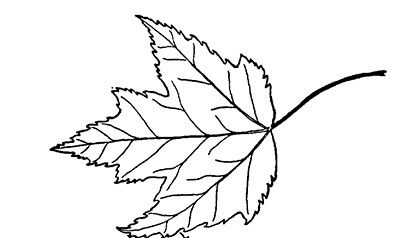
This week, we introduce the red maple or Acer rubrum.
Red maple has simple three to five-lobed leaves with relatively shallow, v-shaped divisions between the lobes. The oppositely held leaves may resemble sugar maple but the V shaped shallow divisions stand in contrast to sugar maple’s deep u-shaped sinuses. In the early spring, it is one of the earliest native trees to flower, producing clusters of reddish flowers as well as reddish colored pairs of winged seeds/fruit. In the fall, foliage typically turns a bright red to maroon color.
The bark is gray and smooth in young trees and may become flaky in older trees.
Red maple, which is a popular ornamental and street tree selection, is one of Indiana’s soft maples alongside silver maple. It also can be found in Indiana woodlands in both moist and dry sites and in bottomlands and uplands.
Red maple, grow 50 to 80 feet tall and are found growing throughout the eastern United States including the coastal regions.
The Morton Arboretum warns that red maple was display chlorosis symptoms of pale green leaves with dark green veins in high pH soil and drought conditions. The species also does not tolerate heavy pollution.
For full article with additional photos view: Intro to Trees of Indiana: Red Maple
If you have any questions regarding wildlife, trees, forest management, wood products, natural resource planning or other natural resource topics, feel free to contact us by using our Ask an Expert web page.
Other Resources:
Hardwoods of the Central Midwest: Soft Maple
Hardwood Lumber and Veneer Series, The Education Store: Soft Maple
Morton Arboretum: Red Maple
Red Maple, Native Trees of Indiana River Walk, Purdue Fort Wayne
Fifty Common Trees of Indiana
An Introduction to Trees of Indiana
Native Trees of the Midwest, The Education Store
Shrubs and Woody Vines of Indiana and the Midwest, The Education Store
Investing in Indiana Woodlands, The Education Store
Forest Improvement Handbook, The Education Store
ID That Tree, Purdue Extension-Forestry & Natural Resources (FNR) YouTube playlist
Woodland Management Moment , Purdue Extension-FNR YouTube playlist
Wendy Mayer, FNR Communications Coordinator
Purdue University Department of Forestry and Natural Resources
Lenny Farlee, Sustaining Hardwood Extension Specialist
Purdue University Department of Forestry and Natural Resources
Purdue Landscape Report, Why are the Japanese beetles running late this year?: Nothing heralds summer like the hum of Japanese beetles ravenously descending on a flower garden. Cool weather this spring has slowed emergence of adults from the soil. Heavy spring rains early followed by relatively drier weather in late June, may have trapped adult Japanese beetles under a crusty layer of hardened soil. Due to their large numbers in many parts of Indiana last year, they are very likely just waiting for a good rain to soften the surface, so they can dig themselves into the light of day and on to your flowers. So, if we get a little more rain by the time this article comes out, we are likely to be awash in adult beetles.
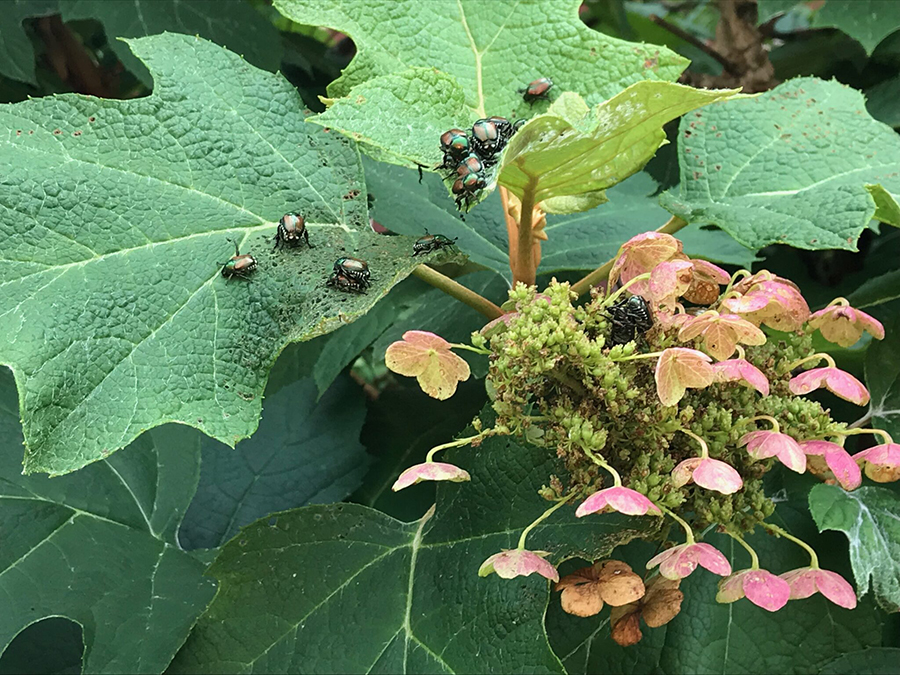 Weather is only part of what makes Japanese beetles predictably unpredictable. Beneficial organisms including fungi, microsporidia, and parasitic wasps also act different life stages of Japanese beetles. Japanese beetles have been the target of several national programs to release these beneficial organisms to reduce beetle populations. Favorable conditions for these beneficials can help reduce the local abundance of grubs and beetles.
Although killing grubs will reduce the number of beetles, the small size of lawns and the long flight range of makes it unlikely for your grub control program to reduce defoliation. In experiments conducted in my lab over 20 years ago, we found adult beetles can easily fly a kilometer (0.66 miles) in a single day. With adults living for several weeks, it is easy to image beetles traveling long distances from untreated lawns to plants on your property.
Life cycle of Japanese beetles: As the weather warms in the spring larvae (aka white grubs) move closer to the surface and begin feeding on turf roots. In May they enter a pupal stage and stop feeding. In June they typically emerge from the soil as adults. Adults fly in summer when they feed on flowers and leaves. In late July and early August adults lay eggs into the turfgrass. White grubs hatch from eggs and feed on the roots until frost when the larvae begin dig deeper into the soil to avoid killing temperatures.
To find out what you can do about Japanese beetles and view photos view: Why are the Japanese beetles running late this year?
Resources:
Report Invasive
Invasive Species, Got Nature?
Invasive Species, Playlist, Purdue Extension – FNR YouTube Channel
Indiana Department of Entomology and Plant Pathology
Spotted lanternfly: Everything You Need to Know in 30 Minutes, Video, Emerald Ash Borer University
Emerald Ash Borer, EAB Information Network
Invasive plants: impact on environment and people, The Education Store, Purdue Extension’s resource center
Woodland Management Moment: Invasive Species Control Process, Video, Purdue Extension – Forestry and Natural Resources (FNR) YouTube Channel
What are invasive species and why should I care?, Got Nature? Blog, Purdue Extension – Forestry and Natural Resources
Pest Management, The Education Store
Cliff Sadof, Professor Entomology/Extension Fellow
Purdue Entomology

Recent Posts
- Popular Landscape Shrub is Invasive
Posted: October 15, 2026 in Alert, Forestry, Forests and Street Trees, Invasive Plant Species, Plants, Woodlands - Purdue Extension’s Regional Teams Are Here: Connecting Communities with Expertise and Opportunity
Posted: October 14, 2026 in Community Development, Forestry, Forests and Street Trees, Gardening, How To, Timber Marketing, Urban Forestry, Wildlife, Woodlands - Why Do Our Trees Go From Green Leaves to Different Colors?
Posted: in Forestry, Forests and Street Trees, Urban Forestry, Woodlands - October Is Firewood Month: Protect Indiana’s Forests by Making Smart Choices
Posted: October 1, 2026 in Forestry, Forests and Street Trees, How To, Invasive Insects, Urban Forestry - Question: Why Did the Shagbark Hickories Survive the Tornado?
Posted: August 27, 2026 in Forests and Street Trees, How To, Urban Forestry - Jarred Brooke Receives Early Career Award for Prescribed Fire Work
Posted: July 20, 2026 in Forestry, Forests and Street Trees, Natural Resource Planning, Safety - Pruning Highlight; Espalier Pruning: Training Trees into Living Patterns
Posted: July 8, 2026 in Forestry, Forests and Street Trees, Gardening - Pruning Highlight-Pollarding Trees: A Traditional Pruning Practice with Modern Uses
Posted: June 11, 2026 in Forestry, Forests and Street Trees, Urban Forestry, Wildlife, Woodlands - Flat-Faced Longhorn Beetle Found in Hardwood Logs – IDNR Division of Entomology
Posted: June 8, 2026 in Alert, Forestry, Forests and Street Trees, Invasive Insects, Urban Forestry, Wildlife, Woodlands - Connecting Research to Practice: Natural Resources & Land Use Spring Training
Posted: June 5, 2026 in Forestry, Forests and Street Trees, How To, Invasive Animal Species, Invasive Plant Species, Land Use, Natural Resource Planning, Urban Forestry, Wildlife, Woodlands
Archives
Categories
- Alert
- Aquaculture/Fish
- Aquatic/Aquaculture Resources
- Ask the Expert
- Christmas Trees
- Community Development
- Disease
- Drought
- Forestry
- Forests and Street Trees
- Gardening
- Got Nature for Kids
- Great Lakes
- How To
- Invasive Animal Species
- Invasive Insects
- Invasive Plant Species
- Land Use
- Natural Resource Planning
- Nature of Teaching
- Plants
- Podcasts
- Ponds
- Publication
- Safety
- Spiders
- Timber Marketing
- Urban Forestry
- Webinar
- Wildlife
- Wood Products/Manufacturing
- Woodland Management Moment
- Woodlands