 Purdue University - Extension - Forestry and Natural Resources
Got Nature? Blog
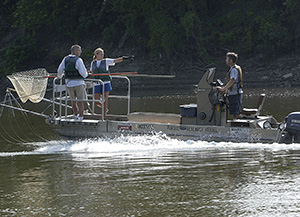
Photo credit: Tom Campbell
As boats enter and exit public bodies of water, they risk transferring aquatic plants, mussels or invertebrates that attach themselves to the bottom of the boat. While this might seem pretty harmless at first, this spreading of aquatic species runs the risk of introducing invasive species into new environments.
Invasive species cause harm to local ecosystems by reproducing exponentially when they are outside of their usual habitat and the organisms that keep their populations in check. They can then cause great damage by feeding on local species and the food they depend on. Once an invasive species is detected, it is oftentimes very expensive and difficult to control. For example, around 1991, the U.S. and Canada spent an estimated $20 million per year to control invasive sea lampreys and restore the trout populations that were damaged by them. In Indiana alone, we spend around $800,000 a year to attempt to control the growth of Eurasian watermilfoil, another nuisance invasive species.
In an attempt to avoid more cases like this in the future, the Indiana Department of Natural Resources (INDNR) is looking for help. Volunteers can sign up to record information about boats and their potential aquatic hitchhikers entering and leaving lakes during times of heavy use. The DNR Division of Fish and Wildlife can take this data and use it for public outreach and planning species management.
Those interested are highly encouraged to sign up on INDNR’s Volunteer Program page.
Resources
Aquatic Invasive Species (AIS), Indiana Department of Natural Resources
DNR Seeks Help Gathering Info on Spread of Aquatic Species, WFYI
Indiana Invasive Species Council, Purdue Entomology Extension
Invasive Plants, Purdue Agriculture Weed Science
The Education Store, Purdue Extension Resource Center (search “invasive”)
Indiana Department of Natural Resources
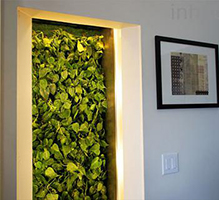 We all know that trees help to improve our air quality. Absorbing toxins, reducing CO2 levels and providing shade are well-known benefits of trees, and many initiatives are in place to increase urban forested areas. However, there is an interesting fact to consider. According to the U.S. EPA, the average American spends 90% of their time indoors, where those benefits of outdoor trees aren’t nearly as impacting. In fact, pollutants are estimated to be two to five times higher indoors than outdoors and account for several billion dollars of health costs nationally. Indoor air needs to be cleaned too. This is the problem that Purdue’s BioWall team hopes to solve.
The project began in 2009 as part of a fully self-sustainable house called the INhome. In 2011, INhome competed against 20 other teams in the United States Department of Energy’s Solar Decathlon and scored second place, largely due to its most distinguishable feature, the BioWall. The BioWall was integrated into the return duct of INhome’s air conditioning system, filtering the air inside the home through the roots of golden pothos and other species of ivy that are known to have a strong effect on air quality.
Today, the BioWall team is in the process of testing out an updated version of the BioWall. Prototype designs are being tested to improve the air cleaning qualities as well as the lifespan of the plants. Bypass tubes are being implemented to lessen the amount of air passing over the plants’ roots, allowing them to dry out slower and live longer. Eventually, the team would like to put out a consumer version in the next few years for about $2,000. It’s a lofty goal, but the team believes they can succeed and bring affordable and self-sustaining indoor air cleanliness to homes around the world.
For more information, check out the BioWall team’s website.
Resources
BioWall, Purdue University
Office of University Sustainability, Purdue University
Questions About Your Community: Indoor Air, United States Environmental Protection Agency
William Hutzel, Professor of Mechanical Engineering Technology
Purdue University
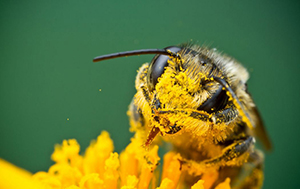
Photo credit: Colin Hutton
An often overlooked part of the ecosystem responsible for our food and environmental health are the pollinators. This group of animals move pollen from flower to flower, fertilizing seeds, fruits and vegetables. Pollinators include honey bees, native bees, moths, beetles, birds and bats, and they are struggling. 40% of honey bee colonies have been lost in the last year, and in the past two decades, over 90% of Monarch butterflies have disappeared.
After noticing this sharp decline, large efforts are starting to take place to restore the pollinator population. The Pollinator Partnership has created a Pollinator Week every year from June 15-21 where the pollinator’s importance is highlighted through local events. The White House has announced a National Strategy to Promote Pollinator Health in hopes to return the pollinator population to a sustainable level. In Norway, a connected network of honeybee habitats dubbed the Bee Highway was created. At the large scale, many initiatives are starting to form, but it is important to know that we can also be helpful on an individual level.
Our gardens and landscapes are the homes of many pollinators, providing the food, water and shelter that they need. When planting a garden or landscape, it is important to take this into consideration and follow a few simple guidelines. For an adequate food supply, aim for at least three flower species in bloom at a time. For shelter, pollinators can benefit from a break from the wind and sun provided by plants, fences and other structures. Finally, pesticides should be limited and used in a controlled way. Pick spray instead of dust-based pesticide. Try to use it only when necessary, follow all label directions and spray only in the early morning or at dusk when pollinators are less active. Keep these guidelines in mind, and your garden or landscape will be an attractive home for pollinators!
For more information, please check out the June column of Purdue Yard & Garden News.
Resources
Gardening for Pollinators, Purdue Yard & Garden News
News Columns & Podcasts, Purdue Agriculture
How to Minimize Pesticide Damage of Honey Bees, The Education Store
Honey Bees, Indiana Department of Natural Resources
Pollinator Partnership
B. Rosie Lerner
Extension Consumer Horticulturist, Purdue Extension
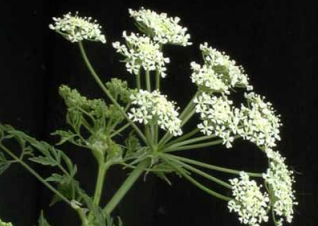
Photo credit: Pedro Tenorio-Lezama, Bugwood.org
Made infamous through the trial of Socrates, Shakespeare’s Hamlet and Macbeth, and several other works of classic literature, poison hemlock is an extremely toxic plant that will pose a risk this summer and should be handled with caution.
Poison hemlock is a biennial plant, meaning that it has a two year lifespan. Last summer, it went through vegetative growth and largely stayed out of sight. This summer, it will produce small white clusters of flowers and will be more likely to catch the attention of animals and people. Poison hemlock is a member of the parsley family and can sometimes be confused with wild carrot. However, its distinguishing feature is its hairless hollow stalks with purple blotches. If you see these, be careful!
The biggest risk with poison hemlock is ingestion. Lethal doses are fairly small, so it is important for animal owners or parents of young children to identify it in their area and remove it if possible. The toxins can also be absorbed through the skin and lungs, so be sure to wear gloves and a mask when handling these plants.
Symptoms of hemlock poisoning include dilation of the pupils, weakening or slowing pulse, blue coloration around the mouth and eventually paralysis of the central nervous system and muscles leading to death. Quick treatment can reverse the effects, so act quickly.
Resources
Invasive Plant Species Fact Sheets: Poison Hemlock, The Education Store, Purdue Extension Resource Center
Recognizing and Managing Poison Hemlock, Purdue Landscape Report
Poison Hemlock, Pest & Crop Newsletter, Purdue Extension – Entomology
Hemlock Woolly Adelgid: Distribution Update, Purdue Landscape Report
What are Invasive Species and Why Should I Care?, Purdue Extension – Forestry and Natural Resources (FNR)
Indiana Invasive Species Council
Report INvasive, Purdue Extension & Indiana Invasive Species Council
Poison Hemlock (Conium maculatum), United States Department of Agriculture (USDA)
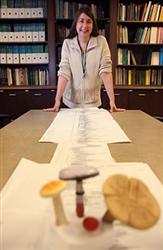
Photo: Tom Campbell
Mushrooms are strange forms of life. Some can kill you within hours, some are psychedelic hallucinogens and others are just good on a pizza. There are estimated to be six to 20 times more species of fungi than plants, and a lot of them are still shrouded in mystery. Since the time of Carl Linnaeus in the 1700s, we have been searching for answers in the fungi kingdom, and recently, we just found a big one in the shape of an evolutionary mapping dubbed the “tree of life.”
Using collections of preserved fungal specimens called fungaria from Purdue’s Arthur Fungarium and Kew’s Fungarium in the Royal Botanic Gardens, two of the biggest and most important fungi collections in the world, mycologists like Catherine Aime were able to study well over 100 years’ worth of preserved specimens and apply modern DNA technology to piece together genomes and discover new connections linking mushroom species. This “tree of life” is the clearest and most comprehensive mapping to date of the evolutionary history of fungi.
Aime says that this study reinforces the importance of fungaria as we advance in the genomic age. These extensive collections are priceless, containing specimens as far back as some from Darwin himself, and documenting hundreds of thousands of species throughout the years. Some of these species might not exist in the future, and it is essential that we document and preserve them as we learn new ways to use them in the future.
The research paper documenting this ‘tree of life’ was published in the Biological Journal of the Linnean Society and is available for journal subscribers and readers at Purdue.
Read the full article.
Resources
DNA Samples From Purdue, Kew Fungi Collections Provide Key to Mushroom ‘Tree of Life’, Purdue Extension
Arthur Fungarium, Purdue Herbaria
Kew’s Fungarium, Kew Royal Botanic Gardens
Aime Lab, Purdue University Department of Botany and Plant Pathology
Fungi – In a Kingdom All By Themselves, Indiana Department of Natural Resources
Natalie van Hoose, Research News Writer
Purdue Extension
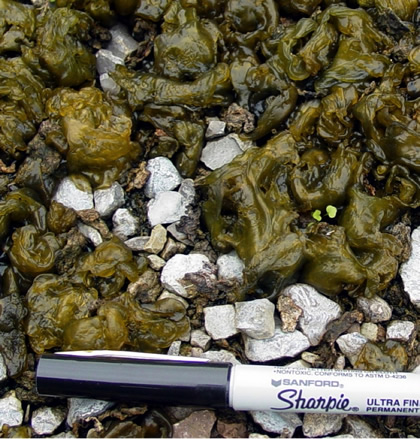
Photo credit: Purdue Plant and Pest Diagnostic Lab
In this month’s column of In the Grow, B. Rosie Lerner, Purdue Extension Consumer Horticulturist, addresses algae that can pop up on stone, concrete, gravel or even lawns this summer as we are getting large amounts of hot, rainy weather.
This terrestrial algae known as Nostoc can look unappealing and also be a slippery safety hazard, but unfortunately, there isn’t much to do about it. Raking the algae will just spread it to larger areas. Keeping the area aerated and dry as much as you are able can help a little with controlling this algae, and applying copper sulfate will also shrink it a little bit, but it will just reappear when warm, rainy weather conditions occur again.
Resources
News Columns & Podcasts, Purdue Agricultural Communication
Nostoc: A Green, Jelly-Like Substance Growing in Lawns, Michigan State University Extension
B. Rosie Lerner
Purdue Extension Consumer Horticulturist
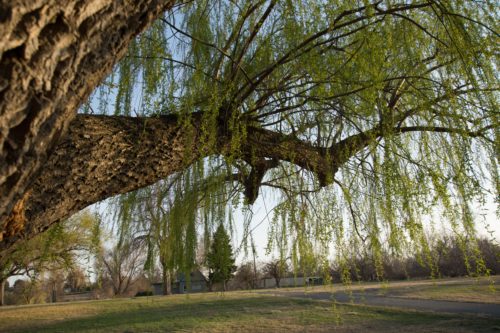 Question: Weeping willow, six years old and 9″ diameter. Wet, clay ground and thriving. Suddenly late last summer, I noticed the leaves were dead, and the bark on the trunk was completely loose and falling off. No other trees or shrubs within 50 feet (black walnut, sycamore, maple, rose of sharon) were affected. No obvious sign of insects, boring, trails, worms, etc.
Answer: When a tree starts to lose leaves, especially in the spring when they should be expanding for the new growing season, it can be puzzling. Often, this is a sign of troubles which can be caused by biotic or abiotic issues but not always a major cause for alarm. The dropping leaves can be a symptom of foliar diseases which weakens the tree, or it could be the result of an insect pest feeding on the petioles of the leaves. There are many pests which can cause leaf drop.
Another possible cause is the response to abiotic disorders which is typically a complex of issues. Leaf drop can occur on trees that have been exposed to prolonged wetness in heavy, clay soils. Some tree species like wet soils but not prolonged wetness without drainage. If trees are exposed to continual wetness, their roots can become diseased and cause the leaf drop. Additionally, it has been noted that trees which were planted improperly, especially if planted too deep, can result in several physiological issues such as decline and dieback.
If trees reveal symptoms of premature fall color, yellowing of leaves or unusual leaf drop, it may be necessary to send in a sample for diagnosis. The Purdue Plant and Pest Diagnostic Laboratory (PPDL) provides this service by a very capable team of pathologists, entomologists and extension specialists to analyze plant issues in the landscape. This is an inexpensive approach to investigating the issues and leading to the best possible curative measures. Protocol for submitting plant samples can be found on the PPDL website.
Resources
Hardwood Tree Improvement and Regeneration Center, Paula Pijut, Research Plant Physiologist, Purdue University
Relationships Between Advance Oak Regeneration and Biotic and Abiotic Factors, Songlin Fei, Associate Professor of Measurements and Quantitative Analysis, Purdue University
Diseases of Landscape Plants: Leaf Diseases, The Education Store, Purdue Extension Resource Center
Lindsey Purcell, Urban Forestry Specialist
Department of Forestry and Natural Resources, Purdue University
 A 20+ extension team led by Kara Salazar, sustainable communities extension specialist, and Michael Wilcox, assistant program leader for extension community development, have produced a new publication and curriculum titled “Enhancing the Value of Public Spaces.” This must-have spiral bound notebook and curriculum zip file download is a great resource for decision makers and local leaders developing community public spaces including park boards, planning commission members, members of organizations, public officials and staff whose missions are related to providing services, programs or management of public spaces. This program serves as a “how-to” guide for creating high-quality action plans to achieve great public spaces.
A one day workshop starts the process with collaborative activities to identify best practices for improving public spaces with emphasis on forming partnerships to achieve desired community goals. Follow-on working group meetings provide the resources and technical support needed to plan and implement projects tailored to individual communities. The completed high quality public spaces action plan can be used as part of comprehensive planning efforts, parks and recreation master plans and fundraising initiatives.
Resources
Enhancing the Value of Public Spaces, The Education Store
Kara Salazar, Sustainable Communities Extension Specialist
Department of Forestry and Natural Resources
Illinois-Indiana Sea Grant
Michael Wilcox
Assistant Program Leader, Extension Community Development Program
Senior Associate, Purdue Center for Regional Development
Faculty and staff in the Department of Forestry and Natural Resources (FNR) are engaged in environmental planning around the state. Extension programs help managers and decision-makers improve Indiana’s natural resource management and environmental planning. We deliver programs to help communities consider how to plan for their unique and life-sustaining environmental resources and provide education and technical assistance to plan commissions. Programs are developed and delivered in collaboration with the Purdue Extension Community Development Program and Illinois-Indiana Sea Grant. Some of the programs FNR faculty and extension staff have developed in collaboration with our partners include:
American Citizen Planner – Indiana (ACP-IN)
American Citizen Planner – Indiana provides training to Indiana citizen planners who currently serve or plan to serve on area or advisory plan commissions. The program features 31 topics detailing core planning theories, practices, and processes. A comprehensive assessment and four virtual training events reinforce the content learned in the units. The program is hosted by a local Purdue Extension educator for either a county or a region.
Conservation Through Community Leadership (CCL)
Communities face many challenges, and many of these are their natural resources. The Conservation through Community Leadership program serves as a roadmap for communities tackling complex land use and natural resource management challenges. The program provides information, tools, and resources to help communities work with diverse stakeholders.
Enhancing the Value of Public Spaces (EVPS)
The Purdue University Extension program, Enhancing the Value of Public Spaces, addresses public spaces and their role in enhancing the quality of place by helping regions, communities and neighborhoods plan and prepare for a sustainable future. The Indiana-based curriculum is designed for use by decision makers and local leaders with oversight and management of community public spaces such as parks boards and planning commission members, public officials and their staff and members of organizations whose missions provide services related to programs or management of public spaces. The program provides a framework for collecting data on community assets and using that data to plan public spaces improvements.
Green Infrastructure and Hazard Mitigation
Communities face several challenges and complex decisions related to natural hazards, which are increasingly exacerbated by climate change. The program supports a collaborative community planning approach to evaluate the relevance and effectiveness of existing community policies and to identify goals, motivations, and barriers for hazard mitigation planning, focusing on water resources, flooding, and green infrastructure.
Land Use
The Purdue University Land Use Team provides research-based resources and educational programs for Extension professionals, government officials, citizen planners, and residents on land use issues impacting their communities. Land Use Team efforts are underpinned by a timely and rigorous professional development system that prepares Purdue Extension professionals to effectively serve on Plan Commissions.
Rainscaping Education Program
Rainscaping is a combination of sustainable landscape design and management practices that prevents polluted runoff from reaching water bodies — directing stormwater to be absorbed by plants and soils. The program provides training and resources on rainscaping practices that can be installed in residential settings or small-scale public spaces projects.
Renewable Energy
Renewable Energy for Community Planning brings resources for general renewable energy, solar and wind. This includes: community planning guidebooks for renewable energy, solar development, landowner leasing for solar, qualifications for a wind lease, wind farm impact statements and much more.
Sustainable Communities
Extension programs that support sustainable community development strategies are available to communities throughout Indiana. These support decision makers with evaluating, prioritizing, and implementing sustainability strategies for their communities.
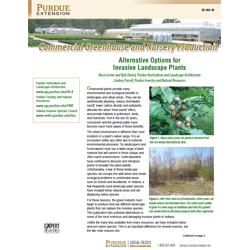 Ornamental plants provide many environmental and ecological benefits to landscapes and urban areas. They can be aesthetically pleasing, reduce stormwater runoff, lower carbon dioxide and pollutants, alleviate the urban “heat island” effect and provide habitats to pollinators, birds and mammals. And in the last 20 years, consumers and the general public have become much more aware of these benefits. The urban environment is different than most locations in a plant’s native range. It is an ecosystem unlike any other due to extreme environmental pressures, so landscapers and homeowners must use a wide range of plant material that will survive in these unique and often harsh environments. Horticulturalists have continued to discover and introduce plants to broaden the plant palette. Unfortunately, a few of these landscape species can escape into wild areas and create ecological problems in unintended areas such as forests and woodlands. In Indiana, a few frequently used landscape plant species have invaded these natural areas and are displacing native species.
For these reasons, the green industry must begin to produce and use different landscape plants that can replace the invasive species. This publication lists potential alternatives to some of the most notorious and damaging invasive plants in Indiana.
For a free download of the full publication, visit Commercial Greenhouse and Nursery Production: Alternative Options for Invasive Landscape Plants.
Resources
Native Trees of the Midwest, The Education Store
Shrubs and Woody Vines of Indiana and the Midwest, The Education Store
FNR/Purdue Extension YouTube Video Playlist, Asian Bush Honeysuckle, Burning Bush and Multiflora Rose
Purdue Plant & Pest Diagnostic Laboratory (PPDL) (Send in samples or photos)
Lindsey Purcell, Chapter Executive Director/Certificate Liaison
Indiana Arborist Association
Rosie Lerner, Horticulturist
Retired

Recent Posts
- ID That Tree: Shumard Oak
Posted: March 9, 2026 in Plants, Urban Forestry, Wildlife, Woodlands - ID That Tree: Fragrant Sumac
Posted: February 4, 2026 in Plants, Urban Forestry, Wildlife - It’s Not Too Late to Order Trees for Spring Planting
Posted: January 13, 2026 in Forestry, How To, Plants - Red in Winter – What Are Those Red Fruits I See?
Posted: December 1, 2025 in Forestry, Plants, Urban Forestry, Wildlife, Woodlands - Untangling and Identifying Vines, Purdue Landscape Report
Posted: September 29, 2025 in Invasive Plant Species, Plants, Wildlife - Control Management of Poison Hemlock
Posted: May 7, 2025 in Invasive Plant Species, Plants, Wildlife, Woodlands - Top 10 Spring Flowering Shrubs, Purdue Landscape Report
Posted: April 28, 2025 in Gardening, Plants, Urban Forestry - PPDL’s 2024 Annual Report – Enhancing Plant Health
Posted: March 21, 2025 in Forestry, Invasive Insects, Invasive Plant Species, Plants, Wildlife - What Are Invasive Species and Why Should I Care?
Posted: February 24, 2025 in Forestry, How To, Invasive Plant Species, Plants, Woodlands - Ask An Expert: Holidays in the Wild
Posted: December 9, 2024 in Christmas Trees, Forestry, Forests and Street Trees, How To, Plants, Wildlife, Woodlands
Archives
Categories
- Alert
- Aquaculture/Fish
- Aquatic/Aquaculture Resources
- Ask the Expert
- Christmas Trees
- Community Development
- Disease
- Drought
- Forestry
- Forests and Street Trees
- Gardening
- Got Nature for Kids
- Great Lakes
- How To
- Invasive Animal Species
- Invasive Insects
- Invasive Plant Species
- Land Use
- Natural Resource Planning
- Nature of Teaching
- Plants
- Podcasts
- Ponds
- Publication
- Safety
- Spiders
- Timber Marketing
- Uncategorized
- Urban Forestry
- Webinar
- Wildlife
- Wood Products/Manufacturing
- Woodland Management Moment
- Woodlands