 Purdue University - Extension - Forestry and Natural Resources
Got Nature? Blog
On this edition of ID That Tree, Purdue Extension forester Lenny Farlee introduces you to the Black Gum, also known as bee gum. This simple leaved species can bring brilliant fall color and is best identified by its branches, which come out at nearly 90 degree angles to the stump, its alligator like bark and small berries.
If you have any questions regarding wildlife, trees, forest management, wood products, natural resource planning or other natural resource topics, feel free to contact us by using our Ask an Expert web page.
Resources
Black Gum and Tupelo, The Education Store, Purdue Extension resource center
ID That Tree Fall Color Edition: Black Gum, Got Nature? Blog, Purdue Extension – FNR
Black Gum/Tupelo, Native Trees of Indiana River Walk, Purdue Fort Wayne
Black Gum & Tupelo, Purdue Arboretum Explorer
ID That Tree, Playlist, Purdue Extension-FNR YouTube Channel
A Woodland Management Moment, Playlist, Purdue Extension-FNR YouTube Channel
Investing in Indiana Woodlands, The Education Store
Forest Improvement Handbook, The Education Store
Lenny Farlee, Sustaining Hardwood Extension Specialist
Purdue University Department of Forestry and Natural Resource
In this edition of ID That Tree, Purdue Extension forester Lenny Farlee introduces you to chestnut oak, sometimes called rock chestnut oak. It is an oak species commonly found in the southern part of the state on high dry sites. It has small, very rounded lobed leaves and strongly ridged, very dark bark.
If you have any questions regarding trees, forests, wildlife, wood products or other natural resource topics, feel free to contact us by using our Ask an Expert web page.
Resources
Chestnut Oak, Native Trees of Indiana River Walk, Purdue – Fort Wayne
Quercus Montana, The Purdue Arboretum Explorer
ID That Tree, Playlist, Purdue Extension – Forestry and Natural Resources Youtube Channel
A Woodland Management Moment, Playlist, Purdue Extension – Forestry and Natural Resources Youtube Channel
Investing in Indiana Woodlands, The Education Store
Tree Appraisal and the Value of Trees, The Education Store
Forest Improvement Handbook, The Education Store
Lenny Farlee, Sustaining Hardwood Extension Specialist
Purdue University Department of Forestry and Natural Resources
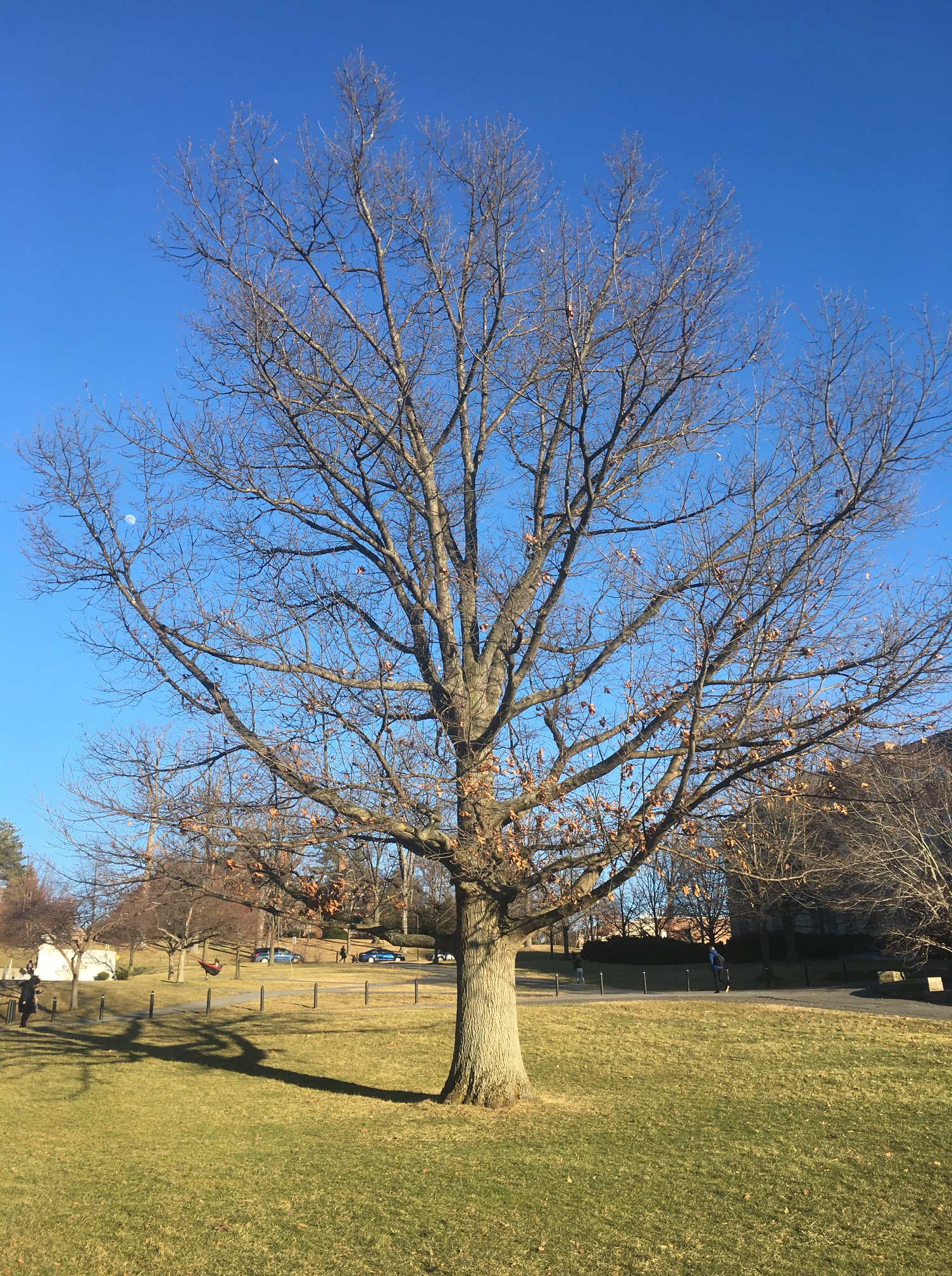
Surviving winter actually begins in fall when leaves turn color and drop to the ground.
Purdue Landscape Report: So, what do trees do in the winter? Do they freeze up like unprotected water pipes? Or burst when it gets below freezing? Yes, the below-ground parts of a tree are kept insulated by mulch, soil and a layer of snow, and that is important to survival, but the exposed parts of a tree are not protected.
Deciduous trees, like maples and oaks, have a lot of water inside their trunks and branches. Water is the single most important substance for tree life, comprising nearly 80% of tree material. Although there is a little less inside the tree during the winter, if the temperature drops low enough, the water in even the most cold-hardy tree will freeze. Broadleaf, deciduous trees lose their leaves in the winter to reduce water loss inside the trunk and branches. Most needle-leaved trees, known as conifers, which include pines and spruce, retain needles year-round – with exceptions of some deciduous evergreens such as larch and bald cypress– only losing older, or damaged needles. Needles are better at retaining water than broadleaves due to their small surface area and waxy outer coating limiting water loss to transpiration, the evaporation of water from leaves. A hard freeze or poorly timed drop in temperatures can be devastating to living tree cells since ice crystals can shred cell membranes, leading to dead leaves, branches, and even whole trees. Most trees live through the winter despite prolonged exposure to brutally cold air and wind and snow, with special strategies and planning.
Dormancy of trees can be divided arbitrarily into three phases: early rest, winter rest, and after-rest. Each of these phases is marked by a distinct set of physiological processes. The transition between the three phases is gradual and there are many metabolic and developmental processes going on in the buds and twigs. A tree begins its preparations in late summer as day length shortens to survive winter temperatures. Cold acclimation occurs gradually and fall color is a sign that the process is in place and pre-dormancy is beginning.
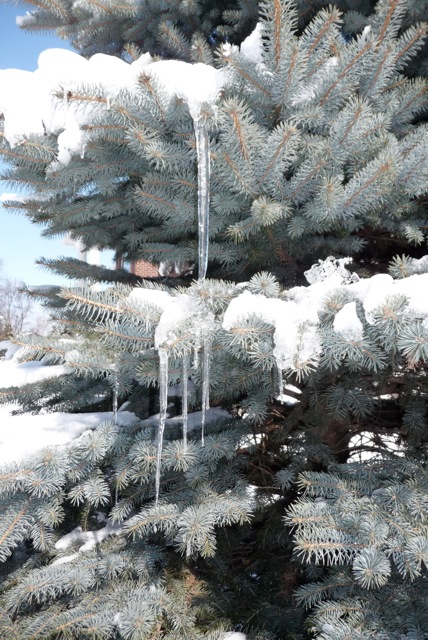
Evergreens are a little different and have a special waxy covering to reduce water loss during the winter.
When the tree enters the winter rest stage, research suggests three basic ways in which a tree prevents freezing. One is to change their membranes, so the membranes become more pliable; this allows water to migrate out of the cells and into the spaces between the cells. The relocated water exerts pressure against the cell walls, but this pressure is offset as cells shrink and occupy less space.
The second way a tree helps prevent freezing is to thicken the fluids within the cells. When days begin to get shorter, trees convert starch to sugars, which act as a natural antifreeze for the plant. The cellular fluid within the living cells becomes concentrated with natural sugars, which lowers the freezing point inside the cells, while the water between the cells is allowed to freeze. Because the cell membranes are more pliable in winter, they’re squeezed but not punctured by the expanding ice crystals.
The third mechanism involves what has been described as a “glass phase,” where the liquid cell contents become so viscous that they appear to be solid, a kind of “molecular suspended animation” and mimic the way silica remains liquid as it is supercooled into glass. This mechanism is triggered by the progressive cellular dehydration that results from the first two mechanisms and allows the supercooled contents of the tree’s cells to avoid crystallizing.
All three cellular mechanisms are intended to keep living cells from freezing. That’s the key for the tree; don’t allow living cells to freeze.
A tree doesn’t have to keep all of its cells from freezing, just the living ones which are primarily the phloem cells. This is significant, since much of a tree’s living trunk is made up of cells that are dead, such as xylem cells. These dead cells can and do freeze, but even the lowest temperature doesn’t have an adverse effect. While a majority of a tree’s above-ground cells do indeed freeze regularly when exposed to subfreezing temperatures, the living cells remain unfrozen and active on a reduced level. There are living cells in the trunk that remain unfrozen even though they are right next to – and at the same temperature as – dead cells that are frozen solid!
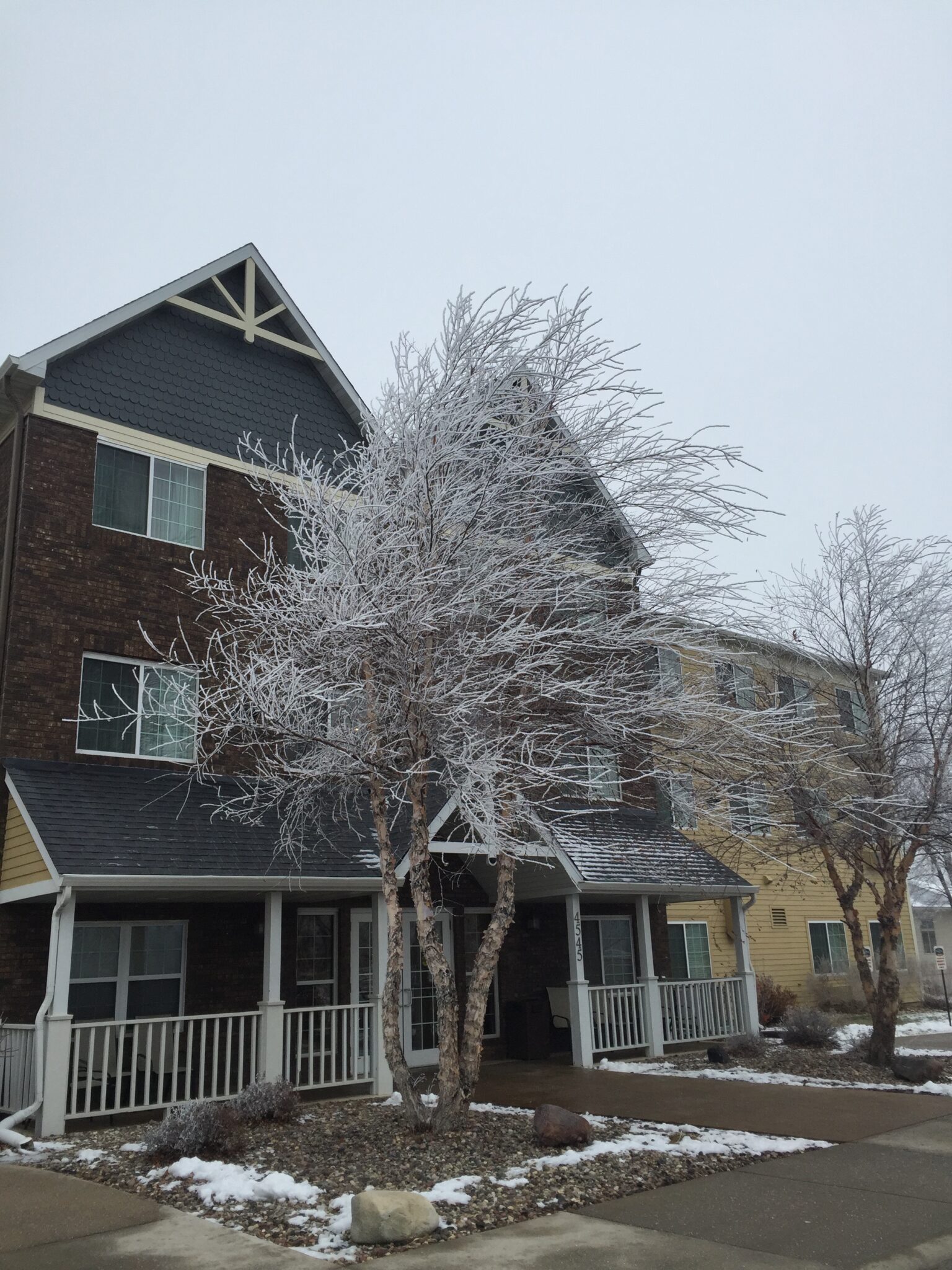
Some trees like many birches can survive temperatures well below -100 F
This seemingly mystical combination of pliable membranes, natural antifreeze, and glasslike supercooling, with frost on the outside and viscous dehydration on the inside, helps trees avoid freezing injury to living cells. Trees are the largest, oldest living organism on our planet and don’t grow older and larger without having very specific strategies for survival.
However, sometimes, trees aren’t able to withstand extreme conditions, especially if nature provides an unusual change. While trees have evolved amazing strategies for withstanding the winter cold, sometimes it gets so cold that trees can explode. During spells of extreme cold or especially when trees haven’t had time to acclimate before the cold arrives, the life-sustaining sap inside a tree can begin to freeze. Sap contains water so it expands when frozen, putting pressure on the bark, which can break and create an explosion, so to speak.
Proper winter care is critical to protect your trees with mulch and water to help trees make it through the winter months. For more information on winter tree care, check out this publication: Winterize Your Trees.
Resources
Purdue Landscape Report, Website
Winterize Your Trees, The Education Store, Purdue Extension resource center
Tree Defect Identification, The Education Store
Forest/Timber, Playlist, Purdue Extension – Forestry and Natural Resources YouTube channel
Urban Forestry, Purdue Extension – FNR playlist
Winter Weather Tree Tips, Got Nature? Blog, Purdue Extension – Forestry and Natural Resources
Tree Wounds and Healing, Got Nature? Blog
Water Now to Minimize Winter Injury, Indiana Yard and Garden – Purdue Consumer Horticulture
Lindsey Purcell, Urban Forestry Specialist
Purdue University, Department of Forestry and Natural Resources
In this edition of ID That Tree, Purdue Extension forester Lenny Farlee introduces the mockernut or white hickory. This species is typically found on high dry ridges and other dry soil locations. Identifying characteristics include a very rounded and oftentimes hairy buds, hair on the leaf stems and twigs in early spring and summer, and a tightly networked ridged and silvery bark.
If you have any questions regarding trees, forests, wildlife, wood products or other natural resource topics, feel free to contact us by using our Ask an Expert web page.
Resources
Hickory and Pecan Species, The Education Store, Purdue Extension resource center
Mockernut Hickory, Native Trees of Indiana River Walk, Purdue – Fort Wayne
ID That Tree, Playlist, Purdue Extension – Forestry and Natural Resources Youtube Channel
A Woodland Management Moment, Playlist, Purdue Extension – Forestry and Natural Resources Youtube Channel
Investing in Indiana Woodlands, The Education Store
Tree Appraisal and the Value of Trees, The Education Store
Forest Improvement Handbook, The Education Store
Lenny Farlee, Sustaining Hardwood Extension Specialist
Purdue University Department of Forestry and Natural Resources
In this edition of ID That Tree, Purdue Extension forester Lenny Farlee introduces you to a native Indiana tree sometimes called the Indiana banana. Meet the pawpaw, a shade-tolerant, fruit-producing, simple-leaved species.
If you have any questions regarding trees, forests, wildlife, wood products or other natural resource topics, feel free to contact us by using our Ask an Expert web page.
Resources
Pawpaw: The Midwest Banana?, Indiana Yard and Garden – Purdue Consumer Horticulture
Growing Pawpaws, The Education Store, Purdue Extension resource center
Unexpected Plants and Animals of Indiana: Pawpaw tree
ID That Tree, Playlist, Purdue Extension – Forestry and Natural Resources Youtube Channel
A Woodland Management Moment, Playlist, Purdue Extension – Forestry and Natural Resources Youtube Channel
Investing in Indiana Woodlands, The Education Store
Tree Appraisal and the Value of Trees, The Education Store
Forest Improvement Handbook, The Education Store
Lenny Farlee, Sustaining Hardwood Extension Specialist
Purdue University Department of Forestry and Natural Resources
In this episode of FNR Ask the Expert, Purdue Extension wildlife specialist Jarred Brooke and Dr. Mike Saunders, associate Professor of Ecology and Natural Resources, talk about prescribed fire and how you can use this technique to manage your fields and woodlands.
If you have any questions regarding trees, forests, wildlife, wood products or other natural resource topics, feel free to contact us by using our Ask an Expert web page.
Resources
Ask An Expert, Playlist, Purdue Extension – Forestry and Natural Resources YouTube channel
Wildlife Habitat Hint: Prescribed Fire Techniques – Backing Fire, Purdue Extension – FNR Video
Wildlife Habitat Hint: Prescribed Fire Techniques – Flanking Fire, Purdue Extension – FNR Video
Wildlife Habitat Hint: Prescribed Fire Techniques – Strip Head Fire, Purdue Extension – FNR Video
Wildlife Habitat Hint: Prescribed Fire Techniques – Spot Fire, Purdue Extension – FNR Video
Wildlife Habitat Hint: Prescribed Fire Techniques – Ring Fire, Purdue Extension – FNR Video
Wildlife Habitat Hint: Late Growing Season Prescribed Fire, Video
Renovating Native Warm-Season Grass Stands for Wildlife: A Land Manager’s Guide, The Education Store, Purdue Extension resource center
Prescribed fire: 6 things to consider before you ignite, Got Nature? Blog, Purdue Extension – Forestry and Natural Resources
Indiana Prescribed Fire Council
Jarred Brooke, Wildlife Extension Specialist
Purdue Department of Forestry and Natural Resource
Mike Saunders, Associate Professor of Ecology and Natural Resources
Purdue University Department of Forestry and Natural Resources
In this edition of ID That Tree, Purdue Extension forester Lenny Farlee introduces you to the chinkapin oak, a member of the white oak family that has leaves that appear sharp like red/black oaks, but really are not. Learn more inside as well as other easier to identify characteristics.
If you have any questions regarding wildlife, trees, forest management, wood products, natural resource planning or other natural resource topics, feel free to contact us by using our Ask an Expert web page.
Resources
Chinkapin Oak, Native Trees of Indiana River Walk, Purdue Fort Wayne
Quercus muehlenbergii, The Purdue Arboretum Explorer
White Oak, The Education Store, Purdue Extension resource center
ID That Tree, Purdue Extension – Forestry & Natural Resources Playlist
A Woodland Management Moment, Purdue Extension – Forestry & Natural Resources Playlist
Investing in Indiana Woodlands, The Education Store
Forest Improvement Handbook, The Education Store
Lenny Farlee, Sustaining Hardwood Extension Specialist
Purdue University Department of Forestry and Natural Resources
In this edition of ID That Tree, Purdue Extension forester Lenny Farlee introduces you to a rebel of the oak family, the shingle oak. Unlike its relatives, the shingle oak’s shiny leaves do not feature any lobes and have a complete margin. Learn more about this oddity and other ways to identify this species inside.
If you have any questions regarding wildlife, trees, forest management, wood products, natural resource planning or other natural resource topics, feel free to contact us by using our Ask an Expert web page.
Resources
Shingle Oak, Native Trees of Indiana River Walk, Purdue Fort Wayne
Quercus imbricaria, The Purdue Arboretum Explorer
ID That Tree, Purdue Extension – Forestry & Natural Resources Playlist
A Woodland Management Moment, Purdue Extension – Forestry & Natural Resources Playlist
Investing in Indiana Woodlands, The Education Store
Forest Improvement Handbook, The Education Store
Lenny Farlee, Sustaining Hardwood Extension Specialist
Purdue University Department of Forestry and Natural Resources
In this edition of ID That Tree, Purdue Extension forester Lenny Farlee introduces you to the white oak group. In addition to identifying four common varieties of white oak by their leaves and acorns, he also explains how to differentiate them from their cousins, the red oaks.
If you have any questions regarding trees, forests, wildlife, wood products or other natural resource topics, feel free to contact us by using our Ask an Expert web page.
Resources
White Oak, The Education Store, Purdue Extension – Forestry and Natural Resources
FNR Hardwood – White Oak, The Purdue Arboretum Explorer
White Oak, Native Trees of Indiana River Walk, Purdue – Fort Wayne
ID That Tree, Playlist, Purdue Extension – Forestry and Natural Resources Youtube Channel
A Woodland Management Moment, Playlist, Purdue Extension – Forestry and Natural Resources Youtube Channel
Investing in Indiana Woodlands, The Education Store
Forest Improvement Handbook, The Education Store
Lenny Farlee, Sustaining Hardwood Extension Specialist
Purdue University Department of Forestry and Natural Resources
In this edition of ID That Tree, Purdue Extension forester Lenny Farlee introduces a whole family of trees, the red oak group. He identifies four common species and shows how to differentiate between them as well as how to keep the red and white oak groups separated.
If you have any questions regarding trees, forests, wildlife, wood products or other natural resource topics, feel free to contact us by using our Ask an Expert web page.
Resources
Red Oak, The Education Store, Purdue Extension – Forestry and Natural Resources
FNR Hardwood – Red Oak, The Purdue Arboretum Explorer
Red Oak, Native Trees of Indiana River Walk, Purdue – Fort Wayne
ID That Tree, Playlist, Purdue Extension – Forestry and Natural Resources Youtube Channel
A Woodland Management Moment, Playlist, Purdue Extension – Forestry and Natural Resources Youtube Channel
Investing in Indiana Woodlands, The Education Store
Forest Improvement Handbook, The Education Store
Lenny Farlee, Sustaining Hardwood Extension Specialist
Purdue University Department of Forestry and Natural Resources

Recent Posts
- ID That Tree: Nannyberry Viburnum
Posted: July 22, 2026 in Forestry, Plants, Wildlife, Woodlands - ID That Tree: Eastern Swamp Privet
Posted: in Forestry, Plants, Wildlife, Woodlands - Indiana Monarch and Pollinator Conservation
Posted: June 1, 2026 in Forestry, Forests and Street Trees, Gardening, How To, Natural Resource Planning, Plants, Urban Forestry, Wildlife - ID That Tree: Shumard Oak
Posted: March 9, 2026 in Plants, Urban Forestry, Wildlife, Woodlands - ID That Tree: Fragrant Sumac
Posted: February 4, 2026 in Plants, Urban Forestry, Wildlife - It’s Not Too Late to Order Trees for Spring Planting
Posted: January 13, 2026 in Forestry, How To, Plants - Red in Winter – What Are Those Red Fruits I See?
Posted: December 1, 2025 in Forestry, Plants, Urban Forestry, Wildlife, Woodlands - Fall Tree Care Tips
Posted: September 20, 2025 in Forestry, Forests and Street Trees, Gardening, How To, Land Use, Plants, Safety, Timber Marketing, Urban Forestry, Wood Products/Manufacturing, Woodlands - Top 10 Spring Flowering Shrubs, Purdue Landscape Report
Posted: April 28, 2025 in Gardening, Plants, Urban Forestry - Protecting Spring Plants From Wildlife Damage Using Repellents
Posted: April 14, 2025 in How To, Plants, Wildlife
Archives
Categories
- Alert
- Aquaculture/Fish
- Aquatic/Aquaculture Resources
- Ask the Expert
- Christmas Trees
- Community Development
- Disease
- Drought
- Forestry
- Forests and Street Trees
- Gardening
- Got Nature for Kids
- Great Lakes
- How To
- Invasive Animal Species
- Invasive Insects
- Invasive Plant Species
- Land Use
- Natural Resource Planning
- Nature of Teaching
- Plants
- Podcasts
- Ponds
- Publication
- Safety
- Spiders
- Timber Marketing
- Urban Forestry
- Webinar
- Wildlife
- Wood Products/Manufacturing
- Woodland Management Moment
- Woodlands