 Purdue University - Extension - Forestry and Natural Resources
Got Nature? Blog
In this edition of ID That Tree, Purdue Extension forester Lenny Farlee introduces you to a common understory shrub that features clusters of flowers and simple leaves reminiscent of red maple. Learn more about this native Indiana species inside.
If you have any questions regarding wildlife, trees, forest management, wood products, natural resource planning or other natural resource topics, feel free to contact us by using our Ask an Expert web page.
Resources:
ID That Tree, Playlist, Purdue Extension – Forestry and Natural Resources Youtube Channel
A Woodland Management Moment, Playlist, Purdue Extension – FNR Youtube Channel
Shrubs and Woody Vines of Indiana and the Midwest, Purdue University Press
Native Trees of the Midwest, Purdue University Press
Investing in Indiana Woodlands, The Education Store
Forest Improvement Handbook, The Education Store
Mapleleaf Viburnum, The Purdue Arboretum Explorer
Lenny Farlee, Sustaining Hardwood Extension Specialist
Purdue University Department of Forestry and Natural Resources
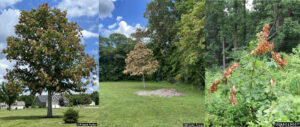
Image 1. Cicada damage is typically restricted to the small, outer twigs. Trees may be completely covered by cicadas or have a few isolated dead twigs. All trees in these images are expected to suffer no serious long term effects from this damage. Images by Clifford Sadof of Purdue University and Pennsylvania Department of Conservation and Natural Resources – Forestry.
Purdue Landscape Report: Dead leaves covering trees (image 1) or on the ground beneath them (image 2) in July would normally be a worrying sign for tree health, but this year much of the damage can be blamed on 17-year cicadas. This damage is unlikely to cause serious trouble for healthy, large trees and management is relatively simple. The choice to prune or not to prune comes down to cost, aesthetics, and concern for the next generation of cicadas.
How Cicadas Damage Plants
Cicada damage is similar to a light pruning and should not be an issue for healthy, mature trees. Cicadas damage trees when they lay their eggs in small twigs (3/16 to 1/2 inch in diameter) on deciduous trees and shrubs. They have a long, thin body part called an ovipositor that resembles a sewing needle that they stab into plants to lay their eggs. This action creates small holes and cracks in the bark (image 3). If enough cicadas lay their eggs in a twig, it can damage the bark enough to kill the twig (image 1).

Image 2. The dead twigs killed by cicada egg laying may break off the tree and litter the ground underneath. Image by Pennsylvania Department of Conservation and Natural Resources – Forestry.
Recognizing Cicada Damage
The degree of cicada damage depends on insect density and the number of trees in the area. To determine if a tree or bush has been damaged by cicadas, ask the following questions:
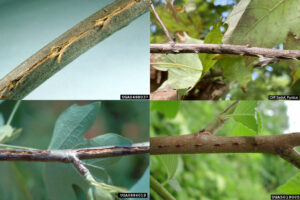
Image 3. Cicada egg laying damage varies between tree species, but is consistently in a straight, length-wise line along the branch. Note that all four examples also have signs of either puncture marks, cracks in the bark, or some combination of the two. Images by John Ghent, Clifford Sadof of Purdue University, Tim Tigner of Virginia Department of Forestry, and Pennsylvania Department of Conservation and Natural Resources – Forestry.
1. Were there 17-year cicadas within 50 meters (~164 ft) of the tree this year? Cicadas do not travel very far. If there weren’t noticeable numbers of 17-year cicadas nearby the damage was likely caused by something else.
2. Is the damage on a deciduous tree or bush? Cicadas rarely lay their eggs on evergreen trees and herbaceous plants. Damage on these types of plants is likely caused by something other than the cicadas.
3. What size of branches and twigs are damaged? Cicadas show a strong preference for small twigs (3/16 to 1/2 inch in diameter). As a result, damaged trees may appear as though their outer layer of leaves is dead while the inner leaves remain healthy (image 2). If larger branches are dead, the damage was probably not caused by cicadas.
4. Does the bark have typical egg laying damage? If you can reach the damaged twigs, look for a row of puncture wounds often connected by cracks length-wise along the branch. Their appearance may vary between tree species (image 3), but they will almost always be length-wise.
Resources:
17 Ways to Make the Most of the 17-year Cicada Emergence, Purdue College of Agriculture
Ask an Expert: Cicada Emergence Video, Got Nature? Blog, Purdue Extension-FNR
Periodical Cicada in Indiana, The Education Store, Purdue Extension resource center
Cicada Killers, The Education Store
Cicada, Youth and Entomology, Purdue Extension
Purdue Cicada Tracker, Purdue Extension-Master Gardener Program
Purdue Landscape Report
Elizabeth Barnes, Exotic Forest Pest Educator
Purdue University Department of Entomology
In this episode of A Woodland Management Moment, Purdue Extension forester Lenny Farlee talks about the process of invasive species control in woodland areas from the combination of various treatments methods to the timing of those treatments.
If you have any questions regarding trees, forests, wildlife, wood products or other natural resource topics, feel free to contact us by using our Ask an Expert web page.
Resources:
A Woodland Management Moment, Playlist, Purdue Extension – Forestry and Natural Resources (FNR) Youtube Channel
Invasive Species, FNR Playlist
Report Invasive Species, Purdue Invasive Species
The GLEDN Phone App – Great Lakes Early Detection Network
EDDMaps – Early Detection and Distribution Mapping System
Indiana Department of Natural Resources: Invasive Species
Indiana Invasive Species Council
Cooperative Invasive Species Management Area (CISMA)
Woodland Stewardship for Landowners: Environmental Quality Incentives Program (EQIP) -helping with invasive species
Invasive plants: impact on environment and people, The Education Store
What are invasive species and why should I care?, Got Nature? Blog, Purdue Extension
Woodland Invaders, Got Nature? Blog
Lenny Farlee, Sustaining Hardwood Extension Specialist
Purdue University Department of Forestry and Natural Resources
In this edition of ID That Tree, Purdue Extension forester Lenny Farlee introduces you to a native Indiana shrub that brings explosions of blossoms in the form of white flower clusters in the spring. Meet the blackhaw and learn more about how to identify this shrub inside.
If you have any questions regarding wildlife, trees, forest management, wood products, natural resource planning or other natural resource topics, feel free to contact us by using our Ask an Expert web page.
Resources:
ID That Tree, Playlist, Purdue Extension – Forestry and Natural Resources Youtube Channel
A Woodland Management Moment, Playlist, Purdue Extension – FNR Youtube Channel
Shrubs and Woody Vines of Indiana and the Midwest, Purdue University Press
Native Trees of the Midwest, Purdue University Press
Investing in Indiana Woodlands, The Education Store
Forest Improvement Handbook, The Education Store
Blackhaw, The Purdue Arboretum Explorer
Lenny Farlee, Sustaining Hardwood Extension Specialist
Purdue University Department of Forestry and Natural Resources
Purdue Landscape Report: Finally, spring has sprung and summer is on its way. The hot days and warm nights are welcome for us, but summer isn’t always so kind to our trees, especially in our urban forests and landscapes. Trees are dynamic living organisms that respond to external stimuli in very strategic ways and each season presents its own challenges and summer is no different.
During the summer, growth slows as some resources become limited and typically, this is water. As the summer season progresses, the likelihood of less rain means potential drought conditions. The primary responses of a tree to heat and drought are a reduction in photosynthesis and carbon assimilation rates. This translates to a reduction in energy production and food reserves. This reduction can increase vulnerability to health issues and reduced defense mechanisms against pests.
There are some key steps to summer tree care which can help trees through potentially challenging conditions in the summer.
- Watch the water; be sure to supplement trees with additional watering when there isn’t adequate rainfall that measures at least an inch per week. Mature trees need supplemental watering just as the younger, newly established trees. Be sure to know the symptoms of dry conditions and how much to water with more information here.
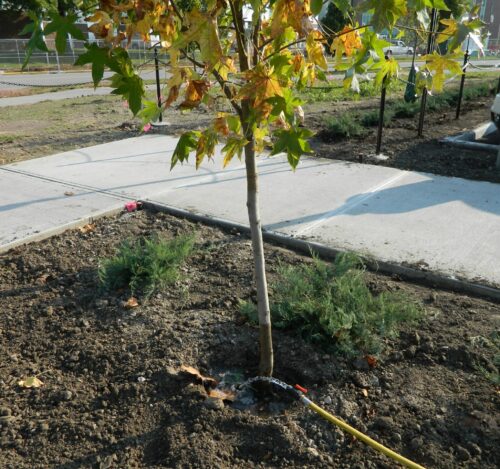
Drought symptoms should be monitored weekly to prevent decline and dieback during the dry months.
- Refresh your mulch; adding mulch to tree rings or even better, expanding them is a great way to reduce water requirements and competition for water and other resources. As trees grow, so do the roots under the tree and expanding mulching rings outward to the dripline of the crown is a great way to keep trees healthier. Also, this helps with those surface root issues as well.

Expanding mulch rings is a great way to improve tree root health and reduce surface root issues.
- Don’t get bugged too much; summer brings out the best in pests too! Many mite and scale species love the heat and can cause major damage and even death to your trees. Look for signs and symptoms of scale infestations and mite damage on your trees and shrubs now. More information on scales can be found here. Additional details on mite damage can be found here.
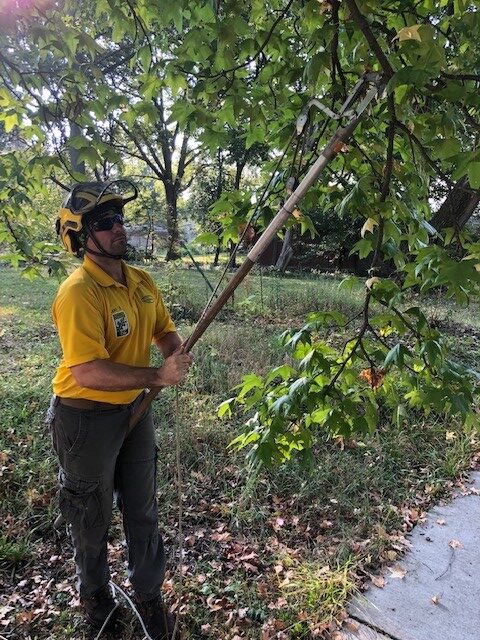
- A nip and tuck are fine; summer is actually a good time to prune as needed to meet objectives such as reducing risk, improving branch structure, and removing conflicts or improving aesthetics. Be sure to only remove what is necessary and reduce the amount of live, green tissue removal. Remember, this is what produces food for the tree. Additional tree pruning techniques are discussed in this publication.
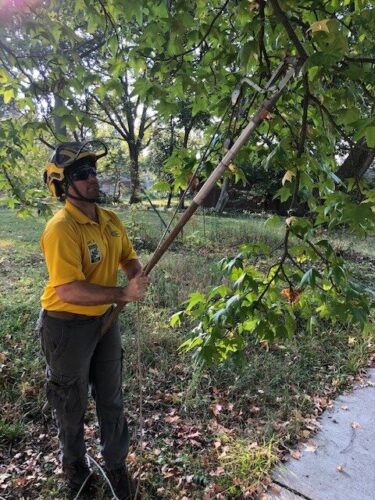
Proper pruning during the summer is a good way to improve aesthetics and stability during stormy weather.
- Call in a professional; it is always a good idea to consult an ISA Certified Arborist for answers to tree questions. A reputable arborist trained in best practices and current research can provide the best solutions to keeping trees healthy and reduce potential risk for damage during those summer storms. Finding a qualified arborist can be a challenge itself. Refer to this website to find an ISA arborist near you.
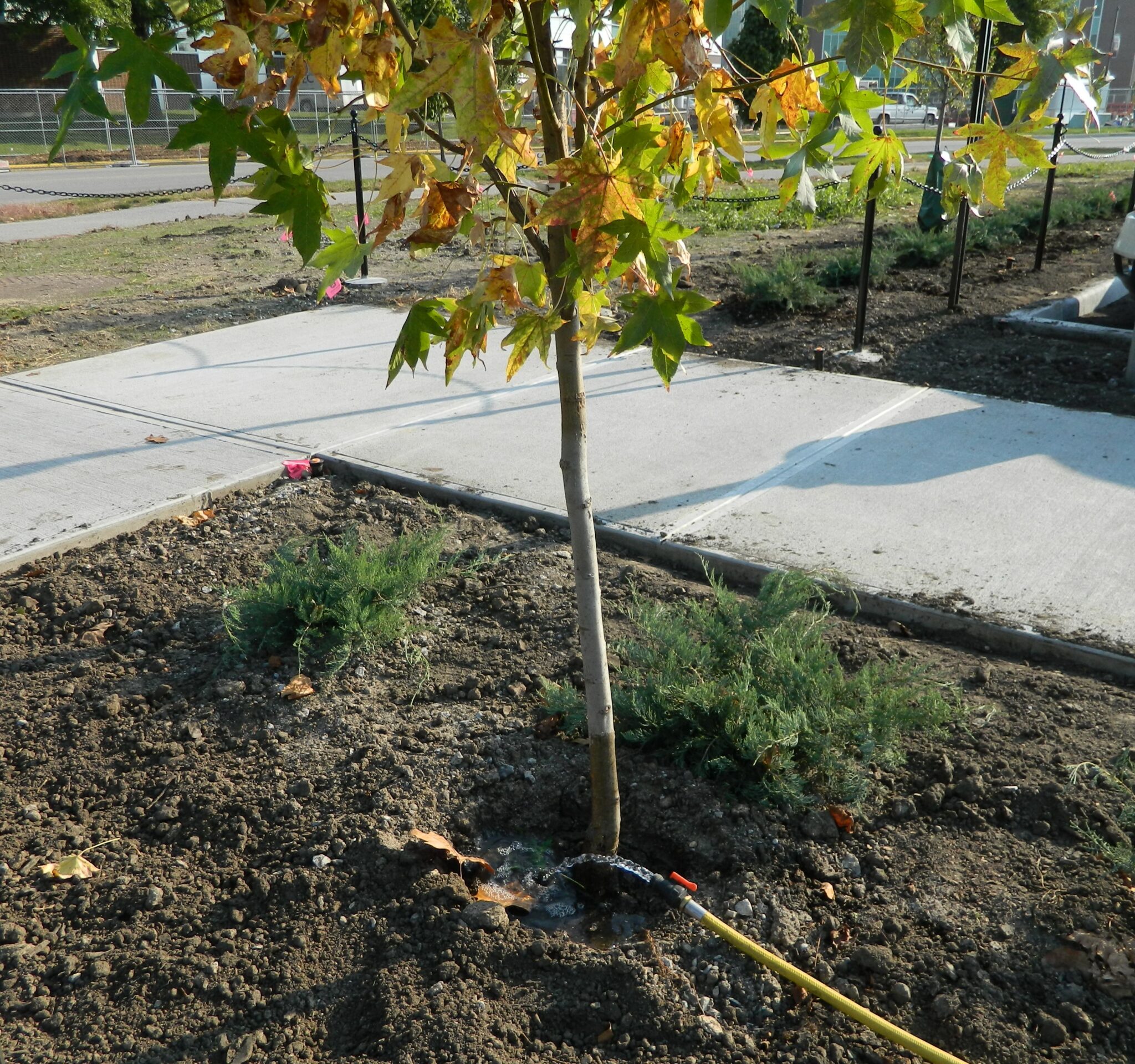

For additional information on urban tree care, check out all the publications at the Purdue Education Store.
Resources:
Planting Your Tree Part 1: Choosing Your Tree, Purdue Extension YouTube Channel
Tree Planting Part 2: Planting a Tree, Purdue Extension YouTube Channel
Tree Selection for the “Un-natural” Environment, The Education Store, Purdue Extension resource center
Tree Installation: Process and Practices, The Education Store
Tree Pruning Essentials Video, Purdue Extension YouTube Channel
Tree Defect Identification, The Education Store
Tree Wound and Healing, Got Nature? Blog, Purdue Extension – Forestry and Natural Resources
Surface Root Syndrome, The Education Store
Purdue Landscape Report
Lindsey Purcell, Urban Forestry Specialist
Purdue Department of Forestry and Natural Resources
In this edition of ID That Tree, Purdue Extension forester Lenny Farlee introduces you to a native Indiana tree that produces green blooms that turn purple and eventually produce the pawpaw fruit, also called the Indiana banana.
If you have any questions regarding wildlife, trees, forest management, wood products, natural resource planning or other natural resource topics, feel free to contact us by using our Ask an Expert web page.
Resources:
ID That Tree, Playlist, Purdue Extension – Forestry and Natural Resources Youtube Channel
A Woodland Management Moment, Playlist, Purdue Extension – FNR Youtube Channel
Shrubs and Woody Vines of Indiana and the Midwest, Purdue University Press
Native Trees of the Midwest, Purdue University Press
Investing in Indiana Woodlands, The Education Store
Forest Improvement Handbook, The Education Store
Growing Pawpaws, The Education Store
Pawpaw: The Midwest Banana?, Indiana Yard and Garden – Purdue Consumer Horticulture
Unexpected Plants and Animals of Indiana: Pawpaw tree, Got Nature? Post, Purdue Extension – Forestry and Natural Resources
Lenny Farlee, Sustaining Hardwood Extension Specialist
Purdue University Department of Forestry and Natural Resources
You may know sassafras for its fall fruit, but did you know this native Indiana tree also produces yellow spring blooms? Learn more about this tree in this edition of ID That Tree with Purdue Extension forester Lenny Farlee.
If you have any questions regarding wildlife, trees, forest management, wood products, natural resource planning or other natural resource topics, feel free to contact us by using our Ask an Expert web page.
Resources:
ID That Tree, Playlist, Purdue Extension – Forestry and Natural Resources YouTube Channel
A Woodland Management Moment, Playlist, Purdue Extension – FNR YouTube Channel
Shrubs and Woody Vines of Indiana and the Midwest, Purdue University Press
Native Trees of the Midwest, Purdue University Press
Investing in Indiana Woodlands, The Education Store
Forest Improvement Handbook, The Education Store
Sassafras albidum, Purdue Arboretum Explorer
Sassafras, The Education Store, Purdue Extension resource center
Lenny Farlee, Sustaining Hardwood Extension Specialist
Purdue University Department of Forestry and Natural Resources
Join fisheries specialist Dr. Mitch Zischke and Fred Whitford from the Purdue Pesticide program as they share about pond vegetation, from what is pond vegetation and why is it useful, to how you prevent negative effects from aquatic plants and what can you do to control problem plants.
If you have any questions regarding trees, forests, wildlife, wood products or other natural resource topics, feel free to contact us by using our Ask an Expert web page.
Resources:
Aquatics & Fisheries, Playlist, Purdue Extension – Forestry and Natural Resources YouTube Channel
Ask an Expert: Pond Wildlife Management, Video, Purdue Extension – FNR YouTube Channel
Ask an Expert: Pond Management: What to Do in Winter, How to Plan for Spring, Video, Purdue Extension – FNR YouTube Channel
Aquatic Pest Management, The Education Store, Purdue Extension resource center
Pond Management: Stocking Fish in Indiana Ponds, The Education Store
Aquatic Plant Management: Identifying and Managing Aquatic Vegetation, The Education Store
Aquatic Vegetation Management, College of Agriculture – Purdue Extension
Pond and Wildlife Management, College of Agriculture – Purdue Extension
Purdue Plant and Pest Diagnostic Lab, College of Agriculture – Purdue Extension
Find your county extension educator, College of Agriculture – Purdue Extension
Purdue Pesticide Program eLearning Aquatic Pest Management Module, Purdue Pesticide Program, Purdue Extension
Part 1: Know Your Pond, Video, Purdue Extension YouTube Channel
Part 2: Selecting the Right Equipment for the Job, Video, Purdue Extension YouTube Channel
Part 3: Proper Placement of the Herbicide, Video, Purdue Extension YouTube Channel
Part 4: Stopping the Hitchhikers Boat Cleaning, Video, Purdue Extension YouTube Channel
Mitch Zischke, Clinical Assistant Professor
Purdue Department of Forestry and Natural Resources
Fred Whitford, Clinical Engagement Professor
Purdue Department of Botany and Plant Pathology
Meet the Hawthorns, a family of small trees with wide-ranging features that make it difficult to tell various species apart. Learn about this group of native Indiana trees, which produce beautiful spring blooms, from Purdue Extension forester Lenny Farlee in this episode of ID That Tree.
If you have any questions regarding wildlife, trees, forest management, wood products, natural resource planning or other natural resource topics, feel free to contact us by using our Ask an Expert web page.
Resources:
ID That Tree, Playlist, Purdue Extension – Forestry and Natural Resources YouTube Channel
A Woodland Management Moment, Playlist, Purdue Extension – FNR YouTube Channel
Shrubs and Woody Vines of Indiana and the Midwest, Purdue University Press
Native Trees of the Midwest, Purdue University Press
Investing in Indiana Woodlands, The Education Store
Forest Improvement Handbook, The Education Store
Lenny Farlee, Sustaining Hardwood Extension Specialist
Purdue University Department of Forestry and Natural Resources
Question:
I live in central Indiana and have had no cicadas yet. Are they still emerging or is it safe to uncover my tender trees?
Answer:
If you haven’t seen or heard any 17-year cicadas near your trees yet, there probably won’t be any emerging there this year. You should be safe to take off the netting now, but I’d still suggest learning the signs of cicada egg laying damage and keeping an eye on any trees you’re worried about. The damage typically looks like a row of small holes in the bark connected by cracks (exp. periodical cicada (Magicicada septendecim) but it can vary depending on the species of plant. If you see signs of egg laying damage, you can put the netting back on to protect your trees from any additional injury.
Resources:
17 Ways to Make the Most of the 17-year Cicada Emergence, Purdue College of Agriculture
Ask an Expert: Cicada Emergence Video, Got Nature? Blog, Purdue Extension-FNR
Periodical Cicada in Indiana, The Education Store, Purdue Extension resource center
Cicada Killers, The Education Store
Purdue Cicada Tracker, Purdue Extension-Master Gardener Program
Elizabeth Barnes, Exotic Forest Pest Educator
Purdue University Department of Entomology

Recent Posts
- ID That Tree: Nannyberry Viburnum
Posted: July 22, 2026 in Forestry, Plants, Wildlife, Woodlands - ID That Tree: Eastern Swamp Privet
Posted: in Forestry, Plants, Wildlife, Woodlands - Indiana Monarch and Pollinator Conservation
Posted: June 1, 2026 in Forestry, Forests and Street Trees, Gardening, How To, Natural Resource Planning, Plants, Urban Forestry, Wildlife - ID That Tree: Shumard Oak
Posted: March 9, 2026 in Plants, Urban Forestry, Wildlife, Woodlands - ID That Tree: Fragrant Sumac
Posted: February 4, 2026 in Plants, Urban Forestry, Wildlife - It’s Not Too Late to Order Trees for Spring Planting
Posted: January 13, 2026 in Forestry, How To, Plants - Red in Winter – What Are Those Red Fruits I See?
Posted: December 1, 2025 in Forestry, Plants, Urban Forestry, Wildlife, Woodlands - Fall Tree Care Tips
Posted: September 20, 2025 in Forestry, Forests and Street Trees, Gardening, How To, Land Use, Plants, Safety, Timber Marketing, Urban Forestry, Wood Products/Manufacturing, Woodlands - Top 10 Spring Flowering Shrubs, Purdue Landscape Report
Posted: April 28, 2025 in Gardening, Plants, Urban Forestry - Protecting Spring Plants From Wildlife Damage Using Repellents
Posted: April 14, 2025 in How To, Plants, Wildlife
Archives
Categories
- Alert
- Aquaculture/Fish
- Aquatic/Aquaculture Resources
- Ask the Expert
- Christmas Trees
- Community Development
- Disease
- Drought
- Forestry
- Forests and Street Trees
- Gardening
- Got Nature for Kids
- Great Lakes
- How To
- Invasive Animal Species
- Invasive Insects
- Invasive Plant Species
- Land Use
- Natural Resource Planning
- Nature of Teaching
- Plants
- Podcasts
- Ponds
- Publication
- Safety
- Spiders
- Timber Marketing
- Urban Forestry
- Webinar
- Wildlife
- Wood Products/Manufacturing
- Woodland Management Moment
- Woodlands