 Purdue University - Extension - Forestry and Natural Resources
Got Nature? Blog
The classic and trusted book “Fifty Common Trees of Indiana” by T.E. Shaw was published in 1956 as a user-friendly guide to local species. Nearly 70 years later, the publication has been updated through a joint effort by the Purdue Department of Forestry and Natural Resources, Indiana 4-H, and the Indiana Department of Natural Resources, and reintroduced as “An Introduction to Trees of Indiana.”
The full publication is available for download for $7 in the Purdue Extension Education Store. The field guide helps identify common Indiana woodlot trees.
Each week, the Intro to Trees of Indiana web series will offer a sneak peek at one species from the book, paired with an ID That Tree video from Purdue Extension forester Lenny Farlee to help visualize each species as it stands in the woods. Threats to species health as well as also insight into the wood provided by the species, will be provided through additional resources as well as the Hardwoods of the Central Midwest exhibit of the Purdue Arboretum, if available.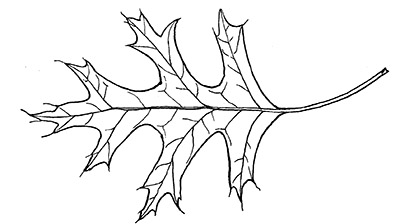
This week, we take a look at the eighth of our featured oak varieties in Indiana, the Pin Oak or Quercus palustris.
The leaves of pin oak are multi-lobed, with lobes coming out at nearly a 90-degree angle from the center of the leaves, and feature bristle tips like all members of the red/black oak family. On the pin oak, the alternately held leaves typically have less lobes than other members of the red/black oak group. In the fall, leaves change from medium green to a red to reddish brown color.
One key characteristic of pin oak are the branches, which angle downward especially on the lower part of the tree. The pin oak tends to keep its lower branches for a long period of time, which can create pin knots in the wood.
The trunk of pin oak is typically straight and single stemmed, while the bark is smooth and gray and may develop dark fissures with age.
The fruit is a rounded acorn with a relatively flat top with smooth scales, which covers only about one quarter of the nut.
Pin oaks, which grow to 60 to 70 feet tall and are relatively fast growing, are found mostly in moist to wet areas, such as streams, lakes and other wetlands, oftentimes in soils that have a medium to high acidity. Pin oaks also have been planted in many sites for landscape purposes.
The natural range of the pin oak is in bottomlands and imperfectly drained soils from New Jersey south to Virginia and west to Eastern Kansas and Oklahoma as well as south into North Carolina, Tennessee and Arkansas.
The Morton Arboretum states that pin oak suffers greatly from chlorosis or yellowing of the leaves in soils with high pH. As with other oaks, the pin oak should be pruned in the dormant season to avoid attracting beetles that may carry oak wilt, which can be a potential disease problem along with oak blister.
For full article with additional photos view: Intro to Trees of Indiana: Pin Oak, Forestry and Natural Resources’ News.
If you have any questions regarding wildlife, trees, forest management, wood products, natural resource planning or other natural resource topics, feel free to contact us by using our Ask an Expert web page.
Other Resources:
ID That Tree: Pin Oak
ID That Tree: Red Oak Group
Hardwood Lumber and Veneer Series: Red Oak Group
Morton Arboretum: Pin Oak
Pin Oak, Native Trees of Indiana River Walk, Purdue Fort Wayne
Fifty Common Trees of Indiana
An Introduction to Trees of Indiana
Native Trees of the Midwest, The Education Store
Shrubs and Woody Vines of Indiana and the Midwest, The Education Store
Investing in Indiana Woodlands, The Education Store
Forest Improvement Handbook, The Education Store
ID That Tree, Purdue Extension-Forestry & Natural Resources (FNR) YouTube playlist
Woodland Management Moment , Purdue Extension-FNR YouTube playlist
Wendy Mayer, FNR Communications Coordinator
Purdue University Department of Forestry and Natural Resources
Lenny Farlee, Sustaining Hardwood Extension Specialist
Purdue University Department of Forestry and Natural Resources
In 1978, Dan Cassens purchased a 10-acre plot of land close to the Purdue campus on which he planted a few Christmas trees as a side project. That plot of land developed into a family Christmas tree farm that Cassens and his wife Vicki have run for more than 40 years.
As the years passed, Dan, now a professor emeritus in the Department of Forestry and Natural Resources after retiring in 2017 following a more than 40-year career at Purdue, enlisted the help of students within the department for both seasonal work and longer-term work on the farm and within his small lumber business.
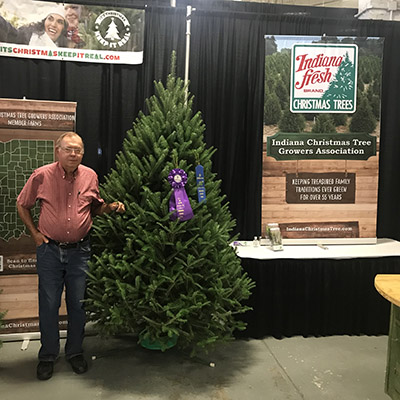
What started as a few extra hands around the tree farm has turned into a hands-on learning opportunity for more than 20 FNR students each year, teaching workers skills from cutting and handling trees to customer service.
“I don’t remember how it got started; I guess I needed somebody to help me and I probably knew a couple of students that were anxious to work,” Cassens said. “I don’t know how many years it has been going on now, but it keeps getting bigger. Last year at Christmas time we had 20 some students helping us part time with the trees. It’s a good group because they have hard, physical work to do, but then they’ve also got time to sit and talk too.”
The work begins in October to prepare the tree farm for its opening on the Saturday before Thanksgiving, a date determined by customer demand over the years. Cassens Tree Farm has both choose-and-cut and pre-cut trees in species ranging from Canaan fir, Fraser fir and Concolor (White) fir to Scotch pine and white pine and Norway spruce. Once cut, trees have to be shook to remove dead needles, have a fresh cut on the butt of the tree to ensure they stand straight on a tree stand, and many get baled or wrapped, which condenses a tree, making it easier to handle and preventing damage to limbs that may occur in transit.
Cassens does not have prerequisite skills for students who work on the farm, save a willingness to work hard, although there are plenty of jobs on the tree farm that require specialized skills.
“We can use anybody that wants to work hard and has time available,” Cassens said. “We try to find out what their abilities are, because we do need people that can drive trucks and use chainsaws. Chainsaw experience is absolutely critical in part of the operation, but other than that, anybody can work in the barn. It doesn’t require much skill, just hard work. It’s hard to get it all sorted out with 20 students with different hours that they can work and different abilities, but we try to find out their abilities and schedules and try to get them placed. Once we get it going, it’s good.”
Daniel Warner, a 2011 alumnus in wood products manufacturing technology, said Cassens was very understanding when it came to lack of knowledge and miscues.
“My first day helping with the tree farm, I didn’t even know why we were planting these little pine trees (I was thinking lumber not Christmas),” Warner recalled. “I was also recruited for the mortar removal on several tons of vintage bricks. On one hatchet wielding, mortar removing day, I managed to get my truck stuck in Dan’s yard in the mud. Needless to say, the fact that we are still good friends shows that there was a great deal of forgiveness.”
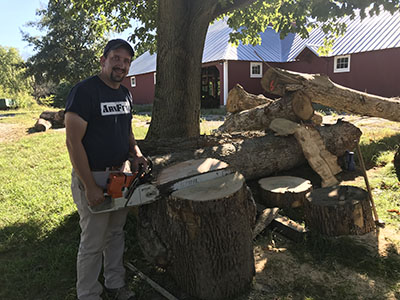
Many of the students who work at Cassens farm are juniors or seniors, but some come back two or three years in a row once a part of the workforce, and often bring friends along to join the crew.
2018 forestry alumnus Ed Oehlman helped at Cassens Trees for five years, beginning the spring of his freshman year.
“I met Dan my freshman year at Purdue and that spring he invited me out to the farm to help him plant Christmas trees and that started my adventure,” Oehlman said. “I got the pleasure of seeing the whole process, from helping him plant trees, spending many hours mowing, sheering trees, spraying and treating trees, and lasting helping sell trees. Selling Christmas Trees is to this day one of the best jobs I’ve ever had. You couldn’t work for better people than Dan and Vicki. The days could be long and active, especially Thanksgiving weekend, but they always made sure you were taken care with little snacks or pizza, sometimes even home made soup. It made the time go by so quick, you’d just get started and before you knew it we were shutting up shop. The best was the fun little gamble we did at the end of the day to guess how many trees we had sold that day, which always made work fun! Working with and for Dan was a great learning experience, and not just about wood/lumber or Christmas trees. I learned so many great life and business skills!”
Charlie Warner, 2021 forestry alumnus and current master’s degree student, worked at Cassens Farm for three and a half years as an undergraduate student and has helped out five seasons overall after being introduced to Cassens and the job his freshman year thanks to Damon McGuckin (sustainable biomaterials 2018) and Oehlman.
“Both Ed and Damon worked for Dan at the tree farm throughout their time at Purdue and told me about him and how he was as both a boss and a professor,” Warner said. “Unfortunately, Dan retired from teaching before I had a chance to take his classes but I made up for it when I started working for him. I started working on the tree farm helping Dan with various jobs, whether it was sawing lumber with his Wood-Mizer, loading and unloading his dry kilns where he dried lumber, cutting down trees and bucking the logs to get them ready for the sawmill and many other jobs and mechanical work around the farm. I learned so much from my few years working for Dan. In fact, he was one of the strongest voices urging me to continue my studies and work towards a master’s degree. Not only did Dan teach me everything there is to know about the wood products industry and more, but he also taught me how to communicate with industry employers. He gave me the skills to make myself extremely marketable to a few of my internship opportunities. Furthermore, he taught me many life lessons.”
Additional Resources
Root Rot in Landscape Plants, The Education Store
Ask The Expert: Tree Inspection, Purdue Extension- FNR YouTube Channel
Ask The Expert: Tree Selection and Planting, Purdue Extension- FNR YouTube Channel
Surface Root Syndrome, The Education Store, Purdue Extension resource center
The Nature of Teaching: Trees of the Midwest, The Education Store
Tree Appraisal and the Value of Trees, The Education Store
Construction and Trees: Guidelines for Protection, The Education Store
ID That Tree: Northern Red Oak
ID That Tree: Red Oak Group
Hardwood Lumber and Veneer Series: Red Oak Group
Morton Arboretum: Northern Red Oak
Red Oak, Native Trees of Indiana River Walk, Fort Wayne Purdue
Fifty Common Trees of Indiana
An Introduction to Trees of Indiana
Native Trees of the Midwest, The Education Store
Shrubs and Woody Vines of Indiana and the Midwest, The Education Store
Investing in Indiana Woodlands, The Education Store
Forest Improvement Handbook, The Education Store
ID That Tree, Purdue Extension-Forestry & Natural Resources (FNR) YouTube playlist
Woodland Management Moment, Purdue Extension-FNR YouTube playlist
Wendy Mayer, FNR Communications Coordinator
Purdue University Department of Forestry and Natural Resources
The classic and trusted book “Fifty Common Trees of Indiana” by T.E. Shaw was published in 1956 as a user-friendly guide to local species. Nearly 70 years later, the publication has been updated through a joint effort by the Purdue Department of Forestry and Natural Resources, Indiana 4-H, and the Indiana Department of Natural Resources, and reintroduced as “An Introduction to Trees of Indiana.”
The full publication is available for download for $7 in the Purdue Extension Education Store. The field guide helps identify common Indiana woodlot trees.
Each week, the Intro to Trees of Indiana web series will offer a sneak peek at one species from the book, paired with an ID That Tree video from Purdue Extension forester Lenny Farlee to help visualize each species as it stands in the woods. Threats to species health as well as also insight into the wood provided by the species, will be provided through additional resources as well as the Hardwoods of the Central Midwest exhibit of the Purdue Arboretum, if available. 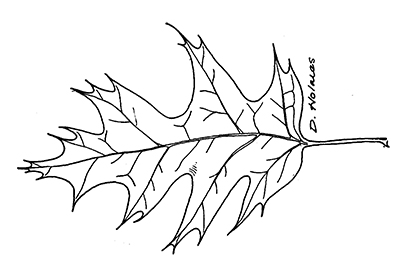
This week, we take a look at the sixth of our oak varieties in Indiana, the Northern Red Oak or Quercus rubra.
This native species is easily identified by its bark and its acorn. The bark looks like ski tracks or long running ridges that run up and down the sides of the tree, while the fruit is a large rounded acorn featuring a tight shallow cap with tight scales that resembles a beret sitting on top of a head.
Like other members of the red oak group, the leaves are multi-lobed and have bristle tips, including a sharp bristle tip on the terminal lobe. On the northern red oak, the alternately held leaves have veins that are palmate, or run out to the ends of the lobes from a single point in the middle. In the fall, the dark green leaves change to a bright red color.
The cluster of terminal buds at the end of northern red oak stems are smooth, shiny and reddish brown to brown in color. The twigs are somewhat angular in appearance.
Northern red oaks, which grow to 60 to 75 feet tall, are found mostly in upland areas. The natural range of northern red oak is the eastern United States and southern Canada, with the exception of the southern coastal plains. It grows well on moist, but well-drained soils.
The Morton Arboretum states that northern red oak has a high tolerance of salt and air pollution, making it a good tree for more exposed areas. This species prefers a well-drained, rich woodland site and it grows best in sandy, loam soil.
As with other oaks, the northern red oak should be pruned in the dormant season to avoid attracting beetles that may carry oak wilt. Galls and mites are common insect problems. This species can develop chlorosis symptoms in high pH soils.
For full article with additional photos view: Intro to Trees of Indiana: Northern Red Oak, Forestry and Natural Resources’ News.
If you have any questions regarding wildlife, trees, forest management, wood products, natural resource planning, or other natural resource topics, feel free to contact us by using our Ask an Expert web page.
Other Resources:
ID That Tree: Northern Red Oak
ID That Tree: Red Oak Group
Hardwood Lumber and Veneer Series: Red Oak Group
Morton Arboretum: Northern Red Oak
Red Oak, Native Trees of Indiana River Walk, Fort Wayne Purdue
Fifty Common Trees of Indiana
An Introduction to Trees of Indiana
Native Trees of the Midwest, The Education Store
Shrubs and Woody Vines of Indiana and the Midwest, The Education Store
Investing in Indiana Woodlands, The Education Store
Forest Improvement Handbook, The Education Store
ID That Tree, Purdue Extension-Forestry & Natural Resources (FNR) YouTube playlist
Woodland Management Moment, Purdue Extension-FNR YouTube playlist
Wendy Mayer, FNR Communications Coordinator
Purdue University Department of Forestry and Natural Resources
Lenny Farlee, Sustaining Hardwood Extension Specialist
Purdue University Department of Forestry and Natural Resources
The classic and trusted book “Fifty Common Trees of Indiana” by T.E. Shaw was published in 1956 as a user-friendly guide to local species. Nearly 70 years later, the publication has been updated through a joint effort by the Purdue Department of Forestry and Natural Resources, Indiana 4-H, and the Indiana Department of Natural Resources, and reintroduced as “An Introduction to Trees of Indiana.”
The full publication is available for download for $7 in the Purdue Extension Education Store. The field guide helps identify common Indiana woodlot trees. 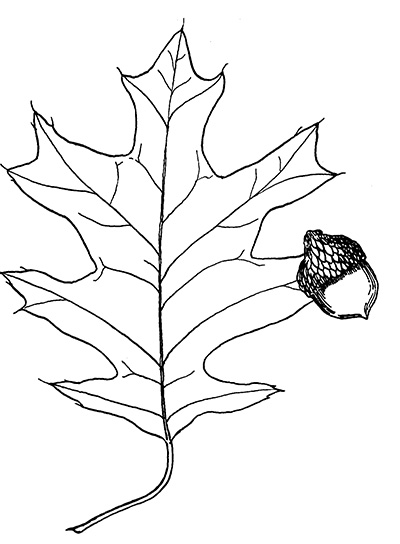
Each week, the Intro to Trees of Indiana web series will offer a sneak peek at one species from the book, paired with an ID That Tree video from Purdue Extension forester Lenny Farlee to help visualize each species as it stands in the woods. Threats to species health as well as also insight into the wood provided by the species, will be provided through additional resources as well as the Hardwoods of the Central Midwest exhibit of the Purdue Arboretum, if available.
This week, we take a look at the seventh of our featured oak varieties in Indiana, the Black Oak or Quercus velutina.
The leaves of black oak are multi-lobed, typically with seven lobes, with deep sinuses in between, and have bristle tips like all members of the red/black oak family. On the black oak, the alternately held leaves can be extremely variable in shape, but the tops of the leaves are dark and shiny and have a leathery appearance. Leaves change from dark green in summer to yellow or yellow-brown in fall.
One key characteristic of black oak are the terminal buds, which are angular and fuzzy, very large and light tan. Alternately, the cluster of terminal buds at the end of northern red oak stems are smooth, shiny and reddish brown to brown in color.
The bark is very dark in color with narrow, blocky ridges, and lacks the silvery running ridges that are found on northern red oak.
The fruit is a small rounded acorn with striping running up and down the sides and a fuzzy coating along the outside edge. The cap is deeper than northern red oak and the scales on the edge of the cap resemble loose, rough shingles.
Black oaks, which grow to 50 to 60 feet tall, are found mostly in dry, upland areas. The natural range of the black oak is nearly all of the eastern United States, from Nebraska, Iowa and Oklahoma to the west, dipping south into Texas, Louisiana, Mississippi, Alabama, Georgia and even a bit of the panhandle of Florida, extending along the eastern coastline, and northward into southern Ontario, Canada.
The Morton Arboretum states that black oak has a high tolerance of alkaline soils and dry sites, although it prefers acidic and dry soil. This species cannot withstand severe drought. It can also be difficult to transplant due to a deep taproot.
As with other oaks, the black oak should be pruned in the dormant season to avoid attracting beetles that may carry oak wilt, which can be a potential disease problem. Galls on leaves caused by mites or insects are common, but not harmful.
For full article with additional photos view: Intro to Trees of Indiana: Black Oak, Forestry and Natural Resources’ News.
If you have any questions regarding wildlife, trees, forest management, wood products, natural resource planning or other natural resource topics, feel free to contact us by using our Ask an Expert web page.
Other Resources:
ID That Tree: Black Oak
ID That Tree: Red Oak Group
Hardwood Lumber and Veneer Series: Red Oak Group
Morton Arboretum: Black Oak
Black Oak, Native Trees of Indiana River Walk, Fort Wayne Purdue
Fifty Common Trees of Indiana
An Introduction to Trees of Indiana
Native Trees of the Midwest, The Education Store
Shrubs and Woody Vines of Indiana and the Midwest, The Education Store
Investing in Indiana Woodlands, The Education Store
Forest Improvement Handbook, The Education Store
ID That Tree, Purdue Extension-Forestry & Natural Resources (FNR) YouTube playlist
Woodland Management Moment , Purdue Extension-FNR YouTube playlist
Wendy Mayer, FNR Communications Coordinator
Purdue University Department of Forestry and Natural Resources
Lenny Farlee, Sustaining Hardwood Extension Specialist
Purdue University Department of Forestry and Natural Resources
The classic and trusted book “Fifty Common Trees of Indiana” by T.E. Shaw was published in 1956 as a user-friendly guide to local species. Nearly 70 years later, the publication has been updated through a joint effort by the Purdue Department of Forestry and Natural Resources, Indiana 4-H, and the Indiana Department of Natural Resources, and reintroduced as “An Introduction to Trees of Indiana.”
The full publication is available for download for $7 in the Purdue Extension Education Store. The field guide helps identify common Indiana woodlot trees.
Each week, the Intro to Trees of Indiana web series will offer a sneak peek at one species from the book, paired with an ID That Tree video from Purdue Extension forester Lenny Farlee to help visualize each species as it stands in the woods. Threats to species health as well as also insight into the wood provided by the species, will be provided through additional resources as well as the Hardwoods of the Central Midwest exhibit of the Purdue Arboretum, if available.
This week, we take a look at the fifth of our oak varieties in Indiana, the Chinkapin Oak or Quercus muehlenbergii.
Also known as the Chinquapin Oak, the leaves of this species feature shallow, evenly lobed margins, but appear to have sharp-pointed teeth at the end resembling red or black oaks. This sharp point, however, is due to a gland at the end of the leaves, and there is no bristle tip as are typically found on red and black oaks. The shape of the leaves can be either broad like chestnut oak, or narrower.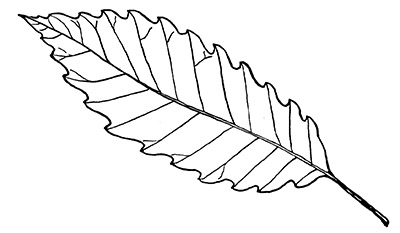
Like other members of the white oak group, the bark of chinkapin oak is light gray and ashy, however it has a flaky appearance.
The fruit of the chinkapin oak is a small acorn that is dark brown or almost black in color. It has a cap that resembles a stocking cap, covering a third or half of the acorn, that features loose knobby scales. Under the cap, the acorn has a large white spot similar to that of a buckeye.
Chinkapin oaks, which grow to 50 to 80 feet tall, are found in both upland and bottomland areas. The natural range of chinkapin oak is the eastern United States, with the exception of the Atlantic coast and the immediate gulf coastal plains.
The Morton Arboretum states that chinkapin oak is best grown in rich, deep soils, but that it is often found in the wild on dry, limestone outcrops in low slopes and wooded hillsides. It notes that this species is one of the best oaks for alkaline soils. As with other oaks, this chinkapin oaks should be pruned in the dormant season to avoid attracting beetles that may carry oak wilt. This species also can be affected by anthracnose, oak wilt and two-lined chestnut borers.
For full article with additional photos view: Intro to Trees of Indiana: Chinkapin Oak, Forestry and Natural Resources’ News.
If you have any questions regarding wildlife, trees, forest management, wood products, natural resource planning, or other natural resource topics, feel free to contact us by using our Ask an Expert web page.
Other Resources:
ID That Tree: Chinkapin Oak
ID That Tree: White Oak Group
Hardwood Lumber and Veneer Series: White Oak Group
Morton Arboretum: Chinkapin Oak
Chinkapin Oak, Native Trees of Indiana River Walk, Fort Wayne Purdue
Fifty Common Trees of Indiana
An Introduction to Trees of Indiana
Native Trees of the Midwest, The Education Store
Shrubs and Woody Vines of Indiana and the Midwest, The Education Store
Investing in Indiana Woodlands, The Education Store
Forest Improvement Handbook, The Education Store
ID That Tree, Purdue Extension-Forestry & Natural Resources (FNR) YouTube playlist
Woodland Management Moment, Purdue Extension-FNR YouTube playlist
Wendy Mayer, FNR Communications Coordinator
Purdue University Department of Forestry and Natural Resources
Lenny Farlee, Sustaining Hardwood Extension Specialist
Purdue University Department of Forestry and Natural Resources
The classic and trusted book “Fifty Common Trees of Indiana” by T.E. Shaw was published in 1956 as a user-friendly guide to local species. Nearly 70 years later, the publication has been updated through a joint effort by the Purdue Department of Forestry and Natural Resources, Indiana 4-H, and the Indiana Department of Natural Resources, and reintroduced as “An Introduction to Trees of Indiana.”
The full publication is available for download for $7 in the Purdue Extension Education Store. The field guide helps identify common Indiana woodlot trees.
Each week, the Intro to Trees of Indiana web series will offer a sneak peek at one species from the book, paired with an ID That Tree video from Purdue Extension forester Lenny Farlee to help visualize each species as it stands in the woods. Threats to species health as well as also insight into the wood provided by the species, will be provided through additional resources as well as the Hardwoods of the Central Midwest exhibit of the Purdue Arboretum, if available.
This week, we introduce the red mulberry or Morus rubra.
Red mulberry has variable leaves, which can come without lobes (entire) or with two (mitten), three or even five lobes. Regardless of shape, the leaves have serrated margins and pointed tips and are arranged alternately on the twigs. The topside of the dark green leaves is sandpapery to the touch and has a matte or flat finish. The dark green leaves turn a golden yellow in the fall.
Basswood has leaves similar to the unlobed variety of red mulberry, but those leaves are smooth to the touch and have finely toothed margins. White mulberry, which is not native to Indiana, also has similar leaves to its cousin red mulberry, but those leaves are typically bright green and smooth, have more rounded teeth on the margins and feature a shinier upper leaf surface.
The bark of red mulberry is gray or brown in color with long flaky ridges, but may show some orange or tan peeking through the fissures in the bark.
The fruit of red mulberry, which hangs individually only the twig, resembles a small blackberry, with a dark purple or almost black color when ripe, that is favored by both birds and humans. Mulberry fruit is typically produced from mid-June to July.
Red mulberry, which is often found under the canopy of other hardwood trees in moist areas such as river bottoms as well as along wooded slopes, wood’s edges and shady roadways, are typically small understory trees, but can grow between 40 and 60 feet tall. Red mulberries are becoming less common on the landscape than the invasive white mulberry, but can be found growing throughout the eastern United States.
The Morton Arboretum warns that red mulberry is susceptible to a variety of pests, including leaf spots, witches brooms, canker diseases, powdery mildew, spider mites and scale insects.
For full article with additional photos view: Intro to Trees of Indiana: Red Mulberry
If you have any questions regarding wildlife, trees, forest management, wood products, natural resource planning or other natural resource topics, feel free to contact us by using our Ask an Expert web page.
Other Resources:
FNR Know Your Tree Series: Red and White Mulberry in Indiana
Morton Arboretum: Red Mulberry
Red Mulberry, Native Trees of Indiana River Walk, Purdue Fort Wayne
Fifty Common Trees of Indiana
An Introduction to Trees of Indiana
Native Trees of the Midwest, The Education Store
Shrubs and Woody Vines of Indiana and the Midwest, The Education Store
Investing in Indiana Woodlands, The Education Store
Forest Improvement Handbook, The Education Store
ID That Tree, Purdue Extension-Forestry & Natural Resources (FNR) YouTube playlist
Woodland Management Moment , Purdue Extension-FNR YouTube playlist
Wendy Mayer, FNR Communications Coordinator
Purdue University Department of Forestry and Natural Resources
Lenny Farlee, Sustaining Hardwood Extension Specialist
Purdue University Department of Forestry and Natural Resources
The classic and trusted book “Fifty Common Trees of Indiana” by T.E. Shaw was published in 1956 as a user-friendly guide to local species. Nearly 70 years later, the publication has been updated through a joint effort by the Purdue Department of Forestry and Natural Resources, Indiana 4-H, and the Indiana Department of Natural Resources, and reintroduced as “An Introduction to Trees of Indiana.”
The full publication is available for download for $7 in the Purdue Extension Education Store. The field guide helps identify common Indiana woodlot trees.
Each week, the Intro to Trees of Indiana web series will offer a sneak peek at one species from the book, paired with an ID That Tree video from Purdue Extension forester Lenny Farlee to help visualize each species as it stands in the woods. Threats to species health as well as also insight into the wood provided by the species, will be provided through additional resources as well as the Hardwoods of the Central Midwest exhibit of the Purdue Arboretum, if available.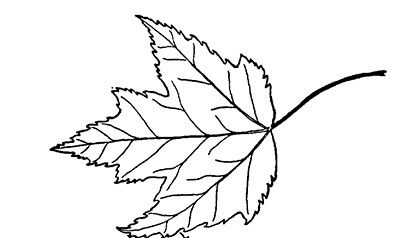
This week, we introduce the red maple or Acer rubrum.
Red maple has simple three to five-lobed leaves with relatively shallow, v-shaped divisions between the lobes. The oppositely held leaves may resemble sugar maple but the V shaped shallow divisions stand in contrast to sugar maple’s deep u-shaped sinuses. In the early spring, it is one of the earliest native trees to flower, producing clusters of reddish flowers as well as reddish colored pairs of winged seeds/fruit. In the fall, foliage typically turns a bright red to maroon color.
The bark is gray and smooth in young trees and may become flaky in older trees.
Red maple, which is a popular ornamental and street tree selection, is one of Indiana’s soft maples alongside silver maple. It also can be found in Indiana woodlands in both moist and dry sites and in bottomlands and uplands.
Red maple, grow 50 to 80 feet tall and are found growing throughout the eastern United States including the coastal regions.
The Morton Arboretum warns that red maple was display chlorosis symptoms of pale green leaves with dark green veins in high pH soil and drought conditions. The species also does not tolerate heavy pollution.
For full article with additional photos view: Intro to Trees of Indiana: Red Maple
If you have any questions regarding wildlife, trees, forest management, wood products, natural resource planning or other natural resource topics, feel free to contact us by using our Ask an Expert web page.
Other Resources:
Hardwoods of the Central Midwest: Soft Maple
Hardwood Lumber and Veneer Series, The Education Store: Soft Maple
Morton Arboretum: Red Maple
Red Maple, Native Trees of Indiana River Walk, Purdue Fort Wayne
Fifty Common Trees of Indiana
An Introduction to Trees of Indiana
Native Trees of the Midwest, The Education Store
Shrubs and Woody Vines of Indiana and the Midwest, The Education Store
Investing in Indiana Woodlands, The Education Store
Forest Improvement Handbook, The Education Store
ID That Tree, Purdue Extension-Forestry & Natural Resources (FNR) YouTube playlist
Woodland Management Moment , Purdue Extension-FNR YouTube playlist
Wendy Mayer, FNR Communications Coordinator
Purdue University Department of Forestry and Natural Resources
Lenny Farlee, Sustaining Hardwood Extension Specialist
Purdue University Department of Forestry and Natural Resources
The classic and trusted book “Fifty Common Trees of Indiana” by T.E. Shaw was published in 1956 as a user-friendly guide to local species. Nearly 70 years later, the publication has been updated through a joint effort by the Purdue Department of Forestry and Natural Resources, Indiana 4-H, and the Indiana Department of Natural Resources, and reintroduced as “An Introduction to Trees of Indiana.”
The full publication is available for download for $7 in the Purdue Extension Education Store. The field guide helps identify common Indiana woodlot trees.
Each week, the Intro to Trees of Indiana web series will offer a sneak peek at one species from the book, paired with an ID That Tree video from Purdue Extension forester Lenny Farlee to help visualize each species as it stands in the woods. Threats to species health as well as also insight into the wood provided by the species, will be provided through additional resources as well as the Hardwoods of the Central Midwest exhibit of the Purdue Arboretum, if available.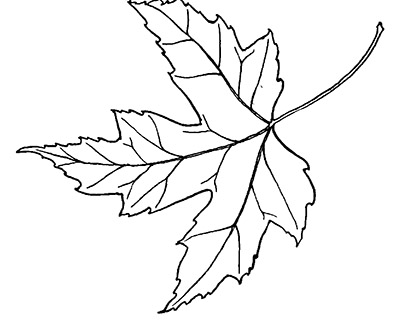
This week, we introduce the silver maple or Acer saccharinum.
Silver maple has simple, typically five-lobed leaves with deeply cut divisions, or sinuses, between the lobes, with narrow lobes at the base. The leaves, which are silvery on the underside, are held oppositely on long leaf stems coming off the twigs. The bark on young trees is smooth and light gray, and darker and scaly on older trees.
Silver maple, which is commonly found in swamps and overflow bottomlands, is one of Indiana’s soft maples alongside red maple. It flowers early and sheds its large winged seed in the spring, typically by late May.
Silver maples, which prefer moist or well-drained soil, grow 50 to 80 feet tall and are found growing from the Great Plains eastward, excluding the Gulf and Atlantic coastal region. Most silver maple lumber is produced in the Mississippi Delta and central states region.
The Morton Arboretum warns that without proper and frequent pruning, high winds and ice can cause limbs to break on silver maple trees due to its weak wood and branch structure. These species is also drought sensitive, so be careful to provide supplemental water during dry periods.
For full article with additional photos view: Intro to Trees of Indiana: Sugar Maple
If you have any questions regarding wildlife, trees, forest management, wood products, natural resource planning or other natural resource topics, feel free to contact us by using our Ask an Expert web page.
Other Resources:
Hardwoods of the Central Midwest: Silver Maple
Hardwood Lumber and Veneer Series, The Education Store: Soft Maple
Morton Arboretum: Silver Maple
Fifty Common Trees of Indiana
An Introduction to Trees of Indiana
Native Trees of the Midwest, The Education Store
Shrubs and Woody Vines of Indiana and the Midwest, The Education Store
Investing in Indiana Woodlands, The Education Store
Forest Improvement Handbook, The Education Store
ID That Tree, Purdue Extension-Forestry & Natural Resources (FNR) YouTube playlist
Woodland Management Moment , Purdue Extension-FNR YouTube playlist
Wendy Mayer, FNR Communications Coordinator
Purdue University Department of Forestry and Natural Resources
Lenny Farlee, Sustaining Hardwood Extension Specialist
Purdue University Department of Forestry and Natural Resources
The classic and trusted book “Fifty Common Trees of Indiana” by T.E. Shaw was published in 1956 as a user-friendly guide to local species. Nearly 70 years later, the publication has been updated through a joint effort by the Purdue Department of Forestry and Natural Resources, Indiana 4-H, and the Indiana Department of Natural Resources, and reintroduced as “An Introduction to Trees of Indiana.”
The full publication is available for download for $7 in the Purdue Extension Education Store. The field guide helps identify common Indiana woodlot trees.
Each week, the Intro to Trees of Indiana web series will offer a sneak peek at one species from the book, paired with an ID That Tree video from Purdue Extension forester Lenny Farlee to help visualize each species as it stands in the woods. Threats to species health as well as also insight into the wood provided by the species, will be provided through additional resources as well as the Hardwoods of the Central Midwest exhibit of the Purdue Arboretum, if available.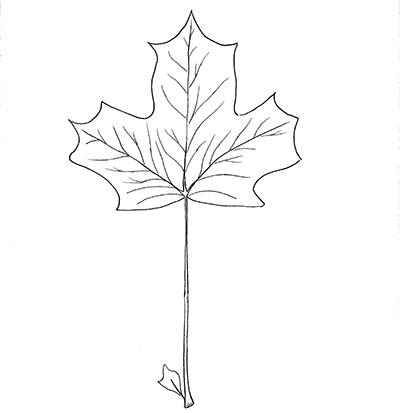
This week, we introduce the black maple or Acer nigrum.
Black maple is easily confused with its cousin, the sugar maple, but there are a few key identifying characteristics to tell them apart. Black maple commonly has stipules, or miniature leaves, at the base of the leaf stem. This species features mottled gray stems and black pointed buds oppositely arranged on the stems. The lobed leaves are darker green and tend to droop down at the edges as the summer goes on.
The bark is lighter gray and smooth in young trees and features flakes or plates in older trees.
The seed or fruit of black maple is a winged seed which occurs in pairs and turns from green to brown when mature, similar to sugar maple.
Black maples, frequently found on moist or bottomland sites, grow 60 to 75 feet tall and can be 40 to 50 feet wide, providing excellent shade with their full foliage.
The Morton Arboretum warns again pruning maps in the spring as they are ‘bleeders’ and will lose large amounts of sap. This species also is susceptible to leaf scorch, verticillium wilt, tar spot and anthracnose and can be affected by borers and cottony maple scale. Black maple suffers from salt, drought and air pollution.
“Don’t be confused by the similarities. Use the tiny stipule (leaf) at the base of the stem, the drooping edges of the dark leaf and its dark buds on gray mottled stems to tell this native apart from its cousin sugar maple. Can you ID this native tree? Meet black maple or Acer nigrum.”
For full article with additional photos view: Intro to Trees of Indiana: Sugar Maple
If you have any questions regarding wildlife, trees, forest management, wood products, natural resource planning or other natural resource topics, feel free to contact us by using our Ask an Expert web page.
Other Resources:
Morton Arboretum: Black Maple
Fifty Common Trees of Indiana
An Introduction to Trees of Indiana
Native Trees of the Midwest, The Education Store
Shrubs and Woody Vines of Indiana and the Midwest, The Education Store
Investing in Indiana Woodlands, The Education Store
Forest Improvement Handbook, The Education Store
ID That Tree, Purdue Extension-Forestry & Natural Resources (FNR) YouTube playlist
Woodland Management Moment , Purdue Extension-FNR YouTube playlist
Black Maple, Native Trees of Indiana River Walk, Fort Wayne, Purdue University
Wendy Mayer, FNR Communications Coordinator
Purdue University Department of Forestry and Natural Resources
Lenny Farlee, Sustaining Hardwood Extension Specialist
Purdue University Department of Forestry and Natural Resources
Each week, the Intro to Trees of Indiana web series will offer a sneak peek at one species from the book, paired with an ID That Tree video from Purdue Extension forester Lenny Farlee to help visualize each species as it stands in the woods. Threats to species health as well as also insight into the wood provided by the species, will be provided through additional resources as well as the Hardwoods of the Central Midwest exhibit of the Purdue Arboretum, if available.
This week, we introduce the sugar maple or Acer saccharum.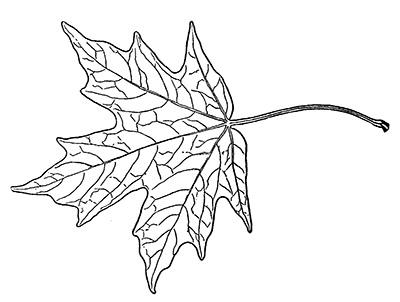
This tree, also called hard maple, has simple leaves typically with five lobes, two smaller lobes at the base and three larger lobes at the top, with u-shaped sinuses between the lobes. The shade-tolerant species has opposite leaf arrangement with relatively long leaf stems as well as opposite branch arrangement. The thin twigs are green in their youth, turning to a medium brown as they age. The leaves produce brilliant fall colors ranging from yellow to burnt orange.
The bark of sugar maple typically has a light to medium gray color, but its appearance is variable and somewhat confusing. It can range from relatively smooth on saplings to minor crevices and ridging on medium sized trees to deeper ridges on older trees.
The seed or fruit of sugar maple is a winged seed which occurs in pairs and turned from green to brown when mature.
Sugar maples grow 60 to 75 feet tall and can be 40 to 50 feet wide, providing excellent shade with their full foliage.
Sugar maples produce maple sap, which can be used to make maple syrup. The yield of sugar maples is one of the highest among maple trees. The Morton Arboretum warns again pruning maps in the spring as they are ‘bleeders’ and will lose large amounts of sap. This species also is susceptible to leaf scorch, verticillium wilt, tar spot and anthracnose and can be affected by borers and cottony maple scale.
For full article with additional photos view: Intro to Trees of Indiana: Sugar Maple
If you have any questions regarding wildlife, trees, forest management, wood products, natural resource planning or other natural resource topics, feel free to contact us by using our Ask an Expert web page.
Other Resources:
Hardwoods of the Central Midwest: Sugar Maple
Hardwood Lumber and Veneer Series: Sugar Maple
Morton Arboretum: Sugar Maple
Sugar Maple, Native Trees of Indiana River Walk, Purdue Fort Wayne
Fifty Common Trees of Indiana
An Introduction to Trees of Indiana
Native Trees of the Midwest, The Education Store
Shrubs and Woody Vines of Indiana and the Midwest, The Education Store
Investing in Indiana Woodlands, The Education Store
Forest Improvement Handbook, The Education Store
ID That Tree, Purdue Extension-Forestry & Natural Resources (FNR) YouTube playlist
Woodland Management Moment , Purdue Extension-FNR YouTube playlist
Wendy Mayer, FNR Communications Coordinator
Purdue University Department of Forestry and Natural Resources
Lenny Farlee, Sustaining Hardwood Extension Specialist
Purdue University Department of Forestry and Natural Resources

Recent Posts
- ID That Tree: Shumard Oak
Posted: March 9, 2026 in Plants, Urban Forestry, Wildlife, Woodlands - ID That Tree: Fragrant Sumac
Posted: February 4, 2026 in Plants, Urban Forestry, Wildlife - It’s Not Too Late to Order Trees for Spring Planting
Posted: January 13, 2026 in Forestry, How To, Plants - Red in Winter – What Are Those Red Fruits I See?
Posted: December 1, 2025 in Forestry, Plants, Urban Forestry, Wildlife, Woodlands - Untangling and Identifying Vines, Purdue Landscape Report
Posted: September 29, 2025 in Invasive Plant Species, Plants, Wildlife - Control Management of Poison Hemlock
Posted: May 7, 2025 in Invasive Plant Species, Plants, Wildlife, Woodlands - Top 10 Spring Flowering Shrubs, Purdue Landscape Report
Posted: April 28, 2025 in Gardening, Plants, Urban Forestry - PPDL’s 2024 Annual Report – Enhancing Plant Health
Posted: March 21, 2025 in Forestry, Invasive Insects, Invasive Plant Species, Plants, Wildlife - What Are Invasive Species and Why Should I Care?
Posted: February 24, 2025 in Forestry, How To, Invasive Plant Species, Plants, Woodlands - Ask An Expert: Holidays in the Wild
Posted: December 9, 2024 in Christmas Trees, Forestry, Forests and Street Trees, How To, Plants, Wildlife, Woodlands
Archives
Categories
- Alert
- Aquaculture/Fish
- Aquatic/Aquaculture Resources
- Ask the Expert
- Christmas Trees
- Community Development
- Disease
- Drought
- Forestry
- Forests and Street Trees
- Gardening
- Got Nature for Kids
- Great Lakes
- How To
- Invasive Animal Species
- Invasive Insects
- Invasive Plant Species
- Land Use
- Natural Resource Planning
- Nature of Teaching
- Plants
- Podcasts
- Ponds
- Publication
- Safety
- Spiders
- Timber Marketing
- Uncategorized
- Urban Forestry
- Webinar
- Wildlife
- Wood Products/Manufacturing
- Woodland Management Moment
- Woodlands