 Purdue University - Extension - Forestry and Natural Resources
Got Nature? Blog
This looks to be shaping up as a tough winter for us and our trees. Lots of snow and ice are predicted for the Hoosier state and this can be a challenge for our trees and shrubs.
After a heavy snowfall, protect your trees and property with these simple tips:
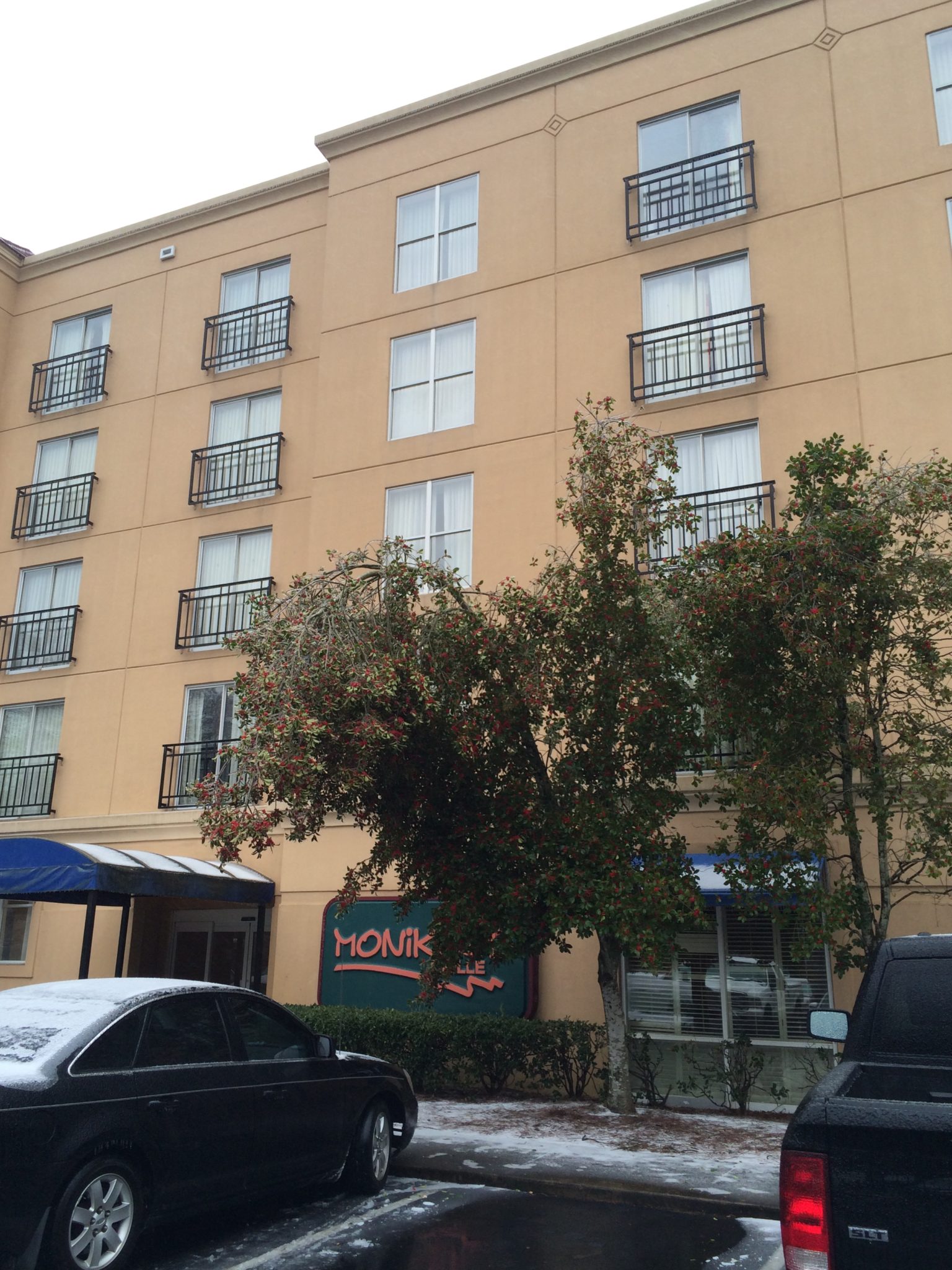
Limbs bending from ice loading.
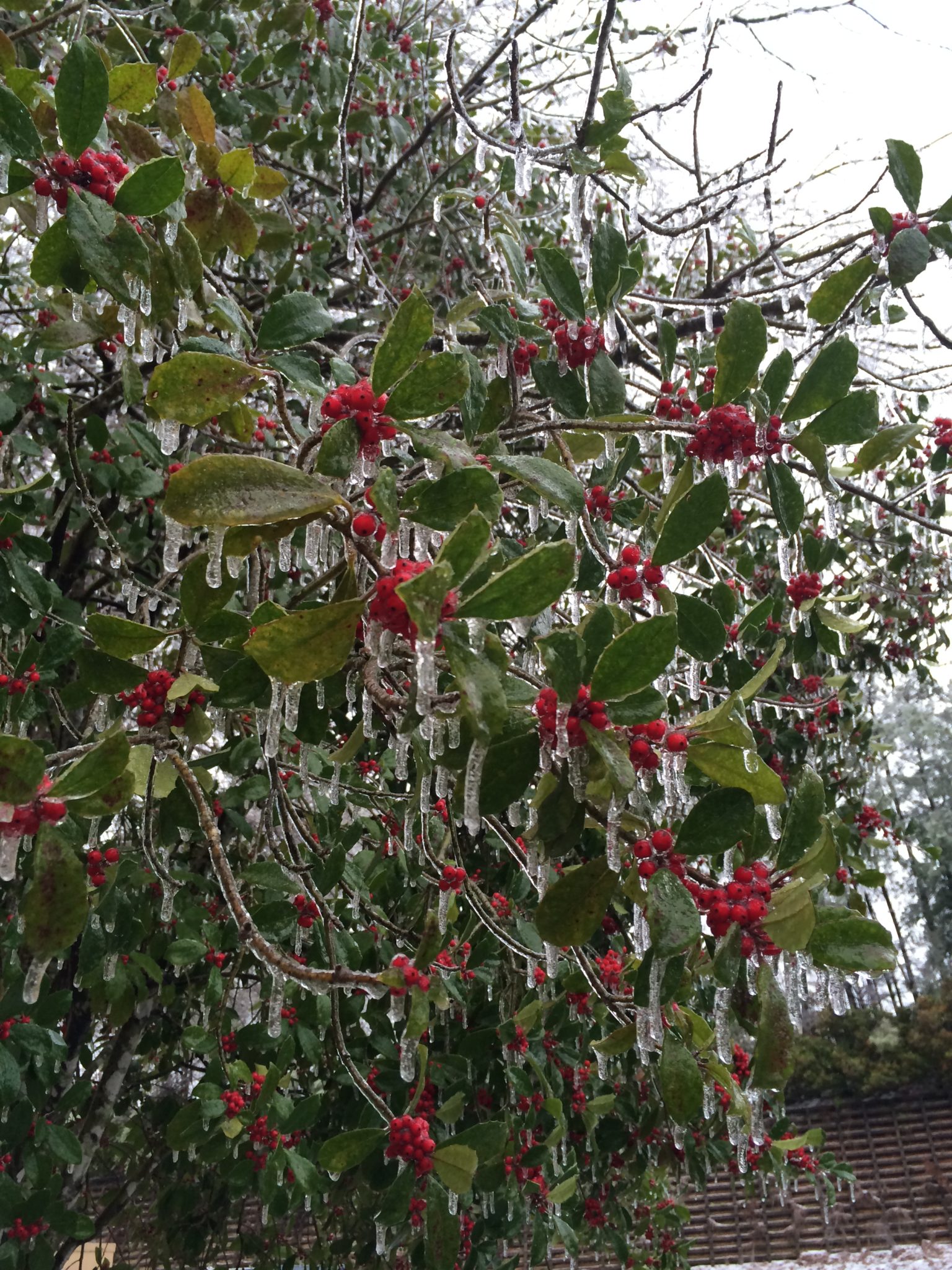
Ice accretion on hawthorn branches.
Do not shake limbs to try to remove snow or ice.
When you find your trees are bending or drooping as a result of ice or snow accumulation, your first instinct is probably to shake the branches or knock the weight off with a broom or something similar. This may cause worse damage or actually cause the branch to snap off. Stop right there! Healthy tree branches are flexible, so knocking off the accumulation of snow or ice accretion may cause them to “snap” back, potentially damaging their food and water transport system. The results of the damage may not be evident until next spring.
Trees that tend to suffer the worst damage as a result of snow and ice are upright evergreens, like arborvitae and juniper, and clump trees, like birch. And, when it comes to ice, age does not make a tree stronger; younger trees are better at actually overcoming damage in ice storms.
Hire a Professional.
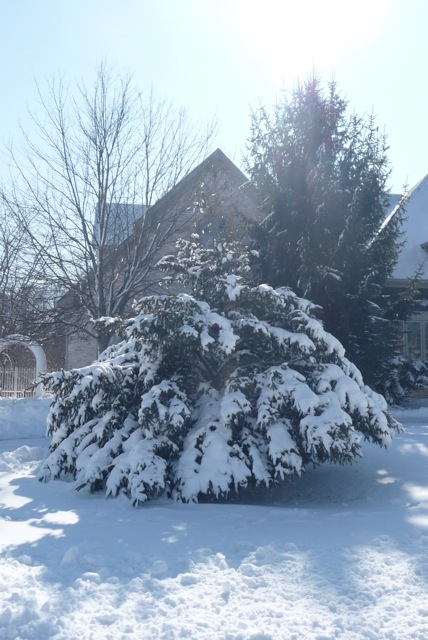
Snow weighing down spruce branches.
Safely remove broken limbs.
Broken and hanging branches can be a threat to people and property. If a limb breaks off from the weight of ice or snow and remains in the tree canopy, have it removed and the remaining stub properly pruned to the branch collar as soon as weather allows. The tree will recover better when properly pruned. For undamaged limbs bending under the weight of ice or snow, don’t prune as a means of correcting the situation. Be patient. It takes time for wood fibers in the limbs to return to its natural position.
Always be mindful of walking or parking under branches loaded down by snow or ice as they may snap and fall, causing injury or damage. If a limb breaks and becomes entangled in power lines, notify your utility company immediately. Never approach a downed power line or a branch touching a utility line.
If there is substantial damage to your tree, have an arborist examine damaged branches and limbs for signs of weakness and injury for reparations. It is best to always hire an ISA Certified Arborist. To find an arborist in your area, visit the website, www.treesaregood.org
How can you help prevent ice damage to trees? Proper pruning is one way. Particularly important is the removal of poor branch attachments and weak branch structure in the tree, prior to winter. For more information on pruning, download the publication, Tree Pruning Essentials.
Full article published in the Purdue Landscape Report.
Resources
Avoid Deadly Risk of Dying Ash Trees with Timely Tree Removal, Got Nature? Purdue Extension-FNR
New Hope for Fighting Ash Borer, Got Nature? Purdue Extension-FNR
Invasive Pest Species: Tools for Staging and Managing EAB in the Urban Forest, Got Nature?
Emerald Ash Borer, Purdue Extension-Entomology
Emerald Ash Borer Tools & Resources – Purdue Extension Entomology
Corrective Pruning for Deciduous Trees, The Education Store, Extension Publications
Lindsey Purcell, Chapter Executive Director
Indiana Arborist Association
 This unit highlights the resources required to produce food and the food wasted along each step of the food production system. It contains two lessons: Producers, Consumers, and Natural Resources; and Food Waste from Farm to Fork, along with all necessary overviews, notes, and resources.
For more details and free downloadable PDF see FNR-558-W publication at The Education Store: Food Waste and Natural Resources Lesson Plans.
Resources
What a Waste of Food!, lesson plans, The Education Store, Purdue Extension’s resource center
Food Waste Lesson Plans, Nature of Teaching
Rebecca Busse, Nature of Teaching Program Coordinator
Purdue Department of Forestry and Natural Resources
Rod N Williams, Engagement Faculty Fellow & Associate Professor of Wildlife Science
Purdue University Department of Forestry and Natural Resources
This summer the Nature of Teaching team partnered with the Maine Department of Inland Fisheries and Wildlife (IFW) to host teacher workshops at the Maine IFW headquarters in Gray and the Fields Audubon Center in Holden, ME. The team worked together to organize and facilitate these two two-day workshops to bring Nature of Teaching educational resources to 47 K-12 public and private school educators, administrators, and environmental center staff.
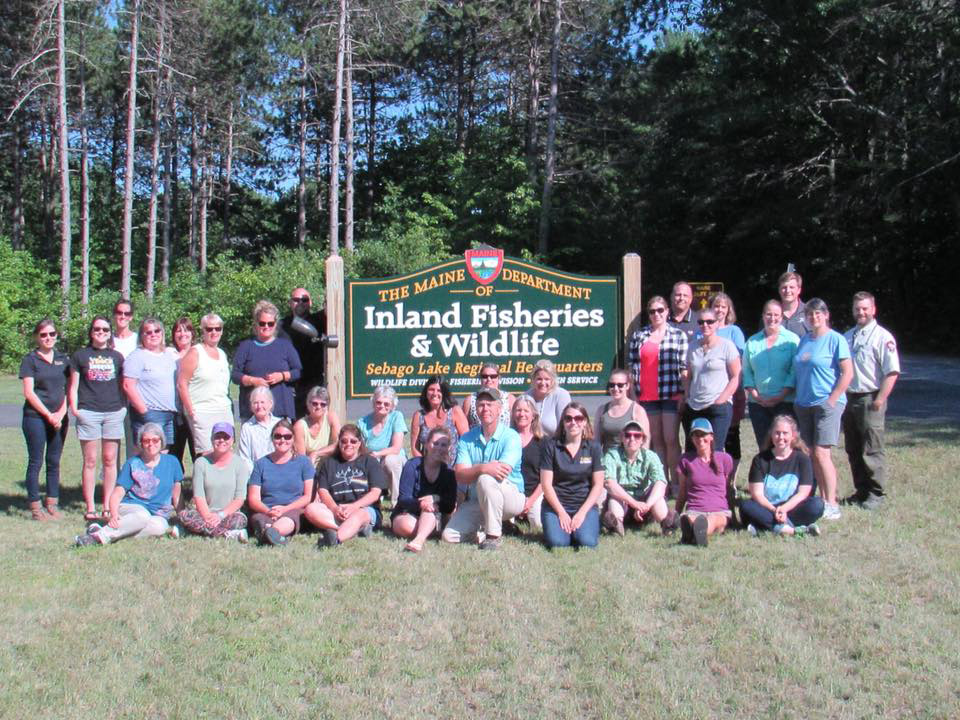
During these workshops, funded by an FNR small grant and an IBAT grant, the Purdue/Maine team, as well as guest speakers from Project Wild, took turns presenting information on wildlife, health and wellness, and food waste. After each presentation, teachers walked through corresponding lesson activities that they could use with their students. Then they were given the opportunity to collaborate with other educators in their grade levels. Workshop participants walked away with a binder of resources and were given the opportunity to pursue stipends by completing a post-workshop survey and submitting student pre/post assessment data.
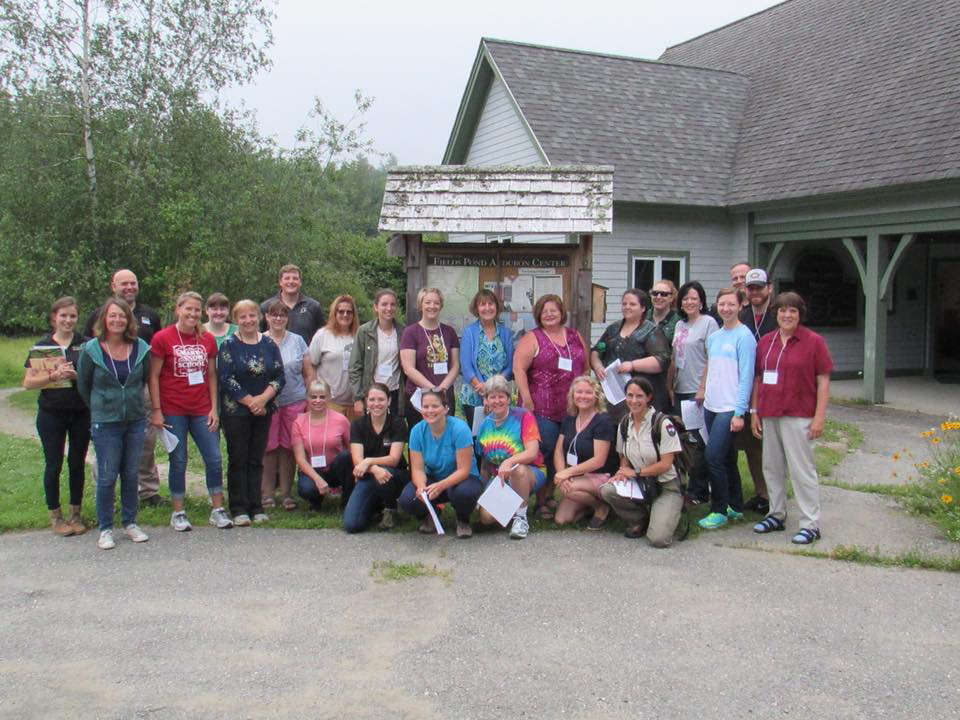
The Purdue/Maine partnership has been beneficial in bringing the Nature of Teaching resources to Maine educators while incorporating local knowledge and expertise and increasing awareness of resources provided by the Maine IFW. The team is currently developing a Mammals of Maine publication to accompany the Mammals of Indiana publication on the Nature of Teaching website, and planning for at least one workshop in Maine next year.
To learn more about the Nature of Teaching, visit our website at www.purdue.edu/nature, connect with us on Facebook at https://www.facebook.com/NatureofTeaching/, or contact Rebecca Busse at busser@purdue.edu.
Resources:
Nature of Teaching Lesson Plan: Conservation Biology, Got Nature? Blog
The Nature of Teaching – Purdue Extension
Rebecca Busse, Nature of Teaching Program Coordinator
Purdue Forestry and Natural Resources
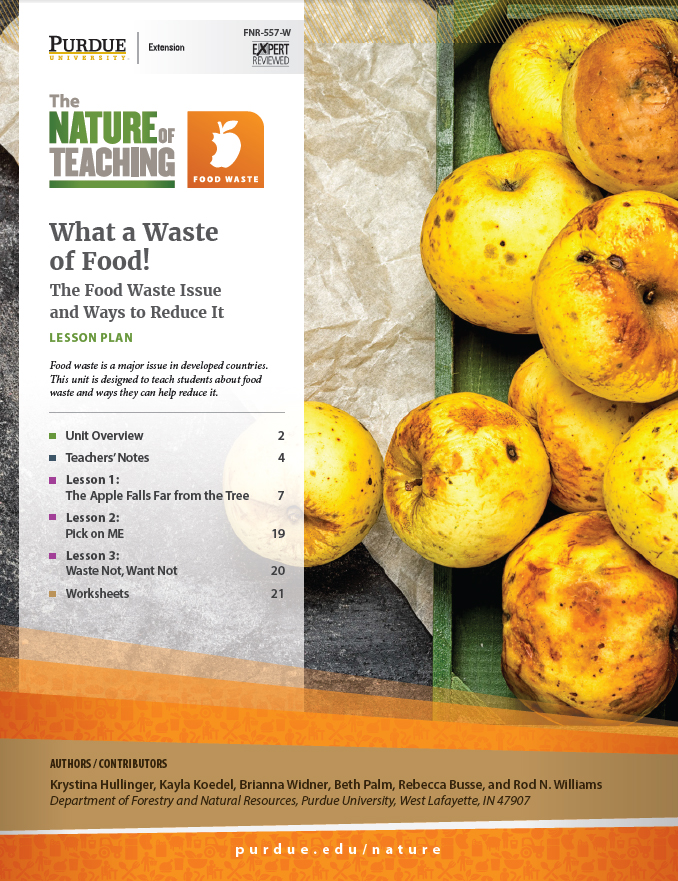 Food waste is a major issue in developed countries. This unit is designed to teach students about food waste and ways they can help reduce it. This section contains one unit with three lesson plans that will teach students how to reduce food waste by learning more about proper food storage, best-by dates, and ugly foods. It also contains a stand-alone lesson on food packaging and composting.
To view this free complete unit see: What a Waste of Food! Lesson Plans and PowerPoint, The Education Store, Purdue Extension.
Resources:
Food Preservation Methods, Purdue Extension
Washing Fresh Vegetables to Enhance Food Safety, Purdue Extension
Food Waste Lesson Plans, Nature of Teaching
Rebecca L Busse, Graduate Research Assistant
Purdue University Department of Forestry and Natural Resources
Rod N Williams, Engagement Faculty Fellow & Associate Professor of Wildlife Science
Purdue University Department of Forestry and Natural Resources
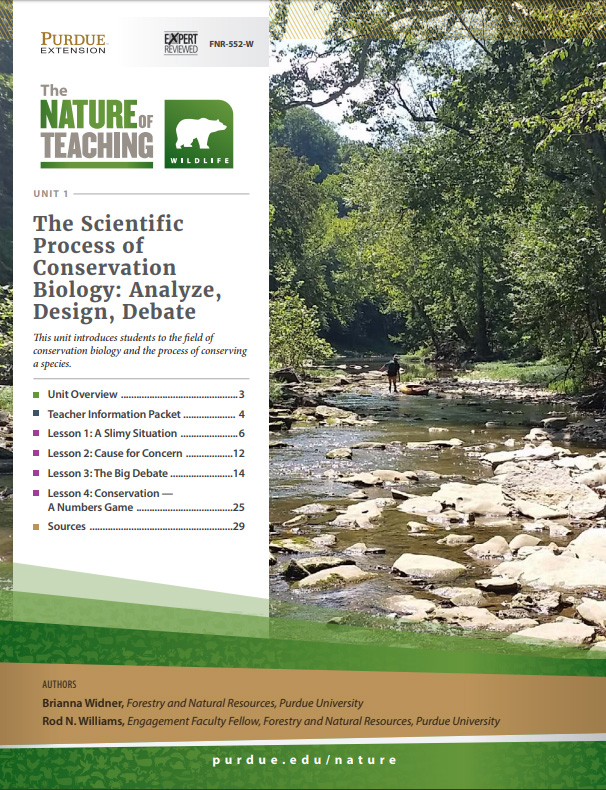 Conservation biology is considered by some to be a “crisis discipline.” Decisions within the field must often be made quickly, sometimes without enough time to gather all of the data one would ideally have, and they can decide the fate of a species. This Nature of Teaching unit titled “the Scientific Process of Conservation Biology: Analyze, Design, Debate,” introduces students to the field of conservation biology and the process of conserving a species. It includes 4 lessons and 4 case studies as well as a teacher information section and list of sources. Students will learn how to: analyze literature, graphs, and figures to discern factors threatening a species; identify different careers involved in conservation biology; learn how to edit, revise an original management plan to better comprehend the iterative process of science; and much more.
To view this free complete unit see: The Scientific Process of Conservation Biology: Analyze, Design, Debate, The Education Store, Purdue Extension.
Resources:
Health & Wellness Lesson Plans, Nature of Teaching
Wildlife Lesson Plans, Nature of Teaching
Food Waste Lesson Plans, Nature of Teaching
Briana Widner, student
Purdue University Department of Forestry and Natural Resources
Rod N Williams, Engagement Faculty Fellow & Associate Professor of Wildlife Science
Purdue University Department of Forestry and Natural Resources
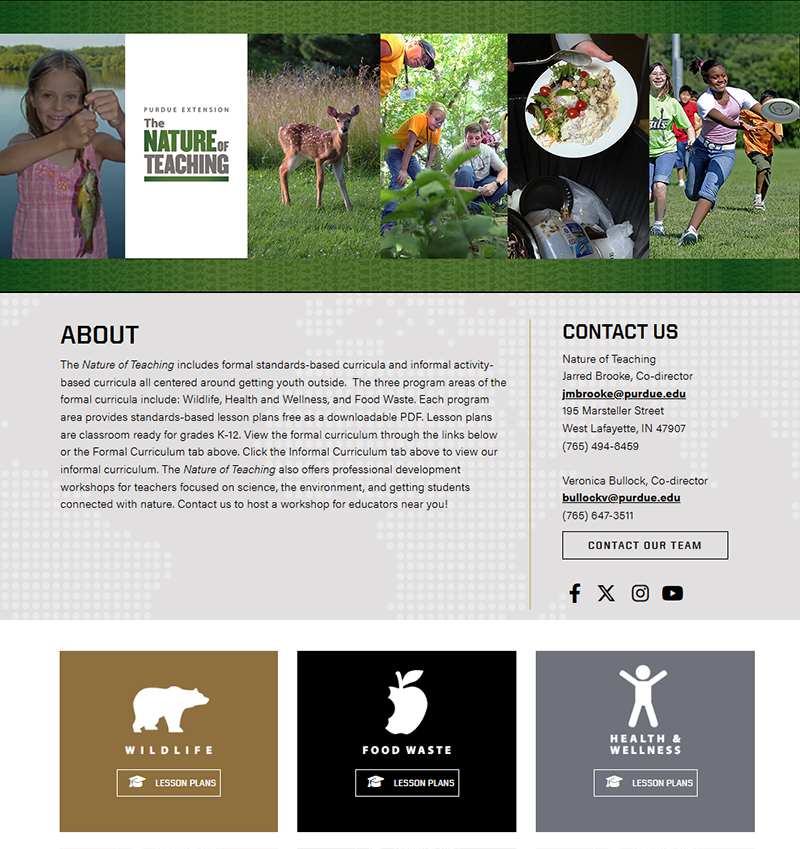 As teachers prepare their lessons for the fall, The Nature of Teaching is a great website to visit for science-based resources. Teachers can find free lesson plans, printable, posters, a photo library, information on upcoming workshops and more. You will find on the website tabs titled “Formal Curriculum” and “Informal Curriculum.” The Nature of Teaching also offers professional development workshops for teachers focused on science, the environment, and getting students connected with nature.
These organized lesson plans meet several K-5 Science and Math Academic Standards along with three 9-12 Natural Resource Management Academic Standards.
Wildlife curriculum include:
- Animal Diversity and Tracking
- Discovering the Watershed: Effects on Water Quality
- Common Indiana Mammals: Natural History and Identification
- Invasive Plants: Impact on Environment and People
- Hellbenders Rock! Natural History and Conservation of the Eastern Hellbender
Food Waste curriculum include:
- Food Waste and Natural Resources
- What a Waste of Food!
- Food Waste and The Environment
- Food Waste Solutions
- Transporting Food Waste
Health & Wellness curriculum include:
- Unit 1 Benefits of Connecting with Nature
- Unit 2 Gardening Station
- Unit 3 Tree Talk Station
Other resources:
- Help the Hellbender, Purdue Extension
- Indiana Department of Natural Resources (INDNR): For Kids
- 4-H, Purdue Extension
- National FFA Organization
- Indiana FFA
- Flying Wild, Association of Fish & Wildlife Agencies
- Project Learning Tree, Indiana Department of Natural Resources
- Project Wet
- Project Wild
- Indiana Wildlife Habitat Evaluation Program (WHEP)
Contact The Nature of Teaching team if you have any questions regarding workshops, certifications and curriculum.
The Nature of Teaching, Purdue Extension

Recent Posts
- Purdue Alumnus Magazine Highlights FNR Graduate and Nature of Teaching Program
Posted: September 13, 2024 in Got Nature for Kids, Nature of Teaching, Wildlife - Nature of Teaching, Connecting Youth With Nature for Health and Education – ANR
Posted: February 6, 2024 in Forestry, How To, Land Use, Nature of Teaching, Plants, Wildlife, Woodlands - Asian jumping worms: Where to get started – Landscape Report
Posted: April 27, 2023 in Invasive Insects, Nature of Teaching, Wildlife, Woodlands - Publication-Preparing Indiana’s Urban Forest for Climate Change
Posted: February 7, 2023 in Forestry, Forests and Street Trees, How To, Nature of Teaching, Plants, Publication, Urban Forestry, Woodlands - New Curriculum Available: How Humans Impact Gene Flow and Genetic Diversity
Posted: June 2, 2021 in Nature of Teaching, Publication - Jarred Brooke Receives PK-12 Council Staff Excellence Award
Posted: April 15, 2021 in Aquaculture/Fish, Aquatic/Aquaculture Resources, Forestry, Natural Resource Planning, Nature of Teaching - Nature of Teaching Virtual Workshops With Certifications
Posted: March 23, 2021 in How To, Nature of Teaching, Wildlife - Publication: Transporting Food Waste
Posted: January 5, 2021 in How To, Nature of Teaching, Publication - Introduction to Nature of Teaching Sneak Peek Videos
Posted: November 2, 2020 in Aquaculture/Fish, Aquatic/Aquaculture Resources, Gardening, Got Nature for Kids, How To, Land Use, Nature of Teaching, Plants, Ponds, Urban Forestry, Wildlife, Woodlands - Nature of Teaching Program Receives Environmental Education Award
Posted: October 30, 2020 in Aquaculture/Fish, Aquatic/Aquaculture Resources, Disease, Drought, Forestry, Forests and Street Trees, Gardening, Got Nature for Kids, How To, Invasive Animal Species, Invasive Insects, Land Use, Natural Resource Planning, Nature of Teaching, Plants, Ponds, Safety, Wildlife
Archives
Categories
- Alert
- Aquaculture/Fish
- Aquatic/Aquaculture Resources
- Ask the Expert
- Christmas Trees
- Community Development
- Disease
- Drought
- Forestry
- Forests and Street Trees
- Gardening
- Got Nature for Kids
- Great Lakes
- How To
- Invasive Animal Species
- Invasive Insects
- Invasive Plant Species
- Land Use
- Natural Resource Planning
- Nature of Teaching
- Plants
- Podcasts
- Ponds
- Publication
- Safety
- Spiders
- Timber Marketing
- Uncategorized
- Urban Forestry
- Webinar
- Wildlife
- Wood Products/Manufacturing
- Woodland Management Moment
- Woodlands