 Purdue University - Extension - Forestry and Natural Resources
Got Nature? Blog
When you rush to the closet to grab your favorite shorts and T-shirt, remember that you are not the only creature looking forward to the warmer weather. It is important to check yourself or have a buddy check you for passengers when you get back from the field to lessen the likelihood of bringing ticks home with you.
Indiana has 15 tick species, but the three listed below are the most prevalent.
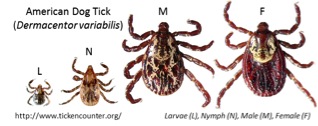
American Dog Tick (Dermacentor variabilis): Found primarily along trails, walkways or in fields, American Dog ticks are rarely found in forests. Despite their name, these ticks feed on a multitude of hosts in addition to the family pet and can transmit Rocky Mountain Spotted Fever, a potentially fatal disease contracted by 32 people in Indiana last year. The American Dog Tick also carries Tularemia, a rare but dangerous disease that is often misdiagnosed for the flu.
American Dog ticks can survive for two years at any stage in life until a suitable host is found. Male ticks mate with the female while she is feeding as after she is sated, she drops off of the host and lays 4,000+ eggs before dying. Larval ticks only feed for three to four days from a host before molting into nymphs. The nymph feeds on a variety of small/medium-sized hosts before dropping to the leaf litter and molting into adults. Interestingly, these ticks are least likely to bite humans.
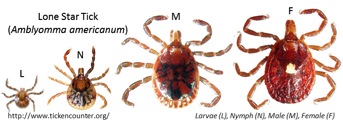 Lone Star Tick (Amblyomma americanum): Found primarily in dense underbrush and forested areas. As with the American Dog Tick, these ticks are capable of transmitting Rocky Mountain Spotted Fever in addition to Monocytic Ehrlichiosis, another tickborne disease that presents with symptoms similar to the flu but was confirmed in 49 Indiana cases in 2013. ‘Stari’ (Southern Tick-Associated Rash Illness) Borreliosis is a tick-vectored disease that presents with a large round or elliptical rash and flu symptoms transmitted by the Lone Star Tick.
Voracious eaters, adult Lone Star ticks often take human hosts or other large mammals. After a week, the female is capable of laying 3,000+ eggs. The larval Lone Star ticks only feed for four days before detaching, burying themselves in leaf litter and molting into nymphs. Able to quickly ascend up pant legs, these nymphs can be firmly attached to a host in < 10 minutes. After five days, the nymphs detach and molt into adults.
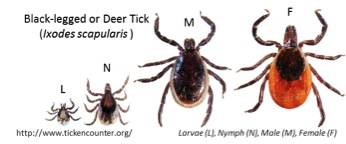
Black-legged or Deer Tick (Ixodes scapularis): Found primarily in deciduous forests, these ticks predominantly use white-tailed deer or other large mammals as hosts. Unlike the relatively accelerated life cycles of the American Dog and Lone Star ticks, the Deer Tick life cycle takes nearly two years to complete.
Deer ticks are most notorious for spreading Lyme disease, a dangerous disease that causes flu-like symptoms that, if left untreated, can spread to joints and compromise the nervous system. More than 100 cases of Lyme disease were confirmed in Indiana in 2013. Babesiosis is caused by microscopic parasites that infect red blood cells, and Anaplasmosis is caused by the bacterium Anaplasma phagocytophilum. Both of these diseases are transmitted through the bite of an infected Deer Tick.
Only the female Deer Tick feeds, and once completely engorged, they lay an egg mass of 1,900+ eggs before dying in late-May. Deer Tick larvae and nymphs remain in the moist leaf litter within forested areas and prefer smaller hosts. After feeding for three days in each developmental stage, they burrow into the litter to molt. Larvae emerge as nymphs in spring, and nymphs emerge as adults in fall.
 The table here illustrates the months of activity for the larval, nymph, male and female tick life cycle stages which gives you a quick reference for Indiana. This information was gathered from the resources listed in this post.
Indiana ticks can carry several diseases, but the three most common are Rocky Mountain Spotted Fever, Lyme Disease and Ehrlichiosis. Symptoms of all three diseases range from spreading rashes, headaches, fatigue, fevers and muscle aches. Likelihood of infection is rare; however, instances of each disease are increasing in Indiana.
Be careful and try not to pick up eight-legged hitchhikers. If you suspect that you have been bitten by a tick or develop a rash along with flu symptoms, contact your local health department for a disease screening.
Resources
Ticks, Indiana Department of Natural Resources
Ticks, Medical Entomology, Purdue University
Rocky Mountain Spotted Fever, Centers for Disease Control and Prevention
Tularemia, Centers for Disease Control and Prevention
Lyme Disease, Centers for Disease Control and Prevention
Ehrlichiosis, Centers for Disease Control and Prevention
Parasites – Babesiosis, Centers for Disease Control and Prevention
Anaplasmosis, Centers for Disease Control and Prevention
‘Stari’ Borreliosis, Columbia University Medical Center
tickencounter.org, Tick Encounter Resource Center, University of Rhode Island
Shaneka Lawson, Adjunct Assistant Professor
Department of Forestry and Natural Resources
 A 20+ extension team led by Kara Salazar, sustainable communities extension specialist, and Michael Wilcox, assistant program leader for extension community development, have produced a new publication and curriculum titled “Enhancing the Value of Public Spaces.” This must-have spiral bound notebook and curriculum zip file download is a great resource for decision makers and local leaders developing community public spaces including park boards, planning commission members, members of organizations, public officials and staff whose missions are related to providing services, programs or management of public spaces. This program serves as a “how-to” guide for creating high-quality action plans to achieve great public spaces.
A one day workshop starts the process with collaborative activities to identify best practices for improving public spaces with emphasis on forming partnerships to achieve desired community goals. Follow-on working group meetings provide the resources and technical support needed to plan and implement projects tailored to individual communities. The completed high quality public spaces action plan can be used as part of comprehensive planning efforts, parks and recreation master plans and fundraising initiatives.
Resources
Enhancing the Value of Public Spaces, The Education Store
Kara Salazar, Sustainable Communities Extension Specialist
Department of Forestry and Natural Resources
Illinois-Indiana Sea Grant
Michael Wilcox
Assistant Program Leader, Extension Community Development Program
Senior Associate, Purdue Center for Regional Development
 Tree disease and insect outbreaks are a lot like fires and floods – they make the news headlines and can lead to some anxiety on the part of landowners. They may also bring out those who use the crisis to make some fast money by taking advantage of that anxiety. I was recently contacted by a landowner who had been advised by a person wanting to buy some timber from him that he should sell some walnut trees “before they are all killed by Thousand Cankers Disease.” There certainly are times when we should consider harvesting trees before they are destroyed by a pest as part of a timber management program (Emerald Ash Borer, for instance), but the evidence we have related to Thousand Cankers Disease (TCD) would suggest that selling your trees immediately to avoid mortality and loss is not necessary. Thousand Cankers Disease has two components: a small twig beetle that carries a canker-forming fungus into the inner bark of walnuts. Black walnut trees in several states have been killed by this disease complex, but so far, although the fungus was found on some weevils in Brown County and the beetle was recently detected at a sawmill in Franklin County, no walnut trees in Indiana have been confirmed as killed by TCD. For additional information on TCD, you can visit the following websites: Thousand Cankers Disease and Indiana Department of Natural Resources (IDNR) TCD.
There is currently no strong evidence suggesting a need to rush to harvest walnut for fear of a massive die-off caused by TCD. In fact, some trees infected with TCD in Tennessee have shown some recovery from disease symptoms that has coincided with improved growing conditions at those sites. This would suggest doing management that keeps walnut healthy and vigorous like thinning, vine control and elimination of invasive plant species may help your trees resist damage from TCD and other diseases or environmental extremes. This story also demonstrates the importance of getting professional, science-based advice with your forest management decisions. Consult a professional forester when making decisions about the sale of trees. You can find foresters in your area at Indiana Forestry & Woodland Owners Association’s (IFWOA) Directory of Professional Foresters. You can learn more about considerations when selling timber at Call Before You Cut and the extension publications Tips on How to Get the Most From Your Timber Harvest and Marketing Timber.
Landowners, timber buyers and foresters form an important team to manage and utilize the amazing renewable resource that is our hardwood forest in Indiana. There are many reputable firms across the state that purchase timber, providing a great marketplace and economic value to landowners. Your professional forester can help you choose the right buyers, loggers and market outlets to provide a fair price for the products and good work in the woods. Get their help and do your homework before making that decision.
Resources
Indiana Department of Natural Resources (IDNR) TCD
Directory of Professional Foresters, Indiana Forestry & Woodland Owners Association (IFWOA)
Call Before You Cut
Tips on How to Get the Most From Your Timber Harvest, The Education Store, Purdue Agriculture Resource Center
Marketing Timber, The Education Store, Purdue Agriculture Resource Center
Lenny Farlee, Hardwood Ecosystem Extension Specialist
Department of Forestry & Natural Resources, Purdue University
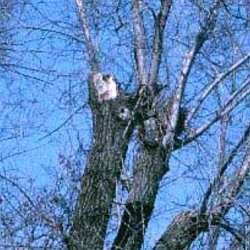 If a bad haircut was fatal, you would be very choosy about your hairstyle. But each year, hundreds of homeowners have their trees pruned by topping, a horticultural “bad haircut” that shortens the life of the tree and leads to greater expense later.Tree care professionals and university experts caution tree owners that topping a tree is the kiss of death in many instances. This damaging pruning practice can shorten the life span of trees significantly, and the damage is long-term; in some instances, the beheaded tree will die within a few years, if not less.
Many people don’t realize topping is a poor practice because trees can be remarkably effective in overcoming the damage in the short term – some can take years to die, a few can even withstand multiple toppings. So the real damage is not easily noticed by the tree owners until the trees can no longer survive such a drastic removal of canopy.
People see trees leaf out year after year and give little thought to the actual effect of the topping. The most immediate effect is a reduced leaf mass, or crown. This smaller number of leaves reduces the amount of energy the tree manufactures to sustain itself. Less energy causes the roots to die back as well. This creates a tree that is less able to supports itself or withstand heavy winds.
The haircut analogy breaks down when you look at what happens after the tree topping occurs. Whereas hair just continues to grow out from the same follicle, branches do not continue to grow out from the same growing point. Tree limbs sprout from previously dormant buds just below the internodal pruning cut. This causes an unhealthy flush of growth near the end of the poorly pruned branch that is typically thin and weakly attached to the tree’s main growth stems.
These weak limbs are easily ripped from the tree in storms, causing damage and creating a liability for property owners. It has been long known that tree topping is harmful to trees, yet the practice of tree topping continues. Reputable arborists will work with a tree’s natural growth habit when pruning and understand the importance of pruning and tree health. Proper pruning can extend the life of a tree and reduce ongoing homeowner expense; however, once a tree is topped, it will require much more frequent pruning to prevent branch failure, costing the owner more money.
The best advice is to hire reputable tree care companies that have recognized qualifications and insurance. Ask the company for credentials from professional organizations such as the International Society of Arboriculture and the Tree Care Industry Association to prove their knowledge and abilities. Also ask for references of where they have pruned trees at other properties to see what their work looks like after the project. A homeowner wouldn’t hire a plumber or carpenter without references, so why shouldn’t an important asset to your property like trees not receive the same consideration?
Trees are a valuable resource and asset to your property that helps make our environment cleaner, healthier and a more beautiful place to live. Those trees deserve better than a life-shortening bad haircut.
Resources
What’s Wrong with Topping Trees? The Education Store
Trees and Storms, The Education Store
First Aid for Trees, Indiana Department of Forestry and Natural Resources
Prune Your Trees, Indiana Department of Forestry and Natural Resources
Lindsey Purcell, Urban Forestry Specialist
Department of Forestry and Natural Resources, Purdue University
 The Indiana Department of Natural Resources (INDNR) has just released a new and updated application for iPhone and Android users. A successor to the previous app released in March 2011, this iteration introduces new features, and DNR Director Cameron Clark calls it a “portable field guide.” The free app contains helpful information about any DNR related properties like forests, wildlife areas and state parks and serves as a helpful companion while planning outdoor activities. To download this app, visit iTunes for iPhone users or Google Play Store for Android users.
Resources
Indiana DNR Smartphone Apps, Indiana Department of Natural Resources
DNR Releases New, Improved Mobile Apps, WANE15
Publications and Maps, Indiana Department of Natural Resources
Indiana Department of Natural Resources
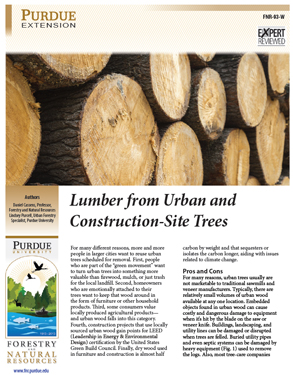 For many different reasons, more and more people in larger cities want to reuse urban trees scheduled for removal. People who are part of the “green movement” want to turn urban trees into something more valuable than firewood, mulch or just trash for the local landfill. This publication describes the pros and cons of using urban trees for lumber, the types of lumber that are economical to produce from urban trees and how you might find a sawyer who can turn your tree into usable lumber.
Resources
Mechanical Damage to Trees: Mowing and Maintenance Equipment, The Education Store
The Education Store, Purdue Extension Resource Center (Find apps, publications, videos and much more)
Lindsey Purcell, Urban Forestry Specialist
Department of Forestry and Natural Resources, Purdue University
Daniel Cassens, Professor of Wood Products
Department of Forestry and Natural Resources, Purdue University
 The Community & Urban Forestry’s Tree Steward Program is designed for homeowners, tree board members, municipal employees, community members, volunteers, students, Master Gardeners and anyone that has an interest in learning more about trees and giving back to their community forest.
Trainers include City Foresters, Certified Arborists, Foresters, Purdue Extension Agents, District Conservationists and other natural resource professionals.
Participants gain knowledge on a variety of community forestry and tree care-related topics, ideas on how to share their knowledge in their communities and an introduction to local and state tree care professionals.
Topics include:
- The Scoop on Soils
- How Does a Tree Grow? (Tree Physiology)
- Tree Identification
- The Right Tree for the Right Place (Tree selection and placement)
- Proper Tree Planting
- Caring for Your Trees
- Threats to Trees: Pests and Disease Diagnosis
- Pruning Do’s & Don’ts
- Identifying Tree Defects
- Benefits of the Urban Forest
- Why Urban Woodlots are Important
- Volunteer Opportunities
For more information, take a look at the Tree Stewards Handout or the Tree Stewards Brochure.
When: Thursday, May 28 and Friday, May 29, 2015, 8:30 am – 4:30 pm
Where: Hayes Arboretum, Nature Center, 801 Elks Rd., Richmond, IN 47374
Cost: $30, includes lunch and refreshments
Registration: Deadline to register is May 21, 2015. Register online using the Indiana DNR events registration form.
Resources
Plant For The Sun – Choose, Plant Trees Wisely for Energy Efficiency, Got Nature?
Indiana’s Urban Woodlots, The Education Store
Indiana Community Tree Selection Guide, Indiana Department of Natural Resources
Indiana Department of Natural Resources
Lindsey Purcell, Urban Forestry Specialist
Department of Forestry and Natural Resources, Purdue University
The Useful to Usable climate initiative based at Purdue University has added an online tool enabling farmers and agricultural advisers to better assess how climate patterns in other parts of the world can influence local conditions and corn yields across the Corn Belt.The Climate Patterns Viewer can help growers make more informed farm management decisions during different phases of the El Niño Southern Oscillation and Arctic Oscillation. It relates historical events of those phases to the effects of associated precipitation and temperatures over the course of a year.
“By tapping into this historical data, growers and advisers can get a sense of what conditions might be coming during a particular ENSO or AO phase based on past experience,” said Melissa Widhalm, project manager of Useful to Usable, or U2U. “The Climate Patterns Viewer is an invaluable planning tool, whether you’re deciding what and when to plant or how to deal with a cooler and shorter growing season.”
Hans Schmitz, Purdue Extension educator and agricultural meteorologist, noted that certain areas of the Corn Belt can be quite a bit drier, wetter, warmer or cooler than average because of the ENSO and AO oscillations.
“The ability to look at the historical effect month-by-month better influences management decisions this growing season,” he said.
More information about this and other U2U tools is available on the U2U website.
Resources
National Institute of Food and Agriculture, (NIFA)
Indiana Small Farm Conference, Purdue Department of Agriculture
Climate Change and Greenhouse Gas Mitigation: Challenges and Opportunities for Agriculture, The Education Store
Melissa Widhalm, Useful to Usable Project Manager
Department of Forestry and Natural Resources
Trees offer many functional and aesthetic benefits, but one of the most common is shade. Because of this, one of the most important aspects of tree selection and planting is placement. Improper placement of trees can diminish the value of the tree on the site. The tree can actually become a liability if it conflicts with infrastructure or just does not providing any useful shade at all. For shade where it’s needed most that also allows passive solar gain in the winter months, you must use an energy efficient design.

Figure 1 (Diagram by Greg Pierceall)
In this hemisphere, the sun is in the south, and the source of cold weather is in the north. Whenever possible, place openings for sunlight and radiant heat primarily on the southern exposure, then on the west and east. For energy efficiency in winter, use the low arc of the sun to capture the maximum amount of warmth through east-, west- and south-facing windows. Windows with a northern exposure are a source of cool air from prevailing winds during the hot months, so give the north minimum exposure and maximum natural protection in the winter.
When selecting trees for energy efficiency, don’t plant evergreen trees near the house on southern exposures. Trees may provide some shade and screening but will also block out the warming effects of the sun during winter months. When choosing trees for shade and solar gain, choose larger, deciduous-canopy trees that provide an advantage year round. Select good quality trees that are suitable for your location from a reputable source. See the publication FNR-433-W on the Education Store website for more information on tree selection and planting.
Correct placement is critical for an energy-efficient design and low maintenance as the tree grows and matures. Be certain that the mature height and spread fit the location before placing the tree. This allows the tree freedom to spread into the design space naturally without excessive pruning to prevent conflicts with the house. However, the tree still must be close enough to the house for the canopy to provide shade. A good rule of thumb is to plant the tree at least 20 feet from the house. For larger shade trees, you may need to plant as far as 40 feet from the house to insure room for growth (see Figure 1).
Trees help make homes energy-efficient by creating a cooling effect during the hot summer months or by allowing the passive solar gain during cold winter months. However, proper selection and placement is critical to make this work.
Resources
Tree Installation: Process and Practices, The Education Store
Tree Planting Instructions, Indiana Department of Natural Resources
Planting & Transplanting Landscape Trees and Shrubs, Department of Horticulture, Purdue University
Lindsey Purcell, Urban Forestry Specialist
Department of Forestry and Natural Resources, Purdue University
 The Purdue Center for Global Soundscapes has been recognized by PBS. NOVA, a PBS documentary series focused on science, interviewed Bryan Pijanowski, Professor of Human-Environment Modeling and Analysis Laboratory, and Matt Harris, Graduate Research Assistant, to learn more on the subject and to share this story on the NOVA website in video format. Soundscape ecology is the study of how the environment changes by studying the sounds within that environment.
Anyone can be a citizen scientist and download their “sounds of earth” to the soundscape ecology database. There is no cost, and it is easy to do. Just visit the website, Record the Earth, for instructions.
Resources
Soundscape Ecology Research Projects, Forestry and Natural Resources
Purdue Boiler Bytes Highlights Discovery Park Global Soundscape Research Center Led by FNR’s Dr. Bryan Pijanowski, Got Nature?
Bryan Pijanowski, Professor of Human-Environment Modeling and Analysis Laboratory
Department of Forestry and Natural Resources

Recent Posts
- Purdue Extension: Empowering Indiana Through Innovation, Education and Community Impact
Posted: January 28, 2026 in Community Development, How To, Invasive Insects, Invasive Plant Species, Natural Resource Planning, Woodlands - Forest Landowners: Share Your Experience with Regeneration and Restoration
Posted: January 27, 2026 in Forestry, How To, Timber Marketing, Woodlands - It’s Not Too Late to Order Trees for Spring Planting
Posted: January 13, 2026 in Forestry, How To, Plants - Now Is The Time To Control Non-Native Bush Honeysuckle
Posted: October 30, 2025 in Forestry, How To, Invasive Plant Species, Woodlands - October Is Firewood Month: Protect Indiana’s Forests by Making Smart Choices
Posted: October 13, 2025 in Forestry, Forests and Street Trees, How To, Invasive Insects, Urban Forestry - ID That Tree: Smooth Sumac
Posted: October 2, 2025 in Forestry, How To, Wildlife - ID That Tree: Wild Grape Vine
Posted: August 12, 2025 in Forestry, How To, Urban Forestry, Wildlife - Publication – Sericea Lespedeza Control
Posted: July 7, 2025 in Forestry, How To, Invasive Plant Species, Wildlife - How to ID Asian Jumping Worms, Purdue Landscape Report
Posted: July 2, 2025 in How To, Invasive Insects, Wildlife - Alert – Water Your Trees, Watch Video
Posted: June 20, 2025 in Alert, Drought, Forests and Street Trees, How To, Urban Forestry, Wildlife, Woodlands
Archives
Categories
- Alert
- Aquaculture/Fish
- Aquatic/Aquaculture Resources
- Ask the Expert
- Christmas Trees
- Community Development
- Disease
- Drought
- Forestry
- Forests and Street Trees
- Gardening
- Got Nature for Kids
- Great Lakes
- How To
- Invasive Animal Species
- Invasive Insects
- Invasive Plant Species
- Land Use
- Natural Resource Planning
- Nature of Teaching
- Plants
- Podcasts
- Ponds
- Publication
- Safety
- Spiders
- Timber Marketing
- Uncategorized
- Urban Forestry
- Webinar
- Wildlife
- Wood Products/Manufacturing
- Woodland Management Moment
- Woodlands