 Purdue University - Extension - Forestry and Natural Resources
Got Nature? Blog
 Fish stocking in a pond is like a retirement plan—you need to have a vision of your ultimate goal. You want to start off in the right direction or your long-term investment may not pay the dividends you had hoped for. Pond Management: Stocking Fish in Indiana Ponds is an 8-page publication written by our experts partnering together from Purdue’s Pesticide Programs, Forestry and Natural Resources and Purdue Weed Science. They share recommendations regarding fish types, numbers, and predator/prey relationships for new and renovated ponds.
Main topics include:
- Stocking new or renovated ponds with no fish present
- Assessment of ponds with existing fish populations
- Northern strain largemouth bass
- Stocking fathead minnows
- Stocking fish to control vegetation
- Dissolved oxygen – fish need it to live
- Fish health
Properly stocking your pond with the correct number of the recommended species at the right size are all important steps in creating a healthy and well-balanced pond that will provide good fishing into the future. For more information on pond management go to extension.purdue.edu/pondwildlife or contact Jarred Brooke at jmbrooke@purdue.edu.
Other resources:
Indiana Pond Fish, Species Identification Card Set, The Education Store, Purdue Extension Resource Center
Forestry and Water Quality: Pollution Control Practices, The Education Store
Marine Shrimp Biofloc Systems: Management Practices, The Education Store
The Nature of Teaching: Healthy Water, Happy Home – Lesson Plan, The Education Store
Aquaculture & Aquatics, Purdue Extension-Forestry & Natural Resources
Jarred Brooke, Wildlife Extension Specialist
Purdue University, Department of Forestry and Natural Resources
Proper disposal of medicine and personal care products is important not only  for you and your loved ones, but for the safety of the community around you. This article will walk you through methods of proper disposal for your area.
“Illinois-Indiana Sea Grant’s (IISG) Pollution Prevention Team is continually working with individuals, communities, and local governments to make the disposal of your unused, expired, or unwanted medicines convenient and safe. Since 2007, IISG has helped set up more than 70 new take-back programs, including more than 40 permanent take-back sites, collecting over 55 tons of unwanted medicines at collection events/locations in Illinois, Indiana, Michigan, and Wisconsin.” Read more and find out “Where to Dispose”. . .
Unwanted Medicine, Indiana Department of Environmental Management
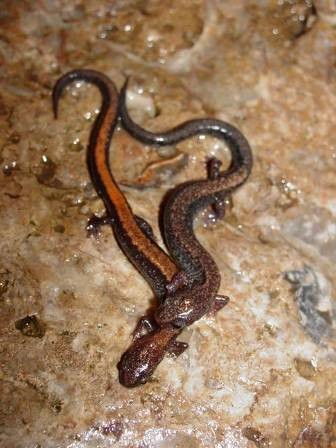 The Purdue Extension-Nature of Teaching has recently released a new publication through The Education Store. The Nature of Teaching provides free Indiana Academic Standard-based lesson plans for students in grades second through sixth to guide them on how to help maintain a healthy environment.
Understanding adaptations for aquatic amphibians can help humans learn more about healthy ecosystems. Through this educational unit, students will be able to explain how amphibian adaptations benefit survival, describe the importance of Eastern Hellbender adaptations, and identify impacts that humans have on aquatic amphibians.
These packed lesson plans are great resources for school teachers, parents, 4-H leaders and other natural resource educators. View the Adaptations for Aquatic Amphibians for the latest installment in the Nature of Teaching resources. See below for other related publications, lesson plans and games.
Resources
Frogs and Toads of Indiana, The Education Store, Purdue Extension
Salamanders of Indiana, The Education Store
Snakes and Lizards of Indiana, The Education Store
Turtles of Indiana, The Education Store
Help the Hellbender, Purdue Extension
Hellbender Decline, Purdue Extension-FNR Youtube
The Nature of Teaching, Lesson Plans K-12, Purdue Extension
Nick Burgmeier, Extension Wildlife Specialist & Research Biologist
Purdue University Department of Forestry and Natural Resources

Empty cage trap with door open. Image taken by Doug Beckers and courtesy of flickr.com.
Having raccoon, groundhog, or other bothersome wildlife problems? Thinking about setting traps to catch these animals? There is much to consider when using traps. Take a look at the latest publication for best results.
Wildlife specialists Brian MacGowan and Rick Shadel have collaborated to bring you this new publication: Considerations for Trapping Nuisance Wildlife with Box Traps.
Homeowners commonly set traps to capture and remove wildlife from their home or yard. Setting a box trap improperly can decrease their effectiveness and even lead to safety risks to both people and wildlife. The purpose of this publication is to 1) outline the legal and ethical factors homeowners should consider before setting a trap, 2) review the basic procedure for effectively trapping wildlife, and 3) help you to determine the fate of the captured animal.
If you have a serious, dangerous, or a nuisance wildlife issue, you may want to consider hiring a professional. Consider reading this publication before deciding whether or not you need to hire a professional: Selecting a Nuisance Wildlife Control Professional.
Resources
Preventing Wildlife Damage – Do You Need a Permit? – The Education Store, Purdue Extension resource center
Selecting a Nuisance Wildlife Control Professional, The Education Store
How to Construct a Scent Station, The Education Store
Question: How do I properly relocate raccoons from my attic?, Got Nature? Blog, Purdue Extension FNR
Nuisance Wildlife – Indiana Department of Natural Resources
Brian MacGowan, Wildlife Extensions Specialist
Purdue Forestry and Natural Resources
Kristol from Tippecanoe County, IN, sent in question to the Purdue Extension-Forestry and Natural Resources experts (Ask an Expert ) asking what resources are available to help with landscaping for a front yard and sidewalk area that accumulates water after a hard rain. She also asked for resources to improve drainage.
Purdue Extension has several articles and resources to help with this type of situation.
The resources in our Rainscaping and Master Gardeners Program shares several neat options:
Rain Gardens Go with the Flow, Indiana Yard and Garden, Purdue Horticulture
Rainscaping Program
Master Gardeners Program
Don’t miss the publications located in the Purdue Extension resource center, The Education Store, relating to the topic:
Tree Installation: Process and Practices
Planting Forest Trees and Shrubs in Indiana
Climate Change: How will you manage stormwater runoff?
For Midwest Landscapes, have a look at the Purdue Landscape Report:
Purdue Landscape Report
Check out upcoming workshops available for land and woodland owners, to talk with an expert:
Purdue Extension-Forestry and Natural Resources Calendar
Check out our Got Nature? posts as well, as this is always a great resource for new information:
Got Nature?, Forestry and Natural Resources-Purdue Extension
These resources give you lots of options that match what your looking for along with experts in the field to contact if needed.
We always appreciate the questions coming in, so keep them coming. Our experts will respond quickly and give you the guidance you need for your next steps.
Diana Evans, Extension Information Coordinator
Purdue Forestry and Natural Resources
This looks to be shaping up as a tough winter for us and our trees. Lots of snow and ice are predicted for the Hoosier state and this can be a challenge for our trees and shrubs.
After a heavy snowfall, protect your trees and property with these simple tips:

Limbs bending from ice loading.
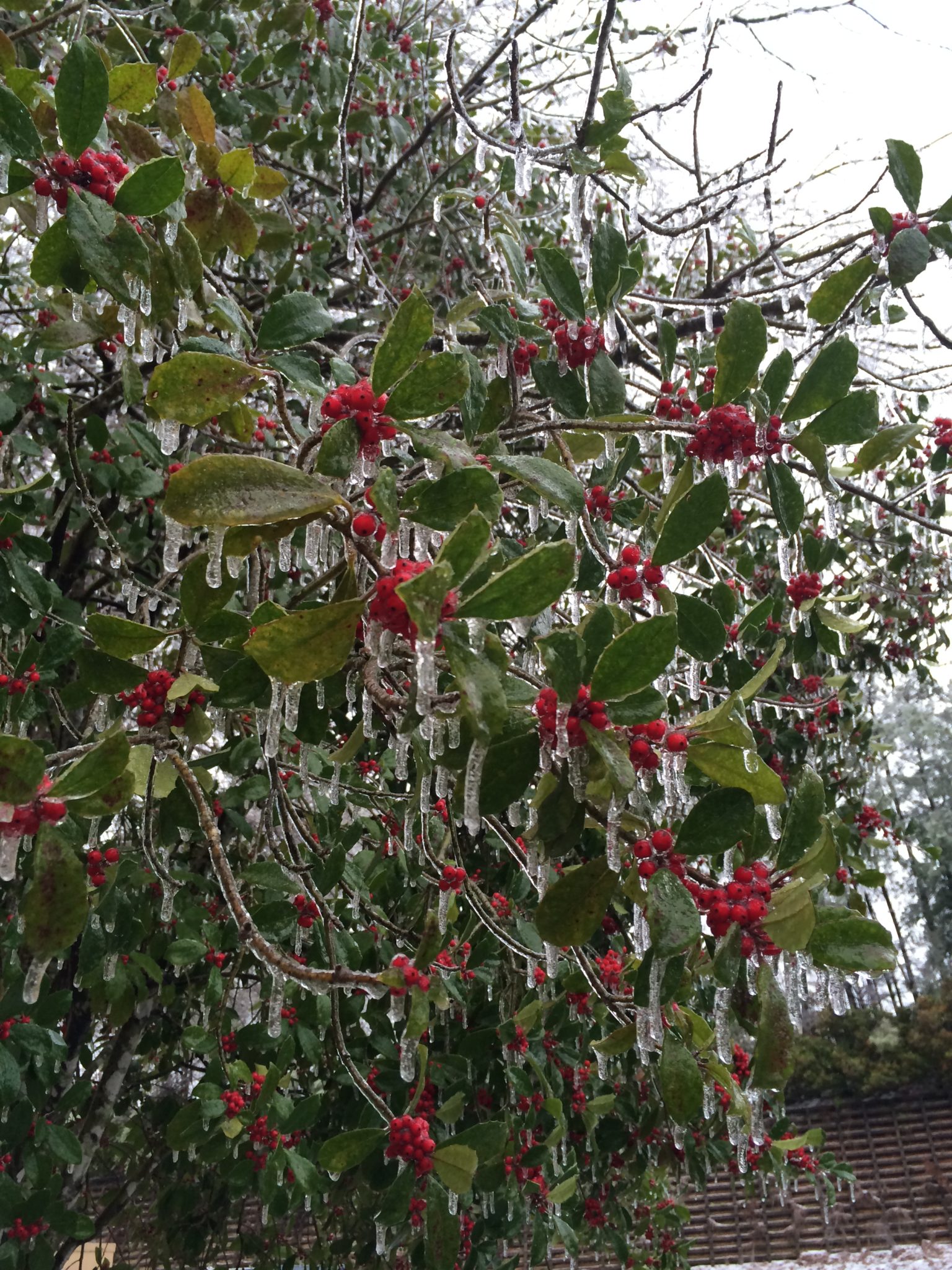
Ice accretion on hawthorn branches.
Do not shake limbs to try to remove snow or ice.
When you find your trees are bending or drooping as a result of ice or snow accumulation, your first instinct is probably to shake the branches or knock the weight off with a broom or something similar. This may cause worse damage or actually cause the branch to snap off. Stop right there! Healthy tree branches are flexible, so knocking off the accumulation of snow or ice accretion may cause them to “snap” back, potentially damaging their food and water transport system. The results of the damage may not be evident until next spring.
Trees that tend to suffer the worst damage as a result of snow and ice are upright evergreens, like arborvitae and juniper, and clump trees, like birch. And, when it comes to ice, age does not make a tree stronger; younger trees are better at actually overcoming damage in ice storms.
Hire a Professional.
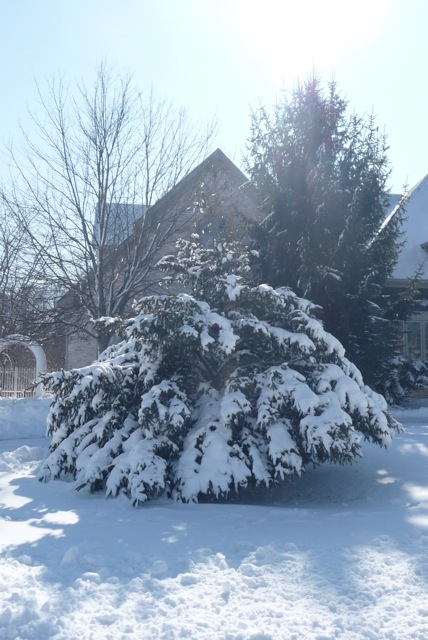
Snow weighing down spruce branches.
Safely remove broken limbs.
Broken and hanging branches can be a threat to people and property. If a limb breaks off from the weight of ice or snow and remains in the tree canopy, have it removed and the remaining stub properly pruned to the branch collar as soon as weather allows. The tree will recover better when properly pruned. For undamaged limbs bending under the weight of ice or snow, don’t prune as a means of correcting the situation. Be patient. It takes time for wood fibers in the limbs to return to its natural position.
Always be mindful of walking or parking under branches loaded down by snow or ice as they may snap and fall, causing injury or damage. If a limb breaks and becomes entangled in power lines, notify your utility company immediately. Never approach a downed power line or a branch touching a utility line.
If there is substantial damage to your tree, have an arborist examine damaged branches and limbs for signs of weakness and injury for reparations. It is best to always hire an ISA Certified Arborist. To find an arborist in your area, visit the website, www.treesaregood.org
How can you help prevent ice damage to trees? Proper pruning is one way. Particularly important is the removal of poor branch attachments and weak branch structure in the tree, prior to winter. For more information on pruning, download the publication, Tree Pruning Essentials.
Full article published in the Purdue Landscape Report.
Resources
Avoid Deadly Risk of Dying Ash Trees with Timely Tree Removal, Got Nature? Purdue Extension-FNR
New Hope for Fighting Ash Borer, Got Nature? Purdue Extension-FNR
Invasive Pest Species: Tools for Staging and Managing EAB in the Urban Forest, Got Nature?
Emerald Ash Borer, Purdue Extension-Entomology
Emerald Ash Borer Tools & Resources – Purdue Extension Entomology
Corrective Pruning for Deciduous Trees, The Education Store, Extension Publications
Lindsey Purcell, Chapter Executive Director
Indiana Arborist Association
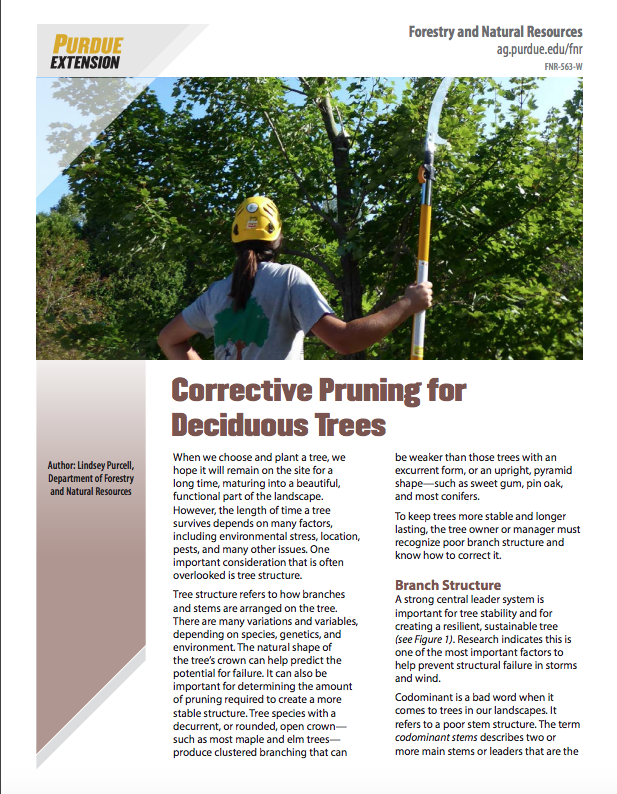
How do I remedy poor branching? Is my tree at risk of splitting, and how can pruning prevent that? Corrective pruning has many implications for tree structure, health, and longevity. Developing a strong, central branch structure in a deciduous tree is critical for preventing structural failure caused by storms, wind, and ice. This 8-page publication explains the problems resulting from a co-dominant stem structure and addresses pruning strategies for correcting poor structure.
To view this full publication please go to Corrective Pruning for Deciduous Trees located in The Education Store, Purdue Extension’s resource center.
Resources
Preparations to Prevent Southwest Tree Injury, Got Nature? Blog
When do you stake a tree?, Got Nature? Blog
Top 5 List for Tree Selection and Planting, Got Nature? Blog
Tree Selection for the “Un-natural” Environment, The Education Store, Purdue Extension
Tree Support Systems, The Education Store, Purdue Extension
Tree Installation: Process and Practices, The Education Store, Purdue Extension
Planting Your Tree Part 1: Choosing Your Tree, video, The Education Store, Purdue Extension
Lindsey Purcell, Urban Forestry Specialist
Purdue Forestry and Natural Resources

A large flock of birds flying over a field. Photo: Indiana DNR
The latest Wildlife Bulletin, provided by the Indiana Department of Natural Resources-Division of Fish and Wildlife, has all the Indiana hunting information you need to know along with upcoming events and resources. Topics include: Get your deer licenses now; Deer hunting checklist; Deer processing videos on YouTube; Hunting seasons dates; Four options to check in game; Sandhill crane migration at Jasper-Pulaski; and much more.
The Wild Bulletin is a free email newsletter offering information about Indiana’s fish and wildlife resources and recreation opportunities. Subjects covered include profiles, information about hunting and fishing season dates, regulation updates, wildlife and fisheries research status reports, tips on wildlife watching and reminders about important dates for Hoosier outdoor enthusiasts.
To subscribe to this free e-newsletter visit Wild Bulletin, Indiana Department of Natural Resources.
Other resources:
State Parks, Indiana Department of Natural Resources (IN DNR)
Outdoor Indiana, Indiana Department of Natural Resources (IN DNR)
Indiana Department of Natural Resources
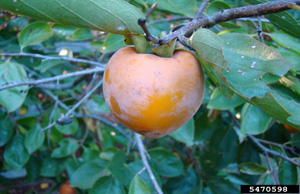
Ripe persimmon. Photo: Rebekah D. Wallace, University of Georgia, Bugwood.org.
The American persimmon tree’s scientific name, Diospyros virginiana, is loosely interpreted “divine fruit” or “fruit of the gods” of Virginia. If you have tasted a ripe persimmon on a crisp fall day, you might agree with that assessment. Several persimmon tree species are found in both the new and old world and have been used for food and wood products for centuries. Our American persimmon is native to the southern half of Indiana but can survive in the northern half of the state as well.
The ripe fruit is famous for the sweet orange pulp used in puddings, cookies and candies. If you are unlucky enough to eat a persimmon that has not yet ripened, your opinion of its eating quality will be quite different. Unripe persimmons have a high tannin content that makes the fruit very astringent – I describe it as feeling like your head is shrinking while simultaneously trying to expel a glue ball from your mouth! Most dedicated persimmon collectors wait for the fruit to become soft and fall from the tree before collecting to avoid this unpleasant experience. Contrary to popular belief, the fruit does not have to experience a frost to ripen. Persimmon fruit normally ripen in September and October, but some trees hold fruit well into winter.
A warning to those tempted to over-indulge in persimmon fruit: the tannin in the unripened fruit can combine with other stomach contents to form what is called a phytobezoar, a sort of gooey food ball that can become quite hard. One patient had eaten over two pounds of persimmons every day for over 40 years. Surgery is often required to remove bezoars, but a recent study indicated Coca-Cola could be used to chemically shrink or eliminate the diospyrobezoar. There is very little risk to those infrequently eating ripe persimmons.
Persimmon is related to ebony and has extremely hard wood once commonly used for golf clubs when “woods” where actually made of wood. The heartwood of persimmon can be black, like ebony, but significant dark heartwood formation may not occur until the tree is quite old. Persimmon is a medium-sized tree here in Indiana but can be over 100 feet tall in the bottomland forests of the Southern U.S. Where I grew up in Southern Indiana, my family ritual in the fall was to go to Brown County State Park and pick up persimmons, separate the tasty pulp from the skin and seeds and freeze the pulp for use in persimmon pudding and candy over the holidays. We might also collect some black walnuts or hickory nuts to include in the candy. We had to be diligent, as the opossums, raccoons and deer liked persimmon as much as we did.

The embryo in persimmon seed – is it a spoon, knife or fork? Photo: Lenny Farlee, Purdue Extension Forester
In addition to use for food, persimmon has some folk tradition related to winter weather forecasting. It was thought the shape of the embryo in the seed could predict the winter weather: a spoon shape indicated deep snow, a knife would indicate icy cutting winds and a fork meant it would be mild with plenty to eat until spring. I collected a few seeds from trees here on the West Lafayette campus and split them open to see what the tree wants to tell me – looks like a spoon to me, but you can make your own predictions.
The Indiana DNR Division of Forestry Nursery sells American persimmon seedlings. You can also find selections for fruit production being sold commercially, along with several Asian persimmon varieties. Male and female flowers are normally formed on separate trees, so plant several to get good pollination.
The following site has a wealth of information on persimmon, including several recipes and locations to buy pulp and seedlings, as well as natural and cultural history including the annual Persimmon Festival in Mitchell, Indiana:
http://www.persimmonpudding.com/.
Resources:
Persimmons, The Education Store, Purdue Extension resource center
Resources and Assistance Available for Planting Hardwood Seedlings, The Education Store
Tree Installation: Process and Practices, The Education Store
Tree Planting Part 1: Choosing a Tree, video, The Education Store
Lenny D Farlee, Sustaining Hardwood Extension Specialist
Purdue University Department of Forestry and Natural Resources
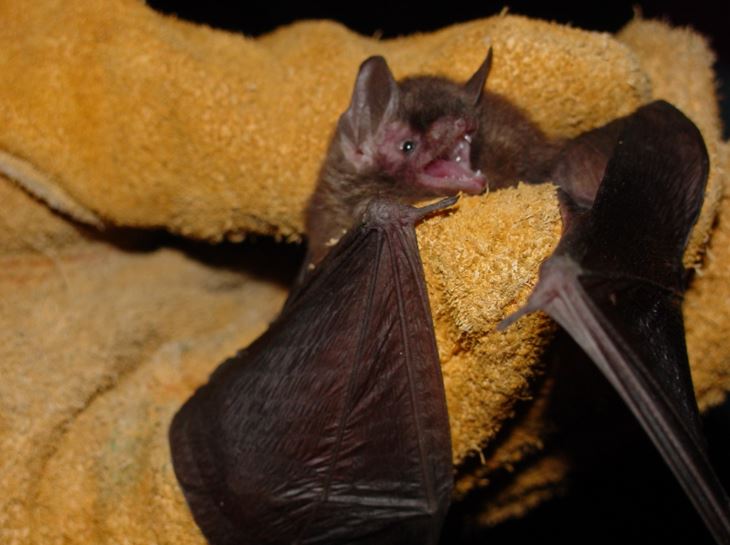 At different times of the year, I get questions about bats in structures. Bats are a timely issue towards the end of summer because young bats will soon be able to fly. Excluding bats from structures is limited to this time. This process is typically called “venting” where access points (both in use and potential) are identified, most are sealed off, and the remaining points are fitted with one-way doors that allow bats to leave but not reenter. If only the opening they use is sealed off, they will simply use another entry point. Think of it this way – our houses have multiple points of entry, but you may only use one. You will use another if necessary.
Bats can make their way into a house in a number of ways – gaps between siding and chimney, gaps between roof sheathing and fascia board, etc. New and old construction alike. Eliminating access to all of these small, potential points of access can be a challenge. The bodies of some bat species are as small as your thumb. Even though you don’t have an attic, there are still spaces inside a structure where bats can live.
Bats are one of the most difficult wildlife conflicts to deal with because of the nature of their habits. They can pass through extremely small openings, move throughout the inside of a structure, and often entre/occupy hard to reach areas. Bat exclusion is not an activity I recommend for most homeowners. There is a skill necessary to find and seal all possible access points. Since most of these are located high above ground and accessing these points can require special ladders, lifts and other safety equipment.
Having bats in the attic isn’t simply a nuisance issue, but also can be a safety issue. Like Most wildlife carry diseases. With bats, histoplasmosis and rabies are the two that are the ones most concern for people with bats in their homes. The Center of Disease Control (CDC) has good information on these and other diseases. Fleas that live on bats can also be vectors for disease. It is always a good idea to limit exposure to wildlife animals as much as possible. For bats, venting in the end of summer and fall and preventing reentry is a logical first step.
If you have bats and want to solve the problem now is the time to contact professionals who can help. Unfortunately, most nuisance wildlife control operators don’t do bat work because it requires specialized equipment and the difficulty of it. Because of that, control will not be cheap for the customer. Many people construct bat houses to attract bats. While beneficial, artificial bat houses will not attract bats from an attic.
Resources:
Selecting a Nuisance Wildlife Control Professional, The Education Store-Purdue Extension’s resource center
Bats in Indiana, Indiana Department of Natural Resources (IDNR)
Bat Houses, Bat Conservation International
Brian J. MacGowan, Extension Wildlife Specialist
Department of Forestry & Natural Resources, Purdue University

Recent Posts
- Purdue Extension: Empowering Indiana Through Innovation, Education and Community Impact
Posted: January 28, 2026 in Community Development, How To, Invasive Insects, Invasive Plant Species, Natural Resource Planning, Woodlands - Forest Landowners: Share Your Experience with Regeneration and Restoration
Posted: January 27, 2026 in Forestry, How To, Timber Marketing, Woodlands - It’s Not Too Late to Order Trees for Spring Planting
Posted: January 13, 2026 in Forestry, How To, Plants - Now Is The Time To Control Non-Native Bush Honeysuckle
Posted: October 30, 2025 in Forestry, How To, Invasive Plant Species, Woodlands - October Is Firewood Month: Protect Indiana’s Forests by Making Smart Choices
Posted: October 13, 2025 in Forestry, Forests and Street Trees, How To, Invasive Insects, Urban Forestry - ID That Tree: Smooth Sumac
Posted: October 2, 2025 in Forestry, How To, Wildlife - ID That Tree: Wild Grape Vine
Posted: August 12, 2025 in Forestry, How To, Urban Forestry, Wildlife - Publication – Sericea Lespedeza Control
Posted: July 7, 2025 in Forestry, How To, Invasive Plant Species, Wildlife - How to ID Asian Jumping Worms, Purdue Landscape Report
Posted: July 2, 2025 in How To, Invasive Insects, Wildlife - Alert – Water Your Trees, Watch Video
Posted: June 20, 2025 in Alert, Drought, Forests and Street Trees, How To, Urban Forestry, Wildlife, Woodlands
Archives
Categories
- Alert
- Aquaculture/Fish
- Aquatic/Aquaculture Resources
- Ask the Expert
- Christmas Trees
- Community Development
- Disease
- Drought
- Forestry
- Forests and Street Trees
- Gardening
- Got Nature for Kids
- Great Lakes
- How To
- Invasive Animal Species
- Invasive Insects
- Invasive Plant Species
- Land Use
- Natural Resource Planning
- Nature of Teaching
- Plants
- Podcasts
- Ponds
- Publication
- Safety
- Spiders
- Timber Marketing
- Uncategorized
- Urban Forestry
- Webinar
- Wildlife
- Wood Products/Manufacturing
- Woodland Management Moment
- Woodlands