 Purdue University - Extension - Forestry and Natural Resources
Got Nature? Blog
Join Purdue Extension forester Lenny Farlee as he introduces you to the Bald Cypress in the video below, one of two deciduous conifers in Indiana.
If you have any questions regarding trees, forests, wildlife, wood products or other natural resource topics, feel free to contact us by using our Ask an Expert web page.
Resources
Indiana Department of Natural Resources – Division of Forestry, District Foresters
Forest Improvement Handbook, The Education Store, Purdue Extension resource center
Tree Appraisal and the Value of Trees, The Education Store
ID That Tree, Playlist, Purdue Extension – Forestry and Natural Resources Youtube Channel
A Woodland Management Moment, Playlist
Lenny Farlee, Sustaining Hardwood Extension Specialist
Purdue University Department of Forestry and Natural Resources
Purdue extension forester Lenny Farlee introduces the red maple, a native tree to Indiana, known for its red to maroon foliage.
If you have any questions regarding trees, forests, wildlife, wood products or other natural resource topics, feel free to contact us by using our Ask an Expert web page.
Resources
ID That Tree, Playlist, Purdue Extension – Forestry and Natural Resources Youtube Channel
A Woodland Management Moment, Playlist, Purdue Extension – Forestry and Natural Resources Youtube Channel
Investing in Indiana Woodlands, The Education Store
Tree Appraisal and the Value of Trees, The Education Store
Forest Improvement Handbook, The Education Store
Lenny Farlee, Sustaining Hardwood Extension Specialist
Purdue University Department of Forestry and Natural Resources
This webinar titled “Tree Selection for the Landscape” by FNR Urban Forestry Specialist Lindsey Purcell talks about the tree selection process including the benefits of trees, urban tree planting, purpose for planting, environmental considerations, proper placement and utility considerations, along with many shared resources.
Please visit the Tree Selection for the Landscape Survey after you watch the video so we can learn more about you and feel free to share your suggestions for future topics.
Resources
Tree Appraisal and the Value of Trees, The Education Store, Purdue Extension resource center
Tree Selection for the “Un-natural” Environment, The Education Store
Tree Pruning Essentials, Video & Document
Tree Pruning: What Do Trees Think?, The Education Store
Mechanical Damage to Trees: Mowing and Maintenance Equipment, The Education Store
Tree Installation Process and Practices, The Education Store
Tree Planting Part 1: Choosing a Tree, The Education Store
Tree Planting Part 2: Planting Your Tree, The Education Store
Planting Problems: Planting Too Deep, Video, Purdue Extension – Forestry and Natural Resources Youtube Channel
Lindsey Purcell, Urban Forestry Specialist
Purdue University, Department of Forestry and Natural Resources
If you missed the LIVE Q&A about invasive plant species from June 4, 2020, no worries. Now you can view the archived video on our Purdue Extension-FNR YouTube Channel with Lenny Farlee, sustaining hardwood extension specialist, and Liz Jackson, extension specialist with Walnut Council and Indiana Forestry Woodland Owners’ Association (IFWOA), discussing invasive plant species, how to identify them, reporting and controlling techniques.
Here are the resources that were talked about in the video as it will help guide you as you identify invasives.
Resources
Help Stop Invasive Species with PlayCleanGo
Best management practices – Top 10 list (pdf)
Great Lakes Early Detection Network – Download the app at Apple App Store
Eddmaps website – A good place to see mapping and keep track of your reports and overall reports by species or location.
Call DEPP 1-866-NOEXOTIC or email depp@dnr.in.gov
Indiana Native Plant Society – Natives to replace invasives
Alternative Option for Invasive Landscape Plants (pdf)
A Guide to the Regulated Terrestrial Plant Species” (pdf)
Calendar of control- seasonality to treatment (pdf)
County CISMA groups, SICiM website
Work assistance- Contractor list, SICiM website
CISMA Virtual Conference in August – Learn about the impact of invasives, importance of native species, a bit about how to control, SICiM website
Midwest Invasive Plant Network Control Database provides an outline and efficacy rating for control techniques for many common invasive plant species.
Grow Indiana Natives Certification Program – Learn about substitutes for invasive species, Indiana Native Plants Society
Report Invasive
Indiana Invasive Species Council is an excellent doorway site to invasive species information for the state
Contact your local NRCS office for EQIP Brush Control practice, tree planting and habitat development practices, Natural Resources Conservation Service Indiana
Woodland Management Moment – Garlic Mustard, Video, Purdue Extension – Forestry and Natural Resources Youtube Channel
Woodland Management Moment: Asian Bush Honeysuckle, Video, Purdue Extension – Forestry and Natural Resources Facebook Page
Elizabeth Jackson, with Manager Walnut Council/IN Forestry Woodland Owners’ Association (IFWOA) & Engagement Specialist
Purdue University Department of Forestry and Natural Resources
Lenny Farlee, Sustaining Hardwood Extension Specialist
Purdue University Department of Forestry and Natural Resources
Purdue urban forester Lindsey Purcell shares tips for tree pruning for the landscape, including knowing why you are pruning, how to prune and how to help the tree heal properly.
Please visit the Tree Pruning for the Landscape Survey after you watch the video so we can learn more about you and feel free to share your suggestions for future topics.
Resources
Tree Pruning Essentials, Video & Document
Tree Appraisal and the Value of Trees, The Education Store, Purdue Extension resource center
Tree Pruning: What Do Trees Think?, The Education Store
Mechanical Damage to Trees: Mowing and Maintenance Equipment, The Education Store
Tree Installation Process and Practices, The Education Store
Tree Planting Part 1: Choosing a Tree, The Education Store
Tree Planting Part 2: Planting Your Tree, The Education Store
Planting Problems: Planting Too Deep, Video, Purdue Extension – Forestry and Natural Resources Youtube Channel
Lindsey Purcell, Urban Forestry Specialist
Purdue University, Department of Forestry and Natural Resources
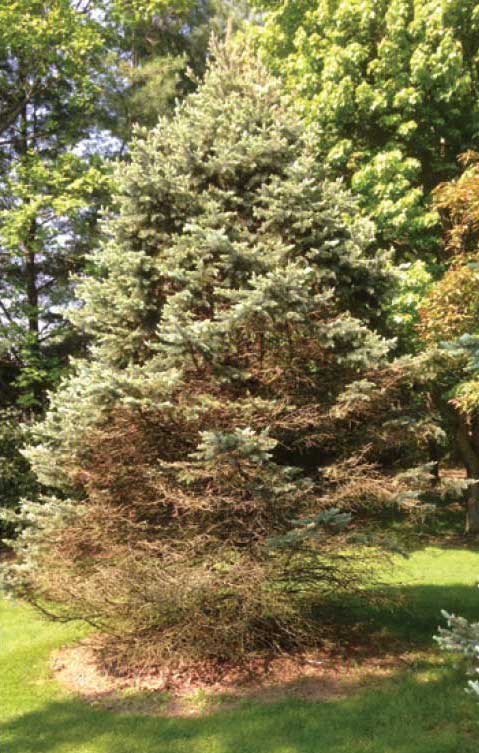 Question: I have a blue spruce that is 40-years old and very tall. It is dying up the middle. I have read about the Needle Cast problem. Also read about Spectro 90 copper based fungus control. I can only spray so high. Is there a chemical that can be placed on the ground to be absorbed by the tree?
Answer: Thank you for contacting us regarding your tree issues. Rhizosphaera needle cast (Rhizosphaera kalkhoffii) is a foliar disease of spruce trees. It is most common in trees growing outside of their native range. It starts on the inner and lower growth and progresses upward through the tree. It can take up to 15 months for the needles to show visible symptoms after the initial infection. Young trees may be killed by this disease, but usually branches die off after 3-4 consecutive years of defoliation, causing trees to look disfigured.
Early identification of Rhizosphaera can prevent major damage to individual trees and prevent the spread to nearby trees. Protecting new growth as it emerges is very important. For best effectiveness, fungicides should be applied when the emerging needles are half elongated (1/2 to 2 inches in length). Needle cast diseases can be effectively controlled with fungicides containing chlorothalonil. For Rhizosphaera needle cast, two properly-timed applications per year for at least two consecutive years, and sometimes three years, is required for control. Heavily infected trees may require several years of fungicide applications but should be sprayed, soil drenches are not effective. Also, clean-up of any infected needles and branches will help reduce the spread of the disease.
Resources
Needle cast in Colorado Blue Spruce, Purdue Landscape Report
Blue Spruce Update, Purdue Landscape Report
Why Spruce Trees Lose Their Needles, Purdue Extension
Blue Spruce Decline, Purdue Extension
Diseases Common in Blue Spruce, Purdue Extension
Tree Installation: Process and Practices, The Education Store, Purdue Extension resource center
Tree Planting and Urban Forestry Videos, Subscribe to our Purdue Extension-FNR YouTube Channel
Find an Arborist, International Society of Arboriculture
Lindsey Purcell, Urban Forestry Specialist
Purdue University, Department of Forestry and Natural Resources
Purdue sustaining hardwood extension specialist Lenny Farlee talks about identifying invasive plant species in the webinar below.
Don’t forget to fill out the Invasive Plants Threaten our Woodlands Part 1, Identification survey after watching video to share your suggestions, other forest topics you would like to see and to help us learn more about you.
Resources
A Woodland Management Moment, Playlist, Purdue Extension – Forestry and Natural Resources Youtube Channel
Invasive Species, Playlist
Report Invasive Species, Purdue Invasive Species
The GLEDN Phone App – Great Lakes Early Detection Network
EDDMaps – Early Detection and Distribution Mapping System (Report Invasives)
Cooperative Invasive Species Management Area (CISMA)
Indiana Department of Natural Resources: Invasive Species
Indiana Invasive Species Council
Woodland Stewardship for Landowners, Playlist
Invasive plants: impact on environment and people, The Education Store, Purdue Extension resource center
Woodland Invaders, Got Nature? Blog
Indiana Invasive Species Council
Hardwood Tree Improvement & Regeneration Center (HTIRC)
Lenny Farlee, Sustaining Hardwood Extension Specialist
Purdue University Department of Forestry and Natural Resources
In this Tree Installation for The Landscape Webinar, urban forestry specialist Lindsey Purcell shares information regarding research finds and current best management practices for tree installation.
Please visit the Tree Installation for the Landscape Survey after you watch the video so we can learn more about you and feel free to share your suggestions for future topics.
Resources
Tree Installation Process and Practices, The Education Store, Purdue Extension resource center
Tree Support Systems, The Education Store
Tree Pruning Essentials, Video & Document
Tree Appraisal and the Value of Trees, The Education Store
Tree Pruning: What Do Trees Think?, The Education Store
Mechanical Damage to Trees: Mowing and Maintenance Equipment, The Education Store
Tree Planting Part 1: Choosing a Tree, The Education Store
Tree Planting Part 2: Planting Your Tree, The Education Store
Planting Problems: Planting Too Deep, Video, Purdue Extension – Forestry and Natural Resources Youtube Channel
Lindsey Purcell, Urban Forestry Specialist
Purdue University, Department of Forestry and Natural Resources
Do you know what’s “bugging” your trees? There are several exotic insects which may be attacking our trees that you should be on the lookout for. Some have already arrived in Indiana, and others are still beyond our borders but have a risk of showing up here in the future.
Dr. Elizabeth Barnes, exotic forest pest educator with Purdue Department of Entomology, and Liz Jackson Purdue extension forestry specialist, describe these exotic insects, symptoms to watch for in your trees, and discuss what some of the biggest future pest concerns are in this Facebook Live session from June 18, 2020.
Resources
Purdue Report Invasive website
Indiana Department of Natural Resources Division of Entomology & Plant Pathology
Don’t Move Firewood
Purdue Plant and Pest Diagnostic Lab
Indiana District Foresters
Indiana Consulting Foresters
Purdue Landscape Report
Insect specific sites:
Asian Longhorned Beetle Information (from APHIS)
Spotted Lanternfly (Penn State Extension)
Emerald Ash Borer Information from Purdue
EAB University: Invasive insects and pathogens webinar series
Elizabeth Jackson, Manager Walnut Council/IN Forestry Woodland Owners Association (IFWOA) & Engage Specialist
Purdue University Department of Forestry and Natural Resources
Elizabeth Barnes, Exotic Forest Pest Educator
Purdue University Entomology
Across the entire United States, and into Canada and Mexico, coyotes can be found just about everywhere. But what would you do if you encountered a coyote while out all alone? Would you feel comfortable knowing how to act? How about how to keep your children or pets safe in such an encounter?
In our June 11th Ask the Experts series, “Coexisting with Coyotes,” Purdue researchers Brian MacGowan and Bee Overbey talked about these topics and more. As a keystone species in their ecosystem, coyotes play an extremely important role in maintaining population levels of other animals, such as deer, rabbits, raccoons, and voles. By keeping these populations in check, plants and trees are better able to grow, and this creates greater biodiversity and healthier habitat. And coyotes are not going anywhere! This resilient, intelligent species has learned to adapt around humans and every change that we bring.
Check out the video below to learn more about coyotes, how important they are to the lands where they are found, and tips on how to coyote-proof your property and keep yourself and your loved ones safe in coyote encounters. By working together, we can easily and safely coexist with this vital native species.
Resources
Ask an Expert, Playlist, Purdue Extension – Forestry and Natural Resources (FNR) YouTube Channel
Coyotes, IN DNR
Coyotes (PDF), Wildlife Conflicts, Department of Entomology, Purdue University
Coexisting With Coyotes, Wild Bulletin, Indiana Department of Natural Resources, Division of Fish and Wildlife
Urban Coyotes – Should You Be Concerned?, Purdue Extension – FNR Got Nature? Blog
Pets Disappearing? The Cause May Be Coyotes, Purdue Extension – FNR Got Nature? Blog
Question: Which is the correct species of coyotes I have on my land here in Indiana, coyote or coywolf?, Purdue Extension – FNR Got Nature? Blog
Permitted Wildlife Rehabilitators, Indiana Department of Natural Resources
Dealing with Nuisance Coyotes, Indiana Department of Natural Resources (IN DNR)-Fish and Wildlife
Urban Coyote Research Center, Urban Coyote Ecology & Management, Cook County, Illinois
Brian MacGowan, Wildlife Extension Specialist
Purdue Forestry and Natural Resources
Brande (Bee) Overbey
Purdue Forestry and Natural Resources

Recent Posts
- Purdue Extension: Empowering Indiana Through Innovation, Education and Community Impact
Posted: January 28, 2026 in Community Development, How To, Invasive Insects, Invasive Plant Species, Natural Resource Planning, Woodlands - Forest Landowners: Share Your Experience with Regeneration and Restoration
Posted: January 27, 2026 in Forestry, How To, Timber Marketing, Woodlands - It’s Not Too Late to Order Trees for Spring Planting
Posted: January 13, 2026 in Forestry, How To, Plants - Now Is The Time To Control Non-Native Bush Honeysuckle
Posted: October 30, 2025 in Forestry, How To, Invasive Plant Species, Woodlands - October Is Firewood Month: Protect Indiana’s Forests by Making Smart Choices
Posted: October 13, 2025 in Forestry, Forests and Street Trees, How To, Invasive Insects, Urban Forestry - ID That Tree: Smooth Sumac
Posted: October 2, 2025 in Forestry, How To, Wildlife - ID That Tree: Wild Grape Vine
Posted: August 12, 2025 in Forestry, How To, Urban Forestry, Wildlife - Publication – Sericea Lespedeza Control
Posted: July 7, 2025 in Forestry, How To, Invasive Plant Species, Wildlife - How to ID Asian Jumping Worms, Purdue Landscape Report
Posted: July 2, 2025 in How To, Invasive Insects, Wildlife - Alert – Water Your Trees, Watch Video
Posted: June 20, 2025 in Alert, Drought, Forests and Street Trees, How To, Urban Forestry, Wildlife, Woodlands
Archives
Categories
- Alert
- Aquaculture/Fish
- Aquatic/Aquaculture Resources
- Ask the Expert
- Christmas Trees
- Community Development
- Disease
- Drought
- Forestry
- Forests and Street Trees
- Gardening
- Got Nature for Kids
- Great Lakes
- How To
- Invasive Animal Species
- Invasive Insects
- Invasive Plant Species
- Land Use
- Natural Resource Planning
- Nature of Teaching
- Plants
- Podcasts
- Ponds
- Publication
- Safety
- Spiders
- Timber Marketing
- Uncategorized
- Urban Forestry
- Webinar
- Wildlife
- Wood Products/Manufacturing
- Woodland Management Moment
- Woodlands