 Purdue University - Extension - Forestry and Natural Resources
Got Nature? Blog
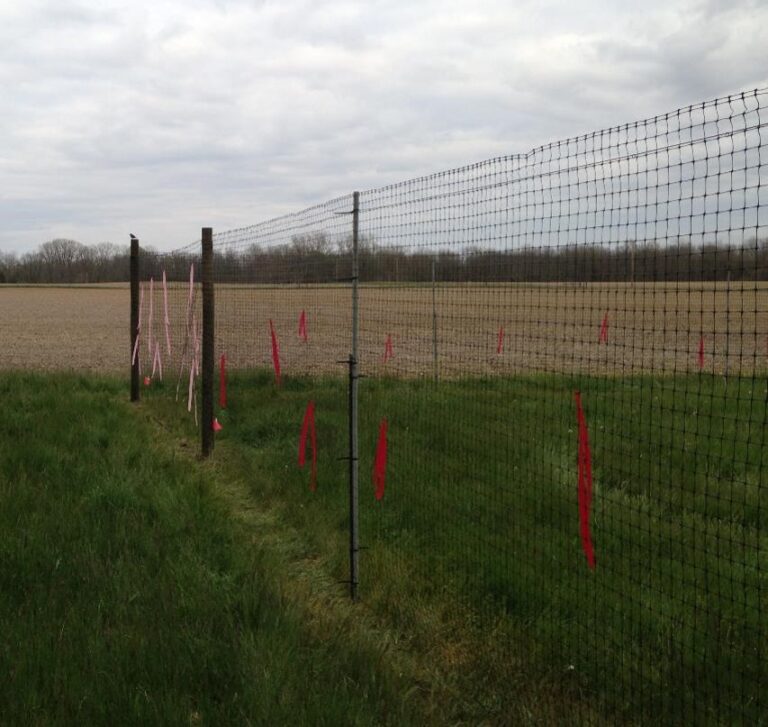 Hardwood Tree Improvement & Regeneration Center (HTIRC) Newsletter: USDA conservation programs provide technical and financial incentives for landowners to install and maintain conservation practices, including tree plantations. They are an important tool to help encourage landowners to make an investment in long-term activities like planting hardwood trees. Research across the eastern US, including work done by the HTIRC, demonstrates that deer browse can be one of the most significant barriers to establishment of a successful tree plantings. Deer may increase mortality, but more often they are preventing planted or naturally regenerating trees from growing in height due to repeated browsing. This damage can also deform trees, resulting in poor stem form and lower potential log quality. Plantations where deer selectively browse desirable species may lose important species like oaks due to overtopping by less favored, and therefore less browsed, species that become free to grow. Reducing the damage done by deer browse is an important, and in many locations the most critical step in successful tree planting establishment in many areas across the eastern US.
One of the primary purposes for these conservation tree plantings is developing forest wildlife habitat, but to successfully establish that habitat may require excluding deer for a few years, until the trees are tall enough to continue growing past the deer browse damage. Fortunately, many state Natural Resource Conservation Service offices are recognizing the impact that deer browse is having on establishing successful conservation tree plantings. To address this barrier to successfully establishing tree plantings and natural regeneration, new scenarios are being added to the Tree and Shrub Establishment practice:
-
- The “Planted Area with Protection” scenario provides cost assistance for tree and shrub planting and placement of a temporary perimeter fence to exclude deer until trees have grown above the height of deer browsing.
- The “Regeneration Area with Protection” scenario provides cost assistance for placement of a temporary fence to protect natural regeneration of tree and shrub species.
- Increased cost assistance payments may be available to help offset some of the additional cost a deer exclusion fence adds to a planting project. States may have differing cost assistance rates and practice requirements. These and other additions to the NRCS tree planting practices provide landowners and natural resource managers effective tools to establish tree plantings that can produce high quality hardwood trees in the future. Check with your local foresters and NRCS offices to see if this practice is available in your area and details on payment rates and requirements. If the practice is not available, work with your local resource management contacts to request addition of this practice for your area in the future.
The HTIRC has supported this fencing practice through research and demonstration plantings that have showcased the benefits deer exclusion fencing can provide for timely establishment and timber quality development in hardwood plantings.
Resources:
Woodland Stewardship For Landowners, Playlist, Purdue Extension – Forestry and Natural Resources YouTube Channel
Woodland Management Moment, Purdue Extension – FNR Playlist
A Woodland Management Moment – Deer Fencing, Purdue Extension – FNR Video
Wildlife Habitat Hint: Exclusion Cage, Purdue Extension – FNR Video
How to Build a Plastic Mesh Deer Exclusion Fence, The Education Store, Purdue Extension resource center
Ask An Expert: Handling Harvested Deer, Purdue Extension – FNR YouTube Channel
Forest Improvement Handbook, The Education Store
Finding help from a professional forester, Indiana Forestry & Woodland Owners Association
Lenny Farlee, Sustaining Hardwood Extension Specialist
Hardwood Tree Improvement & Regeneration Center (HTIRC)
Purdue University Department of Forestry and Natural Resources
Purdue Landscape Report – Black Root Rot: Black root rot (BRR), caused by the fungus Thielaviopsis basicola,has a host range of several hundred plants. In the landscape, the most common hosts include pansies (Fig. 1), and vinca, along with calibrachoa and petunia. In perennial hosts, it often infects lavender, phlox, milkweed and butterfly-weed (Asclepius spp.). Even woody plants, like holly and elderflower (Sambucus spp.) can succumb.
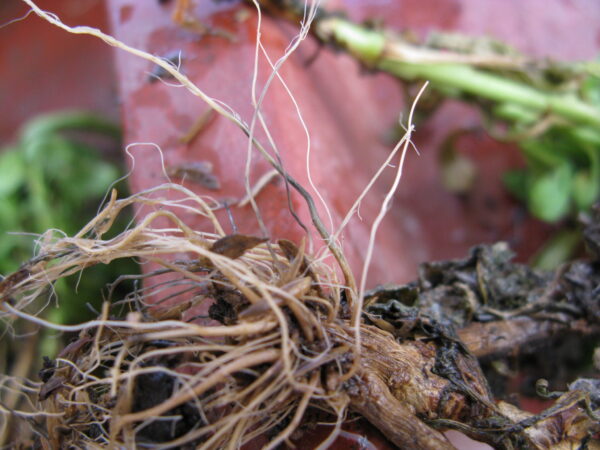
Figure 2. Clean roots showing the characteristic black root rot. Photo by Janna Beckerman.
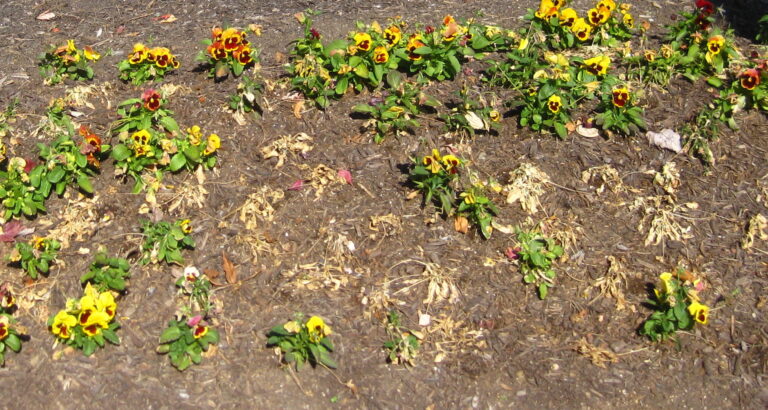
Figure 1. Pansies get a bad a rap for falling down in hot weather. Thielaviopsis is often the real culprit. Photo by Janna Beckerman.
Symptoms of black root rot are often mistaken for nutrient deficiencies. Older leaves may develop symptoms that look like iron chlorosis, while young leaves become stunted. Infected plants grow more slowly compared to healthy plants. Shoot length is reduced compared to healthy plants, and scattered dead shoots may be apparent. In pansy, one of the key symptoms of BRR is when seemingly ‘healthy’ plants may suddenly collapse when a brief hot spell occurs (Fig. 1).
Keep in mind that diagnosing any root rot requires observing the affected plant for symptoms, and collecting the infected tissue at the right time to culture out the pathogen or pathogens causing the problem.
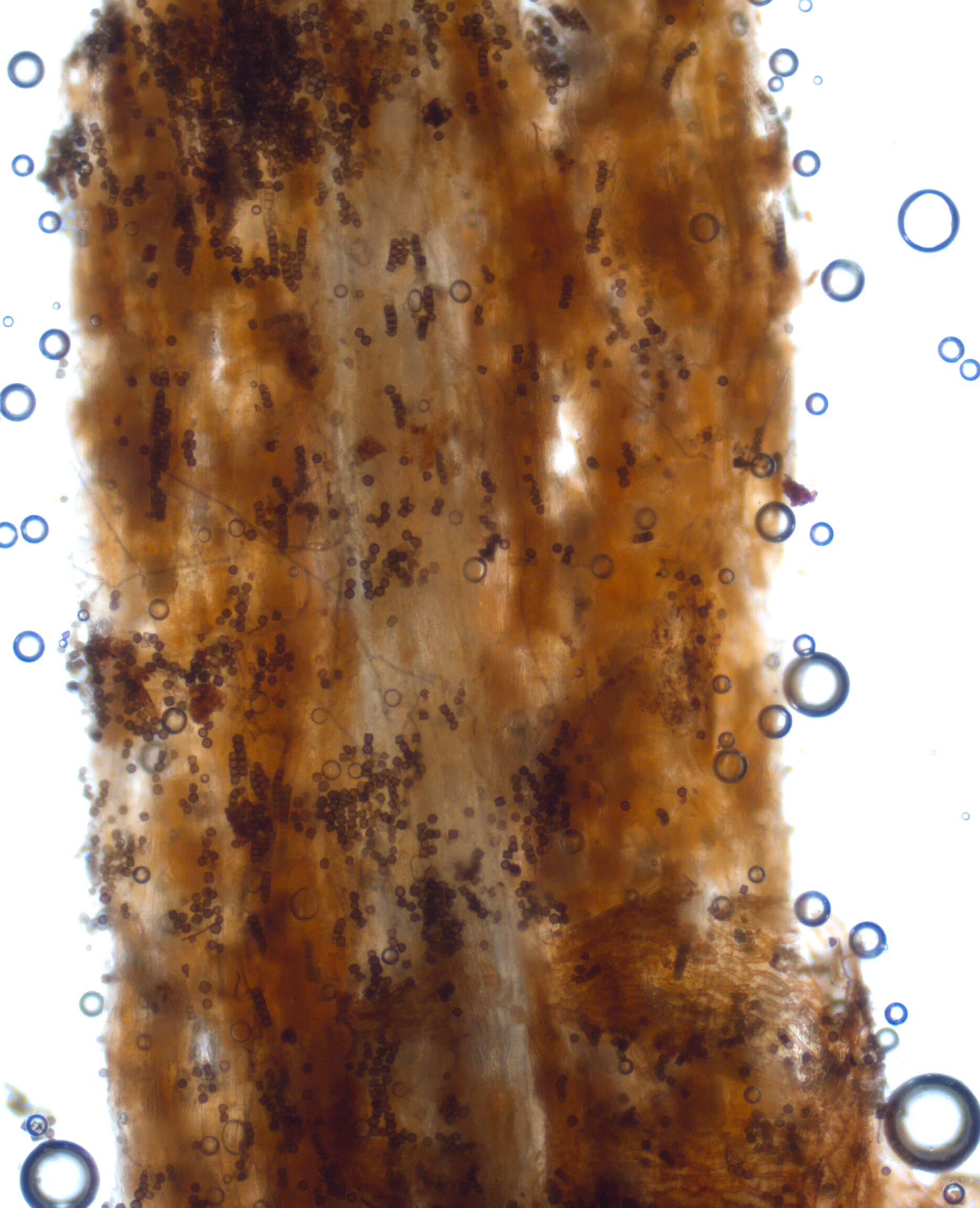
Figure 3. Looking at sectioned black root reveals numerous chlamydospores. Photo by Janna Beckerman.
Resources:
Purdue Landscape Report
Root Rot in Landscape Plants, The Education Store
Ask The Expert: Tree Inspection, Purdue Extension- FNR YouTube Channel
Ask The Expert: Tree Selection and Planting, Purdue Extension- FNR YouTube Channel
Janna Beckerman, Professor
Purdue Botany and Plant Pathology
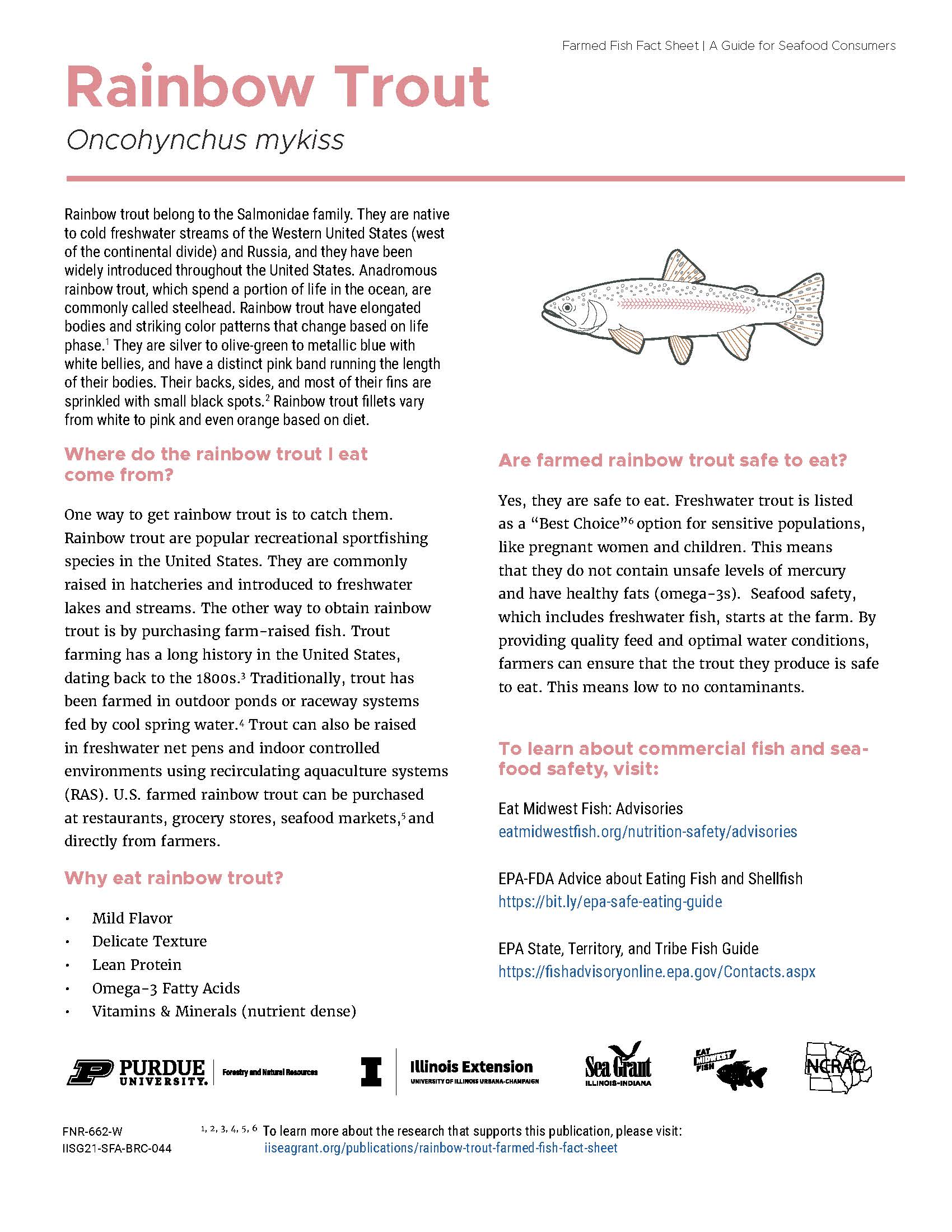 Find the answer in this free downloadable publication titled Rainbow Trout Farmed Fish Fact Sheet, FNR-622-W, along with culinary characteristics, cooking tips and a recipe for Grilled Rainbow Trout with Apricot Salsa.
This is the fourth in a series of consumer guides that describe fish and shellfish farmed in the Midwest region of the United States. (See FNR-608-W, Walleye Farmed Fish Fact Sheet, FNR-618-W, Yellow Perch Farmed Fish Fact Sheet and FNR-621-W, Tilapia Farmed Fish Fact Sheet).
Resources:
Fish: Healthy Protein Handout, The Education Store, Purdue Extension resource center
Walleye Farmed Fish Fact Sheet: A Guide for Seafood Consumers, The Education Store
Fish Cleaning with Purdue Extension County Extension Director, Got Nature? Blog, Purdue Extension – Forestry and Natural Resources (FNR)
Eat Midwest Fish, Website
Sustainable Aquaculture: What does it mean to you?, The Education Store
Best Practices Guide for Charter Fishing and COVID-19, The Education Store
Pond Management: Managing Fish Populations, The Education Store
Aquatics & Fisheries, YouTube Playlist, Purdue Extension – FNR
Amy Shambach, Aquaculture Marketing Outreach Associate
Purdue Department of Forestry and Natural Resources/Illinois Indiana Sea Grant Program
 Pat Zollner, professor of wildlife science, and doctoral student Marian Wahl are researching black vultures in Indiana in order to better understand vulture ecology as well as to develop methods to mitigate future harm to Indiana and Kentucky livestock.
In addition to looking to see what causes some black vulture to become aggressive predators of livestock, instead of simply scavengers, the research group also is looking to learn signs that can determine whether an animal has been killed by vultures or simply scavenged.
For their knowledge of and research on black vultures, Zollner and Wahl were interviewed by the New York Times for its article “Black Vulture Attacks on Animals May Be Increasing.”
“What is totally unknown in Indiana and most places is how often this (predation) happens,” Zollner said. “Addressing that gap is one of the goals of our research.”
More on Zollner and Wahl’s black vulture research and how you can help by either taking an online survey or donating calves believed to have been killed by black vultures can be found in “Citizen Participation Needed in Black Vulture Research.”

Some of the group’s research efforts were recently featured in a pictorial titled “A Day on the SIPAC Farm.” See Wahl, Zollner and undergraduate students Gabrielle Dennis and Danielle Jones in action in the photo feature by Tom Campbell.
This article is shared on Forestry & Natural Resources News & Stories – Black Vulture Research Highlighted by NY Times.
Resources:
Citizen Participation Needed in Black Vulture Research, Purdue Extension-Forestry and Natural Resources (FNR) Blog
Black Vulture Research, March Edition of Beef Monthly
Black Vulture Ecology and Human-Wildlife Conflicts, Purdue FNR, Dr. Pat Zollner’s Website
Agriculture & Livestock, The Education Store, Purdue Extension resource center
Wendy Mayer, FNR Communications Coordinator
Purdue University Department of Forestry and Natural Resources
In this episode of A Woodland Management Moment, Purdue Extension forester Lenny Farlee talks about how you can use nuts and seeds left dropped by existing trees, from walnuts to oaks and hickories, to establish new seedlings in other areas of your landscape through a process called direct seeding.
If you have any questions regarding trees, forests, wildlife, wood products or other natural resource topics, feel free to contact us by using our Ask an Expert web page.
Resources:
A Woodland Management Moment, Playlist, Purdue Extension – Forestry and Natural Resources (FNR) YouTube Channel
Shrubs and Woody Vines of Indiana and the Midwest, Purdue University Press
Native Trees of the Midwest, Purdue University Press
Investing in Indiana Woodlands, The Education Store
Forest Improvement Handbook, The Education Store
ID That Tree, Playlist, Purdue Extension – FNR YouTube Channel
Resources and Assistance Available for Planting Hardwood Seedlings, The Education Store
Woodland Stewardship for Landowners Video Series, Playlist, Indiana Department of Natural Resources YouTube Channel
Ask an Expert: Tree Selection and Planting, Purdue Extension – Forestry and Natural Resources (FNR) YouTube Channel
Lenny Farlee, Sustaining Hardwood Extension Specialist
Purdue University Department of Forestry and Natural Resources
MyDNR Email Newsletter: DNR recently updated its recommendations related to the bird disease outbreak. Based on the data received from reports submitted by Indiana residents, it appears that the bird illness is consistently affecting specific areas. Find which counties are continuing to be affected by this outbreak on our website.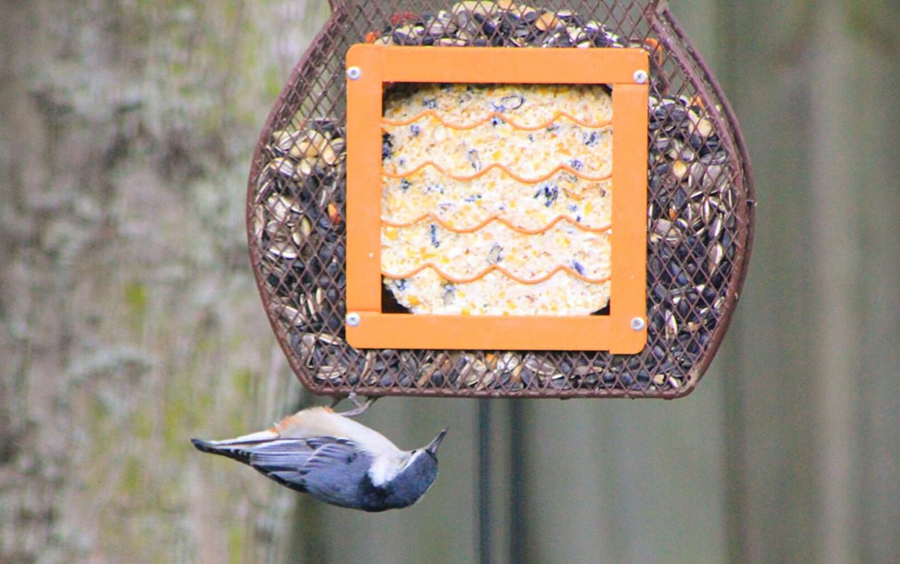
One of the simplest and most effective ways residents can help wild birds is by regularly cleaning bird feeders. Seed and suet feeders should be cleaned at least once every two weeks, and hummingbird feeders should be cleaned at least once a week. Bird feeders can be a breeding ground for disease if not properly cleaned. Help your feathered visitors stay healthy year-round by scrubbing feeders with soap and water, followed by a short soak in a 10% bleach solution.
Resources:
Cause of Songbird Deaths Remains a Mystery, Purdue Extension-Forestry and Natural Resources, Got Nature? Blog
Birdfeeder tips, The National Audubon Society
Birds and Residential Window Strikes: Tips for Prevention, The Education Store, Purdue Extension resource center
Breeding Birds and Forest Management: the Hardwood Ecosystem Experiment and the Central Hardwoods Region, The Education Store
Managing Woodlands for Birds Video, Purdue Extension-Forestry and Natural Resources YouTube Channel
Indiana Department of Natural Resources
On this episode of ID That Tree, meet the Northern Catalpa, native to southern Indiana along the Ohio River bottoms. This species, which provides rot resistant wood great for outdoor usage, features beautiful flower clusters in early summer, huge heart shaped leaves in whirled formation, and long bean-like fruit pods.
If you have any questions regarding wildlife, trees, forest management, wood products, natural resource planning or other natural resource topics, feel free to contact us by using our Ask an Expert web page.
Resources:
ID That Tree, Playlist, Purdue Extension – Forestry and Natural Resources Youtube Channel
A Woodland Management Moment, Playlist, Purdue Extension – FNR Youtube Channel
Shrubs and Woody Vines of Indiana and the Midwest, Purdue University Press
Native Trees of the Midwest, Purdue University Press
Investing in Indiana Woodlands, The Education Store
Forest Improvement Handbook, The Education Store
Northern Catalpa, The Purdue Arboretum Explorer
Lenny Farlee, Sustaining Hardwood Extension Specialist
Purdue University Department of Forestry and Natural Resources
On this edition of ID That Tree, Purdue Extension forester Lenny Farlee introduces you to the swamp white oak, a native Indiana species typically found in bottomlands and wet sites. This member of the white oak group has rounded lobed leaves that are dark on top and light colored on the flip side, and produces acorns that are held on long stems.
If you have any questions regarding wildlife, trees, forest management, wood products, natural resource planning or other natural resource topics, feel free to contact us by using our Ask an Expert web page.
Resources:
ID That Tree, Playlist, Purdue Extension – Forestry and Natural Resources Youtube Channel
A Woodland Management Moment, Playlist, Purdue Extension – FNR Youtube Channel
Shrubs and Woody Vines of Indiana and the Midwest, Purdue University Press
Native Trees of the Midwest, Purdue University Press
Investing in Indiana Woodlands, The Education Store
Forest Improvement Handbook, The Education Store
Swamp White Oak, The Purdue Arboretum Explorer
Lenny Farlee, Sustaining Hardwood Extension Specialist
Purdue University Department of Forestry and Natural Resources
In this spring bloom edition of ID That Tree, meet the bladdernut, which features clusters of tiny white/yellow flowers in the spring. Learn more about this small shrub from Purdue Extension forester Lenny Farlee inside.
If you have any questions regarding wildlife, trees, forest management, wood products, natural resource planning or other natural resource topics, feel free to contact us by using our Ask an Expert web page.
Resources:
ID That Tree, Playlist, Purdue Extension – Forestry and Natural Resources Youtube Channel
A Woodland Management Moment, Playlist, Purdue Extension – FNR Youtube Channel
Shrubs and Woody Vines of Indiana and the Midwest, Purdue University Press
Native Trees of the Midwest, Purdue University Press
Investing in Indiana Woodlands, The Education Store
Forest Improvement Handbook, The Education Store
Lenny Farlee, Sustaining Hardwood Extension Specialist
Purdue University Department of Forestry and Natural Resources
On this edition of ID That Tree, meet the American hornbeam, also known as the musclewood or the water or blue beech. This native Indiana understory tree stands out due to its gray bark and striations that resemble muscles and sinews as well as its doubly toothed leaves.
If you have any questions regarding wildlife, trees, forest management, wood products, natural resource planning or other natural resource topics, feel free to contact us by using our Ask an Expert web page.
Resources:
ID That Tree, Playlist, Purdue Extension – Forestry and Natural Resources Youtube Channel
A Woodland Management Moment, Playlist, Purdue Extension – FNR Youtube Channel
Shrubs and Woody Vines of Indiana and the Midwest, Purdue University Press
Native Trees of the Midwest, Purdue University Press
Investing in Indiana Woodlands, The Education Store
Forest Improvement Handbook, The Education Store
American Hornbeam, The Purdue Arboretum Explorer
Lenny Farlee, Sustaining Hardwood Extension Specialist
Purdue University Department of Forestry and Natural Resources

Recent Posts
- October Is Firewood Month: Protect Indiana’s Forests by Making Smart Choices
Posted: October 1, 2026 in Forestry, Forests and Street Trees, How To, Invasive Insects, Urban Forestry - Heavy August Rains Bring More Mosquitoes to Indiana
Posted: September 9, 2026 in How To, Invasive Insects, Safety, Wildlife - Question: Why Did the Shagbark Hickories Survive the Tornado?
Posted: August 27, 2026 in Forests and Street Trees, How To, Urban Forestry - Indiana Fall Hunting Licenses on Sale and New Mobile App Available
Posted: August 12, 2026 in Forestry, How To, Wildlife - Trees and Storms: Understanding Damage, Risk and Recovery
Posted: in How To, Urban Forestry - Celebrate Pollinator Week With Flowers of June Tour
Posted: June 15, 2026 in Forestry, Gardening, How To, Wildlife - Connecting Research to Practice: Natural Resources & Land Use Spring Training
Posted: June 5, 2026 in Forestry, Forests and Street Trees, How To, Invasive Animal Species, Invasive Plant Species, Land Use, Natural Resource Planning, Urban Forestry, Wildlife, Woodlands - Indiana Monarch and Pollinator Conservation
Posted: June 1, 2026 in Forestry, Forests and Street Trees, Gardening, How To, Natural Resource Planning, Plants, Urban Forestry, Wildlife - Spring Storms Are Coming: How to Reduce Tree Damage and Risk
Posted: May 1, 2026 in How To, Urban Forestry, Wildlife, Woodlands - It’s Timberdoodle Time!
Posted: April 3, 2026 in Got Nature for Kids, How To, Wildlife
Archives
Categories
- Alert
- Aquaculture/Fish
- Aquatic/Aquaculture Resources
- Ask the Expert
- Christmas Trees
- Community Development
- Disease
- Drought
- Forestry
- Forests and Street Trees
- Gardening
- Got Nature for Kids
- Great Lakes
- How To
- Invasive Animal Species
- Invasive Insects
- Invasive Plant Species
- Land Use
- Natural Resource Planning
- Nature of Teaching
- Plants
- Podcasts
- Ponds
- Publication
- Safety
- Spiders
- Timber Marketing
- Urban Forestry
- Webinar
- Wildlife
- Wood Products/Manufacturing
- Woodland Management Moment
- Woodlands