 Purdue University - Extension - Forestry and Natural Resources
Got Nature? Blog
Purdue Landscape Report, Why are the Japanese beetles running late this year?: Nothing heralds summer like the hum of Japanese beetles ravenously descending on a flower garden. Cool weather this spring has slowed emergence of adults from the soil. Heavy spring rains early followed by relatively drier weather in late June, may have trapped adult Japanese beetles under a crusty layer of hardened soil. Due to their large numbers in many parts of Indiana last year, they are very likely just waiting for a good rain to soften the surface, so they can dig themselves into the light of day and on to your flowers. So, if we get a little more rain by the time this article comes out, we are likely to be awash in adult beetles.
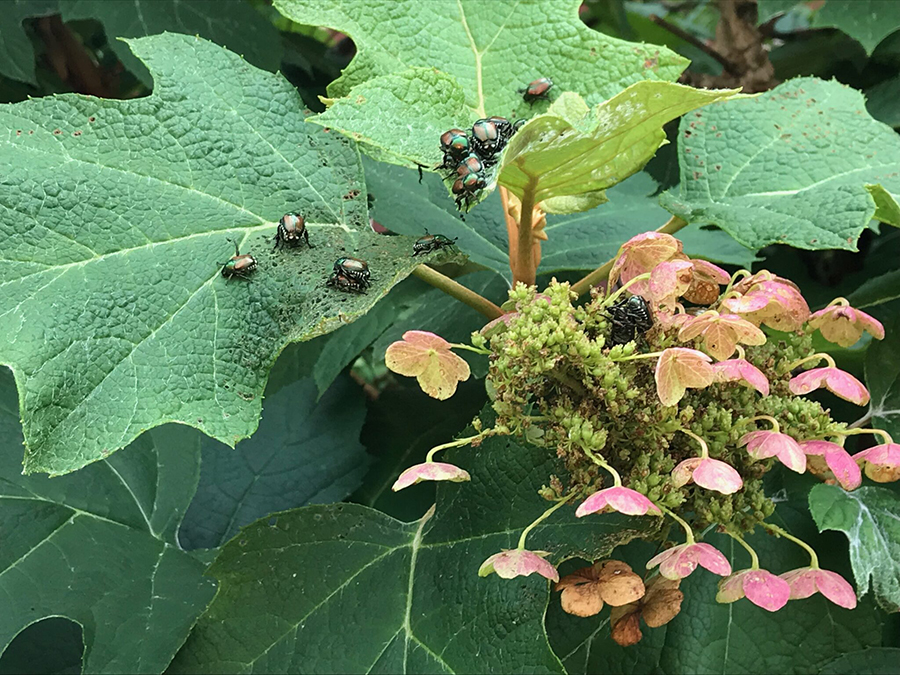 Weather is only part of what makes Japanese beetles predictably unpredictable. Beneficial organisms including fungi, microsporidia, and parasitic wasps also act different life stages of Japanese beetles. Japanese beetles have been the target of several national programs to release these beneficial organisms to reduce beetle populations. Favorable conditions for these beneficials can help reduce the local abundance of grubs and beetles.
Although killing grubs will reduce the number of beetles, the small size of lawns and the long flight range of makes it unlikely for your grub control program to reduce defoliation. In experiments conducted in my lab over 20 years ago, we found adult beetles can easily fly a kilometer (0.66 miles) in a single day. With adults living for several weeks, it is easy to image beetles traveling long distances from untreated lawns to plants on your property.
Life cycle of Japanese beetles: As the weather warms in the spring larvae (aka white grubs) move closer to the surface and begin feeding on turf roots. In May they enter a pupal stage and stop feeding. In June they typically emerge from the soil as adults. Adults fly in summer when they feed on flowers and leaves. In late July and early August adults lay eggs into the turfgrass. White grubs hatch from eggs and feed on the roots until frost when the larvae begin dig deeper into the soil to avoid killing temperatures.
To find out what you can do about Japanese beetles and view photos view: Why are the Japanese beetles running late this year?
Resources:
Report Invasive
Invasive Species, Got Nature?
Invasive Species, Playlist, Purdue Extension – FNR YouTube Channel
Indiana Department of Entomology and Plant Pathology
Spotted lanternfly: Everything You Need to Know in 30 Minutes, Video, Emerald Ash Borer University
Emerald Ash Borer, EAB Information Network
Invasive plants: impact on environment and people, The Education Store, Purdue Extension’s resource center
Woodland Management Moment: Invasive Species Control Process, Video, Purdue Extension – Forestry and Natural Resources (FNR) YouTube Channel
What are invasive species and why should I care?, Got Nature? Blog, Purdue Extension – Forestry and Natural Resources
Pest Management, The Education Store
Cliff Sadof, Professor Entomology/Extension Fellow
Purdue Entomology
 The classic and trusted book “Fifty Common Trees of Indiana” by T.E. Shaw was published in 1956 as a user-friendly guide to local species. Nearly 70 years later, the publication has been updated through a joint effort by the Purdue Department of Forestry and Natural Resources, Indiana 4-H, and the Indiana Department of Natural Resources, and reintroduced as “An Introduction to Trees of Indiana.”
The full publication is available for download for $7 in the Purdue Extension Education Store. The field guide helps identify common Indiana woodlot trees.
Each week, the Intro to Trees of Indiana web series will offer a sneak peek at one species from the book, paired with an ID That Tree video from Purdue Extension forester Lenny Farlee to help visualize each species as it stands in the woods. Threats to species health as well as also insight into the wood provided by the species, will be provided through additional resources as well as the Hardwoods of the Central Midwest exhibit of the Purdue Arboretum, if available.
This week, we introduce the slippery elm or Ulmus rubra.
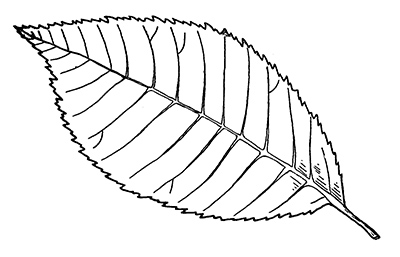
The slippery elm, also called red elm, is easily identified by its doubly-serrated simple leaves on short leaf stems, with a sandpapery upper surface. The bark features strong vertical ridges, which when sliced open feature alternating layers of tan and dark brown. The inner bark is slick, which gives the tree its name. The species also is called red elm due to its reddish heartwood.
Slippery elm has slightly larger leaves than its relative, the American elm, as well as a sandpapery texture on the leaves and twigs. The slippery elm is typically found more in upland areas, while the American elm is found in moist soil conditions such as valleys as well as river and creek bottoms.
Slippery elm can be found throughout much of the eastern and central United States, from Minnesota south into central Texas and as far west as central Kansas and Nebraska. Its range extends from northern Florida to Vermont along the east coast.
Like the American elm, which used to be a common street tree in Indiana, the number of slippery elms has dwindled due to Dutch elm disease, a fungal diseased which ravaged the species in the second half of the 20th century. Another disease called Elm Yellows (formerly phloem necrosis) also seriously affected slippery elms.
For full article with additional photos view: Intro to Trees of Indiana: Red Elm
Resources:
Elm, The Education Store, Purdue Extension resource center
Slippery Elm, Native Trees of Indiana River Walk, Purdue – Fort Wayne
Top 5 List for Tree Selection and Planting, Purdue Extension-Forestry & Natural Resources (FNR) Got Nature? Blog
Fifty Common Trees of Indiana
An Introduction to Trees of Indiana
Native Trees of the Midwest, The Education Store, Purdue Extension’s resource center
Shrubs and Woody Vines of Indiana and the Midwest, The Education Store
ID That Tree, Purdue Extension-FNR’s YouTube playlist
Woodland Management Moment , Purdue Extension-FNR’s YouTube playlist
Investing in Indiana Woodlands, The Education Store
Forest Improvement Handbook, The Education Store
Wendy Mayer, FNR Communications Coordinator
Purdue University Department of Forestry and Natural Resources
Lenny Farlee, Sustaining Hardwood Extension Specialist
Purdue University Department of Forestry and Natural Resources
Purdue Landscape Report, What is Happening to the Weeping Willows?: While recent temperatures have been moderate in many parts of the state, rainfall has been lacking. (See The Annual Drought Article). There are chasms in the clay of my backyard that will swallow my kids and dogs whole. While I am not truly worried about the safety of my smaller family members, a lot of the plants that are not in shade are stressed. At the Purdue Plant and Pest Diagnostic Laboratory, we have received quite a few calls, emails, and samples about trees in decline. Trees that are already stressed, infected by a pathogen, or are infested by wood-boring insects will be showing their true colors in these drought conditions: chlorosis, leaf loss, and limb dieback.
Willow showing yellowing of older leaves on lower branches.
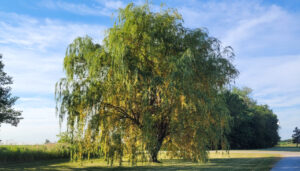 This month, one group of trees limps along to the top of our list of plants under stress due to lack of water: Willows. Salix spp. are not great landscape trees in general unless planted in locations that retain water. While they grow quickly and can appear beautiful for a number of years, when the soil becomes dry, these trees can very quickly develop limb dieback or cankers. In many cases, cankers become more obvious during these periods of stress because they were already present before the drought stress occurs. Damaged limbs die faster and multiple species of canker-causing fungi have been found to move faster in drought stressed wood of some tree species. We have found the fungi Cytospora, Botryosphaeria, and Colletotrichum associated with cankers on recent branch submissions to the lab.
Thinning of the branches, cracks/splits in the bark, and black lesions on green stems can indicate the presence of a canker which should be pruned out and destroyed, if at all possible. Supplemental irrigation may be required during dry spells for trees that are water loving or, at least, drought intolerant. Fungicides are not effective for these fungal pathogens that live inside the wood, where fungicides can’t penetrate. In most cases larger willow trees will not die because of these problems but they may suffer significant branch loss and may become disfigured. In some cases very young trees or shrub type willows may be killed.
For full article and photos view: What is Happening to the Weeping Willows?
Resources:
Summer Tree Care, Purdue Landscape Report
Drought? Don’t Forget the Trees!, The Education Store, Purdue Extension resource center
Extreme Heat, Purdue Extension – IN-PREPared
Drought Information, Indiana Department of Natural Resources
Planting Your Tree Part 1: Choosing Your Tree, Purdue Extension YouTube Channel
Tree Selection for the “Un-natural” Environment, The Education Store
Tree Pruning Essentials Video, Purdue Extension YouTube Channel
Tree Defect Identification, The Education Store
Tree Wound and Healing, Got Nature? Blog, Purdue Extension – Forestry and Natural Resources
Surface Root Syndrome, The Education Store
John Bonkowski, Plant Disease Diagnostician
Plant and Pest Diagnostic Laboratory
In this Moment in the Wild video, Purdue Extension wildlife technician Zach Truelock introduces you to the common water snake. He shows you how to tell it apart from the venomous cottonmouth and also shares identification and breeding information.
If you have any questions regarding wildlife, trees, forest management, wood products, natural resource planning, or other natural resource topics, feel free to contact us by using our Ask an Expert web page.
Resources
Snakes of Indiana, The Education Store, Purdue Extension resource center
Snakes and Lizards of Indiana, The Education Store
Snakes of Indiana, The Education Store
Snakes of the Central and Northeastern United States, The Education Store
Forestry Management for Reptiles and Amphibians: A Technical Guide for the Midwest, The Education Store
Appreciating Reptiles and Amphibians in Nature, The Education Store
Indiana Amphibian and Reptile ID Package (4 softcover books), The Education Store
When Juvenile Snakes Come Calling, FNR Got Nature? blog
A Moment in the Wild, Playlist, Purdue Extension – Forestry and Natural Resources
A Moment in the Wild: Black Racer, Video, Purdue Extension – Forestry and Natural Resources YouTube channel
A Moment in the Wild: Eastern Kingsnake, Purdue Extension – FNR Video
A Moment in the Wild: Eastern Hognose, Purdue Extension – FNR Video
Ask An Expert, Purdue Extension – FNR Playlist
Zach Truelock, Hellbender Technician
Purdue Forestry and Natural Resources
Rod Williams, Assistant Provost for Engagement/Professor of Wildlife Science
Purdue University Department of Forestry and Natural Resources
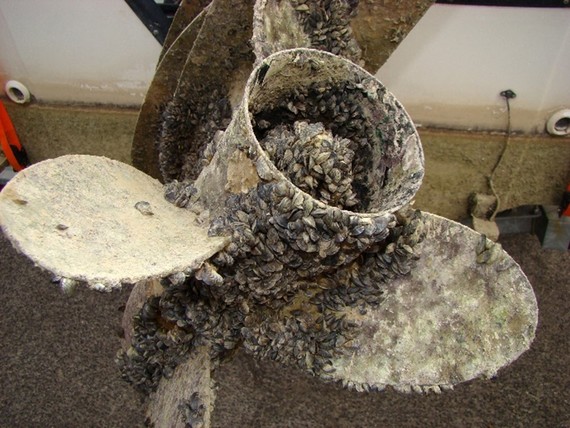 Wild Bulletin, Indiana DNR Fish & Wildlife email newsletter, Help stop the spread of aquatic invasive species: DNR and several Indiana conservation organizations gathered to take part in the fourth annual Great Lakes Aquatic Invasive Species Landing Blitz from June 24th to July 10th. Staff and volunteers were at state parks helping boaters, anglers and other water enthusiasts check their watercraft and other equipment for aquatic invasive species, along with educating them on preventive measures.
Aquatic invasive species are plants, animals, and other organisms that are not native to Indiana waters and have the potential to cause harm. These species are concerning because they outcompete native species, threaten human health, change and degrade the ecosystem, and/or require intense maintenance and monitoring.
Most invasive species find their way to Indiana through human behaviors. Modern transportation brings goods including invasive species from all around the world in a matter of hours or days. Some exotic pets or plants used in aquariums or water gardens escape into the wild and if they are adapted to Indiana’s conditions, they can become invasive. Boats and ships moving from waterbody to waterbody can spread invasives. Some invasives were brought to the U.S. intentionally as bio-controls for other invasives; others were introduced as game or food species.
Invasive species can be very expensive or impossible to control. For instance, Indiana spends an estimated $1 million per year in public waters to chemically control Eurasian watermilfoil, an invasive water plant that can shade out native species and interferes with boating and fishing. The damage to sport fisheries and commercial resources from AIS can be serious.
To learn how to stop “hitchhikers” and to learn more about aquatic invasive species view IN DNR: Aquatic Invasive Species.
Resources:
Invasive Mussels, IN DNR Fish and Wildlife
Aquatic Invasive Species in the Great Lakes: The Quagga Mussel, Purdue Extension – Forestry & Natural Resources (FNR) Got Nature? Blog
Aquatic Invaders in the Marketplace, Illinois-Indiana Sea Grant (IISG)
Invasive Species, Playlist, Purdue Extension – FNR YouTube Channel
What are invasive species and why should I care?, Got Nature? Blog, Purdue Extension – Forestry and Natural Resources
Report Invasive Species, Purdue Invasive Species
The GLEDN Phone App – Great Lakes Early Detection Network
EDDMaps – Early Detection and Distribution Mapping System
Indiana Department of Natural Resources: Invasive Species
Indiana Invasive Species Council
Cooperative Invasive Species Management Area (CISMA)
Great Lakes Sea Grant Network (GLERL), NOAA – Great Lakes Environmental Research Laboratory
A Field Guide to Fish Invaders of the Great Lake Regions, Illinois-Indiana Sea Grant (IISG)
Purdue Researchers Get to the Bottom of Another Quagga Mussel Impact, Illinois-Indiana Sea Grant (IISG)
Invasive plants: Impact on Environment and People, The Education Store, Purdue Extension’s resource center
Protect Your Waters, U.S. Fish and Wildlife Service & U.S. Coast Guard
Nongame and Endangered Wildlife, Indiana Department of Natural Resources
Indiana Department of Natural Resources (IN DNR) – Fish and Wildlife
The classic and trusted book “Fifty Common Trees of Indiana” by T.E. Shaw was published in 1956 as a user-friendly guide to local species. Nearly 70 years later, the publication has been updated through a joint effort by the Purdue Department of Forestry and Natural Resources, Indiana 4-H, and the Indiana Department of Natural Resources, and reintroduced as “An Introduction to Trees of Indiana.”
The full publication is available for download for $7 in the Purdue Extension Education Store. The field guide helps identify common Indiana woodlot trees.
Each week, the Intro to Trees of Indiana web series will offer a sneak peek at one species from the book, paired with an ID That Tree video from Purdue Extension forester Lenny Farlee to help visualize each species as it stands in the woods. Threats to species health as well as also insight into the wood provided by the species, will be provided through additional resources as well as the Hardwoods of the Central Midwest exhibit of the Purdue Arboretum, if available.
This week, we introduce the flowering dogwood or Cornus florida.
This small native Indiana tree has beautiful white blossoms in the spring, and red to maroon foliage in the fall. It has opposite leaf arrangement with simple leaves featuring a venation pattern that sees the veins angle and sweep along the edges of the leaf and curve to the tip. The bark is a rough alligator hide texture that ranges from light to medium gray.
The showy white flowers, which appear in April or May, are followed by berry-like fruit clusters that are green at first, later turning red.
Flowering dogwood is the largest dogwood in the state of Indiana. It is shade tolerant, but it prefers good soil drainage and protection from the wind.
Flowering dogwood is a great alternative to the invasive callery pear.
According to Morton Arboretum, the flowering dogwood grows to 20 to 40 feet tall.
According to the Wood Database, flowering dogwood is commonly used in golf club heads, textile shuttles, bows for archery, mallets, pulleys and turned objects.
For full article with additional photos view: Intro to Trees of Indiana: Northern catalpa
Resources:
Flowering Dogwood, Native Trees of Indiana River Walk, Purdue Fort Wayne
Fifty Common Trees of Indiana
An Introduction to Trees of Indiana
Native Trees of the Midwest, The Education Store, Purdue Extension’s resource center
Shrubs and Woody Vines of Indiana and the Midwest, The Education Store
Investing in Indiana Woodlands, The Education Store
Forest Improvement Handbook, The Education Store
ID That Tree, Purdue Extension-Forestry and Natural Resources (FNR) YouTube Channel-playlist
Woodland Management Moment, Purdue Extension-FNR YouTube Channel-playlist
Wendy Mayer, FNR Communications Coordinator
Purdue University Department of Forestry and Natural Resources
Lenny Farlee, Sustaining Hardwood Extension Specialist
Purdue University Department of Forestry and Natural Resources
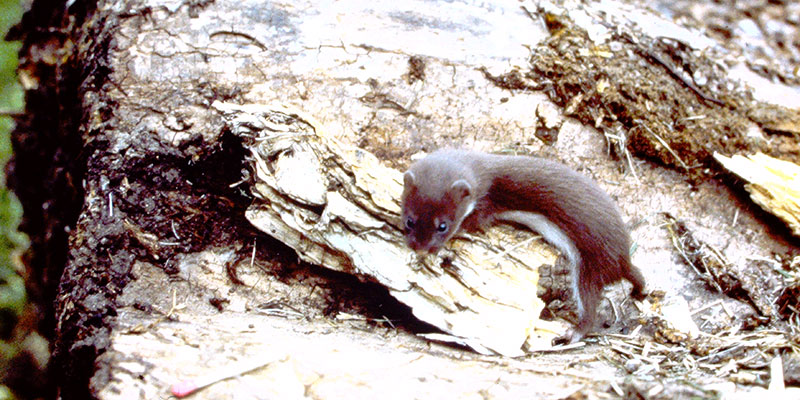
MyDNR, Indiana’s Outdoor Newsletter-Help the DNR by Reporting a Mammal: Did you get something unusual on a trail camera and want to share it to help wildlife in Indiana? DNR has launched a new Report a Mammal page. We are asking for the public’s help to submit sightings to the new online report form. Report a Mammal includes animals like armadillos, badgers, gray foxes, flying squirrels, star-nosed moles, ground squirrels, weasels, and more.
Indiana DNR offers a new, easier way to submit a report for the mammal, no password required. The report form also includes species at risk of declining and Species of Greatest Conservation Need, along with an area to submit a photo or brief video to help document the observation. Media of the animal observed would be most useful, though DNR biologists can examine evidence left by the mammal too (tracks, scat, or other signs). Completion of this form is voluntary. Data submitted may be shared within DNR and partners with the discretion of DNR staff. Personal information will be used to process your observation and may also be used for participation in surveys and other secondary purposes. DNR staff will only respond to reports if more information is needed.
To view what to report and for identification tips see: Full article > > >
Resources:
A Template for Your Wildlife Habitat Management Plan, The Education Store, Purdue Extension resource center
Wildlife Habitat Hint, Purdue Extension – Forestry & Natural Resources (FNR) YouTube Playlist
Orphaned Wildlife, Got Nature? blog
Orphaned & Injured Animals, Indiana Department of Natural Resources (IN DNR)
Purdue Extension – FNR: Ask An Expert, Video, Purdue Extension – FNR YouTube channel
Nature of Teaching, Website
A Woodland Management Moment, Playlist, Purdue Extension – Forestry and Natural Resources YouTube channel
Indiana Department of Natural Resources (IN DNR) – Fish and Wildlife
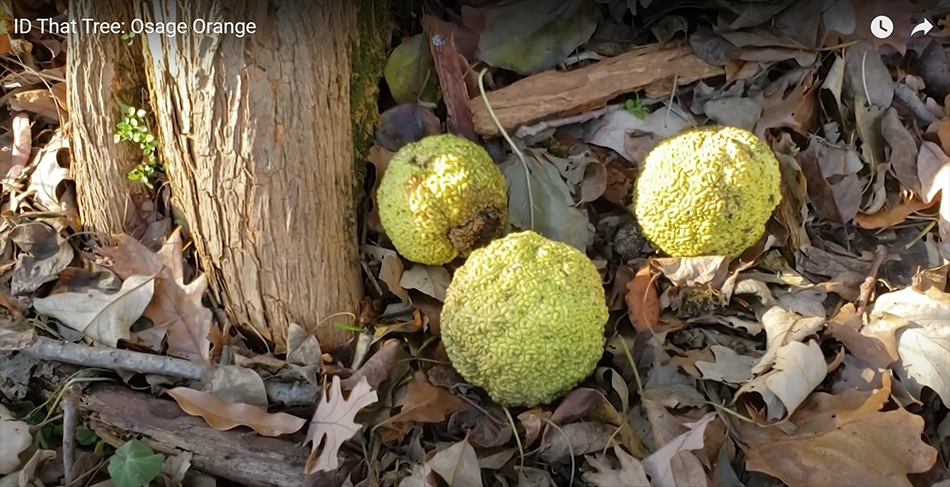 Question: I am building a hedge row and am contemplating working with Osage-orange seedlings and planting them. Is this a good choice?
Answer: Osage-orange, (Maclura pomifera) aka hedge, hedge-apple, bodark, bois d’arc and several other common names, is a tree native to parts of Arkansas, Oklahoma, and Texas, but has been planted in every one of the lower 48 states. The reason for that extensive planting was Osage-orange was promoted as the best tree for “living fences”, which were hedgerows planted to enclose or exclude livestock before the use of barbed wire. Osage-orange was also widely panted as a hedge-row and windbreak by the conservation programs of the FDR administration in the 1930’s. You can still encounter some of those old hedgerows on the landscape. It made a good hedgerow because the stems have stout thorns at the base of the leaves and will produce large and dense sprout colonies when cut back or pruned. It produced a living fence described as “horse-high, bull-strong, and pig-tight”.
The wood of Osage-orange was also used for wagon wheel parts, tool handles and fence posts due to its strength and rot-resistance. I have met a few landowners who showed me Osage gate or fence posts they had helped set as a child that were still in good condition 60 or more years later. It is also an excellent firewood, with one of the highest BTU yields of any native tree. Native peoples used straight-grained Osage-orange wood for outstanding bows, thus the French name bois d’arc and the English derivation bodark. Some crafters still seek Osage wood for making traditional bows or for turnings and other decorative items. The wood becomes so hard and dense with drying that it is recommended in most cases to work it green. The yellow-orange fresh wood color gradually ages to a deep reddish brown.
Osage-orange may have had more favorable treatment as a wood for many uses were it not for the tendency of the tree to fork, bend and twist, making straight, long stems uncommon.
The fruit of Osage-orange is where this and the hedge-apple name comes from. Osage-orange is neither a citrus tree nor an apple, but the large, round, green to yellow fruit suggest each to some extent. The interlacing bumps and crevices and the round shape suggest a brain to many, including myself. The closest relatives of Osage-orange are actually the mulberries. The size of this fruit and the limited number of current animals that will use it have prompted some to suggest it was originally eaten and propagated by large, and now extinct, ice-age animals such as the giant ground sloth, mammoth, and mastodon.
Osage-orange has many interesting and sometimes useful characteristics, but it can also become weedy in some situations. It can spread by seed or sprouts into disturbed areas like abandoned fields, farmlands, or grazed areas and out-compete native vegetation. For these reasons, planting new areas to Osage-orange is usually discouraged.
Resources:
You Say Hedge-Apple, I Say Osage Orange!, Indiana Yard and Garden – Purdue Consumer Horticulture.
Osage Orange, The Wood Database
ID That Tree: Osage-Orange, Purdue Extension-FNR’s YouTube playlist
ID That Tree, Purdue Extension-FNR’s YouTube playlist
Windbreaks – Agroforestry for Any Property, Caring for your Woodland, University of Wisconsin-Madison, Extension
The Woody Plant Seed Manual, U.S. Forest Service
Native Trees of the Midwest, The Education Store, Purdue Extension’s resource center
Shrubs and Woody Vines of Indiana and the Midwest, The Education Store
Woodland Management Moment , Purdue Extension-FNR’s YouTube playlist
Investing in Indiana Woodlands, The Education Store
Forest Improvement Handbook, The Education Store
Lenny Farlee, Sustaining Hardwood Extension Specialist
Purdue University Department of Forestry and Natural Resources
 The classic and trusted book “Fifty Common Trees of Indiana” by T.E. Shaw was published in 1956 as a user-friendly guide to local species. Nearly 70 years later, the publication has been updated through a joint effort by the Purdue Department of Forestry and Natural Resources, Indiana 4-H, and the Indiana Department of Natural Resources, and reintroduced as “An Introduction to Trees of Indiana.”
The full publication is available for download for $7 in the Purdue Extension Education Store. The field guide helps identify common Indiana woodlot trees.
Each week, the Intro to Trees of Indiana web series will offer a sneak peek at one species from the book, paired with an ID That Tree video from Purdue Extension forester Lenny Farlee to help visualize each species as it stands in the woods. Threats to species health as well as also insight into the wood provided by the species, will be provided through additional resources as well as the Hardwoods of the Central Midwest exhibit of the Purdue Arboretum, if available.
This week, we introduce Ohio Buckeye or Aesculus glabra.
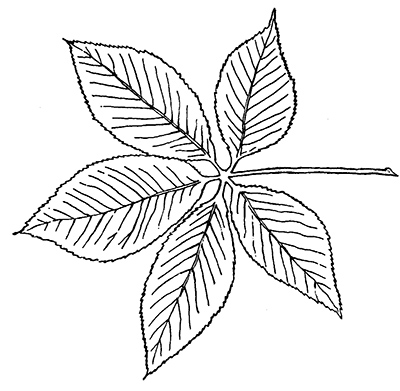
This understory tree is easily identifiable by its oppositely arranged compound leaves with five leaflets, placed like the fingers on your hand, that originate from one location on the long leaf stems. Ohio Buckeye features clusters of tubular yellow/green flowers borne on the end of the stems in the spring. In the winter, twigs show large white leaf scars where leaves were present the season prior. This tree produces round, shiny dark brown nuts, which are contained in a spiny shell.
 Ohio Buckeye is one of the first trees to leaf out in the spring, while its smooth buds also form early in the season. It is also one of the first trees to lose its leaves, typically at the end of the summer.
Ohio Buckeyes are found mostly in the understory, in the shade of other trees, on moist sites. They grow to be anywhere from 20 to 40 feet tall. According to the Morton Arboretum, Ohio Buckeyes are native from western Pennsylvania to Iowa and south to Alabama and Arkansas.
Ohio Buckeye is susceptible to a variety of pests and diseases from leaf blotch and powdery mildew to infestation by scale and Japanese beetles.
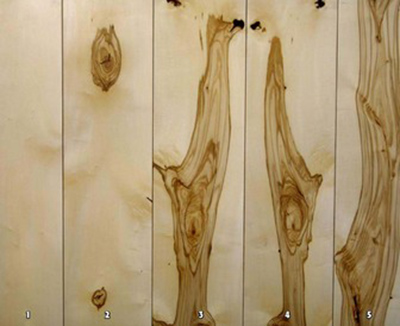
According to the Hardwoods of the Central Midwest exhibit, the sapwood is white to grayish with a darker irregular heartwood. The wood has uniformly distributed pores and its growth rings are slightly visible. With a 12 percent moisture content, buckeye weighs about 25 pounds per cubic foot, making it one of Indiana’s lightest weight woods.
The wood from Ohio Buckeye is very desirable for carving. In the past, it was used for artificial limbs. When the material is processed today, it is used for low-strength pallets and crates. It can also be used for paint grade molding.
For full article with photos view: Intro to Trees of Indiana: Ohio Buckeye
Resources:
Ohio Buckeye – Purdue Arboretum
ID That Tree Winter Edition: Opposite Leaf Arrangement – Ohio buckeye, Red maple, Purdue Extension-Forestry and Natural Resources’ YouTube playlist
Fifty Common Trees of Indiana
An Introduction to Trees of Indiana
Native Trees of the Midwest, The Education Store, Purdue Extension’s resource center
Shrubs and Woody Vines of Indiana and the Midwest, The Education Store
ID That Tree, Purdue Extension-FNR’s YouTube playlist
Woodland Management Moment , Purdue Extension-FNR’s YouTube playlist
Investing in Indiana Woodlands, The Education Store
Forest Improvement Handbook, The Education Store
Wendy Mayer, FNR Communications Coordinator
Purdue University Department of Forestry and Natural Resources
Lenny Farlee, Sustaining Hardwood Extension Specialist
Purdue University Department of Forestry and Natural Resources
MyDNR, Indiana’s Outdoor Newsletter, 2022-23 Migratory Bird Hunting Seasons: Indiana’s migratory bird hunting seasons for 2022-2023 have been submitted to the US Fish and Wildlife Service. These seasons include those for mourning doves, waterfowl (ducks, coots, mergansers, and geese), woodcock, snipe, and sora rails.
The seasons are listed in the image below with mourning dove hunting listed first with dates of Sept. 1 – Oct. 16 and then Nov. 1 – 27. If you need more information you can contact Adam Phelps, 812-929-0355, aphelps@dnr.IN.gov.
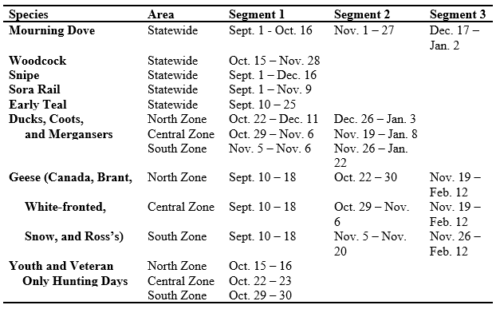
For the daily limits view 2022-23 Migratory Bird Hunting Seasons, Indiana Department of Natural Resources calendar post.
Resources:
Birds and Residential Window Strikes: Tips for Prevention, The Education Store, Purdue Extension resource center
Breeding Birds and Forest Management: the Hardwood Ecosystem Experiment and the Central Hardwoods Region, The Education Store
It’s For the Birds, Indiana Yard and Garden-Purdue Consumer Horticulture
Managing Woodlands for Birds Video, Purdue Extension-Forestry and Natural Resources (FNR) YouTube Channel
Ask An Expert, Playlist, Purdue Extension – FNR YouTube channel
No Room at the Inn: Suburban Backyards and Migratory Birds, Education Store, Purdue Extension resource center
Hardwood Ecosystem Experiment – Wildlife Responses to Timber Harvesting, The Education Store
Subscribe, Purdue Extension – FNR YouTube Channel
Division of Fish & Wildlife
Indiana Department of Natural Resources

Recent Posts
- Purdue Extension: Empowering Indiana Through Innovation, Education and Community Impact
Posted: January 28, 2026 in Community Development, How To, Invasive Insects, Invasive Plant Species, Natural Resource Planning, Woodlands - Forest Landowners: Share Your Experience with Regeneration and Restoration
Posted: January 27, 2026 in Forestry, How To, Timber Marketing, Woodlands - It’s Not Too Late to Order Trees for Spring Planting
Posted: January 13, 2026 in Forestry, How To, Plants - Now Is The Time To Control Non-Native Bush Honeysuckle
Posted: October 30, 2025 in Forestry, How To, Invasive Plant Species, Woodlands - October Is Firewood Month: Protect Indiana’s Forests by Making Smart Choices
Posted: October 13, 2025 in Forestry, Forests and Street Trees, How To, Invasive Insects, Urban Forestry - ID That Tree: Smooth Sumac
Posted: October 2, 2025 in Forestry, How To, Wildlife - ID That Tree: Wild Grape Vine
Posted: August 12, 2025 in Forestry, How To, Urban Forestry, Wildlife - Publication – Sericea Lespedeza Control
Posted: July 7, 2025 in Forestry, How To, Invasive Plant Species, Wildlife - How to ID Asian Jumping Worms, Purdue Landscape Report
Posted: July 2, 2025 in How To, Invasive Insects, Wildlife - Alert – Water Your Trees, Watch Video
Posted: June 20, 2025 in Alert, Drought, Forests and Street Trees, How To, Urban Forestry, Wildlife, Woodlands
Archives
Categories
- Alert
- Aquaculture/Fish
- Aquatic/Aquaculture Resources
- Ask the Expert
- Christmas Trees
- Community Development
- Disease
- Drought
- Forestry
- Forests and Street Trees
- Gardening
- Got Nature for Kids
- Great Lakes
- How To
- Invasive Animal Species
- Invasive Insects
- Invasive Plant Species
- Land Use
- Natural Resource Planning
- Nature of Teaching
- Plants
- Podcasts
- Ponds
- Publication
- Safety
- Spiders
- Timber Marketing
- Uncategorized
- Urban Forestry
- Webinar
- Wildlife
- Wood Products/Manufacturing
- Woodland Management Moment
- Woodlands