 Purdue University - Extension - Forestry and Natural Resources
Got Nature? Blog
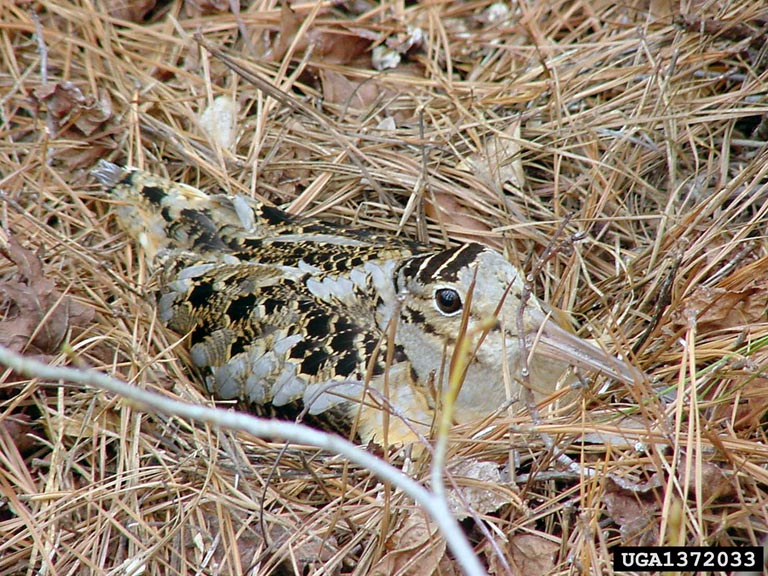
American Woodcock. Photo credit: Ricky Layson Photography, Bugwood.org.
You know Spring is around the corner when the days get longer and the temperatures rise. While the weather has pleasantly been warm this year so far, perhaps my favorite harbinger of Spring is the annual arrival of the American Woodcock, also known as the Timberdoodle. Their unique “peents” and the spectacular aerial flights of males looking to attract mates can be very entertaining.
Woodcock are migratory and spend their winters in the southern U.S. They arrive in Indiana in the early spring. Male woodcock typically set up their singing grounds in open fields and forest openings and recently logged areas. However, they can often be seen in urban areas including parks and even residential communities. The best time to observe them is at dusk. Woodcock will spend time on the ground “peenting” for a while, then fly high into the air to perform their “dance” only to return to the ground where they will repeat the process. This will go on until it gets dark. You can sometimes hear them peent in the morning before sunrise.
If you’re outside around dusk in early spring, keep an ear out — you just might hear the peent of a timberdoodle nearby.
Resources:
American Woodcock, Indiana Department of Natural Resources, Department of Fish & Wildlife
Americna Woodock – Listen to Woodcock call, Purdue Ross Biological Reserve
The Birders’ Dozen Profile 2: American Woodcock, Indiana Woodland Steward
Learn how forests are used by birds new videos, Got Nature? Blog
Managing Woodlands for Birds, The Education Store-Purdue Extension resource center
Managing Woodlands for Birds Video, Purdue Extension-Forestry and Natural Resources (FNR) YouTube Channel
Birds and Residential Window Strikes: Tips for Prevention, The Education Store, Purdue Extension resource center
Breeding Birds and Forest Management: The Hardwood Ecosystem Experiment and the Central Hardwoods Region, The Education Store
No Room at the Inn: Suburban Backyards and Migratory Birds, The Education Store
The Birders’ Dozen, Profile: Baltimore Oriole, Indiana Woodland Steward
Ask An Expert, Playlist, Purdue Extension – FNR YouTube Channel
It’s For the Birds, Indiana Yard and Garden-Purdue Consumer Horticulture
National Audubon Society
The Cornell Lab of Ornithology
Subscribe, Purdue Extension – FNR YouTube Channel
Brian MacGowan, Extension Wildlife Specialist
Purdue University, Department of Forestry and Natural Resources
Hummingbirds are a popular attraction in any backyard and we receive questions on when they will be coming to Indiana and how to attract them to your backyard. Our Purdue professor emeritus of wildlife ecology Barny Dunning in this interview for CBS4 Indianapolis titled “How to attract hummingbirds during peak migration,” shares how planting a variety of plants that bloom will help draw them in along with a simple hummingbird mixture.
The ruby-throated hummingbird is the only species of hummingbird that nests in the Hoosier state. These colorful visitors are migratory and arrive from their wintering grounds around mid-April.
Dr. Brian MacGowan has a publication titled Attracting Hummingbirds to Your Yard that is a great resource to share along with this video showing how to prepare your hummingbird feeders and how to find out when they will be migrating to your area. Hummingbird Central also tracks spring and fall migrations. Anyone can submit sightings on their website and view up-to-date sightings.
Resources:
Attracting Hummingbirds to Your Yard publication, The Education Store-Purdue Extension resource center
Virtual Tour Brings Forest Management for Birds to Life, Got Nature? Blog, Purdue Extension FNR
Birding Through the Seasons, Indiana Forestry & Woodland owners Association (IFWOA)
Behold! The Atlas of Breeding Birds of Indiana, MyDNR, Indiana Department of Natural Resources, Got Nature? Blog, Purdue Extension FNR
Breeding Birds and Forest Management: the Hardwood Ecosystem Experiment and the Central Hardwoods Region, The Education Store, Purdue Extension – Forestry and Natural Resources
Forest Birds, The Education Store
Managing Woodlands for Birds, The Education Store
Managing Woodlands for Birds Video, Purdue Extension-Forestry and Natural Resources (FNR) YouTube Channel
The Birders’ Dozen, Profile: Baltimore Oriole, Indiana Woodland Steward
Birds and Residential Window Strikes: Tips for Prevention, The Education Store, Purdue Extension resource center
No Room at the Inn: Suburban Backyards and Migratory Birds, Education Store
Question: Is there any risk of becoming infected with avian influenza virus by feeding backyard birds?, Got Nature? Blog, Purdue Extension FNR
Preventing Wildlife Damage – Do You Need a Permit?, The Education Store
How to Construct a Scent Station video, The Education Store
Subscribe – Purdue Extension-FNR YouTube Channel
Brian MacGowan, Wildlife Extension Specialist
Purdue Forestry and Natural Resources
MyDNR, Indiana’s Outdoor Newsletter: While temperatures were frigid, conditions were perfect for DNR mammalogists to conduct surveys for rare and endangered bats. About half of the bat species found in Indiana avoid the cold by seeking out climate-controlled caves where they can hibernate.

Image credit: Indiana Department of Natural Resources
During this time, biologists count bats to get a snapshot of roughly how many of each species are present. Conducting surveys regularly provides a better understanding of population trends over time and conducting them at the same time every other year helps to minimize disturbance. The surveys primarily target the Indiana bat, but also include counts for the gray bat, little brown bat, tricolored bat and big brown bat.
Donations to the Indiana Nongame Wildlife Fund help the DNR purchase equipment needed for surveys. One critical tool is digital cameras which enable biologists to spend less time in caves disturbing the bats and more time in the office viewing photos to obtain a more accurate count.
While the data is still being tallied for the 2026 winter bat count, the impression DNR mammalogists have from this winter’s surveys is that multiple bat species continue to show signs of population growth.
Want to help bats? You can give them the best chance to thrive by growing native plants, installing bat houses, protecting forested habitat and minimize disturbance to bats.
To subscribe to the newsletter, visit MyDNR Email Newsletter.
Resources:
Hardwood Ecosystem Experiment (HEE) Highlights: Bats, Video, Purdue Extension – Forestry and Natural Resources (FNR) YouTube Channel
Bats in the Belfry, Purdue Extension – FNR Got Nature? Blog
Ask An Expert: Bats on the Hardwood Ecosystem Experiment (HEE), Video, Purdue Extension – FNR Facebook
Bats in Indiana, Indiana Department of Natural Resources (IN DNR)
Bat Houses, Bat Conservation International
Creating a Wildlife Habitat Management Plan for Landowners, The Education Store, Purdue Extension’s resource center
The Hardwood Ecosystem Experiment (HEE): Indiana Forestry and Wildlife, The Education Store
Subscribe to Purdue Extension-FNR YouTube Channel
Unexpected Plants and Animals of Indiana: Indiana Bats, Purdue College of Agriculture News
Selecting a Nuisance Wildlife Control Professional, The Education Store, Purdue Extension’s resource center
FAQs – How can I get rid of nuisance wildlife (bats, deer, racoons, etc.)?
Division of Fish and Wildlife
Indiana Department of Natural Resources (IN DNR)
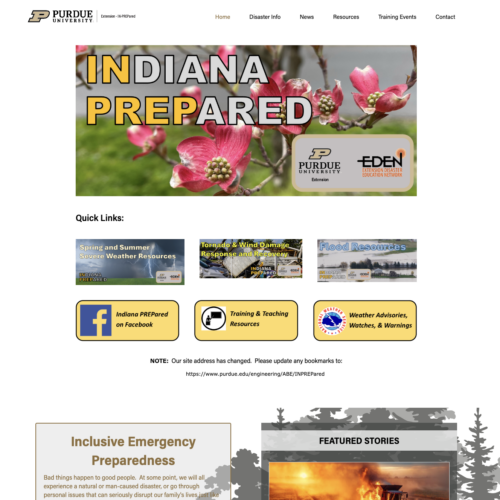 Indiana’s weather can shift quickly, from calm spring and summer mornings to severe thunderstorms, damaging winds and flash floods by afternoon. These sudden changes make it essential for individuals, families and communities to stay informed and prepared.
INdiana PREPared and the Extension Disaster Education Network (EDEN) have a wide range of resources and educational materials that can be used to help Extension professionals spread the word about preparing for and responding to severe spring and summer weather events.
Find a full collection of resources at these various webpages:
- Educator/Trainer Resources
- Spring and Summer Severe Weather Resources
- Tornado and Wind Damage Response and Recovery
- Flood Resources for Educators
 Stock your Go-Bag!
We encourage everyone to be ready for severe weather events by preparing a Go-Bag of important supplies. Click the image on the right/below to access INPREP’s Go-Bag Checklist, and feel free to share with your local clients. Remember to take into account the needs of family members impacted by disabilities!
By incorporating these IN-PREPared materials into programs, outreach efforts and conversations with community members, we can make a meaningful difference in how our communities respond and recover. Together, we can ensure that Hoosiers have the knowledge, tools and confidence to face severe weather with greater safety and resilience.
Resources:
Purdue Extension: Empowering Indiana Through Innovation, Education and Community Impact, Purdue Extension
Avian Flu in Birds, IN-PREPared
Combine & Field Fires, IN-PREPared
Trees and Storms – The Education Store, Purdue Education’s resource center
Community Development, Purdue Extension
Contact Your County Extension Educator, Purdue Extension
An Introduction to Trees of Indiana, Purdue University Press
Native Trees of the Midwest, Purdue University Press
ID That Tree, Playlist, Subscribe to Purdue Extension – Forestry and Natural Resources YouTube Channel
A Woodland Management Moment, Playlist, Purdue Extension – FNR YouTube Channel
Forest Improvement Handbook, The Education Store
Finding help from a professional forester, Indiana Forestry & Woodland Owners Association
District Foresters for 10 plus acres, Indiana Department of Natural Resources
Invasive Species Playlist, Playlist, Purdue Extension – FNR YouTube Channel
Indiana Department of Natural Resources: Invasive Species
What are invasive species and why should I care?, Got Nature? Blog, Purdue Extension – FNR
Invasive plants: impact on environment and people, The Education Store
Diana Evans, Extension & Web Communications Specialist
Purdue University Department of Forestry and Natural Resources
Ed Sheldon, Farm/Veteran Job Coach and Engagement Coordinator
Department of Agriculture & Biological Engineering, Purdue University
Michael Wilcox, Assistant Director and Program Leader for Community Development
EDEN State Point-of-Contact
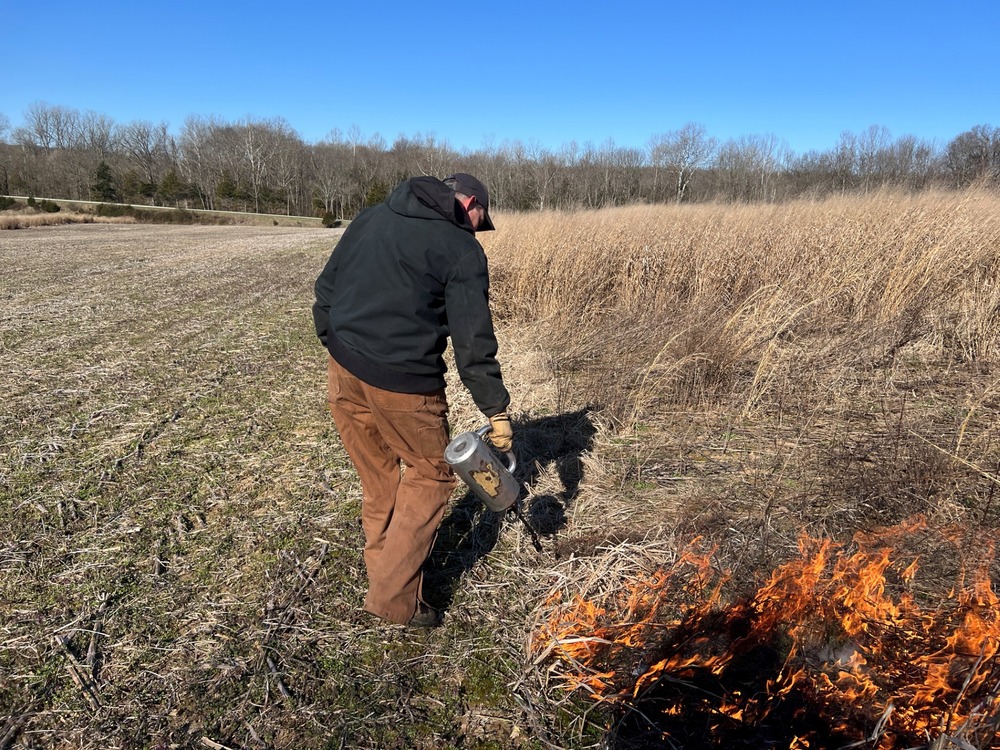
Indiana joined 22 other states in 2025 when it launched its state-level Certified Prescribed Burn Manager (CPBM) Program. This program resulted from HB-1557, which went into effect on July 1, 2025. For more information about the new prescribed fire law in Indiana and what it means for burners, check out the Indiana Prescribed Burn Law Factsheet.
This article will walk through the steps to complete all stages of the program. The Indiana DNR CPBM Policy can be viewed by visiting the Indiana Prescribed Fire Council website.
The CPBM program consists of three parts:
- Online Training
- In-Person Training
- Prescribed Burn Experience
 Indiana CPBM Requirements At-a-glance
- Online Training
- S-130
- S-190
- L-180
- IS-100
- In-Person Training
- S-130 Field Day (no pack test requirement)
- Indiana DNR Prescribed Fire for Managers
- Burn Experience (Minimum of 5 total burns for experience)
- Participate in 5 prescribed fires
- At least 3 in woodland at least 1 in grassland
- Ben an Apprentice Burn Manager for 2 burns
- 1 woodland and 1 grassland burn
- Paperwork and Documentation
- IN CPBM Application
- IN CPBM Experience Log
- IN CPBM Task Book
- Burn Plans for Apprentice Burns

Online Training Requirements
The online training required for the CPBM program includes many of the same courses as are necessary for Basic Wildland Firefighting.
- S-130 Firefighter Training
- S-190 Introduction to Wildland Fire Behavior
- L-180 Human Factors on the Fireline I
- S-100 Introduction to the Incident Command System
These are self-paced, free online courses available through FEMA, the National Fire Academy (NFA), and the Wildland Fire Learning Portal.
- FEMA – IS-100
- National Fire Academy Registration Page – S-130, S-190, L-180
- Wildland Fire Learning Portal – S-130, S-190, L-180
*Before taking any courses through FEMA or registering for the NFA, you need to obtain a FEMA SID#. You can do that at FEMA: Student Identification System.

In-Person Training Requirements
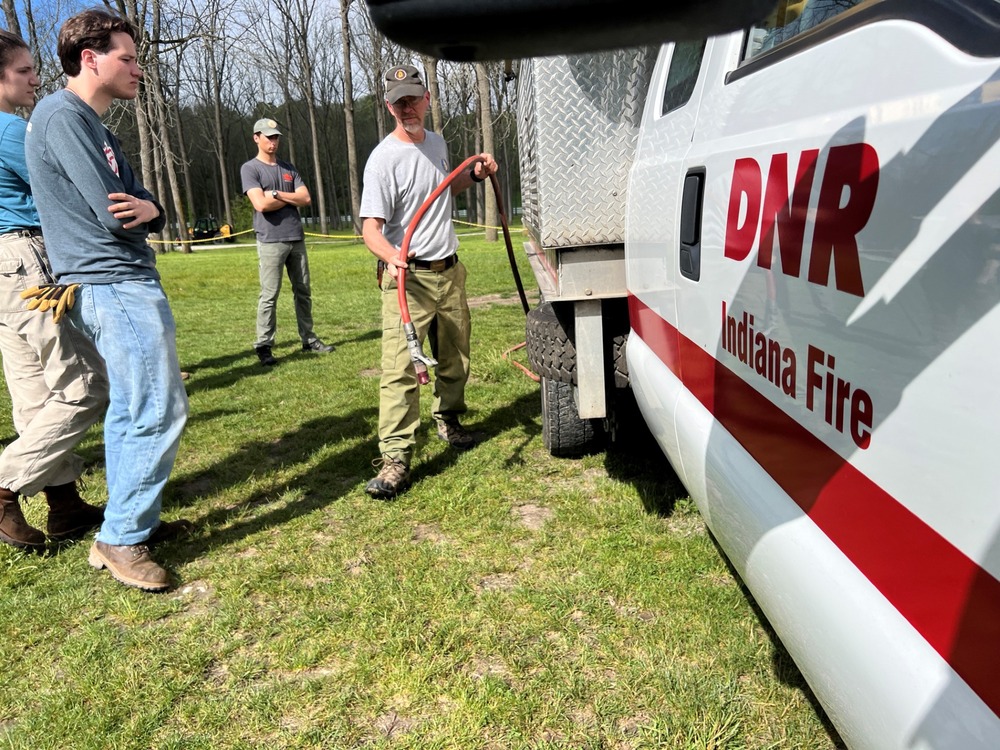 The two requirements for in-person training are:
- S-130 Field Day (1-day; no pack test required)
- Indiana DNR Prescribed Fire for Managers (2-day)
How to complete the in-person training?
In-person S-130 Field Days and Indiana DNR Prescribed Fire for Managers courses are offered 1-2 times per year, often offered in the spring (Feb-Mar) and in December.
*To take the S-130 Field Day, you need to complete the required online training before the field day. To take the Prescribed Fire for Managers Course, you need to take the S-130 Field Day.
You can find information about upcoming trainings by visiting the Indiana Prescribed Fire Council (INPFC) website and the Indiana DNR Fire Headquarters Training Portal.

Prescribed Burn Experience
To be an Indiana CPBM, you need the following prescribed fire experience:
- Participate in 5 prescribed fires across the 2 major fuel model groups in Indiana (grass and hardwood timber litter)
- At least 3 of the burns shall be in the hardwood timber litter fuel model
- Serve as an Apprentice Burn Manager on 2 of the 5 prescribed burns – 1 from each of the two fuel model groups (grass and timber litter)
Serving as an “Apprentice Burn Manager” means you need to lead burns under the guidance of an existing CPBM, RxB1, or RxB2 (RxB1 & RxB2 are Burn Boss qualifications through the National Wildfire Coordinating Group) and complete a Certified Prescribed Burn Manager Task Book related to preparing for and managing a prescribed burn.
How do I receive prescribed fire experience?
To get experience as a crew member on prescribed fires, here are a few steps:
- Meet Common Training Requirements: Many organizations (but not all) require burn crews to have basic wildland fire training courses, many of which are needed for the CPBM program. Having these trainings will open the door for more opportunities.
- Basic Wildland Firefighter (FFT2) Requirements (bolded are required for CPBM)
- S-130 (Online and Field Day)
- S-190
- L-180
- IS-100
- IS-700B
- Arduous Work Capacity Test (Pack Test)
- Basic Wildland Firefighter (FFT2) Requirements (bolded are required for CPBM)
- Attend a Learn-N-Burn: these half- or full-day events can help you get your feet wet with prescribed fire and are offered by groups like the Indiana DNR Division of Fish and Wildlife and Purdue Extension. Generally, prior experience or training is not required for these events.
- Upcoming Learn-N-Burns can be found under Events on the INPFC events website.
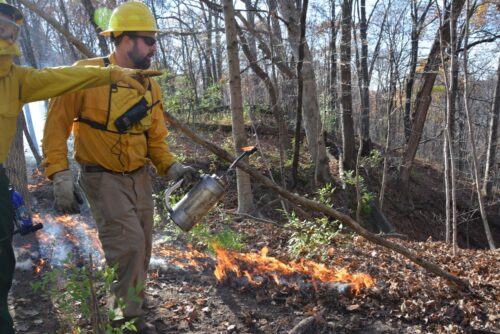 Find Volunteer Opportunities: Many organizations accept volunteers for prescribed fire, but may require Basic Wildland Firefighter Training (see above).
- Volunteer on burns with The Nature Conservancy
- To be a TNC fire volunteer, you need to be a FFT2 or complete the Prescribed Fire Crew Member (RxCM) standard, which is similar to FFT2 standards but does not require IS-700 and requires a moderate pack test. View the TNC Fire Manual for more information.
- To learn more about helping TNC on prescribed burns, contact Stuart Orr, Indiana Fire Program Manager at sorr@tnc.org.
- Volunteer on burns with The Nature Conservancy
- Volunteer with your Local Land Trust
- Indiana is home to over 20 land trusts, many of which utilize prescribed fire.
- Each land trust may have different requirements to volunteer for prescribed fire.
- Visit the Discover Your Land Trust page on the Indiana Land Protection Alliance website to find a land trust in your area.
- Find landowners in your area who are using prescribed fire and volunteer to help
- Several landowners across Indiana use prescribed fire and may be seeking help.
- You may be able to find landowners who burn through existing conservation networks, such as local NGOs (NWTF, NDA, PF, or QF Chapters) or landowner groups such as the Indiana Forest and Woodland Owners Association.
- Join or start a Prescribed Burn Association, which is a collection of landowners who help each other burn by pooling resources, equipment, knowledge, and crew through a “Neighbor Helping Neighbor” model.
- Several landowners across Indiana use prescribed fire and may be seeking help.
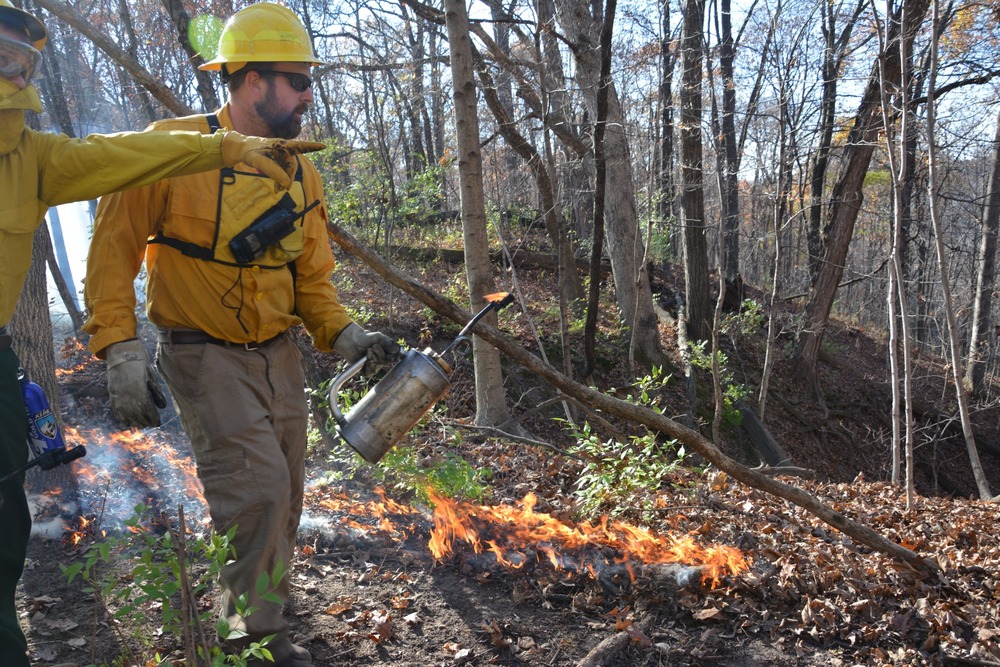
How do I receive apprentice burn manager fire experience?
The first step in finding opportunities is building relationships with current prescribed fire practitioners. By volunteering as a crew member, you start to learn about prescribed fire and build relationships with existing burn managers. This may lead to opportunities to apprentice in the future.
The Indiana Prescribed Fire Council is piloting a Prescribed Fire Opportunity Sharing Network to help connect those seeking burn experience with experienced burners. You can use the links below to sign up for this network as either a Mentor (have experience) or Mentee/Apprentice (need experience). Register on the Mentor sign-up or the Mentee sign-up.
Resources:
FNR Ask The Expert: Prescribed Fire, Purdue Extension Forestry & Natural Resources
100 Year Project Shares New Video, Prescribed Fire, Purdue Extension – FNR Got Nature? Blog
Brooke’s Prescribed Fire Videos Utilized in Global USFS Efforts, Purdue Extension – FNR Got Nature? Blog
Prescribed fire: 6 things to consider before you ignite, Got Nature? Blog, Purdue Extension – 4Forestry and Natural Resources
Wildlife Habitat Hint: Prescribed Fire Techniques – Backing Fire, Video, Purdue Extension – Forestry and Natural Resources YouTube channel
Wildlife Habitat Hint: Prescribed Fire Techniques – Flanking Fire, Purdue Extension – FNR Video
Wildlife Habitat Hint: Prescribed Fire Techniques – Strip Head Fire, Purdue Extension – FNR Video
Wildlife Habitat Hints: Prescribed Fire Techniques – Ring Fire, Purdue Extension – FNR Video
Wildlife Habitat Hints: Prescribed Fire Techniques – Point Source Fire, Purdue Extension – FNR Video
Wildlife Habitat Hint: Late Growing Season Prescribed Fire, Purdue Extension – FNR Video
FNR Ask The Expert: Prescribed Fire with Jarred Brooke and Mike Saunders, Purdue Extension – FNR Video
Indiana Prescribed Fire Council
Renovating Native Warm-Season Grass Stands for Wildlife: A Land Manager’s Guide, The Education Store, Purdue Extension resource center
Jarred Brooke, Wildlife Extension Specialist
Purdue Department of Forestry and Natural Resources
 Purdue Extension is proud to share the 2025 Impact Report, a showcase of the people, programs, and partnerships driving stronger, more resilient communities across Indiana. This year’s report highlights how research from Purdue’s College of Agriculture is being put into action, from addressing the spread of tar spot in corn, to monitoring invasive species, to supporting farmers navigating concerns around Highly Pathogenic Avian Influenza (bird flu).
Here is a quick snapshot of the great articles and information you will find:
- Saving One of Indiana’s Top Crops From Tar Spots
- 4-H Tech Changemakers Lead the Way in AI
- Teaching Small Steps to Achieve Healthier Lives
- Strengthening Financial Security Through Tax Preparation and Education
- Uniting Indiana Residents Against Invasive Species
Highlighting Lenny Farlee, Extension forester, and Henry Quesada, professor and assistant director of Extension. Check out all of our FNR resources listed below. - Supporting Childcare Providers to Create Stronger Communities
- Emergency Preparedness and Response to Highly Pathogenic Avian Flu
- Making the Best Better: Strengthening Teen Leadership Skills
- Check out program impacts
Explore the full report to see how Extension is making a difference statewide and beyond: Purdue Extension Impact Report 2025.
Resources:
What are Invasive Species and Why Should I Care?, Purdue Extension – Forestry & Natural Resources (FNR) Blog
Woodland Management Moment: Invasive Species Control Process, Purdue Extension – FNR YouTube channel
Asian Bush Honeysuckle, Purdue Extension – FNR YouTube channel
Burning Bush, Purdue Extension – FNR YouTube channel
Callery Pear, Purdue Extension – FNR YouTube channel
Multiflora Rose, Purdue Extension – FNR YouTube channel
Invasive Plants Threaten Our Forests Part 1: Invasive Plant Species Identification
Aquatic Invasive Species, Illinois-Indiana Sea Grant (IISG)
Indiana Invasive Species Council
Emerald Ash Borer Information Network, Purdue University and Partners
The GLEDN Phone App – Great Lakes Early Detection Network
EDDMaps – Early Detection and Distribution Mapping System
1-866 No EXOTIC (1-866-663-9684)
depp@dnr.IN.gov – Email Indiana Department of Natural Resources (DNR)
Woodland Stewardship for Landowners, Playlist, Purdue Extension – FNR YouTube channel
A Woodland Management Moment, Playlist, Purdue Extension – FNR YouTube channel
Subscribe to Purdue Extension – FNR YouTube channel YouTube channel
Nature of Teaching, Purdue College of Agriculture
Community Development, Purdue Extension
Are you a woodland owner who is just beginning to explore forest regeneration, restoration and reforestation activities?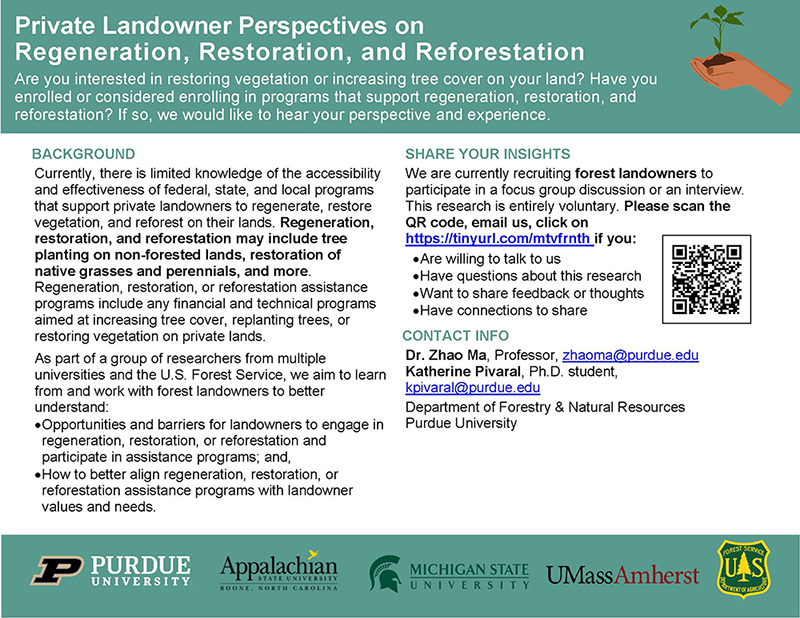
The Human Dimensions Lab at the Department of Forestry and Natural Resources with Purdue University is conducting research to understand private landowners’ perspectives on regeneration, restoration and reforestation. Private forest and woodland owners are key partners in forest and vegetation management efforts across the United States. These activities may involve tree planting, restoration of native vegetation or other practices aimed at enhancing forest and vegetation cover on private lands. Various federal, state and local programs offer financial and technical assistance to support these efforts and understanding landowner perspectives is important for informing future research and outreach.
About the Research
As part of a collaborative research effort involving multiple universities and the U.S. Forest Service, the Purdue University research team is working directly with private forest landowners to better understand real‑world experiences with regeneration, restoration and revegetation.
Specifically, the research aims to:
- Better understand the opportunities and barriers that landowners face when considering or engaging in regeneration, restoration or revegetation activities, including participation in assistance programs.
- Explore how assistance programs can better align with landowner values, needs and goals.
By learning directly from landowners, especially those who are in the early stages of exploring these activities, the researchers hope to generate insights that can improve the design and delivery of support programs in the future.
Who Can Participate?
The research team is currently recruiting forest and woodland owners who have recently begun exploring regeneration, restoration or reforestation topics and are willing to share their perspectives.
Participation may include an interview or focus group discussion, depending on participant preference and availability. All participation is entirely voluntary.
Why Participate?
By sharing your experiences, questions and thoughts, you can help researchers and land management agencies better understand what works, what doesn’t and what support landowners truly need. Your insights can contribute to more effective, landowner‑centered programs that support forest and woodland stewardship on private lands.
Learn More or Get Involved
If you are interested in participating, have questions about the research, would like to share feedback or know others who may be interested, please reach out before March 15 and visit the Landowners: Share Your Insight form provided by the Purdue Human Dimensions Lab.
Contact Information:
Primary: Katherine Pivaral, Ph.D. Student
Department of Forestry & Natural Resources, Purdue University
Email: kpivaral@purdue.edu
Dr. Zhao Ma, Professor
Department of Forestry & Natural Resources, Purdue University
Email: zhaoma@purdue.edu
FNR looks forward to learning from and collaborating with forest and woodland owners to better understand how regeneration, restoration and reforestation efforts can support both landowners and the landscapes they steward.
Katherine Pivaral, Ph.D. Student
Department of Forestry & Natural Resources, Purdue University
Resources:
Appalachian State University
Michigan State University
University of Massachusetts – Amherst
U.S. Forest Service
Hardwood Ecosystem Experiment (HEE)
Hardwood Tree Improvement & Regeneration Center (HTIRC)
Forest Improvement Handbook, The Education Store
Managing Your Woods for White-Tailed Deer, The Education Store
Deer Impact Toolbox, Purdue Extension
Virtual Tour Brings Forest Management for Birds to Life, Got Nature? Blog Post, Purdue Extension – Forestry and Natural Resources (FNR)
Silvics Succession Management Webinar, Purdue Extension-FNR YouTube Channel
Subscribe: Deer, Forest Management, ID That Tree, Woodland Management Moment, Invasive Species and many other topic video playlists Purdue Extension-FNR YouTube Channel
 As the snow flies and the temperature drops, there are still some activities that we can do to remind us that spring is on the way. One of those is planning for tree planting. The Indiana DNR Division of Forestry operates a nursery system that provides tree and shrub seedlings to Indiana landowners. The seedlings are intended for conservation plantings for purposes like wildlife habitat, erosion control, windbreaks, and reforestation plantings. The state nursery also provides Select black walnut, red oak, white oak and black cherry seedlings for those interested in growing trees for timber. These seedlings are a result of tree breeding programs at the Division of Forestry and Purdue University. Seedlings are mostly bare-root one and two year old stock intended for spring planting. Seedlings are still available for purchase from the state nursery system. You can find ordering and contact information for the state nursery at Instructions for Ordering Tree Seedlings.
There are also several private nursery options for ordering tree seedlings in Indiana. The private nurseries may be able to offer species, sizes, and quantities of seedlings not available from the state, and can also sell trees for non-conservation purposes like landscaping and Christmas trees. The National Nursery and Seed Directory provided by the USDA Forest Service provides a directory of seed and plant sources across the region.
When planting trees and shrubs, be sure to check the suitability of your site for the species of plants you plan to use. Long-lived woody plants need to be on sites well-suited to their growth for good long-term results. You can consult the Web Soil Survey for maps and information covering the soil types on your property. You can also consult forestry and conservation professionals for advise and assistance. Purdue Extension offers several resources for planning your tree planting including publications and upcoming workshops. Check out upcoming events: Purdue Extension – Forestry and Natural Resources (FNR) Events.
So, take some time while the snow is falling to make plans for a warm spring day of tree planting.
Resources:
Instructions for Ordering Tree Seedlings, Indiana DNR Division of Forestry
National Nursery and Seed Directory, USDA Forest Service
Conservation Tree Planting: Steps to Success – webinar, Purdue Extension-Forestry & Natural Resources (FNR) YouTube Channel
Web Soil Survey, USDA Natural Resources Conservation Service
Deer Impact, Purdue Extension Pond & Wildlife
Planting Forest Trees and Shrubs in Indiana (pdf), located on The Education Store, Purdue Extension’s resource center
Planting and Care of Fine Hardwood Seedlings (pdf), located on The Education Store, Purdue Extension’s resource center
Importance of Hardwood Tree Planting , The Education Store
Designing Hardwood Tree Plantings for Wildlife, The Education Store
Resources and Assistance Available for Planting Hardwood Seedlings, The Education Store
Creating a Wildlife Habitat Management Plan for Landowners, The Education Store
Forest Improvement Handbook, The Education Store
How to Build a Plastic Mesh Deer Exclusion Fence, The Education Store
ID That Tree, Purdue Extension-Forestry & Natural Resources (FNR) YouTube playlist
Woodland Stewardship for Landowners, Purdue Extension – FNR Extension YouTube Playlist
Woodland Management Moment, Purdue Extension – FNR YouTube Playlist
Lenny Farlee, Extension Forester
Hardwood Tree Improvement & Regeneration Center (HTIRC)
Purdue University Department of Forestry and Natural Resources
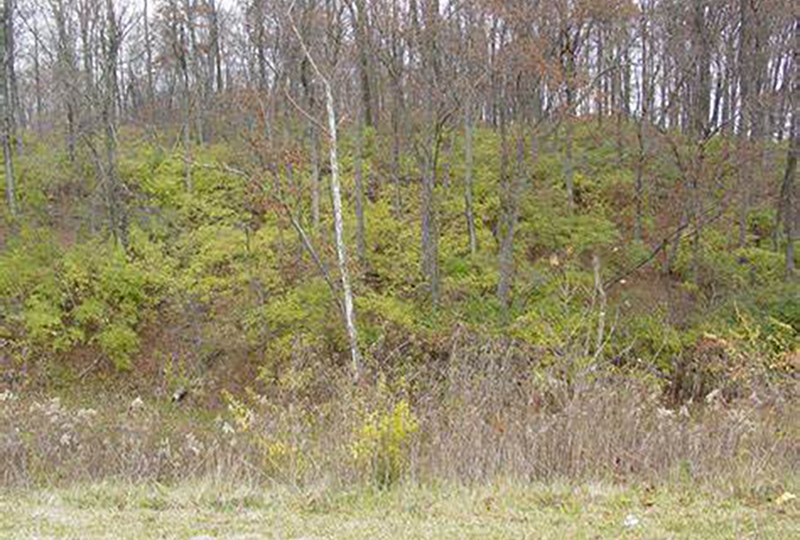
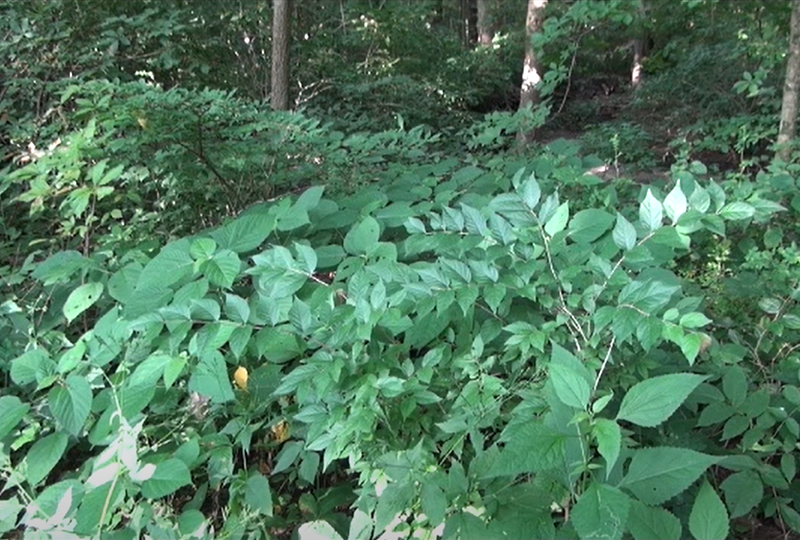
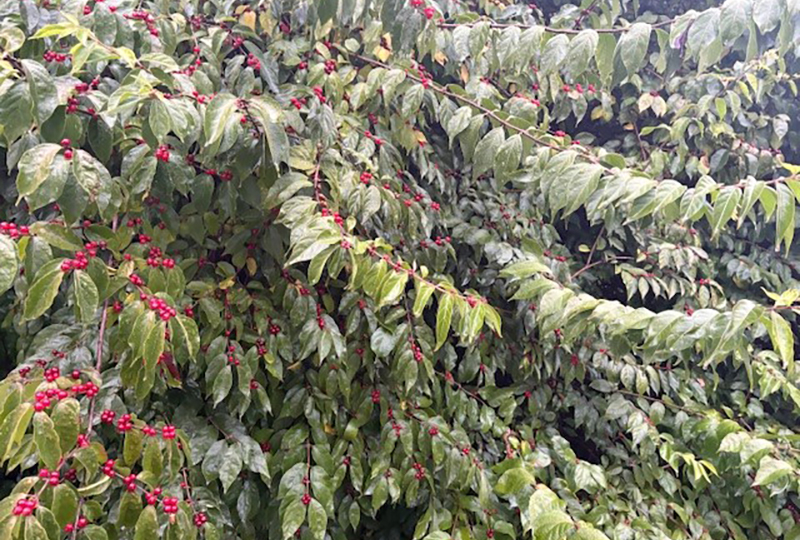
In early November, invasive bush honeysuckle is one of the only understory shrubs that are still green. While many of our native plants are dormant, Asian bush honeysuckle remains green longer making them easy to locate. Doing control measures this time of year also reduces impacts to non-target plants.
How do you control it? That depends on what resources you have available. Small plants can be easily pulled by hand; be sure to hang them on tree branch rather than laying them down on the ground so they don’t re-root. In most cases, some method of herbicide control will be necessary. Ohio State University has a good guide on various methods of control, Controlling Non-Native Invasive Plants in Ohio Forests: Bush Honeysuckle.
Not sure where to start on your property? One of the most daunting aspects of invasive plant control is where to begin. Ellen Jacquart, former Director of Stewardship for the Nature Conservancy in Indiana, wrote an article in the Indiana Woodland Steward. The Where do I Start?! Prioritizing Invasive Plant Control article describes how to plan your invasive plant control including prioritizing what to do first.
Click on the photos below for larger view to help as you identify Asian bush honeysuckle.

Resources:
Subscribe to the Indiana Woodland Steward Newsletter
Consider Fall Eradication of Asian Bush Honeysuckle, Purdue Landscape Report
Asian Bush Honeysuckle, Purdue Extension YouTube Video
A Woodland Moment: Asian Bush Honeysuckle, Purdue Extension – Forestry and Natural Resources (FNR) YouTube Video
Invasive Plants of the Eastern U.S.: An Introduction to the Problematic Non-Native Species, The Education Store, Purdue Extension’s resource center
Report Invasive Species, Purdue Invasive Species
Report Invasive Species: Asian Bush Honeysuckle, Purdue Invasive Species
The GLEDN Phone App – Great Lakes Early Detection Network
EDDMaps – Early Detection and Distribution Mapping System
Episode 11 – Exploring the challenges of Invasive Species, Habitat University-Natural Resource University
What Are Invasive Species and Why Should I Care?, Purdue Extension-FNR Got Nature? Blog
Emerald Ash Borer Information Network, Purdue University and Partners
Aquatic Invasive Species, Illinois-Indiana Sea Grant (IISG)
Invasive plants: impact on environment and people, The Education Store, Purdue Extension’s resource center
Subscribe Purdue Extension-Forestry and Natural Resources YouTube Channel
Brian MacGowan, Wildlife Extension Specialist
Department of Forestry and Natural Resources, Purdue University
As the crisp autumn air settles in and campfires become a seasonal staple, October brings an important reminder: your firewood choices matter. That’s why October is officially Firewood Month, a nationwide campaign to raise awareness about the risks of moving firewood and the spread of invasive forest pests.
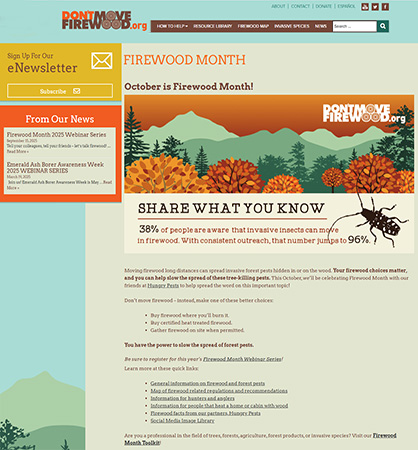 Why “Don’t Move Firewood” Matters
Transporting firewood, even just a few miles, can unintentionally spread destructive pests like emerald ash borer, Asian longhorned beetle and spongy moth. These invaders often hide inside or on firewood, threatening Indiana’s forests, parks and urban trees.
The Don’t Move Firewood website offers excellent resources to help you make informed choices. Whether you’re heating a cabin, heading out to hunt, or planning a backyard bonfire, they recommend:
- Buying firewood where you’ll burn it
- Choosing certified heat-treated wood
- Gathering wood on-site when permitted
You can also explore their Firewood Month Toolkit, maps of regulations and a webinar series designed for professionals and outdoor enthusiasts alike.
While October is Firewood Month, the risk of spreading invasive pests lasts well beyond the fall. Many forest pests remain a threat throughout the year. Adults may still be visible until the first hard freeze, and egg masses can be observed from now through June. The spotted lanternfly females lay egg masses in late summer through early winter, often peaking in October. These masses can survive through winter and hatch in the spring. Learn more about the Spotted Lanternfly from the Indiana Department of Natural Resources. This is why it’s important to practice safe firewood habits year-round.
Spotlight on ReportINvasive
Check out the latest post on the ReportINvasive Facebook which reinforces the importance of Firewood Month. ReportINvasive is a trusted source for updates on invasive species in Indiana, and their social media outreach is a great way to stay informed and engaged. Give the Facebook page a LIKE and FOLLOW for future webinars and workshops.
Concerned About Insects? Purdue Extension Entomology Can Help
 If you suspect insect damage or want to learn more about forest pests, the Purdue Extension Entomology team is an outstanding resource. Their experts provide science-based guidance on insect identification, management strategies, and outreach materials to help protect Indiana’s ecosystems.
Let’s work together to keep Indiana’s forests healthy and resilient. This October, make the smart choice—don’t move firewood!
More Resources
Spotted Lanternfly – including map sharing locations, Indiana Department of Natural Resources
October is Firewood Awareness Month!, Purdue Landscape Report
Indiana Department of Natural Resources: Invasive Species
Indiana Invasive Species Council
Cooperative Invasive Species Management Area (CISMA)
Aquatic Invasive Species, Illinois-Indiana Sea Grant (IISG)
Emerald Ash Borer Information Network, Purdue University and Partners
Invasive plants: impact on environment and people, The Education Store, Purdue Extension’s resource center
Entomology Weekly Review, Indiana Department of Natural Resources, Division of Entomology & Plant Pathology
Division of Entomology & Plant Pathology, Indiana Department of Natural Resources
Diana Evans, Extension and Web Communication Specialist
Purdue University Department of Forestry and Natural Resources

Recent Posts
- It’s Timberdoodle Time!
Posted: April 3, 2026 in Got Nature for Kids, How To, Wildlife - When is the Peak Migration For Hummingbirds and How Can You Attract Them?
Posted: April 2, 2026 in How To, Wildlife - 2026 Winter Bat Survey In Progress, MyDNR
Posted: March 27, 2026 in How To, Wildlife - IN-PREPared: Essential Resources for Indiana’s Severe Weather Season
Posted: March 11, 2026 in How To, Safety - Getting Certified as an Indiana Certified Prescribed Burn Manager
Posted: March 2, 2026 in How To, Urban Forestry, Woodlands - Purdue Extension: Empowering Indiana Through Innovation, Education and Community Impact
Posted: January 28, 2026 in Community Development, How To, Invasive Insects, Invasive Plant Species, Natural Resource Planning, Woodlands - Forest Landowners: Share Your Experience with Regeneration and Restoration
Posted: January 27, 2026 in Forestry, How To, Timber Marketing, Woodlands - It’s Not Too Late to Order Trees for Spring Planting
Posted: January 13, 2026 in Forestry, How To, Plants - Now Is The Time To Control Non-Native Bush Honeysuckle
Posted: October 30, 2025 in Forestry, How To, Invasive Plant Species, Woodlands - October Is Firewood Month: Protect Indiana’s Forests by Making Smart Choices
Posted: October 13, 2025 in Forestry, Forests and Street Trees, How To, Invasive Insects, Urban Forestry
Archives
Categories
- Alert
- Aquaculture/Fish
- Aquatic/Aquaculture Resources
- Ask the Expert
- Christmas Trees
- Community Development
- Disease
- Drought
- Forestry
- Forests and Street Trees
- Gardening
- Got Nature for Kids
- Great Lakes
- How To
- Invasive Animal Species
- Invasive Insects
- Invasive Plant Species
- Land Use
- Natural Resource Planning
- Nature of Teaching
- Plants
- Podcasts
- Ponds
- Publication
- Safety
- Spiders
- Timber Marketing
- Uncategorized
- Urban Forestry
- Webinar
- Wildlife
- Wood Products/Manufacturing
- Woodland Management Moment
- Woodlands