 Purdue University - Extension - Forestry and Natural Resources
Got Nature? Blog
MyDNR, Indiana’s Outdoor Newsletter: We need the public’s help to update The Big Tree Registry, a list of the largest known specimen of each native tree species in Indiana.
“Indiana’s currently tallest recorded tree is a 152-foot-tall bitternut hickory, and our widest tree circumference is a silver maple at more than 361 inches,” said Jacob Roos, DNR urban forestry director. “We need help getting out across the state to find our new record-setting trees.”
That means it’s time to review the recently updated champions list and start looking for new candidates to nominate for the list, which is maintained by DNR’s Division of Forestry.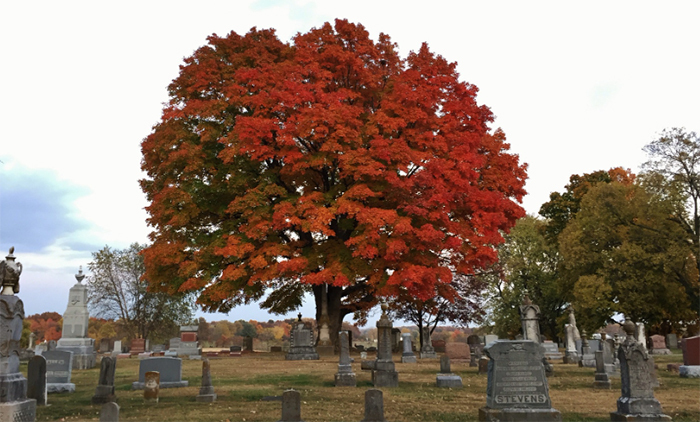 Three measurements are required:• trunk circumference, in inches, at 4 1/2 feet above the ground;• total height, in feet;• and average crown spread, in feet.The total size of each tree nominated is calculated by adding the circumference and height to a quarter of the average crown spread.The individual tree of each Indiana native tree species with the highest total points will be that species’ Big Tree champion. All nominations are reviewed, but only those with the highest scores will be verified.
To see full post please visit IN DNR, It’s Time to Start Looking for Big Trees.
To learn more please visit The Big Tree Registry, IN DNR-Division of Forestry.
Sign up to receive the MyDNR Newsletter by email: MyDNR Email Newsletter
Resources:
Investing in Indiana Woodlands, The Education Store
Forest Improvement Handbook, The Education Store
ID That Tree, Purdue Extension-Forestry & Natural Resources (FNR) YouTube playlist
Woodland Management Moment , Purdue Extension-FNR YouTube playlist
Find an Arborist, International Society of Arboriculture
Planting Your Tree Part 1: Choosing Your Tree, Purdue Extension YouTube Channel
Native Trees of the Midwest, The Education Store
Shrubs and Woody Vines of Indiana and the Midwest, The Education Store
Finding help from a professional forester, Indiana Forestry & Woodland Owners Association
District Foresters for 10 plus acres, Indiana Department of Natural Resources
Indiana Department of Natural Resources
Purdue Extension Showcase, Purdue Extension Annual Report highlights Purdue Extension-Forestry and Natural Resources Hardwood University program: Indiana ranks fourth in the U.S. in hardwood industry production. According to Indiana’s Department of Natural Resources, the hardwood industry contributes $17 billion in value-added to the Indiana economy. However, lack of skilled hardwood employees is the No. 1 impediment to industry success and growth. The number of job openings in wood products manufacturing exceeds the number of qualified applicants by a factor of 3:1 to 10:1. Hardwood industries employees require specialized training to produce lumber and hardwood products, and to maintain sustainable productivity of forest resources.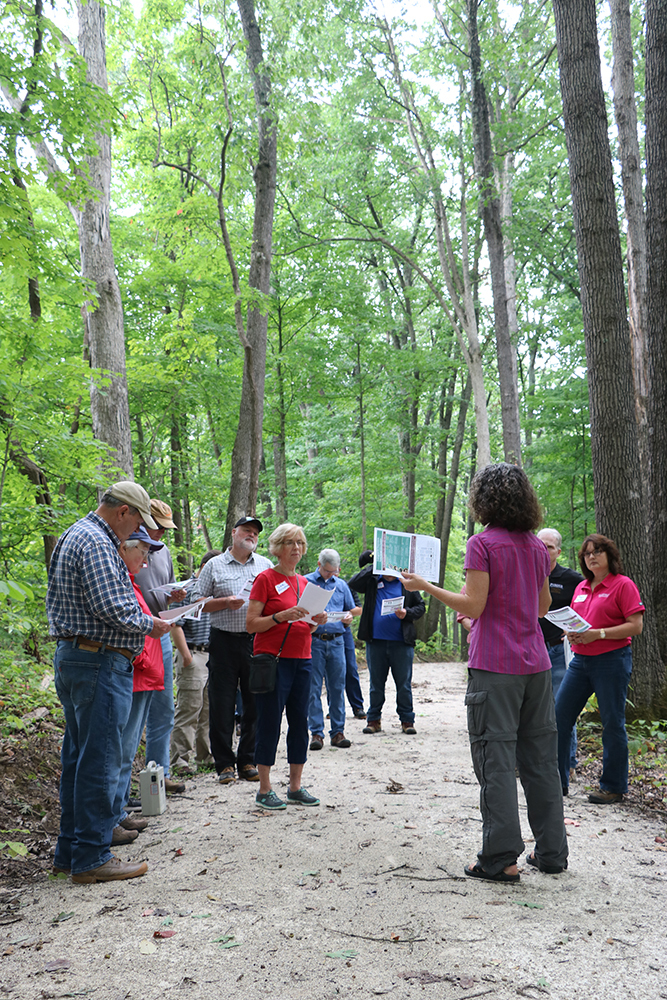
Purdue Extension annually offers a program, Hardwood University, to provide expertise, technical assistance, and education to industrial stakeholders engaged in wood products manufacturing to solve issues related to raw material quality, processing technologies, and manufacturing efficiency. Participants are business owners, chief executive and operations officers, production managers, supervisors, engineers, designers, equipment operators and industry associations in both primary hardwood products manufacturing for lumber and veneer, and secondary wood products manufacturing of furniture, cabinets, millwork, flooring and others. Nine monthly sessions during the academic year provide over 50 hours of instruction. Each session is a minimum of six hours and held at forestry or manufacturing worksites across Indiana. Hardwood industry professionals learned about sustainability of material supply, best management practices, procurement and marketing, tree, log and lumber quality and measurement, step-by-step processing techniques, equipment, and decision-making.
Participants may choose to focus on one of three tracks: 1) primary industry for log buyers, sawmill, stave mill, veneer mill, and lumber drying operators, 2) secondary industry for furniture, cabinet, millwork and other manufacturers of wood products, and 3) training a la carte for companies and individuals that would like to organize in-house training on a selected topic. Participants who finish all nine sessions in a chosen track within two years receive a program completion recognition from external partner Indiana Hardwood Lumbermen’s Association. In addition, sessions qualify for continuing education credits for certified foresters (Society of American Foresters), and consulting foresters (Association of Consulting Foresters). In one year of the program, 168 employees attended the sessions. Participants were employees new to the hardwood industry and employees preparing for advancement or cross-training.
On post-surveys, participants indicated they learned something new, increased awareness, and learned new skills. Participants indicated practices from the sessions that they plan to implement in the next 12 months. Most comments addressed lumber drying, including adjust kiln drying schedule, build/buy lumber dry kiln, change kiln startup procedure, change yard locations for drying particular species, eliminate standing water in yard, improve air flow in yard, and establish lumber drying operation. Also mentioned were: setting up lumber grading for company and training employees to grade lumber, conducting saw maintenance and changing sawing procedures, focusing on management – getting more education, implementing plan, or pursuing professional assistance, and identifying and sorting lumber by quality. Purdue Extension’s training for employees working in the hardwoods industry helps produce skilled workers for company success and to ensure sustainable management of woodlands across Indiana.
To read full article and others, check out Purdue Extension Showcase 2023.
Resources:
Hardwood Tree Improvement & Regeneration Center (HTIRC)
Tropical HTIRC
An Introduction to Trees of Indiana, The Education Store, Purdue Extension resource center
Native Trees of the Midwest, The Education Store
Shrubs and Woody Vines of Indiana and the Midwest, The Education Store
ID That Tree, Playlist, Subscribe to Purdue Extension – Forestry and Natural Resources YouTube Channel
A Woodland Management Moment, Playlist, Purdue Extension – FNR YouTube Channel
Investing in Indiana Woodlands, The Education Store
Forest Improvement Handbook, The Education Store
Finding help from a professional forester, Indiana Forestry & Woodland Owners Association
District Foresters for 10 plus acres, Indiana Department of Natural Resources
Sustainable Biomaterials, FNR Concentration
Wood is Best Video, Woodisbest.org
Rado Gazo, Professor of Wood Processing and Industrial Engineering
Purdue University Department of Forestry and Natural Resources
Hunters have been busy preparing food plots, hanging tree stands and working on their marksmanship skills in hopes for getting that buck of a lifetime. The Indiana deer hunting season for 2023-2024 started September 15th and goes to January 31st. As your hunting adventures begin, Purdue Extension-Forestry and Natural Resources (FNR) has the resources you need. You will find How-To videos that address how to score your white-tailed deer, age determination, how to harvest your deer and many other deer management resources. The FNR videos and publications will give you step-by step guidance on how to receive accurate measurements and share best data collection practices, along with sharing what materials are needed.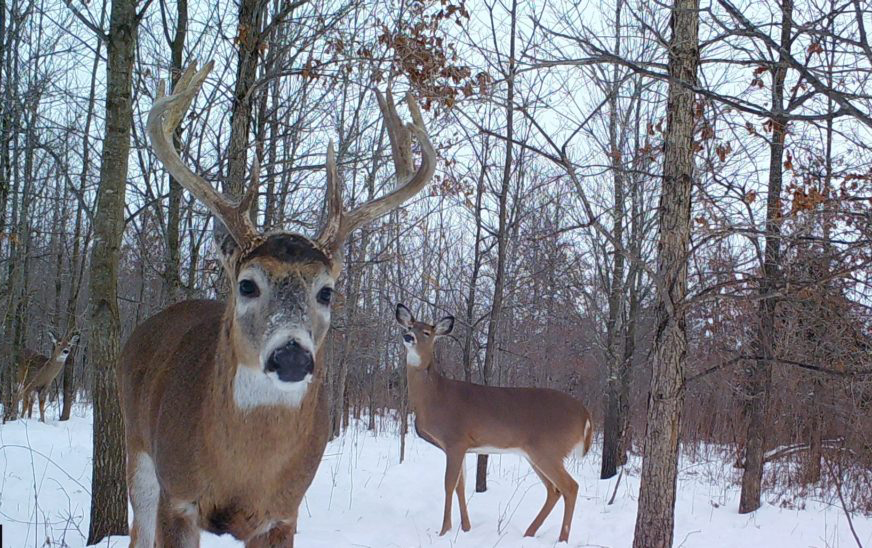
Here is a quick list of just a few of our resources for those deer hunting enthusiasts:
Ask an Expert: Wildlife Food Plots, video, Purdue Extension – Forestry and Natural Resources (FNR) YouTube Channel
Handling Harvested Game: Episode 1, Field Dressing, video, Purdue Extension – FNR YouTube Channel
Handling Harvested Game: Episode 2, Hanging & Skinning, video, Purdue Extension – FNR YouTube Channel
Handling Harvested Game: Episode 3, Deboning, video, Purdue Extension – FNR YouTube Channel
Handling Harvested Game: Episode 4, Cutting, Grinding & Packaging, video, Purdue Extension – FNR YouTube Channel
Deer Harvest Data Collection, Got Nature? Blog, Purdue Extension – FNR
How to Score Your White-tailed Deer, video, The Education Store, Purdue Extension Resource Center
White-Tailed Deer Post Harvest Collection, video, The Education Store
Age Determination in White-tailed Deer, video, The Education Store
Handling Harvested Deer Ask an Expert? video, Purdue Extension – FNR YouTube Channel
How to Build a Plastic Mesh Deer Exclusion Fence, The Education Store
Bovine Tuberculosis in Wild White-tailed Deer, The Education Store
Woodland Stewardship for Landowners: Managing Deer Damage to Young Trees, video, Purdue Extension – FNR YouTube Channel
Integrated Deer Management Project, Purdue FNR
For other hunting and trapping dates view the Indiana Department of Natural Resources, Fish and Wildlife Department website. Enjoy and stay safe!
Diana Evans, Extension & Web Communications Specialist
Purdue University Department of Forestry and Natural Resources
Rod Williams, Assistant Provost for Engagement/Professor of Wildlife Science
Purdue University Department of Forestry and Natural Resources
Jarred Brooke, Wildlife Extension Specialist
Purdue Forestry and Natural Resources
 Indiana Forestry & Woodland Owners Association (IFWOA) is a non-profit organization dedicated to conservation and sustainable management of forests in Indiana. The Fall Leaves & Limbs Newsletter is now available online and is open to all who would like to view the articles and resources.
Fall 2023 Leaves & Limbs Newsletter includes:
- Nesting and Overwintering Habitat for Pollinators and other Beneficial Insects
- Upcoming forestry events
- Chainsaw workshop for Woodland Owners
- Deam Finalists’ Excellent Stewardship to be Honored
- Series of Webinars Discuss Timber Taxes
- 2023 Woodland Owner Conference November 3-4 in Jasper/Huntingburg: Highlights, Agenda, Registration, Hotel
- Report Wilting Sassafras
- Emerging Invasive Plants of the Midwest
More About IFWOA
IFWOA is hosting the Indiana Woodland Owner Conference with field programs and indoor sessions on wildlife and habitat, forest management, and other concerns of landowners. The conference is November 3-4 and is open to anyone, nearly 200 landowners are expected to attend. See the agenda and register at https://www.ifwoa.org/resources/annual-woodland-owner-conference/.
IFWOA advocates for scientific best practices for woodland management to achieve objectives like clean water, wildlife habitat, soil protection, native species diversity, timber production, recreation, carbon sequestration and many others.
This Indiana association has members in every county of Indiana both woodland owners and non-owners, city and rural dwellers, family farmers, wildlife conservationists, agriculture and forestry professionals, tree farmers, loggers, scientists, educators — anyone who cares about the health of Indiana forests and woodlands, and wants to assure those lands receive the care and support they need.
Membership in IFWOA provides a valuable network linkage to information and resources at the leading edge of science, industry and politics impacting Indiana woodlands. If you would like to learn more about membership view Join Today, Indiana Forestry & Woodland Owners Association (IFWOA).
Resources:
Subscribe: Indiana Forestry & Woodland Owners Association (IFWOA) YouTube Channel
“Magnificent Trees of Indiana” webinar with author Carroll Ritter, IFWOA YouTube Channel
Forest Improvement Handbook, The Education Store, Purdue Extension’s resource center
Planting Hardwood Seedlings – The Education Store
Ordering Seedlings from the State Forest Nursery System, Got Nature? – Purdue Extension-FNR
Importance of Hardwood Tree Planting – The Education Store, Purdue Extension Resource Center
Designing Hardwood Tree Plantings for Wildlife – The Education Store
ID That Tree – YouTube Playlist
Forest Management for Reptiles and Amphibians: A Technical Guide for the Midwest, The Education Store
Hardwood Ecosystem Experiment – Forest Birds , Purdue Extension – FNR YouTube Channel
Ask the Expert: Hardwood Ecosystem Experiment – Birds and Salamander Research, Purdue Extension – FNR
Subscribe to Purdue Extension-FNR YouTube Channel
Liz Jackson, Engagement Lead
Indiana Forestry & Woodland Association
Purdue Landscape Report: Many trees are planted for their beautiful fall color, especially in locations where the climate provides reliable autumn weather. I have said this multiple times during extension talks and conversations with submitters to the Purdue Pest & Plant Diagnostic Lab (PPDL), but I seem to have not experienced a ‘normal’ fall since moving to Indiana with how erratic the weather has been from year to year. Depending on weather conditions, such as high heat and drought, colors may develop early or may be duller for specific varieties than expected.
However, individual trees that begin to show fall colors earlier than expected (August, September, even early October) may be shouting out a proverbial cry for help. Plants will often show yellow or red foliage coloration during periods of stress, so this may occur at any point during spring, summer, or fall. Individual trees may also show fall coloration earlier than others of their species in the same area. Now is the time to keep an eye out for this kind of early fall color as it can give you a heads-up on issues you can expect next year.
When examining a tree with early fall color, I would recommend checking the following:
- Is there a root flare?
Purdue Landscape Report: Deep Planting article- If not – tree could be planted too deep or the soil grade may have been changed
- Is there any obvious damage to the trunk, root flare, or surface roots?
- If so, there could internal decay that is not obvious and could be contributing to stress
- Are there any girdling roots?
Purdue Landscape Report: Stem Girdling Roots article- If present, they could be affecting the vascular system and strangling the tree
- Is the rootzone mulched?
- If not, the tree could be under stress from earlier drought, or weed and grass competition.
- If so, make sure it is not mounded against the trunk of the tree
- Does the soil appear compacted? Was there construction near the tree within the last 5 years?
- Compaction leads to issues with water, nutrient, and even oxygen availability to the roots and could lead to general decline
It is important to know the host species, but with the sheer volume of plant material available for sale in the nursery trade, it is even more important to know the cultivar that you are planting so you know what you might expect coming into the fall.
To view this full article and other Purdue Landscape Report articles, please visit Purdue Landscape Report.
Subscribe and receive the newsletter: Purdue Landscape Report Newsletter.
Resources:
Why Fall Color is Sometimes a Dud, Purdue Landscape Report
Forest Migration Plays a Role in Fall Foliage Colors, Purdue College of Agriculture News
U.S. Forest Service Fall Colors, Forest Service, U.S. Department of Agriculture
ID That Tree Fall Color: Sugar Maple, Purdue Extension – Forestry and Natural Resources YouTube Channel, ID That Tree Playlist
ID That Tree Fall Color Edition: Black Gum, Purdue Extension – FNR YouTube Channel, ID That Tree Playlist
Autumn Highlights Tour – South Campus, Purdue Arboretum Explorer
Why Leaves Change Color – the Physiological Basis, The Education Store, Purdue Extension resource center
Subscribe, Purdue Extension-Forestry and Natural Resources YouTube Channel
Planting Your Tree Part 1: Choosing Your Tree, Purdue Extension YouTube Channel
Summer Tree Care, Purdue Landscape Report
Tree Defect Identification, The Education Store
Tree Wound and Healing, Got Nature? Blog, Purdue Extension – Forestry and Natural Resources
Surface Root Syndrome, The Education Store
Shrubs and Woody Vines of Indiana and the Midwest, The Education Store
Ask an Expert: Tree Selection and Planting, Purdue Extension-Forestry & Natural Resources (FNR) YouTube playlist
ID That Tree, Purdue Extension-FNR YouTube playlist
John Bonkowski, Plant Disease Diagnostician
Departments of Botany & Plant Pathology
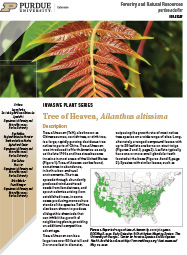 Tree-of-heaven (ToH), also known as Chinese sumac, varnish tree, or stink tree, is a large, rapidly growing deciduous tree native to parts of China. Tree-of-heaven was introduced to North America as early as the late 1700s and has since become invasive in most areas of the United States. Tree-of-heaven can be found, sometimes in abundance, in both urban and rural environments. The tree spreads through abundantly produced wind-scattered seeds from female trees, and sprout colonies arising from established trees, in some cases producing monoculture stands of the species. ToH has also been shown to produce allelopathic chemicals that can inhibit the growth of neighboring plants, providing an additional competitive advantage.
Tree-of-heaven is a serious threat as an invasive species in many habitats or untended areas. It can reach 80 feet or more, its growth rate outpaces most native tree species, and wind scatters seeds that female trees produce in abundance. Controlling ToH is a challenge. In this publication, Purdue University extension specialists and property managers explain herbicide options, application techniques and strategies to control and manage ToH.
To receive the free download visit the Purdue Extension’s resource center: The Education Store – Invasive Plant Series – Tree of Heaven, Ailanthus altissima.
View Forestry and Natural Resources (FNR) YouTube Video: ID That Tree: Invasive Tree of Heaven.
Resources:
Invasive Species, Playlist, Purdue Extension – FNR YouTube Channel
Report Invasive Species, Purdue Invasive Species
What are invasive species and why should I care?, Got Nature? Blog, Purdue Extension – Forestry and Natural Resources
Invasive plants: Impact on Environment and People, The Education Store, Purdue Extension’s resource center
A Woodland Management Moment, Playlist, Purdue Extension – Forestry and Natural Resources (FNR) Youtube Channel
Conservation Tree Planting: Steps to Success, Purdue Extension – FNR Youtube Channel
Forest Improvement Handbook, The Education Store
Tree Risk Management – Got Nature? Blog, Purdue Extension – FNR
Investing in Indiana Woodlands, The Education Store
Woodland Invaders, Got Nature? Blog, Purdue Extension – FNR
Indiana Department of Natural Resources: Invasive Species
Invasive Plant Species Identification, Video, Purdue Extension – FNR Youtube Channel
Mile-a-minute Vine, The Education Store
Lenny Farlee, Extension Forester
Hardwood Tree Improvement & Regeneration Center (HTIRC) & Purdue University Department of Forestry and Natural Resources
Ron Rathfon, Regional Extension Forester, Southern Indiana Purdue Agriculture Center (SIPAC)
Purdue Forestry and Natural Resources
MyDNR, Indiana’s Outdoor Newsletter: The Indiana Cooperative Fish and Wildlife Research Unit, or CRU, that Purdue will host, brings together the U.S. Geological Survey, U.S. Fish and Wildlife Service, Purdue University, the DNR, and the Wildlife Management Institute.
Its focus will be on delivering actionable science addressing fish, wildlife, plants, and other natural resources in Indiana and beyond, including the connection between the health of wildlife and the health of people.
The CRU Program is results focused, bringing together natural resource managers and researchers to work as a team to address the most pressing natural resource management needs with science. As such, the partnerships formalized with the creation of CRUs lead to true co-production of research.
“The creation of this new unit is another milestone in the highly successful USGS Cooperative Research Units Program, and we are proud to join the state of Indiana, Purdue University, the USGS, Wildlife Management Institute, and others to address conservation questions facing Indiana and the region,” said U.S. Fish and Wildlife Service Science Applications Program Assistant Regional Director Craig Czarnecki. “We look forward to engaging with the students and professionals at Purdue University as we co-develop scientific research and support the next generation of conservationists.”
But CRUs don’t just tackle management needs. They do so while cultivating the next generation of scientists and resource managers. The new Indiana CRU will focus on education, training, and outreach related to natural resources vital not only to Indiana, but the Midwest and regional economies as well.
Like all CRUs, the Indiana CRU will consist of 2-5 federal scientists along with graduate students, postdoctoral fellows, and administrative specialists. Federal scientists will serve as faculty at Purdue University, teaching graduate-level courses, supervising graduate students and postdocs, offering workshops for students and cooperators, and conducting research on natural resources topics. Once created, each CRU formalizes research priorities, like aquatic conservation or wildlife disease. Indiana CRU partners will decide these in the coming months.
“We look forward to the tremendous opportunity that collaboration with the Indiana CRU will bring to our state and Purdue University,” said Karen Plaut, executive vice president of research at Purdue University. “It will have a direct impact on graduate education as well as research productivity and innovation.”
For full article please visit: The partnership is Indiana’s first U.S. Geological Survey Cooperative Fish and Wildlife Research Unit, Indiana DNR Calendar.
Sign up to receive the MyDNR Newsletter by email: MyDNR Email Newsletter
Resources:
Purdue Announces New USGS Cooperative Research Unit, Purdue Agriculture New
Wildlife Habitat Education Program: Wildlife Identification Guide, The Education Store, Purdue Extension resource center
Wildlife Habitat Education Program – Teaching and Learning Wildlife Management Practices, The Education Store
Wildlife Habitat Evaluation Program: Preparing for the Wildlife Challenge, The Education Store
Developing a Wildlife Habitat Management Plan, The Education Store
Woodland Wildlife Management, The Education Store
Purdue Integrated Deer Management Project, Purdue College of Agriculture
Purdue Extension-Forestry and Natural Resources (FNR) Publications
Indiana Pond Fish, Species Identification Card Set, Purdue Extension – Forestry and Natural Resources (FNR)
A Guide to Small-Scale Fish Processing Using Local Kitchen Facilities, The Education Store
Subscribe to Purdue Extension-FNR YouTube Channel
Invasive Species, Playlist, Purdue Extension – FNR YouTube Channel
What are invasive species and why should I care?, Got Nature? Blog, Purdue Extension – Forestry and Natural Resources
Invasive plants: Impact on Environment and People, The Education Store, Purdue Extension’s resource center
Indiana Department of Natural Resources, Department of Fish & Wildlife

Figure 1. By the time all pine leaves are yellow, it is too late to save a tree.
Purdue Landscape Report: Trees stressed by prolonged drought are more subject to attack by boring insects. This article provides tips and a video link on how to manage pines for borers.
Record breaking heat and sporadic rainfall during July of 2023 took their toll on landscape trees. Cone bearing evergreens, like white pines, are especially susceptible to drought and flooding. These environmental stresses reduce the ability of trees to defend themselves against boring insects. To make matters even worse, insect borers use their keen sense of smell to guide them to these stressed trees. Trees often take several years to recover from drought. Monitoring trees for early signs of decline is critical to a successful management program.
Early intervention can help you keep infested trees from becoming a breeding ground for borers that can destroy an entire planting. Trees that are more than half dead, or those whose needles are mostly yellow are usually too damaged to save. Removing these trees in late fall and winter removes the reproducing borers from the landscape before borers they can emerge to attack healthy trees. As an extra protective measure, insecticides can be applied on to the trunk to kill boring insects chewing into or out of the trees. Apparently healthy trees located near borer-infested trees can also benefit from a soil applied insecticides, like imidacloprid or dinotefuran applied in fall and early spring.

Figure 2. Fine powdery sawdust left by bark beetles and fine shavings of sawyer beetles are signs that a tree may already be too damaged to save.
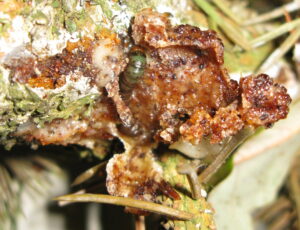
Figure 3. Zimmerman pine moth caterpillar in wound.
Zimmerman pine moth (ZPM)commonly attacks pine trees in late July. Adult female moths lay eggs at the junction of tree branches and the trunk and winters in cracks and crevices. In early spring, when forsythia bloom, larvae bore inside the trunk and can girdle and kill branches and trees leaders. These are the two times of year that this borer is most susceptible to insecticides. Note soil applied imidacloprid is not particularly effective against ZPM. Spruces and most pines are susceptible to this borer.
To view this full article and other Purdue Landscape Report articles, please visit Purdue Landscape Report.
Subscribe and receive the newsletter: Purdue Landscape Report Newsletter.
Resources:
Borers of Pines and Other Needle Bearing Evergreens in Landscapes, The Education Store
Normal Needle Drop: Even Healthy Evergreens are not Evergreen, Purdue Landscape Report
White Pine Decline in Indiana
Tree Defect Identification, The Education Store
Tree wounds and healing, Got Nature? Blog
Tree Risk Management – Got Nature? Blog, Purdue Extension – FNR
Why Is My Tree Dying? – Got Nature? Blog, Purdue Extension – Forestry and Natural Resources
Managing the Zimmerman Pine Moth, The Education Store
The Woody Plant Seed Manual, U.S. Forest Service
Native Trees of the Midwest, Purdue University Press
Investing in Indiana Woodlands, The Education Store
Forest Improvement Handbook, The Education Store
Find an Arborist, International Society of Arboriculture
Subscribe Purdue Extension-Forestry and Natural Resources YouTube Channel
Cliff Sadof, Professor, Ornamental, Pest Management
Purdue Entomology Extension Coordinator
Purdue Landscape Report: Stop me if you’ve heard this one…. A tree is in a slow decline year after year. You are called to your client’s property only to find the root flare well below grade.
Most professionals in the Green Industry have encountered this at some point in their career. The most common reason for the slow decline of trees in the landscape is due to the depth of planting and girdling roots. Deep planting can cause a number of deleterious problems, including an increase in circling/girdling roots restricting vascular tissue and decay of protective bark (Fig. 1). The vascular tissue in the bark is located on the outer portions of the trunk, while the anatomy of roots contains the vascular tissue in the center. This is why roots can graft with roots and stems can graft with stems, but also why roots can girdle the stems of trees (Fig. 2)
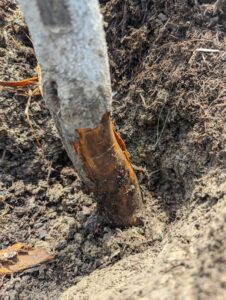
Figure 1. A tree that’s planted too deep can have bark decay from too much soil moisture around the trunk.
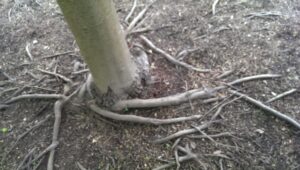
Figure 2. Root girdling can occur on trees that didn’t have a root correction during transplanting and/or being planted too deep. Restriction of vascular tissue in the trunk will decrease the amount of water and nutrients taken up by the tree.
Excessive mounding of mulch (aka volcano mulch) (Fig. 3) can contribute to tree decline, very similar to a tree planted too deep. It’s important to remember that keeping mulch several inches away from the trunk is imperative in tree health.
If a newly transplanted tree is planted significantly too deep, a faster decline can occur, especially in plants that can’t tolerate ‘wet feet’ (aka too much soil moisture) (Fig.4). In heavy-clay soils, the negative effects on tree health increase by creating a bath-tub situation by water not draining expeditiously after a rainfall or irrigation event.
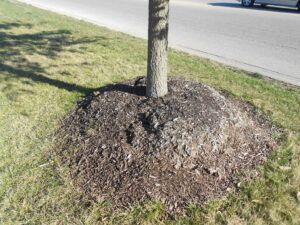
Figure 3. Volcano mulch can cause the same problems that a tree planted too deep can experience.
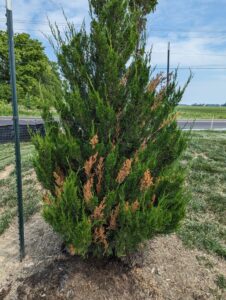
Figure 4. Decline of this juniper is caused by this tree being planted too deep.
To view this full article and other Purdue Landscape Report articles, please visit Purdue Landscape Report.
Subscribe and receive the newsletter: Purdue Landscape Report Newsletter.
Resources:
The Purdue Landscape Report
Planting Your Tree Part 1: Choosing Your Tree, Purdue Extension YouTube Channel
Summer Tree Care, Purdue Landscape Report
Tree Defect Identification, The Education Store
Tree Wound and Healing, Got Nature? Blog, Purdue Extension – Forestry and Natural Resources
Surface Root Syndrome, The Education Store
Shrubs and Woody Vines of Indiana and the Midwest, The Education Store
Ask an Expert: Tree Selection and Planting, Purdue Extension-Forestry & Natural Resources (FNR) YouTube playlist
ID That Tree, Purdue Extension-FNR YouTube playlist
Subscribe – Purdue Extension-FNR YouTube Channel
Kyle Daniel, Commercial Landscape and Nursery Crops Extension Specialist
Purdue Horticulture & Landscape Architecture
In this episode of ID That Tree, Purdue Extension forester Lenny Farlee introduces the Black Spruce. This species is found in bogs, wetlands, and sometimes dry sites within the North Woods of Upper Michigan and Wisconsin. Black Spruce has a bluish cast to the newest needle growth. It has single needles attached to the twigs that are typically less than an inch long. The twigs have a reddish brown cast. This tree also has small cones that are somewhat egg shaped.
If you have any questions regarding wildlife, trees, forest management, wood products, natural resource planning or other natural resource topics, feel free to contact us by using our Ask an Expert web page.
Resources:
ID That Tree, Playlist, Purdue Extension – Forestry and Natural Resources (FNR) YouTube Channel (Invasive White Mulberry, Siberian Elm, Tree of Heaven)
Invasive Species Playlist, Playlist, Purdue Extension – FNR YouTube Channel (Asian Bush Honeysuckle, Burning Bush, Callery Pear, Multiflora rose)
A Woodland Management Moment, Playlist, Purdue Extension – FNR YouTube Channel (Against Invasives, Garlic Mustard, Autumn Olive)
Woodland Stewardship for Landowners, Playlist, Purdue Extension – FNR YouTube Channel (Common Buckthorn, Japanese Barberry)
Report Invasive Species, Purdue Invasive Species
The GLEDN Phone App – Great Lakes Early Detection Network
EDDMaps – Early Detection and Distribution Mapping System
How long do seeds of the invasive tree, Ailanthus altissima remain viable? (Invasive Tree of Heaven), USDA Forest Service
Indiana Department of Natural Resources: Invasive Species
Indiana Invasive Species Council
Cooperative Invasive Species Management Area (CISMA)
Aquatic Invasive Species, Illinois-Indiana Sea Grant (IISG)
Episode 11 – Exploring the challenges of Invasive Species, Habitat University-Natural Resource University
What are invasive species and why should I care?, Got Nature? Blog, Purdue Extension – FNR
Shrubs and Woody Vines of Indiana and the Midwest, The Education Store, Purdue Extension Resource Center
Native Trees of the Midwest, The Education Store
Investing in Indiana Woodlands, The Education Store
Forest Improvement Handbook, The Education Store
Lenny Farlee, Extension Forester
Hardwood Tree Improvement and Regeneration Center
Purdue Department of Forestry & Natural Resources

Recent Posts
- Popular Landscape Shrub is Invasive
Posted: October 15, 2026 in Alert, Forestry, Forests and Street Trees, Invasive Plant Species, Plants, Woodlands - Purdue Extension’s Regional Teams Are Here: Connecting Communities with Expertise and Opportunity
Posted: October 14, 2026 in Community Development, Forestry, Forests and Street Trees, Gardening, How To, Timber Marketing, Urban Forestry, Wildlife, Woodlands - Why Do Our Trees Go From Green Leaves to Different Colors?
Posted: in Forestry, Forests and Street Trees, Urban Forestry, Woodlands - Distinguishing Dogwoods
Posted: October 13, 2026 in Forestry, Urban Forestry, Wildlife, Woodlands - It’s Not Too Early To Start Planning For Spring Tree Planting
Posted: in Forestry, How To - Can I Plant Trees in the Fall?
Posted: October 12, 2026 in Forestry, How To, Land Use, Plants, Urban Forestry, Wildlife - Burning for Benefits: Why Fire Belongs in Indiana
Posted: in Forestry, Safety, Woodlands - Disease May Cause Wilting and Eventual Death of Certain Trees and Shrubs, Purdue Landscape Report
Posted: October 5, 2026 in Disease, Forestry, Plants - October Is Firewood Month: Protect Indiana’s Forests by Making Smart Choices
Posted: October 1, 2026 in Forestry, Forests and Street Trees, How To, Invasive Insects, Urban Forestry - Woodland Flowers of Late Summer
Posted: September 14, 2026 in Forestry, Gardening, Wildlife, Woodlands
Archives
Categories
- Alert
- Aquaculture/Fish
- Aquatic/Aquaculture Resources
- Ask the Expert
- Christmas Trees
- Community Development
- Disease
- Drought
- Forestry
- Forests and Street Trees
- Gardening
- Got Nature for Kids
- Great Lakes
- How To
- Invasive Animal Species
- Invasive Insects
- Invasive Plant Species
- Land Use
- Natural Resource Planning
- Nature of Teaching
- Plants
- Podcasts
- Ponds
- Publication
- Safety
- Spiders
- Timber Marketing
- Urban Forestry
- Webinar
- Wildlife
- Wood Products/Manufacturing
- Woodland Management Moment
- Woodlands