 Purdue University - Extension - Forestry and Natural Resources
Got Nature? Blog
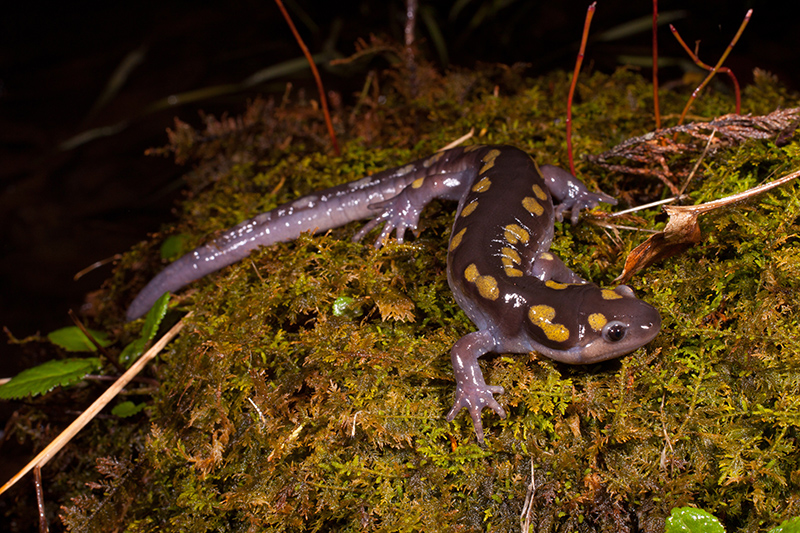
The Spotted Salamander (Ambystoma maculatum) is a common species of mole salamander. Photo credit: T. Travis Brown.
I have been asked some variation of this question multiple times over the past several years. Sometimes the “hellbender” is found in a barn, on a basement floor, crawling across a driveway, or occasionally in a pond. The common denominator is always that someone has found a salamander, and they are concerned it is an Eastern Hellbender that needs help.
I appreciate this concern. I am glad to see that people have become more aware of the existence of the Eastern Hellbender and that it is something worth helping. The Eastern Hellbender is an endangered species in Indiana, and we always welcome reports from concerned citizens. However, the Eastern Hellbender is a very rare species in Indiana and is uncommon throughout most of its range in the eastern United States. The species has been declining in Indiana over the past several decades and is now known only from the Blue River in Washington, Harrison, and Crawford Counties. For this reason alone, it is unlikely that anyone would find a Hellbender on their property.
However, another equally important reason that it is unlikely a Hellbender involves the species biology. The Eastern Hellbender is fully aquatic and lives exclusively in rivers and streams. Unlike most amphibians, its primary means of respiration is by absorbing oxygen directly from the water through its skin. One adaptation Hellbenders have evolved to help with oxygen absorption is the development of wavy skin-folds along the sides of their bodies. These skin-folds provide greater surface area for oxygen absorption. Hellbenders have lungs, but they do not function well enough to allow them to survive extended periods of time on land. Hellbenders have been found on land immediately next to rivers and streams, but this is rare and is generally considered an anomaly.
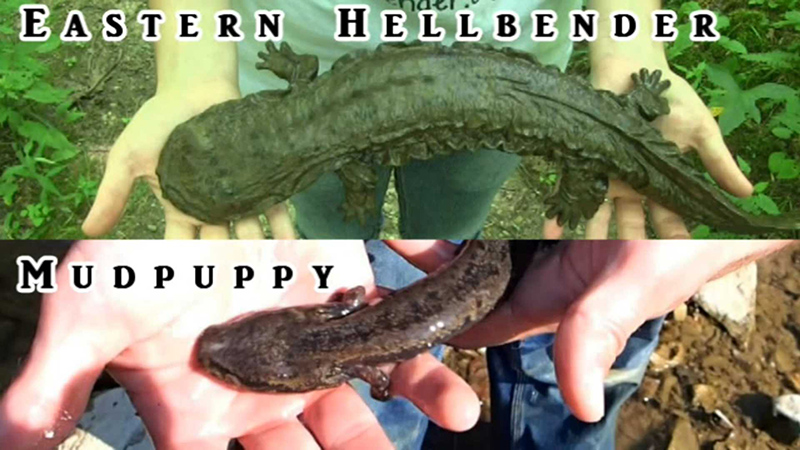
Top: Hellbender, Bottom: Common Mudpuppy.
While this rules out finding them on land away from rivers and streams, what about ponds and lakes? Hellbenders typically prefer clean, cool, swift flowing rivers and streams with a high oxygen content. These conditions are not typically found in ponds and lakes, and would make it unlikely that hellbenders would willingly reside in them. Moreover, these water bodies are usually landlocked with no close access from rivers and streams, and since hellbenders do not like to travel overland, they will likely never encounter a pond or lake.
There are two unlikely possibilities that might result in a Hellbender being found in a pond or lake. The first would be if someone captured a hellbender and moved it there. The second would be a pond or lake owner that lives in the floodplain of a river containing Hellbenders. Hellbenders do occasionally get dislodged by flooding and washed downstream. A large flood has the potential, however unlikely, to wash a Hellbender into a nearby pond. I am unaware of this ever happening, but it is a possibility.
So if you haven’t found a Hellbender, what have you found? If you found your salamander on land, it is very likely one of a group of salamanders known as mole salamanders. Mole salamanders are common throughout most of Indiana. They typically breed in ponds in the spring and then hide under logs or bury themselves underground. They are commonly found during spring breeding migrations and are frequently seen in large numbers. They often times find themselves wandering onto our properties and getting stuck in window wells or hiding themselves under rocks, firewood, or in our barns.
If you found your salamander in the water then it could be either the aforementioned mole salamander or a Common Mudpuppy. Mudpuppies are commonly confused with hellbenders and do live in ponds, wetlands, and creeks. Like the Hellbender, they are fully aquatic and don’t go on land except in very rare circumstances. Mudpuppies have large, fluffy gills behind their heads, which Hellbenders do not have. Mudpuppies also lack the skins folds along the sides of their bodies.
While most people will go their entire lives without ever seeing a Hellbender, if you live in the right areas it is a possibility. If you think you have seen a Hellbender, then please take a photo and let us know by visiting our Hellbender Reporting Webpage below. We are always happy to help.
Resources:
Hellbender ID – video, The Education Store, Purdue Extension resource center
HelptheHellbender.org, Purdue Extension
Help the Hellbender: North America’s Giant Salamander, The Education Store
Salamanders of Indiana, The Education Store
Appreciating Reptiles and Amphibians, The Education Store
Nick Burgmeier, Research Biologist and Extension Wildlife Specialist
Purdue Department of Forestry and Natural Resources
It’s Arbor Day again, and it’s time to celebrate the importance of trees. The fact that trees are essential to both humans and wildlife is well-established. However, most people think of trees in the context of oxygen production, wood products, and habitat for wildlife such as squirrels and birds. I’d like to focus on one of the less well-known services that trees provide, keeping water clean. This service not only benefits people but also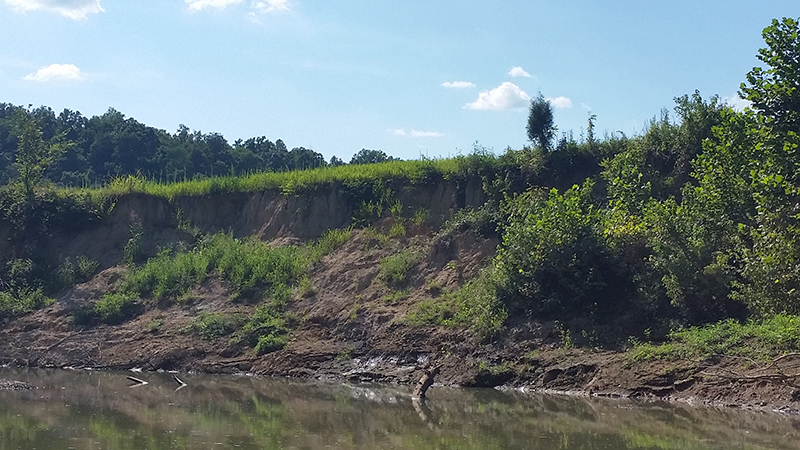 aquatic wildlife like the Hellbender salamander.
The Hellbender salamander is North America’s largest salamander. It is fully aquatic, living its entire life in rivers and streams throughout the midwest and southeast. Hellbenders require cool, clean rivers and streams with rocky substrates to thrive and reproduce. Unfortunately, over the past few decades the species has declined or disappeared from many of these areas. There are several causes that scientists suspect, but the loss of trees due to increases in agriculture and urban/suburban areas is at the top of the list.
Trees do a number of things to keep our water clean. The forest canopy intercepts rainfall and slows the rate at which water enters the ground. This helps reduce flooding. Trees provide shade to rivers and streams thus keeping them cool and allowing for higher levels of dissolved oxygen. Trees also filter nutrients and chemicals from runoff, preventing them from entering streams. One of the most important functions that trees provide is stabilizing our riverbanks and hillsides and preventing sediment from entering the stream and changing our rocky river bottoms to mud bottoms. These functions are especially important in our modern landscape, where agriculture and hard surfaces dominate many areas.
All of these functions help to create a clean environment for Hellbenders and other aquatic wildlife to live. Without trees, it is likely that our rivers and streams would be too dirty for many species to survive. If you are looking for a way to help the Hellbender, then please consider planting a tree this Arbor Day. Several Arbor Day celebrations for 2017 will be held on Saturday, April 29th. Check out activities around your area: Purdue Extension County Offices, Indiana Department of Natural Resources or Tippecanoe Soil & Water Conservation District.
For more ways you can help, please visit Help the Hellbender.org.
Resources:
Rainscaping, Purdue Extension
How Anglers and Paddlers Can Help the Hellbender, The Education Store-Purdue Extension resource center
Hellbender ID, The Education Store
Improving Water Quality by Protecting Sinkholes on Your Property, The Education Store
Improving Water Quality at Your Livestock Operation video, The Education Store
Healthy Water, Happy Home – Lesson Plan, The Education Store
Tree Planting Part 1: Choosing a Tree video, The Education Store
Tree Planting Part 2: Planting Your Tree video, The Education Store
Tree Installation: Process and Practices, The Education Store
Nick Burgmeier, Research Biologist and Extension Wildlife Specialist
Purdue Department of Forestry and Natural Resources

Issue:
There continues to be significant interest in rearing marine shrimp in Indiana and the Midwest. Two issues of interest to existing and potential producers are supply of shrimp larvae and information on Best Management Practices for rearing shrimp here in Indiana.
What Has Been Done:
The Indiana Soybean Alliance sponsored a demonstration project to see whether shrimp larvae could be raised using commercial feedstuffs (Live feeds are traditionally used). The theory being producers would not have to rely on shipments of larvae from tropical regions with significant risks. By using commercial feedstuffs, the footprint of operations could be reduced.
A one day meeting for producers is planned for February 10, 2016, bringing together shrimp rearing experts from Texas A & M and Kentucky State Universities along with Purdue experts in marketing, economics and environmental controls. This program will encompass almost all phases of production through sales.
Results:
Although the larval demonstration project was unsuccessful, with shrimp mortalities within one day of arrival, future research may be undertaken using different protocols by bringing in brood shrimp (parental stocks) instead of shrimp eggs.
Marine Shrimp Biofloc Systems: Basic Management Practices publication, The Education Store, Purdue Extension
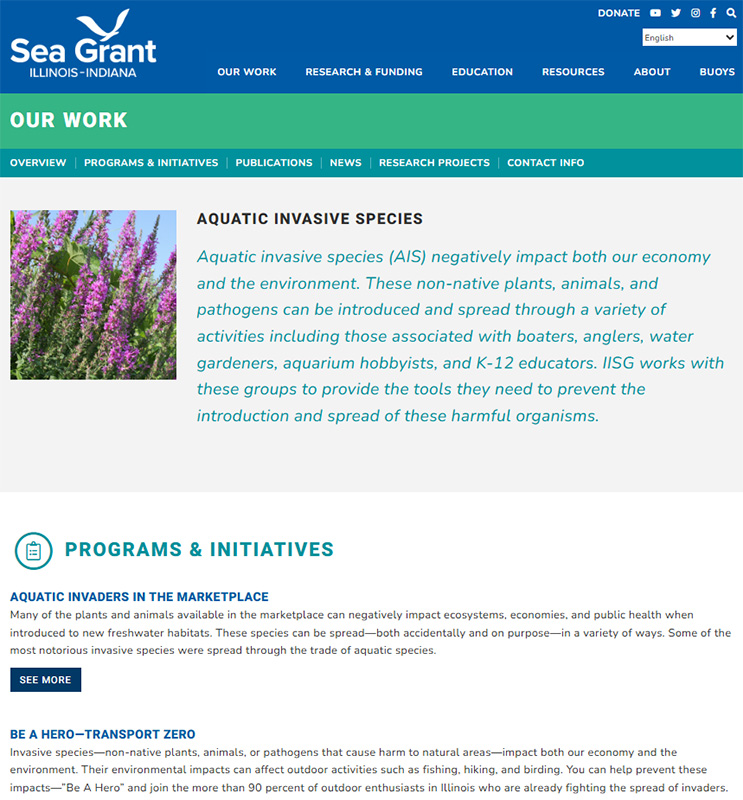
Once aquatic invasive species (AIS) are established in a new environment, typically, they are difficult or impossible to remove. Even if they are removed, their impacts are often irreversible. It is much more environmentally and economically sound to prevent the introduction of new AIS through thoughtful purchasing and proper care of organisms. Check out Illinois-Indiana Sea Grant’s web page the Aquatic Invasive Species and find resources for teachers, water garden hobbyists, aquatic landscaping designers and to aquatic enthusiasts. The video titled Beauty Contained: Preventing Invasive Species from Escaping Water Gardens is also available which contains guidelines that were adopted from the Pet Industry Joint Advisory Council and the Aquatic Nuisance Species Task Force along with addressing the care and selection of plants and animals for water gardens.
Resources:
Aquatic Invaders in the Marketplace, Illinois-Indiana Sea Grant (IISG)
Great Lakes Sea Grant Network (GLERL), NOAA – Great Lakes Environmental Research Laboratory
Indiana Bans 28 Invasive Aquatic Plants, Illinois-Indiana Sea Grant (IISG), Newsroom
A Field Guide to Fish Invaders of the Great Lake Regions, Illinois-Indiana Sea Grant (IISG)
Purdue Researchers Get to the Bottom of Another Quagga Mussel Impact, Illinois-Indiana Sea Grant (IISG)
Protect Your Waters, U.S. Fish and Wildlife Service & U.S. Coast Guard
Clean Boat Programs, Illinois-Indiana Sea Grant
Illinois-Indiana Sea Grant (IISG)
University of Illinois Extension and Purdue University Extension
 Quagga mussels, which arrived in Lake Michigan in the 1990s via ballast water discharged from ships, have colonized vast expanses of the Lake Michigan bottom, reaching densities as high as roughly 35,000 quagga mussels per square meter. The invasive species that can have major economic impacts filters up to 4 liters of water per day, and so far seems unaffected by any means of population control. It is also a constant threat to other systems, as it is readily transported between water bodies.
Researchers have long known that these voracious filter feeders impact water quality in the lake, but their influence on water movement had remained largely a mystery.
“Although Lake Michigan is already infested with these mussels, an accurate filtration model would be imperative for determining the fate of substances like nutrients and plankton in the water,” Purdue University PhD candidate David Cannon said. “In other quagga mussel-threatened systems, like Lake Mead, this could be used to determine the potential impact of mussels on the lake, which could in turn be used to develop policy and push for funding to keep mussels out of the lakes.”
For full article and video view Purdue Researchers Get to the Bottom of Another Quagga Mussel Impact.
Resources:
A Field Guide to Fish Invaders of the Great Lake Regions, Illinois-Indiana Sea Grant (IISG)
Protect Your Waters, U.S. Fish and Wildlife Service & U.S. Coast Guard
Profitability of Hybrid Striped Bass Cage Aquaculture in the Midwest, The Education Store, Purdue Extension resource center
A Guide to Marketing for Small-Scale Aquaculture Producers, The Education Store
Aquaculture Industry in Indiana Growing, Purdue Today
Sustainable Aquaculture: What does it mean to you?, The Education Store
Pond and Wildlife Management website, Purdue Extension
Fish Cleaning with Purdue Extension County Extension Director, Got Nature? Blog, Purdue Extension – Forestry and Natural Resources
Aquaponics: What to consider before starting your business, YouTube, Purdue Ag Economics
Aquatics & Fisheries, Playlist, YouTube, Purdue Extension – Forestry and Natural Resources
Illinois-Indiana Sea Grant (IISG)
University of Illinois Extension and Purdue University Extension
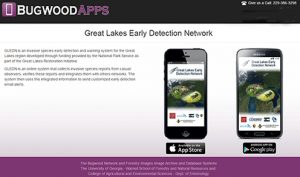 The Forest Pest Outreach and Survey Project at Purdue reminds us that early detection is the best way to slow the spread of invasive species. You can report invasive species by calling the Invasive Species hotline at 1-866-NO-EXOTIC (1-866-663-9684) or using the free Great Lakes Early Detection Network smartphone app, which can be downloaded on iTunes or Google Play. View video to see how easy it is to use the app, Great Lakes Early Detection Network App (GLEDN).
If you’re interested in learning more about invasive pests and how to report them, sign up for one of our free Early Detector Training workshops!
National Invasive Species Awareness Week: February 27-March 3, 2017.
Resources:
Invasive Species – Indiana Department of Natural Resources (IDNR)
Ask an Expert – Purdue Extension-Forestry and Natural Resources
Indiana Invasive Species Council – Includes: IDNR, Purdue Department of Entomology and Professional Partners
Invasive Species Week a reminder to watch for destructive pests, Purdue entomologist says – Purdue Agriculture News
Sara Stack, MS student
Purdue Department of Entomology
You’ve heard about all the traditional careers. But what about being an outdoor scientist? Introducing the world to The Familiar Faces Project which shares careers in fisheries, aquatic sciences, forestry, wildlife and sustainable biomaterials. This video will show by example what it’s like to be an outdoor scientist, walking you through a typical work day of Megan Gunn. For more information about The Familiar Faces Project, contact thefamiliarfacesproject@gmail.com.
Resources:
Aquatic Ecology Research Lab, Forestry and Natural Resources
Megan Gunn, Aquatic Ecology Research Scientist
Purdue University Department of Forestry and Natural Resources
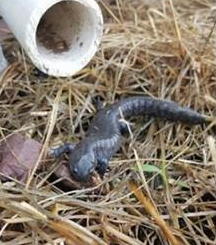 Question from Josh L Lady: Which salamander is this?
Answer:
The picture posted is one of our mole salamanders (family Ambystomatidae). This common family name comes from their habit of staying underground and in burrows of other creatures, except when breeding. Species in this family can be difficult to tell apart at times. Adding to the confusion, there is a species called the Mole salamander (Ambystoma talpoideum) which in Indiana is only found in the extreme southwestern part of the state.
The species below is likely a Small-mouthed Salamander (Ambystoma texanum). It can be found throughout Indiana except the extreme northwestern and southeastern portions of the state. The Small-mouthed Salamander is a moderate sized salamander characterized by its slender head and small mouth. Most individuals are dark gray to grayish brown with light gray speckles (often resembling lichen-like markings), particularly on the lower sides of the body. Adults usually reach 11-19 cm in length and have an average of 15 costal grooves (i.e., the “wrinkles” on the sides of the body; range 13-15).
I say it is likely a Small-mouthed Salamander because they are nearly identical to in appearance to the Streamside Salamander (Ambystoma barbouri). There are minor differences in the teeth and premaxillary bones between the two species; however, these structures are not readily observable in the field. Geographic location and habitat type are the best ways to distinguish these two species. Streamside Salamanders are restricted to extreme southeastern Indiana, occupy hilly areas, and breed in streams. Small-mouthed Salamanders exist nearly statewide, occur in wooded floodplains, and breed in ephemeral wetlands.
Resources:
Salamanders of Indiana, The Education Store, Purdue Extension resource center.
Appreciating Reptiles and Amphibians, The Education Store
Forest Management for Reptiles and Amphibians: A Technical Guide for the Midwest, The Education Store
Ranavirus: Emerging Threat to Amphibians, The Education Store
Brian MacGowan, Wildlife Extension Specialist
Purdue Forestry and Natural Resources
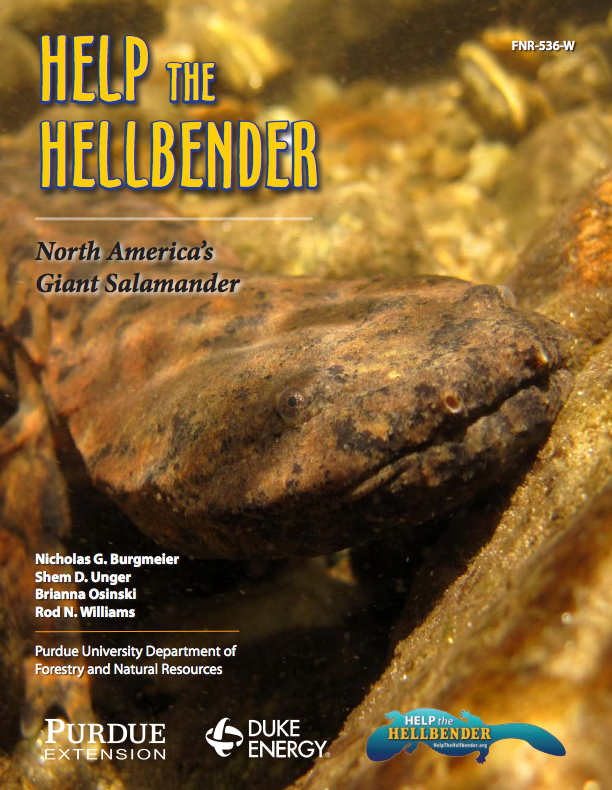 The eastern hellbender is a large, fully aquatic salamander that requires cool, well-oxygenated rivers and streams. Because they require high-quality water and habitat, they are thought to be indicators of healthy stream ecosystems. While individuals may live up to 29 years, possibly longer, many populations of this unique salamander are in decline across their geographic range. It is the largest salamander in North America, found in and around rivers and streams in 17 states from New York to Missouri. Many hellbender populations are in decline within their geographic range. This publication provides information on identifying and preserving this important aquatic animal. You can find Help the Hellbender, FNR-536-W, as well as other great resources that can be found at The Purdue Education Store.
Resources:
How Anglers and Paddlers Can Help the Hellbender, The Education Store
Hellbender ID, The Education Store
Improving Water Quality by Protecting Sinkholes on Your Property, The Education Store
Improving Water Quality at Your Livestock Operation, The Education Store
Healthy Water, Happy Home – Lesson Plan, The Education Store
Nick Burgmeier, Research Biologist and Extension Wildlife Specialist
Purdue Department of Forestry and Natural Resources
Dr. Rod Williams, Associate Head of Extension and Associate Professor of Wildlife Science
Purdue Department of Forestry and Natural Resources
The Eastern hellbenders are the largest salamander in North America and have survived unchanged for nearly 2 million years. Hellbender populations are declining across their range, from Missouri to New York. This decline is likely caused by human influences such as habitat degradation and destruction. Many states are developing conservation programs to help the hellbender. To find out what you can do visit helpthehellbender.org.
Resources:
How Anglers and Paddlers Can Help the Hellbender, The Education Store
Hellbender ID, The Education Store
Improving Water Quality by Protecting Sinkholes on Your Property, The Education Store
Improving Water Quality at Your Livestock Operation, The Education Store
Healthy Water, Happy Home – Lesson Plan, The Education Store
Nick Burgmeier, Project Coordinator, Research Biologist & Wildlife Extension Specialist
Purdue Department of Forestry and Natural Resources
Dr. Rod Williams, Associate Head of Extension and Associate Professor of Wildlife Science
Purdue Department of Forestry and Natural Resources

Recent Posts
- Discover the Great Lakes, The 2025 Helm Magazine is Available
Posted: November 17, 2025 in Aquaculture/Fish, Aquatic/Aquaculture Resources, Wildlife - Illinois-Indiana Sea Grant Newsletter Shares New Resources
Posted: November 13, 2025 in Aquaculture/Fish, Aquatic/Aquaculture Resources, Wildlife - Publication – Fish Muscle Hydrolysate
Posted: September 15, 2025 in Aquaculture/Fish, Aquatic/Aquaculture Resources - Publication – Direct Marketing Guidebook for Small/Medium-Scale Aquaculture Businesses
Posted: March 7, 2025 in Aquaculture/Fish, Aquatic/Aquaculture Resources, Publication - Conservationists Unite for Snuffbox Mussels – Wild Bulletin
Posted: February 20, 2025 in Aquaculture/Fish, Aquatic/Aquaculture Resources, Wildlife - Publication – Handbook on Processing Fish for Small-Scale Fish Farmers
Posted: October 17, 2024 in Aquaculture/Fish, Aquatic/Aquaculture Resources, How To, Publication, Wildlife - IISG Adds New Water Safety Videos
Posted: May 8, 2024 in Aquaculture/Fish, Aquatic/Aquaculture Resources, Community Development, Great Lakes, Wildlife - Farmers Helping Hellbenders RCPP Program Accepting Applications
Posted: May 1, 2024 in Aquaculture/Fish, Forestry, How To, Wildlife, Woodlands - 2024-25 Fishing Guide now available – Wild Bulletin
Posted: April 4, 2024 in Alert, Aquaculture/Fish, Aquatic/Aquaculture Resources, How To, Ponds, Wildlife - Look Out for Invasive Carp in Your Bait Bucket – Wild Bulletin
Posted: March 31, 2024 in Alert, Aquaculture/Fish, Aquatic/Aquaculture Resources, Invasive Animal Species, Wildlife
Archives
Categories
- Alert
- Aquaculture/Fish
- Aquatic/Aquaculture Resources
- Ask the Expert
- Christmas Trees
- Community Development
- Disease
- Drought
- Forestry
- Forests and Street Trees
- Gardening
- Got Nature for Kids
- Great Lakes
- How To
- Invasive Animal Species
- Invasive Insects
- Invasive Plant Species
- Land Use
- Natural Resource Planning
- Nature of Teaching
- Plants
- Podcasts
- Ponds
- Publication
- Safety
- Spiders
- Timber Marketing
- Uncategorized
- Urban Forestry
- Webinar
- Wildlife
- Wood Products/Manufacturing
- Woodland Management Moment
- Woodlands