 Purdue University - Extension - Forestry and Natural Resources
Got Nature? Blog
The 2025 issue of Illinois-Indiana Sea Grant’s magazine, The Helm, is now available. This annual publication is a collection of program research, outreach and education success stories, as well as ongoing activities to address coastal concerns. This issue covers this year’s Shipboard Science Immersion that took place on Lake Michigan, our long-standing team engaged in AIS prevention outreach, our new specialists diving into coastal resilience issues, and past and present program leadership.

Highlights from the newsletter include:
- Educators engage with Great Lakes scientists aboard the Lake Guardian
Teachers joined researchers on Lake Michigan aboard the R/V Lake Guardian, collecting samples, learning new field techniques, and bringing Great Lakes science back to their students. - Scientists and educators investigate Lake Michigan biological hotspots
Every year when a group of Great Lakes educators spend 6–7 days aboard the Lake Guardian as part of the Shipboard Science Immersion, they work side-by-side with scientists engaging in real monitoring work. - IISG looks back on 30 years of AIS outreach
Illinois-Indiana Sea Grant is in the midst of its 30th year of dedicated outreach to address the spread of aquatic invasive species (AIS) in Great Lakes waters. - Coastal communities face challenges in managing beach sand and structures
Beginning in 2025, IISD has not one, but two coastal resilience specialists who are providing support for communities along the southern Lake Michigan shore. - Shaping the Shoreline: Video Series
Explore how natural and engineered structures shape our Great Lakes coastlines. - Stuart Carlton is the new IISG director
Stuart Carlton, longtime Sea Grant communicator and leader, steps into the director role—continuing IISG’s mission of connecting research, education, and outreach. - Tomas Höök reflects on his Sea Grant legacy
After more than a decade as director, Tomas Höök looks back on milestones that shaped IISG’s growth and lasting partnerships.
To view the full newsletter visit: The Helm.
More Resources:
Prescription For Safety: How to Dispose of Unwanted Household Medicine, IISG Publications
A Guide to Marketing for Small-Scale Aquaculture Producers, The Education Store, Purdue Extension resource center
A Guide to Small-Scale Fish Processing Using Local Kitchen Facilities, The Education Store
Marine Shrimp Biofloc Systems: Basic Management Practices, The Education Store
Sustainable Aquaculture: What does it mean to you?, The Education Store
The Benefits of Seafood Consumption The Education Store
Walleye Farmed Fish Fact Sheet: A Guide for Seafood Consumers, The Education Store
Fish Muscle Hydrolysate, The Education Store
Fish Cleaning with Purdue Extension County Extension Director, Got Nature? Blog, Purdue Extension – Forestry and Natural Resources
Aquatics & Fisheries, Playlist, Purdue Extension – Forestry and Natural Resources
Eat Midwest Fish, Illinois-Indiana Sea Grant online resource hub
Community Development, Purdue Extension
Climate Change and Sustainable Development, The Education Store
Climate Change: Are you preparing for it?, The Education Store
Illinois-Indiana Sea Grant (IISG)
Diana Evans, Extension & Web Communications Specialist
Purdue University Department of Forestry and Natural Resources
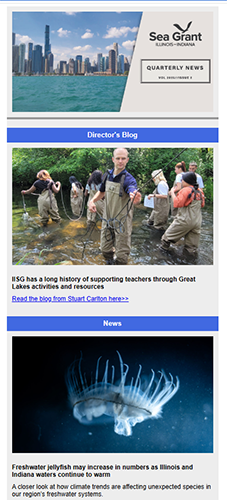 Dive into the latest stories from the Illinois-Indiana Sea Grant (IISG) Newsletter which highlights research, outreach, and partnerships making a difference across the Great Lakes region. In this issue, explore how communities, scientists and educators are working together to protect water quality, strengthen coastal resilience, and inspire stewardship.
Highlights from the newsletter include:
- IISG has a long history of supporting teachers through Great Lakes activities and resources
Read the blog from Stuart Carlton. - Freshwater jellyfish may increase in numbers as Illinois and Indiana waters continue to warm
A closer look at how climate trends are affecting unexpected species in our region’s freshwater systems. - New step-by-step guide and veterinary brochures expand UnwantedMeds.org resources
New tools help communities safely dispose of unwanted or expired medicine—from household to veterinary use—reducing pollution and protecting public health. - The Know Your H₂O Kit gets a real-world lab test by middle schoolers
Students dove into hands-on learning with IISG’s Know Your H₂O Kit, testing their local water and connecting science concepts to real environmental data. - Educators engage with Great Lakes scientists aboard the Lake Guardian
Teachers joined researchers on Lake Michigan aboard the R/V Lake Guardian, collecting samples, learning new field techniques, and bringing Great Lakes science back to their students. - IISG looks back on 30 years of AIS outreach
Illinois-Indiana Sea Grant is in the midst of its 30th year of dedicated outreach to address the spread of aquatic invasive species (AIS) in Great Lakes waters. - Coastal communities face challenges in managing beach sand and structures
Beginning in 2025, IISD has not one, but two coastal resilience specialists who are providing support for communities along the southern Lake Michigan shore. - The Helm
Our latest edition of The Helm brings together insights from field research, outreach efforts, and education across the Great Lakes region. - Shaping the Shoreline: Video Series
Explore how natural and engineered structures shape our Great Lakes coastlines. - Welcome Stuart Carlton, new IISG director
Stuart Carlton, longtime Sea Grant communicator and leader, steps into the director role—continuing IISG’s mission of connecting research, education, and outreach. - Tomas Höök reflects on a legacy of leadership, collaboration and impact at IISG
After more than a decade as director, Tomas Höök looks back on milestones that shaped IISG’s growth and lasting partnerships.
Subscribe to the IISG newsletter by sending your name and email to iisg@purdue.edu. To view the full newsletter visit: Illinois-Indiana Sea Grant (IISG) Quarterly Newsletter.
More Resources:
Prescription For Safety: How to Dispose of Unwanted Household Medicine, IISG Publications
A Guide to Marketing for Small-Scale Aquaculture Producers, The Education Store, Purdue Extension resource center
A Guide to Small-Scale Fish Processing Using Local Kitchen Facilities, The Education Store
Marine Shrimp Biofloc Systems: Basic Management Practices, The Education Store
Sustainable Aquaculture: What does it mean to you?, The Education Store
The Benefits of Seafood Consumption The Education Store
Walleye Farmed Fish Fact Sheet: A Guide for Seafood Consumers, The Education Store
Fish Muscle Hydrolysate, The Education Store
Fish Cleaning with Purdue Extension County Extension Director, Got Nature? Blog, Purdue Extension – Forestry and Natural Resources
Aquatics & Fisheries, Playlist, Purdue Extension – Forestry and Natural Resources
Eat Midwest Fish, Illinois-Indiana Sea Grant online resource hub
Community Development, Purdue Extension
Climate Change and Sustainable Development, The Education Store
Climate Change: Are you preparing for it?, The Education Store
Natty Morrison, Communications Coordinator
Illinois-Indiana Sea Grant (IISG)
Diana Evans, Extension & Web Communications Specialist
Purdue University Department of Forestry and Natural Resources
 This new publication Fish Muscle Hydrolysate introduces a novel method for producing high-quality protein for larval fish diets, targeting feed and ingredient manufacturers. It outlines the challenges of indoor fish rearing using recirculating aquaculture systems (RAS), particularly the difficulty larvae have digesting traditional dry feeds. The proposed solution uses protein hydrolysates—pre-digested proteins made more accessible through hydrolysis with species-specific digestive enzymes. This approach improves nutrient absorption and growth performance. Notably, the method uses invasive fish species as a sustainable protein source and applies enzymes from the target species for precise, efficient hydrolysis.
This fact sheet is intended for feed ingredient and feed manufacturers interested in producing a species-specific protein source for starter feeds. The early growth and survival of many fish species depend on several factors, including food availability, ingredient digestibility, and environmental conditions.
To receive the free download, visit the Purdue Extension’s resource center: The Education Store – Fish Muscle Hydrolysate.
Resources:
Profitability of Hybrid Striped Bass Cage Aquaculture in the Midwest, The Education Store, Purdue Extension resource center
A Guide to Marketing for Small-Scale Aquaculture Producers, The Education Store
A Guide to Small-Scale Fish Processing Using Local Kitchen Facilities, The Education Store
Marine Shrimp Biofloc Systems: Basic Management Practices, The Education Store
Handbook on Processing Fish for Small-Scale Fish Farmers, The Education Store
Aquaculture Industry in Indiana Growing, Purdue Today
Tilapia Farmed Fish Fact Sheet, The Education Store
Rainbow Trout Farmed Fish Fact Sheet, The Education Store
Pacific White Shrimp Farmed Fish Fact Sheet, The Education Store
Walleye Farmed Fish Fact Sheet: A Guide for Seafood Consumers, The Education Store
Sustainable Aquaculture: What does it mean to you?, The Education Store
The Benefits of Seafood Consumption The Education Store
Walleye Farmed Fish Fact Sheet: A Guide for Seafood Consumers, The Education Store
Pond and Wildlife Management website, Purdue Extension
Fish Cleaning with Purdue Extension County Extension Director, Got Nature? Blog, Purdue Extension – Forestry and Natural Resources
Aquaponics: What to consider before starting your business, YouTube, Purdue Ag Economics
Aquatics & Fisheries, Playlist, YouTube, Purdue Extension – Forestry and Natural Resources
Eat Midwest Fish, Illinois-Indiana Sea Grant online resource hub
Amy Shambach, Aquaculture Marketing Outreach Associate
Purdue Department of Forestry and Natural Resources/Illinois Indiana Sea Grant Program
The aquaculture industry in the United States Department of Agriculture North Central Region (USDA NCR) is relatively small and diverse, consisting primarily of small- to medium-scale family-owned and operated farms, with a few large operations scattered throughout the region. Regardless of farm size, regional aquaculture businesses face similar product marketing challenges, such as low prices and competition with wild-capture and imported farm-raised fish products.
To maximize profits, companies generally adapt marketing strategies based on factors such as location, product offerings, consumers’ willingness to pay, and profit margins. In the NCR, due to relatively high regional production costs, low production capacities, and lack of economically feasible processing infrastructure, many aquaculture businesses have opted to market and sell to wholesalers specializing in recreational stocking, the pet trade, bait, and live food fish. With ongoing changes to the way people shop, including more online purchasing than ever before, regional aquaculture businesses are exploring opportunities for direct marketing to consumers to diversify their sales portfolios. This requires finding new customers who are willing to pay a premium price.
Direct marketing means any marketing strategy that relies on business-to-consumer communication or distribution. This guidebook is for small- to medium-scale farmers interested in directly marketing aquaculture products to individual consumers, essentially shortening the supply chain by eliminating all or some of the intermediaries or “middlemen.”
To receive the free download, visit the Purdue Extension’s resource center: The Education Store – Direct Marketing Guidebook for Small- to Medium-Scale Aquaculture Businesses.
Resources:
Profitability of Hybrid Striped Bass Cage Aquaculture in the Midwest, The Education Store, Purdue Extension resource center
A Guide to Marketing for Small-Scale Aquaculture Producers, The Education Store
A Guide to Small-Scale Fish Processing Using Local Kitchen Facilities, The Education Store
Marine Shrimp Biofloc Systems: Basic Management Practices, The Education Store
Aquaculture Industry in Indiana Growing, Purdue Today
Tilapia Farmed Fish Fact Sheet, The Education Store
Rainbow Trout Farmed Fish Fact Sheet, The Education Store
Pacific White Shrimp Farmed Fish Fact Sheet, The Education Store
Walleye Farmed Fish Fact Sheet: A Guide for Seafood Consumers, The Education Store
Sustainable Aquaculture: What does it mean to you?, The Education Store
The Benefits of Seafood Consumption The Education Store
Walleye Farmed Fish Fact Sheet: A Guide for Seafood Consumers, The Education Store
Pond and Wildlife Management website, Purdue Extension
Fish Cleaning with Purdue Extension County Extension Director, Got Nature? Blog, Purdue Extension – Forestry and Natural Resources
Aquaponics: What to consider before starting your business, YouTube, Purdue Ag Economics
Aquatics & Fisheries, Playlist, YouTube, Purdue Extension – Forestry and Natural Resources
Eat Midwest Fish, Illinois-Indiana Sea Grant online resource hub
Kwamena Quagrainie, Aquaculture Marketing Director/Clinical Engagement Full Professor
Purdue Agricultural Economics/Purdue Forestry & Natural Resources/Illinois Indiana Sea Grant Program
Amy Shambach, Aquaculture Marketing Outreach Associate
Purdue Forestry & Natural Resources/Illinois Indiana Sea Grant Program
Taylor Bradford, Aquaculture Extension Assistant
Illinois-Indiana Sea Grant/Purdue Forestry & Natural Resources/Purdue Agricultural Economics
Stuart Carlton, IISG Assistant Director
Illinois-Indiana Sea Grant/Purdue Forestry & Natural Resources

Photo from Indiana Department of Natural Resources, Division of Fish and Wildlife Instagram
Wild Bulletin, Indiana Department of Natural Resources (DNR) Fish and Wildlife: DNR’s nongame aquatic biologists are in the middle of a multi-year effort to restore snuffbox mussel populations in the Tippecanoe River. The snuffbox mussel reproduces in the wild by releasing glochidia (microscopic mussel larvae) that attach to the gills of a specific fish species, the logperch. The glochidia eventually grow into baby mussels, fall off the logperch, and mature while living in the bottom of a river.
To assist snuffbox populations in the Tippecanoe River, the nongame aquatics team is mimicking this life cycle. After collecting logperch, they infect the fish with glochidia from Salamonie River snuffbox mussels and hold them in underwater enclosures until baby snuffbox mussels fall off and mature to a taggable size. The snuffbox mussels produced are then used to bolster Tippecanoe River populations.
This project and many others like it are made possible because of donations to the Nongame Wildlife Fund. Having diverse, healthy wildlife populations improves the quality of life for all—and you can help. Donate to the Nongame Wildlife Fund to make a difference on conservation initiatives for the state’s most vulnerable species.
Resources:
A Field Guide to Fish Invaders of the Great Lake Regions, Illinois-Indiana Sea Grant (IISG)
Protect Your Waters, U.S. Fish and Wildlife Service & U.S. Coast Guard
Profitability of Hybrid Striped Bass Cage Aquaculture in the Midwest, The Education Store, Purdue Extension resource center
A Guide to Marketing for Small-Scale Aquaculture Producers, The Education Store
Aquaculture Industry in Indiana Growing, Purdue Today
Sustainable Aquaculture: What does it mean to you?, The Education Store
Pond and Wildlife Management website, Purdue Extension
Fish Cleaning with Purdue Extension County Extension Director, Got Nature? Blog, Purdue Extension – Forestry and Natural Resources
Aquaponics: What to consider before starting your business, YouTube, Purdue Ag Economics
Aquatics & Fisheries, Playlist, YouTube, Purdue Extension – Forestry and Natural Resources
Indiana Department of Natural Resources – Division of Fish & Wildlife
Wild Bulletin, Indiana Department of Natural Resources (DNR) Fish and Wildlife: Interested in processing your own deer? Head over to our new webpage to view instructional videos from our partners at the International Hunter Education Association (IHEA) and National Deer Association (NDA). They’ll guide you through each step, including grinding and preserving the meat. Plus, you can download our printable PDF that includes step-by-step instructions for skinning and processing your own deer.
To learn more, view the Deer Processing page on the official Indiana DNR website. This is where you can find the instructional PDF along with training videos and other resources!
Subscribe to the Indiana Department of Natural Resources YouTube Channel.
Resources:
Ask an Expert, Playlist, Purdue Extension – FNR YouTube Channel
Handling Harvested Game: Episode 1, Field Dressing, video, Purdue Extension – FNR YouTube Channel
Handling Harvested Game: Episode 2, Hanging & Skinning, video, Purdue Extension – FNR YouTube Channel
Handling Harvested Game: Episode 3, Deboning, video, Purdue Extension – FNR YouTube Channel
Handling Harvested Game: Episode 4, Cutting, Grinding & Packaging, video, Purdue Extension – FNR YouTube Channel
Introduction to White-tailed Deer Impacts on Indiana Woodlands, Got Nature? Blog & The Education Store
Purdue Extension Pond and Wildlife Management
Understanding White-tailed Deer and Their Impact on Indiana Woodlands, The Education Store
Monitoring White-tailed Deer and Their Impact on Indiana Woodlands, The Education Store
Managing White-tailed Deer Impacts on Indiana Woodlands, The Education Store
How to Build a Plastic Mesh Deer Exclusion Fence, The Education Store
Managing Your Woods for White-Tailed Deer, The Education Store
Deer Harvest Data Collection, Got Nature? Blog, Purdue Extension – FNR
Handling Harvested Deer Ask an Expert? video, Purdue Extension – FNR YouTube Channel
Subscribe to Purdue Extension-Forestry & Natural Resources YouTube Channel, Wildlife Playlist
A Woodland Management Moment – Deer Fencing, Purdue Extension – FNR YouTube Video
Indiana Department of Natural Resources – Division of Fish & Wildlife
The aquaculture industry in the Midwest region of the United States has limited or no access to economically feasible seafood processing infrastructure for farmed seafood products, leaving producers to rely on live ethnic fish and recreational markets. This handbook highlights the necessary elements of processing fish to guide any interested fish farmer or entrepreneur.
Local kitchens, such as shared-use commercial kitchens and licensed on-farm kitchens, can provide resources for fish farming entrepreneurs interested in adding some form of value to their fish, by allowing them to diversify their market. These shared-use commercial kitchens can be found in many communities and are rented by food producers, local food entrepreneurs, and caterers to prepare and process their food products for consumer markets. Using local facilities for processing fish and developing aquaculture products could diversify marketing opportunities for small-scale fish farmers and have a positive impact on farm profitability. A diversified market also reduces market risks for fish farmers. Embarking on processing is an additional investment for a fish farmer and requires resources.
This handbook provides some information and resources for fish farmers interested in using licensed kitchen facilities for fish processing or setting up their own on-farm processing kitchen. This handbook highlights the necessary elements of processing fish to guide any interested fish farmer or entrepreneur.
To receive the free download, visit the Purdue Extension’s resource center: The Education Store – Handbook on Processing Fish for Small-Scale Fish Farmers.
Resources:
Profitability of Hybrid Striped Bass Cage Aquaculture in the Midwest, The Education Store, Purdue Extension resource center
A Guide to Marketing for Small-Scale Aquaculture Producers, The Education Store
A Guide to Small-Scale Fish Processing Using Local Kitchen Facilities, The Education Store
Marine Shrimp Biofloc Systems: Basic Management Practices, The Education Store
Aquaculture Industry in Indiana Growing, Purdue Today
Tilapia Farmed Fish Fact Sheet, The Education Store
Rainbow Trout Farmed Fish Fact Sheet, The Education Store
Pacific White Shrimp Farmed Fish Fact Sheet, The Education Store
Walleye Farmed Fish Fact Sheet: A Guide for Seafood Consumers, The Education Store
Sustainable Aquaculture: What does it mean to you?, The Education Store
The Benefits of Seafood Consumption The Education Store
Walleye Farmed Fish Fact Sheet: A Guide for Seafood Consumers, The Education Store
Pond and Wildlife Management website, Purdue Extension
Fish Cleaning with Purdue Extension County Extension Director, Got Nature? Blog, Purdue Extension – Forestry and Natural Resources
Aquaponics: What to consider before starting your business, YouTube, Purdue Ag Economics
Aquatics & Fisheries, Playlist, YouTube, Purdue Extension – Forestry and Natural Resources
Eat Midwest Fish, Illinois-Indiana Sea Grant online resource hub
Kwamena Quagrainie, Aquaculture Marketing Director/Clinical Engagement Full Professor
Purdue Agricultural Economics/Department of Forestry and Natural Resources/Illinois Indiana Sea Grant Program
Amy Shambach, Aquaculture Marketing Outreach Associate
Purdue Department of Forestry and Natural Resources/Illinois Indiana Sea Grant Program
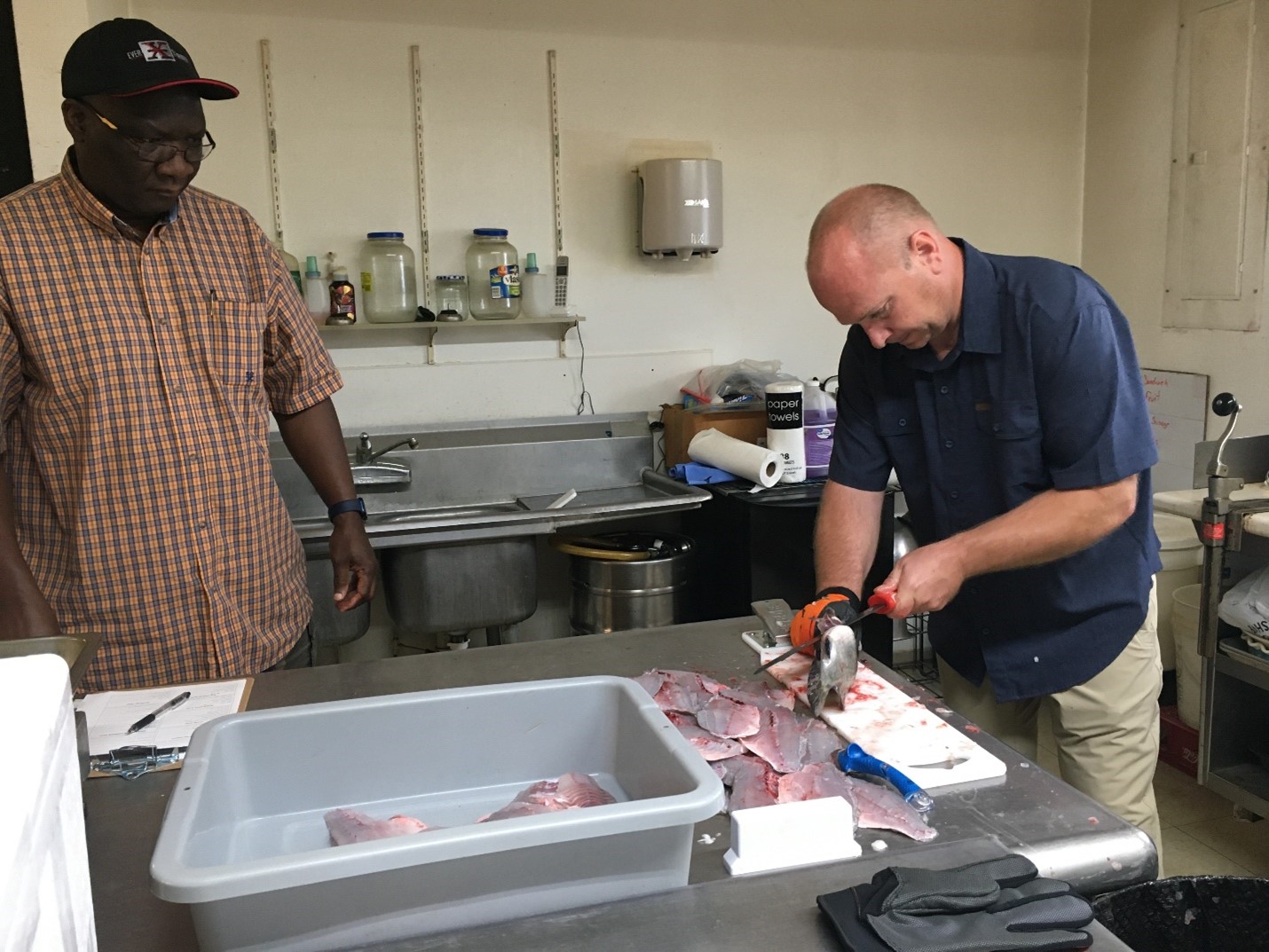
Hanilu Farms in Indiana participating in a small-scale fish processing case study. Photo by Kwamena Quagrainie.
Agricultural & Natural Resources (ANR) Newsletter: The Extension activities of Kwamena Quagrainie, clinical engagement professor in the Departments of Agricultural Economics and Forestry and Natural Resources, relate to economics in aquaculture and aquaponics. Kwamena is also affiliated with the Illinois-Indiana Sea Grant (IISG) program at Purdue University and the University of Illinois.
One aspect of his outreach activities relates to small-scale fish processing. He explored processing fish in shared-use commercial kitchens and on-farm processing facilities in local communities and hosted free HACCP training and pilot training workshops in seafood processing and food safety for fish farmers in Indiana and Illinois. Information from potential use of shared-use commercial kitchens and small on-farm fish processing kitchens were gathered to construct business models, costs, regulations, etc., as case studies, which are published in a handbook as a guide for small-scale fish farmers. The Handbook on Processing Fish for Small-Scale Fish Farmers outlines various aspects of understanding the process, including regulations, required training, requirements for renting a commercial kitchen and what it takes to own an on-farm facility. Fish farmers interested in processing their fish can use the handbook to decide if processing is a feasible pathway to add to their fish production business or to simply get into fish processing using any local facilities.
The other aspect relates to aquaponics as a sustainable food production enterprise and outreach to high schools interested in aquaponics in the classroom. Aquaponics is integrating aquaculture and hydroponics to produce seafood and plants using less land and water resources when compared with conventional food production methods. Kwamena’s primary focus with aquaponics is addressing the challenges in the adoption of aquaponics in the Midwest and helping farmers make informed decisions about getting into Aquaponics as a business. View YouTube video Aquaponics: What to consider before starting your business. Farmers are expressing interest in aquaponics as small farms and, in some cases, as urban farming, which could have some economic benefits because of its small footprint and use of less water and land resources.
The aquaponics in schools program is in its initial stages and is aimed at introducing students to basic scientific concepts through the lens of an aquaponics system. The program has lessons aligned with Science and Engineering Process Standards, incorporating material from biology, chemistry, and environmental science. An aquaponics curriculum developed by IISG is currently being pilot tested by high school teachers. The program will be implemented together with a water quality test kit loan program to schools in Indiana and Illinois.
To learn more about Dr. Quagrainie’s research and publications view: Kwamena Quagrainie, Forestry and Natural Resources profile page.
Resources:
A Guide to Marketing for Small-Scale Aquaculture Producers, The Education Store
A Guide to Small-Scale Fish Processing Using Local Kitchen Facilities, The Education Store
Marine Shrimp Biofloc Systems: Basic Management Practices, The Education Store
Aquaculture Industry in Indiana Growing, Purdue Today
Walleye Farmed Fish Fact Sheet: A Guide for Seafood Consumers, The Education Store, Purdue Extension resource center
Sustainable Aquaculture: What does it mean to you?, The Education Store
The Benefits of Seafood Consumption The Education Store, Purdue Extension Resource Center
Walleye Farmed Fish Fact Sheet: A Guide for Seafood Consumers, The Education Store, Purdue Extension resource center
Pond and Wildlife Management website, Purdue Extension
Fish Cleaning with Purdue Extension County Extension Director, Got Nature? Blog, Purdue Extension – Forestry and Natural Resources
Aquatics & Fisheries, Playlist, Purdue Extension – Forestry and Natural Resources
Eat Midwest Fish, Illinois-Indiana Sea Grant online resource hub
Agricultural & Natural Resources (ANR), Purdue Extension
Diana Evans, Extension & Web Communications Specialist
Purdue University Department of Forestry and Natural Resources
Illinois-Indiana Sea Grant (IISG) have four buoys now in place on the Great Lakes which inform scientists, weather forecasters, anglers, boaters, paddlers, surfers, swimmers and educational programs about current lake conditions. They collect data on wind speed, surface current, wave height, and water temperatures, providing valuable insights for scientists and the public.
- Michigan City Buoy – This buoy is located three miles offshore of Michigan City, Indiana. Purdue University’s Lyles School of Civil Engineering created the anchor used to keep the buoy in place. They also maintain and help deploy this buoy each year. The Michigan City Port Authority and the Lake Michigan Indiana Department of Natural Resources office played pivotal roles in helping deploy the anchor. The buoy itself was funded through a grant provided by Illinois-Indiana Sea Grant. A grant from the Indiana Department of Natural Resources Coastal Management Program allowed for the addition of the temperature chain.
- Chicago Buoy – This buoy, also called Chuoy, is based in the busy waters off Navy Pier, approximately a mile due east of the pier. This buoy is jointly owned and operated by Illinois-Indiana Sea Grant and the Lyles School of Civil Engineering at Purdue University.
For more information about Chuoy, check out this IISG article: New to Navy Pier waters, Chuoy the Buoy Proved a Valuable Forecasting Tool. - Wilmette Buoy – The Wilmette Buoy is situated approximately four miles off Wilmette, in Lake Michigan. The Sheridan Shore Yacht Club and the Coast Guard in Wilmette help deploy and store this buoy each year. Henry’s Sports and Bait shop in downtown Chicago helped deploy the anchor. The buoy was first deployed through a grant from the Great Lakes Observing System and the NOAA Coastal Storms Program.
- Waukegan Buoy – The Waukegan buoy is situated about a mile offshore from Waukegan Harbor in Lake Michigan. This buoy is owned and operated by the University of Illinois and the Illinois State Geological Survey. LimnoTech, Inc. and Illinois-Indiana Sea Grant play pivotal roles in helping deploy and support the buoy. The buoy was first deployed through a grant from NOAA. Continued funding support comes from the Illinois Department of Natural Resources Coastal Management Program.

For more information and photos view Purdue College of Agriculture News: Gearing Up for a Great Lake Day.
“The buoys act as a service to people who are active in Lake Michigan,” said Tomas Höök, director of Illinois-Indiana Sea Grant and professor of Forestry and Natural Resources at Purdue University. “A line runs from the surface of the buoy to the bottom of the lake, and sensors collect a variety of data. The buoy’s modem then communicates with a cell tower, providing data that anyone can access in real-time.”
“Near-record high water levels a few years ago were causing erosion along the shoreline, and there were even cases farther north in Lake Michigan of houses falling into the lake. But if you look back about 10 years, near-record low levels made the shoreline look like a mud flat,” Höök explained. “It’s important to understand because if infrastructure is built while the water is low, it’s highly likely the water level will rise back up and threaten that infrastructure.”
Subscribe to Illinois-Indiana Sea Grant YouTube Channel and view buoy videos along with fishing, water safety and other educational videos.
Illinois-Indiana Sea Grant is a partnership between NOAA, University of Illinois Extension, and Purdue University Forestry and Natural Resources, bringing science together with communities for solutions that work. Sea Grant is a network of 34 science, education and outreach programs located in every coastal and Great Lakes state, Lake Champlain, Puerto Rico and Guam.
Partners and Other Resources:
Lyles School of Civil Engineering, Purdue University
Henry’s Sports and Bait, Chicago, Illinois
Great Lakes Observing System
National Oceanic and Atmospheric Administration (NOAA) Coastal Storms
Illinois State Geological Survey
University of Illinois
Purdue University
Forestry and Natural Resources, Purdue University
LimnoTech
Illinois Department of Natural Resources Coastal Management Program
Indiana Department of Natural Resources Coastal Management Program
Lake Michigan Indiana Department of Natural Resources
Michigan City Port Authority
Center For Great Lakes Literacy (CGLL)
Eat Midwest Fish, Illinois-Indiana Sea Grant and North Central Regional Aquaculture Center
Informing the Development of the Great Lakes Region Decision Support System, The Education Store, Purdue Extension’s resource center
Fish Cleaning with Purdue Extension County Extension Director, Got Nature? Blog, Purdue Extension – Forestry and Natural Resources
Walleye Farmed Fish Fact Sheet: A Guide for Seafood Consumers, The Education Store
Meet the buoys of summer who help Purdue and Illinois study Lake Michigan: BTN LiveBIG, BTN
National Data Buoy Center (noaa.gov), National Data Buoy Center
Diana Evans, Extension & Web Communications Specialist
Purdue University Department of Forestry and Natural Resources
Illinois-Indiana Sea Grant (IISG) has recently added to its YouTube Channel new water safety videos, which share what to watch for and how to stay out of those scary situations that can become dangerous very quickly.
Water Safety Basics: Water safety is more then just knowing how to swim. You need to what can cause hazards, what type of water bodies have hazards and how to avoid or survive those hazards.
Water Safety – What to Know Before You Go to the Beach: On average every year, 87 people die in the Great Lakes, half of them are in Lake Michigan. Ocean waves are very different from Great Lake waves.
Water Safety – Winter Beach Hazards: Water safety is so important during the winter. When covered in snow and ice, it’s difficult to tell where the beach ends and the lake begins. Shelf ice is beautiful but dangerous. There are many places where it cannot support a person’s weight, which may cause a fall into freezing water below, so you should never walk on shelf ice.
Water Safety – How to Escape Dangerous Currents: Of the five Great Lakes, Lake Michigan has the highest number of drownings and rescues each year. Lake Michigan is freshwater. This is so different from an ocean. It doesn’t have the salt, so it is lacking that buoyancy already. If waves get super high and rip currents start to form and that water gets volatile, it is going to be much harder to get out of the situation if you start struggling while you are swimming.
Water Safety – Southern Lake Michigan: Lake Michigan has also had more than 250 recorded cases of swimmers caught in rip currents since 2002, which is double the combined total of the other four Great Lakes. Make sure you check the forecast before you come and have a safety plan. In the ocean you can get hit by two waves in 15 seconds but in the Great Lakes you could get his with five waves in that same time period. Learn more about high frequency waves and how dangerous it can be.
Illinois-Indiana Sea Grant combines research, education, and outreach to empower southern Lake Michigan communities to secure a healthy environment and economy. The program is funded through National Oceanic and Atmospheric Administration (NOAA) via the National Sea Grant College Program, as well as the University of Illinois and Purdue University. IISG also works in partnerships with key organizations, institutions, and agencies in the region to reach more audiences and multiply opportunities for success. IISG brings together scientists, educators, policy makers, community decision makers, outreach specialists, business leaders, and the general public to work towards a healthy environment and economy.
Subscribe to the Illinois-Indiana Sea Grant (IISG) YouTube Channel.
More Resources:
Implementation Examples of Smart Growth Strategies in Indiana, The Education Store, Purdue Extension’s resource center
Conservation Through Community Leadership, The Education Store
Community Development, Purdue Extension
Rainscaping Education Program, Purdue Extension
Rainscaping and Rain Gardens, Purdue Extension YouTube Channel
Enhancing the Value of Public Spaces, The Education Store
Enhancing the Value of Public Spaces: Creating Healthy Communities, The Education Store
Enhancing the Value of Public Spaces Program, Purdue Extension YouTube Channel
One Water Approach to Water Resources Management, The Education Store
Community Development, Purdue Extension
Community Planning Playlist, Purdue Extension-Forestry & Natural Resources (FNR) YouTube Channel
Indiana Creek Watershed Project – Keys to Success, Partnerships and People, Subscribe to Purdue Extension-FNR YouTube Channel
Climate Change and Sustainable Development, The Education Store
Climate Change: Are you preparing for it?, The Education Store
Diana Evans, Extension & Web Communications Specialist
Purdue University Department of Forestry and Natural Resources

Recent Posts
- Discover the Great Lakes, The 2025 Helm Magazine is Available
Posted: November 17, 2025 in Aquaculture/Fish, Aquatic/Aquaculture Resources, Wildlife - Illinois-Indiana Sea Grant Newsletter Shares New Resources
Posted: November 13, 2025 in Aquaculture/Fish, Aquatic/Aquaculture Resources, Wildlife - Publication – Fish Muscle Hydrolysate
Posted: September 15, 2025 in Aquaculture/Fish, Aquatic/Aquaculture Resources - Publication – Direct Marketing Guidebook for Small/Medium-Scale Aquaculture Businesses
Posted: March 7, 2025 in Aquaculture/Fish, Aquatic/Aquaculture Resources, Publication - Conservationists Unite for Snuffbox Mussels – Wild Bulletin
Posted: February 20, 2025 in Aquaculture/Fish, Aquatic/Aquaculture Resources, Wildlife - Learn to Process Your Own Deer – Wild Bulletin
Posted: November 11, 2024 in Aquatic/Aquaculture Resources, Forestry, How To, Wildlife - Publication – Handbook on Processing Fish for Small-Scale Fish Farmers
Posted: October 17, 2024 in Aquaculture/Fish, Aquatic/Aquaculture Resources, How To, Publication, Wildlife - Economics and Aquaculture Expert Kwamena Quagrainie is Featured Specialist in ANR Newsletter
Posted: October 15, 2024 in Aquatic/Aquaculture Resources, Great Lakes - Buoys Keep Eye on Great Lake Conditions
Posted: July 11, 2024 in Aquatic/Aquaculture Resources, Great Lakes, How To - IISG Adds New Water Safety Videos
Posted: May 8, 2024 in Aquaculture/Fish, Aquatic/Aquaculture Resources, Community Development, Great Lakes, Wildlife
Archives
Categories
- Alert
- Aquaculture/Fish
- Aquatic/Aquaculture Resources
- Ask the Expert
- Christmas Trees
- Community Development
- Disease
- Drought
- Forestry
- Forests and Street Trees
- Gardening
- Got Nature for Kids
- Great Lakes
- How To
- Invasive Animal Species
- Invasive Insects
- Invasive Plant Species
- Land Use
- Natural Resource Planning
- Nature of Teaching
- Plants
- Podcasts
- Ponds
- Publication
- Safety
- Spiders
- Timber Marketing
- Uncategorized
- Urban Forestry
- Webinar
- Wildlife
- Wood Products/Manufacturing
- Woodland Management Moment
- Woodlands