 Purdue University - Extension - Forestry and Natural Resources
Got Nature? Blog
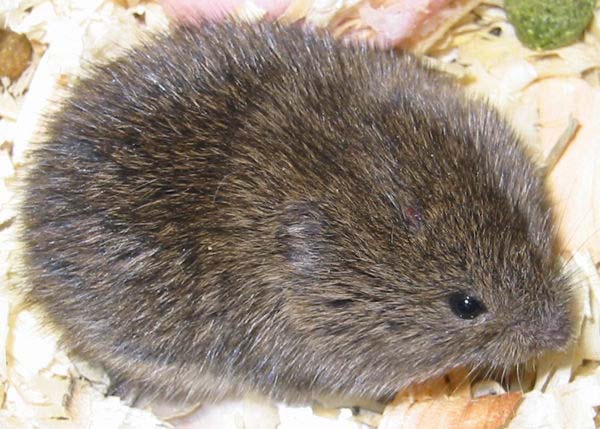 Question: I’m interested in doing regeneration planting of oaks and hickories on my property, and have made attempts with both direct seeding, as well as starting in Rootmaker containers and then planting the seedlings after one year of growth. I have been having a major problem with voles, despite my best attempts at barriers, and am wondering if there is anyone who would be able to advise me?
As an example, I had a black oak seedling, one year old, with great growth, about 18″ tall and with a root ball of comparable size, which I planted this fall. After 2-3 months, in December, the entire root system was eaten and all that remained of the seedling was the stalk, with clear gnaw-marks where it had been chewed off at the base. It was protected by a wire mesh enclosure that covered all sides plus the top, and was set about four inches into the ground. The mesh was finer than the standard chicken wire; the openings were about dime-size.
I would appreciate any guidance your experts can share.
Answer: Based on your description, it certainly sounds like pine (=woodland) voles, Microtus pinetorum, although trapping would be needed to confirm. I am no longer doing work on voles, but earlier work, Selective Feeding of Pine Voles on Roots of Seedlings, showed that they really do like roots of oak seedlings.
When I want to exclude small mammals, I use ¼ inch mesh size or smaller. One other approach I’ve used with success is to create an “apron” of hardware cloth underground and extending outward several inches from the cylinder. Since pine voles create tunnels below the ground surface, this isn’t a guarantee of exclusion, but it certainly should discourage them.
If the problem is too severe for you to tolerate, a rodenticide bait such as zinc phosphide is another option. Thiram is a repellent that could be used – like all repellents, it has variable and short-term effectiveness (but still tends to be better than other commercial products).
The following link offers some practical tips on voles and vole control, including trapping to verify that voles are present, and methods of scouting and treating with rodenticide to reduce exposure risk to other nontarget wildlife and pets, Controlling Voles in Horticulture Plantings and Orchards in Missouri, University of Missouri Extension.
Resources:
Voles!, Purdue Extension-Agronomy
Voles (remember the V), Turfgrass Science, Purdue Horticulture & Landscape Architecture
Dealing with Mole Damage in Your Yard video, Purdue Extension-Forestry & Natural Resources YouTube Channel
Orphaned Wildlife, Got Nature? blog
A Template for Your Wildlife Habitat Management Plan, The Education Store, Purdue Extension resource center
Forest Improvement Handbook, The Education Store
Wildlife Habitat Hint, Purdue Extension – Forestry & Natural Resources (FNR) YouTube Playlist
Conservation Tree Planting: Steps to Success, Purdue Extension – FNR YouTube Video
Woodland Stewardship for Landowners, Purdue Extension – FNR YouTube Playlist
Woodland Management Moment, Purdue Extension – FNR YouTube Playlist
Rob Swihart, Professor of Wildlife Ecology
Department of Forestry and Natural Resources, Purdue University
The classic and trusted book “Fifty Common Trees of Indiana” by T.E. Shaw was published in 1956 as a user-friendly guide to local species. Nearly 70 years later, the publication has been updated through a joint effort by the Purdue Department of Forestry and Natural Resources, Indiana 4-H, and the Indiana Department of Natural Resources, and reintroduced as “An Introduction to Trees of Indiana.”
The full publication is available for download for $7 in the Purdue Extension Education Store. The field guide helps identify common Indiana woodlot trees.
Each week, the Intro to Trees of Indiana web series will offer a sneak peek at one species from the book, paired with an ID That Tree video from Purdue Extension forester Lenny Farlee to help visualize each species as it stands in the woods. Threats to species health as well as also insight into the wood provided by the species, will be provided through additional resources as well as the Hardwoods of the Central Midwest exhibit of the Purdue Arboretum, if available. 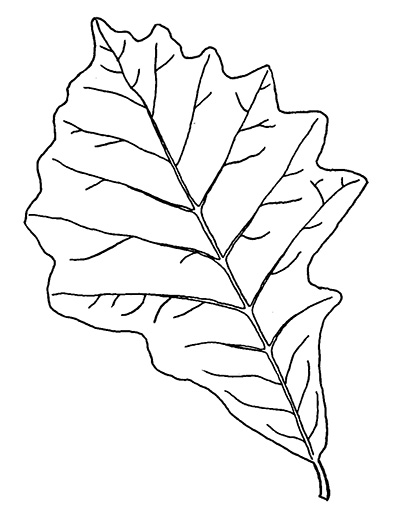
This week, we take a look at the third of our oak varieties in Indiana, the Swamp White Oak or Quercus bicolor.
The swamp white oak has leaves with wavy, uneven lobed margins with blunt teeth, which are wider toward the tip than at the base. The alternately-held leaves are typically dark green on top with a silvery-white underside, which turn orange, gold and yellow in the fall.
The bark on swamp white oak is similar to that of white oak and often peels back especially on younger trees. Mature bark is dark gray-brown with flaky/shreddy bark or blocky ridges that are consistent up and down the tree.
The fruit of the swamp white oak is an acorn held on a long stalk, typically an inch or inch and a half long, called a peduncle.
Swamp white oaks, which grow to 50 to 60 feet tall, are named for the fact that they often grow in wet places, such as line drawing of swamp white oak acorns and peduncle. upland swamps and lowlands. This species also can tolerate well-drained upland sites, making it a good option for landscape plantings. The natural range of swamp white oak is the northern half of the eastern United States, reaching as far south as Missouri, southern Illinois and Kentucky, and north into Wisconsin, Michigan and Pennsylvania.
The Morton Arboretum warns to plant swamp white oak in full sun and shares that the species is one of the easiest oaks to transplant and is more tolerant of poor drainage than other oaks. It also notes that oaks should be pruned in the dormant season to avoid attracting beetles that may carry oak wilt. Swamp white oak can be affected by pests such as anthracnose, powdery mildew, chlorosis in high pH soils, insect galls and oak wilt.
In general, lumber from the white oak group is among the heaviest next to hickory, weighing in at 47 pounds per cubic foot. It is very resistant to decay and is one of the best woods for steam bending.
White oak lumber has been used for a variety of purposes including log cabins, ships, wagon wheels and furniture. It also is preferred for indoor decorative applications ranging from furniture, especially in churches, to cabinets, interior trim, millwork and hardwood flooring and veneers. It also may be used for barrel making.
Its density and durability make white oak a favorite for industrial applications such as railroad ties, mine timbers, sill plates, fence posts and boards, pallets, and blocking, as well as industrial, agricultural and truck flooring.
For full article with additional photos view: Intro to Trees of Indiana: Swamp White Oak, Forestry and Natural Resources’ News.
If you have any questions regarding wildlife, trees, forest management, wood products, natural resource planning or other natural resource topics, feel free to contact us by using our Ask an Expert web page.
Other Resources:
ID That Tree: Swamp White Oak
ID That Tree: White Oak Group
Hardwood Lumber and Veneer Series: White Oak Group
Morton Arboretum: Swamp White Oak
Fifty Common Trees of Indiana
An Introduction to Trees of Indiana
Native Trees of the Midwest, The Education Store
Shrubs and Woody Vines of Indiana and the Midwest, The Education Store
Investing in Indiana Woodlands, The Education Store
Forest Improvement Handbook, The Education Store
ID That Tree, Purdue Extension-Forestry & Natural Resources (FNR) YouTube playlist
Woodland Management Moment , Purdue Extension-FNR YouTube playlist
Wendy Mayer, FNR Communications Coordinator
Purdue University Department of Forestry and Natural Resources
Lenny Farlee, Sustaining Hardwood Extension Specialist
Purdue University Department of Forestry and Natural Resources
The classic and trusted book “Fifty Common Trees of Indiana” by T.E. Shaw was published in 1956 as a user-friendly guide to local species. Nearly 70 years later, the publication has been updated through a joint effort by the Purdue Department of Forestry and Natural Resources, Indiana 4-H, and the Indiana Department of Natural Resources, and reintroduced as “An Introduction to Trees of Indiana.”
The full publication is available for download for $7 in the Purdue Extension Education Store. The field guide helps identify common Indiana woodlot trees.
Each week, the Intro to Trees of Indiana web series will offer a sneak peek at one species from the book, paired with an ID That Tree video from Purdue Extension forester Lenny Farlee to help visualize each species as it stands in the woods. Threats to species health as well as also insight into the wood provided by the species, will be provided through additional resources as well as the Hardwoods of the Central Midwest exhibit of the Purdue Arboretum, if available. 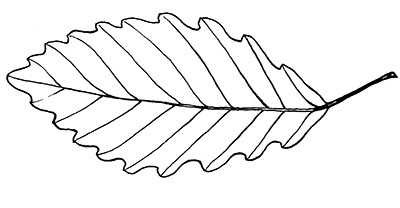
This week, we take a look at the fourth of our oak varieties in Indiana, the Chestnut Oak or Quercus montana.
The leaves of the chestnut oak have small, evenly lobed rounded margins. The upper leaf surface is leathery in appearance and is dark green in color, while the lower surface is a duller green. In the fall, the leaves can range from red and orange to yellow and brown.
The bark may be its tell-tale characteristic. Unlike other members of the white oak group, the bark of Chestnut oak bark chestnut oak is dark and deeply ridged.
The fruit of the chestnut oak is a relatively-large dark brown acorn with a smooth edge on the outer margin of the cap.
Chestnut oaks, which grow to 60 to 70 feet tall, are often found on high, dry sites in Indiana. The natural range of chestnut oak is across the northeastern United States, extending south to the northern parts of Alabama and Georgia and west to the southern tip of Illinois.
The Morton Arboretum warns that chestnut oak is a difficult to transplant due to a deep taproot, but that it can tolerate most soils except those that drain poorly. It also notes that oaks should be pruned in the dormant season to avoid attracting beetles that may carry oak wilt. Chestnut oak can be affected by pests such as scale insects and two-lined chestnut borer. Chestnut oak acorns
In general, lumber from the white oak group is among the heaviest next to hickory, weighing in at 47 pounds per cubic foot. It is very resistant to decay and is one of the best woods for steam bending. Chestnut oak, however, is considered a poor lumber species.
White oak lumber has been used for a variety of purposes including log cabins, ships, wagon wheels and furniture. It also is preferred for indoor decorative applications ranging from furniture, especially in churches, to cabinets, interior trim, millwork and hardwood flooring and veneers. It also may be used for barrel making.
Its density and durability make white oak a favorite for industrial applications such as railroad ties, mine timbers, sill plates, fence posts and boards, pallets, and blocking, as well as industrial, agricultural and truck flooring.
For full article with additional photos view: Intro to Trees of Indiana: Chestnut Oak, Forestry and Natural Resources’ News.
If you have any questions regarding wildlife, trees, forest management, wood products, natural resource planning or other natural resource topics, feel free to contact us by using our Ask an Expert web page.
Other Resources:
ID That Tree: Chestnut Oak
ID That Tree: White Oak Group
Hardwood Lumber and Veneer Series: White Oak Group
Morton Arboretum: Chestnut Oak
Fifty Common Trees of Indiana
An Introduction to Trees of Indiana
Native Trees of the Midwest, The Education Store
Shrubs and Woody Vines of Indiana and the Midwest, The Education Store
Investing in Indiana Woodlands, The Education Store
Forest Improvement Handbook, The Education Store
ID That Tree, Purdue Extension-Forestry & Natural Resources (FNR) YouTube playlist
Woodland Management Moment , Purdue Extension-FNR YouTube playlist
Chestnut Oak, Native Trees of Indiana River Walk, Purdue-Fort Wayne
Wendy Mayer, FNR Communications Coordinator
Purdue University Department of Forestry and Natural Resources
Lenny Farlee, Sustaining Hardwood Extension Specialist
Purdue University Department of Forestry and Natural Resources
American Eagle Foundation: Our native vultures play a crucial role in reducing the spread of disease. However, as black vulture population increases, so too have reports of human-wildlife interactions. Researchers at Purdue University are currently performing research to better understand reports of black vulture depredation on livestock, and their ultimate goal is to find solutions that protect both livestock and birds.
AEF interviewed Dr. Pat Zollner, Dr. Zhao Ma, doctoral student Marian Wahl, and Ph.D. alumna Brooke McWherter for insight into their important research.
Check out the great information in this video discussing how this research was started and the concerns shared to the USDA office from state offices and the public.
Find out what types of vulture species are here in the United States and their roles in the story Protect Our Native Vultures, American Eagle Foundation.
Vultures have a role to play as nature’s garbagemen, cleaning up animal carcasses. If you have any questions regarding this research, or have any experiences to share, contact Marian Wahl.
Resources:
Black Vulture Research Highlighted by NY Times, Got Nature Blog, Purdue Extension-Forestry and Natural Resources
Citizen Participation Needed in Black Vulture Research, Purdue Forestry and Natural Resources News
Black Vulture Research, March Edition of Beef Monthly
Black Vulture Ecology and Human-Wildlife Conflicts, Purdue FNR, Dr. Pat Zollner’s WebsiteDiana Evans, Extension and Web Communication Specialist
Purdue University Department of Forestry and Natural Resources
Marion Wahl, Graduate Research Assistant
Purdue Forestry and Natural Resources
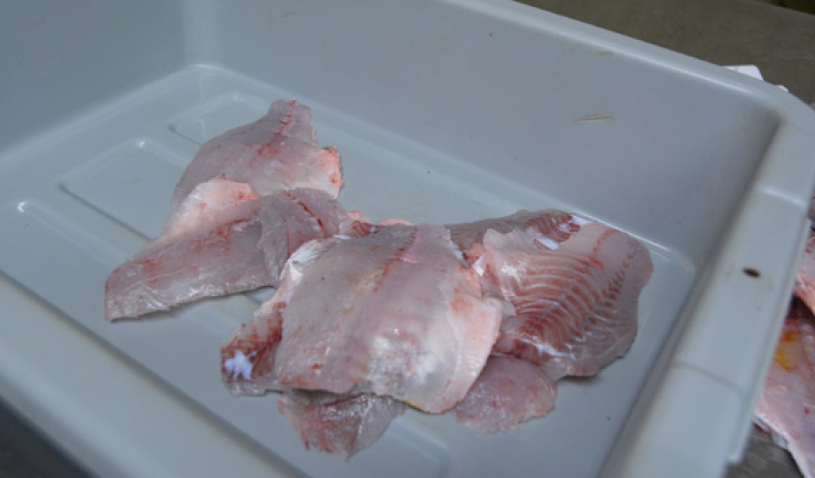 The North Central Regional Aquaculture Center (NCRAC) is supporting a small-scale seafood processing and food safety training for fish farmers in the Midwest. Sponsors for this training session include: Illinois Extension, Purdue Extension and Illinois-Indiana Sea Grant.
Interested fish and aquaponics farmers may sign up for a 2-day HACCP (Hazard Analysis Critical Control Points) training session. The location of farmers will determine how many training sessions will be available and the training session locations.
If you are highly interested and willing to commit to the process, please complete this survey as soon as possible. Seats are limited!
Sign up through this link:
https://purdue.ca1.qualtrics.com/jfe/form/SV_cuaAzf30VfRZixo
For any questions please contact:
Kwamena Quagrainie, Aquaculture Economics/Marketing Specialist
Illinois-Indiana Sea Grant/Purdue Forestry & Natural Resources/Purdue Agricultural Economics/Purdue Extension – FNR
Amy Shambach, Aquaculture Marketing Outreach Associate
Illinois-Indiana Sea Grant/Purdue Extension- FNR
Taylor Bradford, Aquaculture Extension Assistant
Illinois-Indiana Sea Grant/Purdue Forestry & Natural Resources/Purdue Agricultural Economics
Resources:
Fish: Healthy Protein Handout, The Education Store, Purdue Extension resource center
Walleye Farmed Fish Fact Sheet: A Guide for Seafood Consumers, The Education Store
Fish Cleaning with Purdue Extension County Extension Director, Got Nature? Blog, Purdue Extension – Forestry and Natural Resources (FNR)
What is Aquaponics?, Got Nature? blog, Purdue Extension – FNR
Eat Midwest Fish, Website
Sustainable Aquaculture: What does it mean to you?, The Education Store
Best Practices Guide for Charter Fishing and COVID-19, The Education Store
Pond Management: Managing Fish Populations, The Education Store
Aquatics & Fisheries, YouTube Playlist, Purdue Extension – FNR
Purdue Aquaponics: Cut Water Usage, YouTube Channel, Purdue Extension – FNR
Largemouth Bass Fingerling Production, YouTube Channel, Purdue Extension – FNR
North Central Regional Aquaculture Center (NCRAC)
Follow the hellbenders as they start their journey with the Purdue Forestry and Natural Resources husbandry program starting with eggs found in the wild. Learn how they become part of the breeding program with our partner zoos. Travel with our Help the Hellbender crew and see the fruit of their labor as the team releases adult hellbenders into the Blue River. Be sure to follow the Help the Hellbender Facebook page for more videos as there are several release dates scheduled for this summer.
Learn more about the hellbender program and a locally made documentary in the Purdue Forestry and Natural Resources News & Stories, Hellbender Research Featured in New Documentary.
Resources:
Help the Hellbender website
Help the Hellbender Facebook page
Ask the Expert: Learn All About Hellbenders and Take a Tour, Subscribe Purdue Extension – Forestry & Natural Resources (FNR) YouTube Channel
Ask the Expert video: Help the Hellbender – Dr. Stephen Spear of The Wilds, Purdue Extension – FNR YouTube Channel
Ask the Expert video: Live with Mesker Park Zoo and Botanical Gardens – Hellbenders, Purdue Extension – FNR YouTube Channel
A Moment in the Wild video: Hellbender Hide, Purdue Extension – FNR YouTube Channel
A Moment in the Wild video: Release Moment of Hellbenders,
How Anglers and Paddlers Can Help the Hellbender video, Purdue Extension – FNR YouTube Channel
Eastern Hellbender ID Video, Purdue Extension – FNR YouTube Channel
Hellbenders Rock!, The Education Store, Purdue Extension’s resource center
Help the Hellbender, North America’s Giant Salamander, The Education Store
How Our Zoos Help Hellbenders, The Education Store
The Nature of Teaching: Adaptations for Aquatic Amphibians, The Education Store
Healthy Water, Happy Home – Lesson Plan, The Education Store
FNR Assists in First Natural Breeding of Eastern Hellbender in Captivity, Purdue FNR News & Stories
Wendy Mayer, FNR Communications Coordinator
Purdue University Department of Forestry and Natural Resources
Zach Truelock, Hellbender Technician
Purdue Forestry and Natural Resources
Rod Williams, Assistant Provost for Engagement/Professor of Wildlife Science
Purdue University Department of Forestry and Natural Resources
Purdue Landscape Report, Why are the Japanese beetles running late this year?: Nothing heralds summer like the hum of Japanese beetles ravenously descending on a flower garden. Cool weather this spring has slowed emergence of adults from the soil. Heavy spring rains early followed by relatively drier weather in late June, may have trapped adult Japanese beetles under a crusty layer of hardened soil. Due to their large numbers in many parts of Indiana last year, they are very likely just waiting for a good rain to soften the surface, so they can dig themselves into the light of day and on to your flowers. So, if we get a little more rain by the time this article comes out, we are likely to be awash in adult beetles.
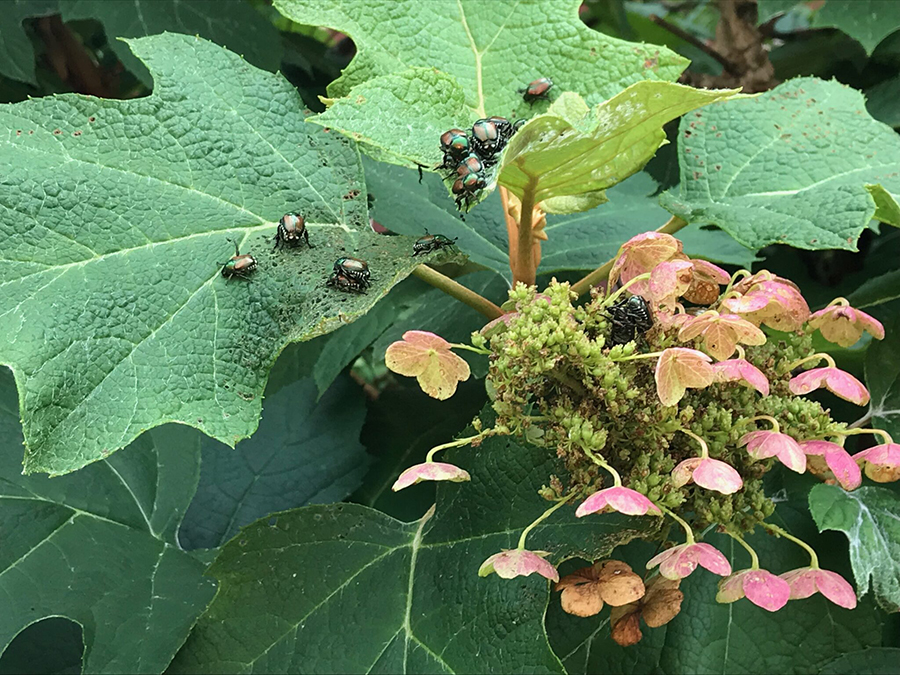 Weather is only part of what makes Japanese beetles predictably unpredictable. Beneficial organisms including fungi, microsporidia, and parasitic wasps also act different life stages of Japanese beetles. Japanese beetles have been the target of several national programs to release these beneficial organisms to reduce beetle populations. Favorable conditions for these beneficials can help reduce the local abundance of grubs and beetles.
Although killing grubs will reduce the number of beetles, the small size of lawns and the long flight range of makes it unlikely for your grub control program to reduce defoliation. In experiments conducted in my lab over 20 years ago, we found adult beetles can easily fly a kilometer (0.66 miles) in a single day. With adults living for several weeks, it is easy to image beetles traveling long distances from untreated lawns to plants on your property.
Life cycle of Japanese beetles: As the weather warms in the spring larvae (aka white grubs) move closer to the surface and begin feeding on turf roots. In May they enter a pupal stage and stop feeding. In June they typically emerge from the soil as adults. Adults fly in summer when they feed on flowers and leaves. In late July and early August adults lay eggs into the turfgrass. White grubs hatch from eggs and feed on the roots until frost when the larvae begin dig deeper into the soil to avoid killing temperatures.
To find out what you can do about Japanese beetles and view photos view: Why are the Japanese beetles running late this year?
Resources:
Report Invasive
Invasive Species, Got Nature?
Invasive Species, Playlist, Purdue Extension – FNR YouTube Channel
Indiana Department of Entomology and Plant Pathology
Spotted lanternfly: Everything You Need to Know in 30 Minutes, Video, Emerald Ash Borer University
Emerald Ash Borer, EAB Information Network
Invasive plants: impact on environment and people, The Education Store, Purdue Extension’s resource center
Woodland Management Moment: Invasive Species Control Process, Video, Purdue Extension – Forestry and Natural Resources (FNR) YouTube Channel
What are invasive species and why should I care?, Got Nature? Blog, Purdue Extension – Forestry and Natural Resources
Pest Management, The Education Store
Cliff Sadof, Professor Entomology/Extension Fellow
Purdue Entomology
Purdue Landscape Report, What is Happening to the Weeping Willows?: While recent temperatures have been moderate in many parts of the state, rainfall has been lacking. (See The Annual Drought Article). There are chasms in the clay of my backyard that will swallow my kids and dogs whole. While I am not truly worried about the safety of my smaller family members, a lot of the plants that are not in shade are stressed. At the Purdue Plant and Pest Diagnostic Laboratory, we have received quite a few calls, emails, and samples about trees in decline. Trees that are already stressed, infected by a pathogen, or are infested by wood-boring insects will be showing their true colors in these drought conditions: chlorosis, leaf loss, and limb dieback.
Willow showing yellowing of older leaves on lower branches.
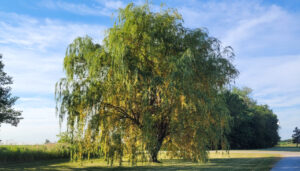 This month, one group of trees limps along to the top of our list of plants under stress due to lack of water: Willows. Salix spp. are not great landscape trees in general unless planted in locations that retain water. While they grow quickly and can appear beautiful for a number of years, when the soil becomes dry, these trees can very quickly develop limb dieback or cankers. In many cases, cankers become more obvious during these periods of stress because they were already present before the drought stress occurs. Damaged limbs die faster and multiple species of canker-causing fungi have been found to move faster in drought stressed wood of some tree species. We have found the fungi Cytospora, Botryosphaeria, and Colletotrichum associated with cankers on recent branch submissions to the lab.
Thinning of the branches, cracks/splits in the bark, and black lesions on green stems can indicate the presence of a canker which should be pruned out and destroyed, if at all possible. Supplemental irrigation may be required during dry spells for trees that are water loving or, at least, drought intolerant. Fungicides are not effective for these fungal pathogens that live inside the wood, where fungicides can’t penetrate. In most cases larger willow trees will not die because of these problems but they may suffer significant branch loss and may become disfigured. In some cases very young trees or shrub type willows may be killed.
For full article and photos view: What is Happening to the Weeping Willows?
Resources:
Summer Tree Care, Purdue Landscape Report
Drought? Don’t Forget the Trees!, The Education Store, Purdue Extension resource center
Extreme Heat, Purdue Extension – IN-PREPared
Drought Information, Indiana Department of Natural Resources
Planting Your Tree Part 1: Choosing Your Tree, Purdue Extension YouTube Channel
Tree Selection for the “Un-natural” Environment, The Education Store
Tree Pruning Essentials Video, Purdue Extension YouTube Channel
Tree Defect Identification, The Education Store
Tree Wound and Healing, Got Nature? Blog, Purdue Extension – Forestry and Natural Resources
Surface Root Syndrome, The Education Store
John Bonkowski, Plant Disease Diagnostician
Plant and Pest Diagnostic Laboratory
The classic and trusted book “Fifty Common Trees of Indiana” by T.E. Shaw was published in 1956 as a user-friendly guide to local species. Nearly 70 years later, the publication has been updated through a joint effort by the Purdue Department of Forestry and Natural Resources, Indiana 4-H, and the Indiana Department of Natural Resources, and reintroduced as “An Introduction to Trees of Indiana.”
The full publication is available for download for $7 in the Purdue Extension Education Store. The field guide helps identify common Indiana woodlot trees.
Each week, the Intro to Trees of Indiana web series will offer a sneak peek at one species from the book, paired with an ID That Tree video from Purdue Extension forester Lenny Farlee to help visualize each species as it stands in the woods. Threats to species health as well as also insight into the wood provided by the species, will be provided through additional resources as well as the Hardwoods of the Central Midwest exhibit of the Purdue Arboretum, if available.
This week, we introduce the flowering dogwood or Cornus florida.
This small native Indiana tree has beautiful white blossoms in the spring, and red to maroon foliage in the fall. It has opposite leaf arrangement with simple leaves featuring a venation pattern that sees the veins angle and sweep along the edges of the leaf and curve to the tip. The bark is a rough alligator hide texture that ranges from light to medium gray.
The showy white flowers, which appear in April or May, are followed by berry-like fruit clusters that are green at first, later turning red.
Flowering dogwood is the largest dogwood in the state of Indiana. It is shade tolerant, but it prefers good soil drainage and protection from the wind.
Flowering dogwood is a great alternative to the invasive callery pear.
According to Morton Arboretum, the flowering dogwood grows to 20 to 40 feet tall.
According to the Wood Database, flowering dogwood is commonly used in golf club heads, textile shuttles, bows for archery, mallets, pulleys and turned objects.
For full article with additional photos view: Intro to Trees of Indiana: Northern catalpa
Resources:
Flowering Dogwood, Native Trees of Indiana River Walk, Purdue Fort Wayne
Fifty Common Trees of Indiana
An Introduction to Trees of Indiana
Native Trees of the Midwest, The Education Store, Purdue Extension’s resource center
Shrubs and Woody Vines of Indiana and the Midwest, The Education Store
Investing in Indiana Woodlands, The Education Store
Forest Improvement Handbook, The Education Store
ID That Tree, Purdue Extension-Forestry and Natural Resources (FNR) YouTube Channel-playlist
Woodland Management Moment, Purdue Extension-FNR YouTube Channel-playlist
Wendy Mayer, FNR Communications Coordinator
Purdue University Department of Forestry and Natural Resources
Lenny Farlee, Sustaining Hardwood Extension Specialist
Purdue University Department of Forestry and Natural Resources
The classic and trusted book “Fifty Common Trees of Indiana” by T.E. Shaw was published in 1956 as a user-friendly guide to local species. Nearly 70 years later, the publication has been updated through a joint effort by the Purdue Department of Forestry and Natural Resources, Indiana 4-H, and the Indiana Department of Natural Resources, and reintroduced as “An Introduction to Trees of Indiana.”
 The full publication is available for download for $7 in the Purdue Extension Education Store. The field guide helps identify common Indiana woodlot trees.
Each week, the Intro to Trees of Indiana web series will offer a sneak peek at one species from the book, paired with an ID That Tree video from Purdue Extension forester Lenny Farlee to help visualize each species as it stands in the woods. Threats to species health as well as also insight into the wood provided by the species, will be provided through additional resources as well as the Hardwoods of the Central Midwest exhibit of the Purdue Arboretum, if available.
This week, we introduce the Kentucky Coffeetree or Gymnocladus dioicus.
This native species, which is part of the broad legume family, historically provided a substitute for coffee, care of the dark bean like seeds held within its fruit, which is in the form of a wide, thick-shelled pod.
It is easily identifiable by its large seed pods, long doubly-compound leaves and textured, flaking/peeling bark with vertical ridges. Its compound leaves, sometimes two feet or more in length, are arranged alternately on very thick twigs that have a mottled color and a distinct, salmon-colored pith.
This tree is found in many parts of the state, but it is never a common tree and is usually widely scattered. According to the Morton Arboretum, Kentucky coffeetree is tolerant to pollution and a wide range of soils making it a suitable tree for urban environments.
This species can grow to up to 100 feet in height and as large as five and a half feet in diameter at breast height.
For full article with photos view: Intro to Trees of Indiana: Kentucky Coffeetree
Resources:
Kentucky Coffeetree, The Purdue Arboretum Explorer
Kentucky Coffeetree, Purdue Fort Wayne Native Trees of Indiana River Walk
Top 5 List for Tree Selection and Planting, Purdue Extension-Forestry & Natural Resources (FNR) Got Nature? Blog
Fifty Common Trees of Indiana
An Introduction to Trees of Indiana
Native Trees of the Midwest, The Education Store, Purdue Extension’s resource center
Shrubs and Woody Vines of Indiana and the Midwest, The Education Store
ID That Tree, Purdue Extension-FNR’s YouTube playlist
Woodland Management Moment , Purdue Extension-FNR’s YouTube playlist
Investing in Indiana Woodlands, The Education Store
Forest Improvement Handbook, The Education Store
Wendy Mayer, FNR Communications Coordinator
Purdue University Department of Forestry and Natural Resources
Lenny Farlee, Sustaining Hardwood Extension Specialist
Purdue University Department of Forestry and Natural Resources

Recent Posts
- It’s Timberdoodle Time!
Posted: April 3, 2026 in Got Nature for Kids, How To, Wildlife - Keep An Eye Out for Hammerhead Worms, Purdue Landscape Report
Posted: April 2, 2026 in Invasive Animal Species, Wildlife, Woodlands - When is the Peak Migration For Hummingbirds and How Can You Attract Them?
Posted: in How To, Wildlife - ID That Tree Featured in National Woodland Owners Association Newsletter
Posted: April 1, 2026 in Urban Forestry, Wildlife, Woodlands - New 2026 Indiana Woodland Steward Newsletter
Posted: March 30, 2026 in Urban Forestry, Wildlife, Woodlands - A Woodland Management Moment: Why Aspect Matters
Posted: in Urban Forestry, Woodland Management Moment, Woodlands - 2026 Winter Bat Survey In Progress, MyDNR
Posted: March 27, 2026 in How To, Wildlife - Fast-Growing Trees for the Landscape, Purdue Landscape Report
Posted: March 26, 2026 in Forestry, Urban Forestry, Woodlands - Urban Tree Spotlight: Planting Deciduous Shade Trees, Purdue Landscape Report
Posted: March 25, 2026 in Forests and Street Trees, Urban Forestry, Woodlands - Beetle that attacks Tree-of-Heaven found in Indiana, Purdue Landscape Report
Posted: March 20, 2026 in Invasive Insects, Wildlife, Woodlands
Archives
Categories
- Alert
- Aquaculture/Fish
- Aquatic/Aquaculture Resources
- Ask the Expert
- Christmas Trees
- Community Development
- Disease
- Drought
- Forestry
- Forests and Street Trees
- Gardening
- Got Nature for Kids
- Great Lakes
- How To
- Invasive Animal Species
- Invasive Insects
- Invasive Plant Species
- Land Use
- Natural Resource Planning
- Nature of Teaching
- Plants
- Podcasts
- Ponds
- Publication
- Safety
- Spiders
- Timber Marketing
- Uncategorized
- Urban Forestry
- Webinar
- Wildlife
- Wood Products/Manufacturing
- Woodland Management Moment
- Woodlands