 Purdue University - Extension - Forestry and Natural Resources
Got Nature? Blog
Once the leaves have fallen and the landscape is dominated by shades of brown and gray, bright colors like red catch our attention. There are several red fruits that we may encounter in the late fall and winter here in Indiana that add some color to the landscape. These fruits are retained on trees and shrubs for a variety of reasons. Some are not as palatable to wildlife, so they are eaten later in the season. Some are more resistant to freeze damage and thus cling to branches longer than delicate fruits. There may also be an advantage to their appearance. Many of these plants have seeds dispersed by wildlife like birds, which eat the seeds and excrete them later, providing an opportunity to produce new plants away from the parent. Many birds can see much of the same color spectrum we do, plus enhanced vision in the ultra-violet bands. Brightly-colored seeds with waxy skins may reflect more ultra-violet light and be more noticeable to the birds.
What are some of those red fruits?
One family of plants accounts for several red fruit we can see in late fall and winter, the rose family. This family includes apples, plums, cherries, hawthorns, pears and others as well as the roses. In Indiana we have several hawthorns (Crataegus species) that produce a fruit resembling a tiny apple. These vary in size by species but are typically ¼ to ½ inch diameter and often held in clusters. Hawthorns are typically small trees and may have long thin thorns on the twigs.

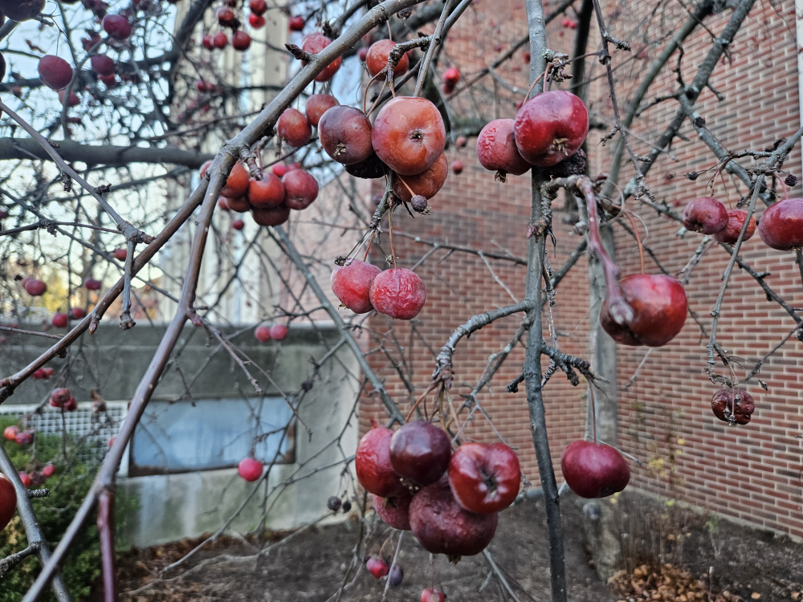
Another rose family member are the apples and crabapples with some small native trees like sweet crabapple, Malus coronaria, and several varieties of fruit-bearing apples and ornamental crabapples planted but sometimes escaping to natural areas. While our native crabapples are usually about 1-2 inches diameter and green to yellow, the domesticated apples and crabapples often have red fruit in various sizes from large apples to ½ inch diameter crabapples.

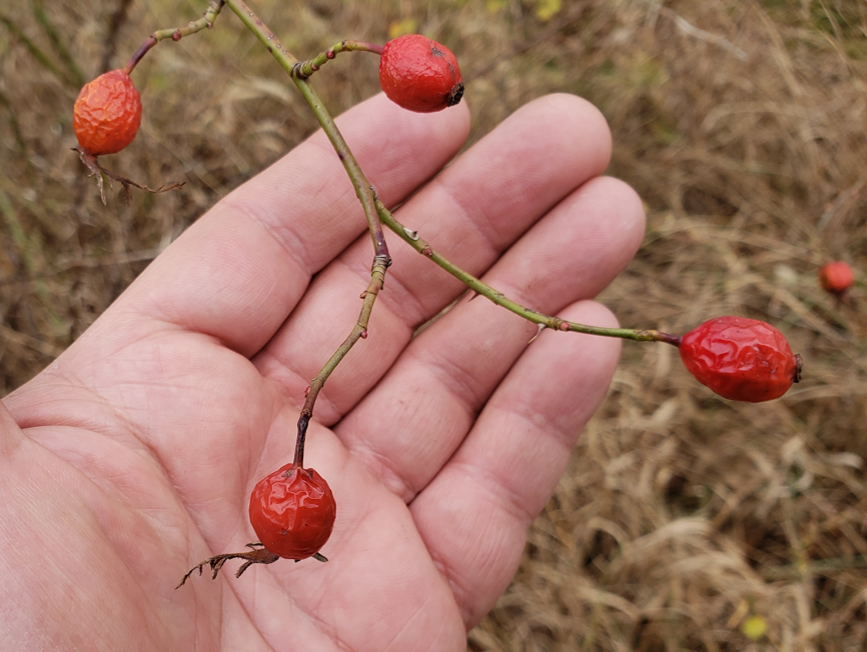
We also have several beautiful native roses in Indiana, and a particularly problematic exotic invasive rose in multiflora rose. Unfortunately, you are more likely to encounter multiflora rose with small ¼ inch clusters of red fruit. Our native roses typically have larger fruit and fewer fruit per cluster.

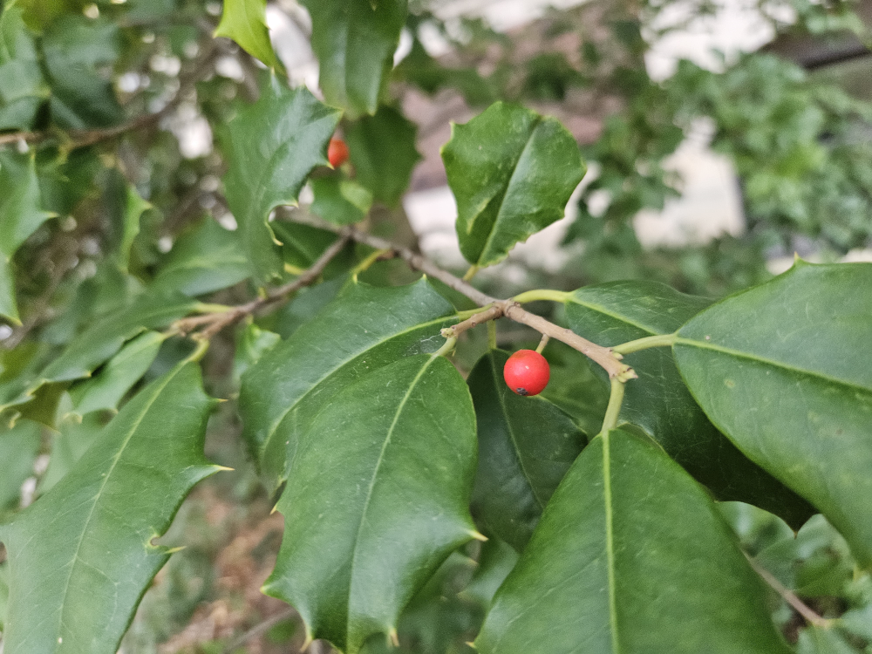
Holly is also noted for red fruit and some being evergreen as well. Our native Indiana hollies are all deciduous, losing their leaves in the fall but often retaining the red fruit on the female plants into winter. The most widespread species is winterberry, Ilex verticillate, a shrub which is seeing more use ornamentally due to its striking red fruit held past Christmas most years. American holly, an evergreen broadleaved tree, is well-known for its glossy, spiny foliage and red fruit on the female trees. Although not native to Indiana, it is spreading from plantings into natural areas. Several evergreen hollies from Europe and Asia are also common in ornamental plantings and may escape into natural areas.
Not only are these late-season showy fruit attractive, but they also provide some important nourishment for wildlife when the many other fruits are long-gone.
Resources:
Ask An Expert: Holidays in the Wild, Purdue Extension – Forestry and Natural Resources (FNR) YouTube Channel
Selecting a Real Christmas Tree, Got Nature? Blog Post, Purdue Extension – FNR
Tips on How You Can Recycle Your Christmas Tree, Got Nature? Blog Post, Purdue Extension – FNR
ID That Tree, Playlist, Purdue Extension – FNR YouTube Channel
ID That Tree: Prickly Ash, Purdue Extension – FNR YouTube Channel
A Woodland Management Moment, Playlist, Purdue Extension – FNR YouTube Channel
Shrubs and Woody Vines of Indiana and the Midwest, The Education Store, Purdue Extension Resource Center
Native Trees of the Midwest, The Education Store
Investing in Indiana Woodlands, The Education Store
Forest Improvement Handbook, The Education Store
Tree Installation: Process and Practices, The Education Store
Tree Planting Part 1: Choosing a Tree, video, The Education Store
Lenny Farlee, Extension Forester
Hardwood Tree Improvement and Regeneration Center
Purdue Department of Forestry & Natural Resources
Wild Bulletin, Indiana Department of Natural Resources (DNR) Fish and Wildlife: Snow blanketing the ground creates a canvas for spotting wildlife tracks. Here are some tips for exploring snow-covered trails or your own backyard to reveal a whole world of activity you might otherwise miss.
Tips and Tricks:

Photo by: Indiana Department of Natural Resources
- Look near water sources, tree lines, or feeding spots where animals are more likely to gather.
- Find an Indiana wildlife track identification book or website to help you identify the animal you are tracking. Some animal tracks are more common to spot in Indiana, and here are some examples:
- Deer: Heart-shaped hooves, often in pairs.
- Rabbits: A hopping pattern with large back feet and small front feet.
- Foxes and Coyotes: Oval-shaped paw prints with claw marks visible.
- Bring tools like a small ruler or notebook. This will help you record measurements for identification. Snapping a photo is also helpful for identifying the track later on!
- Follow the tracks. Tracks often lead to other signs, like nests, scat, or feeding areas. Stay quiet and watch—you might even spot the animal itself!
Are you ready to track wildlife and connect with the creatures around you? Bundle up, head out, and see what stories the snow has to tell!
For more information, visit the DNR Rare and Endangered Mammals page.
Resources:
ID That Tree, Playlist, Purdue Extension – Forestry and Natural Resources (FNR) YouTube Channel
Invasive Species Playlist, Playlist, Purdue Extension – FNR YouTube Channel (Asian Bush Honeysuckle, Burning Bush, Callery Pear, Multiflora rose)
Report Invasive, Purdue Extension
Forestry for the Birds Virtual Tour and Pocket Guide, Got Nature? Blog, Purdue Extension – FNR
Injured Wildlife and What to Do, Got Nature? Blog, Purdue Extension – FNR
Frost Seeding to Establish Wildlife Food Plots and Native Grass and Forb Plantings – The Education Store, Purdue Extension’s resource center
Wildlife Habitat Hint: Tips for Evaluating a First Year Native Grass and Forb Plantings, Purdue Extension – FNR YouTube Channel
Drone Seeding Native Grasses and Forbs: Project Overview & Drone Setup, Purdue Extension – FNR YouTube channel
Forest Improvement Handbook, The Education Store
Forest Management for Reptiles and Amphibians: A Technical Guide for the Midwest, The Education Store
Ask the Expert: Hardwood Ecosystem Experiment – Birds and Salamander Research, Purdue Extension – FNR
A Template for Your Wildlife Habitat Management Plan, The Education Store
Managing Your Woods for White-Tailed Deer, The Education Store
Woodland Stewardship for Landowners, Playlist, Purdue Extension – FNR YouTube channel
Nature of Teaching Unit 1: Animal Diversity and Tracking, The Education Store
Subscribe Purdue Extension – Forestry and Natural Resources YouTube Channel, Playlists include wildlife, Nature of Teaching, Moments in the Wild and much more.
Indiana Department of Natural Resources – Division of Fish & Wildlife
Wild Bulletin, Indiana Department of Natural Resources (DNR) Fish and Wildlife: Looking to build habitat that benefits wildlife species near you? February is a great time to complete winter habitat improvement projects, such as frost seeding native forbs, edge feathering forest boundaries, prescribe-burning warm-season grass, and removing invasive species.
DNR’s wildlife habitat fact sheets can teach you the best techniques for your desired management practices. Need more information for your unique property? Contact your district’s Wildlife Biologist, who can meet with you to provide suggestions on wildlife habitat improvements based on your specific goals.
To learn more please visit DNR: Wildlife Habitat Fact Sheets.
Resources:
Frost Seeding to Establish Wildlife Food Plots and Native Grass and Forb Plantings – The Education Store, Purdue Extension’s resource center
Tips for Evaluating a First Year Native Grass and Forb Planting, Got Nature? – Purdue Extension-Forestry & Natural Resources (FNR)
Wildlife Habitat Hint: Tips for Evaluating a First Year Native Grass and Forb Plantings, Purdue Extension – FNR YouTube Channel
Calibrating a No-Till Drill for Conservation Plantings and Wildlife Food Plots – The Education Store
Drone Seeding Native Grasses and Forbs: Project Overview & Drone Setup, Purdue Extension – FNR YouTube channel
Drone Seeding Native Grasses and Forbs: Seed Mixing, Loading the Hopper, Programming the Route, Purdue Extension – FNR YouTube channel
Drone Seeding Native Grasses and Forbs: Recapping the Project, Purdue Extension – FNR YouTube channel
Renovating Native Warm-season Grass Stands for Wildlife, The Education Store
Forest Improvement Handbook, The Education Store
Ordering Seedlings from the State Forest Nursery System, Got Nature? – Purdue Extension-Forestry & Natural Resources (FNR)
Designing Hardwood Tree Plantings for Wildlife – The Education Store
ID That Tree – YouTube Playlist
Forest Management for Reptiles and Amphibians: A Technical Guide for the Midwest, The Education Store
Ask the Expert: Hardwood Ecosystem Experiment – Birds and Salamander Research, Purdue Extension – FNR
A Template for Your Wildlife Habitat Management Plan, The Education Store
Managing Your Woods for White-Tailed Deer, The Education Store
Woodland Stewardship for Landowners, Playlist, Purdue Extension – FNR YouTube channel
Winter Weather Tree Tips, Got Nature? Blog, Purdue Extension – FNR
Indiana Department of Natural Resources
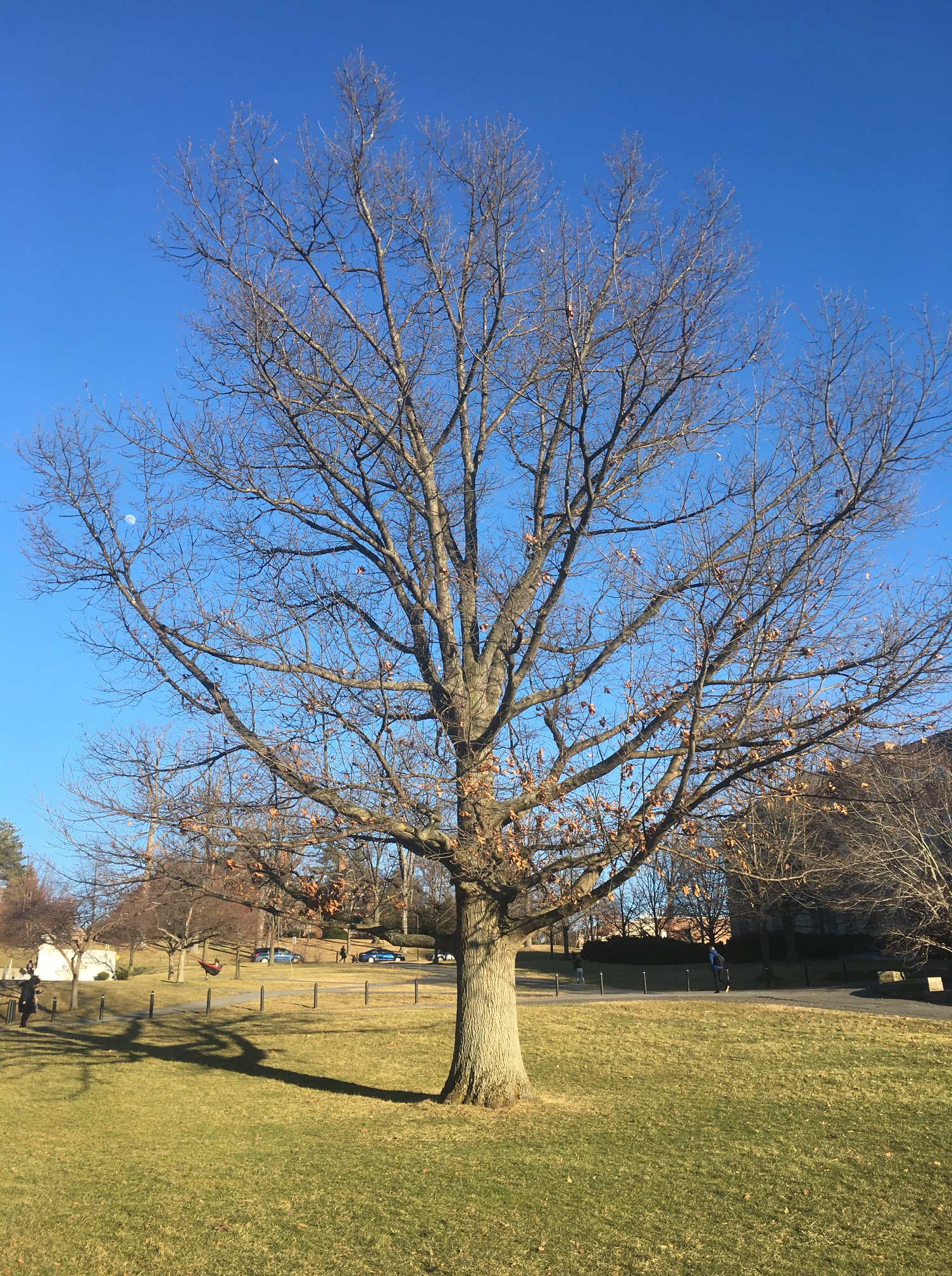
Surviving winter actually begins in fall when leaves turn color and drop to the ground.
Purdue Landscape Report: So, what do trees do in the winter? Do they freeze up like unprotected water pipes? Or burst when it gets below freezing? Yes, the below-ground parts of a tree are kept insulated by mulch, soil and a layer of snow, and that is important to survival, but the exposed parts of a tree are not protected.
Deciduous trees, like maples and oaks, have a lot of water inside their trunks and branches. Water is the single most important substance for tree life, comprising nearly 80% of tree material. Although there is a little less inside the tree during the winter, if the temperature drops low enough, the water in even the most cold-hardy tree will freeze. Broadleaf, deciduous trees lose their leaves in the winter to reduce water loss inside the trunk and branches. Most needle-leaved trees, known as conifers, which include pines and spruce, retain needles year-round – with exceptions of some deciduous evergreens such as larch and bald cypress– only losing older, or damaged needles. Needles are better at retaining water than broadleaves due to their small surface area and waxy outer coating limiting water loss to transpiration, the evaporation of water from leaves. A hard freeze or poorly timed drop in temperatures can be devastating to living tree cells since ice crystals can shred cell membranes, leading to dead leaves, branches, and even whole trees. Most trees live through the winter despite prolonged exposure to brutally cold air and wind and snow, with special strategies and planning.
Dormancy of trees can be divided arbitrarily into three phases: early rest, winter rest, and after-rest. Each of these phases is marked by a distinct set of physiological processes. The transition between the three phases is gradual and there are many metabolic and developmental processes going on in the buds and twigs. A tree begins its preparations in late summer as day length shortens to survive winter temperatures. Cold acclimation occurs gradually and fall color is a sign that the process is in place and pre-dormancy is beginning.
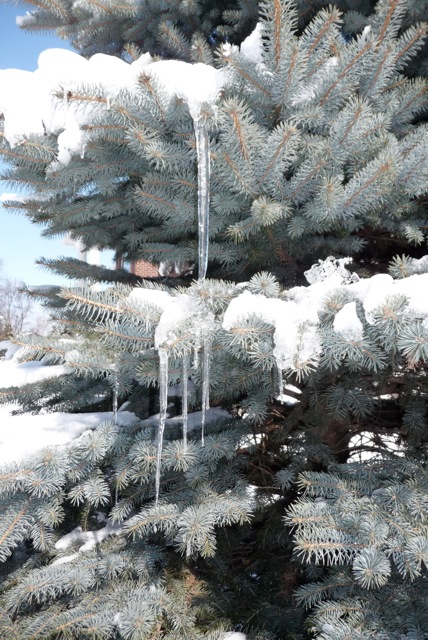
Evergreens are a little different and have a special waxy covering to reduce water loss during the winter.
When the tree enters the winter rest stage, research suggests three basic ways in which a tree prevents freezing. One is to change their membranes, so the membranes become more pliable; this allows water to migrate out of the cells and into the spaces between the cells. The relocated water exerts pressure against the cell walls, but this pressure is offset as cells shrink and occupy less space.
The second way a tree helps prevent freezing is to thicken the fluids within the cells. When days begin to get shorter, trees convert starch to sugars, which act as a natural antifreeze for the plant. The cellular fluid within the living cells becomes concentrated with natural sugars, which lowers the freezing point inside the cells, while the water between the cells is allowed to freeze. Because the cell membranes are more pliable in winter, they’re squeezed but not punctured by the expanding ice crystals.
The third mechanism involves what has been described as a “glass phase,” where the liquid cell contents become so viscous that they appear to be solid, a kind of “molecular suspended animation” and mimic the way silica remains liquid as it is supercooled into glass. This mechanism is triggered by the progressive cellular dehydration that results from the first two mechanisms and allows the supercooled contents of the tree’s cells to avoid crystallizing.
All three cellular mechanisms are intended to keep living cells from freezing. That’s the key for the tree; don’t allow living cells to freeze.
A tree doesn’t have to keep all of its cells from freezing, just the living ones which are primarily the phloem cells. This is significant, since much of a tree’s living trunk is made up of cells that are dead, such as xylem cells. These dead cells can and do freeze, but even the lowest temperature doesn’t have an adverse effect. While a majority of a tree’s above-ground cells do indeed freeze regularly when exposed to subfreezing temperatures, the living cells remain unfrozen and active on a reduced level. There are living cells in the trunk that remain unfrozen even though they are right next to – and at the same temperature as – dead cells that are frozen solid!
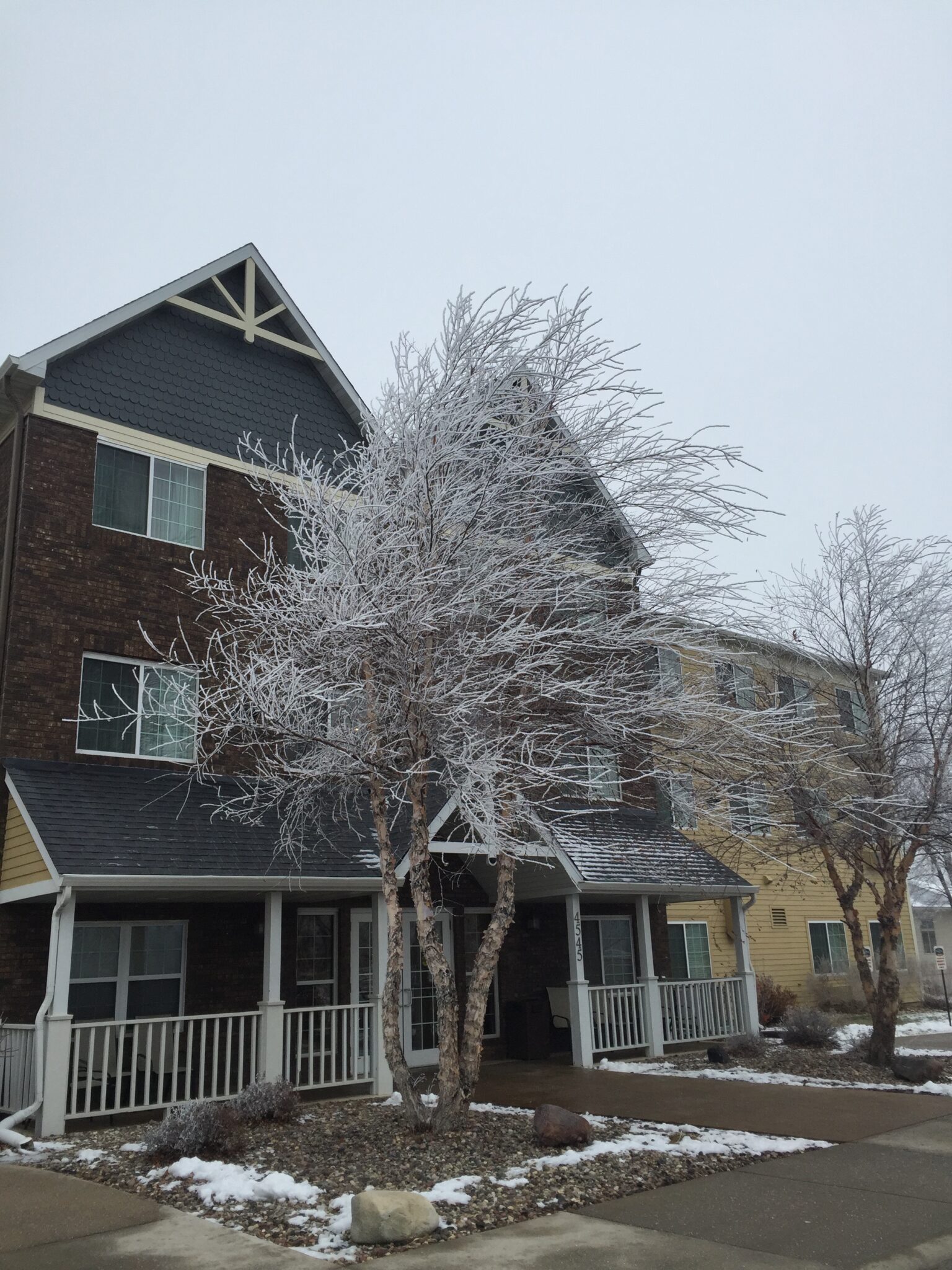
Some trees like many birches can survive temperatures well below -100 F
This seemingly mystical combination of pliable membranes, natural antifreeze, and glasslike supercooling, with frost on the outside and viscous dehydration on the inside, helps trees avoid freezing injury to living cells. Trees are the largest, oldest living organism on our planet and don’t grow older and larger without having very specific strategies for survival.
However, sometimes, trees aren’t able to withstand extreme conditions, especially if nature provides an unusual change. While trees have evolved amazing strategies for withstanding the winter cold, sometimes it gets so cold that trees can explode. During spells of extreme cold or especially when trees haven’t had time to acclimate before the cold arrives, the life-sustaining sap inside a tree can begin to freeze. Sap contains water so it expands when frozen, putting pressure on the bark, which can break and create an explosion, so to speak.
Proper winter care is critical to protect your trees with mulch and water to help trees make it through the winter months. For more information on winter tree care, check out this publication: Winterize Your Trees.
Resources
Purdue Landscape Report, Website
Winterize Your Trees, The Education Store, Purdue Extension resource center
Tree Defect Identification, The Education Store
Forest/Timber, Playlist, Purdue Extension – Forestry and Natural Resources YouTube channel
Urban Forestry, Purdue Extension – FNR playlist
Winter Weather Tree Tips, Got Nature? Blog, Purdue Extension – Forestry and Natural Resources
Tree Wounds and Healing, Got Nature? Blog
Water Now to Minimize Winter Injury, Indiana Yard and Garden – Purdue Consumer Horticulture
Lindsey Purcell, Urban Forestry Specialist
Purdue University, Department of Forestry and Natural Resources
In Tennessee, magnolia and the highly invasive ornamental pear trees are in full bloom. In New Jersey, crocuses and buttercups are vibrant spectacles of color. Here in Indiana, flowering dogwood, pawpaw, and red oak have responded to an early spring with a burst of blooms as well. This vibrant display is the result of a mild winter. Unfortunately, there is a downside. A sudden cold freeze after this swathe of warm weather could severely damage blossoms, buds, and significantly reduce yields in fruit and nut trees.
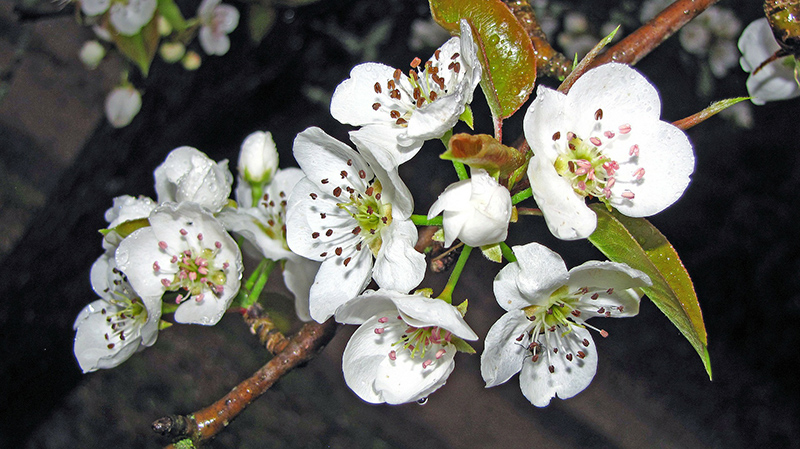
Blooms on pear tree.
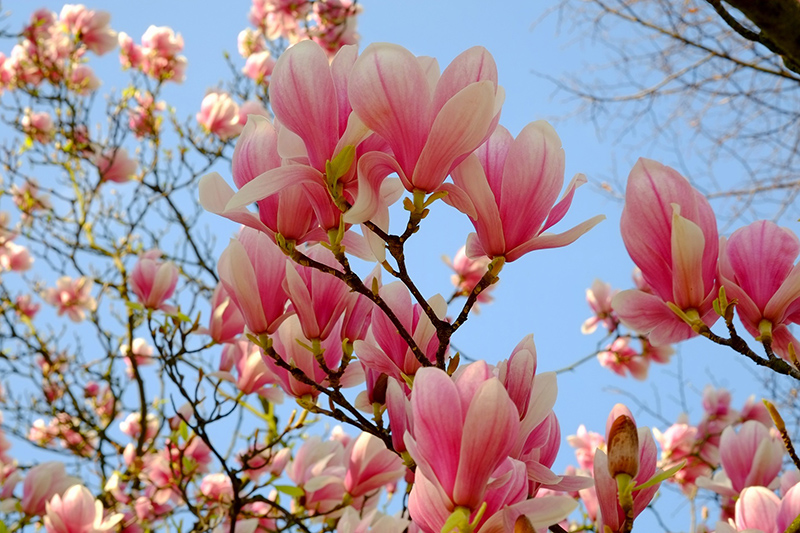
Blooms on magnolia tree.
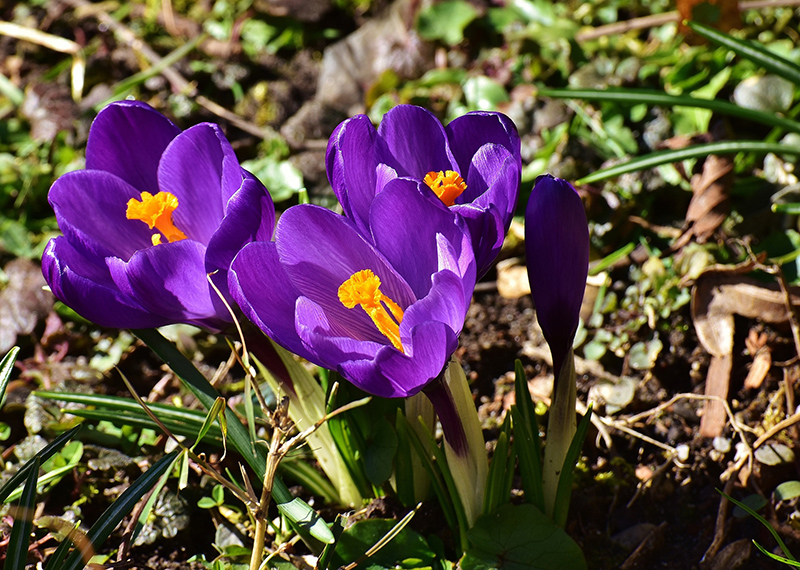
Crocus blooms.
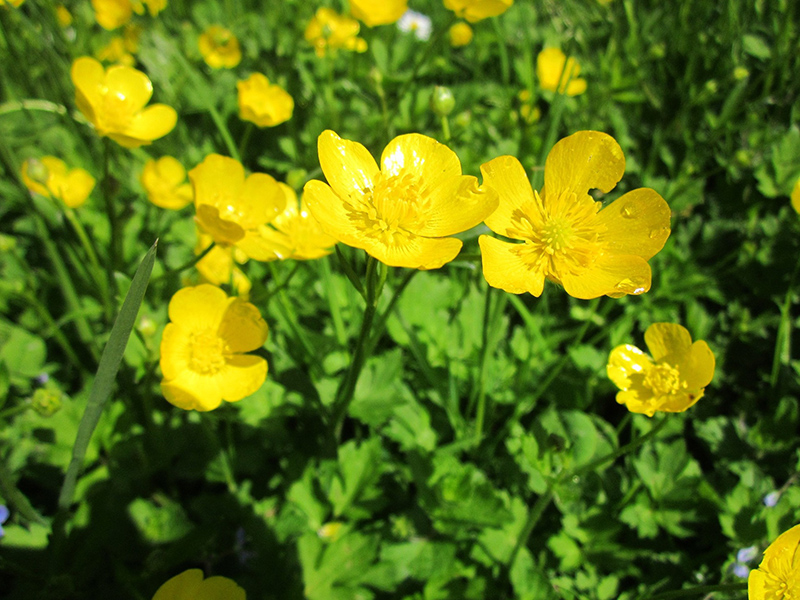
Buttercup blooms.
Growth of a tree or flower is the result of the weather and the perpetuation of its natural growth cycle. To store sufficient resources for the following year, trees use the winter season as an opportunity to shuttle nutrients to their roots. With cold temperatures keeping pests at bay, fewer nutrient resources are needed for defense and maintenance. These nutrients will be shuttled to the branches the following spring to support the growth of buds and blossoms. Interruption in the storage process caused by early spring conditions interferes with nutrient supplies and kickstarts the growing cycle again.
Nutrients once slated for root storage are now being sent to the branches to begin fruit and bud production despite having fewer resources in storage than usual. A freeze that occurs after leaves and buds begin to appear will damage the new growth and likely delay flowering and fruiting until much later in the year when surfeit energy is available to support a second growth effort. While trees are usually able to leaf out a second time, there are often more issues with low yield and early leaf drop.
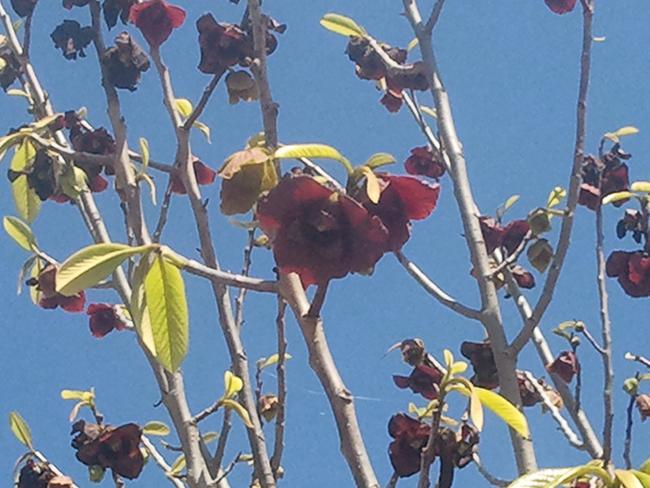
Pawpaw
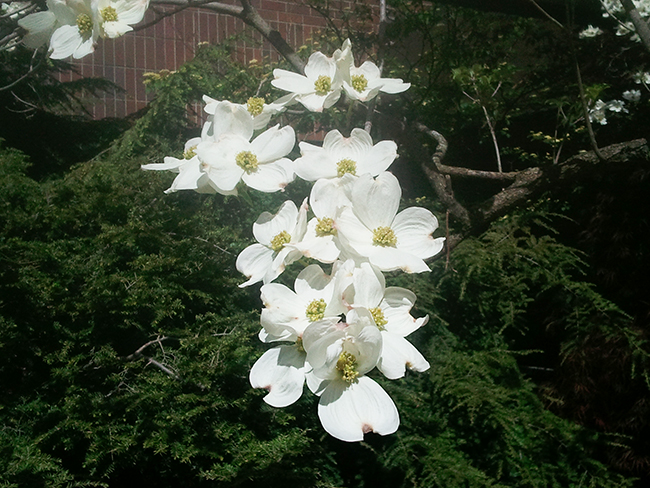
Dogwood
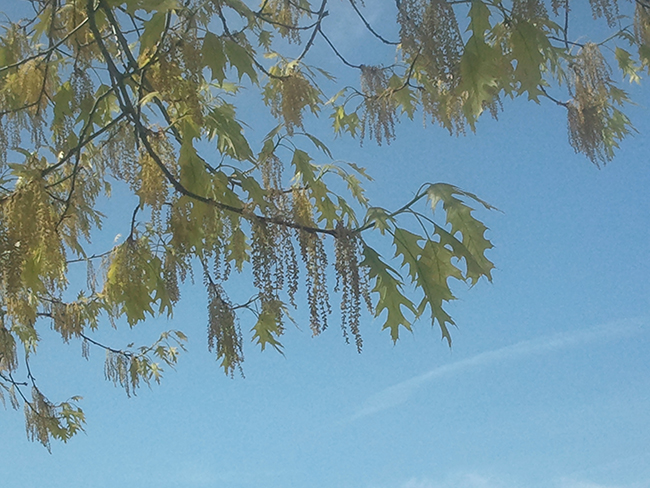
Red oak
Also, insect pests, usually subdued by cold winter temperatures are likely to be out much earlier than usual and with greater numbers. This increase in insect presence does not necessarily bode well for plant pollinator populations. If, for example, a tree flowers earlier than honeybee populations are available, then it is possible that those trees will go unpollinated. Also, if other pollinators are also unavailable, there will be no fruits the following year on that tree.
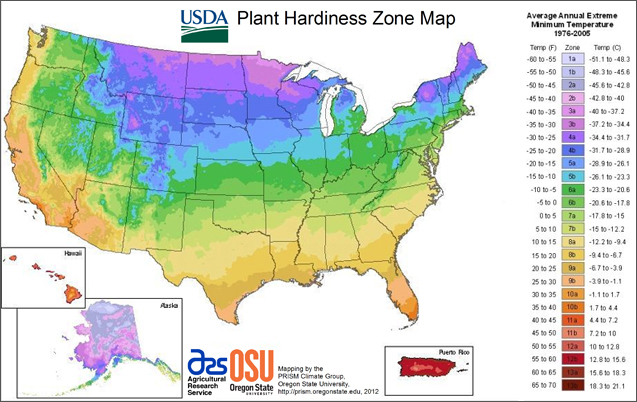
USDA Plant Hardiness Zone Map. Agricultural Research Service, U.S. Department of Agriculture, planthardiness.ars.usda.gov.
Ultimately, the state of our seed, fruit, and nut production depends on two major events; pollination and lack of a cold freeze. If we see a sudden cold snap that damages the trees and eliminates pollinators, then next spring will be a time of sorrow rather than an exciting start to the growing season. The dramatic shifts in weather temperatures over the last decade have led the Department of Agriculture to reevaluate and reassess plant hardiness zones. For the first time in thirty years, an updated map with new zones has now been created, USDA Plant Hardiness Zone Map.
Resources:
Purdue Plant Doctor App, Purdue Extension
Purdue Plant and Pest Diagnostic Laboratory, Purdue Agriculture
Planting & Transplanting Landscape Trees and Shrubs, The Education Store, Purdue Extension resource center
Tree Planting Part 1: Choosing a Tree – video, The Education Store
Tree Installation: Process and Practices, The Education Store
Shaneka Lawson, USDA Forest Service/HTIRC Research Plant Physiologist/Adjunct Assistant Professor
Purdue University Department of Forestry and Natural Resources
Lenny Farlee, Sustaining Hardwood Extension Specialist
Purdue Department of Forestry and Natural Resources

Recent Posts
- It’s Timberdoodle Time!
Posted: April 3, 2026 in Got Nature for Kids, How To, Wildlife - Keep An Eye Out for Hammerhead Worms, Purdue Landscape Report
Posted: April 2, 2026 in Invasive Animal Species, Wildlife, Woodlands - When is the Peak Migration For Hummingbirds and How Can You Attract Them?
Posted: in How To, Wildlife - ID That Tree Featured in National Woodland Owners Association Newsletter
Posted: April 1, 2026 in Urban Forestry, Wildlife, Woodlands - New 2026 Indiana Woodland Steward Newsletter
Posted: March 30, 2026 in Urban Forestry, Wildlife, Woodlands - A Woodland Management Moment: Why Aspect Matters
Posted: in Urban Forestry, Woodland Management Moment, Woodlands - 2026 Winter Bat Survey In Progress, MyDNR
Posted: March 27, 2026 in How To, Wildlife - Fast-Growing Trees for the Landscape, Purdue Landscape Report
Posted: March 26, 2026 in Forestry, Urban Forestry, Woodlands - Urban Tree Spotlight: Planting Deciduous Shade Trees, Purdue Landscape Report
Posted: March 25, 2026 in Forests and Street Trees, Urban Forestry, Woodlands - Beetle that attacks Tree-of-Heaven found in Indiana, Purdue Landscape Report
Posted: March 20, 2026 in Invasive Insects, Wildlife, Woodlands
Archives
Categories
- Alert
- Aquaculture/Fish
- Aquatic/Aquaculture Resources
- Ask the Expert
- Christmas Trees
- Community Development
- Disease
- Drought
- Forestry
- Forests and Street Trees
- Gardening
- Got Nature for Kids
- Great Lakes
- How To
- Invasive Animal Species
- Invasive Insects
- Invasive Plant Species
- Land Use
- Natural Resource Planning
- Nature of Teaching
- Plants
- Podcasts
- Ponds
- Publication
- Safety
- Spiders
- Timber Marketing
- Uncategorized
- Urban Forestry
- Webinar
- Wildlife
- Wood Products/Manufacturing
- Woodland Management Moment
- Woodlands