 Purdue University - Extension - Forestry and Natural Resources
Got Nature? Blog
 Discover the challenges posed by Sericea lespedeza, an invasive plant species prevalent in Indiana. This guide provides essential facts and control options, highlighting how Sericea outcompetes native plants and offers little value to wildlife. A must-read for conservationists and land managers dedicated to preserving native ecosystems.
Learn the most effective strategies for managing Sericea lespedeza across diverse landscapes including old fields, conservation plantings and native grasslands: Sericea Lespedeza Control
This publication is part of a seven publication series The Managing Conservation Plantings Series which include details on how to control invasive species and other problematic plants in Conservation Reserve Program (CRP) plantings and native warm-season grass and wildflower conservation plantings.
Publications in this series include:
- Golden Rod Control
- Thinning Native Warm-Season Grasses
- Sericea Lespedeza Control
- Woody Encroachment and Woody Invasives
- Johnson Grass Control
- Reed Canarygrass Control
- Teasel Control (Common and Cut Leaved)
- Controlling Introduced Cool-season Grasses
- Crownvetch, Sweetclover and Birdsfoot Trefoil Control
Resources:
Deer Impact Toolbox & Grassland Management, Purdue Extension Pond and Wildlife Management
Pond and Wildlife Management, Purdue Extension
Forestry for the Birds Virtual Tour and Pocket Guide, Got Nature? Blog, Purdue Extension – FNR
Frost Seeding to Establish Wildlife Food Plots and Native Grass and Forb Plantings – Purdue Extension – FNR YouTube channel
Wildlife Habitat Hint: Tips for Evaluating a First Year Native Grass and Forb Plantings, Purdue Extension – FNR YouTube Channel
Drone Seeding Native Grasses and Forbs: Project Overview & Drone Setup, Purdue Extension – FNR YouTube channel
Ask an Expert: Wildlife Food Plots, video, Purdue Extension – FNR YouTube Channel
Handling Harvested Game: Episode 1, Field Dressing, video, Purdue Extension – FNR YouTube Channel
Managing Your Woods for White-Tailed Deer, The Education Store
Forest Improvement Handbook, The Education Store
Forest Management for Reptiles and Amphibians: A Technical Guide for the Midwest, The Education Store
A Template for Your Wildlife Habitat Management Plan, The Education Store
Woodland Stewardship for Landowners, Playlist, Purdue Extension – FNR YouTube channel
Nature of Teaching Unit 1: Animal Diversity and Tracking, The Education Store
Nature of Teaching, Purdue College of Agriculture
Invasive Species Playlist, Playlist, Purdue Extension – FNR YouTube Channel
Report Invasive, Purdue Extension
Subscribe Purdue Extension – Forestry and Natural Resources YouTube Channel
Jarred Brooke, Wildlife Extension Specialist
Purdue Department of Forestry and Natural Resources
In this edition of Wildlife Habitat Hint, Purdue wildlife extension specialist Jarred Brooke shares methods to control the invasive sericea lespedeza. This plant species, though was once used for erosion control and mineland reclamation, is too invasive and of little wildlife value.
If you have any questions regarding wildlife, trees, forest management, wood products, natural resource planning or other natural resource topics, feel free to contact us by using our Ask an Expert web page.
Resources
Sericea Lespedeza: Plague on the Prairie, Purdue Extension
Wildlife Habitat Hint, Playlist, Purdue Extension – Forestry and Natural Resouces
Invasive Species, Playlist
A Woodland Management Moment, Playlist
Woodland Stewardship for Landowners, Playlist
Habitat Help LIVE Q&A – Native Grasses and Forbs for Wildlife, Video, Purdue Extension – Forestry and Natural Resources Youtube channel
Renovating Native Warm-Season Grass Stands for Wildlife: A Land Manager’s Guide, The Education Store, Purdue Extension resource center
Jarred Brooke, Wildlife Extension Specialist
Purdue Department of Forestry and Natural Resources
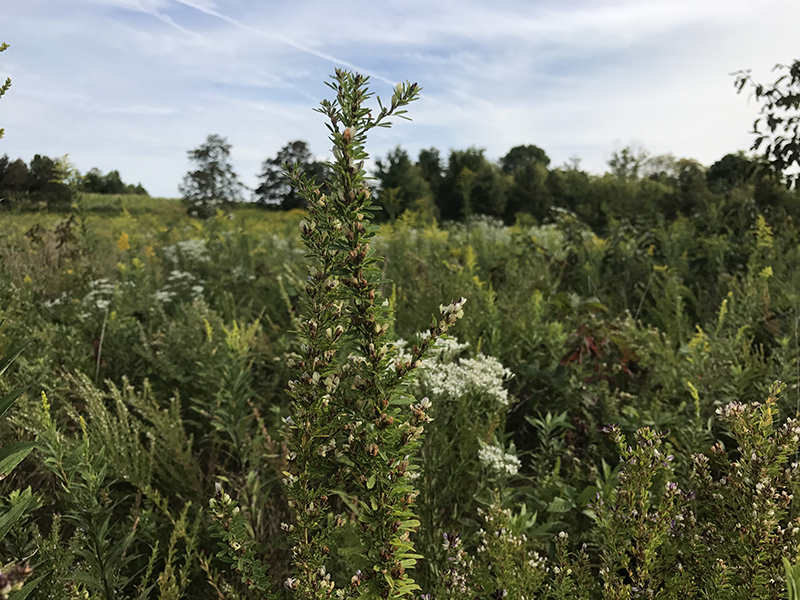 Sericea lespedeza is arguably one of the most problematic invasive species of old fields, prairies and other early successional areas managed for wildlife. Sericea lespedeza is a perennial legume native to eastern Asia that was originally promoted for erosion control, cattle forage, cover and food for wildlife. But as with many plant introductions during the early and mid-19th century (e.g., multiflora rose, autumn olive, and bush honeysuckle), the original beliefs – while well intentioned – were ill fated and short-sided. Sericea has become invasive, is considered noxious in many states, and can be found from Massachusetts to Nebraska and from Florida to Ontario.
Here are 3 problems with sericea and 3 tools for control.
Problems:
- Sericea is adapted to a wide variety of conditions: sericea is able to tolerant and thrive in acidic soils with relatively low soil fertility and is also drought tolerant. These factors combined with allopathic chemicals makes sericea extremely competitive causing sericea to quickly invade and overtake early successional areas displacing many native species.
- Sericea produces an abundance of seed: one sericea plant is able to produce more than 1000 seeds and seeds are thought to be viable for up to 20 years in the seedbank. Sericea was initially thought to provide an abundance of seed valuable to wildlife including northern bobwhite. However, the seed cannot be digested by most wildlife, thus it provides no nutritional benefits and bobwhite can actually starve by consuming only sericea seed. Research in Kansas also reported a higher percentage of sericea seed germinated after passing through the digestive system of bobwhite compared to unconsumed seed.
- Sericea responds prolifically following spring fires: fire is the most effective way to manage early successional vegetation. However, fire during the dormant season seems to only anger sericea and exacerbate the problem. Fire scarifies sericea seed and seedling density is increased following spring fires.
Control: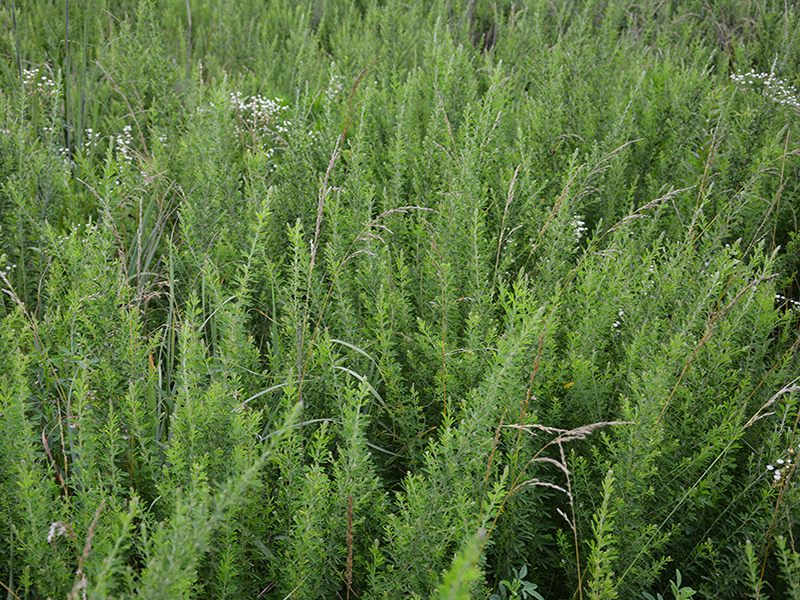
- Herbicide: triclopyr (32 oz/acre), triclopyr + fluroxypyr (1.5 pt/acre), or glyphosate (1-2 qt/acre) can be used to effectively control sericea in early successional areas from June through July when sericea is 12-18 inches tall. Metsulfuron methyl (1 oz/ac) provides effective control when applied to sericea during flowering (Aug-Sep).
- Prescribed fire: while prescribed fire during the dormant season enhances sericea germination, fire during the late-growing season (July-Sep) can reduce sericea seed production and can decrease sericea survival. However, fire alone may not be enough to control sericea long term.
- Herbicide + Prescribed Fire: sericea can be controlled with herbicide during the growing season. This can be followed up with a late-growing season fire to consume any sericea not killed by the herbicide and reduce sericea seed production. The following summer herbicide can be used again to kill any new sericea seedlings or plants that have resprouted from rhizomes.
If you find sericea in fields that you manage, working quickly to stop seed production and kill the existing plants will be the most effective way to control an invasion.
Web Resources:
Herbicides to control sericea lespedeza, Southeastern Association of Fish & Wildlife Agencies
Effects of Growing-Season Prescribed Burning on Vigor of Sericea Lespedeza in the Kansas Flint Hills: I. Suppression of Seed Production and Canopy Dominance, Kansas Agricultural Experiment Station Research Reports
Other Resources:
If Your Native Grasses Look Like This, It’s Time for Management, Got Nature?, Purdue Extension-FNR
Invasive plants: impact on environment and people, The Education Store, Purdue Extension
Jarred Brooke, Extension Wildlife Specialist
Purdue University Department of Forestry and Natural Resources

Recent Posts
- Publication – Planting Forest Trees and Shrubs in Indiana
Posted: April 8, 2026 in Forests and Street Trees, Urban Forestry, Wildlife, Woodlands - ID That Tree: Virgin’s Bower Clematis
Posted: April 6, 2026 in Urban Forestry, Wildlife, Woodlands - It’s Timberdoodle Time!
Posted: April 3, 2026 in Got Nature for Kids, How To, Wildlife - Keep An Eye Out for Hammerhead Worms, Purdue Landscape Report
Posted: April 2, 2026 in Invasive Animal Species, Wildlife, Woodlands - When is the Peak Migration For Hummingbirds and How Can You Attract Them?
Posted: in How To, Wildlife - ID That Tree Featured in National Woodland Owners Association Newsletter
Posted: April 1, 2026 in Urban Forestry, Wildlife, Woodlands - New 2026 Indiana Woodland Steward Newsletter
Posted: March 30, 2026 in Urban Forestry, Wildlife, Woodlands - A Woodland Management Moment: Why Aspect Matters
Posted: in Urban Forestry, Woodland Management Moment, Woodlands - 2026 Winter Bat Survey In Progress, MyDNR
Posted: March 27, 2026 in How To, Wildlife - Fast-Growing Trees for the Landscape, Purdue Landscape Report
Posted: March 26, 2026 in Forestry, Urban Forestry, Woodlands
Archives
Categories
- Alert
- Aquaculture/Fish
- Aquatic/Aquaculture Resources
- Ask the Expert
- Christmas Trees
- Community Development
- Disease
- Drought
- Forestry
- Forests and Street Trees
- Gardening
- Got Nature for Kids
- Great Lakes
- How To
- Invasive Animal Species
- Invasive Insects
- Invasive Plant Species
- Land Use
- Natural Resource Planning
- Nature of Teaching
- Plants
- Podcasts
- Ponds
- Publication
- Safety
- Spiders
- Timber Marketing
- Uncategorized
- Urban Forestry
- Webinar
- Wildlife
- Wood Products/Manufacturing
- Woodland Management Moment
- Woodlands