 Purdue University - Extension - Forestry and Natural Resources
Got Nature? Blog
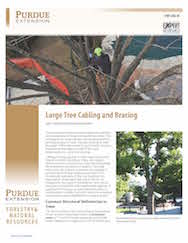 Due to reasons such as pruning, location of growth and species characteristics, trees can grow in ways that don’t endorse long-term health and safety. To counter trees growing in unsafe ways, cabling, bracing, guying, or props can be utilized to prevent branch or whole-tree failure. These tree support systems reinforce critical areas of the tree by limiting the movement of branches or leaders. In the publication titled Large Tree Cabling and Bracing, FNR-550-W, common structural deficiencies in trees and the tree support devices used to prevent problems caused by those deficiencies are described and covered.
Resources:
Tree Support Systems, The Education Store, Purdue Extension
Tree Planting Part 1: Choosing a Tree, The Education Store, Purdue Extension
Tree Pruning: What Do Trees Think?, The Education Store, Purdue Extension
Forest Improvement Handbook, The Education Store, Purdue Extension
Got Nature?, Purdue Extension, Forestry and Natural Resources
Lindsey Purcell, Urban Forestry Specialist
Purdue University, Department of Forestry and Natural Resources
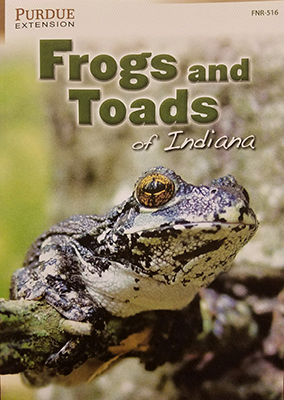 Frogs and Toads of Indiana is the latest and final addition to Purdue Extension’s line of field guides focused on the reptiles and amphibians of Indiana. Readers of this guide will not only learn how to ID the Anuran species of Indiana but will also learn about their distribution throughout the state along with their habits and behaviors. The guide is richly illustrated, filled with interesting facts, and has been peer-reviewed by expert herpetologists.
As many herpetologists and recreational herpers can attest, seeing what you are hearing is not always possible. With this in mind, we developed a website The Frogs and Toads of Indiana for users that wish to learn the calls of Indiana Anuran species.
The Frogs and Toads of Indiana, FNR-516, can be purchased from the The Education Store for $10.00.
Resources, The Education Store-Purdue Extension resource center:
Salamanders of Indiana
Snakes and Lizards of Indiana
Snakes of the Central and Northeastern United States
Turtles of Indiana
Additional resources:
The Nature of Teaching, Lesson Plans K-12, Purdue Extension
Nick Burgmeier, Research Biologist and Extension Wildlife Specialist
Purdue Department of Forestry and Natural Resources

Young maple tree leaves.
https://pixabay.com/
Spring is a time of awakening for our forests as the cold temperatures slowly move to another part of the world and the first crop of buds appear on the trees. These delicate buds are the physical representation of energy stored by the tree over the winter for later use in leaf production. This splurging of energy in springtime is an effort by the tree to produce as many leaves as possible to initiate photosynthesis and carbon assimilation for growth. Unfortunately for the trees, these juicy new leaf bundles are an irresistible temptation for the grazing animals in need of nutrients to replenish those stores lost during winter.
How can the trees thwart these hungry ungulates? One would be led to believe that the sedentary nature of trees renders them defenseless. Fortunately, that is not the case. In a research study published earlier this year, scientists at Leipzig University and the German Centre for Integrative Biodiversity Research (iDiv) have found that European beech (Fagus sylvatica L.) and Sycamore maple (Acer pseudoplatanus L.) trees use chemical warfare to fight back against foraging roe deer (Capreolus capreolus).
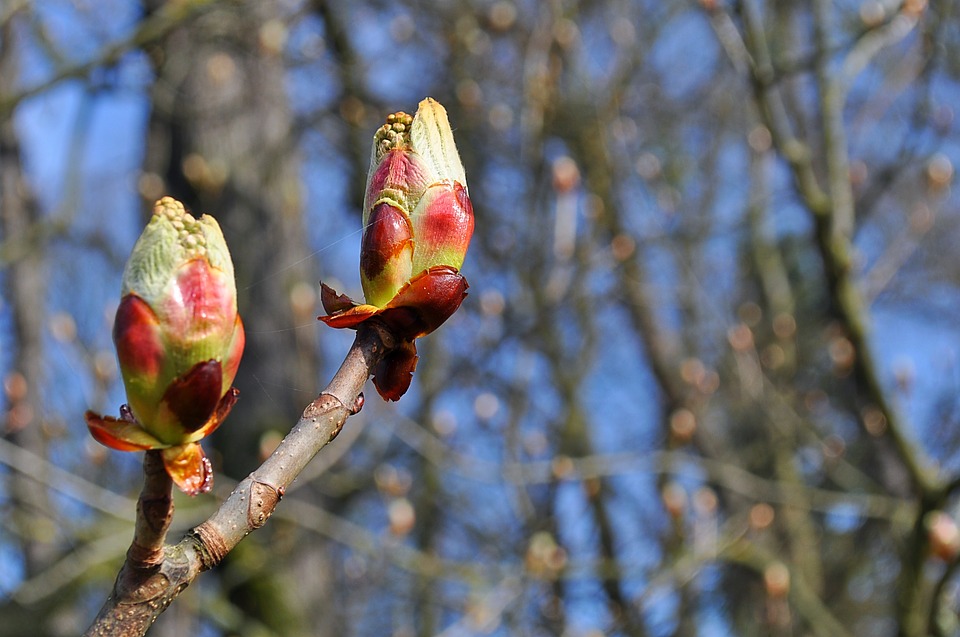
Buds in spring.
https://pixabay.com/
In has been established in other forest species that feeding insects stimulate trees to produce chemicals to deter them from further feeding. This study is the first to present data that indicates that a tree species can identify and selectively defend against browsing deer. Manually clipping buds and leaves to simulate storm or mechanized (chainsaw) damage activated the jasmonic acid wound response pathways in both beech and maple but no defensive responses. However, introduction of deer saliva after clipping the buds and leaves led to increased production of salicylic acid (used in humans as a chemical exfoliant, antiseptic, and acne treatment) and tannins (bitter tasting substance used to cure leather and to make ink) in beech leaves with tannins and flavonol (used as an antioxidant in humans and also functions to block bacterial adhesion) being elevated in maple. These chemicals make the leaves and buds distasteful and difficult to digest.
The results of this study open up entirely new lines of research into tree defense responses. What types of responses do other tree species have? Do they produce stronger chemicals? Is deer browse preference based on the presence or absence of a chemical response? Do they wander from tree to tree to browse to avoid the full onslaught of the chemical response? I am certain that those are stories for another day.
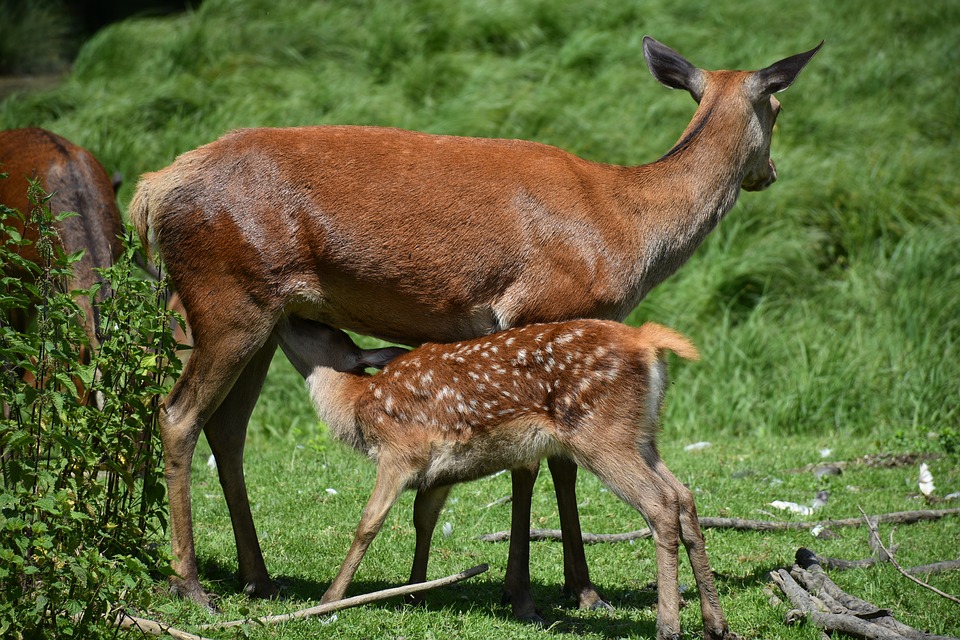
Deer.
https://pixabay.com/.
Reference Materials
Scientific Literature: Ohse, B., Hammerbacher, A., Seele, C., Meldau, S., Reichelt, M., Ortmann, S., and Wirth, C. 2016. Salivary cues: simulated roe deer browsing induces systemic changes in phytohormones and defense chemistry in wild-grown maple and beech saplings. Functional Ecology doi: 10.1111/1365-2435.12717.
Online site: German Centre for Integrative Biodiversity Research (iDiv) Halle-Jena-Leipzig. “Trees recognize roe deer by saliva: Smart defense mechanisms against browsing.” ScienceDaily. ScienceDaily, 12 September 2016. Last Accessed: October 10, 2016.
Resources:
Nuisance Wildlife, Indiana Department of Natural Resources-Fish and Wildlife
Wildlife Damage, Purdue Extension-Department of Forestry and Natural Resources
Preventing Wildlife Damage – Do You Need a Permit?, The Education Store, Purdue Extension
Internet Center for Wildlife Damage Management (ICWDM), University of Wisconsin-Stevens Point
Shaneka Lawson, USDA Forest Service/HTIRC Research Plant Physiologist/Adjunct Assistant Professor
Purdue University Department of Forestry and Natural Resources

Recent Posts
- Publication – Planting Forest Trees and Shrubs in Indiana
Posted: April 8, 2026 in Forests and Street Trees, Urban Forestry, Wildlife, Woodlands - ID That Tree: Virgin’s Bower Clematis
Posted: April 6, 2026 in Urban Forestry, Wildlife, Woodlands - It’s Timberdoodle Time!
Posted: April 3, 2026 in Got Nature for Kids, How To, Wildlife - Keep An Eye Out for Hammerhead Worms, Purdue Landscape Report
Posted: April 2, 2026 in Invasive Animal Species, Wildlife, Woodlands - When is the Peak Migration For Hummingbirds and How Can You Attract Them?
Posted: in How To, Wildlife - ID That Tree Featured in National Woodland Owners Association Newsletter
Posted: April 1, 2026 in Urban Forestry, Wildlife, Woodlands - New 2026 Indiana Woodland Steward Newsletter
Posted: March 30, 2026 in Urban Forestry, Wildlife, Woodlands - A Woodland Management Moment: Why Aspect Matters
Posted: in Urban Forestry, Woodland Management Moment, Woodlands - 2026 Winter Bat Survey In Progress, MyDNR
Posted: March 27, 2026 in How To, Wildlife - Fast-Growing Trees for the Landscape, Purdue Landscape Report
Posted: March 26, 2026 in Forestry, Urban Forestry, Woodlands
Archives
Categories
- Alert
- Aquaculture/Fish
- Aquatic/Aquaculture Resources
- Ask the Expert
- Christmas Trees
- Community Development
- Disease
- Drought
- Forestry
- Forests and Street Trees
- Gardening
- Got Nature for Kids
- Great Lakes
- How To
- Invasive Animal Species
- Invasive Insects
- Invasive Plant Species
- Land Use
- Natural Resource Planning
- Nature of Teaching
- Plants
- Podcasts
- Ponds
- Publication
- Safety
- Spiders
- Timber Marketing
- Uncategorized
- Urban Forestry
- Webinar
- Wildlife
- Wood Products/Manufacturing
- Woodland Management Moment
- Woodlands