 Purdue University - Extension - Forestry and Natural Resources
Got Nature? Blog
Purdue Landscape Report: I have lost count of the number of times I’ve witnessed people working with chainsaws in shorts, a tank top, and flip flops with maybe a pair of earbuds, and it makes me cringe every time. According to the CDC, over 36,000 chainsaw-related injuries a year are reported with annual medical costs of more than $350 million (Johnson, 2023). Wearing the proper personal protective equipment (PPE) can help prevent accidents and injuries (Fig. 1). PPE is there to protect you from head to toe and if you are investing in a chainsaw, it doesn’t take much more to invest in the proper PPE. Including a work shirt and pants, if you’re using a chainsaw you should wear protection for your head, eyes and ears, hands, legs, and feet, most of which can be found at your local hardware store or home center.
Protecting your head means using a helmet, not a baseball cap or bandanna. Depending on the type of work you’re doing there is a risk of being struck by wood or branches or if kickback occurs, sending the chainsaw back towards your head. Safety glasses will help keep sawdust and other debris out of your eyes and should be stamped with Z87.1, showing they conform to ANSI safety regulations. Normal glasses and sunglasses are not rated for being struck and can shatter, sending broken lenses into your eyes. Ear protection can be in the form of plugs or muffs and should be rated to reduce noise to appropriate levels when worn properly.
Most modern chainsaws have built-in anti vibration technology to reduce fatigue, but having a nice pair of work gloves will still help to protect your hands and grip. Gloves will help protect against debris and are also good to wear for chainsaw maintenance. Although not about PPE, another note on protecting your hands when operating a chainsaw includes the proper use of the chain brake. Injuries can occur on the right hand because operators will remove it from the back handle to activate the chain brake with the palm of their hand and miss it, putting their hand on the still moving chain. Injuries on either hand can happen when one handing a saw while using your other hand to brace or manage what you are cutting and losing control. The chain brake is designed to be engaged by popping your left wrist forward while maintaining a grip with both hands on the handles.
To protect your legs some form of chaps or chap pants are needed. Prices can range from around $40 for a pair of wrap-chaps that can be worn over your work pants up to around $400 for a high-end pair of chap pants that are a stand-alone work pant replacement. Whichever you choose to wear, the protection should be from the top of your thigh to the top of your foot and wrap around your calf. Care should be taken to keep them clean from gas and oil and if they are ever damaged by a chainsaw, chaps should be discarded and replaced. Once the protective material has been damaged the safety has been compromised. Chainsaw boots are also available to protect your lower legs and feet but are expensive and can be heavy. A sturdy work boot should be worn at the very least while staying alert to how close the chainsaw is coming to you. And please, no open-toed shoes.
Whatever the task, if you are going to do your own chainsaw work, then I implore you to wear your PPE from head to toe. I know it’s hot and can get uncomfortable, but all it takes is one mistake to send you to the ER. If you feel the job is beyond your capabilities you can always contact an ISA certified arborist at Find an Arborist through the treesaregood.org website.
To view this full article and other Purdue Landscape Report articles, please visit Purdue Landscape Report.
Subscribe and receive the newsletter: Purdue Landscape Report Newsletter.
Resources:
The Purdue Landscape Report
A Woodland Management Moment, Playlist, Purdue Extension – Forestry and Natural Resources (FNR) Youtube Channel
Conservation Tree Planting: Steps to Success, Purdue Extension – FNR Youtube Channel
Forest Improvement Handbook, The Education Store
Find an Arborist website, Trees are Good, International Society of Arboriculture (ISA)
Caring for storm-damaged trees/How to Acidify Soil in the Yard – In the Grow, Purdue Extension
Moist soil and rotten roots makes it easy for trees to come crashing down – Fox 59 News
Tree Risk Management – Got Nature? Blog, Purdue Extension – FNR
Mechanical Damage to Trees: Mowing and Maintenance Equipment – The Education Store
Trees and Electric Lines – The Education Store
Tree Support Systems, The Education Store
Corrective Pruning for Deciduous Trees, The Education Store
Tree Installation: Process and Practices, The Education Store
Ben McCallister, Urban Forestry Specialist
Purdue Forestry & Natural Resources
Purdue Landscape Report: Poison hemlock was introduced to North America as a garden/ornamental plant. It is a native of Europe, and it is a member of the Apiaceae (parsley) family.
Purdue experts Bill Johnson and Marcelo Zimmer wrote about poison hemlock in a Purdue Pest & Crop newsletter.
They wrote that poison hemlock can be noticed very early in the spring every year, as it is typically one of the first weeds to green up, usually in late February to early March if temperatures are favorable. They said the largest threat of this weed is the toxicity of its alkaloids if ingested by livestock or humans, but it can also reduce the aesthetic value of landscapes and has been reported to creep into no-till corn and soybean fields as well.
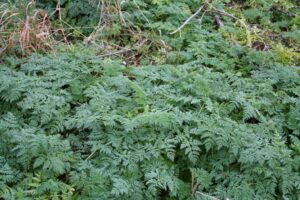
Poison Hemlock
Purdue Extension’s fact sheet on poison hemlock states that it can also be found along roads, streams, trails, ditches, forest edges, and waste areas.
The Purdue experts said that poison hemlock is a biennial weed that exists as a low-growing herb in the first year, and bolts to three to eight feet tall in the second year, when it produces flowers and seed. It is often not noticed until the bolting and reproductive stages of the second year. Poison hemlock is often confused with wild carrot, but can be distinguished by its lack of hairs and purple blotches that occur on the stems.
The experts pointed out that poison hemlock contains five alkaloids that are toxic to humans and livestock, and it can be lethal if ingested. They warn that the plant’s alkaloids may also be absorbed through the skin, so if you find yourself hand-pulling poison hemlock, it would be a good idea to wear gloves. All parts of the plants contain the toxic alkaloids with levels being variable throughout the year. Symptoms of toxicity include nervousness, trembling, and loss of coordination followed by depression, coma, and/or death. Initial symptoms will occur within a few hours of ingestion.
For history buffs, the Greek philosopher Socrates was sentenced to death by hemlock poisoning.
Cases of poisoning due to poison hemlock ingestion are rare as the plants emit a mousy odor that makes it undesirable and unpalatable to livestock and humans. Consumption and toxicity in animals usually occur in poorly managed or overgrazed pastures where animals are forced to graze poison hemlock because desirable forage is lacking.
To view this full article and other Purdue Landscape Report articles, please visit Purdue Landscape Report.
Subscribe and receive the newsletter: Purdue Landscape Report Newsletter.
Resources:
Recognizing and Managing Poison Hemlock, Purdue Landscape Report
Purdue Pest & Crop Newsletter
Invasive Plant Species Fact Sheets: Poison Hemlock, The Education Store, Purdue Extension Resource Center
Hemlock Woolly Adelgid: Distribution Update, Purdue Landscape Report
Be Careful Around Highly Toxic Poison Hemlock Plant This Summer, Purdue Extension – Forestry and Natural Resources (FNR)
Poison Hemlock (Conium maculatum), United States Department of Agriculture (USDA)
Invasive plants: impact on environment and people, The Education Store, Purdue Extension’s resource center
Woodland Management Moment: Invasive Species Control Process, Video, Purdue Extension – Forestry and Natural Resources (FNR) YouTube Channel
Invasive Species, Playlist, Purdue Extension – FNR YouTube Channel
What are invasive species and why should I care?, Got Nature? Blog, Purdue Extension – FNR
Report Invasive, Purdue College of Agriculture – Entomology
Purdue Pest and Plant Diagnostic Lab, send in photo or sample
John Woodmansee, Extension Educator, Whitely County
Purdue Extension
Before embarking on a 40-plus year career guiding students and constituents across the state on the topics of timber tax and forest economics, becoming known as the Purdue Forestry and Natural Resources historian or pitching in on various community projects to promote forest maintenance and recreation, Dr. Bill Hoover began his career of service in the U.S. Army Corps of Engineers as a basic training officer and later a combat engineering battalion operations officer in Vietnam.
Hoover grew up with military men on both sides of his family and was mentored by several World War II veterans as a member of the Boy Scouts.
“Most of my Boy Scout leaders took it as their role to prepare us for military service,” Hoover explained. “Attending Penn State, a land grant college, meant I was required to take ROTC courses and drills for two years. Advanced ROTC seemed like the logical choice since serving as an officer was better than as an enlisted grunt.”
After graduating from Penn State in December 1966 with his bachelor’s degree in forest management and a commission as a second lieutenant reserve officer in the U.S. Army, Hoover reported for training in Ft. Belvoir, Virginia, where he learned to be a combat engineer junior officer. From there, he moved on to Ft. Lewis, Washington, where he taught classes on all phases of military life and supervised enlisted officers, and finally to the Mojave Desert, where he participated in training evaluation. Just after Christmas in 1967, Hoover deployed to Vietnam as a combat engineer in the 39th engineer battalion, 18th engineer brigade.
Just over a year later, Hoover returned home on Dec. 29, 1968, and was relieved from active duty two weeks later. Months later, he was awarded a Bronze Star for Meritorious Service for his efforts, which included everything from construction of bunkers and other structures to bridge building and culvert replacements, supervision of material distribution to field companies, and daily mine sweeps.
“I don’t remember ever firing my weapon. I learned to work with men in tough situations and I experienced a new culture,” Hoover said. “The recommendation from the Battalion Commander got me into graduate school at Penn State, not my academic record. The GI Bill with the assistantship provide sufficient income to lead a pleasant life in State College. I didn’t use up the GI Bill benefit until my first year at Iowa State University for my PhD program.”
In 1974-75, an influx of talent joined the FNR faculty ranks. Joe O’Leary, Harmon “Mickey” Weeks, Harvey Holt, Ann Spacey and Bill Hoover were all hired that year and all would go on to join the ranks of FNR’s professor emeritus list.
“Mr. Bill Hoover, a candidate for the PhD in economics from Iowa State, joined the faculty as a teacher and research in forest economics with a specialization in econometrics,” first year department head Mason Carter said in his opening letter of the 1975 FNR Log book.
While Hoover may have been hired for his knowledge of econometrics, or the application of statistics and economic models, he would make his impact on the department in other ways.
“My value appeared to be in other places and I was hired to work with the folks in the wood research lab in marketing and feasibility studies working with Carl Eckelman on laminated veneer lumber and Mike Hunt on composite panels,” Hoover said. “The nature of the work was to identify potential markets, help design a product that would best serve those, produce samples, test them and give samples to potential use adopters. Laminated veneer and lumber type products were less common at the time. The price of lumber got high enough that substitute products made sense and I did economic feasibility studies for the manufacturers of the products.”
Hoover’s name also became synonymous with wood products throughout the state of Indiana through his production of the Indiana Forest Products Price Report, a yearly publication he undertook his second year at Purdue and continued until he handed it off to the Indiana Division of Forestry upon his retirement in 2013. The later-defunct publication is currently being revived in a virtual format by Dr. Mo Zhou.
“It was a survey of mills,” Hoover explained. “It was a questionnaire asking for the prices they paid for delivered logs for a wide variety of species, for sawed logs of four grades and of veneer logs of five species and two grades. It was done in cooperation with Ag statistics. I maintained the mailing list and they mailed it out. It had increased validity come from that group.”
To view this full article, please visit our 2023 FNR News & Stories page.
Resources:
FNR Former Faculty
Investing in Indiana Woodlands, The Education Store, Purdue Extension’s resource center
Financial and Tax Aspects of Tree Planting, The Education Store
Determining Tax Basis of Timber, The Education Store
How to Treat Timber Sale Income, The Education Store
Protection of Forest Land in Indiana, The Education Store
Tax Treatment of Conservation Easements, The Education Store
Marketing Timber, The Education Store
Tips on How to Get the Most from Your Timber Harvest, The Education Store
Predicting Black Walnut Log Prices, The Education Store
Wendy Mayer, FNR Communications Coordinator
Purdue University Department of Forestry and Natural Resources
In this episode of ID That Tree, Purdue Extension forester Lenny Farlee introduces the Balsam Poplar. This species is found in the North Woods of Northern Wisconsin and the Upper Peninsula of Michigan. This species can be quite tall and has gray bark with relatively prominent diamond shapes along it. These trees have a very vertical form and their leaves are elongated, sharply pointed, and have a shiny finish. Balsam Poplar also have very resinous sticky bud scales located below the leaves along the stem.
If you have any questions regarding wildlife, trees, forest management, wood products, natural resource planning or other natural resource topics, feel free to contact us by using our Ask an Expert web page.
Resources:
ID That Tree, Playlist, Purdue Extension – Forestry and Natural Resources YouTube Channel (Invasive White Mulberry, Siberian Elm, Tree of Heaven)
Invasive Species Playlist, Playlist, Purdue Extension – FNR YouTube Channel (Asian Bush Honeysuckle, Burning Bush, Callery Pear, Multiflora rose)
A Woodland Management Moment, Playlist, Purdue Extension – FNR YouTube Channel (Against Invasives, Garlic Mustard, Autumn Olive)
Woodland Stewardship for Landowners, Playlist, Purdue Extension – FNR YouTube Channel (Common Buckthorn, Japanese Barberry)
Report Invasive Species, Purdue Invasive Species
The GLEDN Phone App – Great Lakes Early Detection Network
EDDMaps – Early Detection and Distribution Mapping System
How long do seeds of the invasive tree, Ailanthus altissima remain viable? (Invasive Tree of Heaven), USDA Forest Service
Indiana Department of Natural Resources: Invasive Species
Indiana Invasive Species Council
Cooperative Invasive Species Management Area (CISMA)
Aquatic Invasive Species, Illinois-Indiana Sea Grant (IISG)
Episode 11 – Exploring the challenges of Invasive Species, Habitat University-Natural Resource University
What are invasive species and why should I care?, Got Nature? Blog, Purdue Extension – FNR
Shrubs and Woody Vines of Indiana and the Midwest, The Education Store, Purdue Extension Resource Center
Native Trees of the Midwest, The Education Store
Investing in Indiana Woodlands, The Education Store
Forest Improvement Handbook, The Education Store
Lenny Farlee, Extension Forester
Hardwood Tree Improvement and Regeneration Center
Purdue Department of Forestry & Natural Resources
In this episode of ID That Tree, Purdue Extension forester Lenny Farlee introduces the Pin or Fire Cherry. This species is found in the North Woods of Northern Wisconsin and the Upper Peninsula of Michigan, and highly associated with disturbances such as fire. This species has a smooth bark with a reddish bronze color. It also has a very shiny surface with horizontal lenticels. The leaves are alternately arranged and are elongated. There are also clusters of white flowers that grow from one point on the stem.
If you have any questions regarding wildlife, trees, forest management, wood products, natural resource planning or other natural resource topics, feel free to contact us by using our Ask an Expert web page.
Resources:
ID That Tree, Playlist, Purdue Extension – Forestry and Natural Resources YouTube Channel (Invasive White Mulberry, Siberian Elm, Tree of Heaven)
Invasive Species Playlist, Playlist, Purdue Extension – FNR YouTube Channel (Asian Bush Honeysuckle, Burning Bush, Callery Pear, Multiflora rose)
A Woodland Management Moment, Playlist, Purdue Extension – FNR YouTube Channel (Against Invasives, Garlic Mustard, Autumn Olive)
Woodland Stewardship for Landowners, Playlist, Purdue Extension – FNR YouTube Channel (Common Buckthorn, Japanese Barberry)
Report Invasive Species, Purdue Invasive Species
The GLEDN Phone App – Great Lakes Early Detection Network
EDDMaps – Early Detection and Distribution Mapping System
How long do seeds of the invasive tree, Ailanthus altissima remain viable? (Invasive Tree of Heaven), USDA Forest Service
Indiana Department of Natural Resources: Invasive Species
Indiana Invasive Species Council
Cooperative Invasive Species Management Area (CISMA)
Aquatic Invasive Species, Illinois-Indiana Sea Grant (IISG)
Episode 11 – Exploring the challenges of Invasive Species, Habitat University-Natural Resource University
What are invasive species and why should I care?, Got Nature? Blog, Purdue Extension – FNR
Shrubs and Woody Vines of Indiana and the Midwest, The Education Store, Purdue Extension Resource Center
Native Trees of the Midwest, The Education Store
Investing in Indiana Woodlands, The Education Store
Forest Improvement Handbook, The Education Store
Lenny Farlee, Extension Forester
Hardwood Tree Improvement and Regeneration Center
Purdue Department of Forestry & Natural Resources
In this episode of ID That Tree, Purdue Extension forester Lenny Farlee introduces the Paper Birch. This species is found in the North Woods of Northern Wisconsin and the Upper Peninsula of Michigan. This species has white chalky bark that peels and flakes off the sides of the tree. Under the bark, the tree tends to be a light tan to bronze color. They have alternate leaf arrangement, are catkins as part of their flowering structure, and have simple leaves.
If you have any questions regarding wildlife, trees, forest management, wood products, natural resource planning or other natural resource topics, feel free to contact us by using our Ask an Expert web page.
Resources:
ID That Tree, Playlist, Purdue Extension – Forestry and Natural Resources YouTube Channel (Invasive White Mulberry, Siberian Elm, Tree of Heaven)
Invasive Species Playlist, Playlist, Purdue Extension – FNR YouTube Channel (Asian Bush Honeysuckle, Burning Bush, Callery Pear, Multiflora rose)
A Woodland Management Moment, Playlist, Purdue Extension – FNR YouTube Channel (Against Invasives, Garlic Mustard, Autumn Olive)
Woodland Stewardship for Landowners, Playlist, Purdue Extension – FNR YouTube Channel (Common Buckthorn, Japanese Barberry)
Report Invasive Species, Purdue Invasive Species
The GLEDN Phone App – Great Lakes Early Detection Network
EDDMaps – Early Detection and Distribution Mapping System
How long do seeds of the invasive tree, Ailanthus altissima remain viable? (Invasive Tree of Heaven), USDA Forest Service
Indiana Department of Natural Resources: Invasive Species
Indiana Invasive Species Council
Cooperative Invasive Species Management Area (CISMA)
Aquatic Invasive Species, Illinois-Indiana Sea Grant (IISG)
Episode 11 – Exploring the challenges of Invasive Species, Habitat University-Natural Resource University
What are invasive species and why should I care?, Got Nature? Blog, Purdue Extension – FNR
Shrubs and Woody Vines of Indiana and the Midwest, The Education Store, Purdue Extension Resource Center
Native Trees of the Midwest, The Education Store
Investing in Indiana Woodlands, The Education Store
Forest Improvement Handbook, The Education Store
Lenny Farlee, Extension Forester
Hardwood Tree Improvement and Regeneration Center
Purdue Department of Forestry & Natural Resources
In this episode of ID That Tree, Purdue Extension forester Lenny Farlee introduces the Black Ash. This species is typically found in wetland environments within Indiana and the North Woods of Northern Wisconsin. This species has light gray flaky bark, opposite leaf arrangement, and compound leaves. These trees separate very easily along their growth rings and thus have a long tradition of native peoples creating baskets with them. This species is under is a major threat by the emerald ash borer.
If you have any questions regarding wildlife, trees, forest management, wood products, natural resource planning or other natural resource topics, feel free to contact us by using our Ask an Expert web page.
Resources:
ID That Tree, Playlist, Purdue Extension – Forestry and Natural Resources YouTube Channel (Invasive White Mulberry, Siberian Elm, Tree of Heaven)
Black Ash, Native Trees of Indiana River Walk, Fort Wayne-Purdue
Invasive Species Playlist, Playlist, Purdue Extension – FNR YouTube Channel (Asian Bush Honeysuckle, Burning Bush, Callery Pear, Multiflora rose)
A Woodland Management Moment, Playlist, Purdue Extension – FNR YouTube Channel (Against Invasives, Garlic Mustard, Autumn Olive)
Woodland Stewardship for Landowners, Playlist, Purdue Extension – FNR YouTube Channel (Common Buckthorn, Japanese Barberry)
Report Invasive Species, Purdue Invasive Species
The GLEDN Phone App – Great Lakes Early Detection Network
EDDMaps – Early Detection and Distribution Mapping System
How long do seeds of the invasive tree, Ailanthus altissima remain viable? (Invasive Tree of Heaven), USDA Forest Service
Indiana Department of Natural Resources: Invasive Species
Indiana Invasive Species Council
Cooperative Invasive Species Management Area (CISMA)
Aquatic Invasive Species, Illinois-Indiana Sea Grant (IISG)
Episode 11 – Exploring the challenges of Invasive Species, Habitat University-Natural Resource University
What are invasive species and why should I care?, Got Nature? Blog, Purdue Extension – FNR
Shrubs and Woody Vines of Indiana and the Midwest, The Education Store, Purdue Extension Resource Center
Native Trees of the Midwest, The Education Store
Investing in Indiana Woodlands, The Education Store
Forest Improvement Handbook, The Education Store
Lenny Farlee, Extension Forester
Hardwood Tree Improvement and Regeneration Center
Purdue Department of Forestry & Natural Resources
In this episode of ID That Tree, Purdue Extension forester Lenny Farlee introduces the Balsam Fir. This species is found in the North Woods of Northern Wisconsin and the Upper Peninsula of Michigan. It’s the primary fir found in the area and features soft and aromatic needles, which are flattened and have white stripes along the underside. Another notable characteristic is the three buds at the end of the twigs. This species can be easily identified from a distance due to its tight pointed spire like appearance.
If you have any questions regarding wildlife, trees, forest management, wood products, natural resource planning or other natural resource topics, feel free to contact us by using our Ask an Expert web page.
Resources:
ID That Tree, Playlist, Purdue Extension – Forestry and Natural Resources YouTube Channel (Invasive White Mulberry, Siberian Elm, Tree of Heaven)
Invasive Species Playlist, Playlist, Purdue Extension – FNR YouTube Channel (Asian Bush Honeysuckle, Burning Bush, Callery Pear, Multiflora rose)
A Woodland Management Moment, Playlist, Purdue Extension – FNR YouTube Channel (Against Invasives, Garlic Mustard, Autumn Olive)
Woodland Stewardship for Landowners, Playlist, Purdue Extension – FNR YouTube Channel (Common Buckthorn, Japanese Barberry)
Report Invasive Species, Purdue Invasive Species
The GLEDN Phone App – Great Lakes Early Detection Network
EDDMaps – Early Detection and Distribution Mapping System
How long do seeds of the invasive tree, Ailanthus altissima remain viable? (Invasive Tree of Heaven), USDA Forest Service
Indiana Department of Natural Resources: Invasive Species
Indiana Invasive Species Council
Cooperative Invasive Species Management Area (CISMA)
Aquatic Invasive Species, Illinois-Indiana Sea Grant (IISG)
Episode 11 – Exploring the challenges of Invasive Species, Habitat University-Natural Resource University
What are invasive species and why should I care?, Got Nature? Blog, Purdue Extension – FNR
Shrubs and Woody Vines of Indiana and the Midwest, The Education Store, Purdue Extension Resource Center
Native Trees of the Midwest, The Education Store
Investing in Indiana Woodlands, The Education Store
Forest Improvement Handbook, The Education Store
Lenny Farlee, Extension Forester
Hardwood Tree Improvement and Regeneration Center
Purdue Department of Forestry & Natural Resources
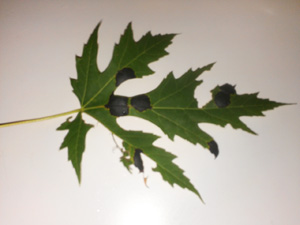 Question: we have several maple trees in our neighborhood afflicted with this black spot (see attached photo). What can we do to protect our maple trees?
Anwer: while it is difficult to confirm a diagnosis from photos alone it looks and could be a fungal disease called tar spot. The most common species are Rhytisma acerinum and R. punctatum. Symptoms first appear in late spring or early summer as infected leaves develop light green or yellow-green spots. During mid to late summer these produce black tar-like raised structures on the upper surface of leaves within the yellow spots. R. acerinum causes larger spots that are 0.5 to 2 cm in diameter; R.punctatum causes many small punctate spots that are smaller (about 1mm in diameter). Spots caused by R. punctatum are sometimes called speckled tar spots.
Tar spot is a common disease on silver maple and is primarily considered to be a cosmetic problem rather than a serious threat. The Purdue Plant and Pest Diagnostic Laboratory has additional information on tar spot including more photos and best treatment, Tar Spot on Maple.
To confirm a diagnosis, you can submit a sample directly to the Purdue Plant & Pest Diagnostic Lab (PPDL) or find a certified arborist to come to your property and access your tree.
Resources:
Large Spots on Maple Leaves that Look Like Tar, Purdue Extension News
Find an Arborist, International Society of Arboriculture
Diseases in Hardwood Tree Plantings, The Education Store, Purdue Extension’s resource center
Fifty Common Trees of Indiana
An Introduction to Trees of Indiana
Native Trees of the Midwest, The Education Store
Shrubs and Woody Vines of Indiana and the Midwest, The Education Store
Tree Installation: Process and Practices, The Education Store
Planting Your Tree Part 1: Choosing Your Tree, Video, Purdue Extension – Forestry & Natural Resource (FNR) YouTube Channel
Investing in Indiana Woodlands, The Education Store
Forest Improvement Handbook, The Education Store
ID That Tree, Purdue Extension-FNR YouTube playlist
Purdue Plant and Pest Diagnostic Laboratory
Diana Evans, Extension and Web Communication Specialist
Purdue University Department of Forestry and Natural Resources
This native Indiana shrub can be found on the edge of standing water and in wetlands. In this episode of ID That Tree, Purdue Extension forester Lenny Farlee introduces you to the buttonbush, which is known for its attractive round flowers in mid-summer, which are a favorite of pollinators, and its simple leaves, which are held in a whorled arrangement.
If you have any questions regarding wildlife, trees, forest management, wood products, natural resource planning or other natural resource topics, feel free to contact us by using our Ask an Expert web page.
Resources:
ID That Tree, Playlist, Purdue Extension – Forestry and Natural Resources YouTube Channel (Invasive White Mulberry, Siberian Elm, Tree of Heaven)
Invasive Species Playlist, Playlist, Purdue Extension – FNR YouTube Channel (Asian Bush Honeysuckle, Burning Bush, Callery Pear, Multiflora rose)
A Woodland Management Moment, Playlist, Purdue Extension – FNR YouTube Channel (Against Invasives, Garlic Mustard, Autumn Olive)
Woodland Stewardship for Landowners, Playlist, Purdue Extension – FNR YouTube Channel (Common Buckthorn, Japanese Barberry)
Report Invasive Species, Purdue Invasive Species
The GLEDN Phone App – Great Lakes Early Detection Network
EDDMaps – Early Detection and Distribution Mapping System
How long do seeds of the invasive tree, Ailanthus altissima remain viable? (Invasive Tree of Heaven), USDA Forest Service
Indiana Department of Natural Resources: Invasive Species
Indiana Invasive Species Council
Cooperative Invasive Species Management Area (CISMA)
Aquatic Invasive Species, Illinois-Indiana Sea Grant (IISG)
Episode 11 – Exploring the challenges of Invasive Species, Habitat University-Natural Resource University
What are invasive species and why should I care?, Got Nature? Blog, Purdue Extension – FNR
Shrubs and Woody Vines of Indiana and the Midwest, The Education Store, Purdue Extension Resource Center
Native Trees of the Midwest, The Education Store
Investing in Indiana Woodlands, The Education Store
Forest Improvement Handbook, The Education Store
Lenny Farlee, Extension Forester
Hardwood Tree Improvement and Regeneration Center
Purdue Department of Forestry & Natural Resources

Recent Posts
- Opportunities for Prescribed and Wildland Fire Training
Posted: November 4, 2026 in Forestry, How To, Wildlife, Woodlands - Wildlife Issues and Solutions: A New Online Series
Posted: in Forestry, How To, Wildlife, Woodlands - Burning for Benefits: Where Fire Belongs in Indiana
Posted: in Forestry, Safety, Wildlife, Woodlands - Residents, Alumni Invited to Share Indiana Natural Resource, Spaces, Species Memories
Posted: in Forestry, Forests and Street Trees, Gardening, Urban Forestry, Wildlife - Now Is The Time To Control Non-Native Bush Honeysuckle
Posted: October 30, 2026 in Forestry, How To, Invasive Plant Species, Woodlands - Help Strengthen the Future of Indiana Maple Syrup
Posted: October 29, 2026 in Forestry, How To, Woodlands - Popular Landscape Shrub is Invasive
Posted: October 15, 2026 in Alert, Forestry, Forests and Street Trees, Invasive Plant Species, Plants, Woodlands - Purdue Extension’s Regional Teams Are Here: Connecting Communities with Expertise and Opportunity
Posted: October 14, 2026 in Community Development, Forestry, Forests and Street Trees, Gardening, How To, Timber Marketing, Urban Forestry, Wildlife, Woodlands - Why Do Our Trees Go From Green Leaves to Different Colors?
Posted: in Forestry, Forests and Street Trees, Urban Forestry, Woodlands - Deer and Turkey Archery Seasons Opening Soon, MyDNR
Posted: October 13, 2026 in Alert, Safety, Wildlife
Archives
Categories
- Alert
- Aquaculture/Fish
- Aquatic/Aquaculture Resources
- Ask the Expert
- Christmas Trees
- Community Development
- Disease
- Drought
- Forestry
- Forests and Street Trees
- Gardening
- Got Nature for Kids
- Great Lakes
- How To
- Invasive Animal Species
- Invasive Insects
- Invasive Plant Species
- Land Use
- Natural Resource Planning
- Nature of Teaching
- Plants
- Podcasts
- Ponds
- Publication
- Safety
- Spiders
- Timber Marketing
- Urban Forestry
- Webinar
- Wildlife
- Wood Products/Manufacturing
- Woodland Management Moment
- Woodlands