 Purdue University - Extension - Forestry and Natural Resources
Got Nature? Blog
Everyone experiences phenology. What is phenology and how can observing plant and animal life cycle stages help us understand changes in climate, water, light and other abiotic factors? In this webinar hosted by Indiana Forestry & Woodland Owners Association (IFWOA), presenter Amanda Wanless of Indiana Phenology explains what phenology is and how each season is unique. Phenology includes the leafing and flowering, the ripening of crops in the fields, the emergence of insects, the migration of birds and much more. Amanda discusses how you can observe seasonal change on the landscape, and ways to monitor on your own or join a citizens science network collecting long term data.
Check out the Indiana Forestry & Woodland Association YouTube Channel for videos including: What is IFWOA?; A New Carbon Program for Hardwood Landowners Webinar, Indiana’s Native Orchids, Magnificent Trees of Indiana, Be Tick Aware and much more.
The Indiana Forestry & Woodland Owners Association (IFWOA) was founded in 1977 and is a non-profit organization dedicated to conservation and sustainable management of woodlands in Indiana. IFWOA advocates for scientific best practices for management to achieve objectives of clean water, wildlife habitat, soil protection, native species diversity, timber production, recreation, carbon sequestration and many others.
IFWOA is an affiliate of the National Woodland Owners Association. IFWOA is a partner, collaborator or is represented on leading National and State organizations. These memberships or collaborations are selected to advance Indiana Woodland owner’s interests. IFWOA monitors and influences legislation and economic trends impacting Indiana woodlands and landowners for our members. Membership in IFWOA provides a valuable network linkage to information and resources at the leading edge of science, industry and politics impacting Indiana woodlands.
Resources:
Magnificent Trees of Indiana, Purdue University Press
Forest Improvement Handbook, The Education Store, Purdue Extension’s resource center
Planting Hardwood Seedlings – The Education Store
Ordering Seedlings from the State Forest Nursery System, Got Nature? – Purdue Extension-FNR
Importance of Hardwood Tree Planting – The Education Store, Purdue Extension Resource Center
Forest Improvement Handbook – The Education Store
Designing Hardwood Tree Plantings for Wildlife – The Education Store
ID That Tree – YouTube Playlist
Forest Management for Reptiles and Amphibians: A Technical Guide for the Midwest, The Education Store
Hardwood Ecosystem Experiment – Forest Birds , Purdue Extension – FNR YouTube Channel
Managing Woodlands for Birds , Purdue Extension – FNR YouTube Channel
Sustaining Our Oak-Hickory Forests , Purdue Extension – FNR YouTube Channel
Ask the Expert: Hardwood Ecosystem Experiment – Birds and Salamander Research, Purdue Extension – FNR
Subscribe to Purdue Extension-FNR YouTube Channel
Liz Jackson, Engagement Lead
Indiana Forestry & Woodland Association

Brian MacGowan, Wildlife Extension Specialist and Extension Coordinator.
Agriculture Natural Resources (ANR) Newsletter: Dr. Brian MacGowan is an Extension wildlife specialist and Extension coordinator in the Department of Forestry and Natural Resources (FNR). Brian grew up in rural St. Joseph County and began his career in Extension in 1999.
Part of Brian’s Extension program focuses on professional development in cooperation with many agencies and organizations including the Indiana Chapter of the Wildlife Society, Natural Resources Conservation Service, Indiana Department of Natural Resources, and Fur Takers of America. For example, Brian works with the FTA and DNR to conduct the Professional Trappers College Furbearer Management Short Course held annually since 1980. Nuisance wildlife control operators, conservation officers, wildlife biologists, and trappers attend a week-long workshop. Almost all participants report improved trapping skills (98%) and that the knowledge gained will help them in their professional career (87%).
Much of his Extension and research has focused on management on public and private woodlands. He served as a co-PI on the Hardwood Ecosystem Experiment (www.heeforeststudy.org) where he studied the effects of timber harvesting on movement and survival of timber rattlesnakes and box turtles. More recently, Brian worked with Dr. Linda Prokopy to evaluate the impact of the Forest Management for the Private Woodland Owner Course and its role in the landowner decision-making process.
Brian also co-instructs (with Dr. Rod Williams) FNR506 Theory and Application of Natural Resources Extension Programming. Since 2012, graduate students per department policy develop a logic model, an Extension plan and an Extension deliverable. In FNR506, students increase their familiarity with natural resource Extension programs, create a logic model based on their own research and Extension interests, develop a plan that outlines extension goals, and increase skills for communicating with non-scientific audiences. To date 270 students have completed the course and produced more than 400 Extension deliverables. A recent academic review showed that “integration of Extension training and activity into the graduate program has been a great success, helping students better understand the role of Extension and outreach into the land grant mission.” Based on data from course evaluations, student interest in Extension has increased 66 percent as a result of the class and 42 percent of students said they would consider a career in Extension.
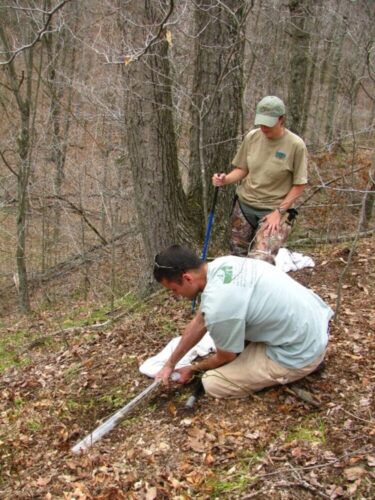
Brian conducting field work in the woods.
MacGowan launched the Natural Resources Extension internship program in 2015. This program, which is funded through the Renewable Resources Extension Act (RREA), helps students develop leadership and decision-making skills, increase communication skills, build professional references, and clarify career goals while also enhancing the scope and capacity of the FNR Extension program. Proposals are submitted to a departmental committee, which selects up to three paid internships to be awarded each funding cycle. Eric Norland, the RREA National Program leader, described the internship program as “unique and innovative” and noted “how forward-looking and beneficial (this program is) to both the program and the intern.” Thus far, 21 students have participated in internships, producing 30 videos and 16 publications, helping organize 22 workshops, making 19 presentations, hosting booths at 12 events, and contributing to 15 demonstration areas. A survey following the internships showed a 64 percent increase in a student considering a career in Extension and a 52 percent improvement in ability to speak with non-scientific audiences.
According to Brian, he received some valuable advice early in his career. “One of the best things about working in Extension is you are only limited by time and your imagination. If you have an idea that is good enough, someone will work with you to see it through.”
Agriculture & Natural Resource (ANR) is comprised of many specialists from Purdue Extension and from departments at Purdue. The Purdue Extension Educators serve as research based, unbiased information source for county and state constituents on a variety of topics including: crops, ag business, livestock, natural resource, horticulture, small farms, urban ag, pesticide use, and land conservation. In partnership with Purdue University subject matter experts, ANR Extension Educators can provide relevant and proven best management practices to address many client’s situational needs.
Resources:
Wildlife, Playlist, Purdue Extension – Forestry and Natural Resources (FNR) YouTube Channel
Ask the Expert: Birdwatching, Purdue Extension – FNR YouTube Channel
How to Stop Woodland Animals from Digging in Your Flower Pots, Got Nature? Blog with video, Purdue Extension FNR
Considerations for Trapping Nuisance Wildlife with Box Traps, The Education Store
Hardwood Ecosystem Experiment (HEE) – Wildlife Responses to Timber Harvesting, The Education Store
Snakes and Lizards of Indiana, The Education Store
Turtles of Indiana, The Education Store
Attracting Hummingbirds to Your Yard, The Education Store
Agriculture Natural Resources (ANR)
In this edition of ID That Tree, Purdue extension forester Lenny Farlee helps you identify American elderberry, a native shrub found in wetland areas and other areas with good-quality moist soils. This shrub produces small white flowers which turn to berries and are favored by birds and humans alike. It has opposite leaf arrangement with compound leaves and often is found as a cluster of stems with relatively smooth texture.
If you have any questions regarding wildlife, trees, forest management, wood products, natural resource planning or other natural resource topics, feel free to contact us by using our Ask an Expert web page.
Resources:
ID That Tree, Playlist, Purdue Extension – Forestry and Natural Resources YouTube Channel (Invasive White Mulberry, Siberian Elm, Tree of Heaven)
Invasive Species Playlist, Playlist, Purdue Extension – FNR YouTube Channel (Asian Bush Honeysuckle, Burning Bush, Callery Pear, Multiflora rose)
A Woodland Management Moment, Playlist, Purdue Extension – FNR YouTube Channel (Against Invasives, Garlic Mustard, Autumn Olive)
Woodland Stewardship for Landowners, Playlist, Purdue Extension – FNR YouTube Channel (Common Buckthorn, Japanese Barberry)
Report Invasive Species, Purdue Invasive Species
The GLEDN Phone App – Great Lakes Early Detection Network
EDDMaps – Early Detection and Distribution Mapping System
How long do seeds of the invasive tree, Ailanthus altissima remain viable? (Invasive Tree of Heaven), USDA Forest Service
Indiana Department of Natural Resources: Invasive Species
Indiana Invasive Species Council
Cooperative Invasive Species Management Area (CISMA)
Aquatic Invasive Species, Illinois-Indiana Sea Grant (IISG)
Episode 11 – Exploring the challenges of Invasive Species, Habitat University-Natural Resource University
What are invasive species and why should I care?, Got Nature? Blog, Purdue Extension – FNR
Shrubs and Woody Vines of Indiana and the Midwest, The Education Store, Purdue Extension Resource Center
Native Trees of the Midwest, The Education Store
Investing in Indiana Woodlands, The Education Store
Forest Improvement Handbook, The Education Store
Lenny Farlee, Extension Forester
Hardwood Tree Improvement and Regeneration Center
Purdue Department of Forestry & Natural Resources
In this episode of ID That Tree, Recep Yildiz a FNR graduate student shares his expertise on how to ID black alder. Black alder, which is also known as common alder or European alder, is found in most of Europe and extends into North Africa and Asia. It is easily identified by its gummy twigs and leaves. Learn more about the black alder tree and how it was introduced to Indiana with now current warning signs of being an invasive species.
If you have any questions regarding wildlife, trees, forest management, wood products, natural resource planning or other natural resource topics, feel free to contact us by using our Ask an Expert web page.
Resources:
ID That Tree, Playlist, Purdue Extension – Forestry and Natural Resources YouTube Channel (Invasive White Mulberry, Siberian Elm, Tree of Heaven)
Invasive Species Playlist, Playlist, Purdue Extension – FNR YouTube Channel (Asian Bush Honeysuckle, Burning Bush, Callery Pear, Multiflora rose)
A Woodland Management Moment, Playlist, Purdue Extension – FNR YouTube Channel (Against Invasives, Garlic Mustard, Autumn Olive)
Woodland Stewardship for Landowners, Playlist, Purdue Extension – FNR YouTube Channel (Common Buckthorn, Japanese Barberry)
Report Invasive Species, Purdue Invasive Species
The GLEDN Phone App – Great Lakes Early Detection Network
EDDMaps – Early Detection and Distribution Mapping System
How long do seeds of the invasive tree, Ailanthus altissima remain viable? (Invasive Tree of Heaven), USDA Forest Service
Indiana Department of Natural Resources: Invasive Species
Indiana Invasive Species Council
Cooperative Invasive Species Management Area (CISMA)
Aquatic Invasive Species, Illinois-Indiana Sea Grant (IISG)
Episode 11 – Exploring the challenges of Invasive Species, Habitat University-Natural Resource University
What are invasive species and why should I care?, Got Nature? Blog, Purdue Extension – FNR
Spotted Lanternfly Feeds on Over 70 Plus Plant Species, Got Nature? Blog, Purdue Extension – FNR
Shrubs and Woody Vines of Indiana and the Midwest, The Education Store, Purdue Extension Resource Center
Native Trees of the Midwest, The Education Store
Investing in Indiana Woodlands, The Education Store
Forest Improvement Handbook, The Education Store
Recep Yildiz, FNR graduate student
Purdue Department of Forestry & Natural Resources
In this episode of ID That Tree, Recep Yildiz a FNR graduate student shares his expertise on how to ID Persian walnut or sometimes called common walnut or English walnut. It is not native to Indiana but is widely cultivated and grown for nuts. This species is deciduous and native to Europe, the Himalayas and China. Learn more about Persian walnut and along with clear photos of the bark and leaves.
If you have any questions regarding wildlife, trees, forest management, wood products, natural resource planning or other natural resource topics, feel free to contact us by using our Ask an Expert web page.
Resources:
ID That Tree, Playlist, Purdue Extension – Forestry and Natural Resources YouTube Channel (Invasive White Mulberry, Siberian Elm, Tree of Heaven)
Invasive Species Playlist, Playlist, Purdue Extension – FNR YouTube Channel (Asian Bush Honeysuckle, Burning Bush, Callery Pear, Multiflora rose)
A Woodland Management Moment, Playlist, Purdue Extension – FNR YouTube Channel (Against Invasives, Garlic Mustard, Autumn Olive)
Woodland Stewardship for Landowners, Playlist, Purdue Extension – FNR YouTube Channel (Common Buckthorn, Japanese Barberry)
Report Invasive Species, Purdue Invasive Species
The GLEDN Phone App – Great Lakes Early Detection Network
EDDMaps – Early Detection and Distribution Mapping System
How long do seeds of the invasive tree, Ailanthus altissima remain viable? (Invasive Tree of Heaven), USDA Forest Service
Indiana Department of Natural Resources: Invasive Species
Indiana Invasive Species Council
Cooperative Invasive Species Management Area (CISMA)
Aquatic Invasive Species, Illinois-Indiana Sea Grant (IISG)
Episode 11 – Exploring the challenges of Invasive Species, Habitat University-Natural Resource University
What are invasive species and why should I care?, Got Nature? Blog, Purdue Extension – FNR
Spotted Lanternfly Feeds on Over 70 Plus Plant Species, Got Nature? Blog, Purdue Extension – FNR
Shrubs and Woody Vines of Indiana and the Midwest, The Education Store, Purdue Extension Resource Center
Native Trees of the Midwest, The Education Store
Investing in Indiana Woodlands, The Education Store
Forest Improvement Handbook, The Education Store
Recep Yildiz, FNR graduate student
Purdue Department of Forestry & Natural Resources
This exotic invasive tree species is commonly found in Indiana landscape, callery pear. Callery pear has been planted as an ornamental tree in the midwest for decades. The original selection bradford pear was actually infertile and would not spread from seed but additional varieties have been planted and have crossed with the original Bradford and those are producing fertile seed. Find out how the seed spreads and what we can do to help our forest.
If you have any questions regarding wildlife, trees, forest management, wood products, natural resource planning or other natural resource topics, feel free to contact us by using our Ask an Expert web page.
Resources:
ID That Tree, Playlist, Purdue Extension – Forestry and Natural Resources YouTube Channel (Invasive White Mulberry, Siberian Elm, Tree of Heaven)
Invasive Species Playlist, Playlist, Purdue Extension – FNR YouTube Channel (Asian Bush Honeysuckle, Burning Bush, Callery Pear, Multiflora rose)
A Woodland Management Moment, Playlist, Purdue Extension – FNR YouTube Channel (Against Invasives, Garlic Mustard, Autumn Olive)
Woodland Stewardship for Landowners, Playlist, Purdue Extension – FNR YouTube Channel (Common Buckthorn, Japanese Barberry)
Report Invasive Species, Purdue Invasive Species
The GLEDN Phone App – Great Lakes Early Detection Network
EDDMaps – Early Detection and Distribution Mapping System (Report Invasives)
How long do seeds of the invasive tree, Ailanthus altissima remain viable? (Invasive Tree of Heaven), USDA Forest Service
Indiana Department of Natural Resources: Invasive Species
Indiana Invasive Species Council
Cooperative Invasive Species Management Area (CISMA)
Aquatic Invasive Species, Illinois-Indiana Sea Grant (IISG)
Episode 11 – Exploring the challenges of Invasive Species, Habitat University-Natural Resource University
What are invasive species and why should I care?, Got Nature? Blog, Purdue Extension – FNR
Shrubs and Woody Vines of Indiana and the Midwest, The Education Store, Purdue Extension Resource Center
Native Trees of the Midwest, The Education Store
Investing in Indiana Woodlands, The Education Store
Forest Improvement Handbook, The Education Store
Lenny Farlee, Extension Forester
Hardwood Tree Improvement and Regeneration Center
Purdue Department of Forestry & Natural Resources
The classic and trusted book “Fifty Common Trees of Indiana” by T.E. Shaw was published in 1956 as a user-friendly guide to local species. Nearly 70 years later, the publication has been updated through a joint effort by the Purdue Department of Forestry and Natural Resources, Indiana 4-H, and the Indiana Department of Natural Resources, and reintroduced as “An Introduction to Trees of Indiana.”
The full publication is available for download for $7 in the Purdue Extension Education Store. The field guide helps identify common Indiana woodlot trees.
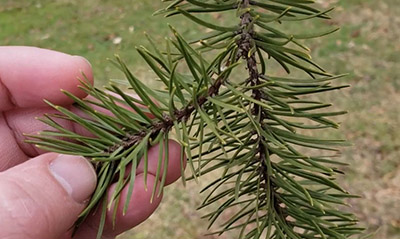
Each week, the Intro to Trees of Indiana web series will offer a sneak peek at one species from the book, paired with an ID That Tree video from Purdue Extension forester Lenny Farlee to help visualize each species as it stands in the woods. Threats to species health as well as also insight into the wood provided by the species, will be provided through additional resources as well as the Hardwoods of the Central Midwest exhibit of the Purdue Arboretum, if available.
This week, we meet the Jack pine, or Pinus banksiana.
This conifer, also known as scrub pine, has clusters of two dark green needles, which are one to one and a half inches long, noticeably curved or arched like a bow and slightly twisted.
Bark on the jack pine is dark to medium gray, thin and flaky when young and features thick plates in older trees. This tree growth irregularly and can produce between one and three whorls of side branches annually. It tends to have a much lighter crown than white pine or the spruces.
The cones of jack pine are one to three inches long and remain closed while on the tree unless disturbed by a heat event such as fire. The cones may also be curved and twisted into many irregular shapes and tend to stay on the tree for many years.
For full article with additional photos view: Intro to Trees of Indiana: Jack Pine, Forestry and Natural Resources’ News.
If you have any questions regarding wildlife, trees, forest management, wood products, natural resource planning or other natural resource topics, feel free to contact us by using our Ask an Expert web page.
Other Resources:
ID That Tree: Jack Pine
Morton Arboretum: Jack Pine
Jack Pine, Native Trees of Indiana River Walk, Purdue Fort Wayne
Borers of Pines and Other Needle Bearing Evergreens in Landscapes, The Education Store, Purdue Extension’s resource center
Managing the Zimmerman Pine Moth, The Education Store
Purdue Arboretum Explorer
The Woody Plant Seed Manual, U.S. Forest Service
Native Trees of the Midwest, The Education Store
Shrubs and Woody Vines of Indiana and the Midwest, The Education Store
Investing in Indiana Woodlands, The Education Store
Forest Improvement Handbook, The Education Store
ID That Tree, Purdue Extension-Forestry & Natural Resources (FNR) YouTube playlist
Woodland Management Moment , Purdue Extension-FNR YouTube playlist
Wendy Mayer, FNR Communications Coordinator
Purdue University Department of Forestry and Natural Resources
Lenny Farlee, Extension Forester
Purdue University Department of Forestry and Natural Resources
The classic and trusted book “Fifty Common Trees of Indiana” by T.E. Shaw was published in 1956 as a user-friendly guide to local species. Nearly 70 years later, the publication has been updated through a joint effort by the Purdue Department of Forestry and Natural Resources, Indiana 4-H, and the Indiana Department of Natural Resources, and reintroduced as “An Introduction to Trees of Indiana.”
The full publication is available for download for $7 in the Purdue Extension Education Store. The field guide helps identify common Indiana woodlot trees.
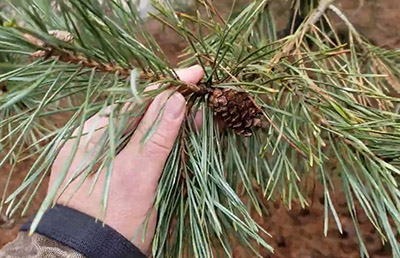
Each week, the Intro to Trees of Indiana web series will offer a sneak peek at one species from the book, paired with an ID That Tree video from Purdue Extension forester Lenny Farlee to help visualize each species as it stands in the woods. Threats to species health as well as also insight into the wood provided by the species, will be provided through additional resources as well as the Hardwoods of the Central Midwest exhibit of the Purdue Arboretum, if available.
This week, we meet the scotch pine, or Pinus sylvestris, which is not native to Indiana, but has been widely planted in the state for Christmas tree production.
This conifer, also known as Scots pine, has clusters of two blue green or yellow green needles, which are one to three inches long and do not break when bent.
Bark on the scotch pine is light gray on the outside and orange in color on the inner bark, but it is not flaky like red pine. Bark on the lower end of the trunk is dark and blocky, while the upper bark is more orange.
On the tree, cones are cylindrical and pointed at the ends, approximately three inches long and do not have spines at the end of the scales. Cones become more egg shaped as the scales begin to open up once off the tree.
Scotch pine, which grows to between 25 and 60 feet tall, is typically found on acidic, moist, well-drained soil. It prefers full sun and has some drought tolerance. The species’ native range is Scotland, Scandinavia, northern Europe and northern Asia. According to the U.S. Forest Service database, It has been introduced across the United States and Canada and is naturalized in the Northeast and in the Great Lakes states.
For full article with additional photos view: Intro to Trees of Indiana: Scotch Pine, Forestry and Natural Resources’ News.
If you have any questions regarding wildlife, trees, forest management, wood products, natural resource planning or other natural resource topics, feel free to contact us by using our Ask an Expert web page.
Other Resources:
ID That Tree: Scotch Pine
Morton Arboretum: Scotch Pine
A Choose-and-Cut Pine and Fir Christmas Tree Case Study
Diplodia Tip Blight of Two-Needle Pines, The Education Store, Purdue Extension’s resource center
Borers of Pines and Other Needle Bearing Evergreens in Landscapes, The Education Store
America’s Least Wanted Wood-Borers, Japanese Pine Sawyer, The Education Store
Managing the Zimmerman Pine Moth, The Education Store
Purdue Arboretum Explorer
The Woody Plant Seed Manual, U.S. Forest Service
Native Trees of the Midwest, The Education Store
Shrubs and Woody Vines of Indiana and the Midwest, The Education Store
Investing in Indiana Woodlands, The Education Store
Forest Improvement Handbook, The Education Store
ID That Tree, Purdue Extension-Forestry & Natural Resources (FNR) YouTube playlist
Woodland Management Moment , Purdue Extension-FNR YouTube playlist
Wendy Mayer, FNR Communications Coordinator
Purdue University Department of Forestry and Natural Resources
Lenny Farlee, Extension Forester
Purdue University Department of Forestry and Natural Resources
The Niehaus’ tree farm encompasses 182 acres in Perry and Dubois counties in southern Indiana. The land has been in their family since Dave Niehaus’ grandparents bought it soon after they married in 1909. Back then, only 100 or so acres of the property were forest; the remaining 80 acres comprised open land.
Niehaus’ grandparents built a house on the farm in 1918. In 1931, his grandfather died in a horse accident, leaving his grandmother to raise their nine children. Dave’s father, the oldest, was 19 at the time.
The children grew up and moved on, but Niehaus’ grandmother would continue living there for the remainder of her life. Young Dave grew up in Saint Meinrad, about six miles away. “I spent a lot of time up there, in the forest,” he says. “The fields then were in the Soil Bank program (now the Conservation Reserve Program) because about 40 acres of the open ground was in the flood plain, so they were used to losing their crops, and losing their soil down in the bottoms. In the CRP ground, once a year you’d have to mow all of that down. Dad had a little 8N Ford tractor with a side mower on there, and I mowed all that down and just spent time with Grandma up there.”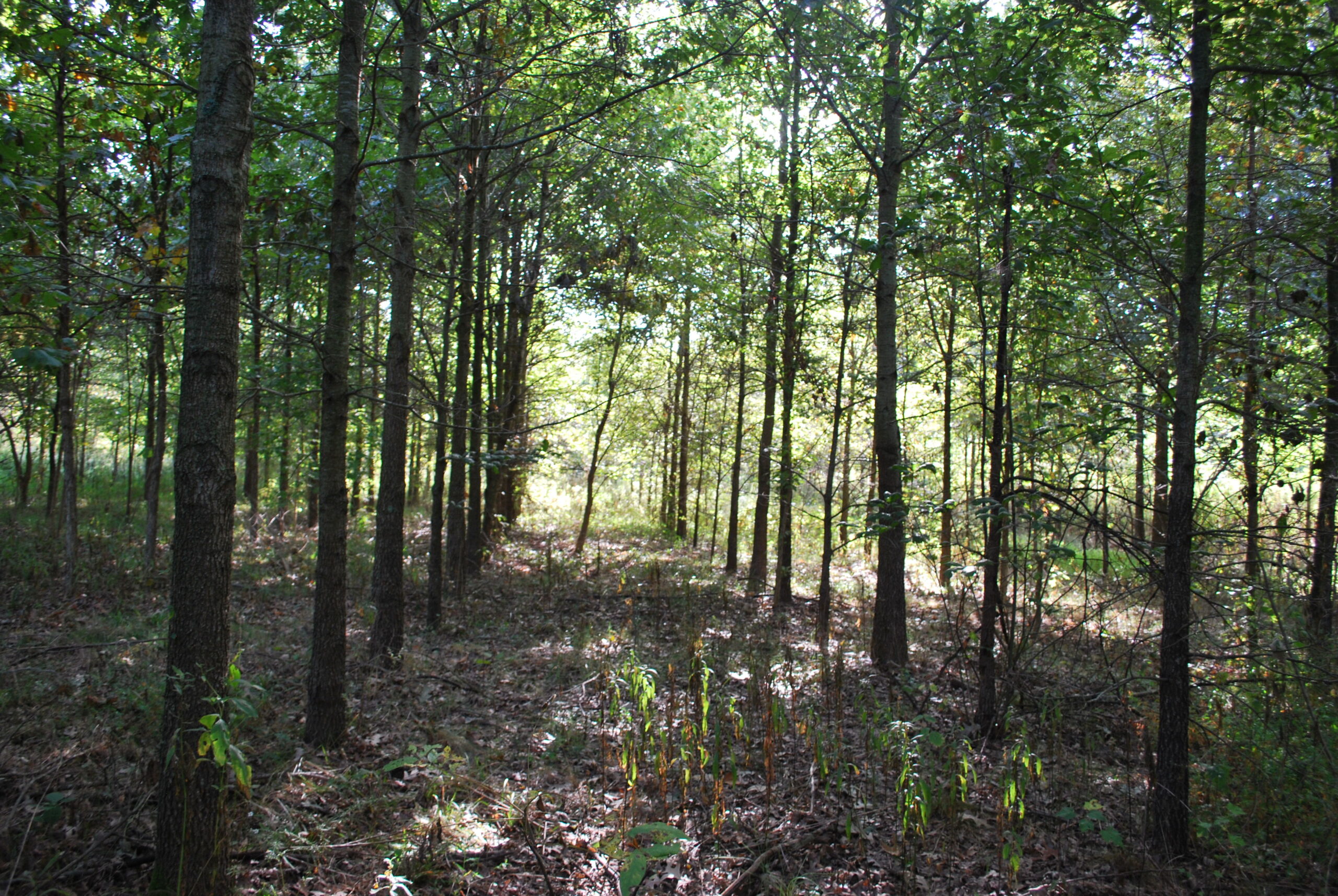
Niehaus’ older brother bought the property in 1969. When he decided to sell, Dave stepped up to purchase it in 2005. “It’s our roots,” he explains. “I didn’t want it divided up.”
Ten years earlier, he’d asked his brother for some land so he could try his hand at planting trees. Niehaus was an Army veteran and a carpenter; he didn’t know much about forestry, but he wanted to learn. He started in 1995 on a four-acre horse pasture with 16 5-gallon buckets of acorns he’d raked up in a city park. He rigged up a PVC pipe that dug a trench in the subsoil as he dropped the acorns through a funnel into the pipe, planting them in rows across the field.
The following spring, not a single white oak came up. “My brother just laughed and said, ‘You got a lot of fat mice running around up there,” Niehaus recalls.
The following fall, he enlisted the help of Dr. Jim Wichman with the Indiana Department of Natural Resources, Division of Forestry Nursery Section. Niehaus started one bucket of acorns in his garden, where he could better protect them from predators and mold. He experimented with coverage, noting that germination under peat moss far exceeded that of pine needles and dirt. He then hand-transplanted the seedlings to rows on the open land — a second, and more successful, try at growing a forest.
Over the next three years, Niehaus cultivated enough seedlings to hand plant the four acres. He expanded his sights.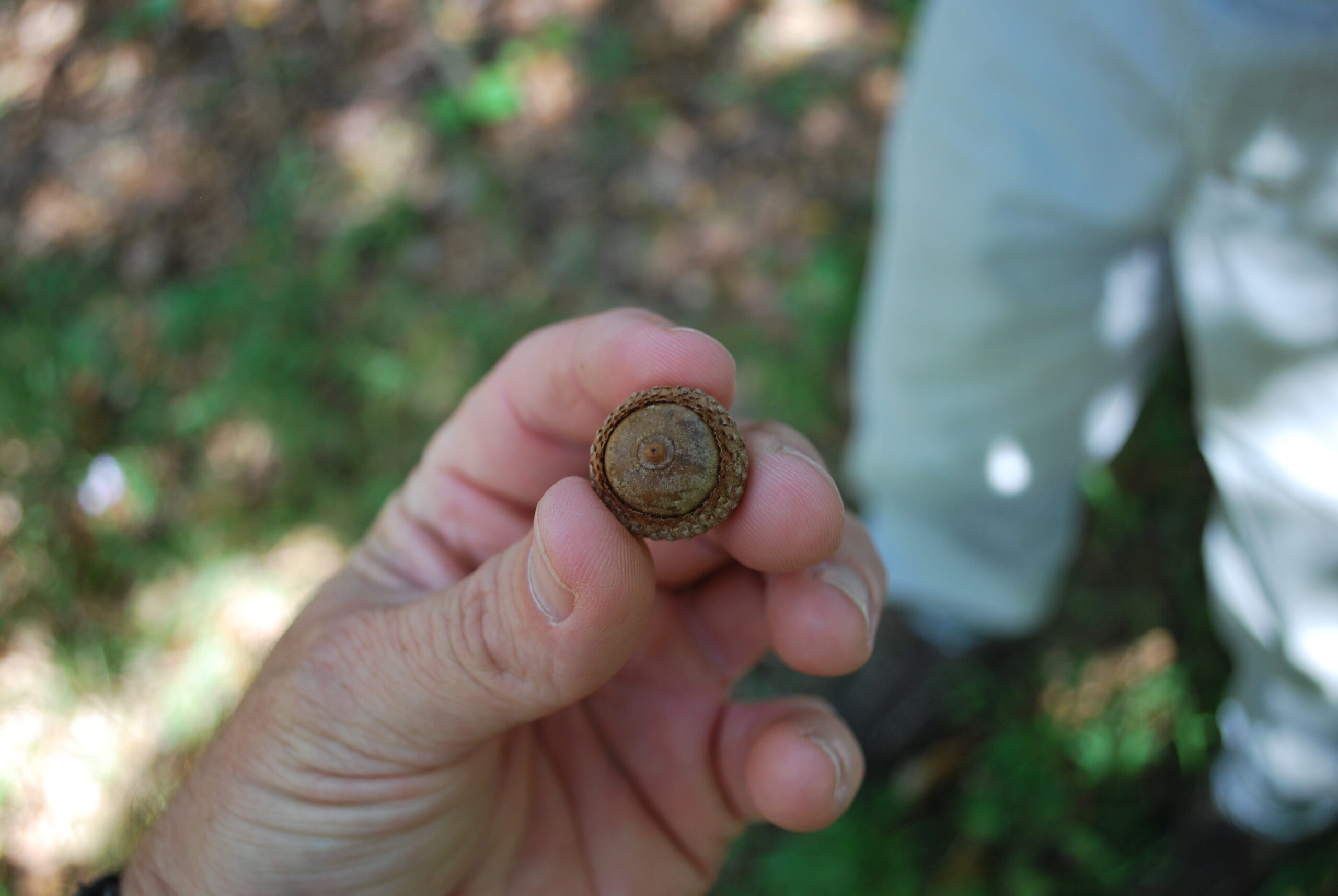
One year he got 500 seedlings from the state nursery and in the course of planting them, credits his then 10-year-old daughter with an important lesson. “She said, ‘Dad, this is going to look funny when this grows up… When you go into a forest, the trees are spaced here and there. And these are all going to be in a row.’ And I said, ‘Andrea, you just got the vision.’ So that’s what it is now.”
After he bought the property in 2005, Niehaus signed on for a class at the Southern Indiana Purdue Agricultural Center in nearby Dubois, Indiana, Forest Management for the Private Woodland Owner. Extension Forester Ron Rathfon led the eight-week course.
“I wanted to know a little more about forestry,” Niehaus says. “I wanted to be a good steward of the property.”
Rathfon has been helping residents manage their woodlands for 30 years, along with the Purdue Forestry and Natural Resources Extension team and public and private resource professionals who offer classroom and field instruction. “Ron makes the class interesting, and he makes it fun,” Niehaus says.
His main takeaways from the course were in tree identification and forest biology. “If you want to manage your forest to get it to grow back to be oak trees, you have to be able to recognize the different species of trees at different ages,” Niehaus says.
For full article with additional photos view: Creating A Woodland Legacy: Dave and Carol Niehaus, Extension News and Stories
Resources
Hardwood Ecosystem Experiment – Wildlife Responses to Timber Harvesting, The Education Store, Purdue Extension resource center
Forest Improvement Handbook, The Education Store
Invasive plants: impact on environment and people, The Education Store
Managing Your Woods for White-Tailed Deer, The Education Store
Shrubs and Woody Vines of Indiana and the Midwest, The Education Store
Forest Management for Reptiles and Amphibians: A Technical Guide for the Midwest, The Education Store
Breeding Birds and Forest Management: the Hardwood Ecosystem Experiment and the Central Hardwoods Region, The Education Store
Native Trees of the Midwest, The Education Store
Investing in Indiana Woodlands, The Education Store
ID That Tree, Purdue Extension-Forestry & Natural Resources (FNR) YouTube playlist
Woodland Management Moment , Purdue Extension-FNR YouTube playlist
Subscribe: Deer, Forest Management, ID That Tree, Woodland Management Moment, Invasive Species and many other topic video playlists, Purdue Extension-Forestry and Natural Resources YouTube Channel
Ron Rathfon, Regional Extension Forester
Purdue University Department of Forestry and Natural Resources
The classic and trusted book “Fifty Common Trees of Indiana” by T.E. Shaw was published in 1956 as a user-friendly guide to local species. Nearly 70 years later, the publication has been updated through a joint effort by the Purdue Department of Forestry and Natural Resources, Indiana 4-H, and the Indiana Department of Natural Resources, and reintroduced as “An Introduction to Trees of Indiana.”
The full publication is available for download for $7 in the Purdue Extension Education Store. The field guide helps identify common Indiana woodlot trees. 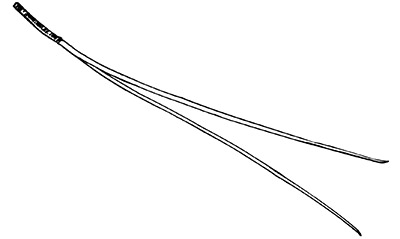
Each week, the Intro to Trees of Indiana web series will offer a sneak peek at one species from the book, paired with an ID That Tree video from Purdue Extension forester Lenny Farlee to help visualize each species as it stands in the woods. Threats to species health as well as also insight into the wood provided by the species, will be provided through additional resources as well as the Hardwoods of the Central Midwest exhibit of the Purdue Arboretum, if available.
This week, we meet the red pine, or Pinus resinosa, which is not native to Indiana, but has been planted widely across the state.
This conifer has clusters of two slender, flexible, green or yellow green needles, which are four to six inches long. If the needles are bent, they will break cleanly, unlike that of ornamentally planted Austrian pine. The long needles cause a very tufted look to the tree canopy.
Bark on the red pine is scaly and red-orange in color in younger trees and platy and reddish brown in older trees. Cones are egg-shaped, approximately two inches long and have smooth scales.
Red pine tends to be very, straight and tall, growing to between 50 and 80 feet tall. This species, which can be as tall as 200 feet, is typically found on sandy, well-drained soils with low pH and full sun. The natural range of the red pine is the northeastern United States and southern Canada near the Great Lakes and St. Lawrence River. The species can be found as far west as Minnesota and into Manitoba. It can be found dipping south into Wisconsin, Illinois, Michigan, West Virginia and Pennsylvania.
For full article with additional photos view: Intro to IN Trees: Red Pine, Forestry and Natural Resources’ News.
If you have any questions regarding wildlife, trees, forest management, wood products, natural resource planning or other natural resource topics, feel free to contact us by using our Ask an Expert web page.
Other Resources:
ID That Tree: Red Pine
Morton Arboretum: Red Pine
Diplodia Tip Blight of Two-Needle Pines, The Education Store, Purdue Extension’s resource center
Borers of Pines and Other Needle Bearing Evergreens in Landscapes, The Education Store
Native Trees of the Midwest, The Education Store
Shrubs and Woody Vines of Indiana and the Midwest, The Education Store
Investing in Indiana Woodlands, The Education Store
Forest Improvement Handbook, The Education Store
Purdue Arboretum Explorer
The Woody Plant Seed Manual, U.S. Forest Service
ID That Tree, Purdue Extension-Forestry & Natural Resources (FNR) YouTube playlist
Woodland Management Moment , Purdue Extension-FNR YouTube playlist
Wendy Mayer, FNR Communications Coordinator
Purdue University Department of Forestry and Natural Resources
Lenny Farlee, Extension Forester
Purdue University Department of Forestry and Natural Resources

Recent Posts
- Opportunities for Prescribed and Wildland Fire Training
Posted: November 4, 2026 in Forestry, How To, Wildlife, Woodlands - Wildlife Issues and Solutions: A New Online Series
Posted: in Forestry, How To, Wildlife, Woodlands - Burning for Benefits: Where Fire Belongs in Indiana
Posted: in Forestry, Safety, Wildlife, Woodlands - Residents, Alumni Invited to Share Indiana Natural Resource, Spaces, Species Memories
Posted: in Forestry, Forests and Street Trees, Gardening, Urban Forestry, Wildlife - Now Is The Time To Control Non-Native Bush Honeysuckle
Posted: October 30, 2026 in Forestry, How To, Invasive Plant Species, Woodlands - Help Strengthen the Future of Indiana Maple Syrup
Posted: October 29, 2026 in Forestry, How To, Woodlands - Popular Landscape Shrub is Invasive
Posted: October 15, 2026 in Alert, Forestry, Forests and Street Trees, Invasive Plant Species, Plants, Woodlands - Purdue Extension’s Regional Teams Are Here: Connecting Communities with Expertise and Opportunity
Posted: October 14, 2026 in Community Development, Forestry, Forests and Street Trees, Gardening, How To, Timber Marketing, Urban Forestry, Wildlife, Woodlands - Why Do Our Trees Go From Green Leaves to Different Colors?
Posted: in Forestry, Forests and Street Trees, Urban Forestry, Woodlands - Deer and Turkey Archery Seasons Opening Soon, MyDNR
Posted: October 13, 2026 in Alert, Safety, Wildlife
Archives
Categories
- Alert
- Aquaculture/Fish
- Aquatic/Aquaculture Resources
- Ask the Expert
- Christmas Trees
- Community Development
- Disease
- Drought
- Forestry
- Forests and Street Trees
- Gardening
- Got Nature for Kids
- Great Lakes
- How To
- Invasive Animal Species
- Invasive Insects
- Invasive Plant Species
- Land Use
- Natural Resource Planning
- Nature of Teaching
- Plants
- Podcasts
- Ponds
- Publication
- Safety
- Spiders
- Timber Marketing
- Urban Forestry
- Webinar
- Wildlife
- Wood Products/Manufacturing
- Woodland Management Moment
- Woodlands