 Purdue University - Extension - Forestry and Natural Resources
Got Nature? Blog
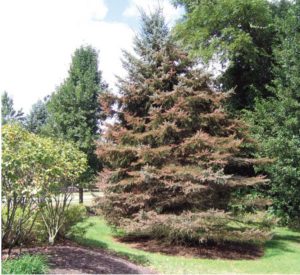
Fig. 1. Severely infected tree showing the ‘purple-brown’ needle symptoms.
Purdue Landscape Report: Colorado blue spruce is not native to Indiana (no spruce is!), and it often suffers from environmental stresses such as drought, excessive heat, humidity, and compacted or heavy clay soils—making it an already poor choice for our landscape. If that weren’t enough, it also suffers from needle cast diseases. Needle cast is a generic term that refers to foliar diseases of coniferous plants that result in the defoliation (“casting off”) of needles. Needle casts vary by host, and severity is dependent upon the age of infected needles. Of all the foliar diseases affecting woody landscape plants and shrubs, needle casts are the most serious for the simple reason that coniferous plants do not have the ability to refoliate, or produce a second flush of needles from defoliated stems. Rhizosphaera needle cast is a fungal disease, caused by Rhizosphaera kalkhoffii that attacks the needles of Colorado blue spruce in the spring, as new needles emerge. However, infected needles often don’t show symptoms right away, and may take one to three years to develop. Infected needles later turn purple to brown and fall from the tree prematurely (Fig. 1), leaving the inner portion of the branch bare.
As the disease progresses, severely infected branches die, leaving the tree with a hollow or thin appearance (Fig. 2). The disease usually starts near the base of the tree where humidity levels are the highest but continues to spread upward. As the disease continues, trees become unsightly and lose their value as a visual screen or privacy fence.
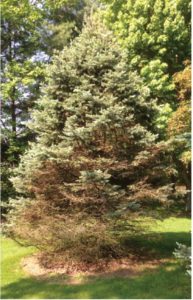
Fig. 2. As the disease spreads up the tree, lower branches begin to die.
The Rhizosphaera pathogen sporulates in the spring (Fig. 3), which is the best time to control this disease. The fungal fruiting structures emerge on these needles and are usually large enough to be visible to the eye, with the fruiting structures appearing as rows of small dots running lengthwise along the white bands of the needles. In severe infections, trees may only have the current year’s needles remaining rather than the 5- to 7-year complement of needles a healthy spruce maintains. Destructive epidemics of needle casts or rusts are not uncommon and develop under periods of extended leaf wetness. The after-affect of these epidemics can persist for several years. In the urban setting, needle casts are more of an endemic, as most conifers are ill-suited to the Midwest urban environment. Most conifers retain their needles for two to seven years. The length of time that a needle is retained depends on the species of coniferous plant and if the plant has been subjected to stress such as drought, flooding, salt damage, disease, or insect pest. Trees that lack the full complement of needles are stressed or undergoing pest attack. When attempting to determine the cause of needle drop, examine the branch carefully to determine if the problem is normal needle drop, the yearly occurrence on normal needle shedding. The newest needles should not be affected and problems should not appear within the last two to three years of growth.
Managing Rhizosphaera: there are conifers that are more resistant to Rhizosphaera, and include white spruce (P. glauca) and its variant Black Hills spruce, both of which are intermediate in resistance. Norway spruce (P. abies) is highly resistant to this disease. Some Colorado blue spruce cultivars, like ‘Hoopsii,’ and ‘Fat Albert’ are reportedly more resistant to the disease.
Spectro-90, or copper-based fungicide, can protect new growth and prevent new infections; Concert II, Heritage, Pageant, and Trinity are labeled for use in commercial and residential landscapes, and nurseries, but data regarding their efficacy is lacking for this disease. Daconil Weatherstik is not labeled for blue spruce in the landscape but is still available for use in the nursery and for other landscape diseases.
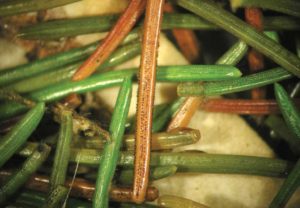
Fig. 3. Closeup of fruiting bodies. Photo by Paul Bachi, UK.
It is important to protect new growth as it emerges no matter which fungicide you apply; fungicides should be applied when the new needles are half elongated (late April or early May) and again three to four weeks later, possibly with a third application if wet weather or growth persists. Rhizosphaera needle cast may be controlled in one year if fungicides are applied correctly. However, severely infected trees usually require two or more years of fungicide applications. Even though fungicide application will effectively control this disease, reinfection may occur in subsequent years. Application to large trees requires special equipment to ensure adequate coverage. Read fungicide labels carefully and apply only as directed.
When planting new trees, consider planting Norway or white spruce, which are more resistant to Rhizosphaera. Other spruce, like Serbian, simply haven’t had widespread evaluation in the Midwest, so buyer beware! Properly spacing spruce trees will help reduce disease incidence. Spruce trees grow best in moderately moist, well-drained soils but can be planted in other soils if adequate moisture is available. Avoid heavy clay, as trees planted on these sites often suffer iron, magnesium, and manganese deficiency. Water newly planted trees, and water during drought periods to help maintain tree vigor and minimize stress. Stressed trees should also be mulched and fertilized as needed. Properly prune dead or severely infected branches during dry weather. If trees are severely infected, the lower whorl of branches may also be removed to help increase air circulation.
Article originally published by the Indian Nursery & Landscape Association Magazine, March/April 2018. www.inla1.org
Resources:
Needlecast in Colorado Blue Spruce, Purdue Landscape Report
Blue Spruce Update, Purdue Landscape Report
Why Spruce Trees Lose Their Needles, Purdue Extension
Blue Spruce Decline, Purdue Extension
Ask an Expert Question: Blue Spruce dying, what can I do?, Purdue Extension – Forestry and Natural Resources (FNR) Got Nature? Blog
Tree Installation: Process and Practices, The Education Store, Purdue Extension resource center
Tree Planting and Urban Forestry Videos, Subscribe to our Purdue Extension-FNR YouTube Channel
Janna Beckerman, professor
Purdue Botany and Plant Pathology
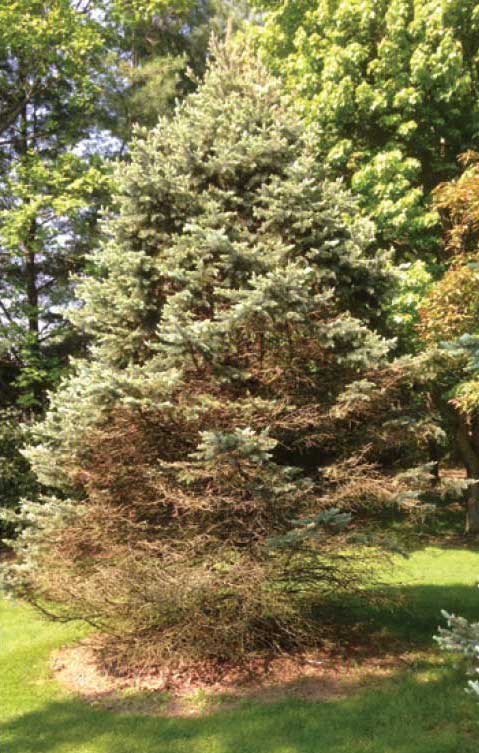 Question: I have a blue spruce that is 40-years old and very tall. It is dying up the middle. I have read about the Needle Cast problem. Also read about Spectro 90 copper based fungus control. I can only spray so high. Is there a chemical that can be placed on the ground to be absorbed by the tree?
Answer: Thank you for contacting us regarding your tree issues. Rhizosphaera needle cast (Rhizosphaera kalkhoffii) is a foliar disease of spruce trees. It is most common in trees growing outside of their native range. It starts on the inner and lower growth and progresses upward through the tree. It can take up to 15 months for the needles to show visible symptoms after the initial infection. Young trees may be killed by this disease, but usually branches die off after 3-4 consecutive years of defoliation, causing trees to look disfigured.
Early identification of Rhizosphaera can prevent major damage to individual trees and prevent the spread to nearby trees. Protecting new growth as it emerges is very important. For best effectiveness, fungicides should be applied when the emerging needles are half elongated (1/2 to 2 inches in length). Needle cast diseases can be effectively controlled with fungicides containing chlorothalonil. For Rhizosphaera needle cast, two properly-timed applications per year for at least two consecutive years, and sometimes three years, is required for control. Heavily infected trees may require several years of fungicide applications but should be sprayed, soil drenches are not effective. Also, clean-up of any infected needles and branches will help reduce the spread of the disease.
Resources
Needle cast in Colorado Blue Spruce, Purdue Landscape Report
Blue Spruce Update, Purdue Landscape Report
Why Spruce Trees Lose Their Needles, Purdue Extension
Blue Spruce Decline, Purdue Extension
Diseases Common in Blue Spruce, Purdue Extension
Tree Installation: Process and Practices, The Education Store, Purdue Extension resource center
Tree Planting and Urban Forestry Videos, Subscribe to our Purdue Extension-FNR YouTube Channel
Find an Arborist, International Society of Arboriculture
Lindsey Purcell, Urban Forestry Specialist
Purdue University, Department of Forestry and Natural Resources
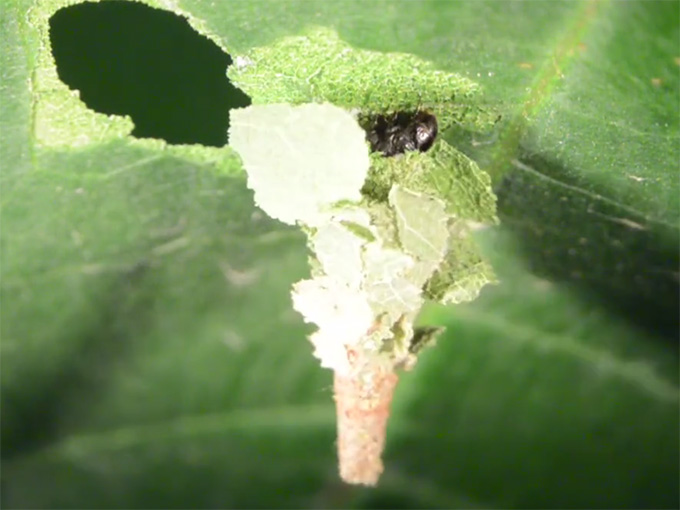 The evergreen bagworm, as its name implies, is well known for its ability to defoliate evergreen trees and shrubs like spruce, arborvitae, fir, junipers and pine. When given a chance, it will also feed on deciduous trees like maples, honeylocust, and crabapples. In late May and early June bagworms hatch from eggs that overwinter in the bag of their mother. When young bagworms begin feeding on broadleaved plants the caterpillars are too small to feed all the way through, so they leave circular patterns of skeletonization. Bagworms can be easily controlled with a spray application of spinosad (Conserve, or Fertilome borer and bagworm killer), or Bacillus thuringiensis (Dipel). More control options are available on the Purdue Tree Doctor App, purdueplantdoctor.com.
View this video located on the Purdue Plant Doctor App Suite Facebook page to watch a young bagworm caterpillar poke its head out of its silken bag to feed on a maple leaf. The young caterpillar scrapes the leaf surface to feed, and cuts bits of green tissue and glues it on its back. At the end of the video it sticks out its legs and flips the entire bag over to hide from the lights.
Resources:
Purdue Plant Doctor App Suite, Purdue Extension-Entomology
Landscape & Ornamentals: Bagworms, The Education Store
Upcoming Workshops, Purdue Extension-Forestry & Natural Resources
Ask An Expert, Purdue Extension-Forestry & Natural Resources
FNR contacts:
Lindsey Purcell, Urban Forestry Specialist
Purdue University, Department of Forestry and Natural Resources
Lenny D Farlee, Sustaining Hardwood Extension Specialist
Purdue University Department of Forestry and Natural Resources
Author:
Cliff Sadof, Professor
Purdue University Department of Entomology

Recent Posts
- Spotted Lanternfly Feeds on Over 70 Plus Plant Species
Posted: May 20, 2026 in Alert, Forestry, Forests and Street Trees, Gardening, Invasive Insects, Urban Forestry, Wildlife - Painted Hickory Borer, Purdue Landscape Report
Posted: May 14, 2026 in Forestry, Invasive Insects, Wildlife - Saving Giants of the Blue River: Purdue Team Earns Statewide Recognition
Posted: in Aquaculture/Fish, Aquatic/Aquaculture Resources, Wildlife - Restoring Roots to Save the Salamanders, USDA – Natural Resources Conservation Service
Posted: May 6, 2026 in Aquaculture/Fish, Forestry, Wildlife - Spring Storms Are Coming: How to Reduce Tree Damage and Risk
Posted: May 1, 2026 in How To, Urban Forestry, Wildlife, Woodlands - Cryptocline Leaf Spot (Anthracnose) of Elm, Purdue Landscape Report
Posted: April 30, 2026 in Disease, Forestry, Woodlands - Mechanical Damage to Trees: Mowing and Maintenance Equipment
Posted: April 24, 2026 in Forestry, Forests and Street Trees, Urban Forestry - A Woodland Management Moment: Growing Quality Black Walnut in Openings
Posted: April 20, 2026 in Urban Forestry, Woodland Management Moment, Woodlands - Spring Into Bloom With ID That Tree
Posted: in Forests and Street Trees, Urban Forestry, Woodlands - Question: Have Whippoorwill Birds Declined in Numbers?
Posted: in Ask the Expert, Wildlife
Archives
Categories
- Alert
- Aquaculture/Fish
- Aquatic/Aquaculture Resources
- Ask the Expert
- Christmas Trees
- Community Development
- Disease
- Drought
- Forestry
- Forests and Street Trees
- Gardening
- Got Nature for Kids
- Great Lakes
- How To
- Invasive Animal Species
- Invasive Insects
- Invasive Plant Species
- Land Use
- Natural Resource Planning
- Nature of Teaching
- Plants
- Podcasts
- Ponds
- Publication
- Safety
- Spiders
- Timber Marketing
- Urban Forestry
- Webinar
- Wildlife
- Wood Products/Manufacturing
- Woodland Management Moment
- Woodlands