 Purdue University - Extension - Forestry and Natural Resources
Got Nature? Blog
 Did you know that the majority of tilapia grown in the Midwest region of the United States are sold live in ethnic markets? And the majority of tilapia eaten in the United States are imported from Asia and Latin America?
Farmed tilapia is considered safe to eat. In fact, they are identified as a “Best Choice” fish for pregnant women, breastfeeding mothers and children according to the EPA and FDA.
This publication, “Tilapia Farmed Fish Fact Sheet“, is the third in a series of consumer guides that describe fish and shellfish farmed in the Midwest region of the United States. The fact sheet also includes culinary characteristics, cooking tips and a recipe for Sauteed Tilapia.
To view other consumer guide publications and video resources, check out Purdue Extension’s The Education Store website.
Resources:
Fish: Healthy Protein Handout, The Education Store, Purdue Extension resource center
Walleye Farmed Fish Fact Sheet, The Education Store
Yellow Perch Farmed Fish Fact Sheet, The Education Store
Salmon and Trout of the Great Lakes: A Visual Identification Guide, The Education Store
Eat Midwest Fish, Illinois-Indiana Sea Grant online resource hub
Amy Shambach, Aquaculture Marketing Outreach Associate
Purdue Department of Forestry and Natural Resources
Join Purdue FNR’s own professor of wildlife science, Dr. Rod Williams, along with Mike Lodato, member of the Indiana Technical Advisory Committee for Herpetology, and Nate Engbrecht, herpetologist for the Indiana Department of Natural Resources, to learn tips on the how’s, when’s and where’s of herping in Indiana, including what gear to take, where to go and what you might see in different parts of the state.
If you have any questions regarding wildlife, trees, forest management, wood products, natural resource planning, or other natural resource topics, feel free to contact us by using our Ask an Expert web page.
Resources:
What’s a Herp? Indiana Department of Natural Resources YouTube Channel
Appreciating Reptiles and Amphibians in Nature, The Education Store, Purdue Extension resource center
The Nature of Teaching, Unit 3: Reptiles, Amphibians, and the Scientific Method, The Education Store
A Moment in the Wild: Eastern Newt Video, Purdue Extension – FNR YouTube Channel
Help the Hellbender, Purdue Extension
Rod Williams, Professor of Wildlife Science
Purdue Department of Forestry and Natural Resources
Nate Engbrecht, Herpetologist
Indiana Department of Natural Resources
Mike Lodato, Member of the Indiana Technical Advisory Committee for Herpetology
Illinois-Indiana Sea Grant (IISG), serving communities in the Great Lakes region, has largemouth bass workshops now available as videos on the IISG YouTube Channel. Presenters from Illinois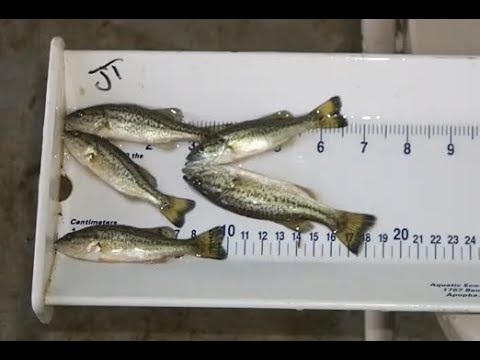 and Kentucky share their expertise with largemouth bass production, marketing trends and best management practices.
Indoor Larval Largemouth Bass Rearing Video
Presenter: Giovanni Molinari, Research Assistant, Center for Fisheries, Aquaculture and Aquatic Science, Sothern Illinois University-Carbondale
Learn about larval largemouth bass rearing in an indoor recirculating aquaculture system from Southern Illinois University graduate student Giovanni Molinari.
Largemouth Bass Production Video
Presenter: Dr. James H. Tidwell, Chair for School of Aquaculture and Aquatic Sciences, Aquaculture Research Center, Kentucky State University
Gain an overview of largemouth bass production from Dr. Tidwell, including stocking and food fish production.
Largemouth Bass Fingerling Production Video
Presenter: Shawn Coyle, Research Associate with the School of Aquaculture and Aquatic Sciences, College of Agriculture, Kentucky State University
Learn about the production of feed trained largemouth bass fingerlings through the first year.
Largemouth Bass Market Trends Video
Presenter: Paul Hitchens, Aquaculture Specialist, Southern Illinois University
Learn about the marketing trends to the food fish market and live market. Paul shares what they gather and how they analyze the numbers there at SIU.
Through workshops, educational materials, and one-on-one interactions, Illinois-Indiana Sea Grant provides people with the tools they need to help incorporate fish into their diet, aid aquaculture producers in defining markets and create value-added opportunities for their products.
Resources:
Eat Midwest Fish website launches fresh fish finder, Illinois – Indiana Sea Grant
Walleye Farmed Fish Fact Sheet: A Guide for Seafood Consumers, The Education Store, Purdue Extension resource center
Yellow Perch Farmed Fish Fact Sheet, The Education Store
Tilapia Farmed Fish Fact Sheet, The Education Store
Fish: Healthy Protein Handout, The Education Store
Fish Cleaning with Purdue Extension County Extension Director, Got Nature? Blog, Purdue Extension – Forestry and Natural Resources
Illinois-Indiana Sea Grant (IISG) YouTube Channel and IISG website, IISG grant combines research, education, and outreach to empower southern Lake Michigan communities to secure a healthy environment and economy.
Amy Shambach, Aquaculture Marketing Outreach Associate
Purdue Department of Forestry and Natural Resources/Illinois Indiana Sea Grant Program
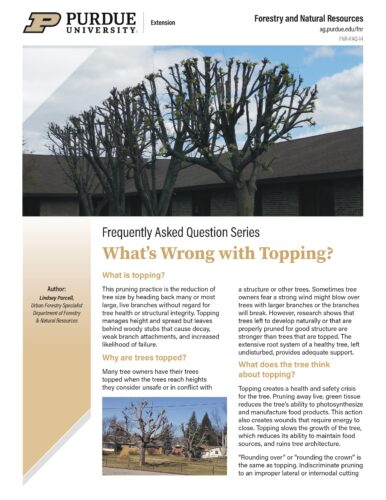 As trees grow and reach heights which many consider to be unsafe, tree owners would often top their trees by reducing the tree size. This is by heading back most of the large, live branches from the tree. However, topping trees proves to be more damaging than beneficial.
Topping trees can cause decay, weak branch attachments, and an increased likelihood of failure. If we do not top our trees and leave them to develop naturally, the structural strength of the trees is stronger than those that are not topped. The extensive root system, when left undisturbed, provides adequate support for the trees.
This publication titled What’s Wrong with Topping goes in-depth on the implications of topping and provides better alternatives to topping.
To view other urban forestry publications and video resources, check out Purdue Extension’s The Education Store website.
Resources:
Planting Your Tree Part 1: Choosing Your Tree, Purdue Extension YouTube Channel
Tree Planting Part 2: Planting a Tree, Purdue Extension YouTube Channel
Tree Selection for the “Un-natural” Environment, The Education Store, Purdue Extension resource center
Tree Installation: Process and Practices, The Education Store
Tree Pruning Essentials Video, Purdue Extension YouTube Channel
Lindsey Purcell, Urban Forestry Specialist
Purdue Department of Forestry and Natural Resources
Spring is here! It is the time of year for some of us to be planting new trees. In this Ask an Expert session, we welcome Lindsey Purcell, urban forestry specialist, as he teaches us how to plant and properly care for our trees. He goes over the tree selection process, including which invasive species trees we should avoid, and how to continue to take care of our trees once planted.
If you have any questions regarding wildlife, trees, forest management, wood products, natural resource planning, or other natural resource topics, feel free to contact us by using our Ask an Expert web page.
Resources:
Planting Your Tree Part 1: Choosing Your Tree, Purdue Extension YouTube Channel
Tree Planting Part 2: Planting a Tree, Purdue Extension – Forestry and Natural Resources YouTube Channel
Indiana Invasive Plant List, Indiana Invasive Species Council, Purdue Entomology
Alternatives to Burning Bush for Fall Color, Purdue Landscape Report
Invasive Plant Species: Callery Pear, Youtube, Purdue Extension
Equipment Damage to Trees, Purdue FNR Extension
Landscape Report Shares Importance of Soil Testing, Purdue FNR Extension
Lindsey Purcell, Urban Forestry Specialist
Purdue Department of Forestry and Natural Resources
Join Lenny Farlee, Purdue FNR Extension Forester, as he explains why the typical thinking of what is a tree and what is a shrub isn’t always simple as far as looking for the “single” trunk to call it a tree. There is some crossover. Lenny shares the different ways to identify if it is a shrub and then the various species in Indiana.
If you have any questions regarding wildlife, trees, forest management, wood products, natural resource planning, or other natural resource topics, feel free to contact us by using our Ask an Expert web page.
Resources:
Shrubs and Woody Vines of Indiana and the Midwest, Purdue University Press
Native Trees of the Midwest, Purdue University Press
101 Trees in Indiana, Amazon
ID That Tree, Purdue Extension – Forestry and Natural Resources YouTube Playlist
Lenny Farlee, Sustaining Hardwood Extension Specialist
Purdue Department of Forest and Natural Resources
Join Lenny Farlee, Purdue FNR Extension Forester, as he goes over the different principles used to identify various trees in Indiana. Lenny will provide examples of species to practice using those principles for identification.
If you have any questions regarding wildlife, trees, forest management, wood products, natural resource planning, or other natural resource topics, feel free to contact us by using our Ask an Expert web page.
Resources:
Shrubs and Woody Vines of Indiana and the Midwest, Purdue University Press
Native Trees of the Midwest, Purdue University Press
101 Trees in Indiana, Amazon
ID That Tree, Purdue Extension – Forestry and Natural Resources YouTube Playlist
Lenny Farlee, Sustaining Hardwood Extension Specialist
Purdue Department of Forest and Natural Resources
Question: Can I plant grass over soil where a newly removed stump was ground out?
Answer: We generally don’t want to plant new trees or turf immediately over the top of existing stumps in landscapes. The reasoning is a bit complicated but somewhat simple. The stump  location will have limited soil and rooting depth for nutrient uptake and structural stability due to its remaining below ground mass.
The woody debris material created from stump grinding has a high carbon to nitrogen (C:N) ratio. This reduces nitrogen availability for the new tree or grass. Also, there will be significant settling of the ground below the stump as it decays and loses its structural fiber. The soil should be added to replace the below ground roots and stump. It can take several years to fully decompose the stump unless it was ground very deeply or removed with an excavation machine.
The recommendations are adding soil to the stump area, and a little additional soil mounded to compensate for some decay. Plant the grass, preferably sod, however, seed can work, to adequately cover the newly exposed area. Be sure to add slow-release turf fertilizer to compensate for the high C:N ratio that will be robbing nutrition from the newly installed turf. Maintain adequate moisture and look for signs of yellowing, indicating low nitrogen levels.
Also, sprouts may be generated due to the roots acting as energy storage for the tree. Simply treat them with typical lawn herbicide as needed at the label recommended rates.
Resources:
Taking Care of Your Yard: Homeowner’s Essential Guide to Lawns, Trees, Shrubs, and Garden Flowers, The Education Store, Purdue Extension Resource Center
Homeowner Conservation Practices to Protect Water Quality, Purdue Rainscaping, Purdue Extension Resource Center
Planting Your Tree Part 1: Choosing Your Tree, Purdue Extension YouTube Channel
Purdue Landscape Report
Lindsey Purcell, Chapter Executive Director
Indiana Arborist Association
Curious about the upcoming cicada emergence? What is different about this species than the ones you see every summer? What effect can they have on wildlife or on your trees and shrubs? Find out from Purdue Extension wildlife specialist Jarred Brooke, forester Lenny Farlee and Purdue Entomology’s Elizabeth Barnes. Don’t miss the question and answer time with our experts discussing “all things cicadas”.
If you have any questions regarding wildlife, trees, forest management, wood products, natural resource planning or other natural resource topics, feel free to contact us by using our Ask an Expert web page.
Resources:
17-year Cicadas Are Coming: Are You Ready?, Purdue Landscape Report
17 Ways to Make the Most of the 17-year Cicada Emergence, Purdue College of Agriculture
Periodical Cicada in Indiana, The Education Store, Purdue Extension resource center
Cicada Killers, The Education Store
Purdue Cicada Tracker, Purdue Extension-Master Gardener Program
Dr. Elizabeth Barnes, Exotic Forest Pest Educator
Purdue Department of Entomology
Lenny Farlee, Sustaining Hardwood Extension Specialist
Purdue Forestry and Natural Resources
Jarred Brooke, Wildlife Extension Specialist
Purdue Forestry and Natural Resources
In this episode of A Moment in the Wild, Purdue Extension wildlife specialist Nick Burgmeier introduces you to mole salamanders, which live most of their lives underground. He also shares about their breeding habits and their need for ephemeral ponds and other wetlands to survive.
If you have any questions regarding wildlife, trees, forest management, wood products, natural resource planning, or other natural resource topics, feel free to contact us by using our Ask an Expert web page.
Resources
I found this in my barn. Is it a Hellbender?, Purdue Extension
Question: Which salamander is this?, Got Nature? Blog, Purdue Extension – Forestry and Natural Resources
Is it a Hellbender or a Mudpuppy?, Got Nature? Blog
Amphibians: Frogs, Toads, and Salamanders, Purdue Nature of Teaching
A Moment in the Wild, Playlist, Purdue Extension – Forestry and Natural Resources
Help the Hellbender, Playlist & Website
The Nature of Teaching: Adaptations for Aquatic Amphibians, The Education Store, Purdue Extension resource center
Help the Hellbender, North America’s Giant Salamander, The Education Store
Nick Burgmeier, Research Biologist and Wildlife Extension Specialist
Purdue Department of Forestry and Natural Resources

Recent Posts
- Heavy August Rains Bring More Mosquitoes to Indiana
Posted: September 9, 2026 in How To, Invasive Insects, Safety, Wildlife - Question: Why Did the Shagbark Hickories Survive the Tornado?
Posted: August 27, 2026 in Forests and Street Trees, How To, Urban Forestry - New Indiana Woodland Steward Newsletter
Posted: August 12, 2026 in Forestry, Urban Forestry, Wildlife, Woodlands - Indiana Fall Hunting Licenses on Sale and New Mobile App Available
Posted: in Forestry, How To, Wildlife - Trees and Storms: Understanding Damage, Risk and Recovery
Posted: in How To, Urban Forestry - Lighting a Spark: Prescribed Burn Associations
Posted: August 6, 2026 in Community Development, Forestry, Safety, Wildlife - ID That Tree: Nannyberry Viburnum
Posted: July 22, 2026 in Forestry, Plants, Wildlife, Woodlands - ID That Tree: Eastern Swamp Privet
Posted: in Forestry, Plants, Wildlife, Woodlands - Jarred Brooke Receives Early Career Award for Prescribed Fire Work
Posted: July 20, 2026 in Forestry, Forests and Street Trees, Natural Resource Planning, Safety - Bovine Tuberculosis in Wild White-tailed Deer: Background and Frequently Asked Questions
Posted: in Disease, Natural Resource Planning, Wildlife
Archives
Categories
- Alert
- Aquaculture/Fish
- Aquatic/Aquaculture Resources
- Ask the Expert
- Christmas Trees
- Community Development
- Disease
- Drought
- Forestry
- Forests and Street Trees
- Gardening
- Got Nature for Kids
- Great Lakes
- How To
- Invasive Animal Species
- Invasive Insects
- Invasive Plant Species
- Land Use
- Natural Resource Planning
- Nature of Teaching
- Plants
- Podcasts
- Ponds
- Publication
- Safety
- Spiders
- Timber Marketing
- Urban Forestry
- Webinar
- Wildlife
- Wood Products/Manufacturing
- Woodland Management Moment
- Woodlands