 Purdue University - Extension - Forestry and Natural Resources
Got Nature? Blog
In this episode of ID That Tree, Purdue Extension forester Lenny Farlee introduces the Balsam Fir. This species is found in the North Woods of Northern Wisconsin and the Upper Peninsula of Michigan. It’s the primary fir found in the area and features soft and aromatic needles, which are flattened and have white stripes along the underside. Another notable characteristic is the three buds at the end of the twigs. This species can be easily identified from a distance due to its tight pointed spire like appearance.
If you have any questions regarding wildlife, trees, forest management, wood products, natural resource planning or other natural resource topics, feel free to contact us by using our Ask an Expert web page.
Resources:
ID That Tree, Playlist, Purdue Extension – Forestry and Natural Resources YouTube Channel (Invasive White Mulberry, Siberian Elm, Tree of Heaven)
Invasive Species Playlist, Playlist, Purdue Extension – FNR YouTube Channel (Asian Bush Honeysuckle, Burning Bush, Callery Pear, Multiflora rose)
A Woodland Management Moment, Playlist, Purdue Extension – FNR YouTube Channel (Against Invasives, Garlic Mustard, Autumn Olive)
Woodland Stewardship for Landowners, Playlist, Purdue Extension – FNR YouTube Channel (Common Buckthorn, Japanese Barberry)
Report Invasive Species, Purdue Invasive Species
The GLEDN Phone App – Great Lakes Early Detection Network
EDDMaps – Early Detection and Distribution Mapping System
How long do seeds of the invasive tree, Ailanthus altissima remain viable? (Invasive Tree of Heaven), USDA Forest Service
Indiana Department of Natural Resources: Invasive Species
Indiana Invasive Species Council
Cooperative Invasive Species Management Area (CISMA)
Aquatic Invasive Species, Illinois-Indiana Sea Grant (IISG)
Episode 11 – Exploring the challenges of Invasive Species, Habitat University-Natural Resource University
What are invasive species and why should I care?, Got Nature? Blog, Purdue Extension – FNR
Shrubs and Woody Vines of Indiana and the Midwest, The Education Store, Purdue Extension Resource Center
Native Trees of the Midwest, The Education Store
Investing in Indiana Woodlands, The Education Store
Forest Improvement Handbook, The Education Store
Lenny Farlee, Extension Forester
Hardwood Tree Improvement and Regeneration Center
Purdue Department of Forestry & Natural Resources
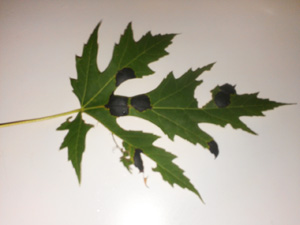 Question: we have several maple trees in our neighborhood afflicted with this black spot (see attached photo). What can we do to protect our maple trees?
Anwer: while it is difficult to confirm a diagnosis from photos alone it looks and could be a fungal disease called tar spot. The most common species are Rhytisma acerinum and R. punctatum. Symptoms first appear in late spring or early summer as infected leaves develop light green or yellow-green spots. During mid to late summer these produce black tar-like raised structures on the upper surface of leaves within the yellow spots. R. acerinum causes larger spots that are 0.5 to 2 cm in diameter; R.punctatum causes many small punctate spots that are smaller (about 1mm in diameter). Spots caused by R. punctatum are sometimes called speckled tar spots.
Tar spot is a common disease on silver maple and is primarily considered to be a cosmetic problem rather than a serious threat. The Purdue Plant and Pest Diagnostic Laboratory has additional information on tar spot including more photos and best treatment, Tar Spot on Maple.
To confirm a diagnosis, you can submit a sample directly to the Purdue Plant & Pest Diagnostic Lab (PPDL) or find a certified arborist to come to your property and access your tree.
Resources:
Large Spots on Maple Leaves that Look Like Tar, Purdue Extension News
Find an Arborist, International Society of Arboriculture
Diseases in Hardwood Tree Plantings, The Education Store, Purdue Extension’s resource center
Fifty Common Trees of Indiana
An Introduction to Trees of Indiana
Native Trees of the Midwest, The Education Store
Shrubs and Woody Vines of Indiana and the Midwest, The Education Store
Tree Installation: Process and Practices, The Education Store
Planting Your Tree Part 1: Choosing Your Tree, Video, Purdue Extension – Forestry & Natural Resource (FNR) YouTube Channel
Investing in Indiana Woodlands, The Education Store
Forest Improvement Handbook, The Education Store
ID That Tree, Purdue Extension-FNR YouTube playlist
Purdue Plant and Pest Diagnostic Laboratory
Diana Evans, Extension and Web Communication Specialist
Purdue University Department of Forestry and Natural Resources
Question: I have 2,700 young white oak and hickory trees that were planted in 2017 that now have black locust creeping in. Should I try to remove them by cutting them down and treating the stumps? What is the best treatment to control the brush?
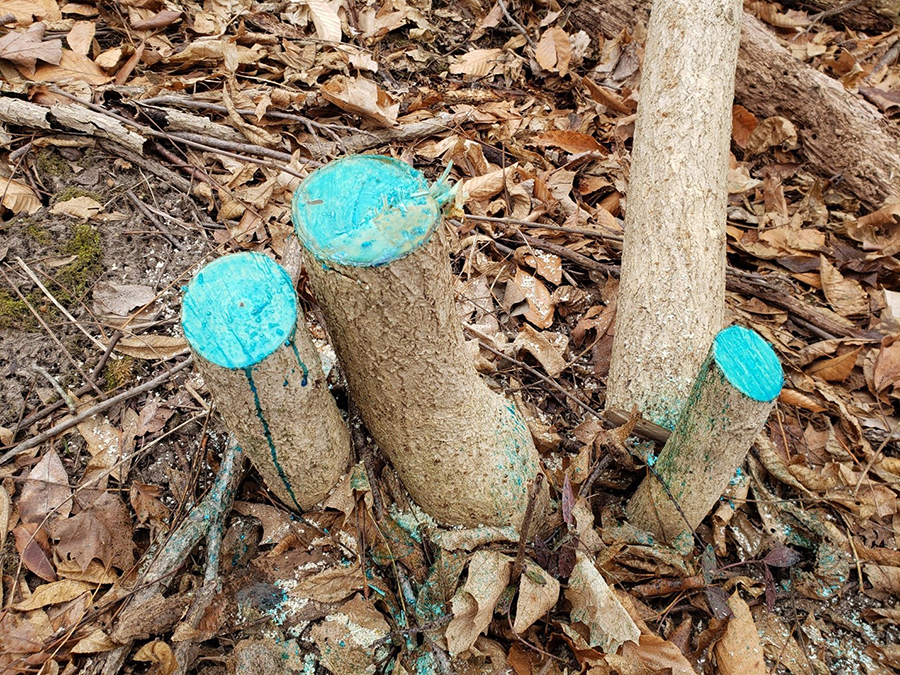
Cut stumps treated with herbicide including a dye to show application. Photo by Lenny Farlee.
Answer: Whether eliminating black locust competing with oaks in a tree planting, or controlling invasive woody shrubs like autumn-olive or Asian bush honeysuckles, cutting the stems near ground-line and treating the stumps with an appropriate herbicide provides a one-two punch to the target plant. Severing the stems from the roots cuts off the flow of photosynthesis-produced food to the roots, and may prevent production and ripening of seed, if done early enough in the growing season. The stump left behind provides a small target area for herbicide application, limiting the damage to nearby native plants that can result from foliar herbicide overspray and drift. The herbicide application should kill the roots and limit re-sprouting. While it requires two sequential operations, cutting and spraying, it may be one of the most efficient methods to control many smaller-diameter woody plants due to the high rate of control achieved when done correctly and limited damage to surrounding desirable vegetation.
So how do you do the “cut-stump” treatment correctly? Several factors need to be considered, but some common elements to effective and efficient treatments include a cutting tool you can operate safely, effective herbicide type and application, and correct timing for the site and situation. Tools can be powered by fuel or electric motors or by your muscles. Be sure you know how to operate them safely and wear appropriate safety gear. I prefer brush saws for near-ground cutting as it limits bending over and is safer to operate than a chainsaw, but they will struggle with some larger diameter or denser stems a chainsaw could cut easily. Handsaws, loppers, pruners, or blade-tools like machetes and brush-hooks are hand-tool options, but larger stems will require more time and effort to cut or will be too large for some hand-tools to handle. Herbicides should be applied immediately after you have cut off the stems. A good choice for many applications is herbicide containing the active ingredient Glyphosate. Glyphosate concentrate herbicides containing 42% or more active ingredient are widely available at many garden and farm stores. Read the label before using the herbicide to confirm the active ingredients, concentration, and requirements for safe and effective applications, including the appropriate safety gear during dispensing and application. Apply the concentrate straight or mixed with up to 50% water to the cut surface immediately after the cut is made. For stems over 3 to 4 inches in diameter, you can apply a band of spray around the perimeter of the stump so the bark, cambium and some sapwood is treated. If you wait to apply the spray to cut surfaces a dozen minutes to hours after the cut is made, two things will happen that can impact the effectiveness of the spray. The surface of the stump will seal as it dries, preventing the entry of the water/herbicide mixture into the plant. You may also have difficulty tracking down the cut stumps if the area is weedy and brushy.
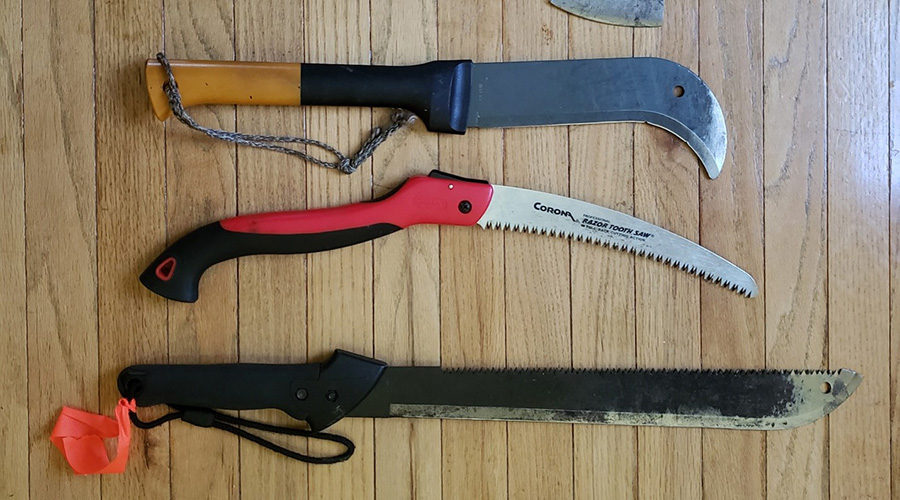
Hand-cutting tools suited for small diameter woody plants. Photo by Lenny Farlee.
Some cautions about timing and locations of this application method. Many plants are pumping lots of sap up from the roots in spring. That sap can flush herbicides out of the application area and result in herbicide failure and re-sprouting from the root system. If the stem is frozen, usually 25 degrees F or colder, herbicide may also not penetrate and evaporate off the frozen stump. Also avoid applications when rain could wash off the herbicide within two or three hours of application.
Several other herbicides are available for this treatment including Triclopyr and 2-4-D/Picloram herbicides. Be sure to read the labels and understand the safety requirements and application instructions before using.
For additional information see the Purdue Extension-FNR webinar Invasive Plants Threaten our Forests Part 2: Control and Management.
More resources:
District Forester, Indiana DNR Division of Forestry, for over 10 acres of woodlands
Directory of Professional Foresters, Indiana Forestry & Woodland Owners Association (IFWOA)
Indiana Woodland Steward E-newsletters, Eleven Member Organization
A Woodland Management Moment, Playlist, Purdue Extension – Forestry and Natural Resources (FNR) Youtube Channel
Conservation Tree Planting: Steps to Success, Purdue Extension – FNR Youtube Channel
Forest Improvement Handbook, The Education Store
Invasive Species, Playlist, Purdue Extension – FNR Youtube Channel
Woodland Stewardship for Landowners, Playlist, Purdue Extension – FNR Youtube Channel
Invasive Plant Species Identification, Video, Purdue Extension – FNR Youtube Channel
Report Invasive Species, Purdue Invasive Species
The GLEDN Phone App – Great Lakes Early Detection Network
EDDMaps – Early Detection and Distribution Mapping System
Indiana Department of Natural Resources: Invasive Species
Indiana Invasive Species Council
Cooperative Invasive Species Management Area (CISMA)
Invasive plants: impact on environment and people, The Education Store, Purdue Extension’s resource center
A Landowner’s Guide to Sustainable Forestry: Part 7: Managing for a Diversity of Value-Added Forest Products, The Education Store
Investing in Indiana Woodlands, The Education Store
Woodland Invaders, Got Nature? Blog, Purdue Extension – FNR
The Education Store, Purdue Extension’s resource center (place keywords in search bar, for ex: invasive, forest, timber)
Lenny Farlee, Extension Forester
Purdue University Department of Forestry and Natural Resources
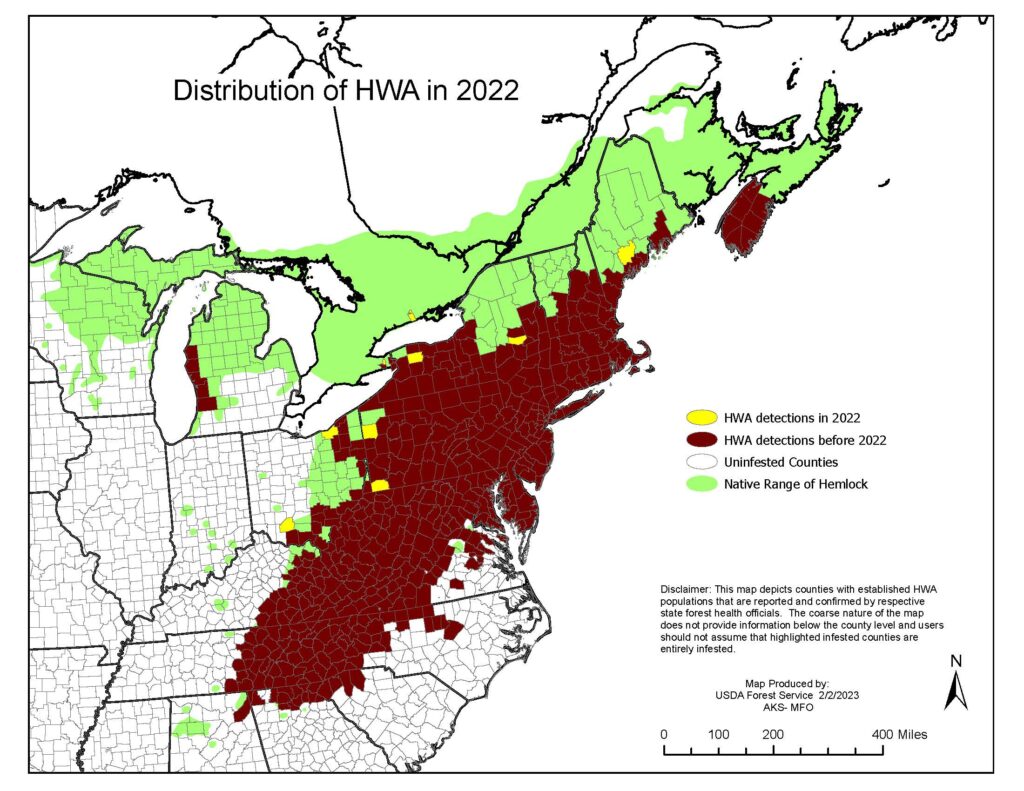
Photo of the distribution of hemlock woolly adelgid in 2022.
Purdue Landscape Report: The hemlock woolly adelgid (Adelges tsugae) continues its eastward spread across the US. In 2022, seven new counties were added to the distribution map of this invasive insect. While it is not present in Indiana yet, it is confirmed throughout the eastern USA from northern Georgia to Maine, extending west into Michigan, Ohio, and Kentucky.
Since its introduction in the 1950s, hemlock woolly adelgid has caused severe mortality of eastern hemlock in the United States. Not only is this a significant impact on our native tree diversity, hemlock losses are linked to a decline in several native bird species in the New England and mid-Atlantic forests (Ellison et al. 2018). In Indiana, eastern hemlock has a scattered native range in isolated locations of the west-central and southern regions of the state. It typically grows on steep slopes, canyons, and ravines. Hemlock woolly adelgid is also a threat to ornamental hemlocks, which are frequently used in landscaping.
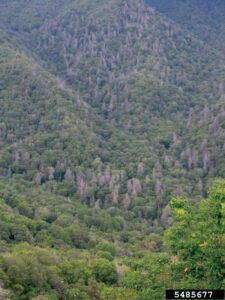
Photo of forest in hills, forest mortality, hemlock woolly adelgid.
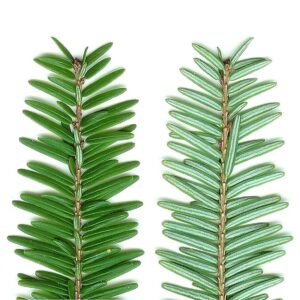
Photo of needles from eastern hemlock.
Identifying Eastern Hemlock
Hemlock woolly adelgid will only feed on hemlocks, so proper tree identification is crucial. If you’re not sure whether your conifer is hemlock, check the color, shape, and arrangement of the needles. The needles of eastern hemlock grow singly (not in clusters) in alternate or opposite positions. The needles are flattened, and have two white stripes on the underside. The cones are small (1-2 cm), and when dry, they can resemble a rosette.
Monitoring for Hemlock Woolly Adelgid
The white “wool” balls are the most tell-tale sign of this pest. Check the undersides of the branches at the base of the needles, and look for small, round, white cottony masses that cover the twig. These are actually the egg sacs of the hemlock woolly adelgid. You may also notice the “crawlers”, or the mobile nymphs, which are tiny, oval-shaped, reddish-brown insects.
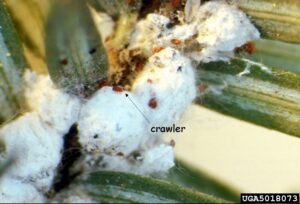
Photo of egg sacs of the hemlock woolly adelgid. These white “wool” balls are the most tell-tale sign of this pest.
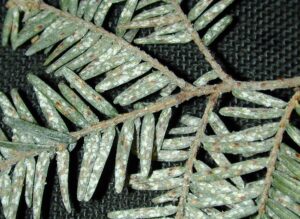
Photo of elongate hemlock scale with flattened white spots.
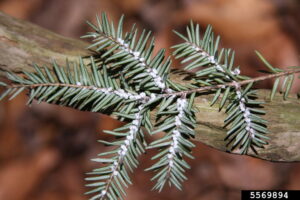
Photo of hemlock wooly adelgids with egg sacks along the twig.
If you frequently check hemlock trees, you may see other white spots that resemble the woolly adelgid. The cocoons of elongate hemlock scale are often confused with hemlock woolly adelgid. However, note how the white “spots” from the scale infestation are flattened and cover the needles. Hemlock wooly adelgids congregate at the base of the needles along the twig, not on the needles themselves, and the egg sacs are round in shape. Single, large egg sacs found throughout the branch are often spider egg sacs or oak skeletonizer cocoons.
Report any suspected findings of hemlock woolly adelgid at the Early Detection Distribution Map System (EDDMapS) website.
To view this original article and other Purdue Landscape Report articles, please visit Purdue Landscape Report.
Resources:
ID That Tree: Eastern Hemlock, video, Purdue Extension – Forestry and Natural Resources (FNR) YouTube Channel
Distinguishing Hemlock From Yew, The Purdue Landscape Report
Normal Needle Drop: Even Healthy Evergreens are not Evergreen, Purdue Plant & Pest Diagnostic Lab (PPDL)
Recognizing and Managing Poison Hemlock, Purdue Landscape Report
Be Careful Around Highly Toxic Poison Hemlock Plant This Summer, Purdue Extension – FNR
Phomopsis Dieback of Spruce, The Education Store, Purdue Extension resource center
Chlorosis of Pine Trees, The Purdue Landscape Report
Borers of Pines and Other Needle Bearing Evergreens in Landscapes, The Education Store
Stress-related Conifer Dieback, The Education Store
Certified Soil Testing Laboratories, Purdue Extension-Master Gardener Program
Tree Installation: Process and Practices, The Education Store
Planting Your Tree Part 1: Choosing Your Tree, video, Purdue Extension – FNR YouTube Channel
Tree Defect Identification, The Education Store
Shrubs and Woody Vines of Indiana and the Midwest, The Education Store
Tree Risk Management – Got Nature? Blog, Purdue Extension – FNR
Consumer Horticulture: Collecting Soil Samples for Testing, The Education Store
Find an Arborist website, Trees are Good, International Society of Arboriculture (ISA)
Purdue Pest and Plant Diagnostic Lab, send in photo or samples
Alicia Kelley, Cooperative Agricultural Pest Survey (CAPS) Coordinator
Purdue Extension – Entomology
This native Indiana shrub can be found on the edge of standing water and in wetlands. In this episode of ID That Tree, Purdue Extension forester Lenny Farlee introduces you to the buttonbush, which is known for its attractive round flowers in mid-summer, which are a favorite of pollinators, and its simple leaves, which are held in a whorled arrangement.
If you have any questions regarding wildlife, trees, forest management, wood products, natural resource planning or other natural resource topics, feel free to contact us by using our Ask an Expert web page.
Resources:
ID That Tree, Playlist, Purdue Extension – Forestry and Natural Resources YouTube Channel (Invasive White Mulberry, Siberian Elm, Tree of Heaven)
Invasive Species Playlist, Playlist, Purdue Extension – FNR YouTube Channel (Asian Bush Honeysuckle, Burning Bush, Callery Pear, Multiflora rose)
A Woodland Management Moment, Playlist, Purdue Extension – FNR YouTube Channel (Against Invasives, Garlic Mustard, Autumn Olive)
Woodland Stewardship for Landowners, Playlist, Purdue Extension – FNR YouTube Channel (Common Buckthorn, Japanese Barberry)
Report Invasive Species, Purdue Invasive Species
The GLEDN Phone App – Great Lakes Early Detection Network
EDDMaps – Early Detection and Distribution Mapping System
How long do seeds of the invasive tree, Ailanthus altissima remain viable? (Invasive Tree of Heaven), USDA Forest Service
Indiana Department of Natural Resources: Invasive Species
Indiana Invasive Species Council
Cooperative Invasive Species Management Area (CISMA)
Aquatic Invasive Species, Illinois-Indiana Sea Grant (IISG)
Episode 11 – Exploring the challenges of Invasive Species, Habitat University-Natural Resource University
What are invasive species and why should I care?, Got Nature? Blog, Purdue Extension – FNR
Shrubs and Woody Vines of Indiana and the Midwest, The Education Store, Purdue Extension Resource Center
Native Trees of the Midwest, The Education Store
Investing in Indiana Woodlands, The Education Store
Forest Improvement Handbook, The Education Store
Lenny Farlee, Extension Forester
Hardwood Tree Improvement and Regeneration Center
Purdue Department of Forestry & Natural Resources
Purdue Landscape Report: Some of the questions that I get asked quite frequently are “Are my trees ok?”, “Do I need to have an arborist come work on my trees?”, and “Is there anything I can do to help my trees without hurting my savings?”. Just like many questions, the answers are dependent on the situation. There are a multitude of cases where it is in the best interest of both you and the tree to hire a professional. From removals and storm damage, to pruning at height and/or around utilities, and other dangerous situations, you really should invest in the cost of a certified arborist. But there are instances where you can save some money and feel the pride of caring for your trees yourself by doing some of your own pruning work.
You might not think too much about pruning. Maybe you feel like “Hey! Anyone can cut off a branch”, and you’re right but also not. There is a right and wrong way to pruning and cleaning out dead wood. Depending on where you cut and how much you remove, you might end up doing more damage to your tree and end up requiring the assistance of an arborist earlier than needed. For the pruning layperson, there are several topics that can help you prune like a pro: safety, equipment, and proper pruning cuts.
First and foremost is safety. From this time of the year onward it’s only going to get hotter, but it’s important to protect your body from accidents with your tools, from the elements, and even from the plants you’re pruning by wearing the proper personal protective equipment (PPE). From the toes up, skilled professionals have their work boots (closed toed shoes), pants (not shorts), at the very least a t-shirt, gloves and safety glasses, and hearing and head protection depending on the equipment and scale of work. And if you’re using power equipment like chainsaws make sure you’ve got protective chaps for that added level of safety.
The standard equipment available for pruning includes hand pruners, loppers, and hand and pole saws (I’ll touch on chainsaws more in a later article). The two main types of pruners and loppers are called bypass and anvil styles. Bypass pruners have two blades that “bypass” each other like scissors, leaving clean cuts on your trees and shrubs. Anvil pruners have a single blade that shuts against a flat surface, the “anvil”, and can leave bruised or crushed plant material after cuts. Use your hand pruners for smaller cuts (up to 3/4” in diameter depending on the quality of your blade) and your loppers for larger diameters that might not require a hand saw.
When choosing a hand or pole saw, it is best to have one specifically designed for pruning. Pruning saws come in different configurations. They can be straight or curved, have fixed or folding blades, and come in different lengths and teeth sizes. A good rule of thumb is shorter blades or blades with smaller teeth for finer pruning cuts and longer blades with larger teeth for bigger diameter limbs (pole saws will usually have larger blades attached to single or extendable poles). You’ll also want a blade that isn’t so thin that it buckles on the first cut. For pruning at home, I recommend a 10-12” saw with medium sized teeth. That coupled with a hand pruner and some loppers should cover most of your pruning projects.
Now that you have your PPE and your pruning equipment you’ll want to begin cutting, but there are some considerations along with dos and don’ts for pruning. First, you want to decide what your goals are (raising the canopy off the ground or a building, thinning the crown to increase light and/or wind, or reducing the canopy by shortening limbs) and how much you need to remove from your tree (Fig. 1). In most cases, less is more. Whenever you remove plant material you are doing two things:
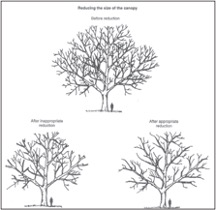
Figure 1a: Examples of canopy reduction, thinning, and raising (FNR-506-W).

Figure 1b: Examples of canopy reduction, thinning, and raising (FNR-506-W).
1) you are injuring the tree, exposing open cuts to pests, diseases, and the elements
2) you are removing plant material that could continue to create energy for the tree if left on.
Both will stress your tree and it will need time to adapt and heal. You can always remove more later, but once you make your cuts you cannot put them back. If your tree needs a heavier prune, it’s time to bring in an arborist.
Next you need to consider what are you cutting? Are you removing whole limbs back to the trunk or are you shortening limbs? If you are removing limbs you want to avoid flush cuts, cutting back even to the trunk. Flush cuts (Fig. 2) are usually oval and have a larger surface area exposing more of the tree to pests, diseases, and the elements. Instead, you want to cut up to the branch bark ridge, a raised portion of bark on the top of the limb where it meets the trunk, and the branch collar, usually a swollen area on the bottom side of the limb where it begins to flare out from the trunk (Fig. 3). This is a proper removal cut that has the smallest surface area exposed and is usually more circular than oval.
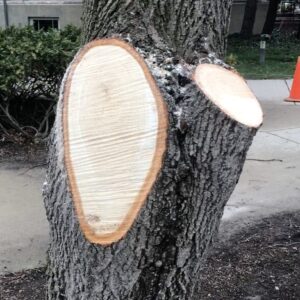
Figure 2: Examples of a flush cut (left) and a proper removal cut (right).
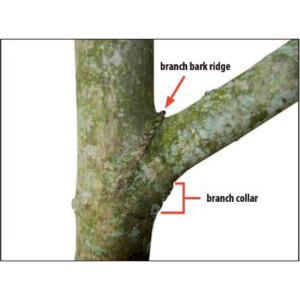
Figure 3: Identifying the branch bark ridge and the branch collar for proper removal cuts (FNR-506-W).
If you are shortening limbs you want to perform a reduction cut, which is removing a larger stem by cutting back to a lateral branch that is at least 1/3 the diameter of the portion you are removing (Fig. 4). This provides sufficient energy production the keep the remaining limb alive. In this situation, you want to avoid heading cuts, which are length reductions without regard to the position or diameter of the lateral branch you are cutting back too. Cutting too far away from the lateral will lead to dead stubs that increase exposure and the time needed to heal over wounds. Cutting to laterals that are too small won’t allow the limb to produce enough energy to survive.
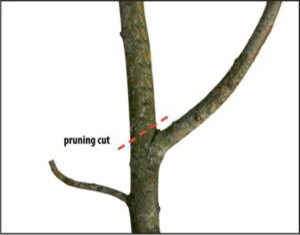
Figure 4: Correct placement of a reduction cut to an properly sized lateral branch (FNR-506-W).
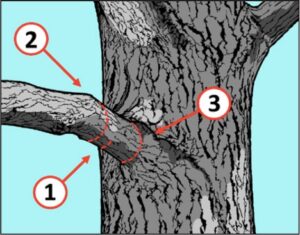
Figure 5: The 3-cut method for safe removal of limbs (FNR-506-W).
Last, whether you are applying removal or reduction cuts, you want to utilize what is called the ternary or 3-Cut Method (Fig. 5). The purpose of this method to stop damage from splitting and tear-outs in larger limbs that can’t be controlled by hand. The first cut is the undercut, about 1/3 the diameter of the limb and usually 6-12 inches from your final cut. The second cut is the top cut just outside the undercut. This cut continues down until it meets the same plane as the undercut where gravity will take hold as the branch snaps and falls. The final cut is to the branch collar, or the chosen lateral as noted above.
Proper pruning can be a daunting task at first. With time, the correct materials, and practice you can better care for your trees, your landscape, and yourself. If you are still worried about your trees, there are plenty of resources at Purdue Extension and The Education Store or you can always find an ISA Certified Arborist nearby using the Trees Are Good website. They will be able to help assess any other issues and provide excellent professional help.
Resources:
Tree Pruning Essentials, Video & Document
Tree Pruning for the Landscape Webinar, Purdue Extension – Forestry and Natural Resources (FNR) Youtube Channel
Tree Appraisal and the Value of Trees, The Education Store, Purdue Extension resource center
Tree Pruning: What Do Trees Think?, The Education Store
Mechanical Damage to Trees: Mowing and Maintenance Equipment, The Education Store
Tree Installation Process and Practices, The Education Store
Tree Planting Part 1: Choosing a Tree, The Education Store
Tree Planting Part 2: Planting Your Tree, The Education Store
Planting Problems: Planting Too Deep, Video, Purdue Extension – FNR Youtube Channel
Ben McCallister, Urban Forestry Specialist
Purdue Forestry and Natural Resources
In this episode of ID That Tree, Purdue Extension forester Lenny Farlee introduces the yellow buckeye. This native species, found in southeastern Indiana on high quality sites, features palmately compound leaves, like fingers on a hand, mostly featuring five leaflets with lighter colored undersides. This species is named for its yellow flower clusters, which appear in the spring. It holds its buckeye seeds in smooth husks, unlike its cousin Ohio buckeye, which has warts and spines.
If you have any questions regarding wildlife, trees, forest management, wood products, natural resource planning or other natural resource topics, feel free to contact us by using our Ask an Expert web page.
Resources:
ID That Tree, Playlist, Purdue Extension – Forestry and Natural Resources (FNR) YouTube Channel (Invasive White Mulberry, Siberian Elm, Tree of Heaven)
Invasive Species Playlist, Playlist, Purdue Extension – FNR YouTube Channel (Asian Bush Honeysuckle, Burning Bush, Callery Pear, Multiflora rose)
A Woodland Management Moment, Playlist, Purdue Extension – FNR YouTube Channel (Against Invasives, Garlic Mustard, Autumn Olive)
Woodland Stewardship for Landowners, Playlist, Purdue Extension – FNR YouTube Channel (Common Buckthorn, Japanese Barberry)
Yellow Buckeye, Native Trees of Indiana River Walk, Purdue University, Fort Wayne
Report Invasive Species, Purdue Invasive Species
The GLEDN Phone App – Great Lakes Early Detection Network
EDDMaps – Early Detection and Distribution Mapping System
How long do seeds of the invasive tree, Ailanthus altissima remain viable? (Invasive Tree of Heaven), USDA Forest Service
Indiana Department of Natural Resources: Invasive Species
Indiana Invasive Species Council
Cooperative Invasive Species Management Area (CISMA)
Aquatic Invasive Species, Illinois-Indiana Sea Grant (IISG)
Episode 11 – Exploring the challenges of Invasive Species, Habitat University-Natural Resource University
What are invasive species and why should I care?, Got Nature? Blog, Purdue Extension – FNR
Shrubs and Woody Vines of Indiana and the Midwest, The Education Store, Purdue Extension Resource Center
Native Trees of the Midwest, The Education Store
Investing in Indiana Woodlands, The Education Store
Forest Improvement Handbook, The Education Store
Lenny Farlee, Extension Forester
Hardwood Tree Improvement and Regeneration Center
Purdue Department of Forestry & Natural Resources
 Purdue Agriculture News – Purdue Extension has been selected to support a multistate effort to help rural, tribal and underserved communities access federal funding for energy and environmental improvement efforts.
The University of Minnesota will lead the effort as an Environmental Justice Thriving Communities Technical Assistance Center (TCTAC) for Region 5 with funding from the U.S. Environmental Protection Agency. Purdue Extension’s Community Development program will provide central support in Indiana to help communities navigate federal grant application systems, identify partners and matching funds, and assist with project design and development.
“Purdue Extension is positioned well to connect with rural and underserved communities across Indiana with staff in all 92 counties,” said Kara Salazar, assistant program leader for Purdue Extension Community Development and sustainable communities extension specialist. “We look forward to working with regional partners as a liaison for communities in need of resources to assist with clean energy and water, affordable and sustainable housing, and addressing legacy pollution.”
Additional partners in Indiana include the North Central Regional Center for Rural Development (NCRCRD), Illinois-Indiana Sea Grant and Purdue Center for Regional Development (PCRD).
Michael Wilcox, associate director of NCRCRD and assistant director and program leader of Purdue Extension Community Development, welcomes interested community partners to reach out to get involved.
“We look forward to connecting with communities across the state while collaborating with our partners across the EPA Region 5. This is another excellent example of states within the north central region working together as partners to address pressing issues while fostering community resilience,” he added.
“Illinois-Indiana Sea Grant is enthusiastic to build on our ongoing programs as we partner on this broad project to help support underserved coastal communities around southern Lake Michigan and throughout the Great Lakes in addressing environmental challenges,” said Tomas Höök, director of Illinois-Indiana Sea Grant and professor in Purdue University’s Department of Forestry and Natural Resources.
Resources:
Implementation Examples of Smart Growth Strategies in Indiana, The Education Store, Purdue Extension’s resource center
Conservation Through Community Leadership, The Education Store
Community Development, Purdue Extension
Conservation Through Community Leadership, video, Purdue Extension You Tube Channel
Rainscaping Education Program, Purdue Extension
Rainscaping and Rain Gardens, Purdue Extension YouTube Channel
Enhancing the Value of Public Spaces, The Education Store
Enhancing the Value of Public Spaces: Creating Healthy Communities, The Education Store
Enhancing the Value of Public Spaces Program, video, Purdue Extension YouTube Channel
Community Planning Playlist, Purdue Extension-Forestry & Natural Resources (FNR) YouTube Channel
Indiana Creek Watershed Project – Keys to Success, Partnerships and People, Subscribe to Purdue Extension-FNR YouTube Channel
Abby Leeds, Senior Communications Specialist
Purdue Agricultural Communications
Michael Wilcox, Associate Director & Program Leader
North Central Regional Center for Rural Development (NCRCRD) & Purdue Extension Community Development
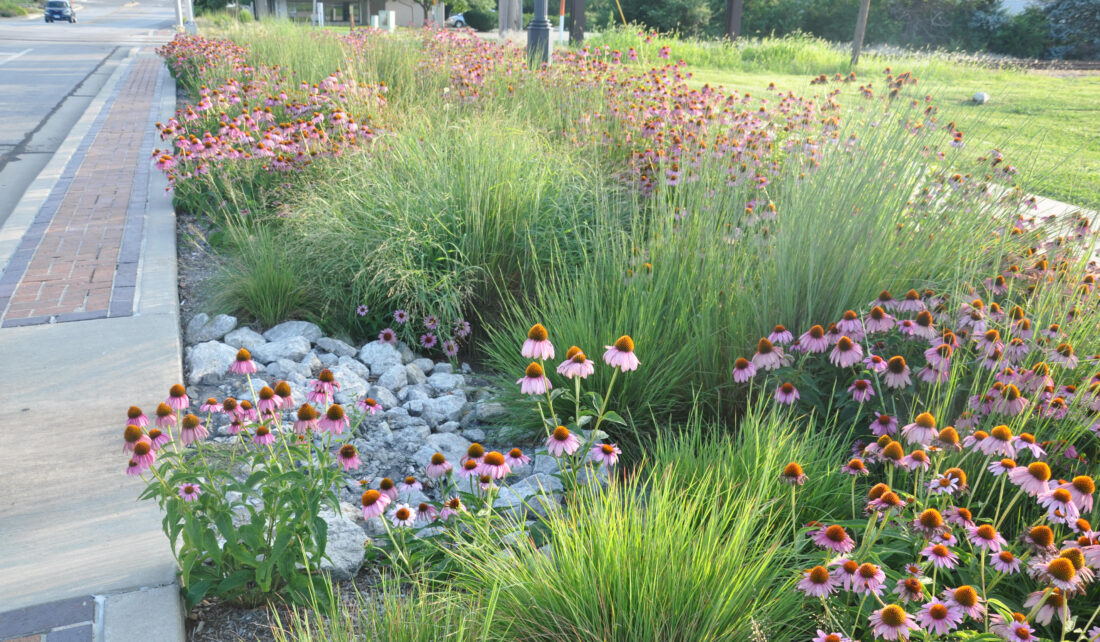 Illinois-Indiana Sea Grant Newsroom – During large rainstorms, many Illinois residents brace themselves for flooding in their basements, streets and neighborhoods. A new online tool, Illinois Groundwork, provides communities and stormwater professionals with resources on green stormwater infrastructure, which provides a way for rain to be absorbed into soil where it lands.
Green stormwater infrastructure offers a way to enhance traditional or “grey” infrastructure using a rain garden or permeable pavement but this approach doesn’t always work as well as it might. Improving access to, and use of, data, research and other resources can help increase the effectiveness of green infrastructure in addressing stormwater management challenges.
“The University of Illinois not only has relevant research and data across many departments, but also real-world examples of successful green infrastructure, along with other extension and education tools, such as the Red Oak Rain Garden,” said C. Eliana Brown, University of Illinois Extension stormwater specialist. “This new tool brings these resources together, providing a robust platform to access green infrastructure knowledge.”
The project is a collaboration of Illinois–Indiana Sea Grant and Illinois Extension. A critical component of Illinois Groundwork is an Illinois-Indiana Sea Grant (IISG)-funded research project that focused on incorporating soils data into green infrastructure design. Soils are the foundation of effective green stormwater infrastructure performance.
“Soil characteristics establish how much and how fast water can move through and absorb into the soil,” explained Margaret Schneemann, IISG water resource economist. “Failing to take soils performance into account means we are not designing green infrastructure as cost-effectively as we could be and may be leaving its benefits on the table.”
Illinois-Indiana Sea Grant is a partnership between NOAA, University of Illinois Extension, and Purdue University Forestry and Natural Resources, bringing science together with communities for solutions that work. Sea Grant is a network of 34 science, education and outreach programs located in every coastal and Great Lakes state, Lake Champlain, Puerto Rico and Guam.
More Resources:
Implementation Examples of Smart Growth Strategies in Indiana, The Education Store, Purdue Extension’s resource center
Conservation Through Community Leadership, The Education Store
Conservation through Community Leadership, Purdue Extension You Tube Channel
Rainscaping Education Program, Purdue Extension
Rainscaping and Rain Gardens, Purdue Extension YouTube Channel
Enhancing the Value of Public Spaces, The Education Store
Enhancing the Value of Public Spaces: Creating Healthy Communities, The Education Store
Enhancing the Value of Public Spaces Program, Purdue Extension YouTube Channel
One Water Approach to Water Resources Management, The Education Store
Community Development, Purdue Extension
Community Planning Playlist, Purdue Extension-Forestry & Natural Resources (FNR) YouTube Channel
Indiana Creek Watershed Project – Keys to Success, Partnerships and People, Subscribe to Purdue Extension-FNR YouTube Channel
Climate Change and Sustainable Development, The Education Store
Climate Change: Are you preparing for it?, The Education Store
Everyone experiences phenology. What is phenology and how can observing plant and animal life cycle stages help us understand changes in climate, water, light and other abiotic factors? In this webinar hosted by Indiana Forestry & Woodland Owners Association (IFWOA), presenter Amanda Wanless of Indiana Phenology explains what phenology is and how each season is unique. Phenology includes the leafing and flowering, the ripening of crops in the fields, the emergence of insects, the migration of birds and much more. Amanda discusses how you can observe seasonal change on the landscape, and ways to monitor on your own or join a citizens science network collecting long term data.
Check out the Indiana Forestry & Woodland Association YouTube Channel for videos including: What is IFWOA?; A New Carbon Program for Hardwood Landowners Webinar, Indiana’s Native Orchids, Magnificent Trees of Indiana, Be Tick Aware and much more.
The Indiana Forestry & Woodland Owners Association (IFWOA) was founded in 1977 and is a non-profit organization dedicated to conservation and sustainable management of woodlands in Indiana. IFWOA advocates for scientific best practices for management to achieve objectives of clean water, wildlife habitat, soil protection, native species diversity, timber production, recreation, carbon sequestration and many others.
IFWOA is an affiliate of the National Woodland Owners Association. IFWOA is a partner, collaborator or is represented on leading National and State organizations. These memberships or collaborations are selected to advance Indiana Woodland owner’s interests. IFWOA monitors and influences legislation and economic trends impacting Indiana woodlands and landowners for our members. Membership in IFWOA provides a valuable network linkage to information and resources at the leading edge of science, industry and politics impacting Indiana woodlands.
Resources:
Magnificent Trees of Indiana, Purdue University Press
Forest Improvement Handbook, The Education Store, Purdue Extension’s resource center
Planting Hardwood Seedlings – The Education Store
Ordering Seedlings from the State Forest Nursery System, Got Nature? – Purdue Extension-FNR
Importance of Hardwood Tree Planting – The Education Store, Purdue Extension Resource Center
Forest Improvement Handbook – The Education Store
Designing Hardwood Tree Plantings for Wildlife – The Education Store
ID That Tree – YouTube Playlist
Forest Management for Reptiles and Amphibians: A Technical Guide for the Midwest, The Education Store
Hardwood Ecosystem Experiment – Forest Birds , Purdue Extension – FNR YouTube Channel
Managing Woodlands for Birds , Purdue Extension – FNR YouTube Channel
Sustaining Our Oak-Hickory Forests , Purdue Extension – FNR YouTube Channel
Ask the Expert: Hardwood Ecosystem Experiment – Birds and Salamander Research, Purdue Extension – FNR
Subscribe to Purdue Extension-FNR YouTube Channel
Liz Jackson, Engagement Lead
Indiana Forestry & Woodland Association

Recent Posts
- Popular Landscape Shrub is Invasive
Posted: October 15, 2026 in Alert, Forestry, Forests and Street Trees, Invasive Plant Species, Plants, Woodlands - Purdue Extension’s Regional Teams Are Here: Connecting Communities with Expertise and Opportunity
Posted: October 14, 2026 in Community Development, Forestry, Forests and Street Trees, Gardening, How To, Timber Marketing, Urban Forestry, Wildlife, Woodlands - Why Do Our Trees Go From Green Leaves to Different Colors?
Posted: in Forestry, Forests and Street Trees, Urban Forestry, Woodlands - Deer and Turkey Archery Seasons Opening Soon, MyDNR
Posted: October 13, 2026 in Alert, Safety, Wildlife - Distinguishing Dogwoods
Posted: in Forestry, Urban Forestry, Wildlife, Woodlands - It’s Not Too Early To Start Planning For Spring Tree Planting
Posted: in Forestry, How To - Can I Plant Trees in the Fall?
Posted: October 12, 2026 in Forestry, How To, Land Use, Plants, Urban Forestry, Wildlife - Burning for Benefits: Why Fire Belongs in Indiana
Posted: in Forestry, Safety, Woodlands - Publication Helps Midwest Fish Producers “Catch a Following” with Consumers
Posted: in Aquaculture/Fish, Aquatic/Aquaculture Resources, Wildlife - Disease May Cause Wilting and Eventual Death of Certain Trees and Shrubs, Purdue Landscape Report
Posted: October 5, 2026 in Disease, Forestry, Plants
Archives
Categories
- Alert
- Aquaculture/Fish
- Aquatic/Aquaculture Resources
- Ask the Expert
- Christmas Trees
- Community Development
- Disease
- Drought
- Forestry
- Forests and Street Trees
- Gardening
- Got Nature for Kids
- Great Lakes
- How To
- Invasive Animal Species
- Invasive Insects
- Invasive Plant Species
- Land Use
- Natural Resource Planning
- Nature of Teaching
- Plants
- Podcasts
- Ponds
- Publication
- Safety
- Spiders
- Timber Marketing
- Urban Forestry
- Webinar
- Wildlife
- Wood Products/Manufacturing
- Woodland Management Moment
- Woodlands