 Purdue University - Extension - Forestry and Natural Resources
Got Nature? Blog
Biologists with the Indiana Department of Natural Resources (DNR) and Purdue University recently documented a very young hellbender salamander, a gilled larva, in the Blue River while conducting routine surveys in south-central Indiana. This discovery is significant because over the past three to four decades, only adult hellbenders have been documented in the Blue River. The presence of a young salamander suggests that conservation efforts and rearing programs are accomplishing their goals for the recovery of this endangered species.
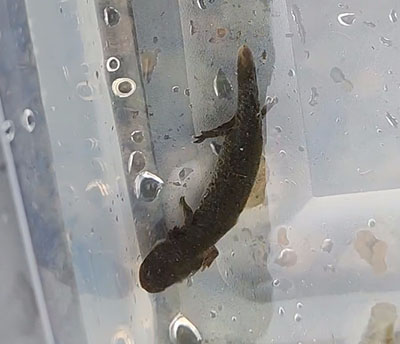
The hellbender (Cryptobranchus alleganiensis) is a large, fully aquatic salamander. Hellbenders do not reach sexual maturity until they are 7-8 years old and require specific habitats to thrive and reproduce. Their decline statewide has been documented as far back as the early-to-mid 1900s as a result of habitat loss and poor water quality. Hellbenders play an important role in aquatic ecosystems and are indicators of clean water.
“Finding hellbender larvae is a huge benchmark of the program’s success,” said DNR’s Nate Engbrecht, the state herpetologist. “It tells us that there has been successful breeding, hatching, and recruitment in the wild. It’s a wonderful sign that captive-reared and released hellbenders are doing what we want them to do at this site.”
The hellbender found by Engbrecht and Purdue hellbender program coordinator Nick Burgmeier was a gilled larva measuring 6.5 centimeters in total length with a 5 centimeter snout-vent length. Based on its size, this animal is estimated to be eight months old.
While hellbender larvae may have been found by fisherman while seining over the years, none have been officially reported to the state herpetologist or to fisheries biologists of the Indiana DNR. The last documented juvenile was reported by William H. Kern Jr. in 1983.
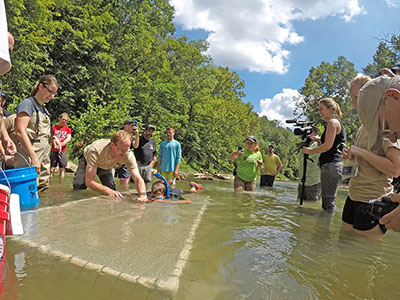
In the event anglers accidentally hook a hellbender, they are reminded to cut the line, let the salamander go unharmed and report the sighting to a natural resource professional.
The importance of the larval sighting is that it shows that the Help the Hellbender partnership’s conservation efforts, breeding and rearing programs are trending in a positive direction.
“Our early research on the lack of reproduction and recruitment indicated it was most likely the result of low population numbers,” said Dr. Rod Williams, director of the Help the Hellbender lab at Purdue. “For the past 12 years, Purdue and zoo partners have worked tirelessly to rear and release animals back into the wild, increase population sizes, and ultimately the chance for natural breeding. This finding, the result of nearly two decades of collective effort, signifies a milestone for our conservation program. While we have much left to do, we have evidence our approach is working.”
The Indiana Hellbender Partnership is a collaboration between the Indiana DNR and Purdue University with funding support from the Indiana DNR Nongame Wildlife Fund, U.S. Fish & Wildlife Service, and partners in local governments, universities, non-governmental organizations, and zoos that are working to recover the state-endangered hellbender. Developed over 15 years, the Indiana Hellbender Partnership is the largest and most comprehensive group working to recover an imperiled amphibian in Indiana.
For full article please visit 2023 FNR News and Stories: Researchers Discover Young Hellbender in Blue River.
Resources:
Help the Hellbender website
Help the Hellbender Facebook page
Ask the Expert: Learn All About Hellbenders and Take a Tour, Subscribe Purdue Extension – Forestry & Natural Resources (FNR) YouTube Channel
Ask the Expert video: Help the Hellbender – Dr. Stephen Spear of The Wilds, Purdue Extension – FNR YouTube Channel
Ask the Expert video: Live with Mesker Park Zoo and Botanical Gardens – Hellbenders, Purdue Extension – FNR YouTube Channel
A Moment in the Wild video: Hellbender Hide, Purdue Extension – FNR YouTube Channel
A Moment in the Wild video: Release Moment of Hellbenders,
How Anglers and Paddlers Can Help the Hellbender video, Purdue Extension – FNR YouTube Channel
Eastern Hellbender ID Video, Purdue Extension – FNR YouTube Channel
Hellbenders Rock!, The Education Store, Purdue Extension’s resource center
Help the Hellbender, North America’s Giant Salamander, The Education Store
How Our Zoos Help Hellbenders, The Education Store
The Nature of Teaching: Adaptations for Aquatic Amphibians, The Education Store
Healthy Water, Happy Home – Lesson Plan, The Education Store
Purdue Expert: Hellbender Salamander, Purdue University News YouTube Channel
FNR Assists in First Natural Breeding of Eastern Hellbender in Captivity, Purdue FNR News & Stories
Helping the Hellbender: Mesker Park Zoo Begins Captive Breeding Efforts, Purdue Agriculture News
Indiana Department of Natural Resources (IN DNR)
MyDNR, Indiana’s Outdoor Newsletter: The latest Hunting Guide for 2023-2024 is available. The Division of Fish & Wildlife is excited to show off the many methods and precautions needed to be successful during hunting season.
The 2023-2024 Indiana Hunting & Trapping Guide is essential in making sure you are hunting legally and safely, as it provides information on what, when, where, why, and how to hunt properly.
Indiana hunting and trapping opportunities include: deer, wild turkey, furbearers, small game, waterfowl and migratory birds along with other game birds. For licenses, where to hunt, and more information view: Hunting and Trapping, IN DNR, Department of Fish and Wildlife.
To subscribe to the newsletter visit MyDNR Email Newsletter.
Explore the outdoors with Indiana Department of Natural Resources in their 24 state parks, Indiana State Parks and Lakes.
Resources:
How to Score Your White-tailed Deer, video, The Education Store, Purdue Extension Resource Center
White-Tailed Deer Post Harvest Collection, video, The Education Store
Age Determination in White-tailed Deer, video, The Education Store
How to Build a Plastic Mesh Deer Exclusion Fence, The Education Store
Managing Your Woods for White-Tailed Deer, The Education Store
Bovine Tuberculosis in Wild White-tailed Deer, The Education Store
Help With Wild Turkey Populations, Video, Purdue Extension – Forestry and Natural Resources YouTube Channel
Turkey Brood Reporting, Indiana Department of Natural Resources (IDNR)
Wild Turkey, Indiana Department of Natural Resources (IDNR)
Wild Turkey Hunting Biology and Management, Indian Department of Natural Resources (IDNR)
Subscribe to Purdue Extension-Forestry & Natural Resources YouTube Channel, Wildlife Playlist
Indiana Department of Natural Resources, Department of Fish & Wildlife
In this episode of ID That Tree, Purdue Extension forester Lenny Farlee introduces the White Spruce. This species is found in the North Woods of Northern Wisconsin and the Upper Peninsula of Michigan. This species has single needles attached to the twig that tend to be relatively angular and stout. The bark tends to be flaky and dark. The cones are two to three inches in length, have thin scales, and are cylindrical in shape.
If you have any questions regarding wildlife, trees, forest management, wood products, natural resource planning or other natural resource topics, feel free to contact us by using our Ask an Expert web page.
Resources:
ID That Tree, Playlist, Purdue Extension – Forestry and Natural Resources YouTube Channel (Invasive White Mulberry, Siberian Elm, Tree of Heaven)
Invasive Species Playlist, Playlist, Purdue Extension – FNR YouTube Channel (Asian Bush Honeysuckle, Burning Bush, Callery Pear, Multiflora rose)
A Woodland Management Moment, Playlist, Purdue Extension – FNR YouTube Channel (Against Invasives, Garlic Mustard, Autumn Olive)
Woodland Stewardship for Landowners, Playlist, Purdue Extension – FNR YouTube Channel (Common Buckthorn, Japanese Barberry)
Report Invasive Species, Purdue Invasive Species
The GLEDN Phone App – Great Lakes Early Detection Network
EDDMaps – Early Detection and Distribution Mapping System
How long do seeds of the invasive tree, Ailanthus altissima remain viable? (Invasive Tree of Heaven), USDA Forest Service
Indiana Department of Natural Resources: Invasive Species
Indiana Invasive Species Council
Cooperative Invasive Species Management Area (CISMA)
Aquatic Invasive Species, Illinois-Indiana Sea Grant (IISG)
Episode 11 – Exploring the challenges of Invasive Species, Habitat University-Natural Resource University
What are invasive species and why should I care?, Got Nature? Blog, Purdue Extension – FNR
Shrubs and Woody Vines of Indiana and the Midwest, The Education Store, Purdue Extension Resource Center
Native Trees of the Midwest, The Education Store
Investing in Indiana Woodlands, The Education Store
Forest Improvement Handbook, The Education Store
Lenny Farlee, Extension Forester
Hardwood Tree Improvement and Regeneration Center
Purdue Department of Forestry & Natural Resources
Purdue Landscape Report: I have lost count of the number of times I’ve witnessed people working with chainsaws in shorts, a tank top, and flip flops with maybe a pair of earbuds, and it makes me cringe every time. According to the CDC, over 36,000 chainsaw-related injuries a year are reported with annual medical costs of more than $350 million (Johnson, 2023). Wearing the proper personal protective equipment (PPE) can help prevent accidents and injuries (Fig. 1). PPE is there to protect you from head to toe and if you are investing in a chainsaw, it doesn’t take much more to invest in the proper PPE. Including a work shirt and pants, if you’re using a chainsaw you should wear protection for your head, eyes and ears, hands, legs, and feet, most of which can be found at your local hardware store or home center.
Protecting your head means using a helmet, not a baseball cap or bandanna. Depending on the type of work you’re doing there is a risk of being struck by wood or branches or if kickback occurs, sending the chainsaw back towards your head. Safety glasses will help keep sawdust and other debris out of your eyes and should be stamped with Z87.1, showing they conform to ANSI safety regulations. Normal glasses and sunglasses are not rated for being struck and can shatter, sending broken lenses into your eyes. Ear protection can be in the form of plugs or muffs and should be rated to reduce noise to appropriate levels when worn properly.
Most modern chainsaws have built-in anti vibration technology to reduce fatigue, but having a nice pair of work gloves will still help to protect your hands and grip. Gloves will help protect against debris and are also good to wear for chainsaw maintenance. Although not about PPE, another note on protecting your hands when operating a chainsaw includes the proper use of the chain brake. Injuries can occur on the right hand because operators will remove it from the back handle to activate the chain brake with the palm of their hand and miss it, putting their hand on the still moving chain. Injuries on either hand can happen when one handing a saw while using your other hand to brace or manage what you are cutting and losing control. The chain brake is designed to be engaged by popping your left wrist forward while maintaining a grip with both hands on the handles.
To protect your legs some form of chaps or chap pants are needed. Prices can range from around $40 for a pair of wrap-chaps that can be worn over your work pants up to around $400 for a high-end pair of chap pants that are a stand-alone work pant replacement. Whichever you choose to wear, the protection should be from the top of your thigh to the top of your foot and wrap around your calf. Care should be taken to keep them clean from gas and oil and if they are ever damaged by a chainsaw, chaps should be discarded and replaced. Once the protective material has been damaged the safety has been compromised. Chainsaw boots are also available to protect your lower legs and feet but are expensive and can be heavy. A sturdy work boot should be worn at the very least while staying alert to how close the chainsaw is coming to you. And please, no open-toed shoes.
Whatever the task, if you are going to do your own chainsaw work, then I implore you to wear your PPE from head to toe. I know it’s hot and can get uncomfortable, but all it takes is one mistake to send you to the ER. If you feel the job is beyond your capabilities you can always contact an ISA certified arborist at Find an Arborist through the treesaregood.org website.
To view this full article and other Purdue Landscape Report articles, please visit Purdue Landscape Report.
Subscribe and receive the newsletter: Purdue Landscape Report Newsletter.
Resources:
The Purdue Landscape Report
A Woodland Management Moment, Playlist, Purdue Extension – Forestry and Natural Resources (FNR) Youtube Channel
Conservation Tree Planting: Steps to Success, Purdue Extension – FNR Youtube Channel
Forest Improvement Handbook, The Education Store
Find an Arborist website, Trees are Good, International Society of Arboriculture (ISA)
Caring for storm-damaged trees/How to Acidify Soil in the Yard – In the Grow, Purdue Extension
Moist soil and rotten roots makes it easy for trees to come crashing down – Fox 59 News
Tree Risk Management – The Education Store, Purdue Extension’s resource center
Mechanical Damage to Trees: Mowing and Maintenance Equipment – The Education Store
Trees and Electric Lines – The Education Store
Tree Support Systems, The Education Store
Corrective Pruning for Deciduous Trees, The Education Store
Tree Installation: Process and Practices, The Education Store
Ben McCallister, Urban Forestry Specialist
Purdue Forestry & Natural Resources
Purdue Landscape Report: Poison hemlock was introduced to North America as a garden/ornamental plant. It is a native of Europe, and it is a member of the Apiaceae (parsley) family.
Purdue experts Bill Johnson and Marcelo Zimmer wrote about poison hemlock in a Purdue Pest & Crop newsletter.
They wrote that poison hemlock can be noticed very early in the spring every year, as it is typically one of the first weeds to green up, usually in late February to early March if temperatures are favorable. They said the largest threat of this weed is the toxicity of its alkaloids if ingested by livestock or humans, but it can also reduce the aesthetic value of landscapes and has been reported to creep into no-till corn and soybean fields as well.
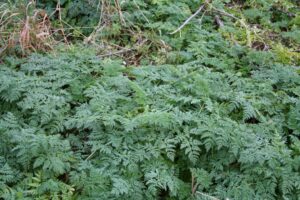
Poison Hemlock
Purdue Extension’s fact sheet on poison hemlock states that it can also be found along roads, streams, trails, ditches, forest edges, and waste areas.
The Purdue experts said that poison hemlock is a biennial weed that exists as a low-growing herb in the first year, and bolts to three to eight feet tall in the second year, when it produces flowers and seed. It is often not noticed until the bolting and reproductive stages of the second year. Poison hemlock is often confused with wild carrot, but can be distinguished by its lack of hairs and purple blotches that occur on the stems.
The experts pointed out that poison hemlock contains five alkaloids that are toxic to humans and livestock, and it can be lethal if ingested. They warn that the plant’s alkaloids may also be absorbed through the skin, so if you find yourself hand-pulling poison hemlock, it would be a good idea to wear gloves. All parts of the plants contain the toxic alkaloids with levels being variable throughout the year. Symptoms of toxicity include nervousness, trembling, and loss of coordination followed by depression, coma, and/or death. Initial symptoms will occur within a few hours of ingestion.
For history buffs, the Greek philosopher Socrates was sentenced to death by hemlock poisoning.
Cases of poisoning due to poison hemlock ingestion are rare as the plants emit a mousy odor that makes it undesirable and unpalatable to livestock and humans. Consumption and toxicity in animals usually occur in poorly managed or overgrazed pastures where animals are forced to graze poison hemlock because desirable forage is lacking.
To view this full article and other Purdue Landscape Report articles, please visit Purdue Landscape Report.
Subscribe and receive the newsletter: Purdue Landscape Report Newsletter.
Resources:
Recognizing and Managing Poison Hemlock, Purdue Landscape Report
Purdue Pest & Crop Newsletter
Invasive Plant Species Fact Sheets: Poison Hemlock, The Education Store, Purdue Extension Resource Center
Hemlock Woolly Adelgid: Distribution Update, Purdue Landscape Report
Be Careful Around Highly Toxic Poison Hemlock Plant This Summer, Purdue Extension – Forestry and Natural Resources (FNR)
Poison Hemlock (Conium maculatum), United States Department of Agriculture (USDA)
Invasive plants: impact on environment and people, The Education Store, Purdue Extension’s resource center
Woodland Management Moment: Invasive Species Control Process, Video, Purdue Extension – Forestry and Natural Resources (FNR) YouTube Channel
Invasive Species, Playlist, Purdue Extension – FNR YouTube Channel
What are invasive species and why should I care?, Got Nature? Blog, Purdue Extension – FNR
Report Invasive, Purdue College of Agriculture – Entomology
Purdue Pest and Plant Diagnostic Lab, send in photo or sample
John Woodmansee, Extension Educator, Whitely County
Purdue Extension
In this webinar hosted by Indiana Forestry & Woodland Owners Association, ecologist Michael Homoya discusses the many naturally occurring species of orchids in Indiana and their range, habitats and blooming seasons. This presentation will look at a selection of them and discuss their floral characteristics as well as range, habitat, and blooming seasons. Michael Homoya served as Botanist/Plant Ecologist for the Indiana Department of Natural Resources, Division of Nature Preserves for 37 years before retiring in 2019. He has written over 75 scientific papers, popular articles, and books about Indiana’s natural features, including Orchids of Indiana, Wildflowers and Ferns of Indiana Forests: A Field Guide, Wake Up, Woods, and Wildflowers of the Midwest.
Check out the Indiana Forestry & Woodland Association YouTube Channel for videos including: What is IFWOA?; A New Carbon Program for Hardwood Landowners Webinar, Indiana’s Native Orchids, Magnificent Trees of Indiana, Be Tick Aware and much more.
The Indiana Forestry & Woodland Owners Association (IFWOA) was founded in 1977 and is a non-profit organization dedicated to conservation and sustainable management of woodlands in Indiana. IFWOA advocates for scientific best practices for management to achieve objectives of clean water, wildlife habitat, soil protection, native species diversity, timber production, recreation, carbon sequestration and many others.
IFWOA is an affiliate of the National Woodland Owners Association. IFWOA is a partner, collaborator or is represented on leading National and State organizations. These memberships or collaborations are selected to advance Indiana Woodland owner’s interests. IFWOA monitors and influences legislation and economic trends impacting Indiana woodlands and landowners for our members. Membership in IFWOA provides a valuable network linkage to information and resources at the leading edge of science, industry and politics impacting Indiana woodlands.
Resources:
Orchids of Indiana, Google Books
Wildflowers and Ferns of Indiana Forests: A Field Guide, Google Books
Wildflowers of the Midwest, Google Books
Magnificent Trees of Indiana, Purdue University Press
Forest Improvement Handbook, The Education Store, Purdue Extension’s resource center
Planting Hardwood Seedlings – The Education Store
Ordering Seedlings from the State Forest Nursery System, Got Nature? – Purdue Extension-FNR
Importance of Hardwood Tree Planting – The Education Store, Purdue Extension Resource Center
Forest Improvement Handbook – The Education Store
Designing Hardwood Tree Plantings for Wildlife – The Education Store
ID That Tree – YouTube Playlist
Forest Management for Reptiles and Amphibians: A Technical Guide for the Midwest, The Education Store
Hardwood Ecosystem Experiment – Forest Birds , Purdue Extension – FNR YouTube Channel
Managing Woodlands for Birds , Purdue Extension – FNR YouTube Channel
Sustaining Our Oak-Hickory Forests , Purdue Extension – FNR YouTube Channel
Ask the Expert: Hardwood Ecosystem Experiment – Birds and Salamander Research, Purdue Extension – FNR
Subscribe to Purdue Extension-FNR YouTube Channel
Liz Jackson, Engagement Lead
Indiana Forestry & Woodland Association
Before embarking on a 40-plus year career guiding students and constituents across the state on the topics of timber tax and forest economics, becoming known as the Purdue Forestry and Natural Resources historian or pitching in on various community projects to promote forest maintenance and recreation, Dr. Bill Hoover began his career of service in the U.S. Army Corps of Engineers as a basic training officer and later a combat engineering battalion operations officer in Vietnam.
Hoover grew up with military men on both sides of his family and was mentored by several World War II veterans as a member of the Boy Scouts.
“Most of my Boy Scout leaders took it as their role to prepare us for military service,” Hoover explained. “Attending Penn State, a land grant college, meant I was required to take ROTC courses and drills for two years. Advanced ROTC seemed like the logical choice since serving as an officer was better than as an enlisted grunt.”
After graduating from Penn State in December 1966 with his bachelor’s degree in forest management and a commission as a second lieutenant reserve officer in the U.S. Army, Hoover reported for training in Ft. Belvoir, Virginia, where he learned to be a combat engineer junior officer. From there, he moved on to Ft. Lewis, Washington, where he taught classes on all phases of military life and supervised enlisted officers, and finally to the Mojave Desert, where he participated in training evaluation. Just after Christmas in 1967, Hoover deployed to Vietnam as a combat engineer in the 39th engineer battalion, 18th engineer brigade.
Just over a year later, Hoover returned home on Dec. 29, 1968, and was relieved from active duty two weeks later. Months later, he was awarded a Bronze Star for Meritorious Service for his efforts, which included everything from construction of bunkers and other structures to bridge building and culvert replacements, supervision of material distribution to field companies, and daily mine sweeps.
“I don’t remember ever firing my weapon. I learned to work with men in tough situations and I experienced a new culture,” Hoover said. “The recommendation from the Battalion Commander got me into graduate school at Penn State, not my academic record. The GI Bill with the assistantship provide sufficient income to lead a pleasant life in State College. I didn’t use up the GI Bill benefit until my first year at Iowa State University for my PhD program.”
In 1974-75, an influx of talent joined the FNR faculty ranks. Joe O’Leary, Harmon “Mickey” Weeks, Harvey Holt, Ann Spacey and Bill Hoover were all hired that year and all would go on to join the ranks of FNR’s professor emeritus list.
“Mr. Bill Hoover, a candidate for the PhD in economics from Iowa State, joined the faculty as a teacher and research in forest economics with a specialization in econometrics,” first year department head Mason Carter said in his opening letter of the 1975 FNR Log book.
While Hoover may have been hired for his knowledge of econometrics, or the application of statistics and economic models, he would make his impact on the department in other ways.
“My value appeared to be in other places and I was hired to work with the folks in the wood research lab in marketing and feasibility studies working with Carl Eckelman on laminated veneer lumber and Mike Hunt on composite panels,” Hoover said. “The nature of the work was to identify potential markets, help design a product that would best serve those, produce samples, test them and give samples to potential use adopters. Laminated veneer and lumber type products were less common at the time. The price of lumber got high enough that substitute products made sense and I did economic feasibility studies for the manufacturers of the products.”
Hoover’s name also became synonymous with wood products throughout the state of Indiana through his production of the Indiana Forest Products Price Report, a yearly publication he undertook his second year at Purdue and continued until he handed it off to the Indiana Division of Forestry upon his retirement in 2013. The later-defunct publication is currently being revived in a virtual format by Dr. Mo Zhou.
“It was a survey of mills,” Hoover explained. “It was a questionnaire asking for the prices they paid for delivered logs for a wide variety of species, for sawed logs of four grades and of veneer logs of five species and two grades. It was done in cooperation with Ag statistics. I maintained the mailing list and they mailed it out. It had increased validity come from that group.”
To view this full article, please visit our 2023 FNR News & Stories page.
Resources:
FNR Former Faculty
Investing in Indiana Woodlands, The Education Store, Purdue Extension’s resource center
Financial and Tax Aspects of Tree Planting, The Education Store
Determining Tax Basis of Timber, The Education Store
How to Treat Timber Sale Income, The Education Store
Protection of Forest Land in Indiana, The Education Store
Tax Treatment of Conservation Easements, The Education Store
Marketing Timber, The Education Store
Tips on How to Get the Most from Your Timber Harvest, The Education Store
Predicting Black Walnut Log Prices, The Education Store
Wendy Mayer, FNR Communications Coordinator
Purdue University Department of Forestry and Natural Resources
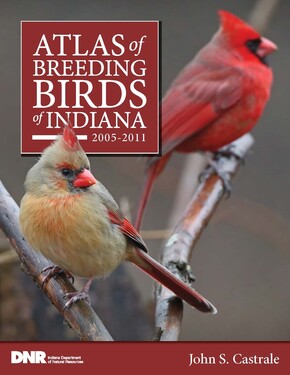 MyDNR, Indiana’s Outdoor Newsletter: The latest Breeding Bird Atlas is available. The Division of Fish & Wildlife thanks all atlas participants for their hard work and patience as we worked together to complete this multi-year feat.
The 2005-2011 Atlas of Breeding Birds of Indiana is essential to conservation efforts, as it provides information on breeding occurrences and habitats of rare birds. Not only does it identify new habitat locations for our state’s birds, but it also provides baseline data that can be used for studies on future populations.
Add some color to your day by browsing through the atlas and its beautiful photos of the native birds of Indiana.
Newsletter can be found online: MyDNR Email Newsletter
For more information please visit DNR: Fish & Wildlife: Breeding Bird Atlas.
Resources:
Breeding Birds and Forest Management: the Hardwood Ecosystem Experiment and the Central Hardwoods Region, The Education Store, Purdue Extension – Forestry and Natural Resources
Forest Birds, The Education Store
Managing Woodlands for Birds, The Education Store
Managing Woodlands for Birds Video, Purdue Extension-Forestry and Natural Resources (FNR) YouTube Channel
Breeding Birds and Forest Management: the Hardwood Ecosystem Experiment and the Central Hardwoods Region, The Education Store
The Birders’ Dozen, Profile: Baltimore Oriole, Indiana Woodland Steward
Ask An Expert, Playlist, Purdue Extension – FNR YouTube channel
It’s For the Birds, Indiana Yard and Garden-Purdue Consumer Horticulture
Birds and Residential Window Strikes: Tips for Prevention, The Education Store, Purdue Extension resource center
No Room at the Inn: Suburban Backyards and Migratory Birds, Education Store, Purdue Extension resource center
Indiana Department of Natural Resources, Department of Fish & Wildlife
In this episode of ID That Tree, Purdue Extension forester Lenny Farlee introduces the Balsam Poplar. This species is found in the North Woods of Northern Wisconsin and the Upper Peninsula of Michigan. This species can be quite tall and has gray bark with relatively prominent diamond shapes along it. These trees have a very vertical form and their leaves are elongated, sharply pointed, and have a shiny finish. Balsam Poplar also have very resinous sticky bud scales located below the leaves along the stem.
If you have any questions regarding wildlife, trees, forest management, wood products, natural resource planning or other natural resource topics, feel free to contact us by using our Ask an Expert web page.
Resources:
ID That Tree, Playlist, Purdue Extension – Forestry and Natural Resources YouTube Channel (Invasive White Mulberry, Siberian Elm, Tree of Heaven)
Invasive Species Playlist, Playlist, Purdue Extension – FNR YouTube Channel (Asian Bush Honeysuckle, Burning Bush, Callery Pear, Multiflora rose)
A Woodland Management Moment, Playlist, Purdue Extension – FNR YouTube Channel (Against Invasives, Garlic Mustard, Autumn Olive)
Woodland Stewardship for Landowners, Playlist, Purdue Extension – FNR YouTube Channel (Common Buckthorn, Japanese Barberry)
Report Invasive Species, Purdue Invasive Species
The GLEDN Phone App – Great Lakes Early Detection Network
EDDMaps – Early Detection and Distribution Mapping System
How long do seeds of the invasive tree, Ailanthus altissima remain viable? (Invasive Tree of Heaven), USDA Forest Service
Indiana Department of Natural Resources: Invasive Species
Indiana Invasive Species Council
Cooperative Invasive Species Management Area (CISMA)
Aquatic Invasive Species, Illinois-Indiana Sea Grant (IISG)
Episode 11 – Exploring the challenges of Invasive Species, Habitat University-Natural Resource University
What are invasive species and why should I care?, Got Nature? Blog, Purdue Extension – FNR
Shrubs and Woody Vines of Indiana and the Midwest, The Education Store, Purdue Extension Resource Center
Native Trees of the Midwest, The Education Store
Investing in Indiana Woodlands, The Education Store
Forest Improvement Handbook, The Education Store
Lenny Farlee, Extension Forester
Hardwood Tree Improvement and Regeneration Center
Purdue Department of Forestry & Natural Resources
In this episode of ID That Tree, Purdue Extension forester Lenny Farlee introduces the Pin or Fire Cherry. This species is found in the North Woods of Northern Wisconsin and the Upper Peninsula of Michigan, and highly associated with disturbances such as fire. This species has a smooth bark with a reddish bronze color. It also has a very shiny surface with horizontal lenticels. The leaves are alternately arranged and are elongated. There are also clusters of white flowers that grow from one point on the stem.
If you have any questions regarding wildlife, trees, forest management, wood products, natural resource planning or other natural resource topics, feel free to contact us by using our Ask an Expert web page.
Resources:
ID That Tree, Playlist, Purdue Extension – Forestry and Natural Resources YouTube Channel (Invasive White Mulberry, Siberian Elm, Tree of Heaven)
Invasive Species Playlist, Playlist, Purdue Extension – FNR YouTube Channel (Asian Bush Honeysuckle, Burning Bush, Callery Pear, Multiflora rose)
A Woodland Management Moment, Playlist, Purdue Extension – FNR YouTube Channel (Against Invasives, Garlic Mustard, Autumn Olive)
Woodland Stewardship for Landowners, Playlist, Purdue Extension – FNR YouTube Channel (Common Buckthorn, Japanese Barberry)
Report Invasive Species, Purdue Invasive Species
The GLEDN Phone App – Great Lakes Early Detection Network
EDDMaps – Early Detection and Distribution Mapping System
How long do seeds of the invasive tree, Ailanthus altissima remain viable? (Invasive Tree of Heaven), USDA Forest Service
Indiana Department of Natural Resources: Invasive Species
Indiana Invasive Species Council
Cooperative Invasive Species Management Area (CISMA)
Aquatic Invasive Species, Illinois-Indiana Sea Grant (IISG)
Episode 11 – Exploring the challenges of Invasive Species, Habitat University-Natural Resource University
What are invasive species and why should I care?, Got Nature? Blog, Purdue Extension – FNR
Shrubs and Woody Vines of Indiana and the Midwest, The Education Store, Purdue Extension Resource Center
Native Trees of the Midwest, The Education Store
Investing in Indiana Woodlands, The Education Store
Forest Improvement Handbook, The Education Store
Lenny Farlee, Extension Forester
Hardwood Tree Improvement and Regeneration Center
Purdue Department of Forestry & Natural Resources

Recent Posts
- Beetle that attacks Tree-of-Heaven found in Indiana, Purdue Landscape Report
Posted: March 20, 2026 in Invasive Insects, Wildlife, Woodlands - ID That Tree: Dwarf Chinkapin Oak
Posted: in Forestry, Urban Forestry, Wildlife, Woodlands - IN-PREPared: Essential Resources for Indiana’s Severe Weather Season
Posted: March 11, 2026 in How To, Safety - DNR Hiring for Indiana Conservation Officer Positions, MyDNR
Posted: March 9, 2026 in Urban Forestry, Wildlife, Woodlands - ID That Tree: Shumard Oak
Posted: in Plants, Urban Forestry, Wildlife, Woodlands - A Woodland Management Moment: Windbreak Around Walnut Plantings
Posted: March 3, 2026 in Forestry, Urban Forestry, Woodland Management Moment - Getting Certified as an Indiana Certified Prescribed Burn Manager
Posted: March 2, 2026 in How To, Urban Forestry, Woodlands - Uniting Indiana Residents Against Invasive Species
Posted: February 27, 2026 in Community Development, Invasive Insects, Wildlife - Have You Seen a Soaring Eagle Lately? Morning Ag Clips
Posted: February 25, 2026 in Urban Forestry, Wildlife - Register for Natural Resources Teacher Institute’s Class of 2026
Posted: February 19, 2026 in Forestry, Wildlife, Woodlands
Archives
Categories
- Alert
- Aquaculture/Fish
- Aquatic/Aquaculture Resources
- Ask the Expert
- Christmas Trees
- Community Development
- Disease
- Drought
- Forestry
- Forests and Street Trees
- Gardening
- Got Nature for Kids
- Great Lakes
- How To
- Invasive Animal Species
- Invasive Insects
- Invasive Plant Species
- Land Use
- Natural Resource Planning
- Nature of Teaching
- Plants
- Podcasts
- Ponds
- Publication
- Safety
- Spiders
- Timber Marketing
- Uncategorized
- Urban Forestry
- Webinar
- Wildlife
- Wood Products/Manufacturing
- Woodland Management Moment
- Woodlands