 Purdue University - Extension - Forestry and Natural Resources
Got Nature? Blog
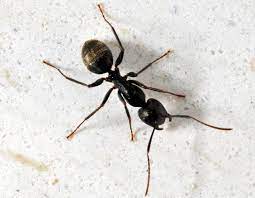 Carpenter ants are very common inside trees, especially on larger, mature trees that are hollow with cavities. They nest in rotted, decayed wood, although some nests may extend into sound heartwood in the center of the tree. Carpenter ant presence is an indication of rotting wood, and infested trees should be checked to determine whether the rot has weakened the tree enough that it has become a risk of failure.
Carpenter ants in trees are not directly harmful to the tree. Control is not necessary for the tree’s health; their presence indicates decay in the tree, and they only feed on dead wood fiber. Wood decay can set in if moisture is present; it is the wood decay that gives the carpenter ants the opportunity to colonize the tree. Carpenter ants use knots, cracks, holes and old insect tunnels to gain access to these areas.
Control of carpenter ants inside trees is difficult but can be done as a way to reduce invasion of the ants into adjacent structures and places where they are unwelcome. It is also possible for ant colonies located inside trees to form satellite colonies inside a nearby home wall. Available controls are not likely to permanently rid a tree of carpenter ants, so retreatment every year or so may be necessary. Dust insecticides (such as Sevin or Abamectin) labeled for use on trees in the landscape are suggested for control. Apply the dust directly into the nest cavity.
Sealing tree cavities or treating tree wounds with wound dressings is not advised. Such treatments are unnecessary and will not eliminate nor prevent decay or carpenter ant activity. Also cutting down otherwise viable trees that happen to be infested with carpenter ants is generally not necessary unless the tree poses a risk.
Resources:
Household & Structural, Department of Entomology, Purdue University
Who Let the Bugs Out?, 4-H Purdue Extension – Entomology
The Space Invaders of Summer, Purdue Agriculture News
Report Invasive Species, Purdue Invasive Species
The GLEDN Phone App – Great Lakes Early Detection Network
EDDMaps – Early Detection and Distribution Mapping System (Report Invasives)
Subscribe – Purdue Extension-FNR YouTube Channel, find videos for wildlife, forestry, urban forestry, community development and more.
Lindsey Purcell, Chapter Administrator & Master Arborist
Indiana Arborist Association
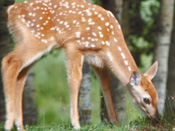 This time of year, sightings of white-tailed deer fawns, fledgling birds and other young critters becomes common. In most cases, the young animal is simply “spreading its wings” and exploring, or mom simply left it to get something to eat. Fawn deer are programmed to hide and remain motionless while mom is away. The fact is wildlife rarely abandons their young. They may leave briefly only to return.
Remember that you should never handle wild animals unless absolutely necessary. Any animal can bite you, and many harbor diseases and pests that can be transmitted to people.
In Indiana, wildlife rehabilitators have necessary state and federal permits to house and care for sick or injured wild animals. If you think you have found a sick or injured animal, you can find a list of licensed Wild Animal Rehabilitators in your area on the DNR Division of Fish and Wildlife’s website.
Resources
Mammals of Indiana, J.O. Whitker and R.E. Mumford
Common Indiana Mammals, R.N. Chapman and R.N. Williams, publication number FNR-413-W
Indiana DNR Orphaned and Injured Animals
Wildlife Habitat Hint: Tips for Evaluating a First Year Native Grass and Forb Plantings, Purdue Extension – FNR YouTube Channel
Drone Seeding Native Grasses and Forbs: Project Overview & Drone Setup, Purdue Extension – FNR YouTube channel
Designing Hardwood Tree Plantings for Wildlife – The Education Store
Forest Management for Reptiles and Amphibians: A Technical Guide for the Midwest, The Education Store
A Template for Your Wildlife Habitat Management Plan, The Education Store
Managing Your Woods for White-Tailed Deer, The Education Store
Woodland Stewardship for Landowners, Playlist, Purdue Extension – FNR YouTube channel
Nature of Teaching Unit 1: Animal Diversity and Tracking, The Education Store
Subscribe Purdue Extension – Forestry and Natural Resources YouTube Channel, Playlists include wildlife, Nature of Teaching, Moments in the Wild and much more.
Brian MacGowan, Extension Wildlife Specialist
Department of Forestry and Natural Resources, Purdue University
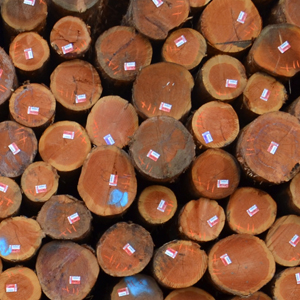 Buying locally, particularly food products from local growers, has become a popular way to support local community business and live an environmentally responsible lifestyle. In Indiana, there is another product that is renewable, recyclable, sustainable and grown locally in abundant supply and high quality – hardwood timber. Indiana is approximately 20-21 percent forestland and is home to over 100 species of native trees, most of which are deciduous hardwoods.
Our hardwood forests and tree plantings provide habitat for wildlife; protection for soil and water resources; recreational opportunities for hikers, campers, birdwatchers and hunters; and beautiful landscape scenes every season of the year. They also provide us with a renewable and sustainable supply of fine hardwood forest products, many of which are harvested, processed and turned into consumer products by companies here in Indiana.
The forests of Indiana are owned primarily by its private citizens; about 84% of the forest is held by individuals as part of a farm or personal woodland. Many of these owners use income from selling trees to maintain their woodlands, pay property taxes and support their families. Wages paid by loggers, lumber mills and wood product companies like flooring, furniture and cabinet manufacturers support thousands of families and add billions of dollars to the Indiana economy. The wood products manufacturing industry is the leading employer in the agriculture sector in Indiana.
Diversity seems to be the theme for Indiana wood products. We have many tree species that enter the marketplace in one form or another, including oak, ash, maple, walnut, cherry, tulip tree, hickory and even sassafras and sycamore. The products produced run the range of our interests and lifespans, from cradles to caskets and all the floors, furniture, cabinets and doors we use in between.
If you are concerned about responsible use of our natural resources, you can feel pretty good about Indiana wood as well. Extensive forest inventories administered by the U.S. Forest Service and Indiana DNR indicate annual growth of wood volume exceeds harvest and natural mortality by over three times. DNR Division of Forestry state forestlands, the privately held Classified Forest and Wildlands properties and privately held Tree Farm properties are certified as meeting sustainable forest management criteria as determined by internationally recognized forest sustainability certifying organizations.
Many landowners recognize the value of using a professional forester to help them meet their property management goals in a renewable, responsible, sustainable way. They are also helping us all enjoy the opportunity to own another great locally grown product – Indiana hardwoods.
If you are looking for a forester to assist you with management on your property, visit Indiana Forestry and Woodland Owners Association (IFWOA) – Directory of Professional Foresters.
To find out more about the forest products of Indiana, visit Indiana Forest Products Community.
To learn more about the extent and sustainability of Indiana forests, visit A Landowner’s Guide to Sustainable Forestry.
Resources:
Purdue Forestry and Natural Resources Publication List
The Education Store, Purdue Extension (place in search field: “timber”)
Find an Indiana Professional Forester, Indiana Forestry & Woodland Owners Association (IFWOA)
Purdue Arboretum Explorer
Native Trees of the Midwest, Purdue University Press
Shrubs and Woody Vines of Indiana and the Midwest, Purdue University Press
Investing in Indiana Woodlands, The Education Store
Forest Improvement Handbook, The Education Store
ID That Tree, Purdue Extension-Forestry & Natural Resources (FNR) YouTube playlist
Woodland Management Moment , Purdue Extension-FNR YouTube playlist
Lenny Farlee, Extension Forester
Hardwood Tree Improvement and Regeneration Center
Forestry and Natural Resources, Purdue University
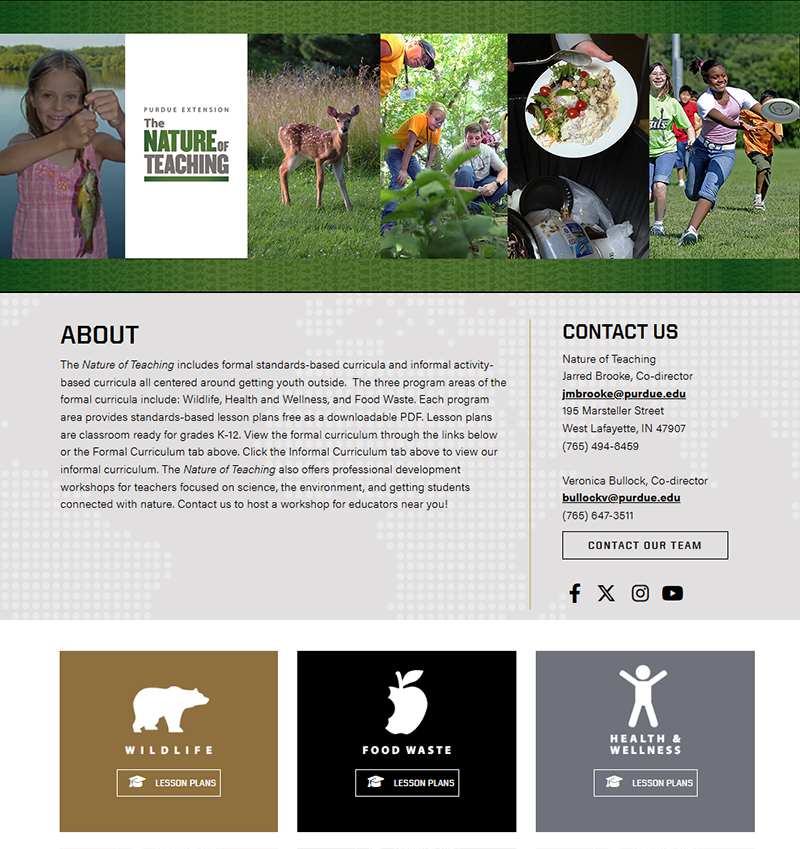 As teachers prepare their lessons for the fall, The Nature of Teaching is a great website to visit for science-based resources. Teachers can find free lesson plans, printable, posters, a photo library, information on upcoming workshops and more. You will find on the website tabs titled “Formal Curriculum” and “Informal Curriculum.” The Nature of Teaching also offers professional development workshops for teachers focused on science, the environment, and getting students connected with nature.
These organized lesson plans meet several K-5 Science and Math Academic Standards along with three 9-12 Natural Resource Management Academic Standards.
Wildlife curriculum include:
- Animal Diversity and Tracking
- Discovering the Watershed: Effects on Water Quality
- Common Indiana Mammals: Natural History and Identification
- Invasive Plants: Impact on Environment and People
- Hellbenders Rock! Natural History and Conservation of the Eastern Hellbender
Food Waste curriculum include:
- Food Waste and Natural Resources
- What a Waste of Food!
- Food Waste and The Environment
- Food Waste Solutions
- Transporting Food Waste
Health & Wellness curriculum include:
- Unit 1 Benefits of Connecting with Nature
- Unit 2 Gardening Station
- Unit 3 Tree Talk Station
Other resources:
- Help the Hellbender, Purdue Extension
- Indiana Department of Natural Resources (INDNR): For Kids
- 4-H, Purdue Extension
- National FFA Organization
- Indiana FFA
- Flying Wild, Association of Fish & Wildlife Agencies
- Project Learning Tree, Indiana Department of Natural Resources
- Project Wet
- Project Wild
- Indiana Wildlife Habitat Evaluation Program (WHEP)
Contact The Nature of Teaching team if you have any questions regarding workshops, certifications and curriculum.
The Nature of Teaching, Purdue Extension
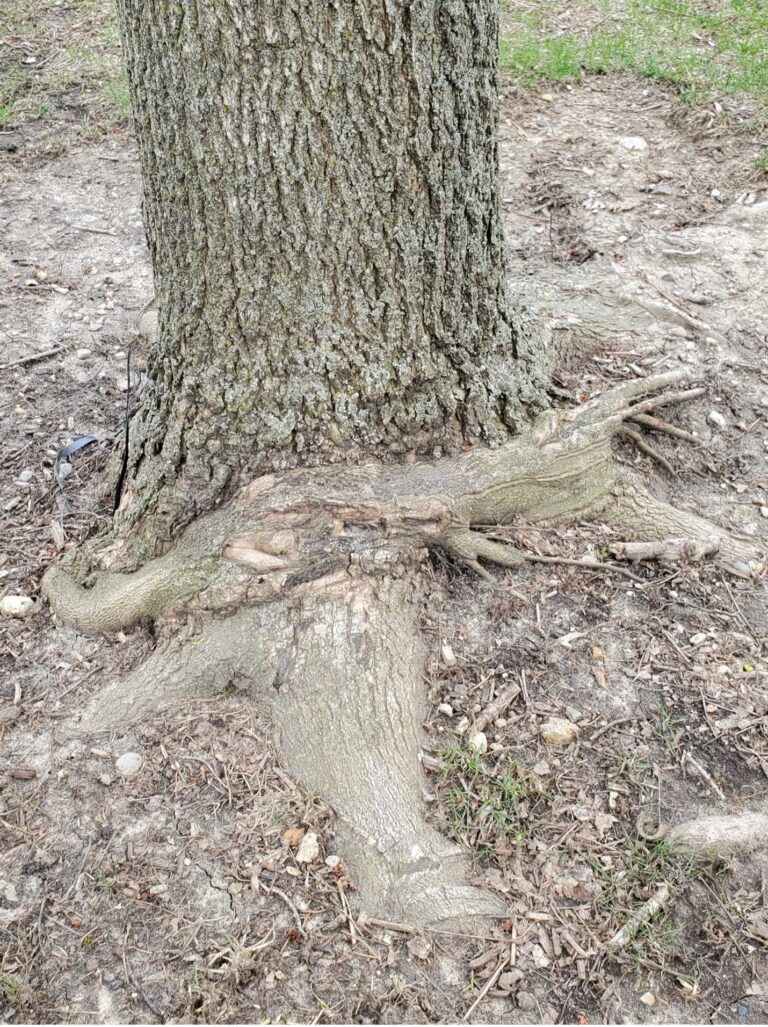 Tree roots wrapped around tree trunks or the lower stem can be very troublesome for tree health and safety. Stem Girdling Roots (SGR) are very common in maple trees and can eventually compress the stem so greatly that it creates a situation where the tree can be more prone to windthrow or blowing over. Additionally, it reduces the flow of water and nutrition to the tree, causing a slow decline and eventual death if not corrected or unable to be treated.
Roots that are not directed away from the trunk causes serious issues, and oftentimes, there is no good rescue treatment or mitigation of the issue. If the tree is small or juvenile and the roots have NOT compressed the stem, careful pruning of the circling roots can be accomplished. If these circling roots are less than one-third the trunk diameter and they can be removed without damaging the trunk, then carefully cut and remove them. This will stop the circling habit and allow roots and trunk under the girdling root to develop in the proper way. Some arborists have removed larger girdling roots with no adverse effects on the tree, and they often respond to removing girdling roots with increased vigor. However, roots that have embedded themselves into the trunk or stem should be left alone. There are no guarantees with this risky process. Any time roots are removed, there is a danger for reducing stability and health.
I would suggest contacting an International Society of Arboriculture Certified Arborist to complete the task and ensure the best possible results.
For resources on tree care, view FNR Extension Publications.
Resources:
Stem Girdling Roots, Purdue Landscape Report
Trees and Storms, The Education Store, Purdue Extension’s resource center
Tree Risk Management, The Education Store
Planting Problems: Trees Planted Too Deep, Video, Purdue Extension – Forestry and Natural Resources YouTube Channel
Planting Your Tree Part 1: Choosing Your Tree, Video, Purdue Extension YouTube Channel
Tree Planting Part 2: Planting a Tree, Video, Purdue Extension YouTube Channel
Tree Appraisal and the Value of Trees, The Educational Store, Purdue Extension resource center
Surface Root Syndrome, The Education Store
Iron Chlorosis of Trees and Shrubs, The Education Store
Tree Pruning Essentials, Publication & Video, The Education Store
Cold Injury to Trees, Got Nature? Post, Purdue FNR Extension
Lindsey Purcell, Executive Director
Indiana Arborist Association
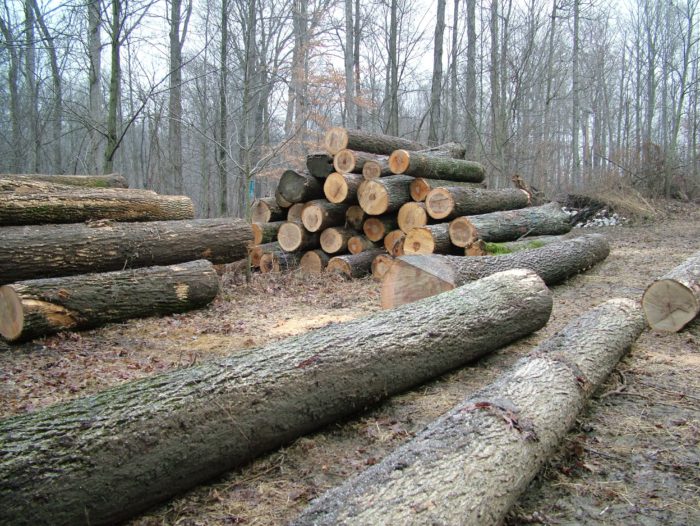 Indiana Conservation Officers and the DNR Division of Forestry are providing useful tips to landowners that can assist in protecting their valuable timber resources. To protect forestry resources, landowners should follow these steps:
- Hire a consultant forester to represent you and to mark and advertise your timber sale.
- Always get several bids from different timber buyers.
- Ask questions and get references from the timber buyer.
- Mark the trees to be cut with a paint mark on the stem and at ground level.
- Know and understand the fine details of the contract.
- Never make an oral agreement.
- Know how much you will be paid and the method of payment.
- Be a good neighbor and work out any property line disputes prior to harvesting.
The DNR offers a free information packet titled “callb4ucut” to those who may be considering harvesting their timber. See www.callb4ucut.com for further information.
For workshops on timber harvesting, check out the FNR Calendar and IN DNR Calendar.
For a list of consulting foresters, see The Indiana Forestry and Woodland Owners Association‘s (IFWOA) Directory of Professional Foresters.
Resources:
The Education Store, Purdue Extension (place in search field: “timber”)
Find an Indiana Professional Forester, Indiana Forestry & Woodland Owners Association (IFWOA)
Purdue Arboretum Explorer
Native Trees of the Midwest, Purdue University Press
Shrubs and Woody Vines of Indiana and the Midwest, Purdue University Press
Investing in Indiana Woodlands, The Education Store
Forest Improvement Handbook, The Education Store
ID That Tree, Purdue Extension-Forestry & Natural Resources (FNR) YouTube playlist
Woodland Management Moment , Purdue Extension-FNR YouTube playlist
 As the snow finally melts, we are approaching the prime time for planting bare-root trees and shrubs in Indiana. Planting bare-root seedlings is a proven, cost-efficient method to establish trees and shrubs on your property for a variety of purposes, as long as some basic steps are followed.
Prior to planting, prepare your site by eliminating competing vegetation where the seedlings will be planted. This can be done with tillage or herbicides. Areas with heavy sod or perennial weed growth are very difficult sites for small seedlings to survive and thrive. Clear all the competing vegetation in the planting area or create circles or bands two to three feet wide where the seedlings can grow. Be sure your site is suited to the species you want to plant. Soil survey and tree planting information from the USDA Natural Resources Conservation Service is available for every county in the state, either at NRCS offices or on the Web Soil Survey website: http://websoilsurvey.sc.egov.usda.gov.
When you receive your seedlings, keep them cool and moist until you can plant them. Plant them as soon as possible since the best place to store a seedling is in the soil! If you can’t plant them within a few days of their arrival, you can dig a trench and “heel in” the seedlings by planting them very close together and covering the roots with soil and/or moist mulch. This is still a short-term storage solution. You want to have your trees planted in their final locations before buds start to open.
When planting, keep seedlings stored in the shade, and roots should be kept moist until placed in the ground. A five gallon bucket with wet peat or sphagnum moss will work just fine for transporting seedlings to their planting locations. You can use several tools for planting, including shovels and commercial tree planting bars. The critical factors are planting the seedling at the correct depth and getting the root system in the ground such that it has good contact with the soil and is ready to grow. Seedlings should be planted with the root collar at or slightly below ground line. The root collar is where the stem changes to the root and is recognized by a color and texture change on the seedling stem. Be sure the soil is firmed around the seedling to close any air pockets that can dry out roots. Get your planting done as early in the spring as you can to take advantage of spring rains and a longer growing season for the seedling.
There are many more considerations for planning and implementing a successful tree planting that you can review in extension publications. See resources below for publications and videos.
To view the large photo used in this posting, visit How To Plant Seedlings.
Resources:
Planting Forest Trees and Shrubs in Indiana, The Education Store, Purdue Extension’s resource center
Native Trees of the Midwest, Purdue University Press
Shrubs and Woody Vines of Indiana and the Midwest, Purdue University Press
Investing in Indiana Woodlands, The Education Store
Forest Improvement Handbook, The Education Store
ID That Tree, Purdue Extension-Forestry & Natural Resources (FNR) YouTube playlist
Woodland Stewardship for Landowners Purdue Extension – FNR Extension YouTube Playlist
Woodland Management Moment, Purdue Extension-FNR YouTube playlist
Conservation Tree Planting: Steps to Success, Purdue Extension – FNR Got Nature? Blog
Lenny Farlee, Extension Forester
Hardwood Tree Improvement and Regeneration Center
Forestry and Natural Resources, Purdue University
 Several myths have surfaced and resurfaced over many years. Indiana’s state forests have been managed by the Division of Forestry since the first state forest was established in 1903. Questions arise including acreage, management, level of harvest, the forestry profession and a number of other issues. The maintenance of ecosystem processes is inherently more important than a given stage of development that must be preserved.
Check out the Forest Management and Wildlife Habitat Myths and Truths of Indiana State Forests (pdf).
Resources:
Frost Seeding to Establish Wildlife Food Plots and Native Grass and Forb Plantings – Purdue Extension YouTube
Wildlife Habitat Hint: Tips for Evaluating a First Year Native Grass and Forb Plantings, Purdue Extension – FNR YouTube Channel
Drone Seeding Native Grasses and Forbs: Project Overview & Drone Setup, Purdue Extension – FNR YouTube channel
Forest Improvement Handbook, The Education Store
Ordering Seedlings from the State Forest Nursery System, Got Nature? – Purdue Extension-Forestry & Natural Resources (FNR)
Designing Hardwood Tree Plantings for Wildlife – The Education Store
ID That Tree – YouTube Playlist
Forest Management for Reptiles and Amphibians: A Technical Guide for the Midwest, The Education Store
Ask the Expert: Hardwood Ecosystem Experiment – Birds and Salamander Research, Purdue Extension – FNR
A Template for Your Wildlife Habitat Management Plan, The Education Store
Managing Your Woods for White-Tailed Deer, The Education Store
Woodland Stewardship for Landowners, Playlist, Purdue Extension – FNR YouTube channel
Nature of Teaching Unit 1: Animal Diversity and Tracking, The Education Store
Subscribe Purdue Extension – Forestry and Natural Resources YouTube Channel, Playlists include wildlife, Nature of Teaching, Moments in the Wild and much more.
Indiana Department of Natural Resources
Division of Fish and Wildlife
As an Extension Wildlife Specialist, this is one of the most common questions I receive. The answer to this seemingly simple question can actually be quite complicated. It depends in part on what wildlife species you desire and what objectives you have for wildlife and other land uses for your property. There is no one plant that will do it. Food habit studies show that deer, turkey and many other wildlife species can consume hundreds of plant species throughout the year. With that in mind, focusing on one or two “miracle” plants would not yield great results (also remember that the presence of wildlife on your property depends on the surrounding properties).
If you have a particular species of wildlife you are interested in, you can compare their habitat 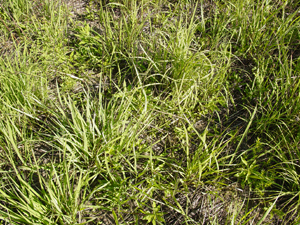 to what you have available to determine what is missing or limiting. You may also use a more general approach, looking at what major plant types are limiting such as hard mast trees, soft mast trees, shrubs, vines, annual forbs and perennial forbs. You will also want to evaluate water, cavities, downed woody debris or snags.
For questions about what to plant, it is easier to answer specific situations. Recently, a blog reader wrote that they just dredged their pond and spread it on a large open pasture about 50 yards from the pond. The reader wanted to know what to plant to attract quail and pheasant while also benefiting deer and turkey populations. Being in Monroe County, quail is more likely, so I will focus on that.
In the fall and winter, quail feed heavily on plant seeds, especially ragweed, pigweed, foxtail and agricultural crop residue. Spring and summer foods include tender green vegetation and soft fruits. Invertebrates are consumed when available and are essential for the development of chicks.
Cover is equally important in deciding what to plant. A mixture of herbaceous (grass, wildflowers) cover with bare ground interspersed with some woody shrubs or open woodland edges will generally benefit quail. With these in mind and using what the “typical” Indiana landscape looks like, the owner may want to consider the following:
Native Warm Season Grass mix – This provides quality brood and nesting cover. Rates are listed in pounds (lbs.) PLS (Pure Live Seed) per acre. A typical mix for quail recommended by the USDA Natural Resources Conservation Service is listed below. The general idea behind this and other mixes for quail is the bunch grass provides overhead cover above and bare ground and space below. This allows free access to seeds on the ground from the wildflowers along with invertebrates on the ground and vegetation. Quail are small and can’t scratch their way to seeds like turkey and other larger birds.
|
Species
|
Rate (PLS)
|
|
Grasses
|
|
|
Big Bluestem
|
0.25 lbs.
|
|
Sideoats grama
|
2.00 lbs.
|
|
Canada Wildrye
|
1.25 lbs.
|
|
Little Bluestem
|
0.50 lbs.
|
|
Wildflowers
|
|
|
Partridge Pea
|
4 oz.
|
|
Illinois Bundleflower
|
1 oz.
|
|
Purple Prairie Clover
|
3 oz.
|
|
Purple Coneflower
|
2 oz.
|
|
Black-eyed Susan
|
1 oz.
|
|
Wild Bergamot
|
1 oz.
|
|
Showy Tick Trefoil
|
1 oz.
|
|
Butterfly Milkweed
|
2 oz.
|
|
Lead Plant
|
2 oz.
|
|
Round-headed Lespedeza
|
2 oz.
|
Plant a mixture of shrubs – Shrubs provide good resting cover and winter cover for quail. Bare root seedlings planted in the spring should be planted 6 ft. x 6 ft. spacing in clumps “about the size of a large pickup truck.” Species that provide good structure for quail include gray or silky dogwood. American plum and serviceberry will also benefit wild turkey and white-tailed deer.
IMPORTANT: Plant species and mixes recommended above may not be suitable for the site moisture or soil conditions. Improper site preparation and methods will lead to planting failures. Contact your county extension office for proper methods and species that are appropriate for your area. It is always best to have a resource professional visit your site to provide you specific advice that considers your current habitat condition and the equipment and resources available to you, along with what you want to accomplish. In addition to your county extension office, you may want to contact your DNR district wildlife biologist. Finally, planting is only a start. Providing habitat for wildlife, and especially for early successional species such as bobwhite quail, requires continually habitat management that may include invasive species control, prescribed burning, disking or more.
Resources:
Natural Resources Conservation Service Indiana
Pheasant Forever
Quail Forever
Pure Live Seed: Calculations and Considerations for Wildlife Food Plots, Purdue Extension – Forestry and Natural Resources (FNR)
Seed Fillers and Carriers for Planting Native Warm-season Grasses and Forbs, Purdue Extension – FNR
Calibrating a No-Till Drill for Conservation Plantings and Wildlife Food Plots, The Education Store, Purdue Extension resource center
Subscribe: Purdue Extension – Forestry and Natural Resources YouTube Channel
Habitat Help LIVE Q&A – Native Grasses and Forbs for Wildlife, Purdue Extension-FNR Got Nature? Blog/Video
Frost Seeding Native Grasses and Forbs with a Drone (UAV): Lessons Learned, Purdue Extension-FNR Got Nature? Blog/Videos
Creating a Wildlife Habitat Management Plan for Landowners, Purdue Extension-FNR Got Nature? Blog
A Template for Your Wildlife Habitat Management Plan, The Education Store, Purdue Extension resource center
Managing Your Woods for White-Tailed Deer, The Education Store
Dr. Brian MacGowan, Wildlife Extension Specialist
Department of Forestry & Natural Resources, Purdue University
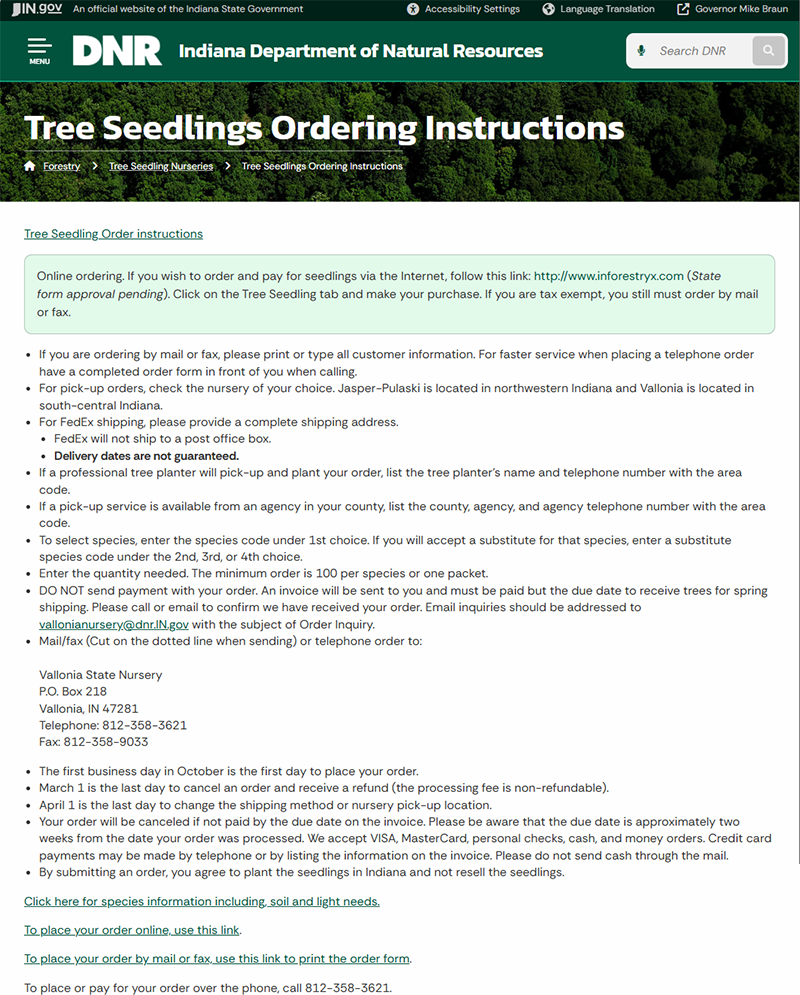 Landowners in Indiana are fortunate to have access to inexpensive, high quality tree and shrub seedlings from the Indiana DNR Division of Forestry nurseries. These seedlings are one- and two-year-old bare-root plants intended for conservation plantings: windbreaks, wildlife habitat, reforestation, erosion control and other conservation uses. The seedlings are not to be planted for landscaping or Christmas trees or resold as rooted stock. Seedlings are available in multiples of 100 or in packets containing a mixture of species for different planting purposes like native nuts, timber or wildlife. You can access instructions for ordering and the order form with available tree species at Tree Seedlings Ordering Instructions, Indiana Department of Natural resources.
Demand for these seedlings is often high, so the nursery fills orders using a lottery drawing system. Orders submitted to the nursery by the third Friday in October are randomly drawn and filled until the nursery runs out of stock or all orders are filled. Orders received after this date are filled first-come, first served with any remaining seedlings. The order form provides spaces for second, third and fourth choices when ordering seedlings, and I recommend you use those to increase your chances of receiving all the seedlings you need. As an example, you might want to plant white oak, but you could list chinkapin oak, bur oak and swamp chestnut oak as alternates in case the white oak sells out. If you have questions about species characteristics, the nurseries provide information at a link on the previously mentioned webpage. Purdue also offers seedling planting advice in the following publication: Planting Forest Trees and Shrubs in Indiana.
Once your order is processed, you will be billed for the seedlings. Once paid, your seedlings are reserved for spring pickup at the nursery, or you can have the seedlings shipped to you for an additional charge. Some counties offer a local pickup service, so you may want to check with your county Extension Office or Soil and Water Conservation District to see if that is available in your area.
So if you would like to buy seedlings from the state forest nurseries, be sure to submit your order before October 19 and include alternative choices on your order form for the best chance of receiving what you need to complete your planting plans.
Resources
Purdue Forestry and Natural Resources Publication List
The Education Store, Purdue Extension (place in search field: “timber”)
Find an Indiana Professional Forester, Indiana Forestry & Woodland Owners Association (IFWOA)
Purdue Arboretum Explorer
Native Trees of the Midwest, The Education Store
Shrubs and Woody Vines of Indiana and the Midwest, The Education Store
Investing in Indiana Woodlands, The Education Store
Forest Improvement Handbook, The Education Store
ID That Tree, Purdue Extension-Forestry & Natural Resources (FNR) YouTube playlist
Woodland Management Moment , Purdue Extension-FNR YouTube playlist

Recent Posts
- 2026 Winter Bat Survey In Progress, MyDNR
Posted: March 27, 2026 in Wildlife - Fast-Growing Trees for the Landscape, Purdue Landscape Report
Posted: March 26, 2026 in Forestry, Urban Forestry, Woodlands - Urban Tree Spotlight: Planting Deciduous Shade Trees, Purdue Landscape Report
Posted: March 25, 2026 in Forests and Street Trees, Urban Forestry, Woodlands - Beetle that attacks Tree-of-Heaven found in Indiana, Purdue Landscape Report
Posted: March 20, 2026 in Invasive Insects, Wildlife, Woodlands - ID That Tree: Dwarf Chinkapin Oak
Posted: in Forestry, Urban Forestry, Wildlife, Woodlands - IN-PREPared: Essential Resources for Indiana’s Severe Weather Season
Posted: March 11, 2026 in How To, Safety - DNR Hiring for Indiana Conservation Officer Positions, MyDNR
Posted: March 9, 2026 in Urban Forestry, Wildlife, Woodlands - ID That Tree: Shumard Oak
Posted: in Plants, Urban Forestry, Wildlife, Woodlands - A Woodland Management Moment: Windbreak Around Walnut Plantings
Posted: March 3, 2026 in Forestry, Urban Forestry, Woodland Management Moment - Getting Certified as an Indiana Certified Prescribed Burn Manager
Posted: March 2, 2026 in How To, Urban Forestry, Woodlands
Archives
Categories
- Alert
- Aquaculture/Fish
- Aquatic/Aquaculture Resources
- Ask the Expert
- Christmas Trees
- Community Development
- Disease
- Drought
- Forestry
- Forests and Street Trees
- Gardening
- Got Nature for Kids
- Great Lakes
- How To
- Invasive Animal Species
- Invasive Insects
- Invasive Plant Species
- Land Use
- Natural Resource Planning
- Nature of Teaching
- Plants
- Podcasts
- Ponds
- Publication
- Safety
- Spiders
- Timber Marketing
- Uncategorized
- Urban Forestry
- Webinar
- Wildlife
- Wood Products/Manufacturing
- Woodland Management Moment
- Woodlands