 Purdue University - Extension - Forestry and Natural Resources
Got Nature? Blog
This winter was a brutal one for sure, but the emerald ash borer still has plenty of life left in it.
Although the Midwest experienced abnormally cold temperatures this winter, it is unlikely that populations of the highly destructive beetle were significantly affected by it, said Adam Witte, exotic forest pest educator in the Purdue University Department of Entomology.
“Headlines have been circulating, suggesting that EAB may have met its match,” Witte said. “But the EAB, as well as most insects in colder climates, is effective at surviving cold temperatures.”
EAB larvae overwintering within ash trees die when temperatures reach minus-28 degrees Fahrenheit below the bark, Witte said. U.S. Forest Service scientists predicting areas in North America where temperatures were cold enough to kill EAB larvae conclude that only parts of Minnesota and North Dakota historically have reached temperatures that low.
Contacts
Adam Witte, Exotic Forest Pest Educator
Department of Entomology
Matthew Ginzel, Associate Professor
Departments of Entomology & Forestry and Natural Resources
Spring brings an opportunity to spend more time outdoors but also increases our exposure to tick bites and infection from some of the diseases that ticks carry. Taking some precautions to reduce risks of exposure and infection from ticks can make your outdoor activities more safe and enjoyable. Ticks can be found in almost any location that has animals and vegetation, so completely avoiding ticks is very difficult. But there are some practices that will help you prevent ticks from biting and passing disease organisms to you.
Here are several suggestions:
- Wear light-colored clothing that makes it easier to see ticks and remove them before they get to bare skin.
- Tuck in shirt-tails, tuck pants into boots or socks or use “tick gators” that are essentially a legging that covers where your pants and socks or boots meet.
- Wearing a hat is another good precautionary measure.
- Treat bare skin with repellants containing 20 to 30% DEET. Always read and follow label directions!
- Treat clothing (not skin!) with repellants containing permethrin prior to entering areas with ticks. Once dried on the clothing, permethrin can still be effective after several washes. Follow label directions.
- Upon your return, inspect clothing for any ticks. Tumbling clothes in a hot dryer for an hour will kill ticks. Shorter times may be effective if the clothes are not wet.
- Wash up after visiting tick-infested areas and do a body check for any ticks.
If you find a tick attached, remove it by using tweezers or a tick removal tool to grasp it as near to the skin as possible and pulling straight out. DO NOT use hot match heads or needles, nail polish, gasoline or similar techniques. Ticks that are removed shortly after they attach may not have the opportunity to pass disease organisms to you, so quick detection and removal are good prevention methods.
If you experience a rash, fever, chills, aching or other unusual symptoms after a tick bite or exposure to tick-infested areas, see your physician immediately. Most tick-borne diseases can be effectively treated with early detection.
Enjoy the outdoors by taking precautions to reduce your risks.
Purdue has an informational webpage on ticks at Purdue Medical Entomology.
The Center for Disease Control and Prevention has an information site on ticks and tick diseases.
Lenny Farlee, Sustaining Hardwood Extension Specialist
Hardwood Tree Improvement and Regeneration Center (HTIRC)
Forestry and Natural Resources, Purdue University
Although perhaps a bit late, spring has seemingly sprung upon us. One of the best signals of spring is the symphony of calling frogs and toads in and around wetlands, ponds and lakes throughout Indiana. Amphibians native to Indiana are an important component of healthy ecosystems. They play important roles as both predator and prey in food webs. We can also consider many amphibians as “bio-indicators” of environmental health. Unfortunately, many species of amphibians and reptiles are thought to be in the decline. While the causes for declines are species-specific, the actions that people take can be a contributing factor.
Unlike other vertebrates, most amphibians and reptiles can be observed up close or even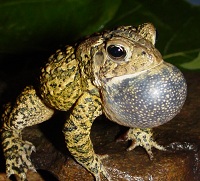 captured by hand – some more easily than others. Exploring natural habitats while searching for, catching and photographing reptiles and amphibians are great ways to gain hands-on experience with nature. However, be mindful that some activities, or the manner in which they are conducted, can harm the very creatures we value. Reptiles and amphibians represent numerous examples where interactions between wildlife and people can have negative consequences despite the best of intentions.
When you go outdoors to enjoy our amphibians and other wildlife, follow some of these simple tips:
Stay on designated roads and trail systems – Human foot traffic can affect plants and animals in some habitats (e.g., you may have noticed the compressed soil and lack of vegetation on even lightly used foot trails). Focusing foot traffic on trails can minimize human impacts on sensitive plants and animals. It is also required on some public properties.
Be a responsible pet owner – Dogs make good companions when hiking outdoors. However, research has demonstrated dogs can disturb, harass or even kill wildlife. While impacts on reptiles and amphibians are unclear, it is good practice to keep your dog leashed while exploring natural areas. Many parks and properties require dogs to be leashed.
Be a good steward of the land – Carelessly turning over logs and coarse woody debris in search of reptiles and amphibians can destroy microhabitat features that took decades to create. It is also prohibited on many public properties. If you do find an animal under a log or rock, return the object to its original location, then place the animal next to it rather than rolling the object directly over the animal.
Minimize or avoid handling animals – If you must handle a wild amphibian or reptile, 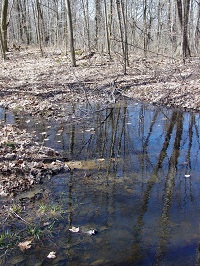 there are safe ways to hold and restrain them. Avoid handling amphibians for long periods of time. Amphibians are prone to desiccation (drying out). There are no formal guidelines on the length of time to handle an amphibian, and it is not clear how handling impacts an animal’s health and wellbeing. Common sense dictates that handling time should be minimized to the greatest extent possible. If a frog or salamander feels “dry,” you have handled it too long, and it should be returned to its location of capture immediately. Keep your hands moist and free of chemicals (e.g., bug spray or sunscreen).
Use good hygiene – The transmission of many diseases among animals can be facilitated by people. There are a number of safeguards that can be implemented to not only protect you, but also the animal populations as well. To prevent spreading diseases and pathogens from one site to another, regularly wash clothing and especially boots that you use in the field. All equipment that contacts an animal or the water the animal was in should be decontaminated using a 1-3 percent bleach solution or air dried for at least three hours before traveling to another water body. You also should use hand sanitizer before and after handling animals in nature. Before eating or handling food, thoroughly wash hands in hot, soapy water if possible; hand sanitizer is an acceptable substitute for remote locations.
For more information about responsibly enjoying wildlife and nature, see Appreciating Reptiles and Amphibians in Nature.
Resources:
Sounds of Frogs & Toads, Purdue Extension – Forestry and Natural Resources (FNR)
Frogs & toads of Indiana, The Education Store, Purdue Extension resource center
Salamanders of Indiana Book, The Education Store
Amphibians: Frogs, Toads, and Salamanders, Purdue Nature of Teaching
The Nature of Teaching: Adaptations for Aquatic Amphibians, The Education Store
Hellbender ID, Playlist, Purdue Extension – FNR YouTube Channel
A Moment in the Wild, Playlist, Purdue Extension – FNR YouTube Channel
Dr. Brian MacGowan, Extension Wildlife Specialist
Department of Forestry & Natural Resources, Purdue University
Early spring brings the emergence of new life in the forest. Unfortunately, not all that life actually belongs there. Several invasive plants are encroaching on woodlands and crowding out the desirable native plants we enjoy and wildlife depend upon for food and shelter. One of the characteristics of some invasive plants is early leaf emergence and growth, which allows us to scout for their presence more easily, while native species are still waking up from winter. Two species that start growing very early in the spring are garlic mustard and Asian bush honeysuckles. Both plants are rapidly greening up and growing as I speak. Look for the kidney to heart shaped leaves of garlic mustard on the forest floor. This biennial will soon be sending up flower stalks from the second season plants that will have white four-petaled flowers. The flower stalks can be up to three feet tall or more depending on the health of the plant and the quality of the growing site.
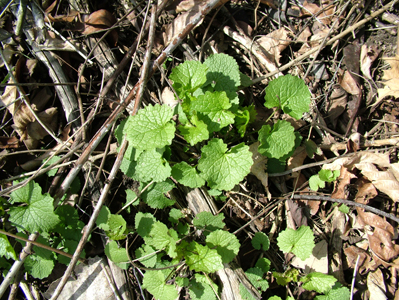
Early spring leaves of garlic mustard.
Asian bush honeysuckle is a medium to large bush that also inhabits the forest understory and edge or disturbed areas. Leaves and twigs area arranged opposite each other. If you slice the stems open, they are hollow inside with fuzzy brown or tan lining. Flowers are yellow, white or even pinkish and tube-shaped. The fine twigs and stems have a light tan or gray-tan color. Leaves are rapidly expanding now, so they will be easily detected until our native plants catch up with leaf cover.

Early growth of Asian bush honeysuckle.
Controlling these plants helps native plants continue to thrive and provide habitat for our wildlife. Garlic mustard can be pulled from moist soil. If seed pods are present, remove the plants from the area and burn or bury them. Foliar herbicides like glyphosate products may be used to spray garlic mustard. If the plants have already set seed pods, the seed may become viable even if the plant has been sprayed, so removal may be the only effective treatment at that time.
Asian bush honeysuckle can be controlled in several ways, depending on the size of the plants. Small plants can be pulled from moist soil. Foliar sprays with herbicides like glyphosate can be effective. Large bushes may be cut and the stumps treated with a brush-killing herbicide. For any herbicide application, read and follow label directions.
Purdue University has invasive species information resources at FNR Extension and Indiana’s ‘Most Unwanted’ Invasive Plant Pests/Indiana Cooperative Agricultural Pest Survey (CAPS) Program.
Lenny Farlee, Sustaining Hardwood Extension Specialist
Hardwood Tree Improvement and Regeneration Center (HTIRC)
Forestry and Natural Resources, Purdue University
I seem to be finding Kirtland’s snakes as I am cleaning my gardens. There seems to be an increase of grubs, beetles and worms, but I have not seen the small lizards yet. We have an abundance of chipmunks. Is there something I can do to discourage the snakes from taking up residency in my yard?
Many people have questions about snakes, and this post addresses the two most common – what is it and what can I do? The answer to the latter is, in part, related to the first, so I’ll address that one first. Indiana is home to a diversity of snake species. Identifying snakes to species can be tricky. First, geographic location often can easily differentiate among similar species or subspecies. Check the distribution map of the species in question and that of similar species. This may not resolve all issues since the distribution of similar species often overlap, distribution maps are not 100 percent accurate (i.e., they are a “best guess”) and some species and subspecies share similar characteristics where their ranges overlap. Second, scale configuration and appearance differs among some groups of species. For snakes, the texture of the body scales (keeled or smooth) or the presence/absence of a divided anal plate (the large scale that covers the cloacal opening) are key. Finally, physical characteristics including size, color and pattern can be used. For some species, conclusive identification is easier with the specimen in hand, although handling venomous species (which are rare in Indiana) is not recommended. With practice, one can become quite adept at identifying all of them.
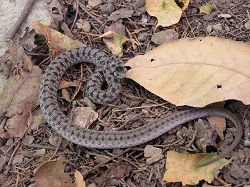
DeKay’s Brownsnake – This species is a small chestnut to dark brown snake averaging 25-30 centimeters in length. The belly is cream to pink. It has two rows of dark spots along the back that fade toward the tail. Dark bars may connect the dorsal spots, giving the impression of a ladder-like pattern. The area within this pattern is usually lighter in color than the sides, often giving the impression of a central stripe.
Kirtland’s snakes referenced in the homeowner’s question are endangered in Indiana. They are generally found near or along the margins of water bodies, but they can also be found in some urban areas on occasion. Due to these facts and since Kirtland’s snakes are generally quite secretive in behavior, this homeowner’s garden visitors are likely another species. Common garden visitors in Indiana include DeKay’s Brown snake (pictured above) or Eastern Gartersnake. Red-bellied Snakes (pictured below) have a pinkish-red belly similar to Kirtland’s snake. They are more of a woodland species, but it could be a possibility. All of these snakes can eat slugs and other garden pests.
Is there something homeowners can do to discourage snakes from taking up residency in their yards and around their homes? There really is no foolproof method to discourage snakes from utilizing a property. Reducing mulch layer thickness; removing brush piles, rock piles or other refuse; and keeping vegetation low are all steps that may help. Keep in mind that this may also reduce use of your property by wildlife you desire. There have been some repellents developed for snakes, but research results on their effectiveness have been mixed at best. In general, you should be wary of repellents that promise to keep animals out of an area. Lastly, there is plastic mesh fencing that you can purchase. Fencing can be used to exclude animals from small areas – it is generally cost-prohibitive for larger areas, and I am not aware of studies that test the effectiveness of fencing for snakes. Snake fencing is generally designed to exclude larger venomous snakes as opposed to the typical garden species that can be quite small. Snakes can also get stuck and die in mesh fences when their head fits through but the body gets stuck. The scales “catch” the mesh when the snake attempts to back out. Mesh fencing is also susceptible to damage from trimmers and falling limbs, and rabbits and rodents can chew holes in it. Thus, regular inspection and maintenance is required to maintain its function.
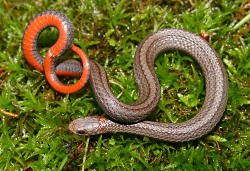
The Red-bellied Snake (18-25 cm) has both a brown and gray color phase. The two black lines along the length of its back may appear similar to the dark spots along the back of the DeKay’s Brownsnake (Storeria dekayi), but lack the crossbars. The belly has a distinctive bright pink or red coloration for which the species was named. Three light blotches may be visible behind the head on the neck.
Remember, while many folks are afraid of snakes or don’t want them around, the vast majority of species are harmless and can actually help homeowners by preying upon animals that actually are a nuisance and cause damage. Before taking any action, consider their benefits to you and how your actions affect other wildlife that call your yard home.
Resources
Snakes and Lizards of Indiana, The Education Store, Purdue Extension’s resource center
Snakes of the Central and Northeastern United States, The Education Store
Snakes of Indiana, The Education Store
Indiana Amphibian and Reptile ID Package (4 softcover books), The Education Store
Reptiles: Turtles, Snakes, and Lizards, Purdue Nature of Teaching Website
Ask An Expert, Playlist, Purdue Extension – Forestry and Natural Resources YouTube channel
A Moment in the Wild: Eastern Hognose, Purdue Extension – FNR Video
A Moment in the Wild: Eastern Kingsnake, Purdue Extension – FNR Video
A Moment in the Wild: Racer, Purdue Extension – FNR Video
Brian MacGowan, Extension Wildlife Specialist
Department of Forestry and Natural Resources, Purdue University
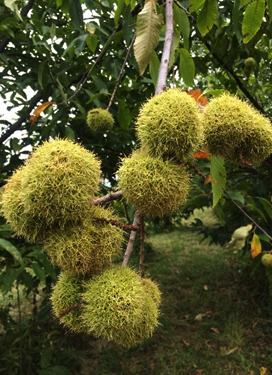
American chestnut fruit protected by a spiny bur. Photo: Dr. Shaneka Lawson, USDA Forest Service, Purdue HTIRC
In the late 1800s, 25% of hardwood trees in North America’s eastern forest were American chestnuts, 40 meters high and two meters across, they provided abundant resources for both people and wildlife in the form of food, shelter and building materials. Lightweight, rot-resistant, straight-grained and easy to work with, chestnut wood was used to build houses, barns, telegraph poles, railroad ties, furniture and even musical instruments. The rapid decline of the chestnut due to the pathogenic fungus Cryphonectria parasitica has been a subject of much debate and despair over the years, but now, chestnuts engineered to battle the fungus might give the iconic trees a chance to reclaim the North American stage.
Research conduced in 2014 was taking genes from wheat, Asian chestnuts, grapes, peppers and other plants and inserting them into American chestnut trees. William Powell of S.U.N.Y.–ESF and scores of collaborators, created hundreds of transgenic trees with the goal of almost 100 percent genetically identical wild American chestnut yet immune to C. parasitica. Testing and gathering data continues to help with future research.
Douglass Jacobs, the Fred M. van Eck Professor of Forest Biology at Purdue University, and a team of scientists at Purdue, use genomics which involves working with the complete set of an organism’s genetic material, to learn more about what causes disease. Genomics also can help identify the genes responsible for useful traits such as pest resistance.
Blight began afflicting the American chestnut in the 1900s, killing billions of trees. Despite being the target of decades-long tree-breeding efforts, the chestnut’s prospects remain in doubt. The list of at-risk species also includes ash, butternut, and bristlecone pine among other members of the five-needle white pine family.
The Hardwood Tree Improvement & Regeneration Center, a joint effort between Purdue and the Forest Service, for years has maintained a breeding program for pest resistance. Almost all of the center’s efforts to date have focused on traditional tree breeding and genomics.
“The chance to work with chestnut and help reintroduce it back to the landscape was a big reason I took the Purdue job in the first place back in December of 2001,” Jacobs said. “Watching species disappear from the landscape provides me personally with a lot of motivation to contribute whatever I can toward helping to save some of these at-risk species.”
To learn more about his research and collaboration with the U.S. Forest Service view full article Biotechnology offers holistic approach to restoration of at-risk forest tree species – Purdue University News, by Purdue Agriculture News.
Resources
A New Generation of American chestnut Trees May Redefine America’s Forests – Scientific American
Consequences of Shifts in Abundance and Distribution of American Chestnut for Restoration of a Foundation Forest Tree – Forests Open Access Forestry Journal
Transgenic American chestnuts show enhanced blight resistance and transmit the trait to T1 progeny – Science Direct (Plant Science)
Scientists Work to Create a Blight-Resistant Chestnut with Hopes of Restoring Tree to America, Forest Service, U.S. Department of Agriculture
FNR Hardwood – American Chestnut, Purdue Arboretum Explorer
Hardwood Tree Improvement Regeneration Center (HTIRC) Research Publications
American Chestnut Trees return to the Hoosier National Forest, Indiana Woodland Steward
Forest Regeneration and Restoration Laboratory, Purdue Forestry and Natural Resources, Dr. Doug Jacobs
Indiana American Chestnut Foundation
Purdue Extension – Forestry and Natural Resources (FNR)
While the weather may tell you otherwise, spring is upon us. With the changing weather comes greening grass, breaking buds and sprouting plants. This plethora of fresh growth can help cure the winter blues, but it also provides wildlife with a desirable food source. Recently you may have noticed deer and other wildlife’s increased utilization of winter wheat fields and other green areas like lawns – early spring is the time you see deer in Indiana feed extensively on grass.
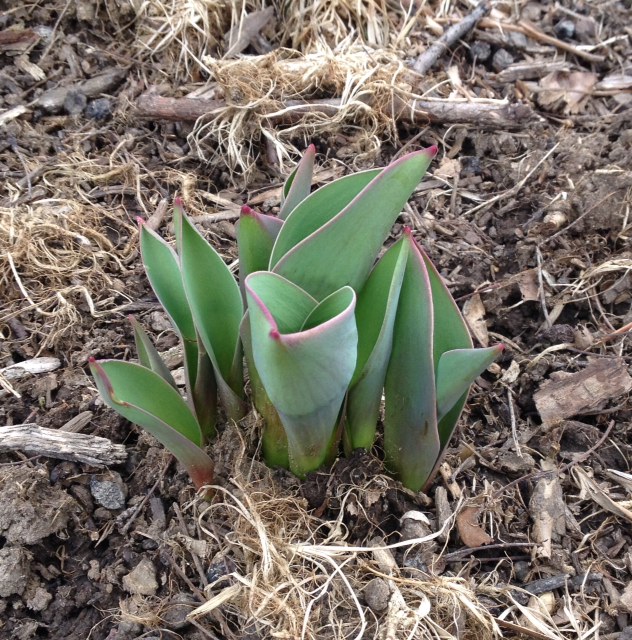 For homeowners, this is the time you need to scout around your home for emerging plants in your landscaping beds. Plants that are frequently browsed by deer such as tulips or hostas need special attention, but the limited amount of green plant material can leave any plant as a potential target. Most homeowners choose a type of taste repellent to protect plants. There are several tips on how to increase the efficacy of this approach.
- Timing: It helps to have some foresight into when damage is likely to occur and/or the plant developmental stage(s). Unfortunately, this is usually based on past experience. Ideally, you want to time applications during these periods. With tulips, for example, applying repellents early during sprouting, later during sprouting and during flower bud development will prevent damage during most years.
- Type of repellent: There are many types of taste repellents labeled for deer and other wildlife species. Most have a combination of capsaicin, putrefied egg solids and/or fatty acids of ammonium soaps. There are, of course, others with different ingredients. So which do you choose? There have been many studies that have investigated the efficacy of repellents. The bottom line – they work, but control is not 100%.
- Label: Failures can often result when not following the directions on the label. The label also provides safety information and what you can/can’t spray. Read and follow the label – it’s the law.
- Expectations: You aren’t going to solve all of your wildlife problems by spraying a few plants or even everything. If you use repellents, reapply according to label directions (every three to four weeks is usually a good rule of thumb). To increase success, you may use them as part of an integrated approach that includes exclusion, cultural practices and other approaches.
Resources
Diagnosing and Controlling Wildlife Damage
Preventing Wildlife Damage – Do You Need a Permit?
Corn and Soybean Crop Depredation by Wildlife
Wildlife Conflicts
Brian MacGowan, Extension Wildlife Specialist
Department of Forestry and Natural Resources
Winter burn is a common occurrence to boxwood, holly, rhododendron and most conifers. Winter burn symptoms often develop when temperatures warm up in late winter and early spring. This type of winter damage is often misdiagnosed as an infectious disease or damage from excessively cold temperatures.
To understand winter injury, it is important to understand that while a plant is creating its food by photosynthesis, it is releasing large amounts of water through the process of transpiration (the evaporation of water from the plant). Over the course of a day, a large tree can lose hundreds of gallons of water. When plants are unable to obtain the water they need (due to drought or frozen soil), the water lost through transpiration cannot be replenished, resulting in dehydration, foliar damage and even death.
Contacts
Michael Mickelbart, Clinical Engagement Assistant Professor
Horticulture and Landscape Architecture
Purdue University
Janna Beckerman, Associate Professor
Botany and Plant Pathology
Purdue University
Tree owners who have broken limbs in their trees or are just taking advantage of early pruning opportunities may notice large amounts of “water” that seem to be pouring out of the branch. This is actually “sap” seeping out of the damaged area, and it would have been going into the limb or branch that was removed. However, since the limb is no longer there, the sap has nowhere to go but out of the freshly cut limb or wound.
Spring weather signals to trees to come out of dormancy, and all trees start pumping water, minerals and carbohydrates upwards into the tree to allow growth of buds, leaves and shoots and will continue throughout the growing season. Certain tree species, such as maple, birch, dogwood and elms, have an exceptionally heavy sap flow in the early spring. When pruned or wounded, these trees will “bleed” quite noticeably. Under normal circumstances, it is best to delay pruning these trees until later in the growing season when the flow of sap is slower.
There is no need for alarm if this sap flow occurs and the overall health of the tree is not going to be affected. The “bleeding” may be objectionable from a cosmetic standpoint, especially if the sap is dripping directly onto people, cars or other targets beneath the wounded area. As the affected area on the tree develops callus material and naturally seals off the wound, it will slow the flow to a stop.
It is not recommended to use any type of wound dressing or covering as this will impede the ability of the tree to seal off the damaged area. Be patient and allow natural healing of the wound to occur. Always use good pruning practices and minimize the size of cut branches to reduce wound size on the tree.
Refer to the following Purdue Extension publication, Trees Need a Proper Start: Prune Them Right, for more information.
Other resources can be found at The Education Store: Pruning Ornamental Trees and Shrubs.
Lindsey Purcell, Urban Forestry Specialist
Department of Forestry and Natural Resources, Purdue University
A recent article in ScienceDaily titled “Excessive Deer Populations Hurt Native Plant Biodiversity” shares how an overpopulation of deer is hurting native plant growth. Landowners seek best management practices as these challenges arise.
For the article from the University of Miami, view: “Excessive deer populations hurt native plant biodiversity.” ScienceDaily, 20 March 2014.
Resources
Preventing Wildlife Damage, Purdue EVERYTHING Wildlife
How to Build a Plastic Mesh Deer Exclusion Fence, Purdue Extension Publication

Recent Posts
- 2026 Winter Bat Survey In Progress, MyDNR
Posted: March 27, 2026 in Wildlife - Fast-Growing Trees for the Landscape, Purdue Landscape Report
Posted: March 26, 2026 in Forestry, Urban Forestry, Woodlands - Urban Tree Spotlight: Planting Deciduous Shade Trees, Purdue Landscape Report
Posted: March 25, 2026 in Forests and Street Trees, Urban Forestry, Woodlands - Beetle that attacks Tree-of-Heaven found in Indiana, Purdue Landscape Report
Posted: March 20, 2026 in Invasive Insects, Wildlife, Woodlands - ID That Tree: Dwarf Chinkapin Oak
Posted: in Forestry, Urban Forestry, Wildlife, Woodlands - IN-PREPared: Essential Resources for Indiana’s Severe Weather Season
Posted: March 11, 2026 in How To, Safety - DNR Hiring for Indiana Conservation Officer Positions, MyDNR
Posted: March 9, 2026 in Urban Forestry, Wildlife, Woodlands - ID That Tree: Shumard Oak
Posted: in Plants, Urban Forestry, Wildlife, Woodlands - A Woodland Management Moment: Windbreak Around Walnut Plantings
Posted: March 3, 2026 in Forestry, Urban Forestry, Woodland Management Moment - Getting Certified as an Indiana Certified Prescribed Burn Manager
Posted: March 2, 2026 in How To, Urban Forestry, Woodlands
Archives
Categories
- Alert
- Aquaculture/Fish
- Aquatic/Aquaculture Resources
- Ask the Expert
- Christmas Trees
- Community Development
- Disease
- Drought
- Forestry
- Forests and Street Trees
- Gardening
- Got Nature for Kids
- Great Lakes
- How To
- Invasive Animal Species
- Invasive Insects
- Invasive Plant Species
- Land Use
- Natural Resource Planning
- Nature of Teaching
- Plants
- Podcasts
- Ponds
- Publication
- Safety
- Spiders
- Timber Marketing
- Uncategorized
- Urban Forestry
- Webinar
- Wildlife
- Wood Products/Manufacturing
- Woodland Management Moment
- Woodlands