 Purdue University - Extension - Forestry and Natural Resources
Got Nature? Blog
Indiana Department of Natural Resources (INDNR) recently received inquiries asking what to do with an abandoned animal. The INDNR web resource titled Orphaned and Injured Animals has steps to follow as you decide if the animal is truly abandoned.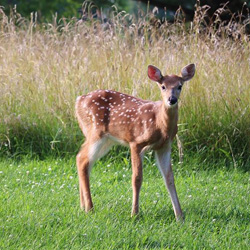
Resources
Got Nature? Orphaned Animals, author Brian MacGowan, extension wildlife specialist, Purdue University:
In most cases, the young animal is simply “spreading its wings” and exploring, or mom simply left it to get something to eat. Fawn deer are programmed to hide and remain motionless while mom is away. The fact is wildlife rarely abandons their young. They may leave briefly only to return.
Remember that you should never handle wild animals unless absolutely necessary. Any animal can bite you, and many harbor diseases and pests that can be transmitted to people.
In Indiana, wildlife rehabilitators have necessary state and federal permits to house and care for sick or injured wild animals. If you think you have found a sick or injured animal, you can find a list of licensed Wild Animal Rehabilitators in your area on the DNR Division of Fish and Wildlife’s website.
Mammals of Indiana, J.O. Whitker and R.E. Mumford
Common Indiana Mammals, R.N. Chapman and R.N. Williams, publication number FNR-413-W
Orphaned and Injured Animals, Indiana DNR
The Education Store (Search keywords to find the resources you need)
It doesn’t sound like there would be much chance of the chemical to get into the shrubs if the imidacloprid is applied close to the base of the tree. Also another thing to consider is unless you’re eating solely certified organic food, there’s a really good chance you’ve consumed very small amounts of imidacloprid at some time.
The United States Department of Agriculture (USDA) Pesticide Data Program monitored imidacloprid residues in food and published their findings in 2006. Imidacloprid was detected in a range of fresh and processed fruits and vegetables. It was detected in over 80% of all bananas tested, 76% of cauliflower and 72% of spinach samples. In all cases, however, the levels detected were below the U.S. EPA’s tolerance levels. Imidacloprid was also found in 17.5% of applesauce and 0.9% raisin samples, although percentage of detections were greater in the fresh unprocessed fruit (26.6% of apples sampled and 18.1% of grapes sampled).
These findings were on direct application to the plant, which would indicate higher concentrations than that which you would find on plants nearby those that were treated. Additionally, it is advised that if homeowners want to use a product with imidacloprid as the active ingredient, then they use one specifically labeled for edible food crops. The product label will contain specific instructions on application, pre-harvest intervals and special instructions on limiting harm to pollinators.
Resources
Purdue Pesticide Programs
Office of Indiana State Chemist – Pesticide Section
Lindsey Purcell, Urban Forestry Specialist
Department of Forestry and Natural Resources, Purdue University
 Woodlots are dynamic, vital ecosystems in the urban and suburban landscapes of the Midwest. People own these small wooded lots in urbanized areas for a variety of reasons: timber production, firewood production, recreation, wildlife habitat, aesthetics and alternative forest products. Many owners who keep and nurture these natural areas are motivated by powerful, non-economic motives based primarily on aesthetics and environmental protection.
This new Purdue Extension publication titled Indiana’s Urban Woodlots is a great way to aid you in a management plan and build your knowledge of what trees can do for you and the environment. This 24-page booklet covers benefits of trees, laws and zoning, stewardship planning, management, planting and renewal, and more.
View The Education Store for this and other Purdue Extension publications. Just type keywords in the search field to find the resources you need.
Lindsey Purcell, Urban Forestry Specialist
Department of Forestry and Natural Resources, Purdue University
Lenny Farlee, Sustaining Hardwood Extension Specialist
Hardwood Tree Improvement and Regeneration Center (HTIRC)
Department of Forestry and Natural Resources, Purdue University
An unsatisfactory approach to tree maintenance or pruning is “topping” it. Topping is the indiscriminant removal of branches of a tree above an arbitrary height, leaving unnatural, grotesque stubs and misshapen tree forms. In addition, increased risk tree conditions are introduced with development of decay, weak branch attachments and poor health.
Large evergreen trees do not respond well to topping. The removal of the upper main stem through topping opens the tree to internal decay, disease or damaging insects; it also removes the most productive portion of the tree. The practice of topping to control tree size or growth is not justified. If the tree is too large to fit the space, it should be removed and replaced with a smaller, more suitable species for its growing space.
Be aware that unprofessional tree service crews use this approach because it takes little skill and is easiest for them to perform. Do not let yourself be persuaded that topping serves your best interest; both you and your tree will suffer from such mistreatment.
The topmost part of an evergreen whose shape is pyramidal, such as a spruce tree, has a growing point known as the apical meristem. In evergreen trees, the apical meristem contains a hormone that suppresses lateral growth, helping it to keep its excurrent or pyramidal form. The further away from the tip (apical meristem), the less affect this hormone has on the lateral growth of the tree’s branches. This is why spruce trees have that pyramidal shape and are not more rounded or decurrent. By topping evergreen trees, it will destroy the apical dominance of the plant and result in growing more round than tall with a misshaped top. It will try to re-establish apical dominance as it matures, but it will most likely look very unusual and not like these species should appear with multiple competing growing tips. Remember, this is a natural form for many evergreens to help shed the heavy loads from snowfall. Remove the apical meristem (tip), and you reduce the suppression of lateral growth. This affects the shape of the spruce tree and exposes it to potentially splitting the tree down the trunk as well as exposure to the problems associated with topping.
Resources
Trees are Good
What’s Wrong with Topping Trees?
Lindsey Purcell, Urban Forestry Specialist
Department of Forestry and Natural Resources, Purdue University
According to the USDA Forest Service, an invasive species is defined as “a species that is non-native to the ecosystem under consideration and whose introduction causes or is likely to cause economic or environmental harm or harm to human health.” Invasive species, along with habitat loss and pollution, are the most severe threats to biodiversity and ecosystem function. Why are they such a problem? One factor that my colleague, Lenny Farlee, points to is that people don’t know they have a problem. That is, they are all around us, and most folks don’t even know it. People must first be able to recognize invasive species from non-invasive species. One of the more recent invaders is tree-of-heaven (Ailanthus altissima).
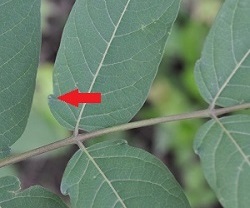
Figure 1. Tree-of-heaven have pinnately compound leaves with 11 to 27 leaflets. Each leaflet has one to several glandular teeth near the base. These are lacking on other trees and shrubs.
Don’t be fooled by the name. They are far from heaven for us. It’s actually been around for a couple hundred years. However, only over the past 10-20 years has it really begun to expand its range. This pattern is very typical of invasive species invasion. Mid-summer is one of the best times to identify and control this tree. Ohio State produced a publication on control methods, and this is linked at the end of this article. I want to focus on identification here.
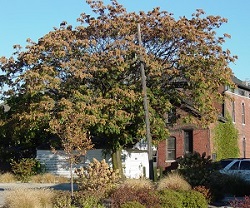
Figure 2. The fruit of tree-of-heaven are winged samaras. They can be green, red or brown in color. Numerous clusters of fruit are easily observed on tree-of-heaven during the summer.
Tree-of-heaven may be confused with similar-sized sumacs or even black walnut to the untrained eye. Because tree-of-heaven can grow very rapidly, they will often have several feet between branching along the main trunk. Some have also described the strong odor from tree-of-heaven similar to rotting peanuts. For most folks, the leaflets and fruit are the easiest features to go by. Each leaflet has one or more glandular lobes or teeth near the base. This is the best feature to differentiate it from similar species of similar size. On older trees, numerous fruit clusters will begin to form towards the end of June and will be present throughout most of July or longer. Black walnuts and other native trees with compound leaves lack these seed clusters.
Resources
Controlling Non-Native Invasive Plants in Ohio Forests: Ailanthus
Indiana Invasive Species Council
Dr. Brian MacGowan, Extension Wildlife Specialist
Department of Forestry & Natural Resources, Purdue University
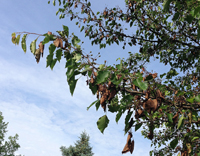 Fire blight is infecting flowering pear trees in large numbers in Indiana for the third consecutive year with a Purdue Extension specialist again urging homeowners to check their trees for symptoms.
Symptoms of the potentially deadly disease with no cure are wilting shoots, cankers on branches and blackened leaves, which give the disease its name because trees appear to be scorched.
Resources
Purdue Pest and Plant Diagnostic Laboratory
The Education Store
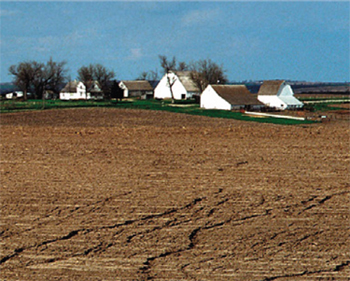 Because agriculture dominates the midwestern landscape, it has a huge impact on environmental quality. Agricultural producers are often advised to adopt practices that help to reduce the impact of agriculture on the environment. However, like all humans, they are often reluctant to change, which makes the work of conservation professionals extremely challenging. In this publication, we explore the myths and realities around what motivates farmers to adopt conservation practices. We draw on the authors’ combined research and applied practitioner experience with farmer adoption of conservation practices. Most evidence is based on studies and observations of traditional row-crop farmers in the midwestern United States.
Adoption of Agricultural Conservation Practices
The Education Store
Purdue Extension
Spring time brings a cacophony of frog calls around ponds and wetlands, but as spring slowly transitions into summer, the warmer temperatures signal the breeding season for many of our native reptiles. One of the oldest and most primitive reptile groups are the turtles. These ancient reptiles have remained relatively unchanged for 225 million years. There are currently ~300 species of turtles worldwide, and 18 species are found in Indiana. Most turtles in Indiana are associated with water, particularly waters that provide a variety of food items, basking sites and adjacent upland habitats. While Indiana is home to a diversity of turtle species, many are declining in number across their range. There are many factors contributing to these declines, but one that is particularly important this time of year is road mortality.
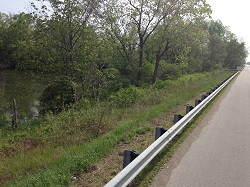
Figure 1: Small pond containing semi-aquatic turtles with a major road intersecting adjacent breeding habitat.
Why do you see so many turtles crossing the road in late spring and early summer (May-June)? This is the time of year when most of our turtles are searching for adequate nesting sites. Unlike amphibians that generally lay their eggs directly in the water, female turtles search for nesting spots in open, unshaded areas where the soil is not muddy or subject to flooding. Nests are often located on the nearest spot of land providing these conditions, but females of some species may travel 1-2 kilometers in search of a suitable net site.
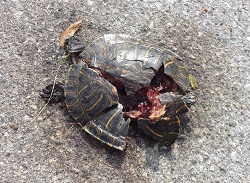
Figure 2: Female Red-eared Slider killed while attempting to cross the road to lay eggs at nearby upland nesting site.
Unfortunately, many of the upland sites are separated from ponds, lakes and streams by roads (Figure 1). As the females leave the ponds to lay eggs, they are forced to cross busy roads and may suffer incredibly high mortality rates (Figure 2). Females are more prone to road mortality than males (which are not required to leave the water to lay eggs), resulting in some populations consisting of nearly all male turtles. Increased female mortality lowers population growth rates (once the female is killed, so are the eggs she was carrying). To further complicate matters, turtles are long-lived species (up to 100 years), and females may not reach sexual maturity for 8-25 years.
What can you do to help? Increase vigilance and slow down when driving, especially in areas where roads intersect ponds and adjacent uplands. If you encounter an injured turtle that needs medical attention, call the Indiana DNR at 800-893-4116 or 317-232-4080 during business hours, 765-473-9722 (northern half of Indiana) or 812-837-9536 (southern half of Indiana) after hours or visit wildlifehotline.info.
For more information on turtles:
The Turtles of Indiana
The Education Store (Search keywords for more information)
Rod Williams, Associate Professor of Wildlife Science
Department of Forestry and Natural Resources, Purdue University
The month of May is not only known for producing flowers but the start of the white-tailed deer fawning season. In fact, nearly 90% of all white-tailed deer fawns are born between mid-May and mid-June. This time of year coincides with many of the outdoor activities that we all enjoy (hiking, mushroom hunting and shed hunting) and may sometimes bring us into contact with deer fawns.
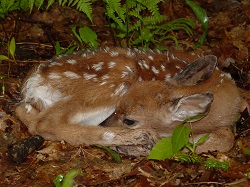
Figure 1. White-tailed deer fawn hiding in cover while the mother is off feeding.
When out enjoying nature, it is not uncommon to come upon a fawn tucked away under brushy cover, alone (Figure 1). At first glance, it may appear that the fawn has been abandoned by its mother, but this is rarely the case. This is actually part of the doe’s strategy to keep her fawn alive. Caching fawns in heavy cover serves to keep the fawn out of sight and away from would-be predators. A fawn will instinctively stay bedded down, remain motionless and silent until its mother returns from feeding. However, if harassed, the fawn may eventually leave the safety of cover and bleat in distress which results in the doe returning immediately to her fawn.
If you happen upon a fawn in the wild, you should not handle or harass it. Handling young fawns can distress not only the fawn, but the mother that is likely close by. If you happen to find a fawn cached in the woods, admire its hiding spot, spotted camouflage pattern and perhaps snap a photo. Take pride in knowing that the young fawn is not an abandoned orphan and will soon grow into the largest wild mammal in Indiana.
Under no circumstance should you remove a fawn from its hiding place. Removing wildlife from the environment is illegal without a proper handling permit from the Department of Natural Resources. If you find a sick or injured animal, you should contact your DNR law enforcement district or regional headquarters. The DNR does not care for injured animals but can connect you to licensed wildlife rehabilitators with the appropriate permits to care for injured wildlife.
Sources
Mammals of Indiana, J.O. Whitker and R.E. Mumford
Common Indiana Mammals, R.N. Chapman and R.N. Williams, FNR-413-W
Indiana DNR Orphaned and Injured Animals
Rod Williams, Associate Professor of Wildlife Science
Department of Forestry and Natural Resources, Purdue University
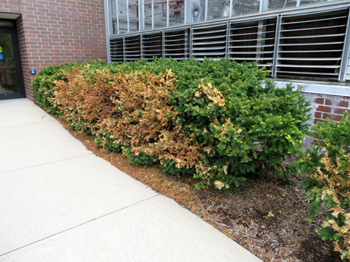 Extreme cold last winter, unrelenting winds and unusually large amounts of salt that were applied to roads, sidewalks and parking lots are taking their toll on landscape plants this spring, a group of Purdue University experts say.
They are seeing considerable damage and expect more this summer and beyond. While it is difficult to determine winter injury until bud break, they say it is now time for homeowners and others with ornamental plants to evaluate their plants for damage that needs to be corrected.

Recent Posts
- Heavy August Rains Bring More Mosquitoes to Indiana
Posted: September 9, 2026 in How To, Invasive Insects, Safety, Wildlife - Question: Why Did the Shagbark Hickories Survive the Tornado?
Posted: August 27, 2026 in Forests and Street Trees, How To, Urban Forestry - New Indiana Woodland Steward Newsletter
Posted: August 12, 2026 in Forestry, Urban Forestry, Wildlife, Woodlands - Indiana Fall Hunting Licenses on Sale and New Mobile App Available
Posted: in Forestry, How To, Wildlife - Trees and Storms: Understanding Damage, Risk and Recovery
Posted: in How To, Urban Forestry - Lighting a Spark: Prescribed Burn Associations
Posted: August 6, 2026 in Community Development, Forestry, Safety, Wildlife - ID That Tree: Nannyberry Viburnum
Posted: July 22, 2026 in Forestry, Plants, Wildlife, Woodlands - ID That Tree: Eastern Swamp Privet
Posted: in Forestry, Plants, Wildlife, Woodlands - Jarred Brooke Receives Early Career Award for Prescribed Fire Work
Posted: July 20, 2026 in Forestry, Forests and Street Trees, Natural Resource Planning, Safety - Bovine Tuberculosis in Wild White-tailed Deer: Background and Frequently Asked Questions
Posted: in Disease, Natural Resource Planning, Wildlife
Archives
Categories
- Alert
- Aquaculture/Fish
- Aquatic/Aquaculture Resources
- Ask the Expert
- Christmas Trees
- Community Development
- Disease
- Drought
- Forestry
- Forests and Street Trees
- Gardening
- Got Nature for Kids
- Great Lakes
- How To
- Invasive Animal Species
- Invasive Insects
- Invasive Plant Species
- Land Use
- Natural Resource Planning
- Nature of Teaching
- Plants
- Podcasts
- Ponds
- Publication
- Safety
- Spiders
- Timber Marketing
- Urban Forestry
- Webinar
- Wildlife
- Wood Products/Manufacturing
- Woodland Management Moment
- Woodlands