 Purdue University - Extension - Forestry and Natural Resources
Got Nature? Blog
Communities that have been infested by emerald ash borers can apply for a share of a federal grant received by the Indiana Department of Natural Resources. This federal grant worth $100,000 will allow for communities in the Great Lakes area to take on tree-planting projects. Due to the loss of trees in the infested areas, planting trees will help replace the large amounts of trees lost by the emerald ash borer. The tree planting project will also improve water quality. Flooding due to storms can cause raw sewage to enter waterways, but trees can intercept the water to stop the flooding. A three inch tree is able to intercept around 400 gallons of water; 800 trees can intercept 320,000 gallons of water which can greatly decrease the chances of flooding. Communities that would like to apply for a share in the grant can first subscribe to the grants information listserv by visiting the Indiana DNR’s forestry site and click on the red envelope on the left side of the page.
Resources
DNR Receives Grant to Help Communities Recover From Ash Borer, Indiana DNR
Emerald Ash Borer, Purdue Extension
Emerald Ash Borer, Indiana DNR
Invasive Insects, Got Nature?
Arrest That Pest! – Emerald Ash Borer in Indiana, Purdue Extension
Carrie Tauscher, Urban Forestry Specialist
Indiana Department of Natural Resources (INDNR)
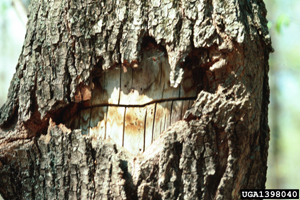
Glycobius speciosus, sugar maple borer, photo by Steven Katovich, USDA Forest Service.
Some of the most diverse taxa on the planet are rarely seen yet play critical roles within our environment. The insects found in the Order Coleoptera (beetles) are represented by over 500,000 species. Collectively, these insects provide a wide range of ecosystem services. They are important pollinators and predators on other insects, and they play essential roles in nutrient cycling. While most species are beneficial or vital for ecosystem functions, there are a few species that are considered pests.
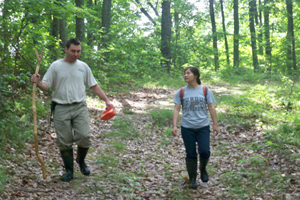
Dr. Jeff Holland and research team studying sugar maple borer in the woods.
The Sugar Maple Borer is a native species found throughout the eastern United States. The larval stage of the beetle specializes in feeding on sugar maple trees, particularly stressed or injured trees. In this podcast, our host, Rod Williams, will be interviewing Dr. Jeff Holland about the unique distribution of this wood-boring beetle, how to survey for this species on your property and the impacts to sugar maple trees throughout the eastern deciduous forests.
To find out more information about sugar maple borers, visit:
Holland Website
Bug Guide Identification
Resources
The Education Store (Search entomology or forest)
Got Nature? Blog Posts
Got Nature? Blog Posts
Jeff Holland, Associate Professor of Spatial Ecology and Biodiversity
Department of Entomology, Purdue University
Rod Williams, Associate Professor of Wildlife Science
Department of Forestry and Natural Resources, Purdue University
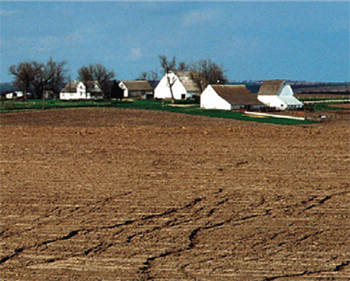 Agricultural educators, community organizers and others promoting environmental awareness can learn about the myths and realities of agricultural conservation from the perspective of a researcher, practitioner and student in a new Purdue Extension publication.
Adoption of Agricultural Conservation Practices: Insights from Research and Practice, developed by the Department of Forestry and Natural Resources at Purdue University, is available for free download from The Education Store.
The authors (Linda Prokopy, associate professor of Natural Resource Social Science; Dan Towery, Indiana Conservation Cropping System Initiative educator; and Nicholas Babin, postdoctoral research assistant in Forestry and Natural Resources) use academic studies and their own observations to address ways of motivating farmers to adopt environmentally-friendly farming practices.
To read the full article, visit Ag conservation publications available from Purdue Extension, Purdue Agriculture News.
Resources
Indiana Soils: Evaluation and Conservation Manual Review, Purdue Agronomy
Conservation Tillage and Water Quality, Purdue Extension
Optimizing Conservation Tillage Systems: Plant-to-Plant Uniformity is Essential for Optimum Yield in No-Till Cont. Corn, The Education Store
Linda Prokopy, Associate Professor of Natural Resource Social Science
Department of Forestry and Natural Resources
 The Wildlife Habitat Education Program (WHEP) helps students understand wildlife ecology and management practices. In addition, students gain skills in teamwork, oral and written communication, decision-making and leadership. The WHEP career development event includes three activities: Wildlife Challenge, Wildlife Management Practices and Wildlife Management Plan. Each activity has an important role in teaching about the management of wildlife populations. The instructions in this publication can help leaders teach students to evaluate habitat for Wildlife Management Practices (WMPs).
Wildlife Habitat Education Program – Teaching and Learning Wildlife Management Practices is available at The Education Store today.
Resources
Wildlife Habitat Education Program (WHEP)
A Template for Your Wildlife Habitat Management Plan, The Education Store
Managing Forest and Wildlife Resources: An Integrated Approach, The Education Store
Teaching and Learning Wildlife Management Practices, The Education Store
Indiana’s State Wildlife Action Plan, Indiana DNR
Brian MacGowan, Extension Wildlife Specialist
Department of Forestry and Natural Resources
Emerald Ash Borer University will be providing webinars on the wood-boring pest, the Emerald Ash Borer, along with other pests and disease threats. These live sessions will allow participants to ask questions to the session presenter and moderators. The webinars will last from October to December 2014. To view the webinars, visit the Emerald Ash Borer website.
Resources
Emerald Ash Borer, Purdue Extension
Emerald Ash Borer, Indiana DNR
Invasive Species, Got Nature?
Arrest That Pest! – Emerald Ash Borer in Indiana, Purdue Extension
Cliff Sadof, Professor-Ornamental & Pest Management
Purdue Department of Entomology
For the first time in history, the majority of people reside in cities. For a species that evolved to live in small, primate tribes on the African Savanna, such a migration marks a dramatic shift. In recent years, it’s become clear that such unnatural surroundings have important implications for our mental and physical health and can powerfully alter how we think.
Enter the urban forest. This article, titled How The City Hurts Your Brain by Jonah Lehrer on Boston.com, shares some insight on healthy living in urban areas. Because of the huge migration to city life, urban forests and park spaces have become an integral part of living a healthy life. The good news is that even slight alterations, such as planting more trees in the inner city or creating urban parks with a greater variety of plants, can significantly reduce the negative side effects of city life.
To view more information, see the Urban Forests post from the National Association of State Foresters (NASF).
The Indiana Department of Natural Resources (INDR) has proposed an idea to the state of Indiana to begin work on a two-mile-long berm in northeast Indiana. The berm will restrict Asian carp from reaching the Great Lakes. It will prevent voracious invasive species from jumping from the Mississippi River watershed during floods to a Great Lakes tributary in Eagle Marsh southeast of Fort Wayne. INDR hopes that work will begin this fall and be completed by September 15, 2015.
View the full article, Work Near on Indiana Berm to Block Asian Carp, from greenbaypressgazette.com.
Resources
Indiana Department of Natural Resources
Asian Carp Movements Project, INDR
Eagle Marsh, Little River Wetlands Project
Invasive Asian Carp May Be Able To Spread Further Than Once Thought, Purdue News
Shocking Asian Carp Out of Midwest Rivers Not a Viable Option, Purdue News
Purdue Agriculture Research: Asian Carp, YouTube video
Got Nature? Podcasts
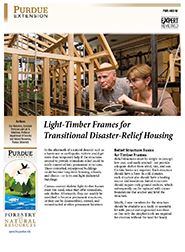 In the aftermath of a natural disaster such as a hurricane or earthquake, victims could get more than temporary help if the structures erected to provide immediate relief could be easily converted into permanent structures. These converted repurposed buildings could become long-term housing, schools and clinics—or farm and light-industrial buildings. This six-page publication describes two different approaches to building canvas-covered, skeletal, light-timber frames to meet this need.
Light-Timber Frames for Transitional Disaster-Relief Housing is available as a free download at The Education Store.
Resources
First Steps to Flood Recovery, The Education Store
Disaster Recovery, IN.gov
Eva Haviarova, Associate Professor of Wood Products
Department of Forestry and Natural Resources
The Guardian has published an article in regards to the large loss of wildlife in the past 40 years. Due to humans’ rapid consumption practices and our ecological footprint, the Earth cannot replenish what we use fast enough. The WWF analyzed 10,000 different populations consisting of animals, fish and birds in the study to create a representative “Living Planet Index” (LPI). The study showed that freshwater ecosystems had the fastest declining population. While the biggest decline in animal numbers are in low income, developing nations, rich nations are “outsourcing” wildlife decline in developing countries by importing food and other goods produced through habitat destruction. What can you do to make a difference to help keep the Earth clean?
View the full article, Earth Has Lost Half of its Wildlife in the Past 40 Years, says WWF, at theguardian.com.
Resources
Living Planet Report 2014, WWF.panda.org
Land and Water Conservation Fund, Indiana DNR
Saving Energy in Your Home series, The Education Store
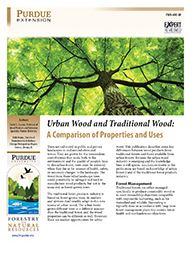 Trees are cultivated in public and private landscapes in and around cities and towns. They are grown for the tremendous contributions they make both to the environment and the quality of people’s lives. In this urban forest, trees must be removed when they die or for reasons of health, safety or necessary changes in the landscape. The wood from these felled landscape trees could potentially be salvaged and used to manufacture wood products but not in the same way as forest-grown trees. This publication describes some key differences between wood products from traditional forests and those available from urban forests.
Urban Wood and Traditional Wood: A Comparison of Properties and Uses is available at The Education Store as a free download.
Resources
Lumber from Hardwood Trees, The Education Store
Winterize Your Trees, The Education Store
Lumber from Urban and Construction-Site Trees, The Education Store
Indiana’s Urban Woodlots, The Education Store
Dan Cassens, Professor of Wood Products and Extension Specialist
Department of Forestry and Natural Resources
Edith Makra, Chairman
Illinois Emerald Ash Borer Wood Utilization Team

Recent Posts
- 2026 Winter Bat Survey In Progress, MyDNR
Posted: March 27, 2026 in Wildlife - Fast-Growing Trees for the Landscape, Purdue Landscape Report
Posted: March 26, 2026 in Forestry, Urban Forestry, Woodlands - Urban Tree Spotlight: Planting Deciduous Shade Trees, Purdue Landscape Report
Posted: March 25, 2026 in Forests and Street Trees, Urban Forestry, Woodlands - Beetle that attacks Tree-of-Heaven found in Indiana, Purdue Landscape Report
Posted: March 20, 2026 in Invasive Insects, Wildlife, Woodlands - ID That Tree: Dwarf Chinkapin Oak
Posted: in Forestry, Urban Forestry, Wildlife, Woodlands - IN-PREPared: Essential Resources for Indiana’s Severe Weather Season
Posted: March 11, 2026 in How To, Safety - DNR Hiring for Indiana Conservation Officer Positions, MyDNR
Posted: March 9, 2026 in Urban Forestry, Wildlife, Woodlands - ID That Tree: Shumard Oak
Posted: in Plants, Urban Forestry, Wildlife, Woodlands - A Woodland Management Moment: Windbreak Around Walnut Plantings
Posted: March 3, 2026 in Forestry, Urban Forestry, Woodland Management Moment - Getting Certified as an Indiana Certified Prescribed Burn Manager
Posted: March 2, 2026 in How To, Urban Forestry, Woodlands
Archives
Categories
- Alert
- Aquaculture/Fish
- Aquatic/Aquaculture Resources
- Ask the Expert
- Christmas Trees
- Community Development
- Disease
- Drought
- Forestry
- Forests and Street Trees
- Gardening
- Got Nature for Kids
- Great Lakes
- How To
- Invasive Animal Species
- Invasive Insects
- Invasive Plant Species
- Land Use
- Natural Resource Planning
- Nature of Teaching
- Plants
- Podcasts
- Ponds
- Publication
- Safety
- Spiders
- Timber Marketing
- Uncategorized
- Urban Forestry
- Webinar
- Wildlife
- Wood Products/Manufacturing
- Woodland Management Moment
- Woodlands