 Purdue University - Extension - Forestry and Natural Resources
Got Nature? Blog
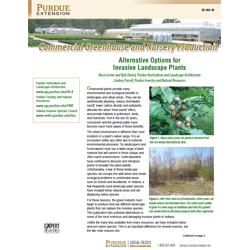 Ornamental plants provide many environmental and ecological benefits to landscapes and urban areas. They can be aesthetically pleasing, reduce stormwater runoff, lower carbon dioxide and pollutants, alleviate the urban “heat island” effect and provide habitats to pollinators, birds and mammals. And in the last 20 years, consumers and the general public have become much more aware of these benefits. The urban environment is different than most locations in a plant’s native range. It is an ecosystem unlike any other due to extreme environmental pressures, so landscapers and homeowners must use a wide range of plant material that will survive in these unique and often harsh environments. Horticulturalists have continued to discover and introduce plants to broaden the plant palette. Unfortunately, a few of these landscape species can escape into wild areas and create ecological problems in unintended areas such as forests and woodlands. In Indiana, a few frequently used landscape plant species have invaded these natural areas and are displacing native species.
For these reasons, the green industry must begin to produce and use different landscape plants that can replace the invasive species. This publication lists potential alternatives to some of the most notorious and damaging invasive plants in Indiana.
For a free download of the full publication, visit Commercial Greenhouse and Nursery Production: Alternative Options for Invasive Landscape Plants.
Resources
Native Trees of the Midwest, The Education Store
Shrubs and Woody Vines of Indiana and the Midwest, The Education Store
FNR/Purdue Extension YouTube Video Playlist, Asian Bush Honeysuckle, Burning Bush and Multiflora Rose
Purdue Plant & Pest Diagnostic Laboratory (PPDL) (Send in samples or photos)
Lindsey Purcell, Chapter Executive Director/Certificate Liaison
Indiana Arborist Association
Rosie Lerner, Horticulturist
Retired
 The Community & Urban Forestry’s Tree Steward Program is designed for homeowners, tree board members, municipal employees, community members, volunteers, students, Master Gardeners and anyone that has an interest in learning more about trees and giving back to their community forest.
Trainers include City Foresters, Certified Arborists, Foresters, Purdue Extension Agents, District Conservationists and other natural resource professionals.
Participants gain knowledge on a variety of community forestry and tree care-related topics, ideas on how to share their knowledge in their communities and an introduction to local and state tree care professionals.
Topics include:
- The Scoop on Soils
- How Does a Tree Grow? (Tree Physiology)
- Tree Identification
- The Right Tree for the Right Place (Tree selection and placement)
- Proper Tree Planting
- Caring for Your Trees
- Threats to Trees: Pests and Disease Diagnosis
- Pruning Do’s & Don’ts
- Identifying Tree Defects
- Benefits of the Urban Forest
- Why Urban Woodlots are Important
- Volunteer Opportunities
For more information, take a look at the Tree Stewards Handout or the Tree Stewards Brochure.
When: Thursday, May 28 and Friday, May 29, 2015, 8:30 am – 4:30 pm
Where: Hayes Arboretum, Nature Center, 801 Elks Rd., Richmond, IN 47374
Cost: $30, includes lunch and refreshments
Registration: Deadline to register is May 21, 2015. Register online using the Indiana DNR events registration form.
Resources
Plant For The Sun – Choose, Plant Trees Wisely for Energy Efficiency, Got Nature?
Indiana’s Urban Woodlots, The Education Store
Indiana Community Tree Selection Guide, Indiana Department of Natural Resources
Indiana Department of Natural Resources
Lindsey Purcell, Urban Forestry Specialist
Department of Forestry and Natural Resources, Purdue University
 Question: Weeping willow, six years old and 9″ diameter. Wet, clay ground and thriving. Late last summer, I noticed the leaves were dead suddenly, and the bark on the trunk was completely loose and falling off. No other trees or shrubs within 50 feet (black walnut, sycamore, maple or rose of Sharon) were affected. No obvious sign of insects, boring, trails, worms, etc. What happened?
Answer: When a tree starts to lose leaves, especially in the spring when they should be expanding for the new growing season, it can be puzzling. Often, this is a sign of trouble that can be caused by biotic or abiotic issues but not always a major cause for alarm. The dropping leaves can be a symptom of foliar diseases which weakens the tree, or it could be the results of an insect pest feeding on the petioles of the leaves. There are many pests which can cause leaf drop.
Another possible cause is the response to abiotic disorders which is typically a complex of issues. Leaf drop can occur on trees that have been exposed to prolonged wetness in heavy, clay soils. Some tree species like wet soils but not prolonged wetness without drainage. If trees are exposed to continual wetness, their roots can become diseased and cause the leaf drop. Additionally, it has been noted that trees that were planted improperly, especially if planted too deep, can result in several physiological issues such as decline and dieback.
If trees reveal symptoms of premature fall color, yellowing of leaves or unusual leaf drop, it may be necessary to send in a sample for diagnosis. The Purdue Plant and Pest Diagnostic Laboratory (PPDL) provides this service by a very capable team of pathologists, entomologists and extension specialists to analyze plant issues in the landscape. This is an inexpensive approach to investigate the issues and lead to the best possible curative measures. Protocol for submitting plant samples can be found on the PPDL website.
Resources
Hardwood Tree Improvement and Regeneration Center
Relationships Between Advance Oak Regeneration and Biotic and Abiotic Factors, Songlin Fei, Associate Professor of Measurements and Quantitative Analysis
Diseases of Landscape Plants: Leaf Diseases, The Education Store
Lindsey Purcell, Urban Forestry Specialist
Department of Forestry and Natural Resources, Purdue University
 “The Walnut Twig Beetle (WTB), Pityophthorus juglandis, the insect involved in Thousand Cankers Disease of Black Walnut (TCD), has been detected in Indiana for the first time at a Franklin County sawmill.
The beetle was detected in a trap placed at the sawmill for a 2014 statewide survey for WTB. Additional WTBs were found during an inspection of walnut logs and lumber at the sawmill. TCD is caused by the fungus Geosmithia morbida that is transmitted by WTB.
The beetles bore into walnut branches, feeding on the tree’s tissues and depositing the fungus that creates a canker, or dead area, under the bark. Multiple feedings cause the formation of thousands of cankers under the bark and destroy the tree’s ability to transport water and nutrients. Gradually the tree dies.
Tests for the fungus from the collected beetles and walnut samples in Franklin County are ongoing. So far, the fungus has not been detected. Surveys at the sawmill have not detected any infested walnut trees. Another survey is planned for this summer for the area surrounding the sawmill.
State Entomologist Phil Marshall has ordered the sawmill quarantined. The sawmill is working with the DNR and is destroying walnut material on the property to prevent movement of TCD from the property.”
Note that no live trees have been found with TCD in Indiana yet. It is not recommended that landowners cut their walnut trees due to the disease. Instead, it is recommended that residents do not move firewood or other bark on materials of any species due to the risk of transporting known and unknown insects and diseases.
View Thousand Cankers Disease, Indiana Department of Natural Resources, for more information.
Resources
Walnut Anthracnose, Walnut Notes, U.S. Department of Agriculture, Forest Service, North Central Forest Experiment Station
Indiana Walnut Council, Industry Representatives include 45 states and 3 foreign countries
Diseases in Hardwood Tree Plantings, The Education Store, Purdue Extension resource center
Study: Fungus Behind Deadly Disease in Walnut Trees Mutates Easily, Complicating Control, Purdue Agriculture News
Indiana Walnut Council
Diseases in Hardwood Tree Plantings, The Education Store, Purdue Extension resource center
Why are my walnut trees dropping their leaves?, Purdue Extension – Forestry & Natural Resources (FNR) Got Nature? Blog
Invasive Species Walnut Twig Beetle Detected in Indiana, Purdue Extension – FNR Got Nature? Blog
Intro to Trees of Indiana: Black Walnut, Purdue Extension – FNR Got Nature? Blog
Planting Hardwood Seedlings in the Central Hardwood Region, The Education Store
Regenerating Hardwoods in the Central Hardwood Region: Soils, The Education Store
Fertilizing, Pruning, and Thinning Hardwood Plantations, The Education Store
Resources and Assistance Available for Planting Hardwood Seedlings, The Education Store
Ever been to Michigan’s Upper Peninsula? I had the opportunity to go (first time visiting Michigan, yay!), and to make it even more awesome, I got the chance to touch yearling black bear cubs. Through Purdue’s Student Chapter of The Wildlife Society, some students had the chance to go to Crystal Falls, Michigan, to shadow Mississippi State graduate students with a project they were working on concerning white-tailed deer. So of course I went. What else am I going to do on a random weekend in February?

We arrived in Michigan eight hours later with plenty of snow on the ground and the temperature already near the negatives. We met up with the graduates Sunday, and they explained to us the purpose of their project: looking into the population decline of white-tailed deer. In order to fully analyze the decline, the project needed to look into the role of predators, winter weather, habitat and the condition and reproduction of deer in order to understand the aspects affecting the population.
So what does this entail? Well first, we hiked through the deep snow in the woods to reach bobcat hair snares to collect any fur, feathers or hair found on thin, spiky coils of wire. The sites were baited with a deer rib cage or beaver which attracted a variety of visitors including bobcats, wolves, coyotes, martens, fishers, hawks, owls, chickadees, snowshoe hares and even flying squirrels. By collecting the hair or feathers caught in the snares, the graduates could collect data using the DNA from the samples. It’s amazing how much you can do with just a little bit of fur!
Next we checked deer traps, which are called clover traps. Mainly they wanted to catch pregnant does, so they could radio collar them and track their progress. They also used a temperature measuring device to get data on whether the doe was alive or dead and whether or not she had dropped fawn (the device would fall out upon birth as it was placed in the vagina of the animal). I got the chance to use telemetry to locate a doe and see whether or not she was alive by the frequency of the feedback.
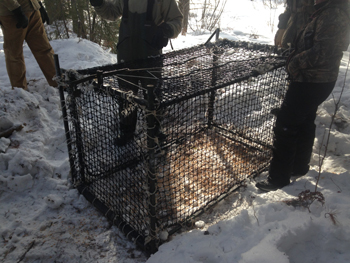
The graduates also wanted us to have the opportunity to see what process they used when they received feedback that a doe was dead. They had a unique case where a radio-collared doe was hunted down by wolves, so we traveled over to the site and saw her remains. We were shown several ways of identifying whether it was a wolf kill or not; this included taking into consideration the space between teeth marks in bite wounds, whether there was hemorrhaging beneath the skin (this only occurs when a deer is alive and bleeding, indicating that it was being hunted) and inspecting the carcass to see if there was blood foam on the nose which indicated a crushed throat where blood from the jugular is mixed with breath. Wolves have a unique way of hunting, as does any predator, and knowing the different marks they leave can help decipher between the different predators.
After seeing the aftermath of a wolf kill, we asked if we could go out at night and try to get one to respond to howls. So with the temperatures just above -30 degrees, we ventured out into the woods and eventually to a frozen lake. We did get a few coyotes to respond, but the wolves were silent, making me wonder if they knew the difference between a recording and a real wolf or if they could smell us nearby. Either way, it was still awesome.

On the final day in Michigan, we had the best opportunity of all: getting up close and helping take measurements on wild black bears. The mother and two cubs were sedated and pulled from their den while we had the chance to touch them and help collect data. It was an incredible experience seeing the cub up close; she was licking her nose (a typical habit of sedated bears) and shivering. We did our best to keep her warm, and the work up took about an hour to complete.
It is projects like these that really give you a glimpse into a day in the field as a wildlife biologist and what can be achieved by completing this research. The data provided by this project will be used for years to come in determining whether predator control is necessary and what the real factors causing deer decline are. It gives people a glimpse into the multiple mechanisms at play when it comes to nature. There is never a simple answer.
Resources
Purdue Student Chapter of The Wildlife Society, Purdue FNR
FNR Majors & Minors, Purdue FNR
Student Life, Purdue FNR
Morgan Sussman, Freshman
Department of Forestry and Natural Resources
 ‘Twas the day before Arbor Day, when all through the park,
Not a creature was stirring, no chirp, squeak or bark.
The birds were perched on the utility wires with care,
In hopes that many trees soon would be there.
All types of squirrels, gray, fox and red,
Had visions of oak trees dancing in their head;
And mama with her overalls, and I my work jeans,
Were prepared and ready to make the park green.When out in the park, there arose such a clatter,
I sprang to my window to see what was the matter.
Away out my door, I flew like a flash,
Running to the crowd that was gathered ‘round the ash.The dead looking tree with no leaves to show,
Gave a glimmer of midday through its branches to objects below.
When what to my wondering eyes came ‘round the corner with ease,
But a miniature truck and in the bed, eight tiny trees.With a little old driver, so lively and quick,
I knew in a moment it must be Mayor Nick.
The trees looking so healthy and flourishing as they came,
He whistled and shouted and called them by name:”White Oak! Red Cedar! Silver Maple and Black Cherry!
Cottonwood, Black Walnut, American Beech and Hackberry!
It is time to grab your gloves, shovels and spades!” He did call,
“Now plant away! Plant away! Plant away all!”With his blueprints out, he started to show,
Where in the park each tree would go.
So excited and anxious with all my gear, I flew
To the truck full of trees, and Mayor Nicholas too.
And then, in a moment, I heard on the road,
The roaring of more trucks with trees overflowed.
As I lifted my head and was turning around,
The city forester and many arborists came with a bound.
Mayor Nick had called in the professionals to help us out,
So we all would understand what this project was all about.
“Before we start planting, I want to explain
the benefits from these trees the city will gain!
Trees increase property value and improve living conditions.
They also relieve stress and help with (CO2) emissions.
Better air and water quality and sound barriers too,
And the best part is the beautiful new view!”
After Mayor Nick’s speech, the city forester stepped in.
“Whose ready to plant some trees?” he said with a grin.
The crowd cheered, and the project was now on its way,
Making the park beautiful and green in honor of Arbor Day.
First thing we had to do was remove the dead trees.
The park was originally filled with ash, which was a feast for EAB.
The arborists cut all the trees down one by one.
There was so much help, in no time the cleanup was done.
As we finally started planting, the professionals came around,
Making sure we were putting the trees properly into the ground.
I learned that you cut and remove only ⅓ – ½ of the B&B.
Then you check the roots, the most important part of the tree.
If the tree has spiraling roots, all four sides must be sawed,
So the tree’s way of nutrient uptake and anchorage is not flawed.
It is also important that the root flare is not below the soil line.
Many people tend to bury it, thinking their tree will be fine.
Before planting your tree, consider the tree’s full-grown size.
Improper planting can cause the tree to die otherwise.
I’m so glad I decided to volunteer today.
I learned so much about planting trees the right way!
After countless hours of hard work and sweat,
Mayor Nick’s goals for the park were finally met.
He thanked everyone, and as he drove out of sight,
He shouted “Happy Arbor Day to all, and to all a good night!”
Resources
FNR Majors & Minors, Purdue FNR
Prospective Students, Purdue FNR
We Know Nature! FNR: This is Your Classroom Project Video
Erin Hipskind, Forestry Student
Department of Forestry and Natural Resources, Purdue University
The Useful to Usable climate initiative based at Purdue University has added an online tool enabling farmers and agricultural advisers to better assess how climate patterns in other parts of the world can influence local conditions and corn yields across the Corn Belt.The Climate Patterns Viewer can help growers make more informed farm management decisions during different phases of the El Niño Southern Oscillation and Arctic Oscillation. It relates historical events of those phases to the effects of associated precipitation and temperatures over the course of a year.
“By tapping into this historical data, growers and advisers can get a sense of what conditions might be coming during a particular ENSO or AO phase based on past experience,” said Melissa Widhalm, project manager of Useful to Usable, or U2U. “The Climate Patterns Viewer is an invaluable planning tool, whether you’re deciding what and when to plant or how to deal with a cooler and shorter growing season.”
Hans Schmitz, Purdue Extension educator and agricultural meteorologist, noted that certain areas of the Corn Belt can be quite a bit drier, wetter, warmer or cooler than average because of the ENSO and AO oscillations.
“The ability to look at the historical effect month-by-month better influences management decisions this growing season,” he said.
More information about this and other U2U tools is available on the U2U website.
Resources
National Institute of Food and Agriculture, (NIFA)
Indiana Small Farm Conference, Purdue Department of Agriculture
Climate Change and Greenhouse Gas Mitigation: Challenges and Opportunities for Agriculture, The Education Store
Melissa Widhalm, Useful to Usable Project Manager
Department of Forestry and Natural Resources

“The U.S. Fish and Wildlife Service announced today it is protecting the northern long-eared bat as a threatened species under the Endangered Species Act (ESA), primarily due to the threat posed by white-nose syndrome, a fungal disease that has devastated many bat populations.
At the same time, the Service issued an interim special rule that eliminates unnecessary regulatory requirements for landowners, land managers, government agencies and others in the range of the northern long-eared bat. The public is invited to comment on this interim rule as the Service considers whether modifications or exemptions for additional categories of activities should be included in a final 4(d) rule that will be finalized by the end of the calendar year. The Service is accepting public comments on the proposed rule until July 1, 2015, and may make revisions based on additional information it receives.
‘Bats are a critical component of our nation’s ecology and economy, maintaining a fragile insect predator-prey balance; we lose them at our peril,’ said Service Director Dan Ashe. ‘Without bats, insect populations can rise dramatically with the potential for devastating losses for our crop farmers and foresters. The alternative to bats is greater pesticide use, which brings with it another set of ecological concerns.’
In the United States, the northern long-eared bat is found from Maine to North Carolina on the Atlantic Coast, westward to eastern Oklahoma and north through the Dakotas, reaching into eastern Montana and Wyoming. Throughout the bat’s range, states and local stakeholders have been some of the leading partners in both conserving the long-eared bat and addressing the challenge presented by white-nose syndrome.” Read more…
Resources
Northern Long-Eared Bat, U.S. Fish & Wildlife Service
Bats, The Education Store
U.S. Fish and Wildlife Service
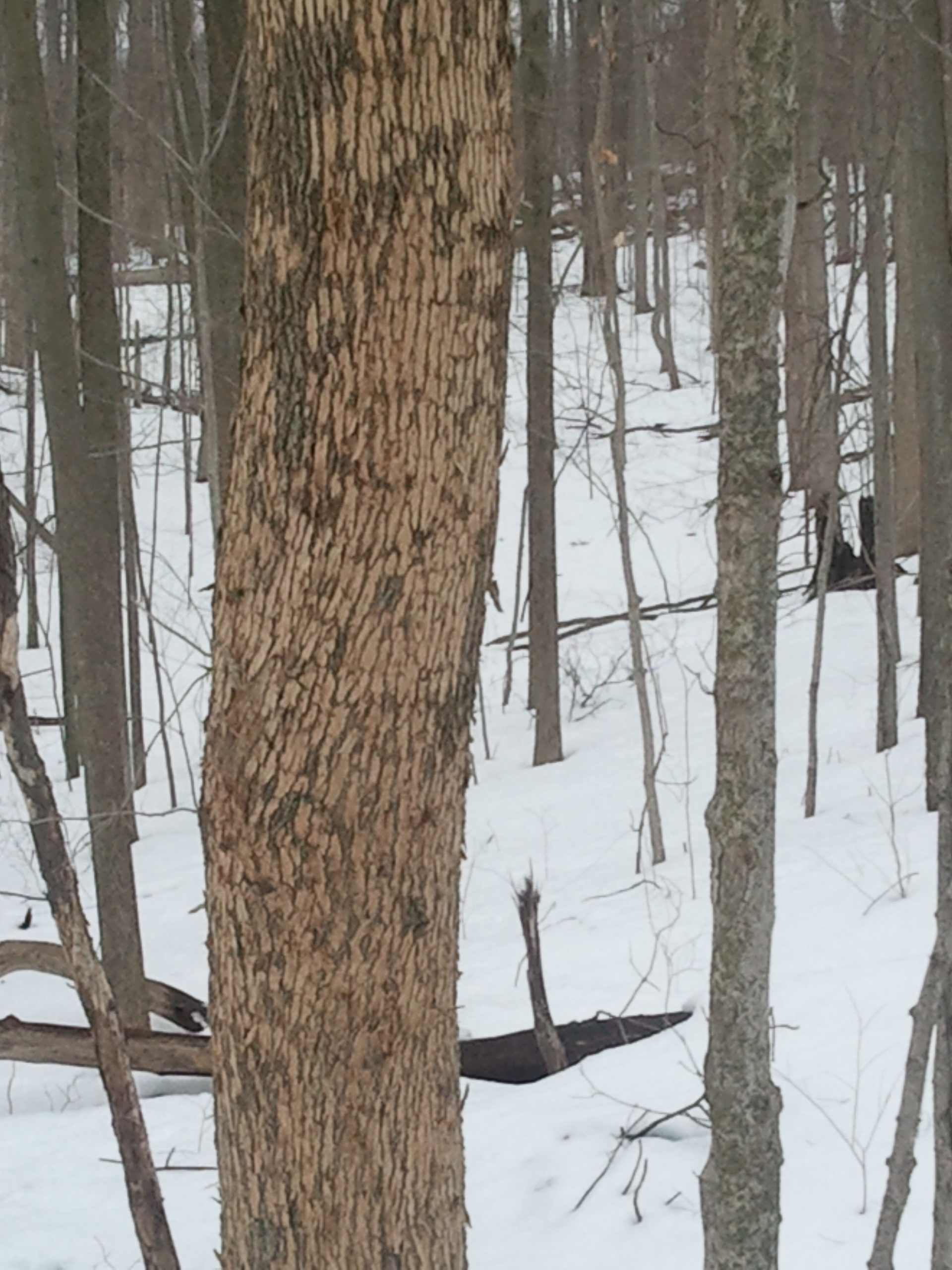
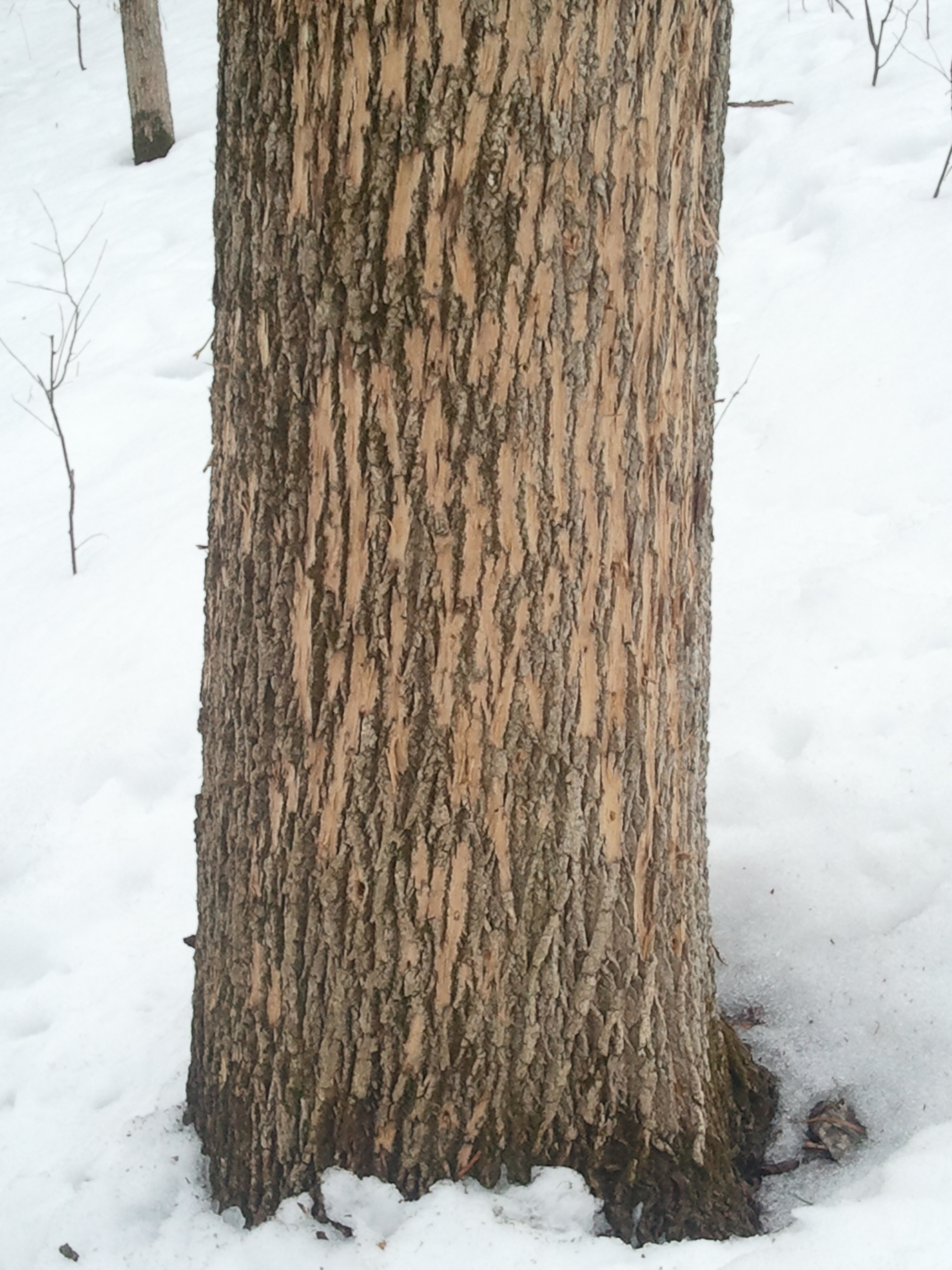
If you’re walking in the woods or maybe even traveling along a road this spring in Indiana, you may come across some trees that look like the one in the photos below. Clearly, something unusual is going on here. What made the bark change color so quickly, and why are there holes in the bark?
The answer to both of those questions for ash trees around the state is Emerald Ash Borer and woodpeckers. As Emerald Ash Borer spreads across Indiana, the population of Emerald Ash Borer larvae overwintering under the bark of ash trees can quickly increase. These grubs provide a tasty treat and important winter and early spring nutrition to hungry woodpeckers. Woodpeckers of several species are experts at detecting and extracting these grubs by pounding holes in tree bark. Ash bark is generally gray on the surface, but the inner bark is a light corky tan color. Once the woodpeckers find the EAB larvae, their excavation activities flake off the outer bark to expose the lighter colored inner bark. This is actually one of the best indicators of the presence of Emerald Ash Borer in a tree. The woodpecker activity often starts in the upper main stem and branches of ash trees, but as the population of EAB larvae in the trees increase, the woodpecker activity spreads down the trunk of the tree. Trees with this much inner bark exposed indicate an advanced infestation of EAB and signal ash tree mortality in the next year or two.
If you would like to learn more about ash trees and the Emerald Ash Borer, visit the Purdue Emerald Ash Borer website.
Trees offer many functional and aesthetic benefits, but one of the most common is shade. Because of this, one of the most important aspects of tree selection and planting is placement. Improper placement of trees can diminish the value of the tree on the site. The tree can actually become a liability if it conflicts with infrastructure or just does not providing any useful shade at all. For shade where it’s needed most that also allows passive solar gain in the winter months, you must use an energy efficient design.

Figure 1 (Diagram by Greg Pierceall)
In this hemisphere, the sun is in the south, and the source of cold weather is in the north. Whenever possible, place openings for sunlight and radiant heat primarily on the southern exposure, then on the west and east. For energy efficiency in winter, use the low arc of the sun to capture the maximum amount of warmth through east-, west- and south-facing windows. Windows with a northern exposure are a source of cool air from prevailing winds during the hot months, so give the north minimum exposure and maximum natural protection in the winter.
When selecting trees for energy efficiency, don’t plant evergreen trees near the house on southern exposures. Trees may provide some shade and screening but will also block out the warming effects of the sun during winter months. When choosing trees for shade and solar gain, choose larger, deciduous-canopy trees that provide an advantage year round. Select good quality trees that are suitable for your location from a reputable source. See the publication FNR-433-W on the Education Store website for more information on tree selection and planting.
Correct placement is critical for an energy-efficient design and low maintenance as the tree grows and matures. Be certain that the mature height and spread fit the location before placing the tree. This allows the tree freedom to spread into the design space naturally without excessive pruning to prevent conflicts with the house. However, the tree still must be close enough to the house for the canopy to provide shade. A good rule of thumb is to plant the tree at least 20 feet from the house. For larger shade trees, you may need to plant as far as 40 feet from the house to insure room for growth (see Figure 1).
Trees help make homes energy-efficient by creating a cooling effect during the hot summer months or by allowing the passive solar gain during cold winter months. However, proper selection and placement is critical to make this work.
Resources
Tree Installation: Process and Practices, The Education Store
Tree Planting Instructions, Indiana Department of Natural Resources
Planting & Transplanting Landscape Trees and Shrubs, Department of Horticulture, Purdue University
Lindsey Purcell, Urban Forestry Specialist
Department of Forestry and Natural Resources, Purdue University

Recent Posts
- 2026 Winter Bat Survey In Progress, MyDNR
Posted: March 27, 2026 in Wildlife - Fast-Growing Trees for the Landscape, Purdue Landscape Report
Posted: March 26, 2026 in Forestry, Urban Forestry, Woodlands - Urban Tree Spotlight: Planting Deciduous Shade Trees, Purdue Landscape Report
Posted: March 25, 2026 in Forests and Street Trees, Urban Forestry, Woodlands - Beetle that attacks Tree-of-Heaven found in Indiana, Purdue Landscape Report
Posted: March 20, 2026 in Invasive Insects, Wildlife, Woodlands - ID That Tree: Dwarf Chinkapin Oak
Posted: in Forestry, Urban Forestry, Wildlife, Woodlands - IN-PREPared: Essential Resources for Indiana’s Severe Weather Season
Posted: March 11, 2026 in How To, Safety - DNR Hiring for Indiana Conservation Officer Positions, MyDNR
Posted: March 9, 2026 in Urban Forestry, Wildlife, Woodlands - ID That Tree: Shumard Oak
Posted: in Plants, Urban Forestry, Wildlife, Woodlands - A Woodland Management Moment: Windbreak Around Walnut Plantings
Posted: March 3, 2026 in Forestry, Urban Forestry, Woodland Management Moment - Getting Certified as an Indiana Certified Prescribed Burn Manager
Posted: March 2, 2026 in How To, Urban Forestry, Woodlands
Archives
Categories
- Alert
- Aquaculture/Fish
- Aquatic/Aquaculture Resources
- Ask the Expert
- Christmas Trees
- Community Development
- Disease
- Drought
- Forestry
- Forests and Street Trees
- Gardening
- Got Nature for Kids
- Great Lakes
- How To
- Invasive Animal Species
- Invasive Insects
- Invasive Plant Species
- Land Use
- Natural Resource Planning
- Nature of Teaching
- Plants
- Podcasts
- Ponds
- Publication
- Safety
- Spiders
- Timber Marketing
- Uncategorized
- Urban Forestry
- Webinar
- Wildlife
- Wood Products/Manufacturing
- Woodland Management Moment
- Woodlands