 Purdue University - Extension - Forestry and Natural Resources
Got Nature? Blog
Purdue Forestry and Natural Resources’ extension efforts over the past two years amidst the COVID-19 pandemic were recognized in the Purdue Extension Specialist Quarterly newsletter.
 The transition to virtual content brought expertise across subject matter areas, ranging from forestry and wildlife, to aquatic sciences and entomology, to the masses in the form of several video series which collectively earned nearly 150,000 views.
The FNR Extension team included: Jay Beugly, Jarred Brooke, Nick Burgmeier, Barny Dunning, Diana Evans, Lenny Farlee, Jason Hoverman, Liz Jackson, Brian MacGowan, Patrick McGovern, Wendy Mayer, Charlotte Owings, Lindsey Purcell, Bee Redfield, Shelby Royal, Bob Rode, Kara Salazar, Mike Saunders, Amy Shambach, Rod Williams, Mitch Zischke, as well as frequent Entomology contributors: Elizabeth Barnes, Cliff Sadof.
The feature in the fourth quarter newsletter begins:
“While Covid caused limitations on travel and in-person events nationwide, across Indiana, many were spending more time in outdoor recreational activities, hiking, bird-watching, hunting and fishing, or managing natural resources properties. Adjusting to the pandemic, the FNR team created an innovative and team-oriented instruction approach through skill-building in video production with coordinated connection and cross-promotion of resources.
“Forestry and Natural Resources (FNR) faculty, specialists, staff, and students, with invited partners across research and Extension, delivered 45-minute Ask an Expert Facebook Live programs for 35 weeks. Programs covered many FNR specialties: Animals & Insects (bats, bird, cicadas, coyotes, deer, fish, frogs, hellbenders, moles, pollinators, salamanders, snakes, toads, turtles, and wood pests); Plants & Ecosystems (invasive plant species, hardwood ecosystems, native grasses for wildlife, conservation tree planting, rainscaping, fall food plots, and selecting, planting and inspecting trees); and Management & Operations (prescribed fires, aquatic plant and pond management, and fish and wildlife management).
Resources:
Ask An Expert Playlist, Purdue Extension – Forestry and Natural Resources (FNR) YouTube Channel
ID That Tree Playlist, Purdue Extension – FNR YouTube Channel
A Woodland Management Moment Playlist, Purdue Extension – FNR YouTube Channel
Wildlife Habitat Hint Playlist, Purdue Extension – FNR YouTube Channel
Subscribe to the Purdue Extension – Forestry and Natural Resources YouTube Channel
Wendy Mayer, FNR Communications Coordinator
Purdue University Department of Forestry and Natural Resources
Diana Evans, Extension and Web Communication Specialist
Purdue University Department of Forestry and Natural Resources
Frost seeding is a great way to establish native grasses and forbs for soil and water conservation and to create habitat for various wildlife and pollinators. You can use multiple tools for frost seeding, such as a tractor or ATV and broadcast spreader or a hand “whirlybird” seed spreader. But one innovative way to broadcast the seed is with a drone – or Unmanned Aerial Vehicle (UAV).
A drone is the tool we used to frost seed native grasses and forbs as part of a project on the Ivy Tech Community College-Lafayette Campus.
The Project
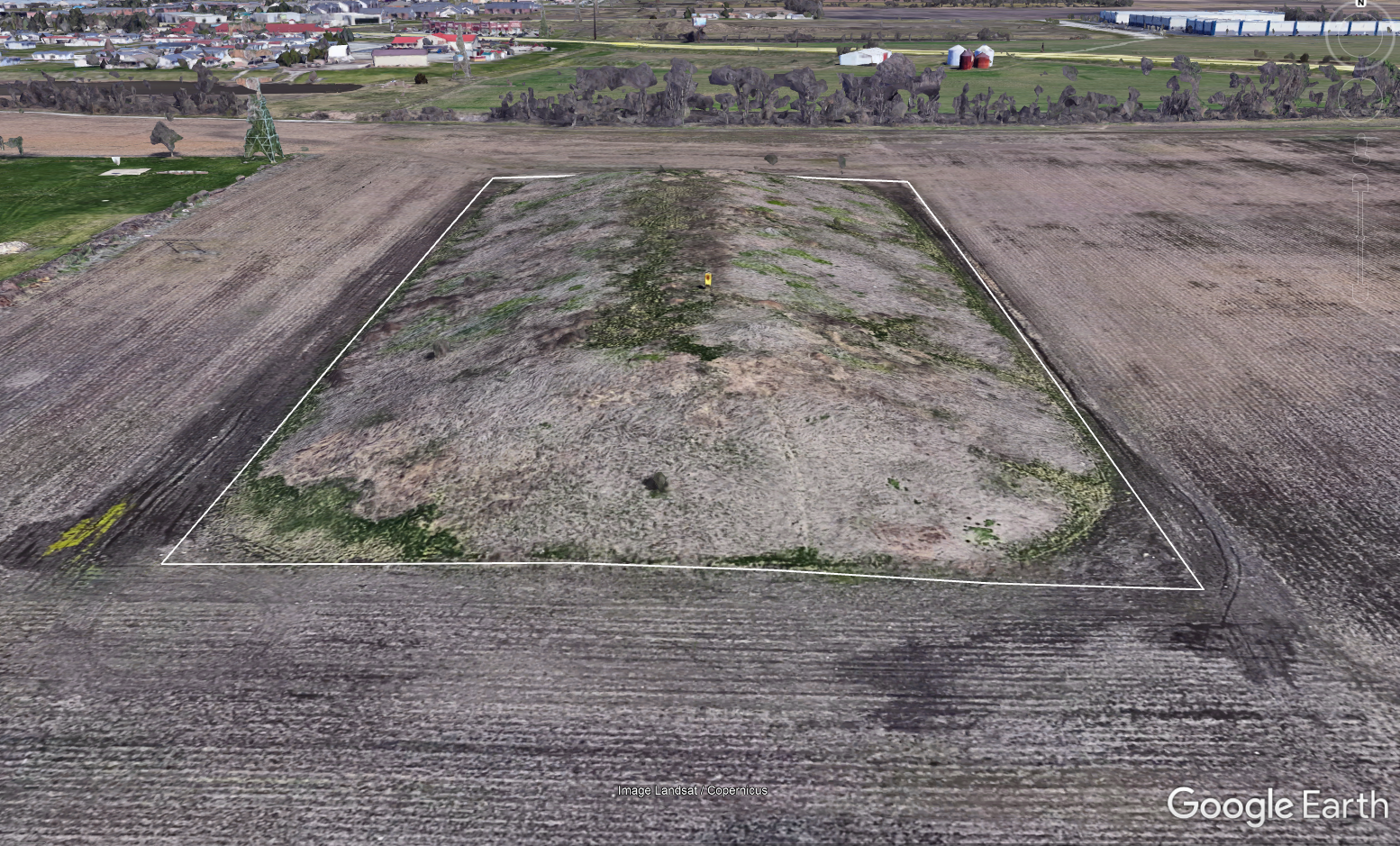 Faculty and staff within the Agriculture Program at Ivy Tech Community College received a grant from the Wabash River Enhancement Corporation (WREC) to plant native grasses and forbs on their property for educational and demonstration opportunities.
We planted a 4-acre mound created from soil leftover after digging a nearby retention pond. The topography and slopes of the mound made using traditional planting equipment like a tractor and no-till drill a challenge. And since the Ivy Tech staff was already familiar with using drones to plant cover crops, they decided it would be the best option to seed the mound.
The Indiana Natural Resources Conservation Service State Biologist created the seed mix we used. The mix included a diverse blend of native warm-season grasses and forbs.
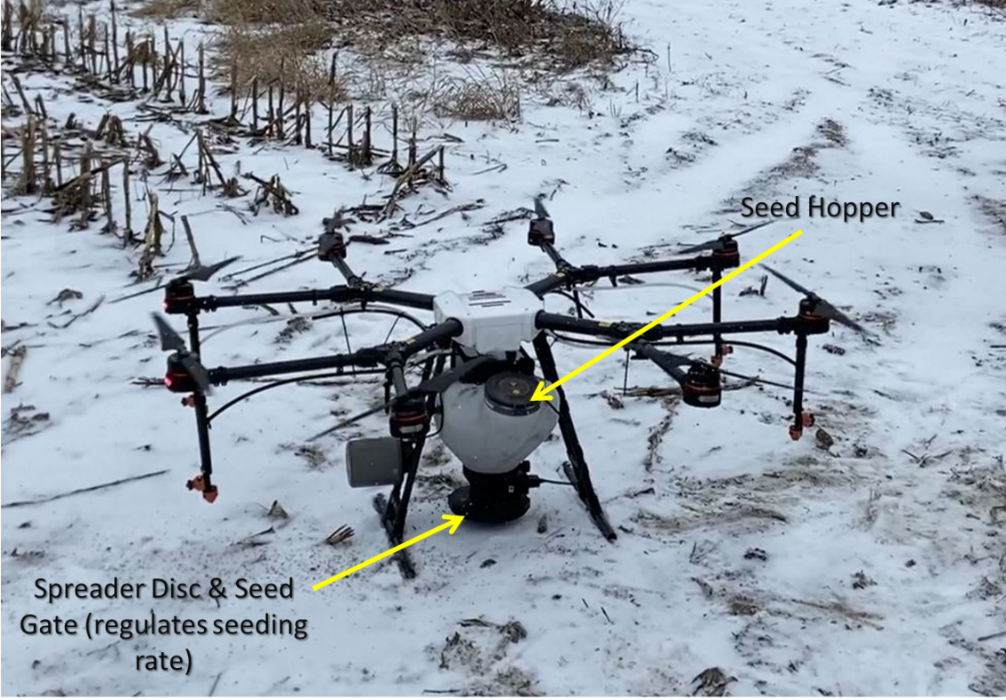 Purdue Extension and Purdue Forestry and Natural Resources assisted in the project by supplying, calibrating, and flying the drone, sharing previous experiences with frost seeding native grasses and forbs, and adjusting the seed mix by adding a carrier to improve seed flow through the drone seed spreader.
The Drone Set-up
We used a DJI Agras MG-1P drone fitted with a seed hopper that could be filled with up to 22 pounds of seed. Once filled, the drone spreads the seed at a specific rate (pounds per acre) by flying a consistent speed and height across the field along a predetermined path. A hand-held controller allows you to change the drone’s flight path, speed, and height. The controller also allows you to turn the broadcast spreader on or off, adjust the seed gate opening (% open), and the revolutions/minute of the disc to change the rate of the spreader.
The Process
Mixing the seed
The first step was to ensure the seed would flow through the seed hopper. This drone is set up to spread cover crops, which are usually large, heavy seeds like cereal rye or smaller (but still relatively heavy) seeds like clovers.
Native grasses and forbs are often much smaller and lower in weight by volume than cover crops. The grasses are also “fluffy” or have extra seed parts (chaff or awns), making them prone to clogging. These qualities of native grasses and forbs can present a challenge when trying to broadcast them without specialized equipment. We often add a carrier, like pelletized lime, to add more weight to the seed mix and allow the seed to flow more easily through the spreader. We added 40 pounds of pelletized lime per acre to the seed mix.
Calibrating the drone
We needed to calibrate the drone to spread the right amount of seed per acre. Calibrating a drone is similar to calibrating any broadcasting equipment. We needed to know:
- How wide the spreader spreads the seed (swath width)
- How fast the drone is flying
- How much seed (lbs) is being spread over a specific area
Check out this video for more information about frost seeding and calibrating a broadcast spreader.
Creating the map and programming the drone
After finishing the calibration, we went to the field to create the map for the project and program the drone. The initial step with the drone is to create a boundary layer in the mapping software. We did this by physically taking the controller to the four corners of the mound and setting a GPS point. When the accuracy showed 5 feet or less, we dropped a pin and used that as a corner. Once the corners were marked, the mapping software created the boundaries of the mound and created an automated path for the drone to fly.
Once we completed the map, we filled the drone with seed and set the flight parameters. Our calibration figures showed that we needed a 90% hopper opening with a speed of 2 mph, and we had a swath width of 18 feet from 10 feet above the ground (drone height). The disc speed was set to 900 revolutions per minute.
Spreading the Seed
Once the seed was mixed and the drone was calibrated and programmed, we started spreading the seed. With the drone, this is as easy as filling the seed hopper, starting the drone, and allowing it to fly the planned and automated mission. Once the seed hopper is empty, the drone automatically remembers where it stopped and returns home to be refilled. Once refilled, the drone will return to where it stopped and restarts spreading the seed. This process repeats until the drone has covered the entire field.
The Challenges
Fluffy seeds and seed flow
One of the biggest challenges we encountered was the flow of the native grass seed through the seed hopper. The seed was too fluffy (not enough weight per volume) to flow correctly through the seed hopper. The seed would flow and spread correctly for a few minutes, then the seed would get clogged, and the drone would stop. Because the fluffy seed was getting stuck at the top of the hopper and not flowing correctly, the sensor on the drone’s seed hopper was telling us the seed hopper was empty. However, at least 5-10 pounds of seed was still in the hopper. This would cause the drone to fly back to be refilled. Each time this happened, it cost us time and battery life on the drone.
We were able to free the seed in the hopper and get it to flow correctly by rocking the drone or flying the drone back and forth quickly until the seed worked itself loose. If you were using traditional equipment like a tractor and fertilizer spreader, the bouncing of the tractor over rough terrain would have naturally agitated the seed and allowed it to flow. But, with a drone flying in the air, the seed was not agitated. We would have needed to add more carrier to the seed mix to increase its weight and improve the seed flow.
Broadcast spreaders designed to spread fluffy seeds like native grasses often have an agitator in the hopper to stop the seed from clogging and improve seed flow. The native grass seed would have flowed better through a drone seed spreader explicitly designed for this type of seed, like this aerial spreader.
Batteries and Battery Life
Some of the challenges with drones, in general, are batteries and battery life. We had to change batteries frequently while spreading and recharge the batteries not in use to ensure we had enough battery life to complete the seeding. The challenges we had with the seed flow exacerbated our challenges with batteries because each time we had to check the seed hopper or free the seed, it cost us battery life.
It was helpful that we had six batteries. This allowed us to rotate between using batteries and charging them and meant we didn’t have to stop spreading to wait on batteries to be charged.
Flight speed
Because we added extra weight to the seed mix by using a carrier, we needed to fly the drone at a slow speed to spread at the correct rate per acre. Keeping the drone at a lower speed (2 mph) was challenging. Often the drone flew at around 3 mph. This is likely due to the physical properties of the electric motors turning the propellers to keep the drone aloft.
Drone malfunction
Another challenge we faced was a malfunction on the UAV where the spreader gate was opening and closing on its own, or not opening at all, and had an error showing on the controller screen that the gate was blocked. We noticed this error and worked on the UAV during the calibration phase and thought it was repaired. We had to stop and take the spreader apart again to identify the problem.
On the day we seeded, we finally decided to open the hopper to 90% opening and physically stop the gears from opening and closing. This left the hopper open constantly, but we could still turn the spreader on and off. After finishing the seeding, we determined the issue was either a faulty servo motor or control board. These parts are inexpensive and can be replaced, but they are specialized parts that require ordering and cannot be picked up from a local hardware store.
Cost of the drone
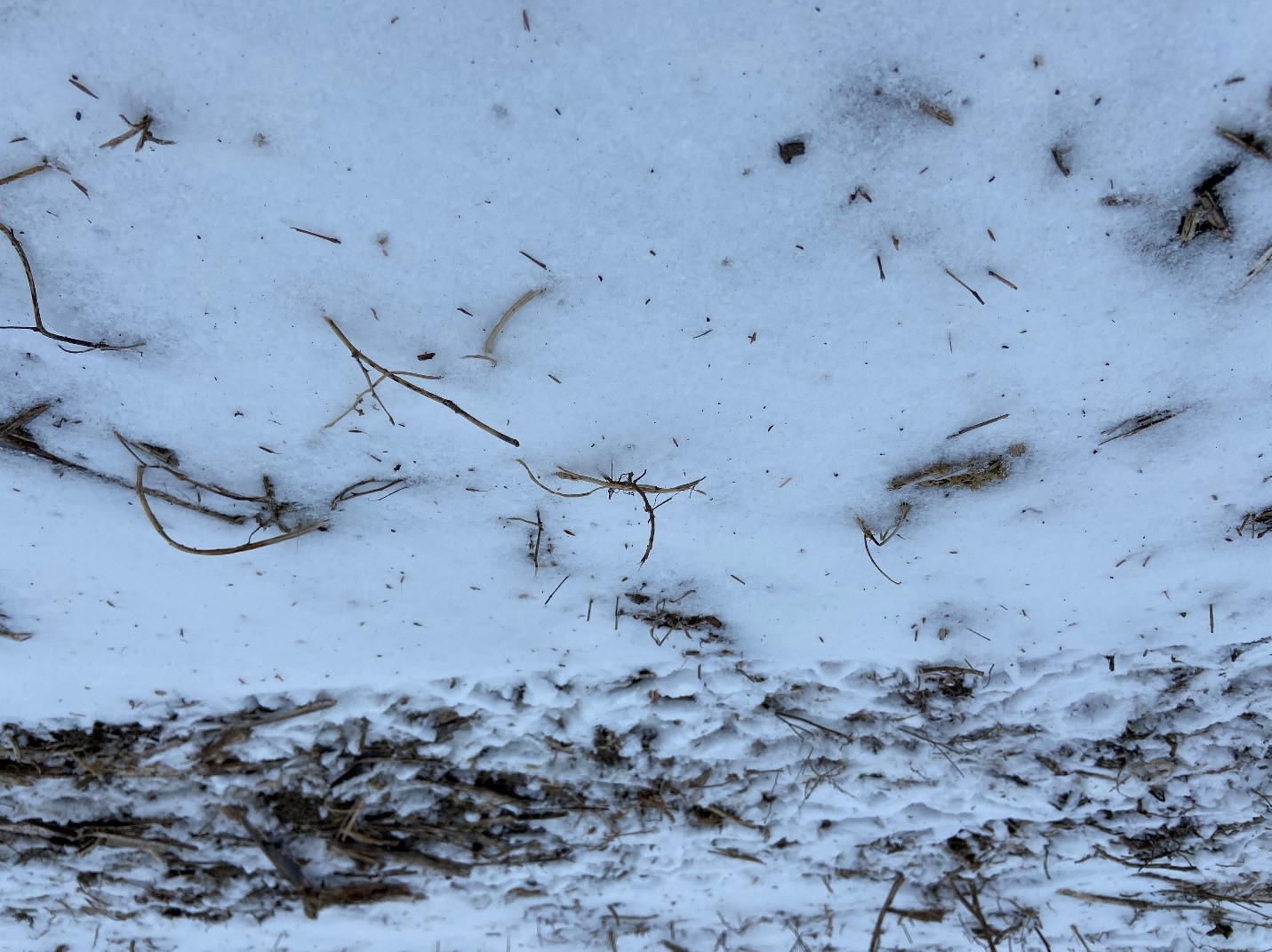 The DJI Agras MG-1P is an older model (older, not outdated), so the cost has decreased. Initially this model cost around $19,000, but it is now about $8,000. This includes both attachments for spraying and spreading. Additional batteries are around $700 each. Cost for the newer models of this type of drone range from $18,000 to ~$30,000, depending on the size and payload.
The Results
Despite the challenges we faced, the drone worked well for spreading the native grass and forb seed for this project. We applied the correct amount of seed required for the area. When the seed flowed correctly, it was spread evenly on the site. However, we will need to come back to the site during the next few summers to see how well native grasses and forbs are established.
A drone may not be effective for large-scale conservation plantings because of the time and batteries required, the small hopper size, and the need to refill the seed hopper. But for smaller plantings or those plantings in areas inaccessible by traditional equipment (in wetlands, on steep slopes, woodlands, etc.), drones could be an effective tool to establish native grasses and forbs.
Resources:
Frost Seeding to Establish Wildlife Food Plots & Native Grass and Forb Plantings, video, The Education Store, Purdue Extension Resource Center
Calibrating a No-Till Drill for Conservation Plantings and Wildlife Food Plots, video, The Education Store
Renovating native warm-season grass stands for wildlife: a land manager’s guide, The Education Store
Creating a Wildlife Habitat Management Plan for Landowners, The Education Store
Purdue Extension Pond and Wildlife Management Website, Purdue Extension
Jarred Brooke, Wildlife Extension Specialist
Purdue Forestry and Natural Resources
This week on ID That Tree, Purdue Extension forester Lenny Farlee introduces you to another Indiana conifer, one that is found natively on dry hillsides in two southern counties near the Ohio River, the Virginia Pine. The Virginia pine is easily identified by its needle clusters that feature twisted two-needle groupings and its cones, which feature spikes at the end of the scales. Learn more about this tree often used for reforestation inside.
If you have any questions regarding wildlife, trees, forest management, wood products, natural resource planning or other natural resource topics, feel free to contact us by using our Ask an Expert web page.
Resources:
ID That Tree, Playlist, Purdue Extension – Forestry and Natural Resources YouTube Channel
A Woodland Management Moment, Playlist, Purdue Extension – FNR YouTube Channel
Shrubs and Woody Vines of Indiana and the Midwest, The Education Store, Purdue Extension Resource Center
Native Trees of the Midwest, The Education Store
Investing in Indiana Woodlands, The Education Store
Forest Improvement Handbook, The Education Store
Virginia Pine, Native Trees of IN River Walk, Purdue University Fort Wayne
Lenny Farlee, Sustaining Hardwood Extension Specialist
Purdue University Department of Forestry and Natural Resources
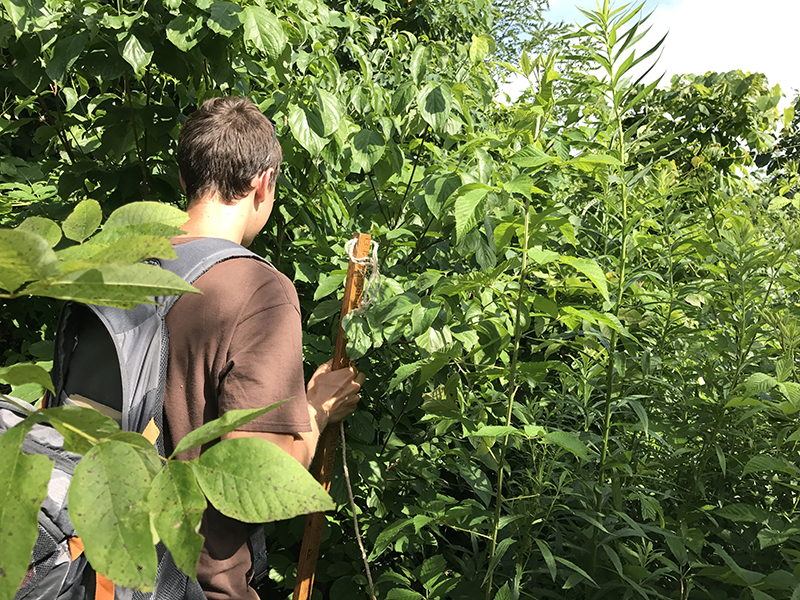
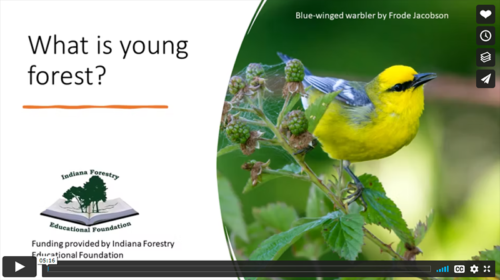
 What do whip-poor-wills, woodcock, bobcats, and box turtles have in common? All these species make their home in young forests. But, what is a young forest? And what do young forests look like?
This new video series from the Hoosier National Forest helps shed some light on these questions and more.
Specialists representing a diversity of organizations (American Bird Conservancy, Purdue Extension, National Wild Turkey Federation, Indiana Department of Natural Resources, U.S. Forest Service) discuss the importance of young forest as habitat for a wide variety of wildlife, managing young forests and misconceptions about young forest.
 U.S. Forest Service Vimeo Young Forest Videos:
- Hoosier National Forest – What is young forest?
- Who Needs Young Forest?
- What Does Young Forest Management Look Like?
- Misconceptions About Young Forest
Other resources:
Harvesting our forests, the wildlife debate, Purdue Extension – Forestry and Natural Resources (FNR) Got Nature? Blog
Wildlife Responses to Timber Harvesting, The Education Store, Purdue Extension’s resource center
Breeding Birds and Forest Management: the Hardwood Ecosystem Experiment and the Central Hardwoods Region, The Education Store
 Forest Management for Reptiles and Amphibians: A Technical Guide for the Midwest, The Education Store
Hardwood Ecosystem Experiment – Forest Birds , Purdue Extension – FNR YouTube Channel
Managing Woodlands for Birds , Purdue Extension – FNR YouTube Channel
Sustaining Our Oak-Hickory Forests , Purdue Extension – FNR YouTube Channel
Ask the Expert: Hardwood Ecosystem Experiment – Birds and Salamander Research, Purdue Extension – FNR YouTube Channel
Hardwood Ecosystem Experiment Highlights: Breeding Birds, Purdue Extension – FNR YouTube Channel
Hardwood Ecosystem Experiment Highlights: Small Mammals, Purdue Extension – FNR YouTube Channel
Hardwood Ecosystem Experiment Highlights: Salamanders, Purdue Extension – FNR YouTube Channel
Hardwood Ecosystem Experiment Highlights: Moths, Purdue Extension – FNR YouTube Channel
Hardwood Ecosystem Experiment Highlights: Bats, Purdue Extension – FNR YouTube Channel
Hardwood Ecosystem Experiment: How the HEE Came to Be, Purdue Extension – FNR YouTube Channel
Hardwood Ecosystem Experiment publications , Hardwood Ecosystem Experiment (HEE) website
New Videos Stress Importance of Young Forests, Purdue News – Forestry and Natural Resources
Jarred Brooke, Wildlife Extension Specialist
Purdue Forestry and Natural Resources
In this episode of ID That Tree, Purdue Extension forester Lenny Farlee introduces you to a native Indiana conifer typically found in sandy soils near Lake Michigan, the Jack pine. This tree is differentiated from other Indiana conifers by its short two-needle clusters often found in a V formation, as well its closed cones, and open crown.
If you have any questions regarding wildlife, trees, forest management, wood products, natural resource planning or other natural resource topics, feel free to contact us by using our Ask an Expert web page.
Resources:
ID That Tree, Playlist, Purdue Extension – Forestry and Natural Resources YouTube Channel
A Woodland Management Moment, Playlist, Purdue Extension – FNR YouTube Channel
Shrubs and Woody Vines of Indiana and the Midwest, The Education Store, Purdue Extension Resource Center
Native Trees of the Midwest, The Education Store
Investing in Indiana Woodlands, The Education Store
Forest Improvement Handbook, The Education Store
Jack Pine, Native Trees of Indiana River Walk, Fort Wayne, Purdue University
Lenny Farlee, Sustaining Hardwood Extension Specialist
Purdue University Department of Forestry and Natural Resources
The Society of Wood Science and Technology (SWST), an international association of over 500 wood science professionals from 44 countries, is committed to the field of wood science for the future. The association is pleased to acknowledge “Women Ambassadors Creating the Future of Wood Science,” a SWST-sponsored traveling exhibition designed to celebrate women ambassadors over time.
 Dr. Eva Haviarova, professor of wood products in the Purdue Department of Forestry and Natural Resources, is among 16 ambassadors that were announced on February 11, 2022, as part of the International Day of Women and Girls in Science celebration.
The first exhibition of Women Ambassadors will take place during the 2022 SWST International Convention in Kingscliff, Australia, July 10-16. The display will be unveiled at the convention’s opening ceremony and reception and will continue to be highlighted during the week. The exhibition will then travel around the world, including a stop at the 2023 SWST International Convention in Asheville, North Carolina. Information from the display also will be available for downloading and printing at individual institutions.
“Being recognized and selected as an ambassador for the wood science field among other very accomplished women on a global scale is a great honor,” Haviarova said. “I am at a point in my career where I feel that I can inspire others and fulfill an important mentor role. A career in wood science was a great choice I made and I wish that more women/girls would see the same potential as I did when I chose to dedicate my life to work with wood, one of the most versatile, inspiring, and sustainable materials out there.”
Resources:
How to Build a Simple Chair for Schools or Homes in Disadvantaged Areas of the World Using Local Resources and Low-End Technology, The Education Store, Purdue Extension’s resource center
Light-Timber Frames for Transitional Disaster-Relief Housing, The Education Store
Who Does That Job?: A Forestry and Natural Resources Coloring Book, The Education Store
How Baby Bear’s Chair Was Made, The Education Store
Purdue Forestry & Natural Resources Undergraduate Degrees and Minors
Purdue Extension – Forestry & Natural Resources Area/Wood Products
Wendy Mayer, FNR Communications Coordinator
Purdue University Department of Forestry and Natural Resources
In this edition of ID That Tree, meet a rarely found native tree that is closely related to the black walnut, the butternut. The butternut has been plagued by fungal disease, but can be identified by large lemon-shaped nuts, very sharp ridges on the nut inside the husk, a “hairy eyebrow” above the leaf scar/below the buds, and long compound leaves with a terminal leaflet intact.
If you have any questions regarding wildlife, trees, forest management, wood products, natural resource planning or other natural resource topics, feel free to contact us by using our Ask an Expert web page.
Resources:
ID That Tree, Playlist, Purdue Extension – Forestry and Natural Resources YouTube Channel
A Woodland Management Moment, Playlist, Purdue Extension – FNR YouTube Channel
Shrubs and Woody Vines of Indiana and the Midwest, The Education Store, Purdue Extension Resource Center
Native Trees of the Midwest, The Education Store
Investing in Indiana Woodlands, The Education Store
Forest Improvement Handbook, The Education Store
Butternut, Native Trees of Indiana River Walk, Purdue Fort Wayne
Indiana Walnut Council, Industry Representatives include 45 states and 3 foreign countries
Lenny Farlee, Sustaining Hardwood Extension Specialist
Purdue University Department of Forestry and Natural Resources
In this edition of ID That Tree, meet a non-native tree originally planted for fence rows, the Osage Orange, also known as a hedge apple. This tree is known by its gray bark with orange undertones and its large yellowish fruit, which has a milky center.
If you have any questions regarding wildlife, trees, forest management, wood products, natural resource planning or other natural resource topics, feel free to contact us by using our Ask an Expert web page.
Resources:
ID That Tree, Playlist, Purdue Extension – Forestry and Natural Resources YouTube Channel
A Woodland Management Moment, Playlist, Purdue Extension – FNR YouTube Channel
Shrubs and Woody Vines of Indiana and the Midwest, The Education Store, Purdue Extension Resource Center
Native Trees of the Midwest, The Education Store
Investing in Indiana Woodlands, The Education Store
Forest Improvement Handbook, The Education Store
Pin Oak, Native Trees of Indiana River Walk, Purdue Fort Wayne
Lenny Farlee, Sustaining Hardwood Extension Specialist
Purdue University Department of Forestry and Natural Resources
On this edition of ID That Tree, meet the black locust, which is recognizable by its small, rounded pinnate leaflets; gray bark with rough, long running ridges with orange undertones; and paired thorns where the buds and leaves originate.
If you have any questions regarding wildlife, trees, forest management, wood products, natural resource planning or other natural resource topics, feel free to contact us by using our Ask an Expert web page.
Resources:
ID That Tree, Playlist, Purdue Extension – Forestry and Natural Resources YouTube Channel
A Woodland Management Moment, Playlist, Purdue Extension – FNR YouTube Channel
Shrubs and Woody Vines of Indiana and the Midwest, The Education Store, Purdue Extension Resource Center
Native Trees of the Midwest, The Education Store
Investing in Indiana Woodlands, The Education Store
Forest Improvement Handbook, The Education Store
Black Locust, Native Trees of Indiana River Walk, Purdue Fort Wayne
Lenny Farlee, Sustaining Hardwood Extension Specialist
Purdue University Department of Forestry and Natural Resources
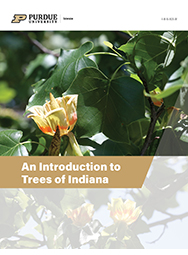
Trees are one of Indiana’s great natural resources. Professor T.E. Shaw, one of the first Indiana Extension foresters, wanted to make sure young Hoosiers, beginners in the field of forestry and tree enthusiasts alike had an educational resource to help them learn the names and identify local trees.
Shaw updated Charles C. Deam’s highly technical Trees of Indiana, which was first published in 1911, putting out an update for the 4-H forestry handbook in 1949. A second edition came out in 1950 and another revision was completed just before Shaw’s death in 1956 and published as “Fifty Common Trees of Indiana” through the Indiana Department of Conservation.
The publication, which utilizes simple methods and user-friendly language, has become a common resource many place in their backpacks before beginning an outdoor adventure.
The 1956 publication has been used for decades by 4-H, FFA and many other classroom and outdoor education programs as an introduction to tree identification for Indiana youth. Nearly 70 years later, the publication will be reintroduced as “An Introduction to Trees of Indiana,” with additional trees added to the resource along with updates of the original species. An Introduction to Trees of Indiana was a collaboration of experts from the Purdue Department of Forestry and Natural Resources (FNR), Indiana 4-H Youth Development and the Indiana Department of Natural Resources.
Add your copy of this new book to your library by visiting the Purdue Extension resource center, The Education Store: An Introduction to Trees of Indiana, product code: 4-H-15-80A.
Other resources:
Fifty Common Trees of Indiana
Native Trees of the Midwest, The Education Store
Shrubs and Woody Vines of Indiana and the Midwest, The Education Store
ID That Tree, Playlist, Subscribe to Purdue Extension – Forestry and Natural Resources YouTube Channel
A Woodland Management Moment, Playlist, Purdue Extension – FNR YouTube Channel
Investing in Indiana Woodlands, The Education Store
Forest Improvement Handbook, The Education Store
Tony Carrell, 4-H Youth Development Extension Specialist
Purdue Extension 4-H Youth Development
Lenny Farlee, Sustaining Hardwood Extension Specialist
Purdue University Department of Forestry and Natural Resources
Lindsey Purcell, Urban Forestry Specialist
Purdue University Department of Forestry and Natural Resources

Recent Posts
- New Indiana Woodland Steward Newsletter
Posted: August 12, 2026 in Forestry, Urban Forestry, Wildlife, Woodlands - ID That Tree: Nannyberry Viburnum
Posted: July 22, 2026 in Forestry, Plants, Wildlife, Woodlands - ID That Tree: Eastern Swamp Privet
Posted: in Forestry, Plants, Wildlife, Woodlands - ID That Tree: Carolina Buckthorn
Posted: July 15, 2026 in Forestry, Wildlife, Woodlands - Identifying Evergreens
Posted: June 24, 2026 in Forestry, Wildlife, Woodlands - Pruning Highlight-Pollarding Trees: A Traditional Pruning Practice with Modern Uses
Posted: June 11, 2026 in Forestry, Forests and Street Trees, Urban Forestry, Wildlife, Woodlands - Danielle Howard Hired as FNR Extension Prescribed Fire Specialist
Posted: June 10, 2026 in Forestry, Wildlife, Woodlands - Flat-Faced Longhorn Beetle Found in Hardwood Logs – IDNR Division of Entomology
Posted: June 8, 2026 in Alert, Forestry, Forests and Street Trees, Invasive Insects, Urban Forestry, Wildlife, Woodlands - Connecting Research to Practice: Natural Resources & Land Use Spring Training
Posted: June 5, 2026 in Forestry, Forests and Street Trees, How To, Invasive Animal Species, Invasive Plant Species, Land Use, Natural Resource Planning, Urban Forestry, Wildlife, Woodlands - Spring Storms Are Coming: How to Reduce Tree Damage and Risk
Posted: May 1, 2026 in How To, Urban Forestry, Wildlife, Woodlands
Archives
Categories
- Alert
- Aquaculture/Fish
- Aquatic/Aquaculture Resources
- Ask the Expert
- Christmas Trees
- Community Development
- Disease
- Drought
- Forestry
- Forests and Street Trees
- Gardening
- Got Nature for Kids
- Great Lakes
- How To
- Invasive Animal Species
- Invasive Insects
- Invasive Plant Species
- Land Use
- Natural Resource Planning
- Nature of Teaching
- Plants
- Podcasts
- Ponds
- Publication
- Safety
- Spiders
- Timber Marketing
- Urban Forestry
- Webinar
- Wildlife
- Wood Products/Manufacturing
- Woodland Management Moment
- Woodlands