 Purdue University - Extension - Forestry and Natural Resources
Got Nature? Blog
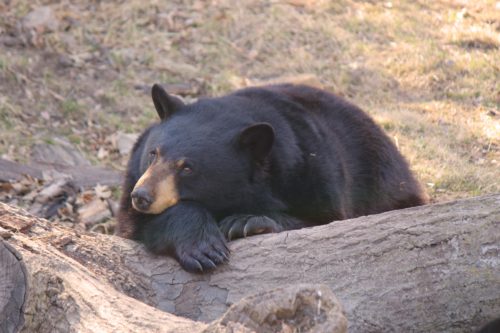 After being sighted in Indiana for the first time in 144 years on June 12 around South Bend, a second sighting of the bear has occurred in the Michigan City area, and this time, the bear has done a little bit of damage foraging for food. The bear had knocked over multiple bee hives and tore into some food at a local farm. It also bent poles holding up bird boxes, likely eating the baby birds inside.
The Department of Natural Resources is hoping the bear will return to upper Michigan on its own where the black bear population reaches around 15,000. However, they are continuing to monitor its movement and are prepared to trap it if needed.
While startling, it is important to note that black bears aren’t as dangerous as most people think. They are usually scared of humans, but it is a wise idea to move bird feeders, grills and trash cans out of your yard. If you encounter a bear, the DNR recommends standing your ground and making a lot of noise while slowly backing away. Do not turn and run. Black bears are also considered an exotic animal in Indiana, and shooting or killing one is a serious offense that can result in large fines or jail time.
Please report bear sightings to dfwinput@dnr.IN.gov or call 812-334-1137.
Resources
Black Bear, Indiana Department of Natural Resources
Black Bear Confirmed in Indiana For First Time in 144 Years, FOX59
 A new educational exhibit aimed for kindergartners to fifth graders called “A Salamander Tale” is ready to be shipped around the country and spread amphibian awareness. This interactive attraction is roughly 300 square feet and helps educate visitors at all ages about hellbenders, other salamanders and amphibians in general. Built into the exhibit is a video game called “Hellbender Havoc,” which provides a fun and unique way to learn about hellbenders. “Hellbender Havoc” is also playable online using Chrome or Firefox browsers.
Rental fees do apply for reserving the exhibit. Indiana state and extension professionals, also including Purdue staff, can rent the exhibit for free after paying for shipping. For more information, please check out the Salamander Tale web page, or feel free to take a look at other current exhibits on the Purdue Traveling Exhibits page. Check out Herbie the Hellbender today and inspire the Herpetologists of tomorrow!
Resources
Purdue Traveling Exhibits, Purdue Agriculture
Help the Hellbender, Purdue Extension
Salamanders of Indiana Book, The Education Store
This is the time of year that many homeowners start their annual battle with nuisance wildlife. While trapping animals is not always required or desirable, it may be necessary in some cases to alleviate damage. Homeowners will typically use a box-style or cage “live” trap. Before you take action, there are a few key points you should first consider.
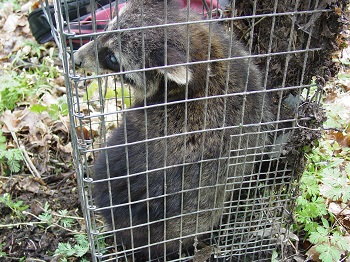
What permits, if any, are required?
Some animals require a permit prior to trapping. Raccoons, skunks, opossums, groundhogs, gray squirrels and fox squirrels are examples of mammals that do not require a permit in Indiana. Resident landowners or tenants can legally capture these species if the animal is causing damage to the property. However, you no longer have to report capture of wildlife to a conservation officer within 72 hours. Perhaps to the surprise of probably most people, rabbits do require a Nuisance Animal Control Permit prior to trapping. The Indiana DNR has a list of permitting requirements.
What do you do with wildlife you catch?
You have two choices of what to do with wildlife you capture: let it go or euthanize it (put to death humanely by injection). In either case, you may not possess an animal for more than 24 hours. If you relocate an animal, you must have permission of the landowner or property manager (even for public lands) AND you may only release that animal within the county of capture.
A common question I receive is, “What should I do?” There is no answer for which is best because circumstances differ. Most people probably prefer to let them go somewhere else because they find euthanizing animals unacceptable. They also may think that letting them go allows them to live out their lives, but this may not be the case. There has been some research on what happens to translocated raccoons and tree squirrels. In both cases, the animals don’t stay where they were let go. In the case of squirrels, a high number died within 88 days of release. Raccoons removed from structures tended to relocate in another structure.
Other things to consider
- Despite being cute and furry, wild animals are exactly that – wild animals. You should always use caution when handling traps that contain wildlife. Wear thick leather gloves and avoid sticking fingers inside the trap.
- If you transport an animal to be released (assuming you have gotten permission), do not place the trap inside your vehicle. Use a pickup truck to avoid contaminating your vehicle with animal waste and to minimize the spread of disease. Wildlife carry many pathogens and diseases that are transmittable to people.
- Animals can roll traps or pull in vegetation from the immediate vicinity. Be careful where you place the trap. Staking box traps is also a good idea.
- Be sure the trap is stable or “bedded” when you set it. Remove rocks and debris from under the trap. You may have to “work” the trap into the ground. Just be sure that debris doesn’t get caught under the treadle. If it does, the trap may not fire.
- You may want to cover your trap by wrapping it with cardboard and wire.
- Check your traps frequently. Indiana has a 24-hour trap check law. It is often a good idea to check them more frequently – perhaps 2 to 3 times a day. This is especially true if you are trapping during extremely hot or cold weather.
- Wildlife species have different times of activity, so you can be selective what time of day you trap. For example, tree squirrels and groundhogs are not active at night. Closing traps at night can avoid non-targets but would also require opening the trap at sunrise.
If you are interested in hiring a state licensed animal control professional, you can visit the Indiana DNR Nuisance Wildlife page and click on the link to “Nuisance Wildlife Control Operators.”
Additional Resources
Preventing Wildlife Damage – Do You Need a Permit?
Indiana Wildlife Conflicts Information
Indiana DNR Nuisance Wildlife
Brian MacGowan, Wildlife Extension Specialist
Department of Forestry and Natural Resources, Purdue University
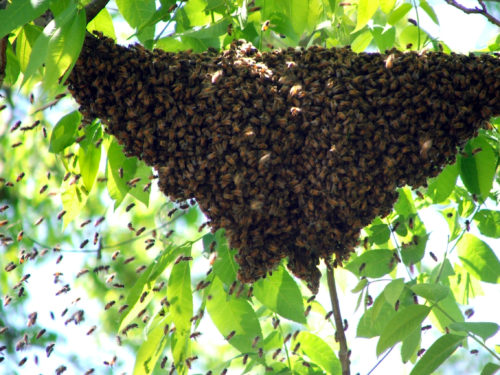 The idea of 10,000 honey bees swarming is a very, very unsettling thought for many people. This sounds like a dangerous and maybe even deadly situation, but in reality, it usually isn’t. Large swarms of honey bees are actually fairly common and completely harmless unless provoked.
As a colony of honey bees grows, sooner or later it outgrows its hive, and it is time to spread out and create a new one. This process starts with the production of new queens. They are grown in special chambers and are fed a diet of “royal jelly” as they grow. When the first one emerges from its chamber fully developed, it kills the others to eliminate the competition.
This new queen leaves the hive in search of “drone zones,” areas where male honey bee drones congregate in hopes to mate with the queen. After a successful mating, the queen returns to the hive, signaling the worker bees of the colony to begin preparing for swarming. Some fly from the hive to explore and search for possible new locations for a new hive. Meanwhile, others start reducing the old queen’s diet, slimming her down in preparation for the swarming. When the new queen begins laying eggs, it is officially time to swarm.
The older bees escort the old queen out of the hive in a massive swarm towards the location scouted out previously to begin a new colony. However, sometimes when a suitable location hasn’t been found in time, the swarm lands on the ground, protecting the queen in the center until one can be found. While probably terrifying to someone with a fear of bees, there is no reason to be alarmed. These bees are focused on protecting the queen and won’t leave the cluster or sting anyone unless provoked. Eventually, when a location is found, the cluster swarms to it and starts a new colony.
So if you encounter a huge group of honey bees, don’t panic. While they might look intimidating, these bees are busy transitioning to a new colony and don’t pose a hazard to anyone.
Resources
Swarms Hanging Around, Purdue Extension
Indiana Honey Bee Swarms, Indiana Department of Natural Resources
The Education Store, Purdue Extension Resource Center
Tom Turpin, Professor, Insect Outreach, Instruction Development Specialist
Department of Entomology, Purdue University
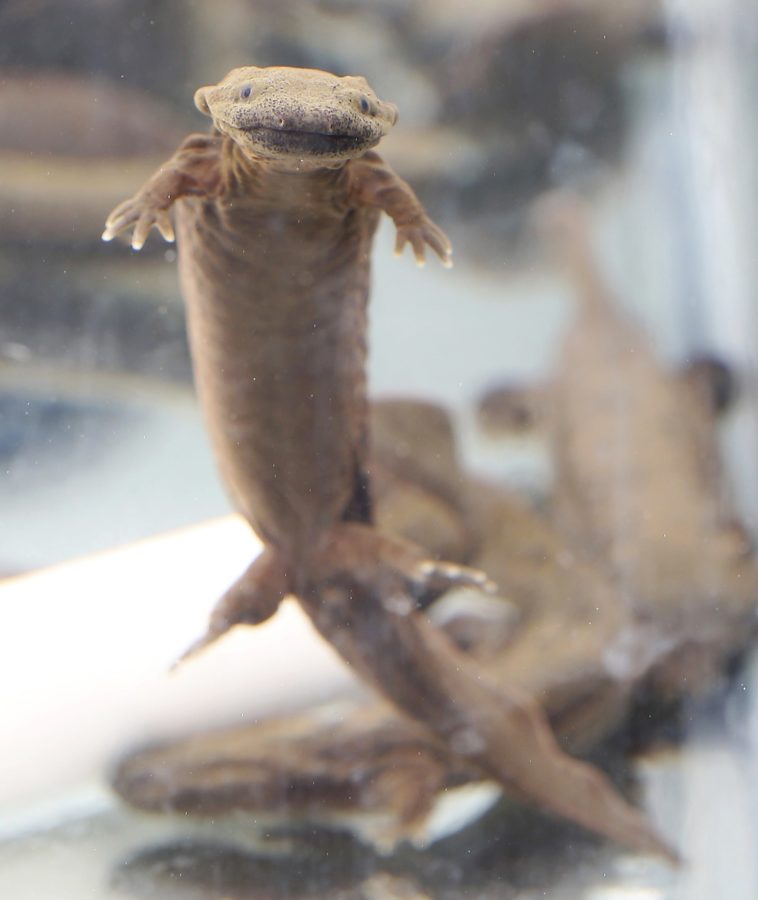 The next big step in the initiative to save the hellbenders of Indiana was completed on May 18, 2015, as three hellbenders were transferred from Purdue University’s Aquaculture Research Lab to the Columbian Park Zoo in Lafayette. This is the last of 50 hellbenders transferred from the lab to Columbian Park Zoo, Fort Wayne Children’s Zoo and Mesker Park Zoo in Evansville.
In 2013, Associate Professor of Wildlife Science Rod Williams and his team collected 300 eggs from the Blue River in Southern Indiana. These eggs grew into young hellbenders in the lab and were transferred to the three zoos to continue growing to adulthood. In the wild, hellbender mortality rate is extremely high, as high as 99%. The salamanders are at their most vulnerable state during their juvenile years, and being raised in captivity will greatly improve their chances of survival when they are released back into the wild in a couple years.
Once released, the hellbenders will be tracked via radio transmitters to monitor their movements, habitat preferences and survivorship. The last group of 18 hellbenders released into the wild had a 22.5% survival rate after one year, and Williams hopes to improve on that. A group of 80 more hellbenders will be released in 2016 with 130 in the following year. Williams’ goal of 40-50% survival rate would mark huge progress in saving the hellbenders of Indiana.
Resources
Help the Hellbender, Purdue Extension
The Nature of Teaching: Adaptations for Aquatic Amphibians, The Education Store, Purdue Extension resource center
How Our Zoos Help Hellbenders, The Education Store
Hellbenders Rock!, The Education Store
Help the Hellbender, North America’s Giant Salamander, The Education Store
How Anglers and Paddlers Can Help the Hellbender, Purdue Extension-FNR YouTube Video
Subscribe to Purdue Extension-FNR YouTube Channel
Rod Williams, Associate Professor of Wildlife Science
Purdue University Department of Forestry and Natural Resources
When you rush to the closet to grab your favorite shorts and T-shirt, remember that you are not the only creature looking forward to the warmer weather. It is important to check yourself or have a buddy check you for passengers when you get back from the field to lessen the likelihood of bringing ticks home with you.
Indiana has 15 tick species, but the three listed below are the most prevalent.
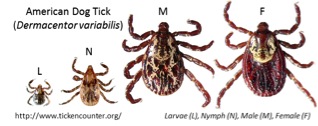
American Dog Tick (Dermacentor variabilis): Found primarily along trails, walkways or in fields, American Dog ticks are rarely found in forests. Despite their name, these ticks feed on a multitude of hosts in addition to the family pet and can transmit Rocky Mountain Spotted Fever, a potentially fatal disease contracted by 32 people in Indiana last year. The American Dog Tick also carries Tularemia, a rare but dangerous disease that is often misdiagnosed for the flu.
American Dog ticks can survive for two years at any stage in life until a suitable host is found. Male ticks mate with the female while she is feeding as after she is sated, she drops off of the host and lays 4,000+ eggs before dying. Larval ticks only feed for three to four days from a host before molting into nymphs. The nymph feeds on a variety of small/medium-sized hosts before dropping to the leaf litter and molting into adults. Interestingly, these ticks are least likely to bite humans.
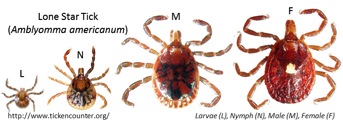 Lone Star Tick (Amblyomma americanum): Found primarily in dense underbrush and forested areas. As with the American Dog Tick, these ticks are capable of transmitting Rocky Mountain Spotted Fever in addition to Monocytic Ehrlichiosis, another tickborne disease that presents with symptoms similar to the flu but was confirmed in 49 Indiana cases in 2013. ‘Stari’ (Southern Tick-Associated Rash Illness) Borreliosis is a tick-vectored disease that presents with a large round or elliptical rash and flu symptoms transmitted by the Lone Star Tick.
Voracious eaters, adult Lone Star ticks often take human hosts or other large mammals. After a week, the female is capable of laying 3,000+ eggs. The larval Lone Star ticks only feed for four days before detaching, burying themselves in leaf litter and molting into nymphs. Able to quickly ascend up pant legs, these nymphs can be firmly attached to a host in < 10 minutes. After five days, the nymphs detach and molt into adults.
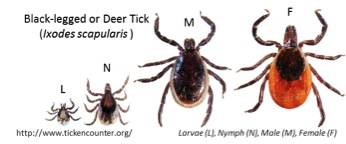
Black-legged or Deer Tick (Ixodes scapularis): Found primarily in deciduous forests, these ticks predominantly use white-tailed deer or other large mammals as hosts. Unlike the relatively accelerated life cycles of the American Dog and Lone Star ticks, the Deer Tick life cycle takes nearly two years to complete.
Deer ticks are most notorious for spreading Lyme disease, a dangerous disease that causes flu-like symptoms that, if left untreated, can spread to joints and compromise the nervous system. More than 100 cases of Lyme disease were confirmed in Indiana in 2013. Babesiosis is caused by microscopic parasites that infect red blood cells, and Anaplasmosis is caused by the bacterium Anaplasma phagocytophilum. Both of these diseases are transmitted through the bite of an infected Deer Tick.
Only the female Deer Tick feeds, and once completely engorged, they lay an egg mass of 1,900+ eggs before dying in late-May. Deer Tick larvae and nymphs remain in the moist leaf litter within forested areas and prefer smaller hosts. After feeding for three days in each developmental stage, they burrow into the litter to molt. Larvae emerge as nymphs in spring, and nymphs emerge as adults in fall.
 The table here illustrates the months of activity for the larval, nymph, male and female tick life cycle stages which gives you a quick reference for Indiana. This information was gathered from the resources listed in this post.
Indiana ticks can carry several diseases, but the three most common are Rocky Mountain Spotted Fever, Lyme Disease and Ehrlichiosis. Symptoms of all three diseases range from spreading rashes, headaches, fatigue, fevers and muscle aches. Likelihood of infection is rare; however, instances of each disease are increasing in Indiana.
Be careful and try not to pick up eight-legged hitchhikers. If you suspect that you have been bitten by a tick or develop a rash along with flu symptoms, contact your local health department for a disease screening.
Resources
Ticks, Indiana Department of Natural Resources
Ticks, Medical Entomology, Purdue University
Rocky Mountain Spotted Fever, Centers for Disease Control and Prevention
Tularemia, Centers for Disease Control and Prevention
Lyme Disease, Centers for Disease Control and Prevention
Ehrlichiosis, Centers for Disease Control and Prevention
Parasites – Babesiosis, Centers for Disease Control and Prevention
Anaplasmosis, Centers for Disease Control and Prevention
‘Stari’ Borreliosis, Columbia University Medical Center
tickencounter.org, Tick Encounter Resource Center, University of Rhode Island
Shaneka Lawson, Adjunct Assistant Professor
Department of Forestry and Natural Resources
 A 20+ extension team led by Kara Salazar, sustainable communities extension specialist, and Michael Wilcox, assistant program leader for extension community development, have produced a new publication and curriculum titled “Enhancing the Value of Public Spaces.” This must-have spiral bound notebook and curriculum zip file download is a great resource for decision makers and local leaders developing community public spaces including park boards, planning commission members, members of organizations, public officials and staff whose missions are related to providing services, programs or management of public spaces. This program serves as a “how-to” guide for creating high-quality action plans to achieve great public spaces.
A one day workshop starts the process with collaborative activities to identify best practices for improving public spaces with emphasis on forming partnerships to achieve desired community goals. Follow-on working group meetings provide the resources and technical support needed to plan and implement projects tailored to individual communities. The completed high quality public spaces action plan can be used as part of comprehensive planning efforts, parks and recreation master plans and fundraising initiatives.
Resources
Enhancing the Value of Public Spaces, The Education Store
Kara Salazar, Sustainable Communities Extension Specialist
Department of Forestry and Natural Resources
Illinois-Indiana Sea Grant
Michael Wilcox
Assistant Program Leader, Extension Community Development Program
Senior Associate, Purdue Center for Regional Development
When you rush to the closet to grab your favorite shorts and T-shirt, remember that you are not the only creature looking forward to the warmer weather. It is important to check yourself or have a buddy check you for passengers when you get back from the field to lessen the likelihood of bringing ticks home with you.
Indiana has 15 tick species, but the three listed below are the most prevalent.
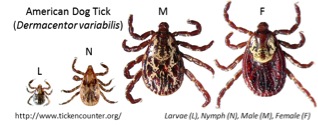
American Dog Tick (Dermacentor variabilis): Found primarily along trails, walkways or in fields. American Dog ticks are rarely found in forests. Despite their name, these ticks feed on a multitude of hosts in addition to the family pet and can transmit Rocky Mountain Spotted Fever, a potentially fatal disease contracted by 32 people in Indiana last year. The American Dog Tick also carries Tularemia, a rare but dangerous disease that is often misdiagnosed for the flu.
American Dog ticks can survive for two years at any stage in life until a suitable host is found. Male ticks mate with the female while she is feeding because after she is sated, she drops off of the host and lays 4,000+ eggs before dying. Larval ticks only feed for three to four days from a host before molting into nymphs. The nymph feeds on a variety of small/medium-sized hosts before dropping to the leaf litter and molting into adults. Interestingly, these ticks are least likely to bite humans.
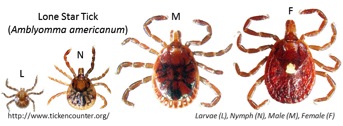
Lone Star Tick (Amblyomma americanum): Found primarily in dense underbrush and forested areas. As with the American Dog Tick, these ticks are capable of transmitting Rocky Mountain Spotted Fever in addition to Monocytic Ehrlichiosis, another tickborne disease that presents with symptoms similar to the flu but was confirmed in 49 Indiana cases in 2013. STARI (Southern Tick-Associated Rash Illness) Borreliosis is a tick-vectored disease that presents with a large round or elliptical rash and flu symptoms transmitted by the Lone Star Tick.
Voracious eaters, adult Lone Star ticks often take human hosts or other large mammals. After a week, the female is capable of laying 3,000+ eggs. The larval Lone Star ticks only feed for four days before detaching, burying themselves in leaf litter and molting into nymphs. Able to quickly ascend up pant legs, these nymphs can be firmly attached to a host in less than 10 minutes. After five days, the nymphs detach and molt into adults.
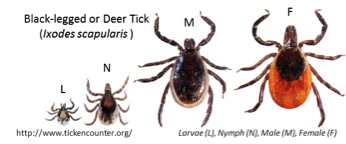
Black-legged or Deer Tick (Ixodes scapularis): Found primarily in deciduous forests, these ticks predominantly use white-tailed deer or other large mammals as hosts. Unlike the relatively accelerated life cycles of the American Dog and Lone Star ticks, the Deer Tick life cycle takes nearly two years to complete.
Deer ticks are most notorious for spreading Lyme disease, a dangerous disease that causes flu-like symptoms that, if left untreated, can spread to joints and compromise the nervous system. More than 100 cases of Lyme disease were confirmed in Indiana in 2013. Babesiosis is caused by microscopic parasites that infect red blood cells, and Anaplasmosis is caused by the bacterium Anaplasma phagocytophilum. Both of these diseases are transmitted through the bite of an infected Deer Tick.
Only the female Deer Tick feeds, and once completely engorged, it lays an egg mass of 1,900+ eggs before dying in late-May. Deer Tick larvae and nymphs remain in the moist leaf litter within forested areas and prefer smaller hosts. After feeding for three days in each developmental stage, they burrow into the litter to molt. Larvae emerge as nymphs in spring, and nymphs emerge as adults in fall.
The table here illustrates the months of activity for the larval, 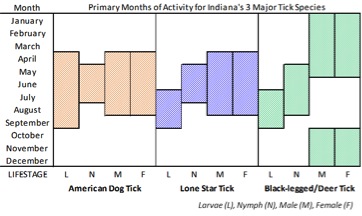 nymph, male and female tick life cycle stages.
Indiana ticks can carry several diseases, but the three most common are: Rocky Mountain spotted fever, Lyme disease and Ehrlichiosis. Symptoms of all three diseases range from spreading rashes and headaches to fatigue, fevers and muscle aches. Likelihood of infection is rare; however, instances of each disease are increasing in Indiana.
Be careful and try not to pick up these six-legged hitchhikers. If you suspect that you have been bitten by a tick or develop a rash along with flu symptoms, contact your local health department for a disease screening.
Resources
Rocky Mountain Spotted Fever, Centers for Disease Control and Prevention
Tularemia, Centers for Disease Control and Prevention
Lyme Disease, Centers for Disease Control and Prevention
Ehrlichiosis, Centers for Disease Control and Prevention
Parasites – Babesiosis, Centers for Disease Control and Prevention
Anaplasmosis, Centers for Disease Control and Prevention
STARI Borreliosis, Columbia University Medical Center
Shaneka Lawson, Adjunct Assistant Professor
Department of Forestry and Natural Resources
Before you begin managing wildlife on your property, there are three questions you need to consider.
- What are your management objectives for your property?
- Which species or group of species do you want to encourage?
- How much money and time do you wish to spend?
Careful consideration of these questions will prepare you to begin managing your property yourself or work with a wildlife professional.
[toggle title=”Making Your Backyard More Attractive to Wildlife”]
The principles and concepts of managing for wildlife in your yard are really the same as large parcels of land – all wildlife need food, water, cover, and space in the proper amounts and arrangement. The major difference is that you have to design your practices so they work with the function and beauty of your yard.
Once you have an understanding of basic landscape design, the next step is to design your landscape for wildlife habitat. Quality habitat is of vital importance to wildlife. Habitat includes proper food, cover, and water in sufficient quantities to meet a species’ basic needs. Does your yard provide the three basics for wildlife?
Food – There are a variety of bird, mammal, amphibian, reptile, and insect species that may want to call your backyard home. While each species has specific food requirements, providing an abundance of each major food category will appeal to the broadest array of wildlife species.
Cover – Every wildlife species visiting your yard has specific cover requirements. Providing an abundance of common cover categories will appeal to the broadest array of wildlife species.
Water – All wildlife needs some sources of water near the place they call home. If a permanent water supply such as a stream or pond is not present near your yard, the addition of a backyard pond or birdbath can provide this needed feature to your landscape. Many species get their daily water requirements from morning dew or food that they eat. However, having a permanent water sources is an effective attractant, especially when available water is scarce. Birdbaths and water misters are readily used by birds and butterflies. Backyard ponds or water gardens provide habitat for aquatic and semiaquatic animals and are attractive backyard landscape features. Having gradual slopes and planting vegetation within and adjacent to the pond with enhance its value to wildlife.
Arrangement of these requirements also important. Planning for backyard wildlife habitat is challenging in that you need to supply the basic requirements for the species you wish to attract, and it must conform and integrate with your landscape design.
Put a Little Wildlife in Your Backyard This Spring (FNR-247W)
Butterflies
Butterflies are beautiful additions to any backyard. Butterflies are insects with a four-stage development: egg – larva – pupa – adult. There are about 20,000 species worldwide and over 700 in North America. Some examples of the types of butterflies include swallowtails, fritillaries, skippers, and sulphurs.
Attracting Butterflies to Your Yard (FNR-248W)
Hummingbirds
Hummingbirds are a popular attraction in any backyard. The ruby-throated hummingbird is the only species of hummingbird that nests in the Hoosier state. These colorful visitors are migratory and arrive from their wintering grounds around mid-April. Ruby-throated hummingbirds remain throughout the summer and can begin fall migration as early as late-July. Migrating ruby-throated hummingbirds can be observed in Indiana throughout the fall. It is possible to observe migrating hummingbirds at your feeder from late-July through October and occasionally later. In fact, during late autumn, rufous hummingbirds can be observed at feeders in Indiana. Some believe it is only a matter of time that other western species such as the black-chinned hummingbird are found in the state.
Ruby-throated hummingbirds have a few simple habitat requirements that can be easily met in most neighborhoods and backyard habitats.
Attracting Hummingbirds to Your Yard (FNR-249W)
Wildlife Houses and Feeders
Suitable cover is often one of the most limited habitat elements in backyard habitats. Over 50 wildlife species in the Midwest use cavities in live trees (den trees) or dead, standing trees (called snags) for nesting and denning cover. Unfortunately, yard management practiced by many of us does not encourage either of these critical habitat features needed by cavity nesting wildlife. New developments often lack an abundance of trees. Even when planted, many of the tree species selected for landscaping such as Bradford pear, flowering crabapple, or ash, do not favor development of natural cavities. Native hardwoods such as oak, sycamore, and beech trees readily form natural cavities, but may take many years to do so. While nest boxes are not a replacement for these species or wildlife habitat management, they are a great way to supplement natural cavities, make your backyard more attractive to cavity nesting species, and complement your landscape design at the same time.
Whether you purchase nest boxes or build them yourself, a properly maintained nest box can last for years. You can maximize their value by installing them at the proper heights and in the proper locations. They should be located near food, water, and other cover needed by your desired species. There are a few basic “rules of thumb” that will help you select and install nesting structures most beneficial for the wildlife species you wish to attract in your backyard.
Size Does Matter – Nest Boxes for Wildlife (FNR-246W)
[/toggle]
[toggle title=”Enhancing Wildlife Habitat”]
Get Help
Cost-share and technical assistance programs often make wildlife management practices affordable. In many cases, dedicating marginal farmland to wildlife management practices can actually improve the per acre net return.
“What kinds of assistance are available to me, and from whom?”
“Is there money available to help me?”
“Where do I go to get help with my wildlife resource problems?”
These are questions frequently asked by Indiana landowners. The answer to these questions can be quite complicated because programs that assist landowners are implemented by a number of public and private organizations. The best place to start for answers to your questions is with your county Cooperative Extension Service Educator. Your county Educator will assist you in contacting the appropriate person and/or agency administering the assistance programs best suited to your needs. The address and phone number for your county’s Cooperative Extension Service Office can be found in the telephone directory under County Government Office, or they may be listed in the white pages under the name of your county.
NRCS, along with FSA, provides leadership for Farm Bill programs. Contact your local USDA Service Center for more information. They will assist you with determining the eligibility of your land, the development of a conservation plan, and the application process. In addition, they can put you in touch with your District Forester or District Wildlife Biologist. They will provide assistance in developing more detailed management plans and in selecting cost-share and incentive programs that can make wildlife management on your property more attractive and affordable. The U.S. Fish and Wildlife Services also provides assistance through their Partners for Wildlife Program.
Wildlife Habitat Tips
Wetlands
Wetland benefits and values include storm water storage, ground water recharge, nutrient recycling, sediment filtering, and wildlife habitat. Over 87percent of Indiana’s wetlands have been degraded or destroyed. Wetland restoration aims to restore drained or degraded wetlands to the point that soils, hydrology, vegetation, and biological habitats are returned to their natural condition or as close as possible. You should obtain the required local, state, and federal permits before beginning any wetland restoration project. Often, blocking drainage tile or installing a basic water control structure (wetland video) can restore a wetland. The U.S. Fish and Wildlife Service (USFWS) can provide technical and financial assistance at little or no cost to you for many wetland restoration projects. Also, contact your county NRCS office.
Forests
Wildlife and the forests in which they live are linked closely together. The abundance of most wildlife populations and associated forested lands have paralleled each other throughout history. Responsible forest management ensures a balance between wildlife populations and their forested habitats.
Grasslands
The species and arrangement you select depend upon your management goals. For example, some species of wildlife such as bobolink, northern harrier, or Henslow’s sparrow require large blocks of grassland. Other species, such as northern bobwhite quail, dickcissel, or American goldfinch do well in small blocks of grasslands. In many situations, these small blocks may be established adjacent to shrubs, trees, or other areas of cover. This will increase the amount of edge (transitional areas among two or more habitat types) near your grasslands, thereby benefiting species of wildlife that prefer edge habitat. A mixture of plant species and habitat types such as grassland, old-field/brushland, and forestland provide escape, nesting, and foraging cover for a wide variety of wildlife species. You should select plants that meet the basic requirements of the wildlife species you wish to attract.
Windbreaks
A windbreak is a barrier that reduces or redirects the energy of the wind. A home or farmstead windbreak is a strip of vegetation, generally consisting of multiple rows of trees and shrubs, which shelters a residence from wind. Animals seek shelter from wind and weather just as people do. Windbreaks are a good source of cover for wildlife in agricultural areas.
Ponds
Many wildlife species depend on an open source of water. In addition, the interface between land and aquatic habitats are often focal points of wildlife use. The proper management of farm ponds can enhance wildlife habitat on your property and also increase wildlife viewing opportunities.
Food Plots
The establishment and maintenance of food plots can be a component of any wildlife management plan. When used in conjunction with other habitat management techniques, food plots are useful for attracting wildlife.
Trees
Trees are an important component to any wildlife habitat. They provide cover, nest sites, and can be an important food source for many wildlife species. A tree planting containing many species provides a diversity of food and structure for wildlife. Select tree species that provide food and/or cover for for wildlife. For example, many native tree species adapted to soil conditions along streams are excellent wildlife trees. A tree planting containing many species provides a diversity of food and structure.
Depending on your goals, the spacing of trees in plantings will vary. Wildlife plantings are usually spaced at 400 to 500 trees per acre; however, if you are planting in a bottomland, or you are interested in managing your tree planting for timber, you may have to plant as many as 900 trees per acre. The deadline for ordering trees from the state nursery is in October of each year and seedlings are available the following March. Your District Forester or Consulting Forester can assist you with tree planting and maintenance. A consulting forester may be needed to plant large areas requiring machine planting.
Shrubs
Shrubs provide escape cover, nest sites for many songbirds, and are an important food resource throughout the year. Select shrub species suited to your soil type that also provide food and nesting habitat for wildlife. The state nursery provides a selection of shrubs for this purpose. Placing one row of shrubs close to the stream helps stabilize the stream bank while providing a setback for the first row of trees. This is a concern to landowners along watercourses with heavy scour erosion. In these situations, trees that are set back from the stream edge are less likely to fall into the stream in later years; however, they are still close enough to provide shade to the stream. The minimum spacing for planting shrubs in 6′ by 6′. Design plantings with irregular edges when possible. Before purchasing your seedlings, contact your county NRCS office or drainage board for any restrictions on tree or shrub plantings near regulated drains.
Grasses and Forbs
Grasses are frequently categorized into two groups – cool season and warm season grasses. Cool season grasses, such as fescue, Kentucky bluegrass, and bromegrass, set seed in late-spring and early-summer. Warm season grasses, often called native prairie grasses, set seed in late-summer and early-fall. Therefore, warm season grasses, such as big bluestem, little bluestem, Indian grass, sideoats grama, and switchgrass, are most vigorous during the hot summer months when cool season grasses have already reached maturity.
While they provide excellent cover, warm season grasses provide little food for wildlife. However, adding native forbs (non-woody plants that are not grasses or sedges) will enhance the food value of any planting. Often these forbs have showy flowers that bloom throughout the spring, summer, or fall.
Maintenance
Habitat maintenance is just as important as establishing good wildlife habitat, yet it is frequently overlooked. Would you plant a new lawn and not mow, water, or fertilize it? The same is true for other habitats. Without proper maintenance, plantings may lose their vigor, become overrun by invasive species, or convert to a less desirable stage of development.
The timing and methods you select depends upon the long-term management objectives for your property. However, some common maintenance provisions are briefly described below. In general, all maintenance is done on a rotational basis. This promotes a diversity of habitat types and provides food and cover during the winter and early spring.
[/toggle]
[toggle title=”White-tailed Deer Impacts on Indiana Woodlands”]
Deer are an important part of Indiana woodlands. Deer can significantly impact the make-up of plants in our natural areas through the plants they eat (referred to as browsing). When the number of deer on the landscape is in balance with the available habitat and deer browsing is at a low intensity, deer can positively impact our forests’ plant diversity. When deer are overabundant, their browsing can impact forests in a variety of negative ways.
Explore the Deer Impact Toolbox to discover the steps landowners and land managers can take to understand, monitoring, and manage deer impacts to Indiana’s forests.
[/toggle]
[toggle title=”Coping with Wildlife Damage”]
Occasionally, wildlife management practices attract unwanted species, leading to problems for landowners. For example, increased deer populations can inhibit the growth of food plots or tree and shrub plantings, or nuisance Canada geese can damage plantings for wildlife, winter wheat, or landscaping around the home.
Properly planned management can still encourage wanted wildlife species while minimizing nuisance wildlife problems. Strategies vary on a case-by-case basis. However, successful plans include taking steps to prevent damage before the damage occurs, monitoring for signs of new damage, and minimizing further damage through a combination of approved techniques. You will rarely be able to eliminate nuisance wildlife, and minimizing nuisance wildlife is an ongoing process.
If you have a nuisance wildlife problem, you will find that many of the nuisance animals are regulated and protected by federal, state, and/or local regulations.
Preventing Wildlife Damage–Do You Need a Permit? (FNR-404)
[/toggle]
[toggle title=”Bovine Tuberculosis – Wild White-Tailed Deer”]
Bovine Tb
Bovine tuberculosis (bovine Tb) is an on-going issue in Indiana’s wild white-tailed deer herd. Bovine Tb was first discovered in wild deer in Indiana in August 2016 near a bovine Tb positive cattle farm in Franklin County. Since August, Indiana Department of Natural Resources and the Board of Animal Health have been monitoring and managing the bovine Tb situation. As of Dec. 7th, 2016 no hunter-harvested deer have tested positive for bovine Tb. Visit Bovine Tb to find more information regarding bovine Tb and answers to frequently asked questions.
[/toggle]
[toggle title=”Decline in Amphibian Populations”]
Frogs and Toads in Indiana
Indiana is home to 17 frog and toad species. About 300 million years ago, amphibians became the first vertebrates to emerge onto land. Today, amphibians as a group are of global conservation concern. Over the last 30 years, we have seen an alarming decline in amphibian populations.
Visit the Purdue Extension-FNR Frogs and Toads Audio SoundCloud to listen to the different frogs and toad sounds in Indiana along with photos.
Check out the Frogs and toads of Indiana full-color 50-page book. For each species, the book includes photos, a physical description, a list of similar species, and a description of important aspects of their ecology and behavior.
For other amphibian publications and resources view:
Snakes and Lizards of Indiana
Snakes of Indiana
Snakes of the Central and Northeastern United States
Indiana Amphibian and Reptile ID Package
Hellbenders
Eastern hellbenders are the largest salamander in North America. Adults are capable of reaching 29 inches in length; however, most individuals are typically 11-24 inches long. Hellbender populations are declining across their range, from Missouri to New York. This decline, which affects the hellbender population in Indiana’s Blue River, is likely caused by human influences such as habitat degradation and destruction. The stream-bottom habitat of hellbenders can be degraded by sediment from eroded banks and fields and destroyed when streams are dammed or dredged.
For more information regarding conservation efforts, teaching curriculum, project partners, videos, activities for kids and much more, view: Help the Hellbender.
View Nature of Teaching for additional lessons that meet Indiana Academic Standards, classroom, games, activities food waste and health and wellness.
[/toggle]
Ever been to Michigan’s Upper Peninsula? I had the opportunity to go (first time visiting Michigan, yay!), and to make it even more awesome, I got the chance to touch yearling black bear cubs. Through Purdue’s Student Chapter of The Wildlife Society, some students had the chance to go to Crystal Falls, Michigan, to shadow Mississippi State graduate students with a project they were working on concerning white-tailed deer. So of course I went. What else am I going to do on a random weekend in February?

We arrived in Michigan eight hours later with plenty of snow on the ground and the temperature already near the negatives. We met up with the graduates Sunday, and they explained to us the purpose of their project: looking into the population decline of white-tailed deer. In order to fully analyze the decline, the project needed to look into the role of predators, winter weather, habitat and the condition and reproduction of deer in order to understand the aspects affecting the population.
So what does this entail? Well first, we hiked through the deep snow in the woods to reach bobcat hair snares to collect any fur, feathers or hair found on thin, spiky coils of wire. The sites were baited with a deer rib cage or beaver which attracted a variety of visitors including bobcats, wolves, coyotes, martens, fishers, hawks, owls, chickadees, snowshoe hares and even flying squirrels. By collecting the hair or feathers caught in the snares, the graduates could collect data using the DNA from the samples. It’s amazing how much you can do with just a little bit of fur!
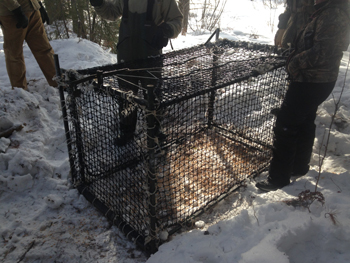
Next we checked deer traps, which are called clover traps. Mainly they wanted to catch pregnant does, so they could radio collar them and track their progress. They also used a temperature measuring device to get data on whether the doe was alive or dead and whether or not she had dropped fawn (the device would fall out upon birth as it was placed in the vagina of the animal). I got the chance to use telemetry to locate a doe and see whether or not she was alive by the frequency of the feedback.
The graduates also wanted us to have the opportunity to see what process they used when they received feedback that a doe was dead. They had a unique case where a radio-collared doe was hunted down by wolves, so we traveled over to the site and saw her remains. We were shown several ways of identifying whether it was a wolf kill or not; this included taking into consideration the space between teeth marks in bite wounds, whether there was hemorrhaging beneath the skin (this only occurs when a deer is alive and bleeding, indicating that it was being hunted) and inspecting the carcass to see if there was blood foam on the nose which indicated a crushed throat where blood from the jugular is mixed with breath. Wolves have a unique way of hunting, as does any predator, and knowing the different marks they leave can help decipher between the different predators.
After seeing the aftermath of a wolf kill, we asked if we could go out at night and try to get one to respond to howls. So with the temperatures just above -30 degrees, we ventured out into the woods and eventually to a frozen lake. We did get a few coyotes to respond, but the wolves were silent, making me wonder if they knew the difference between a recording and a real wolf or if they could smell us nearby. Either way, it was still awesome.

On the final day in Michigan, we had the best opportunity of all: getting up close and helping take measurements on wild black bears. The mother and two cubs were sedated and pulled from their den while we had the chance to touch them and help collect data. It was an incredible experience seeing the cub up close; she was licking her nose (a typical habit of sedated bears) and shivering. We did our best to keep her warm, and the work up took about an hour to complete.
It is projects like these that really give you a glimpse into a day in the field as a wildlife biologist and what can be achieved by completing this research. The data provided by this project will be used for years to come in determining whether predator control is necessary and what the real factors causing deer decline are. It gives people a glimpse into the multiple mechanisms at play when it comes to nature. There is never a simple answer.
Resources
Purdue Student Chapter of The Wildlife Society, Purdue FNR
FNR Majors & Minors, Purdue FNR
Student Life, Purdue FNR
Morgan Sussman, Freshman
Department of Forestry and Natural Resources

Recent Posts
- Beetle that attacks Tree-of-Heaven found in Indiana, Purdue Landscape Report
Posted: March 20, 2026 in Invasive Insects, Wildlife, Woodlands - ID That Tree: Dwarf Chinkapin Oak
Posted: in Forestry, Urban Forestry, Wildlife, Woodlands - DNR Hiring for Indiana Conservation Officer Positions, MyDNR
Posted: March 9, 2026 in Urban Forestry, Wildlife, Woodlands - ID That Tree: Shumard Oak
Posted: in Plants, Urban Forestry, Wildlife, Woodlands - Uniting Indiana Residents Against Invasive Species
Posted: February 27, 2026 in Community Development, Invasive Insects, Wildlife - Have You Seen a Soaring Eagle Lately? Morning Ag Clips
Posted: February 25, 2026 in Urban Forestry, Wildlife - Register for Natural Resources Teacher Institute’s Class of 2026
Posted: February 19, 2026 in Forestry, Wildlife, Woodlands - ID That Tree: Fragrant Sumac
Posted: February 4, 2026 in Plants, Urban Forestry, Wildlife - Woodsy Owl Edition for Educational Learning, USDA – U.S. Forest Service
Posted: January 21, 2026 in Forestry, Forests and Street Trees, Got Nature for Kids, Urban Forestry, Wildlife - Opt-in to the Deer Management Survey, MyDNR
Posted: January 12, 2026 in Forestry, Wildlife
Archives
Categories
- Alert
- Aquaculture/Fish
- Aquatic/Aquaculture Resources
- Ask the Expert
- Christmas Trees
- Community Development
- Disease
- Drought
- Forestry
- Forests and Street Trees
- Gardening
- Got Nature for Kids
- Great Lakes
- How To
- Invasive Animal Species
- Invasive Insects
- Invasive Plant Species
- Land Use
- Natural Resource Planning
- Nature of Teaching
- Plants
- Podcasts
- Ponds
- Publication
- Safety
- Spiders
- Timber Marketing
- Uncategorized
- Urban Forestry
- Webinar
- Wildlife
- Wood Products/Manufacturing
- Woodland Management Moment
- Woodlands