 Purdue University - Extension - Forestry and Natural Resources
Got Nature? Blog
The Wildlife Habitat Education Program (WHEP) is an environmental education program for youth ages 8-19 that teaches all about wildlife habitat and damage management through hands-on activities. This program is the largest of its kind in the nation, and has been awarded the Conservation Education Award by The Wildlife Society, the only professional organization that certifies wildlife biologists around the world.
Purdue Extension’s “WHEP – Wildlife Habitat Education Program” video takes a deeper look at the program through the testimonials of students and staff members involved with the program, including Extension Wildlife Specialist Rob Chapman and Professor of Wildlife Ecology Rod Williams.
Each year, WHEP has a national contest for its senior level (ages 14-19) youth consisting of three individual events and one team event. The first event, the wildlife challenge, consists of 30 general knowledge questions and 20 animal identifications based on skins and/or skulls. With only 30 minutes allowed for this event, it can be a challenging task.
Competitors can look to the WHEP manual for help studying for the general knowledge questions. The new publication “Wildlife Habitat Evaluation Program: Preparing for the Wildlife Challenge” assists further by providing flashcards for all of the species found on the identification questions, complete with pictures of the animal’s skins and a list of characteristics. Practicing with these flashcards is an extremely effective way to learn the material and perform better in the event.
This year’s event has come to a close, with 1st place going to Tennessee, 2nd place to Alabama, and 3rd to North Carolina. Study with the “Wildlife Habitat Evaluation Program: Preparing for the Wildlife Challenge” publication to prepare for next year!
Resources:
Wildlife Habitat Evaluation Program: Preparing for the Wildlife Challenge – The Education Store, Purdue Extension Resource Center
National WHEP Manual – Wildlife Habitat Education Program
Developing a Wildlife Habitat Management Plan – The Education Store
Wildlife Habitat Education Program – Teaching and Learning Wildlife Management Practices – The Education Store
Rod Williams, Professor of Wildlife Ecology
Purdue University Department of Forestry and Natural Resources
Rob Chapman, Extension Wildlife Specialist
Purdue University Department of Forestry and Natural Resources
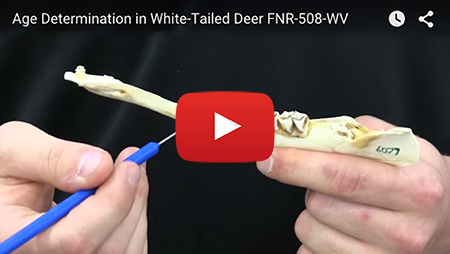 The age of a harvested deer is important for both hunters and landowners to know. The relationship between the age of a deer and its antler development can be an indicator of the deer’s health, and whether foraging conditions or harvest strategies should be changed. To help with determining this, the Purdue Student Chapter of the Quality Deer Management Association has created a How-To video to walk you through two of the techniques used to deduce how old the deer is using it’s jawbone.
This free video is available to view through The Education Store: Age Determination in White-Tailed Deer.
Other Resources:
How to Score Your White-Tailed Deer video, The Education Store-Purdue Extension Resource Center
Food Plots for White-tailed Deer, The Education Store
Boiler Up for Wildlife: Fall outbreaks of EHD and Blue Tongue in deer, Got Nature? Podcasts
Boiler Up for Wildlife: Deer Warts, Got Nature? Podcasts
iTunes – Got Nature? Podcasts
Rod Williams, Associate Professor of Wildlife Science
Department of Forestry and Natural Resources, Purdue University
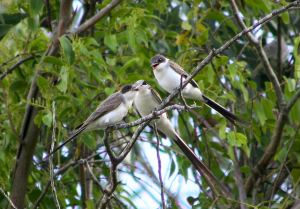 Bird biologist Amy Kearns of Indiana Department of Natural Resources found a fork-tailed flycatcher Tuesday in Daviess County while conducting a survey for another bird. The sighting was extremely unusual because this bird is typically found in Venezuela this time of year and has rarely, if ever, been spotted in Indiana before. Kearns believes that this bird could have ended up in Indiana as a result of its migration route being thrown off by storm systems.
Several avian enthusiasts came to look at this unusual bird, eager for a chance to observe a bit of South American wildlife here in Indiana.
Resources
South American Bird Spotted in Southern Indiana, IndyStar
Fork-tailed Flycatcher, Audubon
2014 Wildlife Science Report, Indiana Department of Natural Resources
Breeding Birds and Forest Management, The Education Store, Purdue Extension Resource Center
 With all of the recent rain we have had throughout the state, I have received several inquiries about effects on wildlife and what we can expect. While some flooding is natural in low areas and wildlife are adapted to respond, extreme flooding can impact wildlife. Flood waters can wash away nests or drown developing or very young animals for those living in low-lying areas. For example, heavy spring rains can reduce nest success of wild turkeys in flood plain areas.
In many cases, wildlife will adapt by simply moving to higher ground. I recently received an email from a Purdue Extension Educator. She was contacted by a homeowner about a possible increase in garter snake populations. According to her email, the homeowner never saw garter snakes in years past until this year. In fact, they were now showing up in neighborhood homes. Certainly our environment changes over time, and wildlife can and do respond to these changes. However, this recent change was likely due to a response of snakes moving to drier ground. This and other similar displacement of wildlife is usually temporary.
What can we do about this? I’m afraid not much for our currently flooded friends. However, in the long-term, times like this reinforce the need to create and enhance quality wildlife habitat. Providing wildlife with quality habitat that contains the necessary food, cover and water resources gives them a fighting chance to deal with issues that inevitably arise. In addition, wetlands that landowners build and restore on their properties not only enhance wildlife habitat, but also help retain flood waters and recharge groundwater supplies.
If some unwanted wildlife has overstayed their welcome around your home, check out my article on trapping nuisance wildlife. If you think you have found a sick or injured animal, you can find a list of licensed Wild Animal Rehabilitators in your area on the DNR Division of Fish and Wildlife’s website. In Indiana, wildlife rehabilitators have necessary state and federal permits to house and care for sick or injured wild animals.
Additional Resources
Preventing Wildlife Damage – Do You Need a Permit? The Education Store, Purdue Extension
The Basics of Managing Wildlife on Agricultural Lands, The Education Store, Purdue Extension
Brian J. MacGowan, Extension Wildlife Specialist
Department of Forestry and Natural Resources, Purdue University
 A new sing-along music video has been added to the Help the Hellbender website. This provides a fun and catchy way for teachers and students to learn about hellbenders and see the researchers hard at work helping add to their numbers.
The Help the Hellbender website also has other resources for teachers and students including lesson plans, coloring pages and a Hellbender Havoc video game. Check out the site and sing along with the hellbenders!
Resources
Help the Hellbender, Purdue Extension
Purdue Partners With Indiana Zoos for Hellbender Conservation, Purdue Agriculture News
The Nature of Teaching: Discovering the Watershed, The Education Store, Purdue Extension Resource Center
Amphibians & Reptiles, Indiana Department of Natural Resources
Purdue Extension-Forestry and Natural Resources
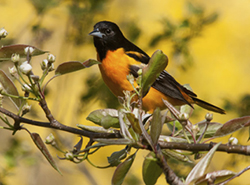 The focus of forest science is increasingly shifting to the management of forests as complex systems rather than as simple agricultural landscapes—with a much greater appreciation for the interactive ecosystem processes. In addition, now for many forest landowners, the ecological value of their land is at least as important as the economic return. It is, therefore, vital to understand how forest management affects not only timber production, but also the overall function of forested ecosystems.
This new publication, Breeding Birds and Forest Management: the Hardwood Ecosystem Experiment and the Central Hardwoods Region, summarizes the effects of forest management on bird species in the Midwest based on data collected as part of the Hardwood Ecosystem Experiment (HEE) in southern Indiana and other studies. We hope this summary provides a basis for understanding interactions between forest management and forest birds as well as guidelines for bird-friendly forest management in Indiana.
Resources
Hardwood Ecosystem Experiment
Hardwood Tree Improvement and Regeneration Center (HTIRC)
The Education Store, Purdue Extension Resource Center
 Mussels are a critical part of the ecosystem and work hard to keep our rivers clean. The Tippecanoe River hosts over 45 species of mussels, including six endangered ones. Mussel populations are in decline after being harvested by the millions in the 19th and 20th centuries. In an effort to restore the mussel population and keep the Tippecanoe River clean for wildlife populations as well as recreational activity, Purdue Extension has launched a new website about mussels called Heart of the Tippy.
This site provides detailed information on mussels and what we can do to help them. For example, carrying your canoe instead of dragging it over rocky-bottomed shallow water can save mussels from being crushed. It also offers an area where visitors can take a pledge to improve the Tippecanoe’s water quality and protect its mussel habitat.
Take the pledge today and help to protect the mussels and keep the Tippecanoe clean!
Resources
Extension Website Presents Ways to Help Protect Indiana’s Endangered Mussels, Purdue Agriculture News
Tippecanoe River, Indiana Department of Natural Resources
 Indiana Department of Natural Resources (INDNR) recently received an inquiry asking what to do with an abandoned animal. The INDNR web resource titled Orphaned and Injured Animals has steps to follow as you decide if the animal is truly abandoned.
Got Nature? Orphaned Animals author Brian MacGowan, extension wildlife specialist, Purdue University, says, “In most cases, the young animal is simply ‘spreading its wings’ and exploring or mom simply left it to get something to eat. Fawn deer are programmed to hide and remain motionless while mom is away. The fact is wildlife rarely abandons their young. They may leave briefly only to return.
Remember that you should never handle wild animals unless absolutely necessary. Any animal can bite you, and many harbor diseases and pests that can be transmitted to people.
In Indiana, wildlife rehabilitators have necessary state and federal permits to house and care for sick or injured wild animals. If you think you have found a sick or injured animal, you can find a list of licensed Wild Animal Rehabilitators in your area on the DNR Division of Fish and Wildlife’s website.”
Resources
Mammals of Indiana, J.O. Whitker and R.E. Mumford
Common Indiana Mammals, R.N. Chapman and R.N. Williams, publication number FNR-413-W
Indiana DNR Orphaned and Injured Animals
The Education Store (search keywords to find the resources you need)
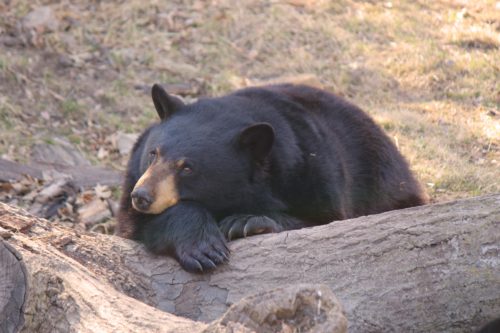 After being sighted in Indiana for the first time in 144 years on June 12 around South Bend, a second sighting of the bear has occurred in the Michigan City area, and this time, the bear has done a little bit of damage foraging for food. The bear had knocked over multiple bee hives and tore into some food at a local farm. It also bent poles holding up bird boxes, likely eating the baby birds inside.
The Department of Natural Resources is hoping the bear will return to upper Michigan on its own where the black bear population reaches around 15,000. However, they are continuing to monitor its movement and are prepared to trap it if needed.
While startling, it is important to note that black bears aren’t as dangerous as most people think. They are usually scared of humans, but it is a wise idea to move bird feeders, grills and trash cans out of your yard. If you encounter a bear, the DNR recommends standing your ground and making a lot of noise while slowly backing away. Do not turn and run. Black bears are also considered an exotic animal in Indiana, and shooting or killing one is a serious offense that can result in large fines or jail time.
Please report bear sightings to dfwinput@dnr.IN.gov or call 812-334-1137.
Resources
Black Bear, Indiana Department of Natural Resources
Black Bear Confirmed in Indiana For First Time in 144 Years, FOX59
 A new educational exhibit aimed for kindergartners to fifth graders called “A Salamander Tale” is ready to be shipped around the country and spread amphibian awareness. This interactive attraction is roughly 300 square feet and helps educate visitors at all ages about hellbenders, other salamanders and amphibians in general. Built into the exhibit is a video game called “Hellbender Havoc,” which provides a fun and unique way to learn about hellbenders. “Hellbender Havoc” is also playable online using Chrome or Firefox browsers.
Rental fees do apply for reserving the exhibit. Indiana state and extension professionals, also including Purdue staff, can rent the exhibit for free after paying for shipping. For more information, please check out the Salamander Tale web page, or feel free to take a look at other current exhibits on the Purdue Traveling Exhibits page. Check out Herbie the Hellbender today and inspire the Herpetologists of tomorrow!
Resources
Purdue Traveling Exhibits, Purdue Agriculture
Help the Hellbender, Purdue Extension
Salamanders of Indiana Book, The Education Store

Recent Posts
- ID That Tree: Nannyberry Viburnum
Posted: July 22, 2026 in Forestry, Plants, Wildlife, Woodlands - ID That Tree: Eastern Swamp Privet
Posted: in Forestry, Plants, Wildlife, Woodlands - Bovine Tuberculosis in Wild White-tailed Deer: Background and Frequently Asked Questions
Posted: July 20, 2026 in Disease, Natural Resource Planning, Wildlife - ID That Tree: Carolina Buckthorn
Posted: July 15, 2026 in Forestry, Wildlife, Woodlands - Bat Roost Reporting Tool
Posted: July 8, 2026 in Alert, Community Development, Invasive Animal Species, Wildlife - Thank You, Turkey Trackers! Your Brood Counts Make a Difference – MyDNR
Posted: in Alert, Community Development, Wildlife - Identifying Evergreens
Posted: June 24, 2026 in Forestry, Wildlife, Woodlands - Celebrate Pollinator Week With Flowers of June Tour
Posted: June 15, 2026 in Forestry, Gardening, How To, Wildlife - Pruning Highlight-Pollarding Trees: A Traditional Pruning Practice with Modern Uses
Posted: June 11, 2026 in Forestry, Forests and Street Trees, Urban Forestry, Wildlife, Woodlands - Danielle Howard Hired as FNR Extension Prescribed Fire Specialist
Posted: June 10, 2026 in Forestry, Wildlife, Woodlands
Archives
Categories
- Alert
- Aquaculture/Fish
- Aquatic/Aquaculture Resources
- Ask the Expert
- Christmas Trees
- Community Development
- Disease
- Drought
- Forestry
- Forests and Street Trees
- Gardening
- Got Nature for Kids
- Great Lakes
- How To
- Invasive Animal Species
- Invasive Insects
- Invasive Plant Species
- Land Use
- Natural Resource Planning
- Nature of Teaching
- Plants
- Podcasts
- Ponds
- Publication
- Safety
- Spiders
- Timber Marketing
- Urban Forestry
- Webinar
- Wildlife
- Wood Products/Manufacturing
- Woodland Management Moment
- Woodlands