 Purdue University - Extension - Forestry and Natural Resources
Got Nature? Blog
Join Rod Williams, Purdue FNR Professor of Wildlife Science, Jason Hoverman, Purdue FNR Professor of Invertebrate Ecology, and Michael Lannoo, Indiana University School of Medicine – Professor of Anatomy and Cell Biology, to learn interesting facts about frogs and toads, their natural history, research about the threats they face, and what can you do to help these species.
If you have any questions regarding wildlife, trees, forest management, wood products, natural resource planning or other natural resource topics, feel free to contact us by using our Ask an Expert web page.
Resources
Mythbusters, Got Nature? Blog, Purdue Extension – Forestry and Natural Resources
Frogs and Toads of Indiana, The Education Store, Purdue Extension resource center
Appreciating Reptiles and Amphibians in Nature, The Education Store
Forestry Management for Reptiles and Amphibians: A Technical Guide for the Midwest, The Education Store
The Nature of Teaching, Unit 3: Reptiles, Amphibians, and the Scientific Method, The Education Store
Ecotoxicology and Environmental Health, The Education Store
Disease Ecology, The Education Store
Okoboji Wetlands: A Lesson in Natural History, 1996, University of Iowa Press
Status and Conservation of Midwestern Amphibians, 1998
Amphibian Declines, 2005, University of California Press
Malformed Frogs: The Collapse of Aquatic Ecosystems, 2008
Leopold’s Shack and Rickett’s Lab: The Emergence of Environmentalism, 2010
The Iowa Lakeside Laboratory: A Century of Discovering the Nature of Nature, 2012
North American Amphibians: Distribution and Diversity, 2014
This Land is Your Land: The Story of Field Biology in America, 2018, The University of Chicago Press
The Call of the Crawfish Frog, 2020
AmphibiaWeb
Indiana Herp atlas
Amphibian Ecology and Conservation
Handbook of Larval Amphibians of the United States and Canada, Cornell Press
Rod Williams, Professor of Wildlife Science
Purdue University Department of Forestry and Natural Resources
Jason Hoverman, Professor of Vertebrate Ecology
Purdue University Department of Forestry and Natural Resources
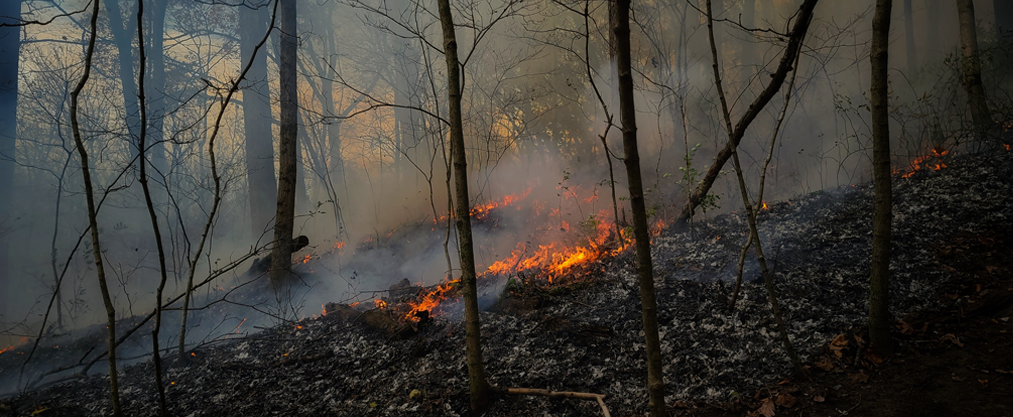 The goal of extension work is to provide practical solutions to local – and global – issues from agricultural production, environmental issues, natural resource conservation, land use and more.
Purdue Extension wildlife specialist Jarred Brooke’s work with prescribed fire is doing just that, as it is now being used to educate a new audience about various techniques of the habitat management method, the Wounaan indigenous community of Panama among others, thanks to the United States Forest Service.
Naomi Mills, a smokejumper squad leader for the Missoula Smokejumpers and fire specialist for USFS International Programs in the Latin America region, is utilizing Brooke’s Wildlife Habitat Hint series on prescribed fire techniques to illustrate various ignition techniques and methods as part of her virtual fire management training sessions.
Resources
Wildlife Habitat Hint: Prescribed Fire Techniques – Backing Fire, Video, Purdue Extension – Forestry and Natural Resources YouTube channel
Wildlife Habitat Hint: Prescribed Fire Techniques – Flanking Fire, Purdue Extension – FNR Video
Wildlife Habitat Hint: Prescribed Fire Techniques – Strip Head Fire, Purdue Extension – FNR Video
Wildlife Habitat Hints: Prescribed Fire Techniques – Ring Fire, Purdue Extension – FNR Video
Wildlife Habitat Hints: Prescribed Fire Techniques – Point Source Fire, Purdue Extension – FNR Video
Wildlife Habitat Hint: Late Growing Season Prescribed Fire, Purdue Extension – FNR Video
FNR Ask The Expert: Prescribed Fire with Jarred Brooke and Mike Saunders, Purdue Extension – FNR Video
Renovating Native Warm-Season Grass Stands for Wildlife: A Land Manager’s Guide, The Education Store, Purdue Extension resource center
Prescribed fire: 6 things to consider before you ignite, Got Nature? Blog, Purdue Extension – Forestry and Natural Resources
Indiana Prescribed Fire Council
Jarred Brooke, Wildlife Extension Specialist
Purdue Department of Forestry and Natural Resource
Each year, the Indiana DNR conducts its Turkey Brood Survey to determine wild turkey productivity. The DNR relies on Hoosier outdoor enthusiasts from across the state to report the number of hens and poults they see from July 1st to August 31st. This helps them calculate a Productive Index (number of poults per hen; figure 1) for counties across the state. Does this sound like something you are interested in? Here are four simple steps to be involved!
- Register for the turkey brood reporting system.
- Spend time outdoors from July 1st to August 31st.
- Count the number of hens and poults you see while spending time outdoors (figure 2).
- Report the number of hens and poults on the DNR’s online portal.
DNR biologists can’t collect brood observations across the state alone. In order to reach the goal of 3,000 observations this year, they need our help! If you’re interested in sharing your turkey brood observations with DNR, visit on.IN.gov/turkeybrood and register after June 10. Record observations any time from July 1 to August 31. Recording observations takes less than 5 minutes.
The DNR appreciates your help to document turkey broods around the state. Sharing observations is easy and critical to the management of wild turkey.
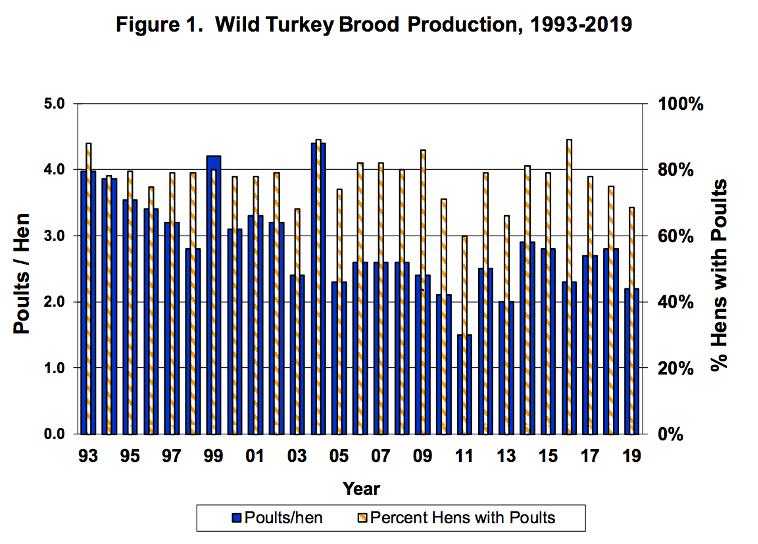
Figure 1. Wild turkey brood production from 1993 to 2019. Image is from the 2019 Wild Turkey Summer Brood Production Index.

Figure 2. Example of how to count and record turkey broods for the turkey brood survey. Image is from the Introduction to Documenting Turkey Brood Publication from the Indiana DNR.
As you enjoy the outdoors, whether it is for recreation or managing your property, we thank you in advance for helping with wildlife conservation.
Resources
Wild Turkey Hunting, Biology and Management, Indiana Department of Natural Resources (IDNR)
Wild Turkey, Indiana Department of Natural Resources (IDNR)
Truths and Myths about Wild Turkey, Purdue Extension
Forest Improvement Handbook, The Education Store
Jarred Brooke, Extension Wildlife Specialist
Purdue Department of Forestry and Natural Resources
Indiana Department of Natural Resources
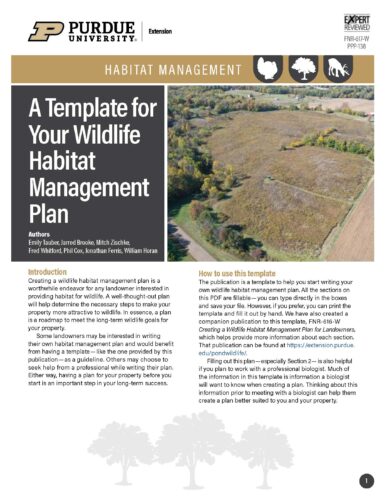 Many landowners are interested in enhancing their property for wildlife. An important step in that process is creating a plan. This publication provides a template to help landowners write a wildlife habitat management plan.
View other wildlife habitat management publications and video resources as you place keywords in the search field located on The Education Store website.
Resources
Creating a Wildlife Habitat Management Plan for Landowners, The Education Store, Purdue Extension resource center
Managing Your Woods for White-Tailed Deer, The Education Store
Woodland Stewardship for Landowners, Playlist, Purdue Extension – Forestry and Natural Resources YouTube channel
A Woodland Management Moment, Purdue Extension – FNR playlist
Wildlife Habitat Hint, Purdue Extension – FNR playlist
Ask an Expert: Wildlife Food Plots, Video, Purdue Extension – Forestry and Natural Resources YouTube channel
Jarred Brooke, Wildlife Extension Specialist
Purdue Department of Forestry and Natural Resource
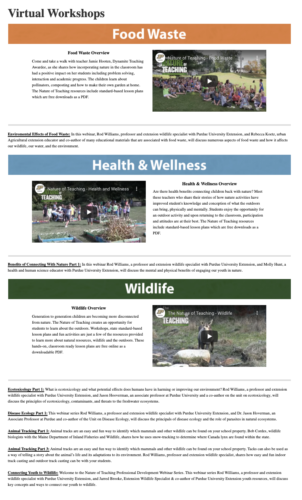
The Nature of Teaching Extension program includes formal standards-based curricula and informal activity-based curricula, all centered around getting youth outside. Topics included are Food Waste, Health & Wellness, and Wildlife. Each program area provides standards-based, classroom-ready, free lesson plans with downloadable PDFs.
The resources keep growing with now opportunities to take the virtual workshops and receive a certificate of completion. The webinars include all the links to the material for K-12 curriculum and activities available. Whether you are a teacher, natural resource leader or a 4-H leader you have the opportunity to use the prepared curriculum with fun activities while teaching K-12 youth about natural resources, conservation, and the environment.
Resources
Virtual Workshops, Nature of Teaching
Nature of Teaching, Website, Purdue College of Agriculture
The Nature of Teaching, YouTube channel
Transporting Food Waste, The Education Store, Purdue Extension resource center
Benefits of Connecting with Nature, The Education Store
Nature of Teaching: Common Mammals of Indiana, The Education Store
Rod Williams, former Professor of Wildlife Science & Wildlife Extension Specialist
Purdue University Department of Forestry and Natural Resources
You may have found salamanders while flipping over rocks and logs in the woods or you may have seen them scurrying in and out of your pond. In this episode of FNR Ask the Expert, join Dr. Rod Williams, extension specialist Nick Burgmeier and IU Northwest’s Dr. Spencer Cortwright as they discuss all things salamander, including the different species as well as some threats to these amazing amphibians.
If you have any questions regarding trees, forests, wildlife, wood products or other natural resource topics, feel free to contact us by using our Ask an Expert web page.
Resources
Ask An Expert, Playlist, Purdue Extension – Forestry and Natural Resources YouTube channel
Help the Hellbender, Purdue Extension – FNR Playlist
A Moment in the Wild, Purdue Extension – FNR Playlist
The Nature of Teaching: Adaptations for Aquatic Amphibians, The Education Store, Purdue Extension resource center
How Our Zoos Help Hellbenders, The Education Store
Help the Hellbender, Website, Purdue College of Agriculture
Rod Williams, Professor of Wildlife Science
Purdue University Department of Forestry and Natural Resources
Nick Burgmeier, Research Biologist and Wildlife Extension Specialist
Purdue Department of Forestry and Natural Resources
 Illinois-Indiana Sea Grant: Freedom Seekers were environmentalists who learned to navigate the land as they escaped slavery. Songs like “Wade in the Water” and “Follow the Drinking Gourd” remind us that history has always been connected to the land we occupy. The lessons featured in this free curriculum, Freedom Seekers: The Underground Railroad, Great Lakes, and Science Literacy Activities, acknowledge the enslaved Africans who had to rely on environmental science principles in their quest for life, liberty and the pursuit of happiness. These lessons provide educators with cross-curricular teaching opportunities for middle and high school students.
“I didn’t realize that the Great Lakes were linked to the Underground Railroad at all,” said Megan Gunn, aquatic education specialist with Illinois-Indiana Sea Grant and Purdue University Forestry and Natural Resources. Gunn worked with partners across the region to finalize the curriculum. “I grew up near Lake Michigan and never learned how my cultural roots were so closely connected to the natural world, so I’m excited for the next generation to have this educational opportunity.”
The Freedom Seekers curriculum is a collaborative project between several organizations and schools throughout the Great Lakes. It is part of a professional development effort for educators to increase their knowledge of the Great Lakes and environmental issues while incorporating Environmental Justice Education (EJE) approaches to K-12 teaching. These EJE approaches leverage cross-curricular connections that focus on increasing the awareness of local issues and history in the Great Lakes region.
Resources
Center For Great Lakes Literacy (CGLL), Website
Ask An Expert: Hot and Cold, Video, Purdue Extension – Forestry and Natural Resources YouTube channel
Diets of Lake Michigan Salmonids, The Education Store, Purdue Extension resource center
Informing the Development of the Great Lakes Region Decision Support System, The Education Store
Salmon and Trout of the Great Lakes: A Visual Identification Guide, The Education Store
New website: Eat Midwest Fish, Got Nature? Blog, Purdue Extension – Forestry and Natural Resources
Scientists bring the Great Lakes to students learning from home, Got Nature? Blog
ID That Tree: Alternate Leaved Dogwood, Got Nature? Blog
Illinois-Indiana Sea Grant (IISG)
A variety of different types of regeneration openings can be created on properties to provide different structures and species of plants that are suitable to a wide variety of wildlife species. In this episode of Woodland Stewardship for Landowners, Purdue Extension forester Lenny Farlee talks about two types of regeneration openings – clearcuts and shelterwoods. These two techniques produce an even-aged forest, where all the plants regenerating in that area are approximately of the same age.
If you have any questions regarding wildlife, trees, forest management, wood products, natural resource planning or other natural resource topics, feel free to contact us by using our Ask an Expert web page.
Resources
Woodland Stewardship for Landowners, Playlist, Purdue Extension – Forestry and Natural Resources (FNR) YouTube Channel
Woodland Management Moment, Purdue Extension – FNR Playlist
Woodland Stewardship for Landowners: Single Tree and Patch-Cut Harvesting, Purdue Extension – FNR Video
Hardwood Ecosystem Experiment: Uneven-aged Management, Purdue Extension – FNR Video
Hardwood Ecosystem Experiment: Even-aged Management, Purdue Extension – FNR Video
Finding help from a professional forester, Indiana Forestry & Woodland Owners Association
Forest Improvement Handbook, The Education Store, Purdue Extension resource center
Lenny Farlee, Sustaining Hardwood Extension Specialist
Purdue University Department of Forestry and Natural Resource
Browsing by deer on planted and naturally regenerated hardwood seedlings is one of the greatest obstacles to seedling establishment in many parts of the central hardwood region. In this Woodland Stewardship For Landowners, Purdue Wildlife Extension Specialist Brian MacGowan talks about different types of deer damage and how landowners could mitigate the damage.
If you have any questions regarding wildlife, trees, forest management, wood products, natural resource planning or other natural resource topics, feel free to contact us by using our Ask an Expert web page.
Resources
Woodland Stewardship For Landowners, Playlist, Purdue Extension – Forestry and Natural Resources YouTube Channel
Woodland Management Moment, Purdue Extension – FNR Playlist
A Woodland Management Moment – Deer Fencing, Purdue Extension – FNR Video
Wildlife Habitat Hint: Exclusion Cage, Purdue Extension – FNR Video
How to Build a Plastic Mesh Deer Exclusion Fence, The Education Store, Purdue Extension resource center
Forest Improvement Handbook, The Education Store
Finding help from a professional forester, Indiana Forestry & Woodland Owners Association
Brian MacGowan, Wildlife Extension Specialist & Extension Coordinator
Purdue Department of Forestry and Natural Resources
Join this edition of Ask an Expert video series with Dr. Joy O’Keefe and PhD candidate Elizabeth Beilke as they share about their studies of bats on the Hardwood Ecosystem Experiment.
The HEE is in its initial stages and is planned as a 100-year project. Data were collected for two years prior to the first round of timber harvests and inventories have been conducted annually since, allowing us to quantify the varied responses of plants and animals to active forest management. This data will ultimately be used to develop management prescriptions that provide for resilient and sustainable managed forest ecosystems in Indiana.
If you have any questions regarding trees, forests, wildlife, wood products or other natural resource topics, feel free to contact us by using our Ask an Expert web page.
Resources
Hardwood Ecosystem Experiment (HEE) Highlights: Bats, Video, Purdue Extension – Forestry and Natural Resources YouTube Channel
Hardwood Ecosystem Experiment (HEE), Playlist, Purdue Extension – Forestry and Natural Resources
Hardwood Ecosystem Experiment, Website
Hardwood Ecosystem Experiment – Wildlife Responses to Timber Harvesting, Purdue Extension – Forestry and Natural Resources
The Hardwood Ecosystem Experiment: Indiana Forestry and Wildlife, The Education Store
Ask An Expert: Bats on the Hardwood Ecosystem Experiment, Video, Purdue Extension – Forestry and Natural Resources Facebook
Bats in Indiana, Indiana Department of Natural Resources (IDNR)
Bat Houses, Bat Conservation International
Joy O’Keefe, Assistant professor and Wildlife Extension Specialist,
University of Illinois (Champaign) Natural Resources and Environmental Sciences

Recent Posts
- Beetle that attacks Tree-of-Heaven found in Indiana, Purdue Landscape Report
Posted: March 20, 2026 in Invasive Insects, Wildlife, Woodlands - ID That Tree: Dwarf Chinkapin Oak
Posted: in Forestry, Urban Forestry, Wildlife, Woodlands - DNR Hiring for Indiana Conservation Officer Positions, MyDNR
Posted: March 9, 2026 in Urban Forestry, Wildlife, Woodlands - ID That Tree: Shumard Oak
Posted: in Plants, Urban Forestry, Wildlife, Woodlands - Uniting Indiana Residents Against Invasive Species
Posted: February 27, 2026 in Community Development, Invasive Insects, Wildlife - Have You Seen a Soaring Eagle Lately? Morning Ag Clips
Posted: February 25, 2026 in Urban Forestry, Wildlife - Register for Natural Resources Teacher Institute’s Class of 2026
Posted: February 19, 2026 in Forestry, Wildlife, Woodlands - ID That Tree: Fragrant Sumac
Posted: February 4, 2026 in Plants, Urban Forestry, Wildlife - Woodsy Owl Edition for Educational Learning, USDA – U.S. Forest Service
Posted: January 21, 2026 in Forestry, Forests and Street Trees, Got Nature for Kids, Urban Forestry, Wildlife - Opt-in to the Deer Management Survey, MyDNR
Posted: January 12, 2026 in Forestry, Wildlife
Archives
Categories
- Alert
- Aquaculture/Fish
- Aquatic/Aquaculture Resources
- Ask the Expert
- Christmas Trees
- Community Development
- Disease
- Drought
- Forestry
- Forests and Street Trees
- Gardening
- Got Nature for Kids
- Great Lakes
- How To
- Invasive Animal Species
- Invasive Insects
- Invasive Plant Species
- Land Use
- Natural Resource Planning
- Nature of Teaching
- Plants
- Podcasts
- Ponds
- Publication
- Safety
- Spiders
- Timber Marketing
- Uncategorized
- Urban Forestry
- Webinar
- Wildlife
- Wood Products/Manufacturing
- Woodland Management Moment
- Woodlands