 Purdue University - Extension - Forestry and Natural Resources
Got Nature? Blog
 Question: My husband and I love to build wildlife habitat areas and have built a large pond with a strategic filtering system in the pond. We had to place a net five to six feet up to keep leaves and acorns out of the filtering system and now the frogs are jumping on the net. One specialist said they are trying to get to the woods to hibernate for winter and one shared that they can stay in the pond as long as it doesn’t freeze. Which answer is correct?
Answer: Both of your answers could be correct. The following is from Michael Lannoo (2005) Amphibian Declines: The Conservation Status of United States Species. In summary, adults will hibernate in both water and on land, although underwater seems to be the most common site. The key is having available oxygen. However, hibernating amphibians when hibernating have extremely low oxygen requirements. So much so that most species get enough O2 from absorption through specialized patches of skin.
- Seasonal Migrations. Green frogs probably do not migrate en masse to breeding sites. Lamoureux and Madison (1999) tracked 23 green frogs and found that they made extensive movements in late fall away from summer breeding ponds to areas of flowing water in streams and seeps. They suggested that flowing water is used because it remains unfrozen and provides adequate oxygen.
- J. Torpor (Hibernation). Green frog tadpoles will typically, but not always, overwinter for 1 yr prior to metamorphosing the following spring (Martof, 1952; Richmond, 1964; Vogt, 1981). While overwintering, and despite cold temperatures, tadpoles remain active and likely feed (Getz, 1958). Tadpoles probably remain active and grow during the winter in Louisiana but do not transform until warm weather (Dundee and Rossman, 1989). In Maine, they remain under silt and dead vegetation during the winter (Hunter et al., 1999). Both tadpoles and adults require aquatic sites that do not completely freeze and that also maintain enough oxygen during the winter (Oldfield and Moriarty, 1994).
Green frog adults typically overwinter in water (Dickerson, 1906; Walker, 1946; Pope, 1947; Wright and Wright, 1949; Harding and Holman, 1999) but will occasionally overwinter on land (Bohnsack, 1951). The frog followed by Bohnsack (1951) was found beneath 5 cm (2 in) of compact leaf litter in an oak-hickory forest near Pickney, Michigan. Lannoo et al. (1998) cites an instance where a large number (25, including 4 gravid females) of green frogs were caught on land near a wetland during a cold snap in northern Wisconsin. Minton (1972) notes that adults near Indianapolis, Indiana, seek cover from early December to early March and that juveniles emerge earlier in the season than do adults. In Maine, green frogs hibernate either underwater or underground from October–March (Hunter et al., 1999). In Ohio, several hibernating individuals have been found in springs and in masses of leaves and aquatic vegetation on the bottom of small ponds (Walker, 1946).
Resources:
Mythbusters, Got Nature? Blog, Purdue Extension – Forestry and Natural Resources
Frogs and Toads of Indiana, The Education Store, Purdue Extension resource center
Appreciating Reptiles and Amphibians in Nature, The Education Store
Forestry Management for Reptiles and Amphibians: A Technical Guide for the Midwest, The Education Store
The Nature of Teaching, Unit 3: Reptiles, Amphibians, and the Scientific Method, The Education Store
Frogs and Toads of Indiana, The Education Store
Snakes and Lizards of Indiana, The Education Store
Ask the Expert: Turtles and Snakes video, Got Nature? post
Brian MacGowan, Wildlife Extension Specialist
Purdue University, Department of Forestry and Natural Resources
In this episode of ID That Tree, Purdue Extension forester Lenny Farlee introduces the blue ash. This native Indiana ash species can be differentiated from other members of the ash family by corky edges on the twig, more branches lower on the stem and a platy, ashy gray bark.
If you have any questions regarding wildlife, trees, forest management, wood products, natural resource planning or other natural resource topics, feel free to contact us by using our Ask an Expert web page.
Resources:
ID That Tree, Playlist, Purdue Extension – Forestry and Natural Resources Youtube Channel
A Woodland Management Moment, Playlist, Purdue Extension – FNR Youtube Channel
Shrubs and Woody Vines of Indiana and the Midwest, The Education Store, Purdue Extension Resource Center
Native Trees of the Midwest, The Education Store
Investing in Indiana Woodlands, The Education Store
Forest Improvement Handbook, The Education Store
Lenny Farlee, Sustaining Hardwood Extension Specialist
Purdue University Department of Forestry and Natural Resources
 MyDNR: Annually, more than 14,000 deer-vehicle collisions are reported in Indiana. If you live where deer are found, especially in suburban areas or where field and forest meet, it is important to know ways to reduce the likelihood of a collision and what to do if you are involved in one. While you can’t eliminate the possibility of running into a deer on the road, you can minimize the risk of severe damage to you or your vehicle.
Deer movements are not random, and the likelihood of seeing deer near roads varies by time of day and month. Deer are most active when many people are commuting to and from work, resulting in increased collisions. While your chance of hitting a deer varies, in general, deer-vehicle collisions are most likely to occur during these conditions:
- At dawn and dusk when deer are most active.
- From September through December, particularly October and November during deer mating season as bucks cross roads more frequently and are less cautious when crossing.
For more information view the Indiana DNR printable PDF (.144mb) Deer-Vehicle Collisions and You.
Resources:
Watch out for deer on the roads, Got Nature? Post, Purdue Extension – Forestry and Natural Resources (FNR)
A Woodland Management Moment – Deer Fencing, Purdue Extension – FNR YouTube Video
Woodland Stewardship for Landowners: Managing Deer Damage to Young Trees, Purdue Extension – FNR YouTube Video
Ask an Expert: Wildlife Food Plots, Purdue Extension – FNR YouTube Video
How to Build a Plastic Mesh Deer Exclusion Fence, The Education Store, Purdue Extension resource center
Deer Harvest Data Collection, Got Nature? Blog, Purdue Extension – FNR
Handling Harvested Game: Episode 4, Cutting, Grinding & Packaging, Purdue Extension – FNR YouTube Video
Indiana Department of Natural Resources
In this edition of ID That Tree, meet the Eastern Hop Hornbeam, so named because of its fruit which resembles hops. This small, native, shade tolerant tree also is identifiable by its simply finely toothed leaves on thin twigs as well as its brown flaky bark. Learn how to separate it from its cousin American Hornbeam inside.
If you have any questions regarding wildlife, trees, forest management, wood products, natural resource planning or other natural resource topics, feel free to contact us by using our Ask an Expert web page.
Resources:
ID That Tree, Playlist, Purdue Extension – Forestry and Natural Resources Youtube Channel
A Woodland Management Moment, Playlist, Purdue Extension – FNR Youtube Channel
Shrubs and Woody Vines of Indiana and the Midwest, The Education Store, Purdue Extension Resource Center
Native Trees of the Midwest, The Education Store
Investing in Indiana Woodlands, The Education Store
Forest Improvement Handbook, The Education Store
Lenny Farlee, Sustaining Hardwood Extension Specialist
Purdue University Department of Forestry and Natural Resources
This native tree comes with its own defense system in very large thorns on the stems and trunk. Meet the honey locust. Purdue Extension forester Lenny Farlee explains that large, long yellow seed pods that resemble bean pods, the option of single or doubly compound leaves on the same tree and smooth gray bark also help identify this species.
If you have any questions regarding wildlife, trees, forest management, wood products, natural resource planning or other natural resource topics, feel free to contact us by using our Ask an Expert web page.
Resources:
ID That Tree, Playlist, Purdue Extension – Forestry and Natural Resources Youtube Channel
A Woodland Management Moment, Playlist, Purdue Extension – FNR Youtube Channel
Shrubs and Woody Vines of Indiana and the Midwest, The Education Store, Purdue Extension Resource Center
Native Trees of the Midwest, The Education Store
Investing in Indiana Woodlands, The Education Store
Forest Improvement Handbook, The Education Store
Lenny Farlee, Sustaining Hardwood Extension Specialist
Purdue University Department of Forestry and Natural Resources
This native Indiana tree species is found in three southwestern counties near the lower Wabash River. It is often found in wet or ponded locations where there is standing water or high water tables. Meet water locust. It has large multi-pronged thorns and compound leaves like its cousin the honey locust, but can be differentiated by its location, its much smaller seed pods and its flattened thorns along the branches.
If you have any questions regarding wildlife, trees, forest management, wood products, natural resource planning or other natural resource topics, feel free to contact us by using our Ask an Expert web page.
Resources:
ID That Tree, Playlist, Purdue Extension – Forestry and Natural Resources Youtube Channel
A Woodland Management Moment, Playlist, Purdue Extension – FNR Youtube Channel
Shrubs and Woody Vines of Indiana and the Midwest, The Education Store, Purdue Extension Resource Center
Native Trees of the Midwest, The Education Store
Investing in Indiana Woodlands, The Education Store
Forest Improvement Handbook, The Education Store
Lenny Farlee, Sustaining Hardwood Extension Specialist
Purdue University Department of Forestry and Natural Resources
If you have ever noticed acorns so numerous that you could not take a step without crushing several, you may be asking the question, “why are there so many acorns?” Some answers to this question can be found in the physiology and ecology of trees and their relationship to wildlife. Oaks and several other tree species occasionally produce enormous crops of seed. This is called “masting” or “mast events”. These events are periodic. In the case of many oak species, a large mast event may happen every two to five years, depending on the species of oak and several other factors. Masting events may be preceded and followed by small or moderate acorn crops, or complete crop failures in some cases. Why does this irregular seed production happen? These events may be tied to several aspects of the life of oaks.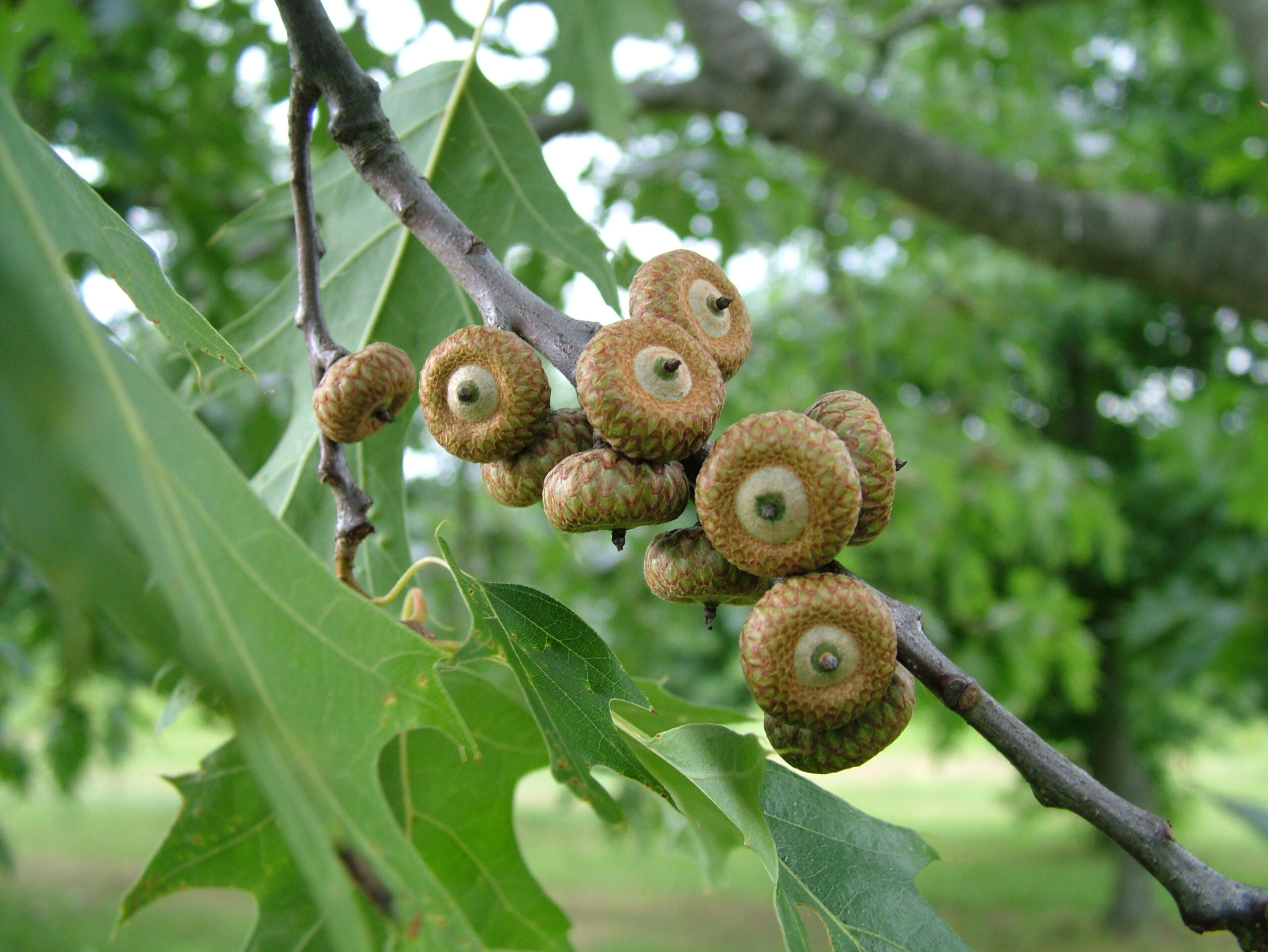
First, the production of a huge volume of a large seed like an acorn requires a lot of resources from the tree. This level of production may not be possible for the tree every year. Trees allocate energy to several different functions, so committing large amounts of energy to one area could mean deficits in others. This may mean there are advantages for the tree to produce occasional, rather than annual, mastings.
Second, weather does not always cooperate to provide the conditions for a bumper acorn crop. Unfavorable weather during pollination and seed development periods can result in reduced production of acorns. Late spring freezes, extremely high temperatures, summer droughts and other weather stresses can reduce acorn pollination and production.
Third, predation by seed-eaters like squirrels, deer, turkey and even weevil larvae can greatly reduce the number of viable acorns. It may take a very large acorn crop to have many acorns escape from the numerous species that depend on acorns for food.
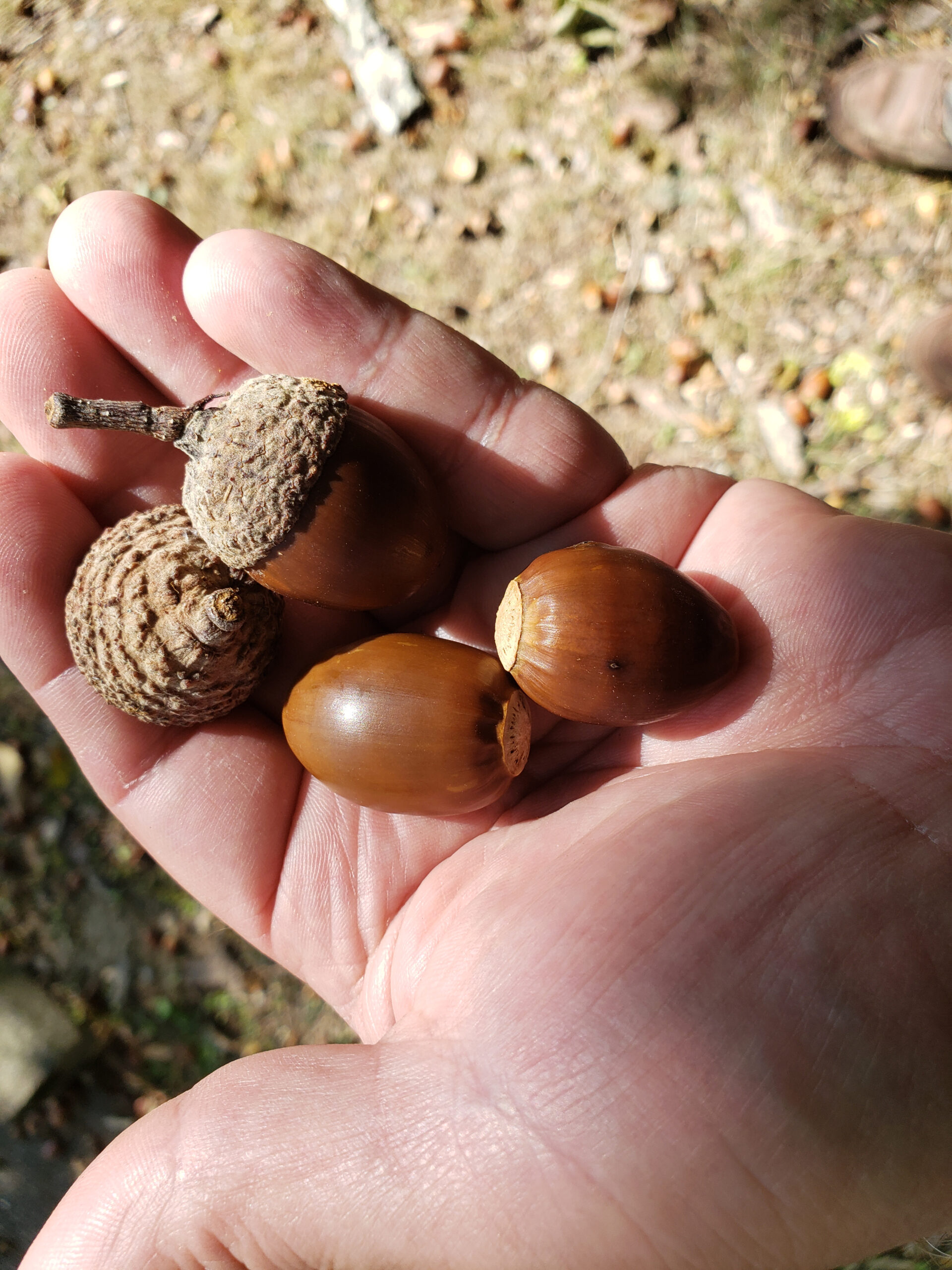
This irregular cycle of large crops can be beneficial for the oaks by overwhelming the seed eaters. Populations of wildlife that depend on acorns may eat most of the seed during normal seed crops, but may not be able to utilize all the seed produced during a masting. This surplus seed is available produce the next generation of oak seedlings.
However, some species will produce copious amounts of the mast if the developmental age of the tree is favorable, regardless of conditions.
Acorn production can vary by species and individual trees across the oak family, but masting is a way this important group of trees can continue to be a part or our Midwestern landscape.
Resources:
Woodland Management Moment: Direct Seeding, Purdue Extension – Forestry and Natural Resources (FNR) YouTube Channel
Ask an Expert: Tree Selection and Planting, Purdue Extension – Forestry and Natural Resources (FNR) YouTube Channel
Forest Improvement Handbook, The Education Store, Purdue Extension resource center
Native Trees of the Midwest, The Education Store
Investing in Indiana Woodlands, The Education Store
Tree Pruning Essentials, The Education Store
Lenny Farlee, Sustaining Hardwood Extension Specialist
Purdue University Department of Forestry and Natural Resources
Lindsey Purcell, Chapter Executive Director and Certificate Liaison
Indiana Arborist Association
On this edition of ID That Tree, Purdue Extension forester Lenny Farlee introduces you to one of our common bottomland trees, the Eastern Cottonwood. This tree stands out for its triangular or delta shaped leaves, often with prominent teeth along the edges, which extend from long flattened leaf stems. This native tree is named for its early season fruit, which is a little tuft of white hairs that holds a small seed that is produced in large quantities and often blown far from the parent tree.
If you have any questions regarding wildlife, trees, forest management, wood products, natural resource planning or other natural resource topics, feel free to contact us by using our Ask an Expert web page.
Resources:
ID That Tree, Playlist, Purdue Extension – Forestry and Natural Resources Youtube Channel
A Woodland Management Moment, Playlist, Purdue Extension – FNR Youtube Channel
Shrubs and Woody Vines of Indiana and the Midwest, The Education Store, Purdue Extension Resource Center
Native Trees of the Midwest, The Education Store
Investing in Indiana Woodlands, The Education Store
Forest Improvement Handbook, The Education Store
Lenny Farlee, Sustaining Hardwood Extension Specialist
Purdue University Department of Forestry and Natural Resources
Prescribed or targeted grazing has been used on Western rangelands for many years to manage range weeds and is also used to reduce fuel and maintain fire breaks in high fire hazard areas. It has also been used in the south to help control kudzu.
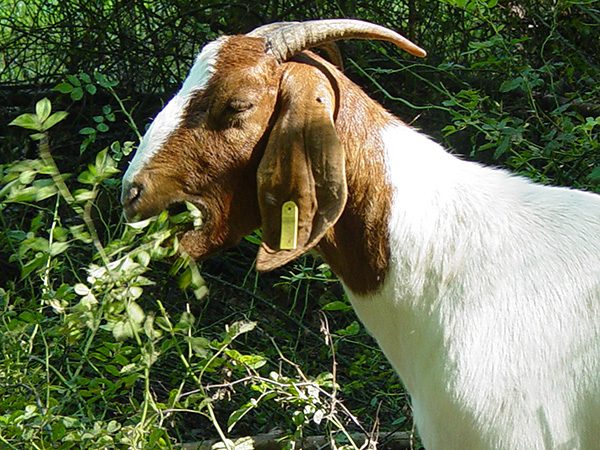
In a recent study, Purdue Extension forester Ron Rathfon tested goat grazing as a method to control a continuous stand of mature, dense multiflora rose in the understory of one of the timber stands at the Southern Indiana Purdue Agricultural Center (SIPAC). After the steep slope resisted a few rounds of prescribed fire and conventional methods like cutting and spraying were deemed impractical due to the terrain and the thick growth of thorny rose, Rathfon decided to give the animals a try at reducing the invasive species.
The results of Rathfon’s five-year experiment were recently published in the journal Restoration Ecology (Volume 29, Issue 4, May 2021) in an article titled “Effects of prescribed grazing by goats on non-native invasive shrubs and native plant species in a mixed hardwood forest.” Rathfon co-authored the publication with professor of forest ecology Dr. Mike Jenkins, and master’s degree alumna Skye Greenler.
“Although prescribed grazing is not new, no research has been published demonstrating its use for invasive brush species management in eastern hardwood forests and quantifying its impacts on native vegetation,” Rathfon explained. “The goal was to test the use of the goats to control invasive woody brush species as a first step in restoring degraded hardwood forests. I anticipated the goats would reduce understory plant cover. What I didn’t know is how long it would take or whether native vegetation would be more severely impacted than the targeted invasive plants.”
Rathfon and his cohorts varied the goat stocking rate (16 vs. 32-48 goats per acre) and also the number of times a plot was grazed during a growing season (once or twice). Goats were not left in the woods continuously throughout the growing season. When they consumed all green leaves, they were removed, to prevent serious long-term damage to the trees, which had occurred with past livestock grazing in woodlands.
Resources:
What are invasive species and why should I care?, Purdue Extension-Forestry and Natural Resources Blog
Invasive Plant Series: Swallow-worts, The Education Store, Purdue Extension resource center
Mile-a-Minute Vine, The Education Store
Planting Forest Trees and Shrubs in Indiana, The Education Store
Invasive Species Playlist, Purdue Extension-Forestry and Natural Resources YouTube Channel
Report Invasive Species, Purdue Invasive Species
The GLEDN Phone App – Great Lakes Early Detection Network
EDDMaps – Early Detection and Distribution Mapping System
Indiana Department of Natural Resources: Invasive Species
Indiana Invasive Species Council
Cooperative Invasive Species Management Area (CISMA)
Wendy Mayer, FNR Communications Coordinator
Purdue University Department of Forestry and Natural Resources
 Pat Zollner, professor of wildlife science, and doctoral student Marian Wahl are researching black vultures in Indiana in order to better understand vulture ecology as well as to develop methods to mitigate future harm to Indiana and Kentucky livestock.
In addition to looking to see what causes some black vulture to become aggressive predators of livestock, instead of simply scavengers, the research group also is looking to learn signs that can determine whether an animal has been killed by vultures or simply scavenged.
For their knowledge of and research on black vultures, Zollner and Wahl were interviewed by the New York Times for its article “Black Vulture Attacks on Animals May Be Increasing.”
“What is totally unknown in Indiana and most places is how often this (predation) happens,” Zollner said. “Addressing that gap is one of the goals of our research.”
More on Zollner and Wahl’s black vulture research and how you can help by either taking an online survey or donating calves believed to have been killed by black vultures can be found in “Citizen Participation Needed in Black Vulture Research.”

Some of the group’s research efforts were recently featured in a pictorial titled “A Day on the SIPAC Farm.” See Wahl, Zollner and undergraduate students Gabrielle Dennis and Danielle Jones in action in the photo feature by Tom Campbell.
This article is shared on Forestry & Natural Resources News & Stories – Black Vulture Research Highlighted by NY Times.
Resources:
Citizen Participation Needed in Black Vulture Research, Purdue Extension-Forestry and Natural Resources (FNR) Blog
Black Vulture Research, March Edition of Beef Monthly
Black Vulture Ecology and Human-Wildlife Conflicts, Purdue FNR, Dr. Pat Zollner’s Website
Agriculture & Livestock, The Education Store, Purdue Extension resource center
Wendy Mayer, FNR Communications Coordinator
Purdue University Department of Forestry and Natural Resources

Recent Posts
- Beetle that attacks Tree-of-Heaven found in Indiana, Purdue Landscape Report
Posted: March 20, 2026 in Invasive Insects, Wildlife, Woodlands - ID That Tree: Dwarf Chinkapin Oak
Posted: in Forestry, Urban Forestry, Wildlife, Woodlands - DNR Hiring for Indiana Conservation Officer Positions, MyDNR
Posted: March 9, 2026 in Urban Forestry, Wildlife, Woodlands - ID That Tree: Shumard Oak
Posted: in Plants, Urban Forestry, Wildlife, Woodlands - Uniting Indiana Residents Against Invasive Species
Posted: February 27, 2026 in Community Development, Invasive Insects, Wildlife - Have You Seen a Soaring Eagle Lately? Morning Ag Clips
Posted: February 25, 2026 in Urban Forestry, Wildlife - Register for Natural Resources Teacher Institute’s Class of 2026
Posted: February 19, 2026 in Forestry, Wildlife, Woodlands - ID That Tree: Fragrant Sumac
Posted: February 4, 2026 in Plants, Urban Forestry, Wildlife - Woodsy Owl Edition for Educational Learning, USDA – U.S. Forest Service
Posted: January 21, 2026 in Forestry, Forests and Street Trees, Got Nature for Kids, Urban Forestry, Wildlife - Opt-in to the Deer Management Survey, MyDNR
Posted: January 12, 2026 in Forestry, Wildlife
Archives
Categories
- Alert
- Aquaculture/Fish
- Aquatic/Aquaculture Resources
- Ask the Expert
- Christmas Trees
- Community Development
- Disease
- Drought
- Forestry
- Forests and Street Trees
- Gardening
- Got Nature for Kids
- Great Lakes
- How To
- Invasive Animal Species
- Invasive Insects
- Invasive Plant Species
- Land Use
- Natural Resource Planning
- Nature of Teaching
- Plants
- Podcasts
- Ponds
- Publication
- Safety
- Spiders
- Timber Marketing
- Uncategorized
- Urban Forestry
- Webinar
- Wildlife
- Wood Products/Manufacturing
- Woodland Management Moment
- Woodlands